England Building control procedure and approved inspectors
Approval of new schemes of insurance for approved Inspectors
Library captured 10 September 2026 · Source updated 10 December 2004
Page 1
#Source page 1
Approval of new schemes of insurance for approved Inspectors
Page 2
#Source page 2
On 5th May 2006 the responsibilities of the Office of the Deputy Prime Minister (ODPM) transferred to the Department for Communities and Local Government.
Department for Communities and Local Government Eland House Bressenden Place London SW1E 5DU Telephone: 020 7944 4400 Website: www.communities.gov.uk
Documents downloaded from the www.communities.gov.uk website areCrown Copyright unless otherwise stated, in which case copyright is assigned to Queens Printer and Controller of Her Majestys Stationery Office.
Copyright in the typographical arrangement rests with the Crown.
This publication, excluding logos, may be reproduced free of charge in any format or medium for research, private study or for internal circulation within an organisation. This is subject to it being reproduced accurately and not used in a misleading context. The material must be acknowledged as Crown copyright and the title of the publication specified.
Any other use of the contents of this publication would require a copyright licence. Please apply for a Click-Use Licence for core material at www.opsi.gov.uk/click-use/system/online/pLogin.asp or by writing to the Office of Public Sector Information, Information Policy Team, St Clements House, 2-16 Colegate, Norwich NR3 1BQ. Fax: 01603 723000 or e-mail: HMSOlicensing@cabinet-office.x.gsi.gov.uk.
This publication is only available online via the Communities and Local Government website: www.communities.gov.uk
Alternative formats under Disability Discrimination Act (DDA):if you require this publication in an alternative format please email alternativeformats@communities.gsi.gov.uk
Page 4
#Source page 4
4.My circular letter of 5 March 2002 also reminded addressees that NHBC Building Control
Services Ltd is insured by its parent, the National House-Building Council, under two schemes approved in 1985 and 1996 respectively. These two schemes together cover all descriptions of building control work. The approvals of those schemes remain in place.
The new approval
5.The Secretary of State has approved, with effect from 10 December 2004, one insurance scheme, the "PYV Limited Scheme". The scheme has been approved in respect of the supervision by approved inspectors of all descriptions of building work other than
work involving the creation, by new build or conversion, of a "non-exempt" dwelling. A "non- exempt" dwelling is a dwelling that does not fall into any of the categories of "exempt" dwelling set out in Annex B to this letter;
minor work (as defined in Regulation 10(1) of the Approved Inspectors Regulations) in which the approved inspector has a professional or financial interest within the terms of Regulation 10, unless the interest arises only from responsibility for design of any of the work.
6.Under Regulation 10 of the Approved Inspectors Regulations, an approved inspector may not have a professional or financial interest in the work he, she or it deals with in the capacity of an approved inspector, unless the work is "minor work" as defined in Regulation 10(1).
"Minor work" includes certain extensions and alterations of dwelling houses. This general independence requirement for approved inspectors remains in place. The exclusion referred to in subparagraph (b) above means that, for the time being, approved inspectors insured under the schemes referred to in paragraph 5 are excluded, in "minor work" cases also, from carrying out the building control function for a project in which they have a professional or financial interest within the terms of Regulation 10, unless that interest arises only from responsibility for the design of any of the work. Thus, in "minor work" cases, the combination of the roles of approved inspector and designer is permitted.
7.Ministers envisage that, in due course, the scheme mentioned in paragraph 5 above, and any others submitted under the October 2001 guidelines, will be re-approved so as to encompass the creation of new non-exempt dwellings. These re-approvals must await the development and application of criteria for designation of new home warranty schemes. This will permit the activation of the proposed rule that approved inspectors should undertake building control in relation to the creation of new non-exempt dwellings only if the dwellings in question are registered under a new home warranty scheme, designated by the Office. Once this rule is operational, and the insurance schemes have been re-approved, it would be open to approved inspectors, additional to NHBC Building Control Services Ltd, to undertake building control on the creation of new non-exempt dwellings. The Office has consulted the
LGA, DSA, ACAI and others, on draft criteria for the designation of warranty schemes. The summary of responses is available on the ODPM website (http://www.communities.gov.uk/stellent/groups/odpm_buildreg/documents/page/odpm_breg_0 28539.hcsp). A decision on the way forward will be announced in the New Year.
8.The range of building control work that may now be undertaken by approved inspectors insured under the newly approved insurance schemes, is summarised in the flow chart at
Page 5
#Source page 5
Annex C to this letter.
Enquiries
9.Any enquiries on this circular letter should be addressed to Steve Mulcair (Building
Regulations Division, ODPM, Zone 18/B, Portland House, Stag Place, London, SW1E 5LP (tel: 020 7944 5752; fax: 020 7944 5739; e-mail: enquiries.br@communities.gov.uk).
Signed by Paul Everall, Head of Buildings Division
Office of the Deputy Prime Minister
10December 2004
section 47(6) of the Building Act 1984 - October 2001
#Source page 6
Annex A: Guidelines for schemes of insurance for Approved Inspectors pursuant to
section 47(6) of the Building Act 1984 - October 2001
a)Professional Indemnity cover
Schemes must provide for professional indemnity insurance covering the AI for losses arising from claims on him/it in respect of negligence, or alleged negligence, in the performance of his/its duties as an AI.
The following minimum limits apply to such cover:
i)for claims against the AI in respect of personal injury (including illness, disease and death) an aggregate limit of £5m per claim (all claims attributable to one occurrence shall be treated as one claim)
ii)for other claims against the AI, a limit of £1m per claim (all claims attributable to one occurrence shall be treated as one claim)
subject to a minimum aggregate limit of £15m for all claims against the AI in respect of his or its work carried out in any one period of 12 months.
b)Defence costs
Cover is to extend to the AI's defence costs, which are to be treated on a "costs in addition basis", i.e. such costs will not be taken into account for the per claim limits, though they will count towards the aggregate limit of £15m.
c)Automatic run off cover
In relation to
(i)any personal injury claims; and
(ii)non-injury claims brought by an owner-occupier in relation to his only or main residence, other than under the law of contract,
cover must be provided in respect of claims notified to the insurer within 10 years of the date of completion of the AI's work in respect of the relevant building project, whether that date is that of acceptance of a final certificate, or of some other event marking the practical termination of the AI's involvement in the project.
The minimum per claim limits set out in (a)(i) and (ii) above apply in respect of this cover, as does the minimum aggregate limit of £15m.
d)Index linking
Not required.
Page 7
#Source page 7
e)Excess
Not more than £2,500 per claim.
f)Voiding of cover
In line with commercial practice, reasonable provisions for voiding of cover will be allowed.
Page 8
#Source page 8
Annex B: Exempt Dwellings
For the purposes of insurance scheme approvals pursuant to the DTLR's October 2001 guidelines, dwellings are "exempt dwellings" if they are:
a)dwellings in purpose groups 2(a) or (b) (Residential (Institutional) and Residential (Other)) in
Appendix D to Approved Document B (2000 Edition);
b)dwellings in purpose groups 1(a), (b) or (c) (flats, maisonettes and dwelling houses)
i)which are being developed, for renting tenants, by a local authority, a registered social landlord, a housing association not registered with the Housing Corporation or a local housing company; or
ii)which are being built, or created by conversion work, by or for a person on their own land and for their own occupation; or
iii)which are flats, serving purposes that are functionally subordinate to one or more non-residential uses of the buildings in which they are situated, whether or not access to the flats involves passing through non-residential accommodation; or
iv)which belong to schools, universities, hospitals or similar establishments and which are used as living accommodation for their staff, pupils or students; or
v)which are specifically designed for use as living accommodation for the staff, pupils or students of such establishments and which are subject to planning conditions or legal agreements restricting their principal use to such living accommodation.
Page 9
#Source page 9
Page 10
#Source page 10
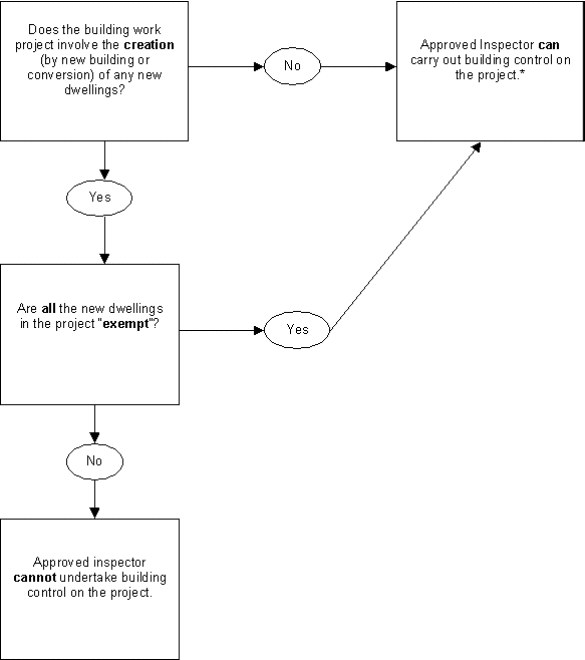
*Provided that any "professional or financial interest" in a "minor work" project arises only from responsibility for the design (as distinct from the construction) of any of the work.
Page 11
#Source page 11