Scotland Enforcement handbook
Building standards enforcement handbook: first edition
Library captured 10 September 2026
1 Purpose of the Guidance
#Source page 1
1.1 Introduction
The purpose of this handbook is to provide guidance for local authorities responsible for enforcement under the Building (Scotland) Act 2003 (the Act), as amended. To take enforcement action, there is also the secondary supporting legislation to consider, such as The Building (Forms) (Scotland) Regulations 2005, as amended (the Forms Regulations), and The Building (Procedure) (Scotland) Regulations 2004, as amended (the Procedure Regulations).
Information in this handbook provides further detail on enforcement powers available in the Act. It does not take precedence over the provisions in the legislation nor is it a substitute for advice from legal advisors.
This handbook is primarily for local authorities (LAs) who have responsibility for taking formal enforcement action. It may also be of interest to building owners who are undertaking construction work. However, the information around enforcement powers contained within the Procedural Handbook may be more helpful for some readers.
The guidance provides more detailed information than the Procedural Handbook[1] and aims to build knowledge and understanding of the procedures that a local authority may follow when taking action. This includes:
•an explanation about the responsibility of LAs
•information to support enforcement action
•the different types of enforcement notices their purpose
•how they are served and the action that may be required by each notice, and
•factors to consider when building a case for court action.
Determining when enforcement action is necessary is the responsibility of the LA. However, it is important to bear in mind that enforcement action should be considered as a backstop only to be used when other resolution avenues have been exhausted or where there is a direct risk to public safety.
1.2 Background
The 2018 Review Panel on Building Standards Compliance and Enforcement identified a need to improve aspects of the building standards system. The provision of national guidance on enforcement was identified as key to more effective and consistent action across Scotland.
This guidance supports a nationally consistent approach to enforcement by LAs and local policies published on their websites.
2 Building Standards System
#Source page 2
2.1 Building Standards System Overview
The building standards system in Scotland is established by the Act. The Act gives powers to Scottish Ministers to make building regulations, procedure regulations, fees regulations and other supporting legislation as necessary, to fulfil the purposes of the Act. The purposes include setting building standards for construction work and conversions and dealing with dangerous and defective buildings. The regulations are made by Scottish Ministers, but must be approved by the Scottish Parliament before they come into force.
The purpose of the building standards system is to protect the public interest and it is intended to ensure that building work on both new and existing buildings results in buildings that meet reasonable standards. It also provides powers to local authorities to address buildings that are in a defective or dangerous condition.
The building standards system sets out the standards to be met when building work or a conversion takes place, to the extent necessary to meet the building regulations. The system is pre-emptive and designed to check that the proposed building work meets the standards. Inspections undertaken during construction and on completion by local authority verifiers are intended to protect the public interest to check compliance with the building regulations and to discourage avoidance of the legislation.
The inspections do not provide a system to control work onsite. That is a matter for the contracts and arrangements put in place between the client and builder.
2.2 Roles Overview
Verifier
The 32 LAs are appointed as verifiers by Scottish Ministers to administer the building standards system for their own geographic area. Their primary function is to protect the public interest by providing an independent check of applications for building warrant to construct or demolish buildings, or convert buildings. This includes checking during the design phase before granting a building warrant and checking during construction phase before accepting a completion certificate.
Relevant person - Building owner, tenant or developer
The relevant person is usually the owner, tenant or a developer who is doing the work for themselves, or who may employ a builder to do the work on their behalf or for the building owner.
When a building warrant is obtained, the relevant person is responsible for compliance with the building regulations. On completion of the work the relevant person must submit a completion certificate to the verifier. The completion certificate certifies that the work, or conversion, was carried out in accordance with the building warrant, and the building, as constructed or converted, complies with the building regulations.
Where the tenant or developer do not carry out their duties under the Act, the owner is ultimately responsible. The building owner is legally responsible for ensuring that all work complies with the building regulations and the local authority can take enforcement action against the building owner where this is not the case.
Local authority
The roles established to operate the building standards system are set out under the Act. The role of checking compliance rests with the verifiers and in prescribed ways certifiers. Enforcement is the responsibility of local authorities.
Local authorities are autonomous bodies under the Local Government (Scotland) Act 1973, and it is not the role of Scottish Ministers to intervene in enforcement matters. It is for LAs to determine the most appropriate course of action, taking into account the particular circumstances of each case.
Building Standards Division
The Building Standards Division is part of the Scottish Government. The Division prepares and updates building standards legislation and guidance documents, conducting any necessary research and consulting on changes as necessary. Updating of the legislation and supporting guidance is informed by collaboration with working groups comprising of experts from industry, academia and stakeholders.
Scottish Ministers approve verifiers, and certifiers of design and construction and the Division checks how verifiers (including local authorities) and certification scheme providers are operating the system.
Should it be necessary, Scottish Ministers can, through the Division, take over the enforcement role of a local authority.
Approved Certifiers
The Act establishes a role for suitably qualified persons (whether individuals or bodies corporate or unincorporated and including public bodies and office-holders) as approved certifiers of design or construction.
The appointment by Scottish Ministers, is to certify that specific elements of design or construction work comply with the building regulations.
2.3 Enforcement Powers Overview
The Act contains powers to enforce compliance with building regulations to secure the health, safety, welfare and convenience of persons in or about buildings and of others who may be affected by buildings. These powers extend to furthering the conservation of fuel and energy and sustainable development.
While every effort to resolve issues will be made by LAs before taking formal enforcement action, they ultimately have legal powers to take enforcement action when they consider it neccessary and in the public interest. These powers will be used when a satisfactory outcome cannot be achieved through a collaborative approach between LAs and those persons responsible for the building, for example the relevant person/owner or developer.
Use of most enforcement powers in the Act is at the discretion of LAs. Decisions on whether or not to take action are based on a range of factors including the scale and/or circumstances of the offence. The exceptions are where the LA consider a building to be in a dangerous condition or where Scottish Ministers direct LAs to take action under section 25 of the Act. In such cases LAs must act.
2.4 Enforcement Provisions
Section 25 - Building Regulations Compliance Notice
Section 25 gives Scottish Ministers powers to require buildings of a particular description to comply with a provision of the regulations. The power is rarely used. However, where a direction is used, LAs may be directed to a serve a building regulations compliance notice on the owner of such a building.
This notice would call for the owner of the building to make the building comply with the provision of the regulations set out by Scottish Ministers.
Section 26 - Continuing Requirement Enforcement Notice
Section 26 gives LAs powers to serve a continuing requirement enforcement notice on the owner of a building. This is used when it appears to LAs that the building is failing to comply with a continuing requirement imposed on the owner.
The notice requires the owner to take steps to ensure compliance with the continuing requirement is achieved.
Section 27 - Building Warrant Enforcement Notice
Section 27 gives LAs the power to serve a building warrant enforcement notice on the 'relevant person' where:
•work that requires a building warrant has been or is being done without a warrant
•where a building warrant has been granted, the work is not in accordance with the warrant.
Section 27 gives LAs powers to serve a building warrant enforcement notice on the relevant person/owner where:
•a limited life building has not been demolished by the expiry period set out in the conditions of the building warrant.
The notice requires the relevant person, or owner as appropriate, to:
•submit a completion certificate and have it accepted by the verifier for work completed without a warrant
•obtain a building warrant for work being done without a warrant
•alter the building so that the work is in accordance with the warrant or obtain an amendment of building warrant for work not carried out in accordance with the warrant
•obtain a building warrant for the demolition of a limited life building and demolish it.
Section 28 - Defective Building Notice
Section 28 gives LAs powers to serve a defective building notice where a building has defects that require to be addressed to bring the building into a reasonable state of repair having regard to its age, type and location.
The notice requires the owner to repair the defects as set out in the notice.
Section 29 and 30 - Dangerous Building Notice
Sections 29 and 30 give LAs powers to serve a dangerous building notice where they consider the building presents a danger to people in or about it, to the public generally or to adjacent buildings or places. Enforcement action for dangerous buildings is not discretionary and a local authority has a duty to act to remove the danger.
LAs have a range of powers to carry out work to the building, including its demolition, to remove or reduce the danger to serving an enforcement notice on the owner. The notice requires the owner to carry out such works as is necessary to remove or reduce the danger.
3 Section 25 - Building Regulations Compliance Notice
#Source page 3
3.1 Context
Other than in relation to a prescribed conversion, the building regulations do not generally require existing buildings to be the subject of work or alteration until and unless the owner intends to do building work.
Scottish Ministers have issued two directions under section 25; they are:
•Statement of Sustainability: This direction applied the requirement of Standard 7.1 to buildings going through the building warrant process in advance of Standard 7.1 taking effect.
•Improvement of Fixed Services: This direction calls for certain non-domestic buildings going through the building warrant process for alterations or extensions to improve the energy efficiency of fixed building services where such work did not form part of their proposals.
From the two examples above it can be seen that a direction under section 25 can be issued to local authorities that does not necessarily require a section 25 - Building Regulations Compliance Notice, to be served in order to achieve the desired outcome.
3.2 Circumstances when a Building Regulation Compliance Notice may be served
It is Scottish Ministers that determine:
•when a direction should be issued
•where it should apply (all local authorities or particular local authorities)
•to which buildings it applies and
•the provisions of the regulations that ought to be met.
The direction can only apply to buildings to which the building regulations apply. For example, a direction cannot be issued for exempted buildings under schedule 1 to Regulation 3.
3.3 Content of the notice
The Forms Regulations, Form 8 - Building Regulations Compliance Notice, is used by LAs when taking enforcement action.
The notice is issued to a named individual who is the owner of the building subject to the enforcement action.
The steps required by the building owner will be set out in the notice and will confirm what provision of the building regulations the building has to meet. The provision of the building regulations will be that set out in the direction issued by Scottish Ministers.
The issue of a building regulations compliance notice does not preclude the need to obtain building warrant approval if a warrant is required for the work.
After the completion of work required by the notice, a completion certificate must be submitted to the verifier. If the work did not require a building warrant, the completion certificate certifies the work has been completed in accordance with the requirements of the notice.
Regulation 51, Procedure Regulations - Notices served by LAs, requires that the particulars of the notice are recorded in the building standards register.
The LA may withdraw, waive or relax any requirement of a notice including the date specified for complying with the notice. The withdrawal of a notice does not affect the power of the LA to issue a further such notice. Where a notice is withdrawn, waived or relaxed the particulars of the notice shall be entered on the building standards register.
3.4 Key dates to consider
The action required to secure compliance of the building is controlled by the dates specified in the notice. There are three key dates that are set out:
•the date the notice takes effect
•the date the building must be made to comply with the provision of the regulations
•the date of the notice.
The date the notice takes effect must be at least 21 days after the date of the notice to allow time for an appeal to be made.
The date the building must be made to comply with the provision of the regulations must be at least 28 days after the date the notice takes effect.
If an appeal is made, the date when the notice comes into effect must be after the appeal is withdrawn or finally determined.
3.5 Failure to comply with the notice
If the building owner does not meet the requirements of the notice then the LA has the power to carry out the necessary work and recover reasonable expenses incurred as a result of undertaking the work. Expenses are recovered from the building owner as a debt. Further information on cost recovery is provided in chapter 13.
A building warrant is not required for work carried out by the LA when the building owner does not comply with the notice.
After completing the work, the local authority must register a completion certificate on the building standards register certifying that the work meets the provisions of the building regulations specified in the notice. The completion certificate to be registered is Forms Regulations, Form 7 - Completion Certificate for Local Authority Use. Accordingly, this completion certificate does not require 'acceptance' by the verifier.
Furthermore, the owner is guilty of an offence if they have not complied with the requirements of the notice. This may result in a summary conviction leading to a fine not exceeding level 5 on the standard scale.
3.6 Right of appeal
Any person aggrieved by the decision to issue an enforcement notice has the right to appeal to the sheriff. The appeal must be made with 21 days of the date of the notice.
Where an appeal is made, the requirements of the notice have no effect until the appeal is withdrawn or finally determined.
If the notice is quashed following an appeal to the sheriff, the particulars of the notice shall be removed from the building standards register.
4 Section 26 - Continuing Requirement Enforcement Notice
#Source page 4
4.1 Context
Section 2 - Continuing Requirements, gives Scottish Ministers powers to impose continuing requirements on buildings, through the building regulations, as appropriate to secure and maintain compliance with the regulations. The use of continuing requirements to achieve any designated provision of the building regulations is unrestricted and may apply on a national basis to any building.
Section 22 - Imposition of Continuing Requirements, sets out when the verifier may impose continuing requirements on any building where it is considered necessary to ensure the purposes of building regulations are not frustrated. Continuing requirements arrangements are agreed to secure ongoing compliance with functional standards and can be imposed when granting or amending a building warrant or when accepting a completion certificate where no warrant was obtained.
The LA is responsible for the enforcement of continuing requirements whether imposed by Scottish Ministers or the verifier.
4.2 Circumstances when a Continuing Requirement Enforcement Notice may be served
Where it appears to a LA that the owner of a building is failing to comply with a continuing requirements imposed b the verifier for securing that the provisions of building regulations are not frustrated, they may serve a Continuing Requirement Enforcement Notice.
4.3 Content of the notice
The Forms Regulations, Form 9 - Continuing Requirement Enforcement Notice, is used by LAs when the owner of a building is failing to comply with a continuing requirement imposed on them by building regulations or by the verifier.
The notice is issued to a named individual who is the owner of the building subject to the enforcement action.
When preparing the notice, the LA specifies the continuing requirement in question and details the required steps to be taken by the building owner to secure compliance with the continuing requirement.
The Procedure Regulations, Regulation 51 - Notices served by local authorities, requires that the particulars of the notice have to be recorded in the building standards register.
LAs may withdraw, waive or relax any requirement of a notice including the date specified for complying with the notice. The withdrawal of a notice does not affect the power of LAs to issue a further such notice. Where a notice is withdrawn, waived or relaxed the particulars of the notice shall be entered on the building standards register.
4.4 Key dates to consider
The action required to secure compliance of the building is controlled by the dates specified in the notice. There are three key dates that are set out:
•the date the notice takes effect
•the date the building must be made to comply with the continuing requirement
•the date of the notice.
The date the notice takes effect must be at least 21 days after the date of the notice to allow time for an appeal to be made.
The date the building must be made to comply with the provision of the regulations must be at least 28 days after the date the notice takes effect.
If an appeal is made, the date when the notice comes into effect must be after the appeal is withdrawn or finally determined.
On completion of the work required by the notice, a completion certificate signed by the relevant person must be submitted to the verifier certifying the work has been completed in accordance with the requirements of the notice.
4.5 Failure to comply with the notice
If the building owner does not meet the requirements of the notice then the LA has power to carry out the necessary work and recover reasonable expenses incurred as a result of doing the work. Expenses are recovered from the building owner as a debt.
After completing the work, the LA must register a completion certificate on the building standards register certifying that the work has been completed in accordance with the notice. The completion certificate to be registered is Form Regulations, Form 7- Completion Certificate For Local Authority Use. Accordingly, this completion certificate does not require 'acceptance' by the verifier.
Furthermore, the owner is guilty of an offence if they have not complied with the requirements of the notice. This may result in a summary conviction leading to a fine not exceeding level 5 on the standard scale.
4.6 Right of appeal
Any person aggrieved by the decision to issue an enforcement notice has the right to appeal to the sheriff. The appeal must be made with 21 days of the date of the notice.
Where an appeal is made, the requirements of the notice has no effect until the appeal is withdrawn or finally determined.
If the notice is quashed following an appeal to the sheriff, the particulars of the notice shall be removed from the building standards register.
5 Section 27 - Building Warrant Enforcement Notice
#Source page 5
5.1 Context
Section 8 - Building Warrants, requires a warrant to be obtained for new construction work, a conversion of an existing building or the demolition of a building.
Section 8 confirms that it is an offence where:
•such work is carried out or being carried out without obtaining a building warrant, when one is required
•work that has a building warrant is carried out not in accordance with the warrant.
Section 14 - Building warrants for limited life buildings, requires a warrant for a limited life building, and may include a condition that the building is demolished by the expiry date stated in the application.
Section 14 confirms it is an offence where the owner of the building fails to demolish the building by the expiry period specified in the warrant or any extended period that has been approved.
5.2 Circumstances when a Building Warrant Enforcement Notice may be served
Where it appears to LAs that:
•work is being or has been carried out without a building warrant where a warrant is required
•work that has a building warrant is being or has been carried out otherwise than in accordance with the warrant
•a limited life building has not been demolished by the appropriate by the appropriate date.
They may serve a Building Warrant Enforcement Notice.
5.3 Content of the notice
The Forms Regulations, Form 10, Building Warrant Enforcement Notice for use by LAs when the owner, or relevant person, of a building requires to obtain a building warrant or submit a completion certificate.
The notice is issued to a named individual who is the relevant person of the building. Where the notice relates to a limited life building the notice is issued to the owner.
The action called for by the notice will:
•where work has been completed without a building warrant, require a Completion Certificate where No Building Warrant Obtained to be submitted by the relevant person to the verifier and secure its acceptance by the verifier
•where work is not complete, require the relevant person to apply for a building warrant.
In addition, the notice may also include a requirement that the work should be suspended, other than work for complying with the notice, until the notice has been complied with. The suspension takes effect as soon as the notice is served.
•Where work has been done not in accordance with the building warrant, require the relevant person to have the work made to comply with the warrant or, where necessary, obtain an amendment to warrant in respect to the non-compliant work.
•Where a limited life building warrant has not been demolished, require the owner to obtain a building warrant for the demolition and to demolish the building.
Procedure Regulations, Regulation 51 - Notices served by local authorities, requires that the particulars of the notice are recorded in the building standards register.
LAs may withdraw, waive or relax any requirement of a notice including the date specified for complying with the notice. The withdrawal of a notice does not affect the power of LAs to issue a further such notice. Where a notice is withdrawn, waived or relaxed the particulars of the notice shall be entered on the building standards register.
5.4 Interdict
There are additional powers available to use for offences relating to the unauthorised occupation or use of a building.
The Act, in Section 21 - Occupation or use without completion certificates, gives LAs the option to make an "application for interdict, seek to restrain or prevent any actual or apprehended occupation or use of a building which constitutes, or would constitute an offence."
This is an offence where a person does so knowing, or without regard to the fact that a completion certificate has not been accepted by the verifier.
Similarly, under section 14 - Building warrants: limited life buildings where a person occupies or uses a building knowing, or without regard, to the fact that the period of intended life of the building has expired, LAs may make an application for interdict to restrain or prevent actual or perceived intent to occupation or use of the limited life building.
This application for interdict may be used irrespective of whether or not LAs propose to, or have used, the enforcement powers available to them.
5.5 Key dates to consider
The action required to secure compliance of the building is controlled by the dates specified in the notice. There are three key dates that are set out:
•the date the notice takes effect
•the date the building must be made to comply with the continuing requirement
•the date of the notice.
The date the notice takes effect must be at least 21 days after the date of the notice to allow time for an appeal to be made.
The date the requirements of the notice should be complied with must be at least 28 days after the date the notice takes effect.
If an appeal is made, the date when the notice comes into effect must be after the appeal is withdrawn or finally determined.
5.6 Failure to comply with the notice
If the building owner does not meet the requirements of the notice then the local authority has the power to carry out the necessary work.
•Where the work is being carried out or has been carried out without a building warrant the work is that required to ensure the work undertaken complies with the building regulations.
•Where the work has not been carried out in accordance with the building warrant or a limited life building has not been demolished by the period of intended life, to ensure compliance with the notice.
LAs may recover reasonable expenses incurred as a result of undertaking the work. Expenses are recovered from the building owner as a debt.
A building warrant is not required for the work carried out by the LA. However, after completing the work, LAs must register a completion certificate on the building standards register certifying that the work has been completed in accordance with the building regulations or, as the case may be, in accordance with the notice.
The completion certificate to be registered is Forms Regulations, Form 7 - Completion Certificate for Local Authority Use. Accordingly, this completion certificate does not require 'acceptance' by the local authority verifier.
Furthermore, the owner is guilty of an offence if they have not complied with the requirements of the notice. This may result in a summary conviction leading to a fine not exceeding level 5 on the standard scale.
5.7 Right of appeal
Any person aggrieved by the decision to issue an enforcement notice has the right to appeal to the sheriff. The appeal must be made with 21 days of the date of the notice.
Where an appeal is made, the requirements of the notice has no effect until the appeal is withdrawn or finally determined. However, where the notice includes a requirement for the suspension of work, as explained above, the suspension continues to have effect unless quashed by an order of the sheriff.
If the notice is quashed following an appeal to the sheriff, the particulars of the notice shall be removed from the building standards register.
6 Section 28 - Defective Building Notice
#Source page 6
6.1 Context
A defective building notice may be served on the owner of a building with defects requiring work to bring that building back into a reasonable state of repair.
6.2 Circumstances when a Defective Building Notice may be served
Where LAs consider that a building has defects that require to be dealt with to prevent significant deterioration, it can serve a notice on the owner of the building. The Act describes the defects that can be dealt with as those "which require rectification in order to bring the building into a reasonable state of repair having regard to its age, type and location".
6.3 Content of the notice
The Forms Regulations, Form 11 - Defective Building Notice is for use by LAs when requiring a building owner to rectify defects.
The notice is served on the owner of a defective building and will specify the defects which require to be rectified and may specify particular steps to be taken to secure compliance with the notice.
6.4 Key dates to consider
The action required to secure compliance is controlled by the dates specified in the notice. There are three key dates that are set out:
•the date the specified work must begin by
•the date the specified work should be complete by
•the date of service of the notice.
The date the specified work must begin by must be at least 7 days after the date of service of the notice.
The date the specified work must be completed by must be at least 21 days after the date the specified work must begin by to allow time for an appeal to be made.
Depending upon the extent of the work, the notice may specify different start and completion dates for different aspects of the work.
If an appeal is made, the date when the notice comes into effect must be after the appeal is withdrawn or finally determined.
If the work requires a building warrant, then this must be obtained before the work starts. To facilitate this, if a warrant has been applied for by the commencement date in the notice then a new commencement date is substituted, which is not less than seven days after the verifier considering the warrant has decided the application. A later date for completion of the work can be set by the LA when an application for a building warrant has been submitted by the first date.
After the completion of work required by the notice the owner must submit to the verifier a completion certificate certifying the work has been completed in accordance with the requirements of the notice, or building warrant and building regulations (depending upon whether the work was subject to a building warrant).
Procedure Regulations, Regulation 51 - Notices served by local authorities, requires that the particulars of the notice are recorded in the building standards register.
LAs may withdraw, waive or relax any requirement of a notice including the date specified for complying with the notice. The withdrawal of a notice does not affect the power of LAs to issue a further such notice. Where a notice is withdrawn, waived or relaxed the particulars of the notice shall be entered on the building standards register.
If the notice is quashed following an appeal to the sheriff, the particulars of the notice shall be removed from the building standards register.
6.5 Failure to comply with the notice
If the building owner has not started the work or completed the work as set out in the notice the LA has power to carry out the necessary work.
The LA may recover reasonable expenses incurred as a result of doing the work. Expenses are recovered from the building owner as a debt.
A building warrant is not required for the work carried out by the LA. However, after completing the work, LAs must register a completion certificate on the building standards register certifying that the work has been completed in accordance with the notice.
Furthermore, the owner is guilty of an offence if they have not complied with the requirements of the notice. This may result in a summary conviction leading to a fine not exceeding level 5 on the standard scale.
6.6 Right of appeal
Any person aggrieved by the decision to issue an enforcement notice has the right to appeal to the sheriff. The appeal must be made with 21 days of the date of the notice.
Where an appeal is made, the requirements of the notice has no effect until the appeal is withdrawn or finally determined.
If the notice is quashed following an appeal to the sheriff, the particulars of the notice shall be removed from the building standards register.
7 Section 29 and 30 - Dangerous Building Notice
#Source page 7
7.1 Context
Enforcement action by LAs in relation to a building that has fallen into a dangerous condition is mandatory. LAs have a duty to act when it becomes aware of a building that poses a danger to:
•people in or about the building
•to the public generally, or
•to adjacent buildings or places.
LAs must carry out such work, including demolition, as it considers necessary to prevent access to the dangerous building or any adjacent part of any road or public space that may be at risk from the building.
It must also carry out such work to protect the public, persons or property adjacent to the dangerous building.
7.2 Circumstances when a Dangerous Building Notice may be served
Forms Regulations, Form 12 - Dangerous Building Notice, is used by LAs to protect the public when it appears that the building owner has failed to prevent the building from falling into a dangerous condition. The notice is served to require a building owner to reduce or remove the danger posed by a building.
LAs must carry out the necessary work, including demolition as considered necessary to remove the danger. In doing so, the LA can create a safety cordon to prevent access to the dangerous building, any adjacent roads or public place that appear to be dangerous due to the state of the building for the protection of the public or property.
7.3 How to serve the notice
It may not be possible to serve a dangerous building notice on the owner before LAs take necessary action to remove the danger. When urgent action is required LAs have powers to carry out work including demolition as it considers necessary. Urgent work by LAs can include the work that would be specified in the dangerous building notice.
LAs must serve a notice on the owner requiring them to carry out specified work except when the danger has been removed by urgent action from the LA.
After the completion of work required by the notice the owner must submit to the verifier a completion certificate certifying the work has been completed in accordance with the requirements of the notice.
LAs must specify two dates for compliance with the notice. There is no statutory dates set in legislation similar to that provided for defective buildings. The first date is for commencement of the work and is set by the LA as appropriate to the nature of the danger and a second date must be specified for completion of the work.
Procedure Regulations, Regulation 51 - Notices served by local authorities, requires that the particulars of the notice have are recorded in the building standards register. This includes where the notice is withdrawn, waived or relaxed.
LAs may withdraw, waive or relax any requirement of a notice including the date specified for complying with the notice. The withdrawal of a notice does not affect the power of LAs to issue a further such notice. Where a notice is withdrawn, waived or relaxed the particulars of the notice shall be entered on the building standards register.
If the notice is quashed following an appeal to the sheriff, the particulars of the notice shall be removed from the building standards register.
7.4 Factors to consider
A building warrant is not required for the carrying out of any work required by a dangerous building notice including when the LA does the work necessary to remove the danger. After completing the work, LAs must register a completion certificate on the building standards register certifying that the work has been completed in accordance with the notice.
7.5 Failure to meet the requirements of the notice
The building owner will be guilty of an offence under the Act if they fail to carry out the work as specified in the notice. This may result in a summary conviction leading to a fine not exceeding level 5 on the standard scale.
If the building owner does not meet the requirements of the notice then LAs have powers to carry out the necessary work and recover reasonable expenses incurred as a result of doing the work. Expenses are recovered from the building owner as a debt.
7.6 Right of appeal
Any person aggrieved by the decision to issue an enforcement notice has the right to appeal to the sheriff. The appeal must be made with 21 days of the date of the notice.
Where an appeal is made, the requirements of the notice has no effect until the appeal is withdrawn or finally determined.
If the notice is quashed following an appeal to the sheriff, the particulars of the notice shall be removed from the building standards register.
8 Evacuation of buildings
#Source page 8
8.1 Who is served with a notice
Notice of requirement for occupants to evacuate a building from local authorities should be in writing and must require occupants to evacuate immediately where the local authority considers occupants are endangered by the state of the building. This applies in relation to work arising from a dangerous building notice as well as emergency work. The requirement to remove from a building is relevant to all enforcement notices when the nature of work required, such as demolition or stabilisation, means continued occupation would be unsafe.
A copy of the notice should be sent to the owner of the building where the owner is not also the occupier.
8.2 Enabling the serving of a notice
If an occupant fails to evacuate a dangerous building or an adjacent building when required by LAs, a warrant may be sought from the sheriff for the ejection of the occupant. If the occupant is required to move immediately, the warrant can be applied for at any time. If, however, the notice to remove specifies a time period, the warrant can only be applied for when that time period expires.
The application to the sheriff must include a certificate, Forms Regulations, Form 15 - Certificate to accompany application for warrant to exercise powers of entry, inspection or testing . This confirms that the occupant will be exposed to danger or has the potential to be exposed to danger, as a result of the dangerous building or the work proposed to the dangerous building (including demolition). The sheriff may require the service of a notice in terms of schedule 5(4) - Evacuation of buildings, but this is in addition to any notice already served by LAs in terms of section 42. A copy should be sent to the sheriff.
Where LAs intend to carry out work upon the failure of the owner to comply with the terms of a notice, and they consider that the occupant may be endangered by such work, the sheriff may grant a warrant of ejection. In any other case the sheriff must grant a warrant for the ejection of the occupier within seven days of the application or if a notice is required under schedule 5(4), within seven days of the date of the notice. There is no right of appeal against the sheriff's decision.
Schedule 5(8) advises the sheriff that the information contained in the certificate accompanying the application for a warrant to eject is sufficient evidence of the facts in the certificate. Schedule 5(9 to 11) give rights to tenants in relation to maintaining their tenancy agreement and non-payment of rent during the time that they have not been able to occupy the building.
Section 43 - Unlawful occupation of evacuated buildings, sets out that it is an offence for a person who has been evacuated/ejected from a building in accordance with section 42 and/or schedule 5 to thereafter occupy the building. However when the need for occupants to vacate buildings has passed, LAs must give notice, in writing, that occupation may resume.
9 Service of Notices
#Source page 9
9.1 Who is served with a notice
Section 37 - Service of notices etc sets out how LAs serve enforcement notices on a person under sections 25 to 29. When serving a notice, LAs must, unless the person being served is the owner of the building in question, serve a copy of the notice on the owner. Similarly, LAs must, unless the person being served is the occupier, serve a copy of the notice on the occupier.
In addition, a copy of the notice must be served on any other person appearing to LAs to have in interest in the building.
The service of notices under the Act is carried out as provided in section 192, subsections 1 to 4, of the Local Government (Scotland) Act 1973[2].
The provisions set out in the Local Government (Scotland) Act 1973 confirm the notice should be posted or delivered to the home or business address of the owner or relevant person as appropriate.
Where the owner (or relevant person) resides outwith the LA's geographic area the notice can be addressed to the factor, agent or persons drawing any rent for the premises.
Where LAs are not able, after reasonable inquiry, to ascertain the address of the person on whom the notice is to be served it can be delivered to the premises to which the notice relates with the notice addressed to the name of the owner, where known, or the 'owner' or 'occupier' where it is not. In these cases the notice may be delivered to some person on the premises or if no one is present the notice may be affixed in a conspicuous position. Any concerns relating to protection of personal data in line with the General Data Protection Regulation (GDPR) should be raised with the LA's GDPR adviser.
Proof of serving the notice can be demonstrated by the production of a certificate from the person posting, delivering or affixing the notice witnessed by a person present at the time of serving the notice.
The notice is issued to a named individual who is the owner (or relevant person where appropriate under section 27) of the building subject to the enforcement action. The notice can be issued by email to the owner of the building from an official LA account as this will confirm the date and time of issue for audit purposes. When preparing the notice, LAs will detail the required steps to be taken by the named person to secure compliance with building regulations.
9.2 Enabling the serving of a notice
To support the serving of notices, LAs may require the occupier or anyone who receives rent in respect of any premises to state the nature of the interest in the premises held by the person being served the notice and also the name and address of anyone else known to that person who has an interest in the premises.
Anyone required to provide such information who refuses or fails to give that information or makes a false or misleading statement is guilty of an offence liable on summary conviction to a fine to exceeding Level 3 on the standard scale set in the Criminal Procedure (Scotland) Act 1995[3].
10 Section 39 - Powers of Entry, Inspection and Carrying out Tests
#Source page 10
10.1 Section 39 - Powers of entry, inspection and testing
Section 39 - powers of entry, inspection and testing, gives LAs powers to enter any premises in relation to action under sections 25 to 30.
Those powers are:
•inspecting any building, or site of any building, in connection with exercising their enforcement functions.
•carrying out reasonable tests on materials used, or proposed to be used, in connection with exercising their enforcement functions.
•carrying out work required by a notice served under sections 25 to 30 where the owner has not done so.
•carrying out work in connection with a dangerous building.
The owner and occupier of premises where enforcement action is being taken must give LAs assistance and provide information as they may reasonably require. If they fail to do so without reasonable excuse, or intentionally obstruct persons from inspecting the building or carrying out tests, they are guilty of an offence and liable on summary conviction to a fine not exceeding Level 3 on the standard scale.
10.2 Section 40 - Work required by notice: right of entry
Section 40 - Work required by notice: right of entry, gives powers for a person to enter a building where they are required to carry out work in relation to notices served under sections 25 to 30.
If the person does not occupy the building they must give the occupier reasonable notice before entering the building.
10.3 Using Powers of Entry - Section 39, schedule 4
Section 39 - Powers of entry, inspection and testing: further provisions, makes provisions for powers of entry. It confirms that where power of entry is required by LAs it must be at a "reasonable time".
In addition, LAs must give 3 days' notice of the intended entry to the occupier, and owner (if known). The Forms Regulations, Form 13 - Notice of Intention To Enter Premises, provides the template for notifying the occupier and owner of the date of inspection.
This notice must be served in accordance with section 37 - Service of notices (see previous section).
In a case where entry is a matter of urgency these timescales ('reasonable time' and 3 days notice) do not apply.
A person who enters any premises under section 39 can be accompanied by other persons and equipment as necessary. However, where access is to be gained through a warrant issued by the sheriff or justice of the peace, the terms of that warrant may set provisions in this regard.
Section 39 and schedule 4 make provision for a person entitled to enter premises must produce written evidence of that entitlement. The authority to enter premises, Form Regulations, Form 1 - Building Warrant, provides the template for this evidence.
10.4 Obtaining a warrant for entry - Section 39 and schedule 4
There may be circumstances where the local authority consider there may be difficulties in gaining access to premises, urgent access is necessary or prior notification of intending to access the premises would defeat the object of the proposed entry. The LA should seek advice from their legal team when determining the need to obtain a warrant for entry. In such circumstances the sheriff or justice of the peace may by warrant authorise the LA and any person authorised by it to access the premises including, if necessary, by force.
However, for a warrant to be issued, one or more of the conditions listed below must be met:
(a) that the exercise of the power in relation to the premises has been refused
(b) that such a refusal is reasonably apprehended
(c) that the premises are unoccupied
(d) that the occupier is temporarily absent from the premises
(e) that the case is one of urgency
(f) that an application for admission to the premises would defeat the object of the proposed entry.
A warrant will not be issued if only conditions (a) or (b) are met unless the sheriff or justice of the peace is also satisfied that notice of the intention to apply for the warrant has been given to the occupier of the premises, or that the giving of such notice would defeat the object of the proposed entry. The Forms Regulations provides a certificate that affirms this criteria has been met (Certificate to accompany application for warrant to exercise powers of entry, inspection or testing – Form 15).
LAs, when leaving, must secure the premises against unauthorised access to the same degree of security as prior to them gaining access.
10.5 Offences relevant to powers of entry
The owner and occupier, including any person on the premises, must assist and provide information to the LA as they require.
Where a person refuses or fails, without a reasonable excuse, to comply with the LA's requirement or intentionally obstructs a person carrying out the power under section 39(3), they are guilty of an offence and liable on summary conviction to a fine not exceeding Level 3 on the standard scale.
It is an offence for any person who has gained entry to the premises to disclose or make use of any commercially confidential information found therein.
11 Consultation for historic and listed buildings
#Source page 11
For the purposes of enforcement, section 35 of the Act - Scheduled monuments, listed buildings etc., sets out consultation requirements and limitations for buildings under the following categories:
•scheduled ancient monuments
•listed buildings
•buildings subject to preservation orders, and
•those buildings in conservation areas subject to control of demolition.
Ancient monuments are those included in the schedule of monuments compiled and maintained under section 1 of the Ancient Monuments and Archaeological Areas Act 1979.
Listed buildings are those included in a list of buildings of special architectural or historic interest compiled or approved under section 1 of the Planning (Listed Buildings and Conservation Areas) (Scotland) Act 1997, preservation notices are under section 3 of that Act and control of demolition of unlisted buildings in conservation areas is under section 66 of that Act.
Before serving a notice that requires work (including demolition) in relation to a type of building defined above there must be consultation with Historic Environment Scotland, the planning authority (where this is not LAs) and anyone else LAs consider necessary. Where the planning authority is within the same authority there should still be a properly recorded consultation.
However, where a dangerous building notice is to be served, or urgent work is needed to remove a danger, consultation must be carried out only "if reasonably practicable". This is intended to cover problems requiring immediate action; in these instances the relevant authorities should be notified subsequently of any such action.
The only qualification of this requirement is that, in relation to the serving of a dangerous building notice or where LAs intends to carry out urgent work necessary to reduce or remove a danger, consultation is required "only if reasonably practicable". This is intended to cover circumstances where immediate action is required; in these instances the relevant authorities should be notified subsequently of any such action as soon as possible. Works undertaken without prior consultation should be limited to the minimum necessary needed to protect the public until the proper consultations have taken place and any necessary consents sought.
There is also an important limitation on the notices. The effect of the notices on a person required to do work in relation to any of the enforcement notices is restricted to work that is not inconsistent with any provisions of the Ancient Monuments and Archaeological Areas Act 1979 or the Planning (Listed Buildings and Conservation Areas) (Scotland) Act 1997. i.e. that where the works required by the notice are of a nature that would normally require listed building consent, conservation area consent or scheduled monument consent, that requirement is not affected or removed by the provisions of section 35 of the Act. So even if there has been prior consultation on the serving of the notice, the relevant consents would still be required before carrying out works.
When looking to establish if the affected building is of a type to which section 35 applies, local planning authorities will hold GIS data on designated and non-designated historic environment assets, and this should always be the first port of call to determine whether a building falls under the requirements of section 35. In an emergency situation, if the planning authority data is not accessible, this information can also be found via the following sources: Welcome to Pastmap | Pastmap or Home | Scotland's environment web.
12 Prosecution
#Source page 12
12.1 Public interest
Where an offence under the Act has been committed the LA may consider initiating proceedings to prosecute the person. Advice should be sought from the LA legal services team and to establish such action is supported by them.
A key aspect of action being taken forward by the Crown Office & Procurators Fiscal Service (COPFS) is where it is considered the prosecution is in the Public Interest. The Prosecution Code is a COPFS publication that aims to provide a general explanation of the various factors which may influence decisions regarding prosecution or alternative action. It includes advice on factors that will influence such a public interest test, for example, the nature and gravity of the offence.
The nature of the offence will be a major consideration in the assessment of the public interest. In general, the more serious the offence the more likely it is that the public interest will require a prosecution. On the other hand, in the case of less serious offences the prosecutor may consider that the public interest would be best served other than by prosecution. In some circumstances the prosecution of a relatively minor offence, at least without first offering an alternative to prosecution, may be regarded as a disproportionate response to the circumstances of the case. It is likely consideration of whether the prosecution should be actioned will also be a consideration of the LA legal team.
12.2 Statutory time bar
Where an offence is created by statute, and the legislation provides that it can only be prosecuted on summary level (i.e. before a sheriff alone) any prosecution must be commenced within six months of the date of the offence unless the statute creating the offence makes a different provision on time. It is worth re-iterating that it is six months from the offence and not six months from the time LAs become aware of the offence.
It is also recognised that in many cases a negotiated solution to ensure compliance will be explored before an enforcement notice is served. Whilst this all takes time it is still a condition that any report to the Procurator Fiscal must be submitted well before the expiry of any six-month time-bar for the case to be fully considered.
Although negotiations may cause delays, any difficulties about reporting in any particular case should be discussed with the Procurator Fiscal at the earliest opportunity and the reason for any delay in reporting should be specified in the report.
Where an offence can be prosecuted on indictment (i.e., before a Jury), it will not be subject to the statutory time-bar. However, timeous action is still necessary to reduce the risk of challenge due to the accused right to a fair trial within a reasonable time under Article 6 of the European Convention on Human Rights and the Human Rights Act 1998.
12.3 Evidence
Scots Law requires corroboration; this means that an accused cannot be convicted of a crime unless the crucial facts of the crime are established by evidence from at least two independent sources. The crucial facts are (1) that the crime was committed and (2) that the accused was the perpetrator of the crime.
The type of evidence to be gathered will depend on the nature of the case being considered. For example, where action is being taken under section 8 - Building Warrants, it will be to demonstrate work has been carried out that requires a building warrant and that no such warrant has been granted.
Evidence can take many forms from direct evidence such as that of an eyewitness, to admissions, and evidence of facts and circumstances known as circumstantial evidence.
At its most simple, corroborated evidence may come from two eyewitnesses who can both speak to having seen the crime being committed and can identify the accused as the perpetrator.
Alternatively, one strong, clear source of evidence may be corroborated by evidence of facts and circumstances pointing to the guilt of the accused.
At the other end of the scale, a corroborated case can come from entirely circumstantial evidence from two or more sources. Each fact or circumstance may, on its own, be of little significance but the strength of the case is based on their combination giving rise to an inference that the accused committed the crime. Only one witness need speak to each fact or circumstance.
Examples of the evidence that may be presented include, detailed chronological site survey notes, photographic/video images, documentation (such as extracts from the building standards register), and witness statements.
An unequivocal admission freely made by an accused is only one source of evidence and requires to be corroborated. The exception to that is where the admission contains "special knowledge" which is knowledge which could only be known to the perpetrator of the crime, such as an accused confessing to murder and telling the police where the victim's body has been concealed.
Prosecutors can only take prosecutorial action where there is sufficient corroborated evidence.
It can be seen, therefore, that keeping a detailed record of all steps taken in advance of a decision being taken to prosecute the person should be maintained. This is to ensure that, should steps to find a negotiated solution fail to secure compliance and a report to the Procurator Fiscal becomes necessary, it will be possible for LAs to rely upon properly maintained records of their actions and to report to the Procurator Fiscal a full picture of the steps taken by them short of reporting to the Procurator Fiscal, and the response or lack thereof by the suspect.
12.4 Requirement to obtain 'S' number
It is necessary that all accused details are accompanied by a unique 'S' number to enable information to be exchanged between different agencies, tracked throughout the justice process and recorded on the Scottish Criminal History System (CHS) of pending and previous cases. The effect of this is that all cases being reported to the Procurator Fiscal, by the local authority, require an 'S' number before they can be reported.
12.5 Submitting a crime report
Once the LA has determined a case merits presentation to the Procurator Fiscal a crime report must be submitted to COPFS.
Such reports can only be submitted by a Specialist Reporting Agency (SRA) which is approved by the Crown Office. It is understood that all 32 LAs are appointed as SRAs and LAs should establish the principal contact within their organisation for submitting crime reports.
All crime reports must be submitted digitally through either a secure email system or via the COPFS secure website, SRAWEB.
To assist SRAs in following best practice in investigating and reporting cases to Procurator Fiscal A Guide for Specialist Reporting Agencies has been published by COPFS. The aim of this publication is to provide advice for specialist reporting agencies which will enable them to contribute effectively to achieving an outcome in reported cases which best serves the public interest. It is strongly recommended LAs take account of the guidance within that publication. It not only provides information on reporting cases to the Procurator Fiscal, such as the key information to be provided in the report, but also other helpful information such as preparation for a trial and court procedures.
13 Recovery of expenses
#Source page 13
13.1 When local authorities may recover expenses
When LAs undertake work in relation to compliance or enforcement, or in relation to a defective or dangerous building, they may recover any expenses reasonably incurred and normal methods of debt recovery apply.
Section 44 – Expenses
Where LAs serve on a person a demand for payment for expense incurred by them in carrying out the work in relation to a building under sections 25(7)(b), 26(3)(b), 27(7)(b), 28(10)(b), 29(2) or (3) or 30(4)(b), sections (2) to (4) make provision for liability for expenses to be restricted or transferred.
Section 45 - Compulsory purchase where owner cannot be found
When LAs have carried out work under sections 29(2) or (3) or 30(4)(b), and the expenses incurred cannot be recovered from the building owner, Scottish Ministers may authorise LAs to purchase the building and its site compulsorily.
Section 46 – Sale of materials from demolished buildings
If a building is demolished by LAs under sections 27(7)(b), 29(2) or (3) or 30 (4)b, LAs may sell any building materials arising from the demolition. LAs may offset the proceeds of any such sale against any sum recovered by them from the building owner under sections 25-30.
13.2 Charging Orders
The Act was amended on 24 January 2015 by the Buildng (Recovery of Expenses)(Scotland) Act 2014 to improve cost recovery powers and help LAs cover their expenses. It introduced charging order provisions in sections 46A to 46H applicable to notices served under section 25-30, or urgent action undertaken on a dangerous building under 29(3). The notices are:
•Building regulations compliance notice
•Continuing requirement enforcement notice
•Building warrant enforcement notice
•Defective building notice
•Dangerous building notice.
The charging order provisions supplement normal methods of debt recovery and allow LAs to make a charging order and register it in the appropriate land register. This means either registering in the Land Register of Scotland or recording in the Register of Sasines.
LAs entitled to their recoverable expenses under sections 25-30 (qualifying expenses) are also entitled to the registration and administration fees associated with the charging order and its discharge, and interest at a reasonable rate.
When LAs make a charging order it must be registered in the appropriate land register.
They must serve a copy of the charging order on the owner(s) of the building concerned and advise them of the effect of the charging order and the right of appeal. The charging order will specify the building concerned and the repayable amount. LAs can determine the most appropriate number of annual instalments between 5 and 30 and the date for payment of each instalment which, will be set out in the charging order.
Although the charging order sets out annual instalments, the owner can repay the full amount at any time. The LA may also agree a lower settlement sum with the owner if they choose.
When the outstanding amount has been paid, the LA must register the discharge of the charging order in the appropriate land register.
An owner can appeal a charging order in the same way as the other decisions and notices in the Act, that is within 21 days of being made. LAs can register the charging order immediately after they have made it even though it does not come into effect until the 21 day appeal period has passed, or if an appeal is made, the appeal has been determined.
The charging order provisions are also designed to help prevent owners from transferring ownership of their building to avoid their liabilities, and help prevent owners using the appeal mechanism as a stalling tactic. If a new owner acquires right to the building 14 or more days after registration, both the new and former owners will become severally liable.
Standard forms for a charging order and a discharge of a charging order are set out in the Building (Scotland) Act 2003 (Charging Orders) Regulations 2014, together with details of notification of the making of a charging order.
13.3 Apportionment of costs
Where the costs have to be recovered for work to a building with multiple owners the title deeds of the building usually confirm how the costs should be shared between the owners.
If this is not stipulated in the deeds or there are gaps in the deeds then the Tenement Management Scheme (TMS), schedule 1 of the Tenements (Scotland) Act 2004 applies.
Under the TMS, all owners pay an equal share of the costs of maintenance and repairs, except:
•when the work involves a part of the tenement that is not used by everyone (in which case only the owners of the flats involved should pay)
•when the floor area of the biggest flat is more than one-and-a-half times the floor area of the smaller flat (in which case repair costs should be split so the owner of the larger flat pays more).
14 Other Offences
#Source page 14
The Act makes provision for prosecution of other offences other than enforcement powers under sections 25 – 30. These offences relate to other parts of the building standards system, and include all actors with responsibility in the building standards system. These are summarised in Annex B.
Annex A
#Source page 15
Case Study 1: West Lothian Council
The property
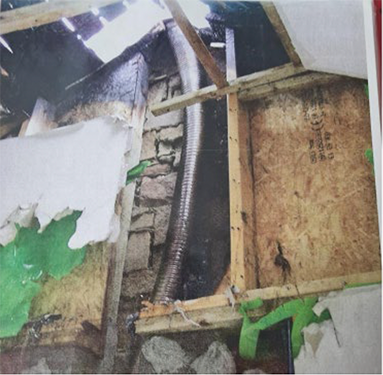
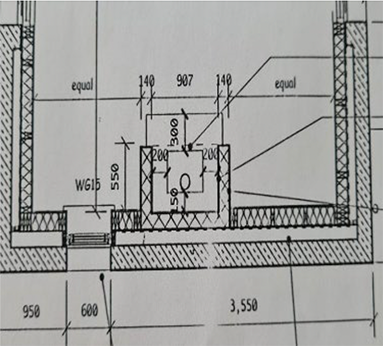
This report relates to a visit by Building Standards officers to a detached domestic premises at a property in West Lothian. This visit, followed a fire which Lothian and Borders Fire and Rescue Service had attended on 29 April 2012. The fire apparently started due to an incorrectly constructed chimney surrounding the flue of a free-standing solid fuel stove in the sitting room of the property.
At the time of Building Standards' visit on 30 April 2012 the fire had been extinguished and the ceiling and gable wall was part exposed showing the construction of the wall and chimney to the south wall of the sitting room of the property. The outer leaf of the cavity wall was constructed of 100 mm stone facing, with a 100 mm cavity between the stone and the inner leaf of the wall. The lower section of the inner leaf of wall up to approximately 2.4 m was constructed of a 147 x 47 mm timber frame which stopped either side of a free-standing concrete block panel with an approximate width of 1.1 m at the chimney. The upper section of the inner leaf of cavity wall, above this height, was constructed of a 147 x 47 mm timber stud partition.
The cavity between the inner and outer leaves was sealed with a cavity barrier to form a chimney. A single walled flue liner was installed partly in the cavity between the stone outer leaf and partly within the upper level timber inner leaf of the wall. During this inspection and through discussions with the owner it became apparent that the fire was as a result of the incorrect installation of a solid fuel stove.
Dangerous buildings notice
Following the fire, a section 30 Dangerous Buildings Notice was served on the owner of the property as appropriate through legislation the requirements of this notice were "to make safe and secure the fire damaged building". Serving a notice on the owner can assist in dealing with insurance; however it was not particularly helpful in this case as the owner felt that they had done nothing wrong, they simply bought a new house that had a completion certificate and an insurance warranty from a national warranty provider. This caused tension between parties.
Public interest
Given the outcome of the incorrectly installed solid fuel stove, Building Standards felt that to do nothing other than serve a Dangerous Buildings Notice was not fully serving the public interest. Therefore, in the hope that it could prevent a similar situation occurring it was felt that the public interest was best served by pursuing formal enforcement action. This enforcement action was initially aimed at the builder who carried out the work; however, during discussions, the Procurator Fiscal identified that the applicant, who was also the relevant person, should also be accused.
Registering a case with the Procurator Fiscal
In order to progress a case and submit that case to the procurator fiscal for consideration, any reports to the Crown Office and Procurator Fiscals Service (COPFS) can only be submitted by a specialist reporting agency (SRA). West Lothian Council is a specialist reporting agency and has been since September 2001. Most, if not all, Local Authorities are SRAs.
From 1 January 2006 SRAs can only report cases electronically to the Procurator via the COPFS secure website, SRAWEB. Procurators Fiscal will no longer accept cases reported in 'hard copy' paper form.
The report to COPFS, through SRAWEB, can only be submitted online from a dedicated PC via a secure connection by a SRA. Therefore, a dedicated PC had to be set up with secure access allowing cases to be submitted to the COPFS. For information, prior to a live report being submitted, there have to have been five full test cases submitted through the system to ensure that the SRA know exactly what is required and that the cases are submitted correctly to the live system. Any failure in providing correct information to the test cases means that the case fails and it has to be started again. COPFS provides specialist training on how they deal with SRA matters, however, this is infrequent, usually only once or twice a year and is heavily subscribed. This training, although helpful, is not mandatory and cases can be submitted through SRAWEB without undergoing the training.
In order to charge someone, there has to be a charge code which refers specifically to the section of legislation that you are charging the accused under already in the system. As there had been no previous cases under this piece of legislation a new charge code had to be created – this took just over three weeks to finalise and is done through COPFS.
In this case there were three charges and two accused with two of these charge codes for the builder and one for the applicant. In summary: 1 case – 2 accused – 3 charges.
The Integration of Scottish Criminal Justice Information Systems (ISCJIS) have created style offence charges, each with a unique charge code, which enables cases to be tracked and recorded throughout the system. These uniform charges and codes, details of which can be found on the ISCJIS website, must be used when reporting cases to the Procurator Fiscal. If no draft charge and code exist for an offence you wish to report, you can request that a new style charge be added to the system by contacting the Information Systems Division at COPFS.
Preparing the report
The parties involved had to be interviewed in order to prepare a report to COPFS. This required invitations to attend Council buildings for a formal interview under caution. The detailed report to COPFS includes information highlighting the issue that forms the basis of the case. In this instance this included the building warrant reference number, description of works, date the building warrant was granted for all stages and dates for completion certificate acceptance. It is also helpful at this stage to highlight the issue and include guidance from the Technical Handbook relating to the issue – in this case, guidance clause 3.19.4.
The following is an excerpt from the submission to COPFS:
•this report has been submitted due to the resultant serious nature of the fire which occurred as the construction of the chimney was not carried out in line with the approved warrant drawings or building regulations.
•this report relates to the failure of Any Builder Limited to take steps as the person carrying out the work to fulfil their statutory obligations as outlined in the Building (Scotland) Act 2003.
•this report relates to the failure of either Any Builder Limited or Example Developments Limited to take steps as the person on whose behalf the work is being carried out to fulfil their statutory obligations as outlined in the Building (Scotland) Act 2003.
The report to COPFS must include details of:
•the reporting officer. This is the person who is registered and submits the case from the secure PC
•witnesses and their designations
•location of the offence
•the date the offence was committed
•prosecution time bar. This is a standard 6 months from being made aware of the offence and is very important in progressing any case. The implications of this are set out later in the case study
•the offences. This is the contravention of the Building (Scotland) Act 2003 (the Act), in this case failure to ensure the requirements set out in section 8 sub-section 2 paragraph (b) were complied with. You must also include the part of the Act that you are referring to
•defences in law. At this stage you need to provide the actual defences in law the accused can consider, in this case paragraphs 4-9 of section 8 of the Act were noted.
Extract from section 8 of the Building (Scotland) Act 2003
(4) In any proceedings against a person referred to in subsection (3)(a) for an offence under subsection (2)(a), it is a defence for the accused to show that before the work was carried out or the conversion was made a person referred to in subsection (3)(b) or (c) had given the accused reasonable cause to believe that a building warrant had been granted for the work or the conversion.
(5) In any proceedings against a person referred to in subsection (3)(b) or (c) for an offence under subsection (2)(b), it is a defence for the accused to show that at the time of the alleged commission of the offence the accused did not know, and had no reasonable cause to know, that the work was being carried out or the conversion made otherwise than in accordance with the warrant.
(6) In any proceedings against a person referred to in subsection (3)(c) for an offence under subsection (2)(a), it is a defence for the accused to show that at the time of the alleged commission of the offence the accused did not know, and had no reasonable cause to know, that the work was being carried out or the conversion made.
(7) The accused is to be taken to have shown the fact specified in subsection (4) or, as the case may be, (5) or (6) if—
(a)sufficient evidence is adduced to raise an issue with respect to it, and
(b)the contrary is not proved by the prosecution beyond reasonable doubt.
In the report you must also provide anticipated lines of defence that all the accused parties may use and suggest rebuttals to these anticipated lines of defence. e.g.:
Defence. Any Builder Limited did not carry out these works, therefore the wrong person/company have been charged with these offences.
Rebuttal. The developer Example Developments Limited has identified that Any Builder Limited were appointed as main contractor for this project.
If part of the project was subcontracted Any Builder Limited as contractor is still the person on whose behalf the work is being carried out.
Defence. Example Developments is being victimised by the section.
Rebuttal. The completed construction resulted in a fire. It is not the intention of the section or its officers to victimise anyone. The section does have a duty to protect public health in West Lothian in relation to the built environment. It is in the public interest that builders are made aware that deviations from approved plans may have serious repercussions. Had the contractor constructed to the approved plans then this report would not have been necessary.
Charges
The report must include the charges levelled at each of the accused, e.g.:
"On 30 April 2012 at 10 Any Other Street, West Lothian, you John Smith being the Director of Any Builder Limited being person carrying out the work of a building, namely construction of, a building of a description to which the Building (Scotland) Regulations 2004 apply, did construct said building otherwise than in accordance with the warrant granted in terms of section 9 of the aforementioned Act, in that you did fail to construct a chimney in accordance with the approved warrant; CONTRARY to the Building (Scotland) Act 2003 section 8(2)(b)".
It must also must include for each charge the offences and penalties - this is taken from the Act:
Offences and Penalties
The Building (Scotland) Act 2003, section 48
48 Penalties for offences
(1) Subsection (2) applies to an offence under any provision of this Act other than sections 14(6), 21(5), 37(4), 39(6) and 43(1)
(2) A person guilty of an offence to which this subsection applies is liable on summary conviction to a fine not exceeding level 5 on the standard scale.
The remainder of the report forms a background to the case setting out again the main issues and providing evidence in the form of what is termed productions. This included:
•details from Companies House to indicate the accused as directors of the companies
•photographs of the offence
•interviews held with the accused and
•statements from witnesses
•copies of approved plans
•building warrant and completion certificate.
Any officer involved in the enforcement case should provide a statement. The report should refer to all this information with references to individual productions that are relevant throughout the report.
Interviews with witnesses and the accused need to be carried out under caution. Invitation to attend interviews are sent recorded delivery and in this case two officers sat in on the interview one to scribe the other to carry out the interview. At the end of the interview the individual being interviewed was asked to read the notes taken and sign that it is a true reflection of the interview and this is used as evidence.
Similarly, evidence of any accused not attending for interview and any email correspondence/telephone calls relating to the matter should also be included at this stage. A list of productions must also be provided. (This case had 33 productions submitted in the report.)
Prosecution time bar
Note: Although as a SRA you submitted the case the decision whether or not to prosecute is one entirely for the PF. Before proceeding with a case, the PF must be satisfied by way of corroborated evidence
•that the case is within the jurisdiction of the court;
•that an offence has been committed;
•that the alleged offender committed that offence and is therefore liable to prosecution; and
•that there is sufficient evidence to prove beyond reasonable doubt both that the offence was committed, and by whom.
The criteria that the PF will consider are explained in the Crown Office and Procurator Fiscal Service Prosecution Code. This sets out the criteria for decision making and the range of options available to prosecutors dealing with reports of crime. When reporting agencies send the PF reports of crime, the PF will decide whether to begin criminal proceedings or whether to take alternative action.
The Procurator Fiscal's office advised in March of 2013 that as they could not find a registered address for the builder due to the company being wound up this had caused a delay which resulted in the time bar being exceeded and the builder would no longer be part of any case. This is why it is important to ensure the report is submitted ideally within 4 months of the offence to give COPFS time to charge the accused within 6 months if that is the decision the Procurator Fiscal takes.
Outcome of court case
The case was heard at the Sheriff Court by Sheriff X. The accused was the sole director of the development company (Example Developments). Two Building Standards officers gave evidence and in summing up the Sheriff noted that the information provided by both officers would not be in question.
It was never Building Standards' intention to see the developer be accused; however, the Procurator Fiscal advised this would be required. The developer had appointed a warranty provider, a project management company to look after the project and a main contractor – this was the developer's defence.
However, during the court case, minutes of a meeting were provided which highlighted that the developer who was also the relevant person knew an amendment to building warrant was required for a change to the ceiling construction but did not submit an amendment and subsequently submitted a completion certificate.
As a result of this, the developer was found guilty under section 8 2b of the Act Where such is carried out, or such a conversion is made in a case where a building warrant has been granted, otherwise in accordance with the warrant - as it had been proven the developer knew that the works had not been carried out in accordance with the warrant but still submitted a completion certifying that the works had been carried out in accordance with the warrant. Therefore, the stove issue was not the defining factor in the case – this ended up being a vehicle to take the case to court.
The preparation time involved in creating the case, gathering evidence and creating the report should not be under-estimated. An estimation of the time taken to create this case and attend court would be in excess of 100 hours for the service.
Issues to consider
•Consider if enforcement action is in the public intertest
•Register a user and PC with Specialist Reporting Agency
•Five trial cases to be put through the SRA
•Check if there is a charge code created (when a similar case been heard previously) as time is required to create a new one
•Evidence gathering and recording all conversations/meetings
•Prosecution time bar – 6 months from knowing about the offence
•Provide a sufficient report to allow the Procurator Fiscal to decide on whether to take the case to court.
Supporting colleagues
It is important not to underestimate and to acknowledge the effects this process has on the individuals working on the report. This includes attending court to give evidence (police interviews, carry out interviews of others under caution). Continued support from team members and management is crucial those Individuals involved during and after the case is completed will prove to be both beneficial and welcomed.
Case Study 2: Scottish Borders Council
The property
The property is a mid-terrace dwelling house in a terrace of four dwelling houses. The property is of traditional masonry construction for both the external and internal walls with a traditional slated roof on timber sarking and timber roof members.
The property was brought to the attention of the enforcement team by colleagues from Trading Standards following its advertisement for sale. The issues identified during the initial assessment were that a masonry wall had been taken down on the ground floor to create an open plan kitchen living space and that works had been undertaken to convert the attic to habitable accommodation.
The formation of the attic accommodation created habitable accommodation at 4.5 m, which would have implications for life safety, if a fire were to occur and also raised the potential for structural issues due to the alteration of the roof structure.
The enlargement of the ground floor area was considered to be a potential structural safety risk due to the removal of the masonry wall and the installation of a timber beam supporting the first floor joists.
When considering whether the evidence provided constituted unauthorised works and therefore further investigation, it was important to apply first principles and determine whether the works in question were exempt, works which do not require a warrant but must comply with the regulation or works which should be the subject of a building warrant. The works were considered against the provisions of the Building (Scotland) Act 2003 and the current Building Standards Technical Handbook - Domestic.
Having established that the works to convert the attic to increase the habitable accommodation should have been the subject of a Building Warrant (schedule 3 type 1 of Mandatory Regulation 5 the Technical Handbook), it was evident that unauthorised works had been undertaken. The removal of a load-bearing wall should have been the subject of a building warrant (schedule 3 type 1 of the Technical Handbook). The question was whether this wall was load-bearing. As the floor joists in the house run from front to back the floor joist in this area ran from side to side, it was not apparently evident if the wall was or was not load-bearing. Given that the floor joists ran in the opposite direction to the others on the first floor it was considered appropriate to treat the wall as load-bearing until otherwise proven. (If works had been undertaken at same time as other warrantable works this would also have required a building warrant).
The next stage in the investigation was to undertake a desktop survey using Uniform and other council assets to establish the history of the property and to check if a building warrant had been applied for covering the works in question. It was established that no building warrant was applied for.
An ownership search through the Land Registry and internal facilities was completed. The owner was then contacted and advised that the works to the attic would require a building warrant and that they would be required to submit a completion certificate to the verifier and secure the verifier's acceptance of the certificate. The owner was also advised that if the removal of the ground floor wall could be load bearing it would need to be covered by the same application.
Following the initial letter to the owner, various exchanges of correspondence and telephone calls took place over a period of several months. Initially, the owner was going to arrange for an engineer to confirm the status of the removed wall and submit the necessary application to regularise the situation.
Following further communications it was clear that the owner was not in a position to make the application. Given the nature of the works involved and the implications for safety it was determined that as the owner was not going to make the application, the Council would have to. The owner was advised that the Council would serve a Notice under section 27 of the Building (Scotland) Act 2003 to regularise the situation.
The Notice was served and subsequently became extant one month later. The Notice under section 27 of the Act required the recipient to "Obtain approval of a Building Warrant by the date specified on the Notice". A short compliance period was agreed with owner to allow the direct action to be progressed at the earliest opportunity.
Given that the owner was not in a position to comply with the terms of the Notice the Council's Architectural section was appointed to progress the necessary application.
Latest position
The Council Architect, accompanied by a structural engineer, attended the site and undertook a detailed survey of the property.
Once the plans had been prepared and the engineering advice considered, the Architectural section will submit an application for a Building Warrant to the Council's Building Standards Section to consider. At the same time as seeking the building warrant, the Council will obtain probable costs from an independent quantity surveyor (QS) to help in determining what would be the most cost effective solution to resolve the matter.
Once the application has been submitted and approved it is envisaged that the owner will be given the opportunity to undertake the necessary remedial works within an agreed period of time. In parallel with the owners undertaking the works the Council seek to recover the cost incurred in securing the building warrant approval.
If the owner is either unable or unwilling to undertake the works the Council will give consideration to the service of a subsequent Notice under section 27 to compel the owner to complete the works and secure a Certificate of Completion.
Action
The process that would be followed is set out below:
The Council's Architect would be appointed to take forward the direct action works. As part of the process they would create a design team for the project, comprising the Architects, clerk of works, quantity surveyor and an engineer if required. The design team would obtain a probable cost from the QS which would be used to determine the authorisation route. The enforcement team have approval in the Council's scheme of delegation to undertake direct action works up to £30,000 without the need for Committee approval. In cases where the costs of the works is under £30,000, authorisation would be approved by a senior officer.
If the probable cost exceeds £30,000 a report would be prepared and presented to the Planning and Building Standards Committee, and subject to approval being granted, the design team would be advised to proceed to the next stage.
The design team would take the approved warrant drawings and generate a bill of quantities and seek tenders from a minimum of three contractors. The team will assess the tender return and recommend a contractor based on quality and cost.
The owner would be advised on the ongoing position and be given an opportunity to undertake the works prior to the contractor being formally appointed.
If the owner does not confirm they would be undertaking the works, the contractor would be appointed and the design team would arrange a pre-commencement meeting to start the works. The design team would oversee the direct action works and confirm to the enforcement team when the works have been completed. A joint inspection with the design team would be undertaken and thereafter if all is satisfactory the Completion Certificate would be issued by the Council.
The design team would conclude the direct action phase and arrange for the final account to be prepared for the works. The enforcement team would apportion the cost to the parties served by the Notice and apply an administration charge to cover the cost incurred by the Council in delivering the direct action works (this does not cover the costs of the design team as they are to directly recharge to the owners).
Annex B
#Source page 16
Other offences
| Section | Subject matter | Description of provision | Penalty for offences | |
|---|---|---|---|---|
| Section 48 Level of fine | Other section level of fine | |||
| Building warrants | ||||
| 8(2) | Building warrants | Where work/conversions are carried out without a building warrant, or where a warrant has been granted, otherwise than in accordance with the warrant, (a) any person carrying out the work or making the conversion, (b) any person on whose behalf the work is being carried out (or conversion made), are guilty of an offence. If the owner does not fall into (a) or (b), the owner is guilty of an offence. | 5 | |
| 11(4) | Building warrants: certification of design | Any approved certifier of design who issues a certificate containing a statement they know to be false or misleading in a material particular or recklessly issue a certificate which is false/misleading in a material particular is guilty of an offence. | 5 | |
| 14(5) | Building warrants: limited life buildings | Where the warrant is subject to the condition that the building is demolished by the expiry of the period stated in the application, but does not constitute a warrant for the demolition and the owner of the building fails to demolish the building by the expiry of the relevant period, the owner is guilty of an offence. | 5 | |
| 14(6) | Occupation of building with expired building warrant | Any person who after the expiry of the period specified in the warrant (or the period as extended or further extended), occupies or uses the building to which the warrant relates knowing that the period has expired or without any regard for whether the period has expired, is guilty of an offence. | N/A | Unlimited |
| 16(1) | Applications and grants: offences | Any person who makes an application for a building warrant or an amendment to a warrant containing a statement which that person knows to be false or misleading in a material particular or recklessly makes such an application containing such a statement, is guilty of an offence. | 5 | |
| 16(2) | Any verifier who grants a building warrant or makes an amendment to a warrant knowing that the application for the warrant or amendment contains a statement which is false in a material particular, is guilty of an offence. | 5 | ||
| Completion Certificates | ||||
| 19(4) | Completion certificates: certificates of construction | Any approved certifier of construction who issues a certificate containing a statement they know to be false or misleading in a material particular or recklessly issue a certificate which is false/misleading in a material particular, is guilty of an offence. | 5 | |
| 20(1) | Completion certificates: offences | Any person under the 2003 Act who submits to a verifier a completion certificate containing a statement which that person knows to be false or misleading in a material particular, or recklessly submits to a verifier a completion certificate containing a statement which is false or misleading in a material particular, is guilty of an offence. | 5 | |
| 20(2) | Any verifier who accepts a completion certificate submitted to it knowing that the certificate contains a statement which is false in a material particular, is guilty of an offence. | 5 | ||
| 21(5) | Occupation or use without completion certificates | Any person who occupies or uses a building which is being, or has been constructed or converted by virtue of a warrant, or without a warrant on condition that no completion certificate has been accepted (other than solely for the purpose of its construction or conversion), knowing that no completion certificate has been accepted, or without any regard for whether a completion certificate has been accepted is guilty of an offence unless the occupation or use is authorised by a permission granted under section 21(3). | N/A | unlimited |
| Enforcement | ||||
| 25(7)(a) | Building regulations compliance | If by the date specified in a "building regulations compliance notice" (or such other date as may have substituted), the owner has not complied with the requirements of the notice, the owner is guilty of an offence. | 5 | |
| 26(3)(a) | Continuing requirement enforcement notices | If by the date specified in a "continuing requirement enforcement notice" (or such other date as may have substituted), the owner has not complied with the requirements of the notice, the owner is guilty of an offence. | 5 | |
| 27(7) | Building warrant enforcement notices | If by the date specified in a "building warrant enforcement notice" (or such later date as the local authority may have substituted), the person on whom the notice is served has not complied with the notice is guilty of an offence, that person | 5 | |
| 28(9) and 28(10) | Defective buildings | Where the owner has either not started or not completed work by the relevant specified dates, the owner is guilty of an offence. | 5 | |
| 30(3) and 30(4) | Dangerous buildings notices | Where the owner has not begun, or has not completed, work required by a dangerous building notice by the date specified in the notice for its commencement or completion (or such later date as the local authority may have substituted), the owner is guilty of an offence. | 5 | |
| Functions | ||||
| 34(2) | Reports and information | Any local authority, verifier or certifier which knowingly or recklessly provides information in pursuance of section 34(1) which is false or misleading in a material particular, is guilty of an offence. | 5 | |
| Documents | ||||
| 37(4) | Service of notices etc. | Any person who having been required by a notice to give information and refuses or fails to give that information, makes in respect of that information any statement which that person knows to be false or misleading un a material particular, is guilty of an offence. | N/A | 3 |
| Entry, inspection and tests | ||||
| 39(6) | Powers of entry, inspection and testing | A person who refuses or fails, without reasonable excuse, to comply with a requirement made under subsection (5), or intentionally obstructs a person acting in the exercise of any power conferred by subsection (1) or (3). | N/A | 3 |
| Evacuation of buildings | ||||
| 43(1) | Unlawful occupation of evacuated buildings | Any person who has removed from a building in compliance with a requirement under section 42, or has been ejected from a building under schedule 5 (evacuation of buildings) and thereafter occupies the building, is guilty of an offence. | N/A | unlimited |
| Execution of works | ||||
| 49 | Offences by bodies corporate etc. | Makes provision in relation to offences committed by bodies corporate, local authorities, partnerships and unincorporated associations. Specified responsible individuals within these bodies may be liable to prosecution and punishment in addition to the body in question. | 5 |
Annex C
#Source page 17
Statutory Forms
The list of forms relevant to enforcement action are summarised below.
These are set out in the Forms Regulations, Schedule 1, and the Act, and amendments introduced by the (Charging Orders) Regulations 2014.
| Form | Title | Legislation |
|---|---|---|
| 7 | Completion Certificate for Local Authority Use | The Building (Forms) (Scotland) Regulations 2005 |
| 8 | Building Regulations Compliance Notice | As above |
| 9 | Continuing Requirement Enforcement Notice | As above |
| 10 | Building Warrant Enforcement Notice | As above |
| 11 | Defective Building Notice | As above |
| 12 | Dangerous Building Notice | As above |
| 13 | Notice of Intention To Enter Premises | As above |
| 14 | Authority to enter premises | As above |
| 15 | Certificate to accompany application for warrant to exercise powers of entry, inspection or testing | As above |
| 16 | Notice to remove from a building | As above |
| - | Charging Order | The Building (Scotland) Act 2003 (Charging Orders) Regulations 2014 |
| - | Discharge of Charging Order | As above |
Footnotes
#Source page 18
1. The Scottish Building Standards Procedural Handbook
2. Local Government (Scotland) Act 1973 (legislation.gov.uk)
3. Criminal Procedure (Scotland) Act 1995 (legislation.gov.uk)