Scotland Building services compliance guides
Domestic Building Services Compliance Guide for Scotland
Library captured 10 September 2026 · Source updated 11 February 2020
Page 1
#Source page 1

Building Standards Division
Domestic
Building Services
Compliance Guide
For Scotland
2015 Edition

Page 2
#Source page 2
Note:
This document applies to Scotland only. For other jurisdictions in the UK, it will be necessary to consult their own building regulations and guidance.
Any reference to the Building regulations in this guide is to the Building (Scotland) Regulations 2004 (as amended).
This guidance comes into effect on 1 October 2015 and is applicable to:
• work that is subject to a building warrant submitted on or after 1 October 2015; or
• work which, by virtue of regulation 5 of and Schedule 3 to the Building (Scotland) Regulations 2004, does not require a building warrant, other than work that is:
•o completed before 1st October 2015; or
•o not completed before that date where the contract for the work is entered into before 1 October 2015 and the work is completed before 31st January 2016.
Whilst publication of this guide is intended to support standardisation of the specification and expected performance of fixed building services throughout the UK, please note that guidance in section 1.8 on replacement of primary heating appliances differs in Scotland from that applied within building regulations elsewhere in the UK.
Produced by the Buildings Standards Division
First published: October 2014
Version 1.0
Document Version Control
Title: Domestic Building Standards Compliance Guide for Scotland – 2015 Edition
Purpose: To provide guidance on compliance with building regulations, namely standards 6.3 to 6.7, as set out in section 6 (energy) of the 2015 Domestic Technical Handbook. This guidance is applicable as described in the note provided above.
| Version | Date | Notes |
| 1.0 | October 2014 | Initial issue in support of the 2015 revision of section 6 (energy) of the Scottish building regulations. |
Section 1: Introduction
#Source page 5
1.1Scope
This guide provides detailed guidance for the installation of fixed building services in new and existing non-domestic buildings in support of compliance with the energy efficiency requirements set out under standards 6.3 to 6.7 of the building regulations.
This edition covers the design, installation and commissioning of:
• conventional means of providing primary and secondary space heating, domestic hot water, mechanical ventilation, comfort cooling and internal & external lighting; and
• low carbon generation of heat by heat pumps, solar thermal panels, and micro- combined heat and power systems.
The guide sets out recommended minimum energy efficiency standards for components of building services systems, including the use of controls. For systems installed in new dwellings, the standards are minimum design limits (or back-stop values). For new or replacement systems and components installed in existing dwellings, the standards represent appropriate provision for complying with building regulations.
It is important to note that standards higher than many of these recommended minimum standards will need to be achieved if:
• new dwellings are to meet the target carbon dioxide emission rate (TER) calculated under standard 6.1 using SAP1
• systems are to comply with the Microgeneration Certification Scheme standards2 that enable building owners to receive payments under the Renewable Heat Incentive (RHI) and qualify for Green Deal funding
• products are to be recognised as renewable technologies under the Renewable Energy Directive.
The guide includes some supplementary information that identifies good practice design and installation standards that exceed the minimum standards in this guide. Microgeneration Certification Scheme standards are an example of good practice standards.
A summary of recommended minimum energy efficiency standards is presented in Table 1 at the end of this section.
1.2Innovative systems
It is also important to note that this guide covers a range of frequently occurring situations and deals with the most commonly used fixed building services technologies. In doing so it neither endorses these methods and technologies nor excludes other more innovative technologies that may offer an alternative means of meeting the functional requirements of building regulations.
Page 6
#Source page 6
Where the alternative technology has been the subject of a recognised testing procedure that assesses its energy performance, this may be used to indicate that the system is adequately efficient. In the event that there is no recognised testing standard, suitable calculations or modelling methods should be used to show the carbon performance of the system.
1.3European Directives
The design and installation of fixed building services products, such as boilers, circulators and heat pumps, shall at the appropriate time comply with all relevant requirements of EU Directives as implemented in the United Kingdom. There are a number of Directives with requirements that directly or indirectly control the energy efficiency of building services.
The Ecodesign Directive 2009/125/EC provides a framework for establishing requirements for ‘energy-related’ products placed on the EU market. Current requirements cover ‘energy- using’ products such as boilers, light bulbs and washing machines. In the future, requirements will also cover products such as windows, insulation material and shower heads whose use has an impact on energy consumption.
The requirements are set out in Commission Regulations listed in the document http://ec.europa.eu/energy/efficiency/ecodesign/doc/overview_legislation_eco-design.pdf. Products covered by the regulations can only be CE-marked and placed on the market if they meet the ecodesign standards specified.
At the time of preparation of this guide, Commission Regulations existed or were being developed for:
• space heaters and combination heaters
• water heaters and hot water storage tanks
• glandless standalone circulators and glandless circulators integrated in products
• water pumps
• air conditioners and comfort fans
• fans driven by motors with an electric input power between 125W and 500W
• lighting products in the domestic and tertiary sectors
• electric motors.
The intention is that the recommended minimum product standards in this guide should at least match the energy efficiency standards set out in Commission Regulations as they come into force. For example, although the implementing regulations for hot water storage tanks were published in September 2013, the standards do not come into force until September 2017. If in any doubt as to whether a product is subject to minimum ecodesign standards, check the Commission document above.
The Energy Labelling Directive 2010/30/EU compliments the Ecodesign Directive by providing a framework for labelling of energy-related products including lamps, luminaires, household air conditioners and washing machines. The Energy Label classifies products on an A to G scale, ‘pulling’ the market towards more efficient products by better informing consumers. The Ecodesign Directive, by contrast, uses regulation to ‘push’ the market away from the worst performing products.
Page 7
#Source page 7
The Renewable Energy Directive 2009/28/EC provides a framework for the promotion of energy from renewable resources. It sets a mandatory UK target of 15% energy generation from renewable sources by 2020 – the ‘renewable energy obligation’ – as a contribution to meeting the EU’s overall target of 20%. Of relevance to building services is that the Directive identifies criteria for training and certification of installers of renewables. The Directive also specifies in Annex VII the standards that heat pumps must achieve to be recognised as renewable technologies by the Directive.
The Energy Efficiency Directive 2012/27/EU establishes a common framework of measures for the promotion of energy efficiency within the EU in order to ensure that the EU meets its target of a 20% reduction in primary energy consumption by 2020. Legislation to implement the Directive in the UK will be published by 5 June 2014. Included will be requirements for public authorities to purchase only energy-efficient products, services and buildings; and requirements for heat meters to be fitted in apartments and buildings connected to a central source of heating or a district heating network. For more information on the specific requirements and technical standards, see the DECC website3.
The Energy Performance of Buildings Directive 2010/31/EU is a recast of the original 2002/91/EC Directive, which in 2002 introduced requirements for:
• the establishment of a methodology for calculating the integrated energy performance of buildings
• minimum energy performance requirements for new buildings, and, where feasible, for larger buildings undergoing major renovation
• energy performance certification of buildings, and
• inspections of heating and air conditioning systems.
The recast Directive included a new requirement to consider in the design of new buildings the feasibility of using renewables and other ‘high-efficiency alternative systems’. There is no mandatory format for this assessment, but it is necessary to declare, as part of the building warrant application, how this has been carried out4.
The building regulations already meet specific requirements of the Directive (for example by setting standards for new buildings and new building work). For guidance on the most recent changes affecting new and existing domestic buildings, see Section 6 Energy of the Non- Domestic Technical Handbook5. For guidance on other requirements relating to building certification and inspection of heating and air conditioning systems, see the BSD website6.
1.4Status of guide
The building regulations in Scotland are expressed in terms of functional standards. These standards are statements of functions the complete building must fulfil or allow. The standards are set out in building regulations and are intended to
• secure the health, safety and welfare and convenience of persons in or about buildings;
Page 8
#Source page 8
• further the conservation of fuel and power; and
• further the achievement of sustainable development.
These functional requirements are often drafted in broad terms and so, from the standard alone, it may not always be immediately clear to a person carrying out work how to comply with the relevant requirements. Consequently, the Building Standards Division issues guidance in the form of Technical Handbooks and other published information, such as this document, which provide practical guidance on ways of complying with specific aspects of the building regulations in most common building situations.
The Technical Handbooks are intended to provide practical guidance, but they are not intended to be comprehensive. Consequently, they may contain references to other documents which will provide more detailed information and assistance on parts of the guidance. This guide is one of those documents. It provides more detailed information on the guidance contained in Section 6 Energy of the Domestic Technical Handbook about compliance with the energy efficiency requirements which apply when installing fixed building services in new and existing buildings.
If you follow the guidance in the Technical Handbooks and companion documents, such guidance may be relied on in any proceedings as tending to negative liability for an alleged contravention of the building regulations (refer to section 0 of the Technical Handbooks for further explanation)
However, in each every case it is for the verifier (local authority) to determine whether work complies with the requirements of the building regulations. Where there is doubt, it is appropriate to check with the verifier before starting work to establish what is necessary for compliance with building regulations. In Scotland, all new buildings and much work to existing buildings will require the issue of a building warrant prior to any works commencing on site. Information on works which must comply with building regulations but for which a building warrant is not required are set out in schedule 3 to regulation 5 (refer to section 0 of the Technical Handbooks).
1.5How to use this guide
The guide is fdivided into the following sections:
Section 1: Introduction and summary of energy efficiency standards
• Fuel-based
Section 2: Gas-fired space and water heating
Section 3: Oil-fired space and water heating
Section 4: Electric heating
Section 5: Solid fuel heating
• Technology-specific
Section 6: Community heating
Section 7: Underfloor heating
Section 8: Mechanical ventilation
Section 9: Heat pumps
Section 10: Comfort cooling
Page 9
#Source page 9
Section 11: Solar water heating
Section 12: Lighting
Section 13: Micro-combined heat and power
Section 14: Heating system circulators
For any particular application, reference may need to be made to more than one section.
Supplementary information is shown against a blue background. This may be further information to help in establishing the minimum energy efficiency provisions needed to comply with the building regulations or it may be guidance on best practice that goes beyond the recommended minimum standards.
Key terms are printed in italics and are defined at appropriate points throughout the guide.
1.6Key terms
Fixed building services means any part of, or any controls associated with:
a.fixed internal or external lighting systems, but does not include emergency escape lighting or specialist process lighting
b.fixed systems for heating, domestic hot water, air conditioning or mechanical ventilation, or
c.any combination of systems of the kinds referred to in paragraph a. or b.
New system means a fixed building services system installed:
a.in a new building
b.for the first time in an existing building
c.as a complete replacement for a system in an existing building.
Seasonal efficiency means the efficiency value used by SAP for a heating appliance. For gas, LPG and oil boilers that have been tested for efficiency, this is SEDBUK7.
1.7Work on existing systems
A requirement of building regulations is that work on existing buildings should be carried out in such a way that when the work is complete:
a.the work itself complies with the applicable requirements of building regulations
b.the parts of the building not affected by the work are no worse in relation to the requirements of regulations than before the work was started.
This means that when a system component like a boiler or a room thermostat is replaced, only the new component is expected to comply with the provisions in this guide (which in some cases may be lower than for new systems).
Page 10
#Source page 10
It is not a general requirement to upgrade the rest of the existing system, but this guide does include some recommendations on minor upgrades for compliance with building regulations where they would be cost-effective and may be necessary to ensure efficient operation of the new component.
Some of the supplementary information is guidance on good practice that, while not essential for compliance with building regulations, would help to save energy. For example, it is convenient and timely to fit thermostatic radiator valves when replacing a boiler and the system has been drained down.
1.8Replacement of primary heating appliances
When replacing an existing appliance, the seasonal efficiency of the new equipment should be as stated in the relevant fuel-based section of this guide, subject to any guidance identifying alternatives in exceptional circumstances.
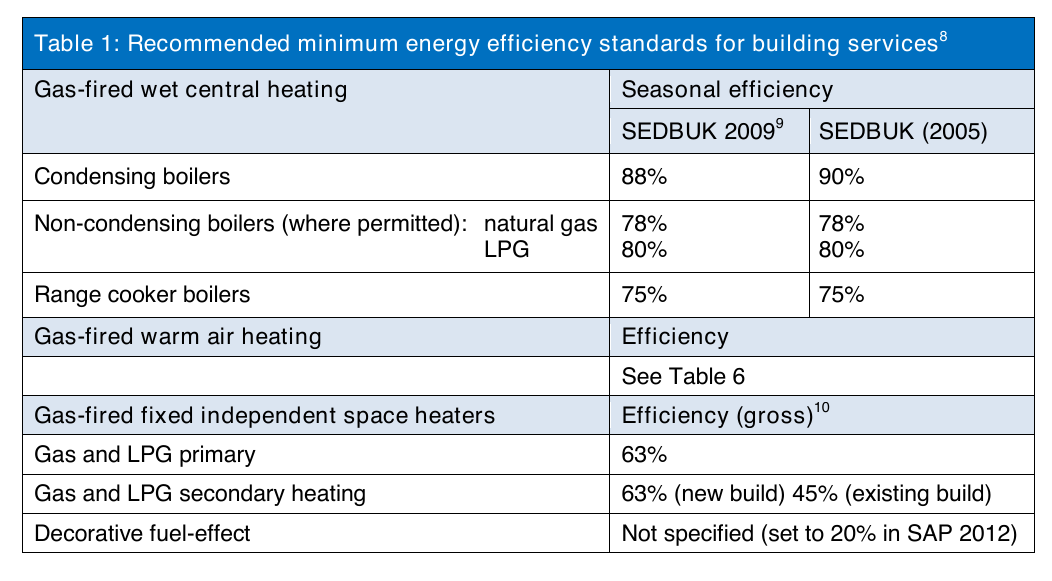
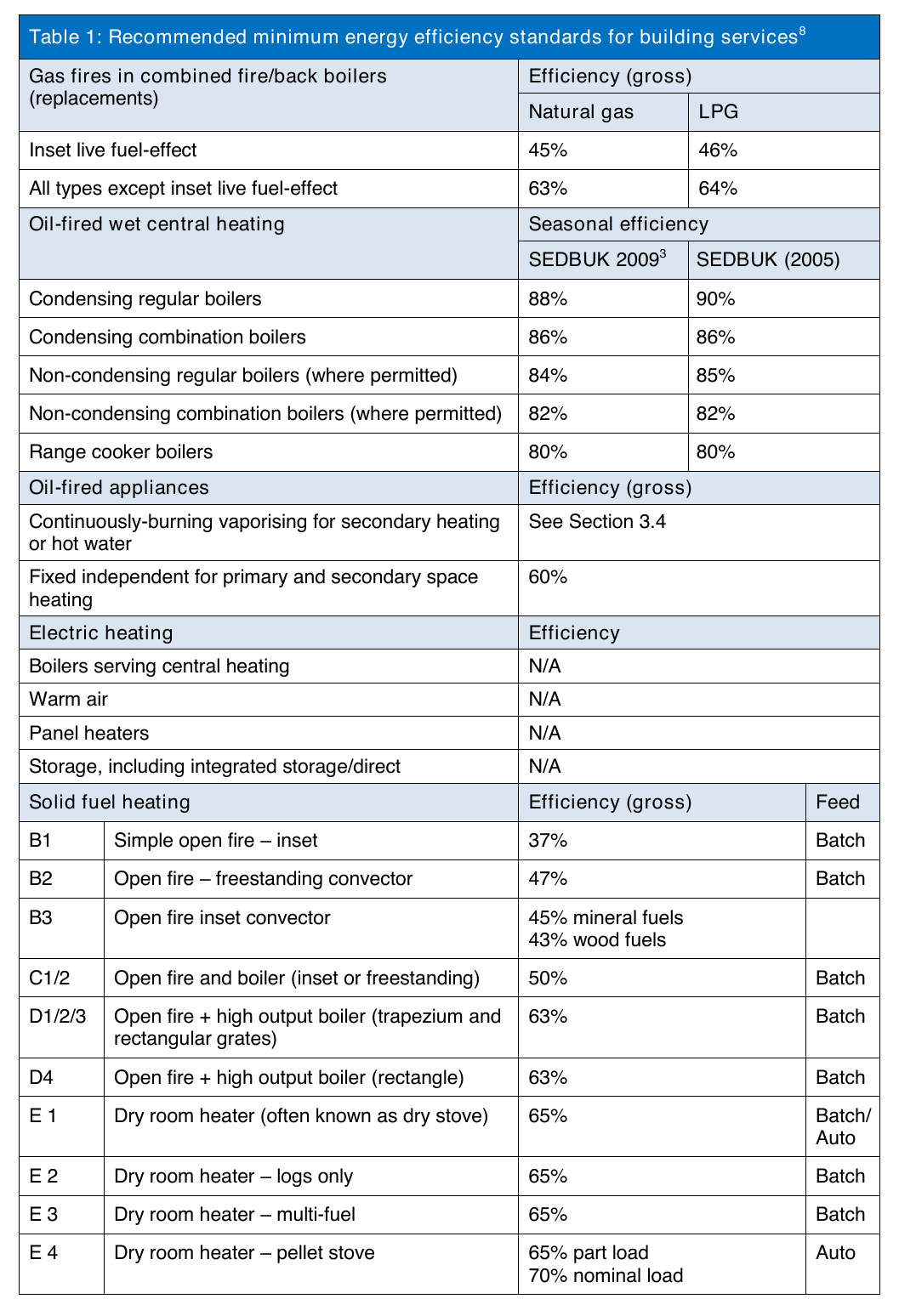
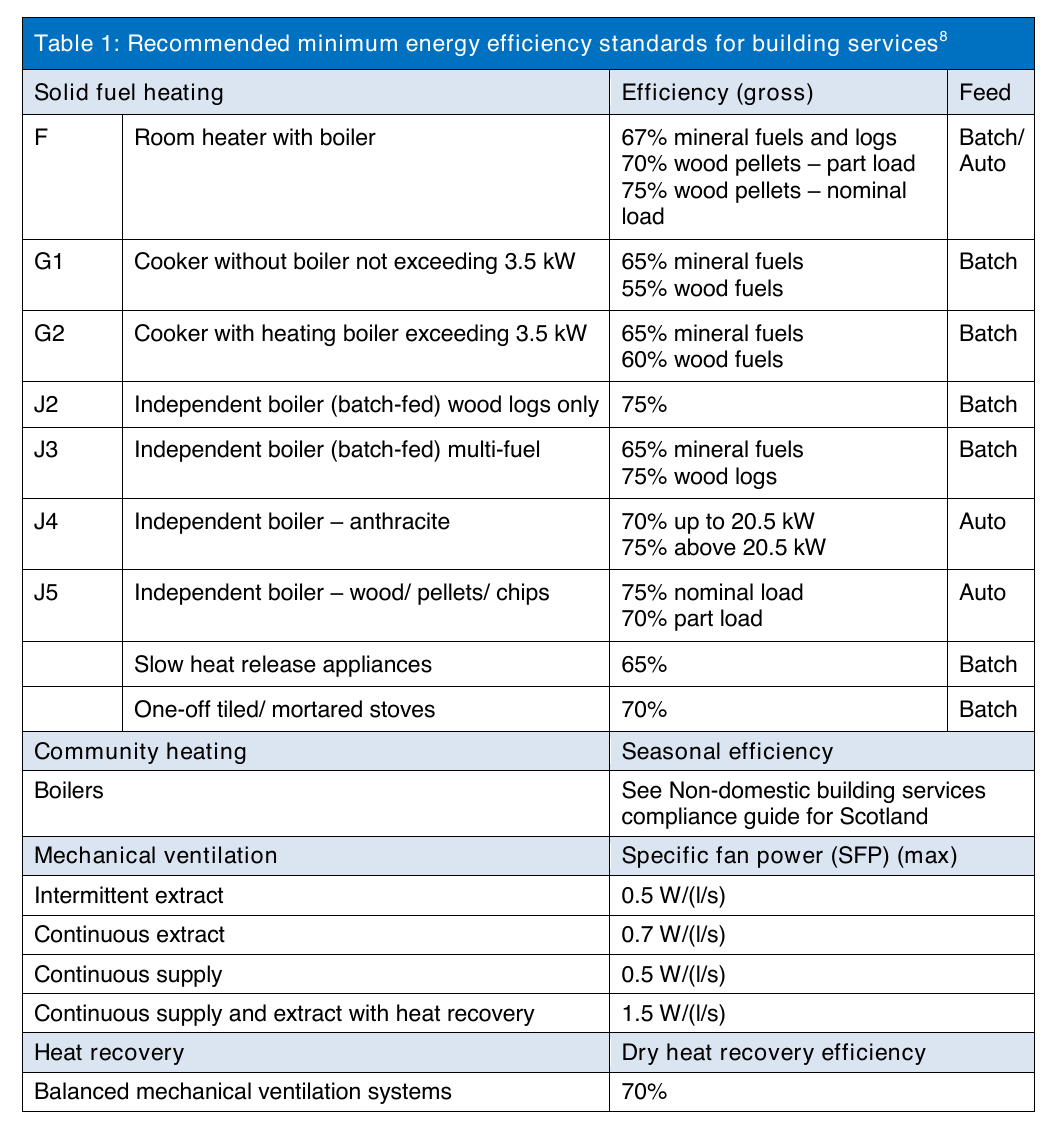
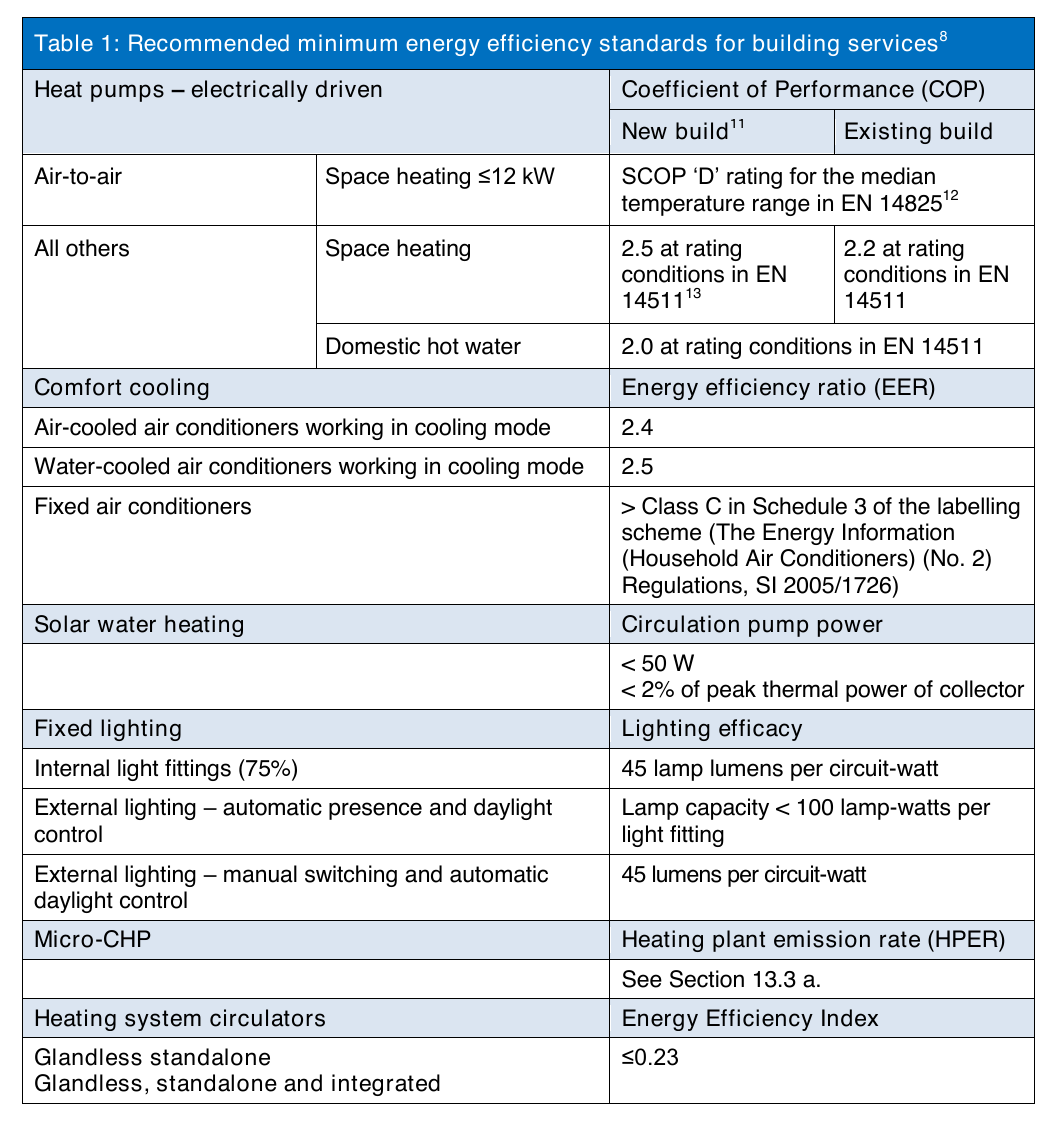
1.9Summary of recommended minimum energy efficiency standards
Table 1 summarises the recommended minimum energy efficiency standards for buiding services in domestic buildings.
Table 1: Recommended minimum energy efficiency standards for building services8
Page 11
#Source page 11
Table 1: Recommended minimum energy efficiency standards for building services8
Page 12
#Source page 12
Table 1: Recommended minimum energy efficiency standards for building services8
Page 13
#Source page 13
Table 1: Recommended minimum energy efficiency standards for building services8
Section 2: Gas-fired space and water heating
#Source page 14
2.1Scope of guidance
This section provides guidance on the specification of gas-fired space heating and hot water systems14 in dwellings to meet relevant energy efficiency requirements in building regulations. The guidance applies to systems fuelled by natural gas and liquid petroleum gas (LPG) and covers:
• wet central heating systems
• range cookers with integral central heating boilers
• warm air heating systems
• fixed independent space heating devices.
2.2Gas-fired wet central heating systems
New systems
New systems for gas-fired wet central heating in new and existing dwellings should meet the minimum standards for:
a.boiler efficiency, system circulation, hot water storage, system preparation and commissioning in Table 2
b.boiler interlock, zoning, and time and temperature control of the heating and hot water circuits in Table 3
c.pipework insulation in Table 5.
Existing systems
Components installed as replacements in existing systems should meet the same standards as for new systems, except where indicated otherwise in Table 4.
Table 4 in addition identifies good practice upgrades to the rest of the system (beyond the requirements of building regulations) when making planned and emergency replacements.
Page 15
#Source page 15
Table 2: Recommended minimum standards for efficiency, system circulation, hot water storage, system preparation and commissioning for gas-fired wet central heating systems
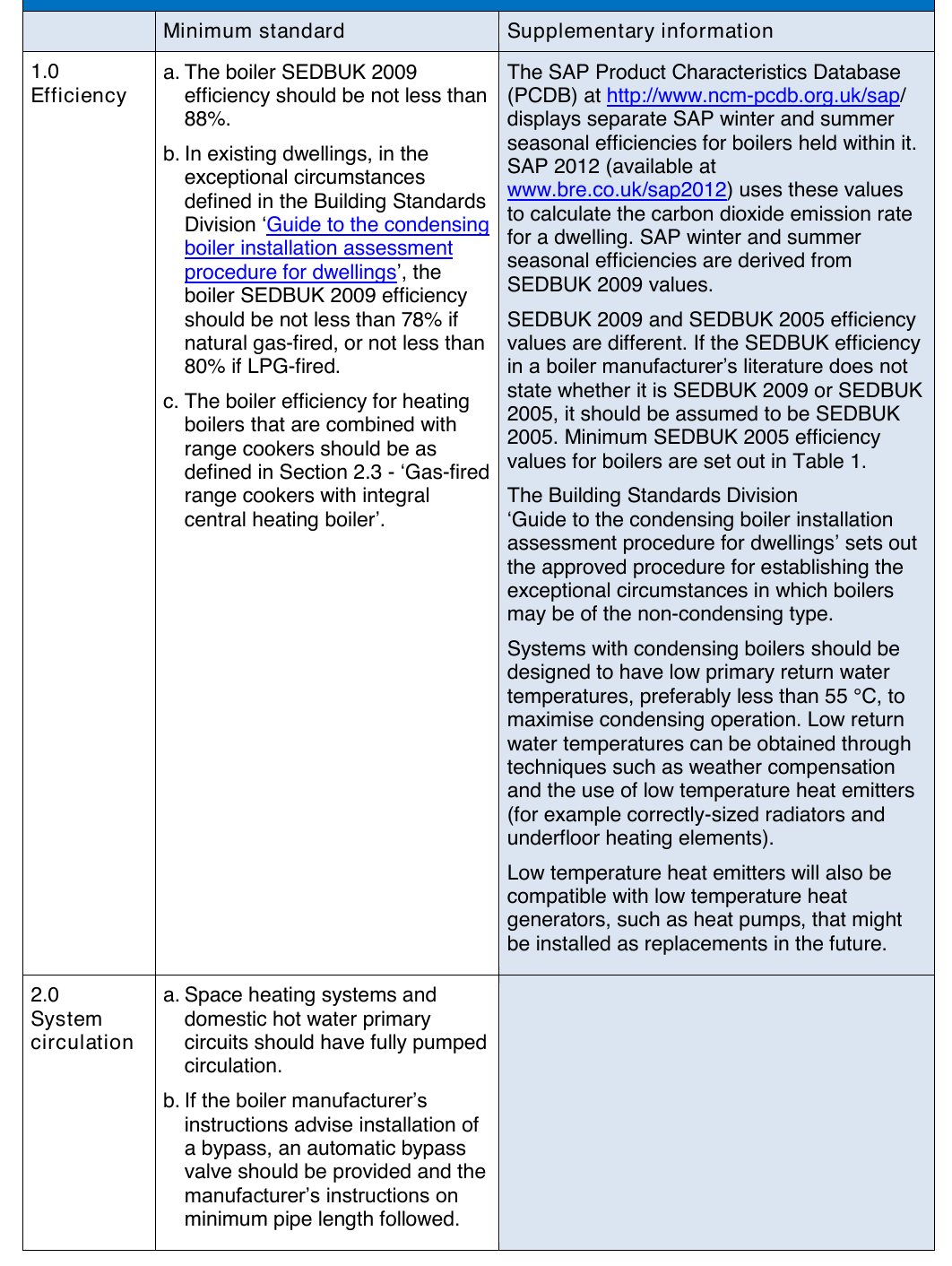
Page 16
#Source page 16
Table 2: Recommended minimum standards for efficiency, system circulation, hot water storage, system preparation and commissioning for gas-fired wet central heating systems
| Minimum standard | Supplementary information | |
|---|---|---|
| 3.0 Hot water storage | a. Vented copper hot water storage cylinders should comply with the heat loss and heat exchanger requirements of BS 1566:2002 Part 1. b. Copper hot water storage combination units should comply with BS 3198:1981. c. Primary storage systems should meet the insulation requirements of the Hot Water Association ‘Performance specification for thermal stores’. d. Unvented hot water storage system products should comply with BS EN 12897: 2006 or an equivalent standard. e. The standing heat loss for all hot water storage vessels in a, b, c and d above should not exceed Q=1.15x(0.2+0.051V2/3) kWh/day where V is the volume of the cylinder in litres. f. All hot water vessels should carry a label with the following information: i. type of vessel (vented, unvented, combination unit or thermal store) ii. nominal capacity in litres iii. standing heat loss in kWh/day iv. heat exchanger performance in kW v. reference to product compliance with relevant standard (e.g. BS 1566, BS 12897) and logos of accreditation bodies as required. For labelling requirements for other heat inputs, see relevant sections (e.g. Section 11 for solar). | If a vented cylinder is not made from copper then the heat loss and heat exchange characteristics should be tested in accordance with BS EN 12897:2006. The HWA thermal storage specification is available for free download from www.hotwater.org.uk. British and European Standards BS 1566: 2002 – ‘Copper indirect cylinders for domestic purposes. Open vented copper cylinders. Requirements and test methods’. BS EN 12897:2006 – ‘Water supply. Specification for indirectly heated unvented (closed) storage water heaters’. BS 3198:1981 – ‘Copper hot water storage combination units for domestic purposes’. |
Page 17
#Source page 17
Table 2: Recommended minimum standards for efficiency, system circulation, hot water storage, system preparation and commissioning for gas-fired wet central heating systems
| Minimum standard | Supplementary information | |
|---|---|---|
| 4.0 System preparation and water treatment | a. Central heating systems should be thoroughly cleaned and flushed out before installing a new boiler. b. During final filling of the system, a chemical water treatment inhibitor meeting the manufacturer’s specification or other appropriate standard should be added to the primary circuit to control corrosion and the formation of scale and sludge. c. Installers should also refer to the boiler manufacturer’s installation instructions for appropriate treatment products and special requirements for individual boiler models. d. Where the mains total water hardness exceeds 200 parts per million, provision should be made to treat the feed water to water heaters and the hot water circuit of combination boilers to reduce the rate of accumulation of limescale. e. For solar thermal systems, see Section 11. | Inhibitors should be BuildCert approved or equivalent. Limescale can be controlled by the use of chemical limescale inhibitors, combined corrosion and limescale inhibitors, polyphosphate dosing, electrolytic scale reducers or water softeners. The relevant standard for water treatment is BS 7593:2006 – ‘Code of practice for treatment of water in domestic hot water central heating systems’ BS 7593 notes that “naturally soft waters of low alkalinity or those supplied via a base- exchange resin softener have an increased potential for corrosion, and, if they are used in any central heating system, a corrosion inhibitor specifically formulated for the purpose should be added and properly maintained.” Manufacturers should be consulted for advice, paying particular attention to dosage levels. Special radiator valves are available that will seal off the radiator as well as the heating circuit to prevent loss of inhibitor when removing a radiator for service or maintenance. A filter can also be fitted to the central heating circuit to help maintain the efficiency and reliability of the system. |
| 5.0 Commiss- ioning | a. On completion of the installation of a boiler or hot water storage system and associated equipment such as pipework, pumps and controls, the equipment should be commissioned in accordance with the manufacturer’s instructions. These instructions will be specific to the particular boiler or hot water storage system. b. The installer should explain fully to the user how to operate the system in an energy efficient manner, and leave behind any user manuals provided by manufacturers. | Solutions such as the HHIC Benchmark Commissioning Checklist can be used to show that commissioning has been carried out satisfactorily. Benchmark licence-holders provide a checklist with the appliance for completion by the persons commissioning the system so that they can record that all the checks have been made and the results show efficient operation of the equipment in compliance with building regulations. The Benchmark checklist should be provided to the builder, or the householder in the case of work in existing dwellings, an appointed agent, or the end user. A Benchmark Commissioning Checklist will be included in all HHIC gas boiler manufacturer members’ installation manuals to help installers record information about the installation. |
Page 18
#Source page 18
Table 3: Recommended minimum standards for control of gas-fired wet central heating systems 1
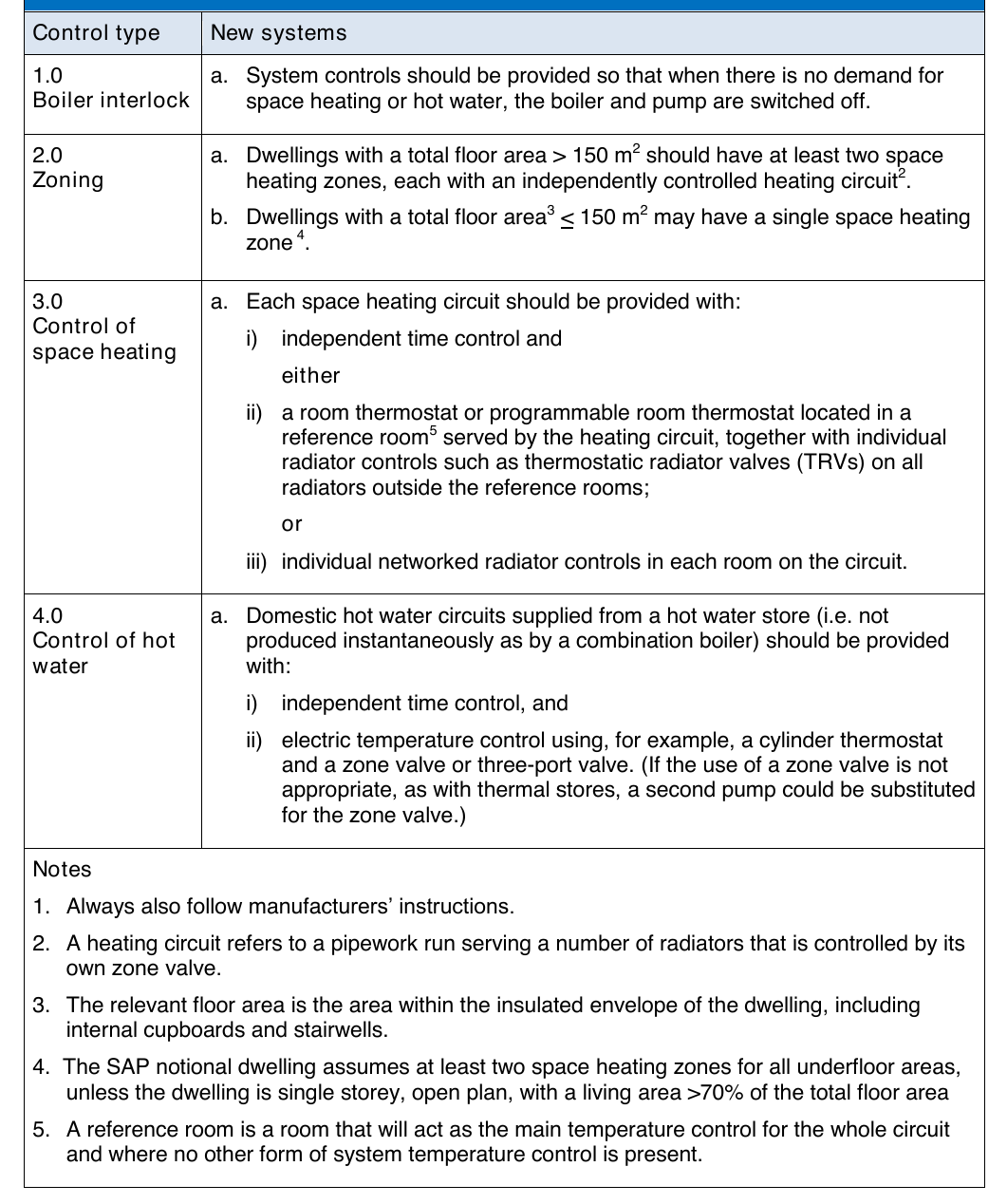
Page 19
#Source page 19
Table 4: Recommended minimum standards when replacing components of gas-fired wet central heating systems 1
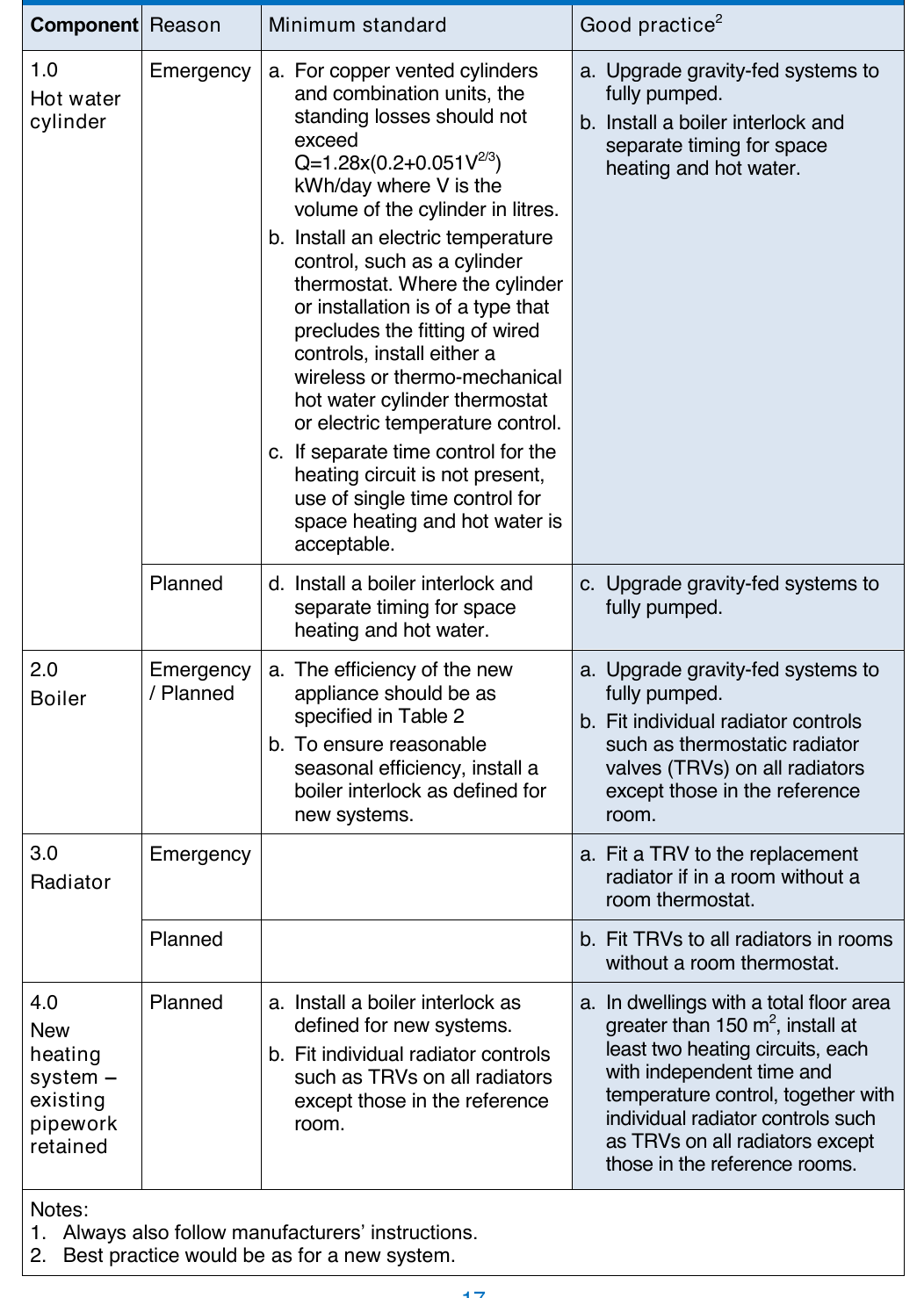
Page 20
#Source page 20
Table 5: Recommended minimum standards for insulation of pipework in gas-fired wet central heating systems
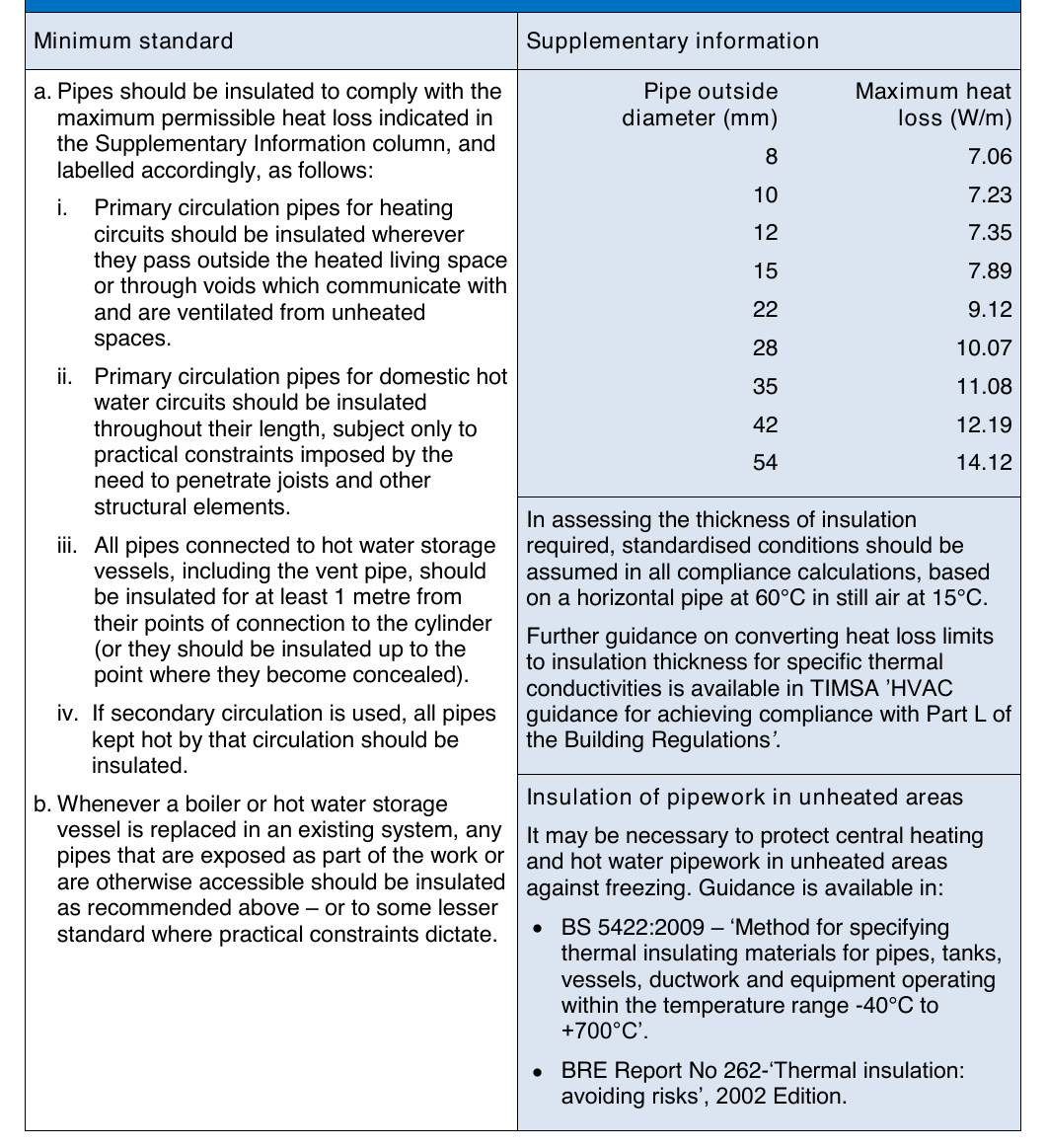
Page 21
#Source page 21
2.3Gas-fired range cookers with integral central heating boiler
Note: This section does not apply to appliances with fully independent boiler and cooker parts within a shared case. For these, the standards for the boiler are as set out in Section 2.2.
Where gas-fired range cookers with an integral central heating boiler (within a single appliance body), are provided as part of a new system or as a replacement component:
a.The appliance should have two independently controlled burners (one for the cooking function and one for the boiler).
b.The SEDBUK 2009 efficiency of the integral boiler should be not less than 75%. The manufacturer’s declaration of appliance performance and SEDBUK value should include the following statement and information:
i. Seasonal efficiency (SEDBUK) = xx % ii. Case heat emission value = yy kW iii. Heat transfer to water at full load = zz kW iv. The values are used in the UK Government’s Standard Assessment Procedure (SAP) for the energy rating of dwellings. The test data from which the values have been calculated has been certified by [insert name and/or identification of Notified body]. See: www.rangeefficiency.org.uk.
If the integral boiler is a condensing boiler, the declaration should make clear whether the efficiency has been calculated in accordance with SEDBUK 2005 or SEDBUK 2009. If it does not, then SEDBUK 2005 must be assumed.
c.The integral boiler should meet the minimum standards for system circulation, hot water storage, system preparation, commissioning, controls and insulation in Tables 2, 3 and 5 (gas-fired central heating systems).
2.4Gas-fired warm air heating
New systems and replacement components for gas-fired warm air heating should meet the minimum standards for:
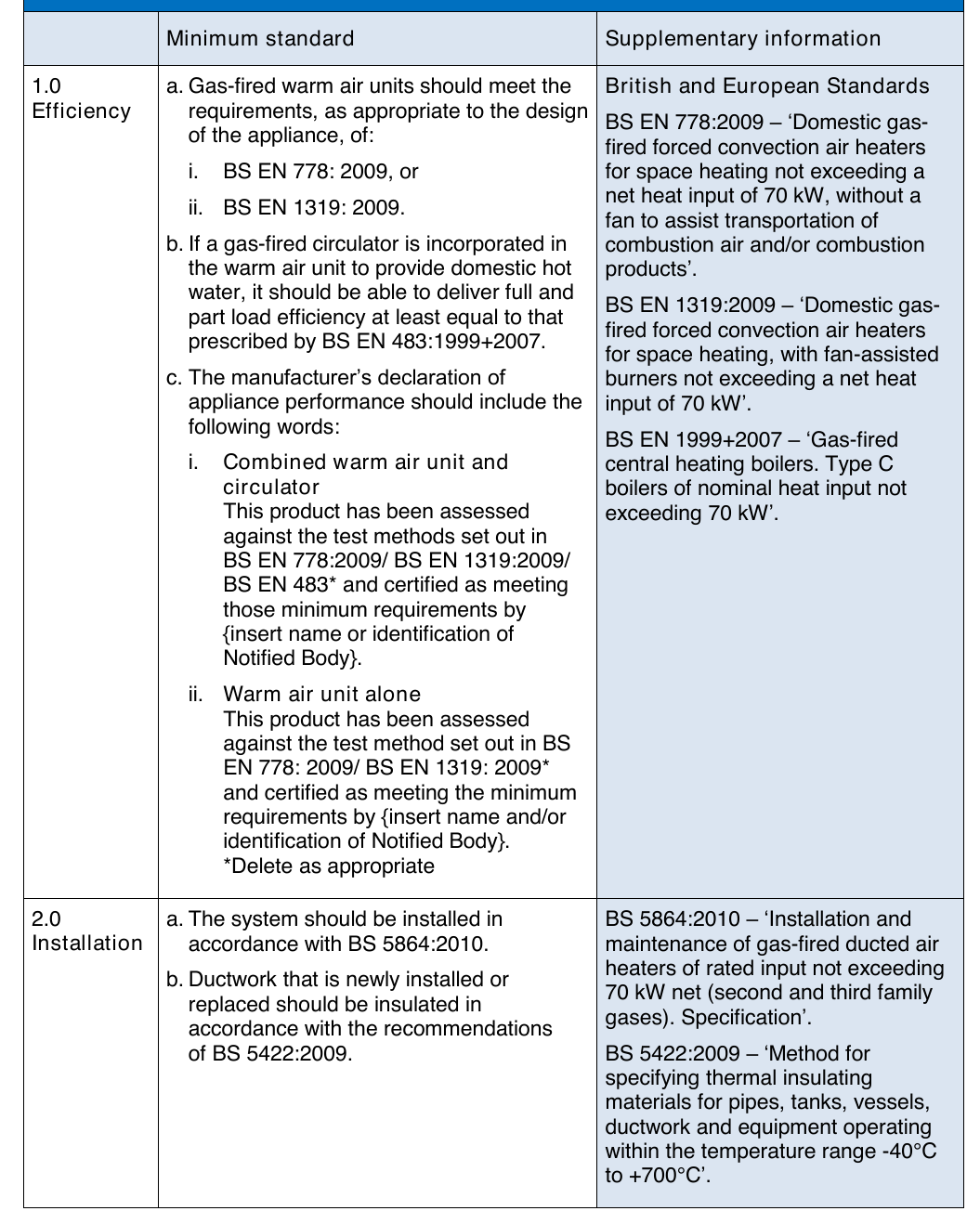
a.efficiency and installation in Table 6
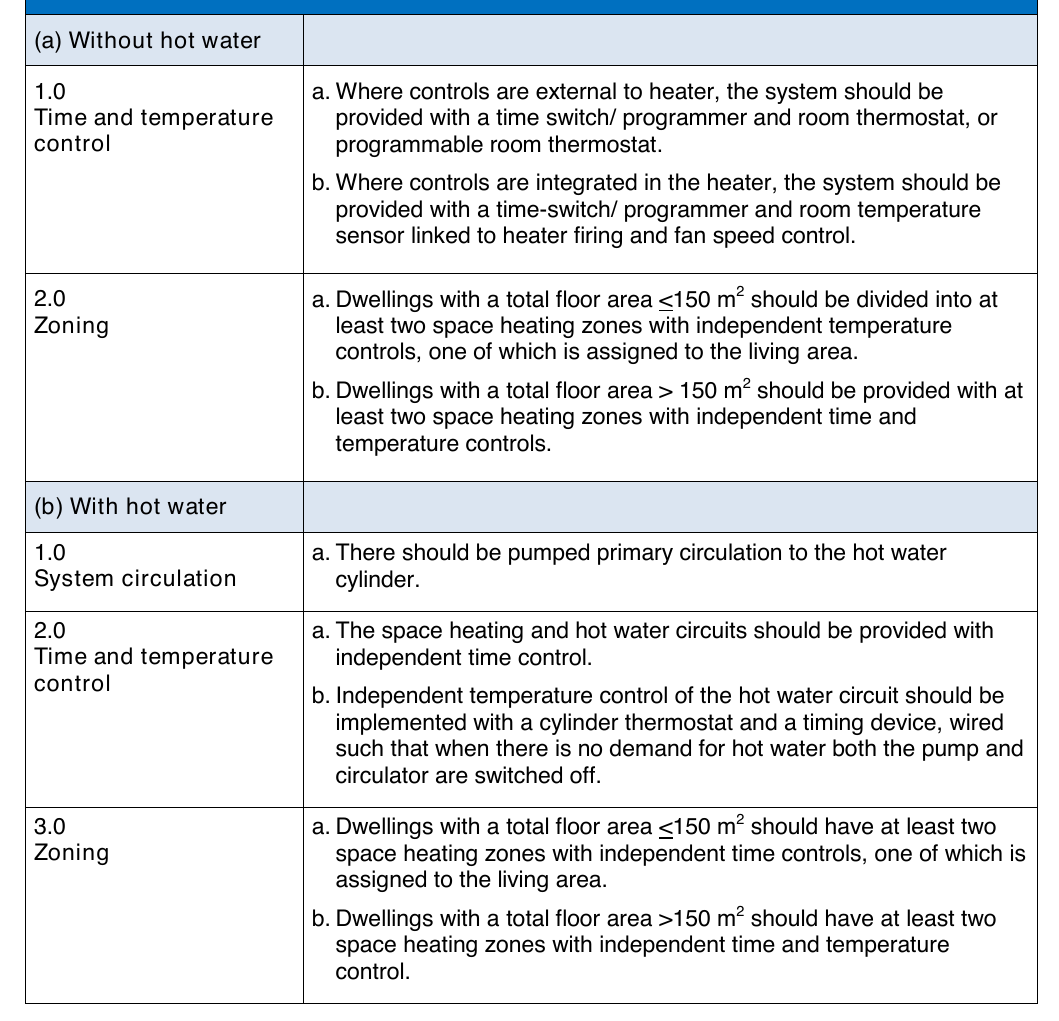
b.zoning, time control and temperature control for (a) space heating without hot water and (b) space heating combined with water heating in Table 7.
Page 22
#Source page 22
Table 6: Recommended minimum standards for efficiency and installation of gas-fired warm air heating systems
Page 23
#Source page 23
Table 7: Recommended minimum standards for control of gas-fired warm air heating systems
2.5Gas-fired fixed independent space heating appliances
Fixed independent space heating appliances may be installed as a means of primary or secondary space heating.
Gas-fired fixed independent appliances for primary space heating
Where gas-fired fixed independent space heating appliances in new and existing dwellings are provided as the primary heat source:
a.The appliance should be one of the types described in Table 8.
b.The efficiency of the appliance (gross calorific value) should be not less than 63% (70% net).
Page 24
#Source page 24
c.The appliance manufacturer’s declaration of appliance performance should include the following stratement and information:
The efficiency of this appliance has been measured as specified in [insert appropriate entry from Table 8] and the result after conversion to gross using the appropriate factor from Table E4 of SAP 2012 is xx %. The test data has been certified by [insert name and/or identification of Notified Body]. The gross efficiency value may be used in the UK Government’s Standard Assessment Procedure (SAP) for energy rating of dwellings.
d.In new dwellings, each appliance should be capable, either independently or in conjunction with room thermostats or other suitable temperature sensing devices, of controlling the temperatures independently in areas that have different heating needs (e.g. separate sleeping and living areas). In existing dwellings, wherever practical, temperature controls should be upgraded to the standards required for new dwellings.
Table 8: Appropriate types of natural gas and LPG-fired fixed independent appliances for primary space heating
British Standard designation (appliance type)
BS EN 1266:2002 – ‘Independent gas-fired convection heaters incorporating a fan to assist transportation of combustion air and/or flue gases’.
BS 7977-1:2009+A1:2013 – ‘Specification for safety and rational use of energy of domestic gas appliances. Radiant/convectors’.
BS EN 613:2001 – ‘Independent gas-fired convection heaters’.
BS EN 13278:2003 – ‘Open fronted gas-fired independent space heaters’.
Gas-fired fixed independent appliances for secondary space heating
Where gas-fired fixed independent space heating appliances are provided as the secondary heat source:
a.In new dwellings, the appliance efficiency (gross calorific value) should be not less than 63% (70% net).
b.In existing dwellings, the appliance efficiency (gross calorific value) should be not less than 45% (50% net).
c.The appliance manufacturer’s declaration of appliance performance should include the following statement and information:
The efficiency of this appliance has been measured as specified in [insert appropriate entry from Table 9] and the result after conversion to gross using the appropriate factor from Table E4 of SAP 2012 is xx%. The test data has been certified by [insert name and/or identification of Notified Body]. The efficiency value may be used in the UK Government’s Standard Assessment Procedure (SAP) for energy rating of dwellings.
Page 25
#Source page 25
| Table 9: Approporiate types of natural gas and LPG-fired fixed independent appliances for secondary space heating | |
| BS EN 1266: 2002 – ‘Independent gas-fired convection heaters incorporating a fan to assist transportation of combustion air and/or flue gases’. | |
| BS 7977-1: 2009+A1:2013 – ‘Specification for safety and rational use of energy of domestic gas appliances. Radiant/convectors’. | |
| BS EN 613: 2001 – ‘Independent gas-fired convection heaters’. | |
| BS EN 13278: 2003 – ‘Open fronted gas-fired independent space heaters’. | |
| Flueless BS EN 14829:2007 – ‘Independent gas-fired flueless space heaters for nominal heat input not exceeding 6 kW’. | Thermal efficiency requirements for this type of appliance are not specified as all the heat produced by the combustion process is released into the space to be heated. In SAP 2012 the efficiency of these appliances is classed as 90% and an adjustment is made for ventilation in the space heating requirement calculation. |
| BS EN 449:2002+A1:2007 – ‘Specification for dedicated liquefied petroleum gas appliances. Domestic flueless space heaters (including diffusive catalytic combustion heaters)’. |
2.6Gas-fired fixed decorative fuel-effect fires
This type of appliance is intended for decorative purposes and therefore a minimum thermal efficiency is not specified. Note that for the purposes of SAP 2012 the efficiency of decorative fuel-effect fires is classed as 20% in the space heating requirement calculation. See Table 4a of SAP 2012.
Gas-fired decorative fires in new and existing dwellings should:
a.meet the product standards in BS EN 509: 2000 – ‘Decorative fuel-effect gas appliances’; and
b.number not more than one appliance per 100 m2 of dwelling floor area.
2.7Gas fires for secondary space heating provided as part of a combined fire and back boiler unit
Where gas fires are provided as a secondary heat source as part of a combined fire and back boiler unit in an existing system:
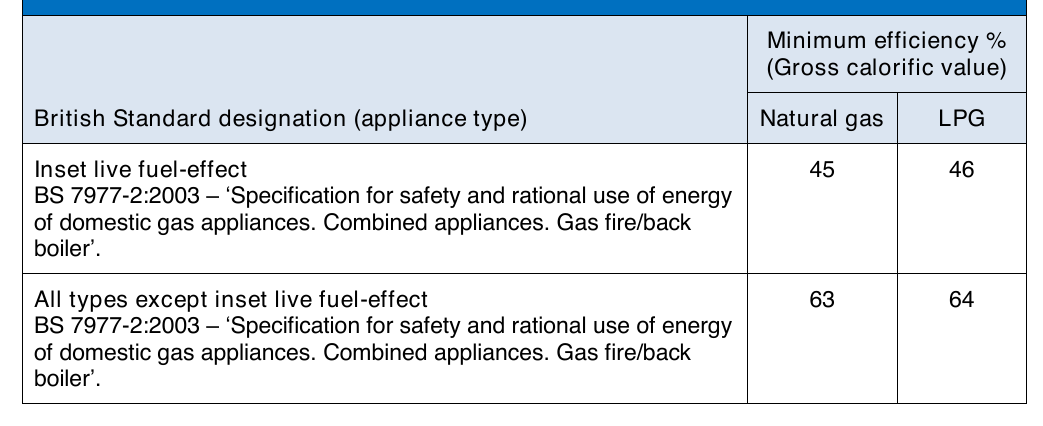
a.The appliance should be one of the types described in Table 10.
b.The efficiency (gross calorific value) of the appliance should be not less than the value in Table 10 for that type of appliance.
c.The appliance manufacturer’s declaration of appliance performance should include the following statement and information
The efficiency of this appliance has been measured as specified in [insert appropriate entry from Table 10] and the result after conversion to gross using the appropriate factor from Table E4 of SAP 2012 is xx%. The test data from which it has been calculated has been certified by [insert name and/or identification of Notified Body]. The efficiency value may be used in the UK Government’s Standard Assessment Procedure (SAP) for energy rating of dwellings.
Page 26
#Source page 26
Table 10: Minimum appliance efficiencies for gas fires in a combined fire and back boiler unit
Page 27
#Source page 27
Supplementary information
Energy Efficiency Best Practice in Housing:
CE30 Domestic heating by gas: boiler systems
CE51 Central heating system specifications (CHeSS)
CE54 Whole house boiler sizing method for houses and flats.
SBGI publications on gas boilers and gas fires: See www.sbgi.org.uk.
CORGI Domestic Manual Series:
GID1 Essential gas safety
GID2 Gas cookers and ranges
GID3 Gas fires and space heaters
GID5 Water heaters
GID7 Central heating wet and dry.
CORGI Design Guides:
WCH1 Wet central heating system design guide
WAH1 Warm air heating system design guide.
British and European Standards:
BS 5440-1:2008 – ‘Flueing and ventilation for gas appliances of rated input not exceeding 70 kW net (1st, 2nd and 3rd family gases). Specification for installation of gas appliances to chimneys and for maintenance of chimneys’.
BS 5440-2:2009 – ‘Flueing and ventilation for gas appliances of rated input not exceeding 70 kW net (1st, 2nd and 3rd family gases). Specification for the installation and maintenance of ventilation provision for gas appliances’.
BS EN 12828:2012 – ‘Heating systems in buildings. Design for water-based heating systems’.
BS EN 12831:2003 – ‘Heating systems in buildings. Method for calculation of the design heat load’.
BS EN 14336:2004 – ‘Heating systems in buildings. Installation and commissioning of water- based heating systems’.
BS 6798:2009 – ‘Specification for installation and maintenance of gas-fired boilers of rated input not exceeding 70 kW net’.
BS 5871-1:2007 – ‘Specification for the installation and maintenance of gas fires, convector heaters, fire/back boilers and decorative fuel effect gas appliances. Gas fires, convector heaters, fire/back boilers and heating stoves (2nd and 3rd family gases)’.
BS 5871-4:2007 – ‘Specification for the installation and maintenance of gas fires, convector heaters, fire/back boilers and decorative fuel effect gas appliances. Independent gas-fired flue less fires, convector heaters and heating stoves of nominal heat input not exceeding 6 kW (2nd and 3rd family gases)’.
BS 5871-2:2005 – ‘Specification for the installation and maintenance of gas fires, convector heaters, fire/back boilers and decorative fuel effect gas appliances. Inset live fuel effect gas fires of heat input not exceeding 15 kW, and fire/back boilers (2nd and 3rd family gases)’.
BS 5871-3:2005 – ‘Specification for the installation and maintenance of gas fires, convector heaters, fire/back boilers and decorative fuel effect gas appliances. Decorative fuel effect gas appliances of heat input not exceeding 20 kW (2nd and 3rd family gases)’.
Section 3: Oil-fired space and water heating
#Source page 28
3.1Scope of guidance
This section provides guidance on the specification of oil-fired space heating and hot water systems15 in dwellings to meet relevant energy efficiency requirements in the building regulations. The guidance applies to the following types of oil-fired heating system:
• wet central heating systems
• range cookers with integral central heating boilers
• vaporising appliances providing secondary heating or hot water
• fixed independent space heating devices.
3.2Oil-fired wet central heating systems
New systems
New systems for oil-fired central heating in new and existing dwellings should meet the minimum standards for:
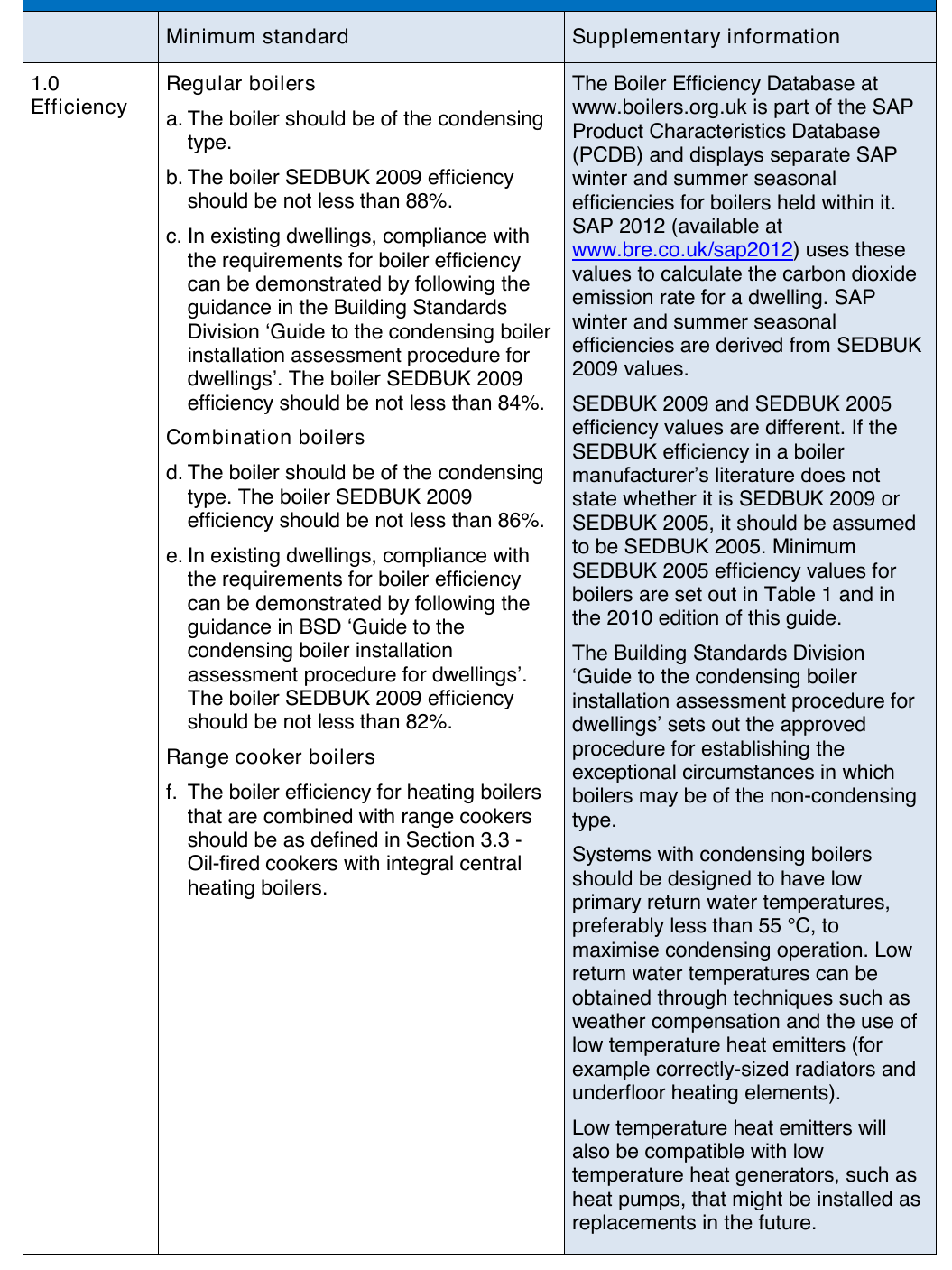
a.boiler efficiency, system circulation, hot water storage, system preparation and commissioning in Table 11
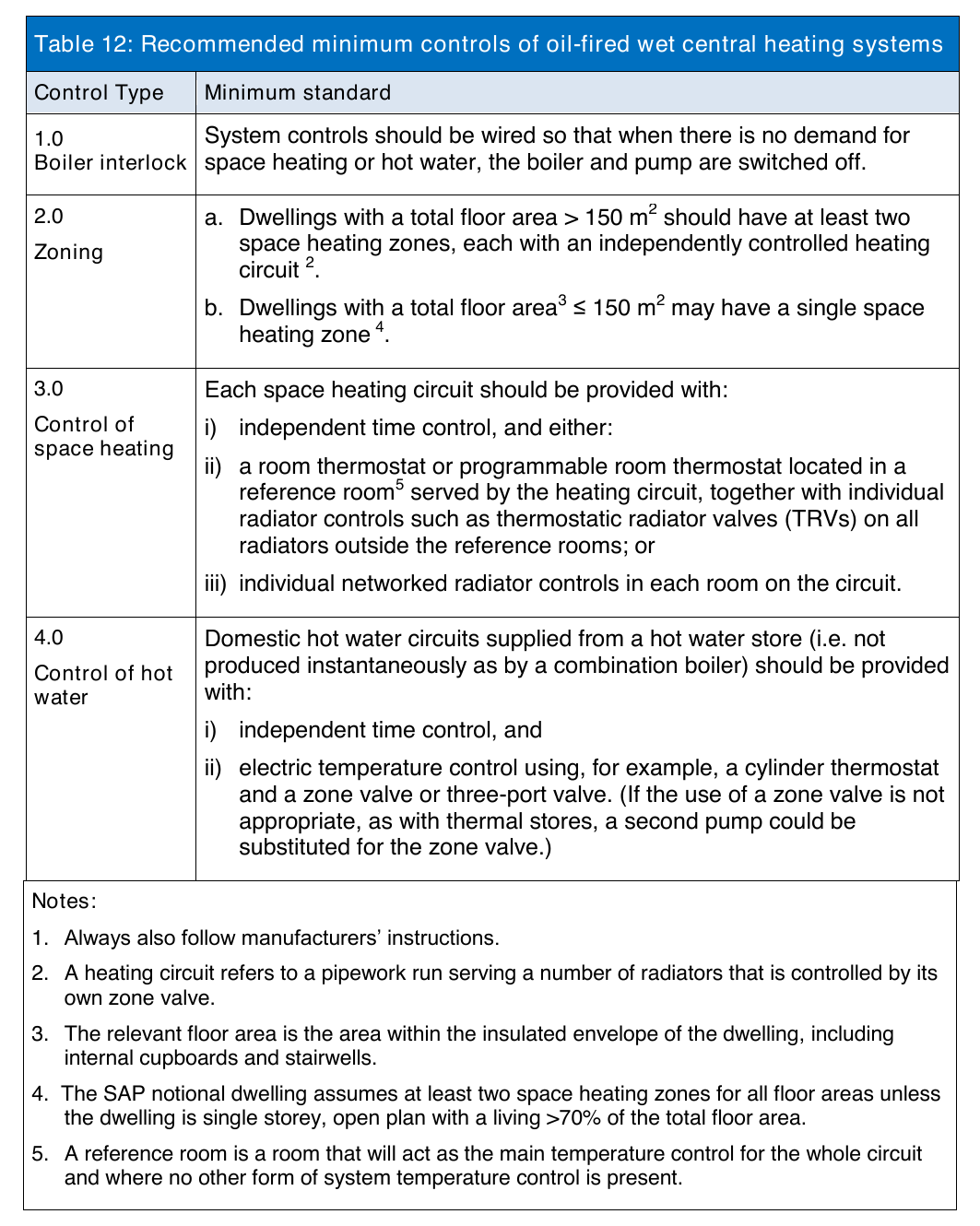
b.boiler interlock, zoning, and time and temperature control of the heating and hot water circuits in Table 12
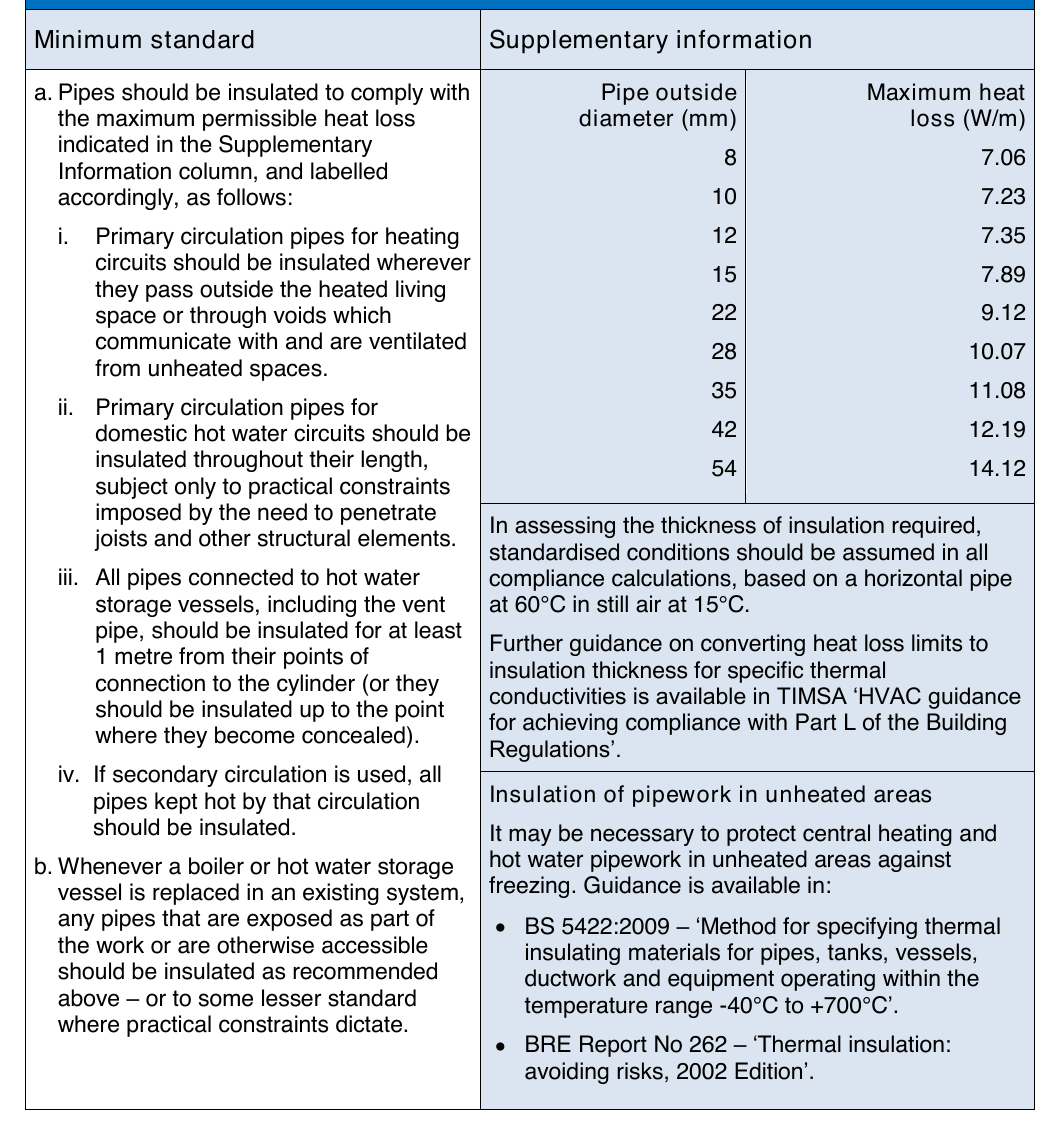
c.pipework insulation in Table 14.
Work on existing systems
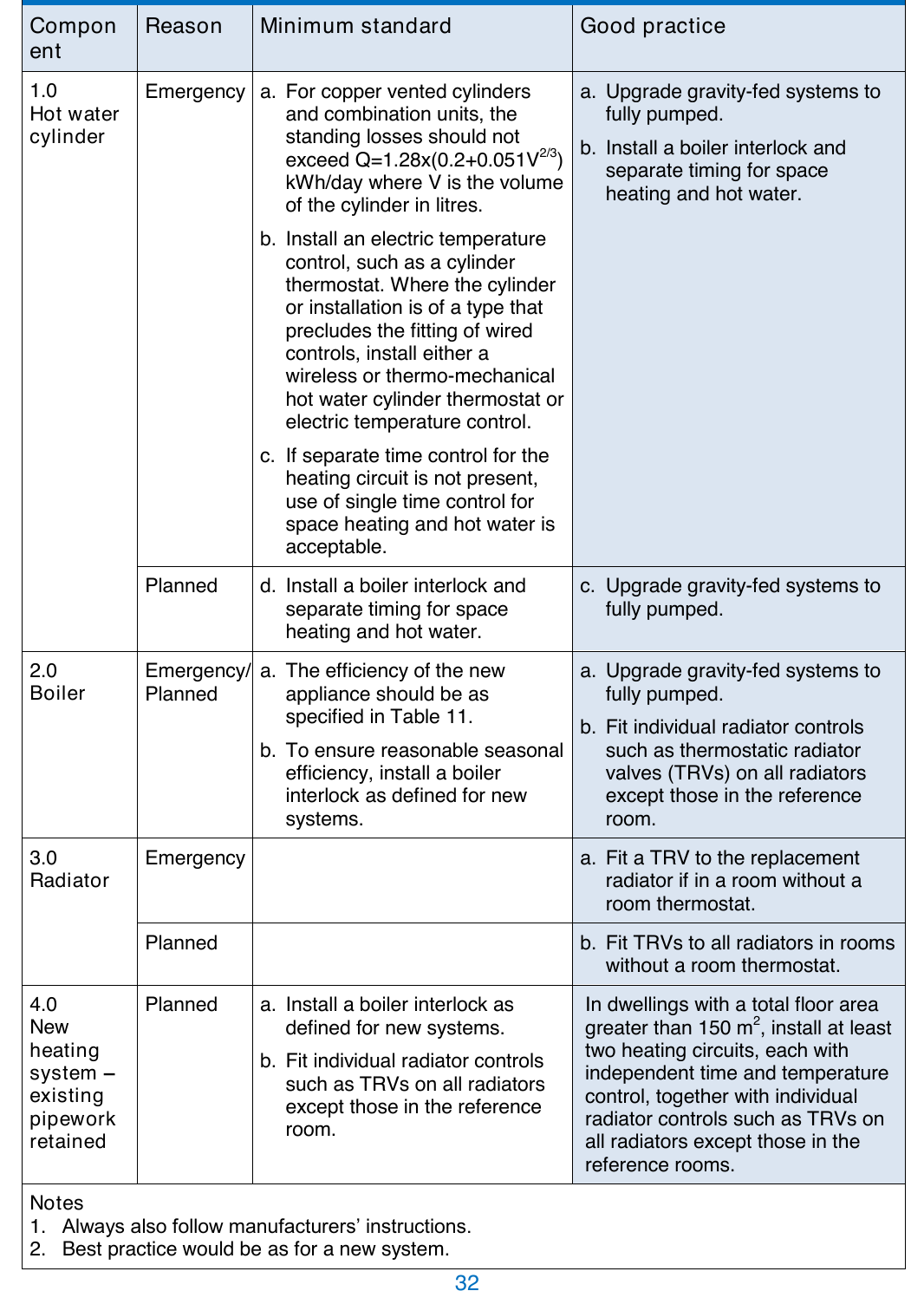
Components installed as replacements in existing systems should meet the same standards as for new systems, except where indicated otherwise in Table 13.
Table 13 in addition identifies good practice upgrades to the rest of the system when making planned and emergency replacements that go beyond the requirements of the building regulations.
Page 29
#Source page 29
Table 11: Recommended minimum standards for efficiency, system circulation, hot water storage, system preparation and commissioning for oil-fired wet central heating systems
Page 30
#Source page 30
Table 11: Recommended minimum standards for efficiency, system circulation, hot water storage, system preparation and commissioning for oil-fired wet central heating systems
| Minimum standard | Supplementary information | |
|---|---|---|
| 2.0 System circulation | a. Space heating systems and domestic hot water primary circuits should have fully pumped circulation. b. If the boiler manufacturer’s instructions advise installation of a bypass, an automatic bypass valve should be provided and the manufacturer’s instructions on minimum pipe length followed. | |
| 3.0 Hot water storage | a. Vented copper hot water storage cylinders should comply with the heat loss and heat exchanger requirements of BS 1566:2002 Part 1. b. Copper hot water storage combination units should comply with BS 3198:1981. c. Primary storage systems should meet the insulation requirements of the Hot Water Association ‘Performance specification for thermal stores’. d. Unvented hot water storage system products should comply with BS EN 12897: 2006 or an equivalent standard as set by an accredited test body such as the British Board of Agrément, the Water Research Council, or KIWA. e. The standing heat loss for all hot water storage vessels in a, b, c and d above should not exceed Q=1.15x(0.2+0.051V2/3) kWh/day, where V is the volume of the cylinder in litres. f. All hot water vessels should carry a label with the following information: i. type of vessel (vented, unvented, combination unit or thermal store) ii. nominal capacity in litres iii. standing heat loss in kWh/day iv. heat exchanger performance in kW v. reference to product compliance with relevant standard (e.g. BS 1566, BS 12897) and logos of accreditation bodies as required. For labelling requirements for other heat inputs, see relevant sections (e.g. Section 11 for solar). | If a vented cylinder is not made from copper then the heat loss and heat exchange characteristics should be tested in accordance with BS EN 12897:2006. The HWA thermal storage specification is available from www.hotwater.org.uk. British and European Standards BS 1566: 2002 – ‘Copper indirect cylinders for domestic purposes. Open vented copper cylinders. Requirements and test methods’. BS EN 12897 – ‘Water supply. Specification for indirectly heated unvented (closed) storage water heaters’. BS 3198:1981 – ‘Copper hot water storage combination units for domestic purposes’. |
Page 31
#Source page 31
Table 11: Recommended minimum standards for efficiency, system circulation, hot water storage, system preparation and commissioning for oil-fired wet central heating systems
| Minimum standard | Supplementary information | |
|---|---|---|
| 4.0 System preparation and water treatment | a. Central heating systems should be thoroughly cleaned and flushed out before installing a new boiler. b. During final filling of the system, a chemical water treatment inhibitor meeting the manufacturer’s specification or other appropriate standard should be added to the primary circuit to control corrosion and the formation of scale and sludge. c. Installers should also refer to the boiler manufacturer’s installation instructions for appropriate treatment products and special requirements for individual boiler models. d. Where the mains total water hardness exceeds 200 parts per million, provision should be made to treat the feed water to water heaters and the hot water circuit of combination boilers to reduce the rate of accumulation of limescale. e. For solar thermal systems, see Section 11. | Inhibitors should be BuildCert approved or equivalent. Limescale can be controlled by the use of chemical limescale inhibitors, combined corrosion and limescale inhibitors, polyphosphate dosing, electrolytic scale reducers or water softeners. The relevant standard for water treatment is BS 7593:2006 – ‘Code of practice for treatment of water in domestic hot water central heating systems’. BS 7593 notes that “naturally soft waters of low alkalinity or those supplied via a base-exchange resin softener have an increased potential for corrosion, and, if they are used in any central heating system, a corrosion inhibitor specifically formulated for the purpose should be added and properly maintained.” Manufacturers should be consulted for advice, paying particular attention to dosage levels. Special radiator valves are available that will seal off the radiator as well as the heating circuit to prevent loss of inhibitor when removing a radiator for service or maintenance. A filter can also be fitted to the central heating circuit to help maintain the efficiency and reliability of the system. |
Page 32
#Source page 32
Table 11: Recommended minimum standards for efficiency, system circulation, hot water storage, system preparation and commissioning for oil-fired wet central heating systems
| Minimum standard | Supplementary information | |
|---|---|---|
| 5.0 Commis- sioning | a. On completion of the installation of a boiler or a hot water storage system, together with associated equipment such as pipework, pumps and controls, the equipment should be commissioned in accordance with the manufacturer’s instructions. These instructions will be specific to the particular boiler or hot water storage system. b. The installer should explain fully to the user how to operate the system in an energy efficient manner, and behind any user manuals provided by manufacturers. | The Oil Controlled Document System (as produced and managed by OFTEC) can be used to show that oil- fired appliances and related systems have been installed and commissioned satisfactorily by listing and recording works and checks which are deemed necessary for the efficient operation of the appliance and system in compliance with the building regulations. A copy of each completed form is left with the householder or agent for record and/or Building Standards inspection purposes, and a copy is retained by the issuing installer and engineer. OFTEC branded forms are provided for the use of OFTEC Registered installers and non-OFTEC branded forms are available for others carrying out oil-fired installation and commissioning works. To assist installers OFTEC oil appliance manufacturing members may provide forms CD/10 & CD/11 or equivalent ‘Boiler Passport’ with their equipment. Controlled Document CD/10 Installing engineers should complete OFTEC Form CD/10 to show that they have compliantly completed the installation of an oil-fired appliance and controls, and wet system commissioning prior to final appliance commissioning. Controlled Document CD/11 Commissioning engineers of oil-fired appliances should complete OFTEC Form CD/11 to record and show that they have completed the commissioning of the appliance and that they have left it operating in a safe and efficient manner. |
Page 33
#Source page 33
Table 12: Recommended minimum controls of oil-fired wet central heating systems
Page 34
#Source page 34
Table 13: Recommended minimum standards when replacing components of oil-fired wet central heating systems
Page 35
#Source page 35
Table 14: Recommended minimum standards for insulation of pipework in oil-fired wet central heating systems
3.3Oil-fired range cookers with integral central heating boilers
This section provides guidance on the specification of oil-fired range cookers with integral central heating boilers for space heating and hot water in dwellings.
Note: The guidance applies only to twin-burner cooker boilers, which should not be confused with the type of range cooker described as a single burner ‘dry heat’ range cooker. The latter is intended only to provide a cooking function, is not included in SAP 2012 calculations, and does not come within the scope of the building regulations energy efficiency requirements.
Page 36
#Source page 36
Where oil-fired range cookers with an integral central heating boiler are provided as part of new systems or as replacement components in existing systems:
a.The appliance should have two independently controlled burners (one for the cooking function and one for the boiler).
b.The SEDBUK 2009 efficiency of the integral boiler should be not less than 80%.
c.The manufacturer’s declaration of appliance performance and SEDBUK value should include the following statement and information
i. Seasonal efficiency (SEDBUK) = xx% ii. Case heat emission value = yy kW iii. Heat transfer to water at full load = zz kW iv. The efficiency values may be used in the UK Government’s Standard Assessment Procedure (SAP) for the energy rating of dwellings. The test data from which they have been calculated has been certified by [insert name and/or identification of Notified body]. See www.rangeefficiency.org.uk.
If the integral boiler is a condensing boiler, the declaration should make clear whether the efficiency has been calculated in accordance with SEDBUK 2005 or SEDBUK 2009. If it does not, then SEDBUK 2005 must be assumed.
d.The integral boiler should meet the minimum standards for oil-fired central heating systems in Tables 11, 12 and 14 for system circulation, hot water storage, system preparation, commissioning, controls and insulation.
3.4Continuously-burning oil-fired vaporising appliances providing secondary heating or hot water
This section provides guidance on the specification of oil-fired vaporising appliances providing secondary heating or hot water for dwellings. The guidance does not apply to appliances which have been converted from another fuel (for example from solid fuel to oil).
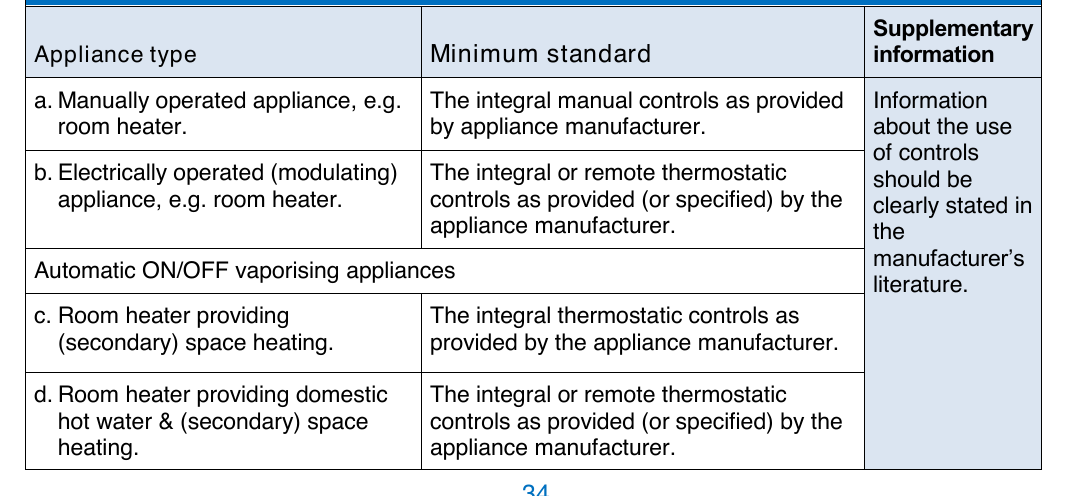
Oil-fired vaporising appliances provided with new systems or as replacement components in existing systems should meet the minimum standards for controls in Table 15.
Table 15: Recommended minimum standards for control of continuously burning oil-fired vaporising appliances
Page 37
#Source page 37
3.5Oil-fired fixed independent space heating appliances
This section provides guidance on the specification of oil-fired fixed independent appliances for primary or secondary space heating in dwellings.
Oil-fired fixed independent appliances for primary heating
Where oil-fired fixed independent space heating appliances are provided as the primary heat source in new dwellings:
a.The efficiency of the appliance (gross calorific value) should be not less than 60%. The appliance manufacturer’s declaration of appliance performance should include the following words:
The net efficiency of this appliance has been measured as specified in OFS A102:2004 and the result after conversion to gross using the appropriate factor from Table E4 of SAP 2012 is xx%. The test data has been certified by [insert name and/or identification of Notified Body]. The efficiency value may be used in the UK Government’s Standard Assessment Procedure (SAP) for energy rating of dwellings.
b.Each appliance should be capable, either independently or in conjunction with room thermostats or other suitable temperature sensing devices, of controlling the temperatures independently in areas that have different heating needs (e.g. separate sleeping and living areas).
Oil-fired fixed independent appliances for secondary heating
Oil-fired fixed independent space heating appliances in new dwellings which are provided as the secondary heat source should have an efficiency (gross calorific value) of not less than 60%.
3.6Supplementary Information
Energy Efficiency Best Practice in Housing publications:
CE29 – ‘Domestic heating by oil: boiler systems’.
CE51 – ‘Central heating system specifications (CHeSS)’.
CE54 – ‘Whole house boiler sizing method for houses and flats’.
OFTEC Technical Books 2, 3, 4 and 5 (see www.oftec.org)
BS EN 12828:2012 – ‘Heating systems in buildings. Design for water-based heating systems’.
BS 5410-1:1997 – ‘Code of practice for oil firing installations up to 45kW output capacity for space heating and hot water supply purposes’.
Section 4: Electric heating
#Source page 38
4.1Scope of guidance
This section provides guidance on the specification of fixed electric heating systems for dwellings to meet relevant energy efficiency requirements in the building regulations. The guidance given in this section covers the following types of fixed electric heating systems:
• electric boilers serving central heating systems
• electric warm air systems
• electric panel heaters
• electric storage systems including integrated storage/direct systems.
Portable, plug-in appliances are not covered by the building regulations or by this guide.
4.2Electric boilers serving central heating systems
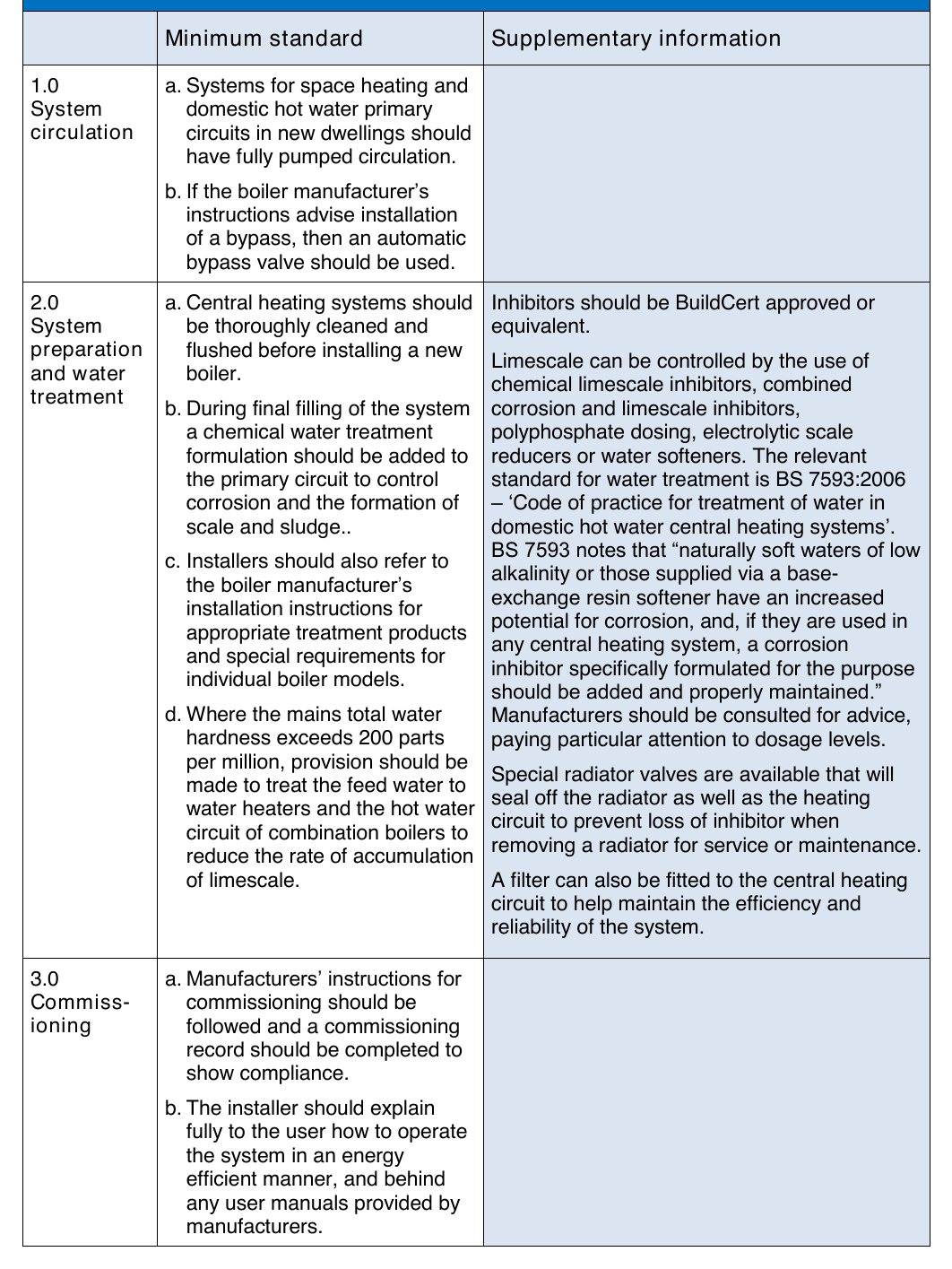
Electric boilers serving wet central heating provided with new systems or as replacement components in existing systems should meet the minimum standards for:
a.system circulation, system preparation and commissioning in Table 16
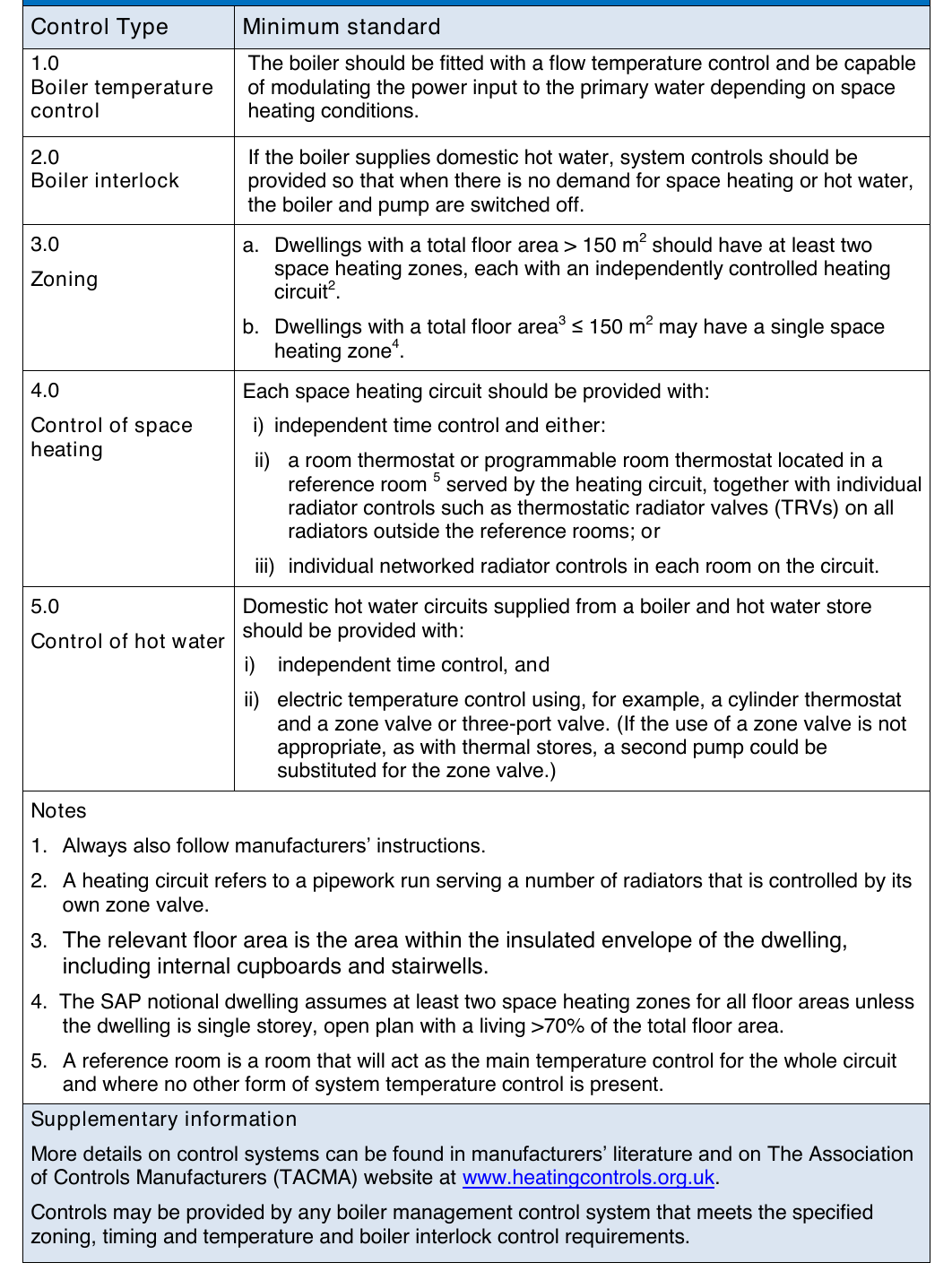
b.boiler interlock, zoning, and time control and temperature control of heating and hot water circuits in Table 17
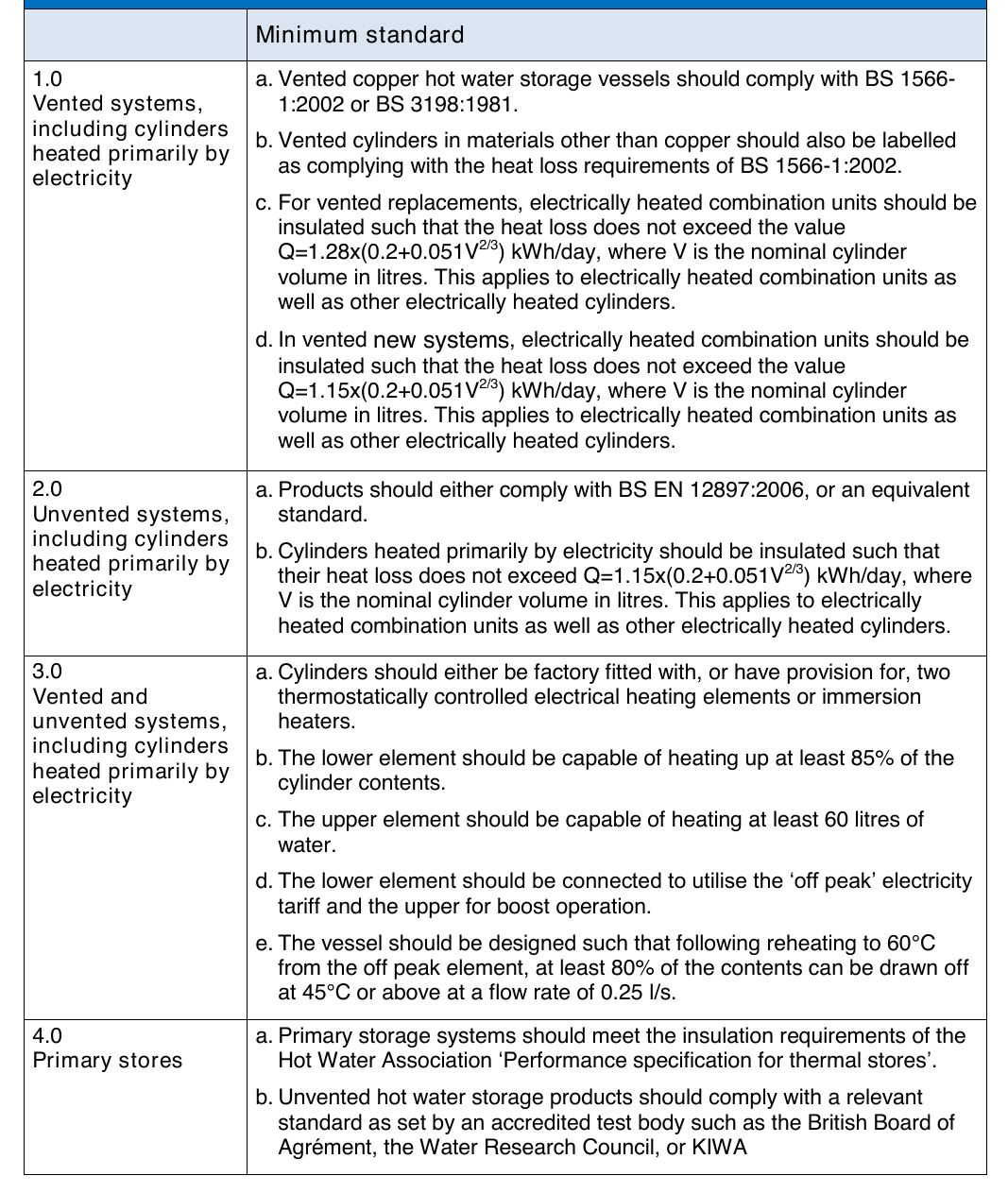
c.hot water storage systems in Table 18
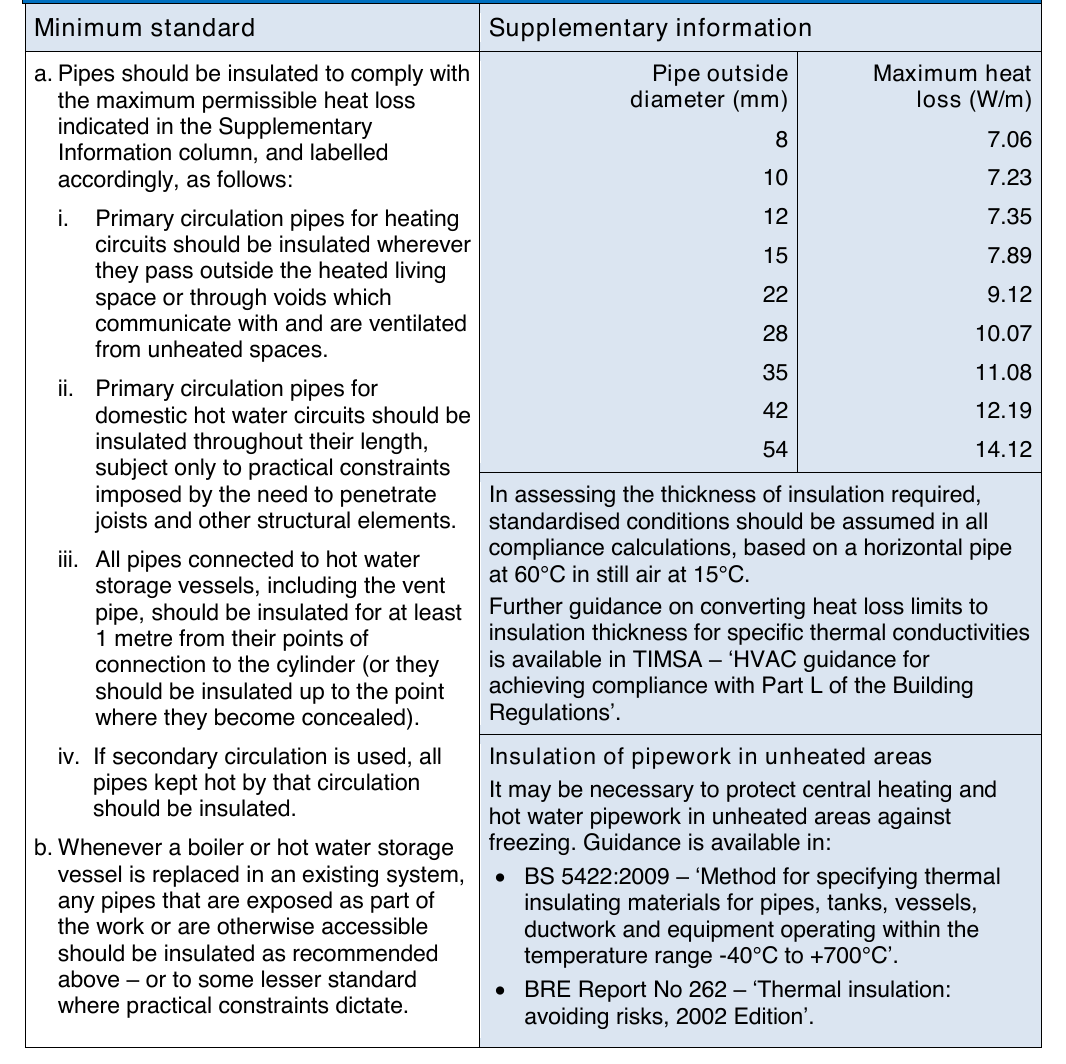
d.pipework insulation in Table 19.
Page 39
#Source page 39
Table 16: Recommended minimum standards for system circulation, preparation and commissioning for electric wet central heating systems
Page 40
#Source page 40
Table 17: Recommended minimum standards for control of electric wet central heating systems
Page 41
#Source page 41
Table 18: Recommended minimum standards for hot water storage in electric wet central heating systems
Page 42
#Source page 42
Table 18: Recommended minimum standards for hot water storage in electric wet central heating systems
| Minimum standard | |
|---|---|
| 5.0 Labelling | a. All hot water storage vessels should carry a label with the following information: i. type of vessel ii. nominal capacity in litres iii. standing heat loss in kWh/day iv. heat exchanger performance in kW. b. Vented copper hot water cylinders should carry clear labelling on the product such as a BSI Kitemark, registered firm status or reference to an equivalent quality control scheme. c. Vented cylinders which are not of copper construction should be labelled as complying with the heat loss and heat exchanger requirements of BS 1566. d. For labelling of hot water storage vessels in solar thermal systems, see Section 11 - Solar water heating. |
| Supplementary information BS 1566-1: 2002 – ‘Copper indirect cylinders for domestic purposes. Open vented copper cylinders. Requirements and test methods’. BS 3198:1981 – ‘Specification for copper hot water storage combination units for domestic purposes’. BS EN 12897:2006 – ‘Water supply. Specification for indirectly heated unvented (closed) storage water heaters’. |
Page 43
#Source page 43
Table 19: Recommended minimum standards for insulation of pipework in central heating systems with electric boilers
4.3Electric heating systems (other than electric boilers for central heating)
This section provides guidance on the following types of fixed electric heating systems:
• electric warm air systems
• electric panel heaters
• electric storage systems including integrated storage/direct systems.
Portable, plug-in appliances are not covered by this guide.
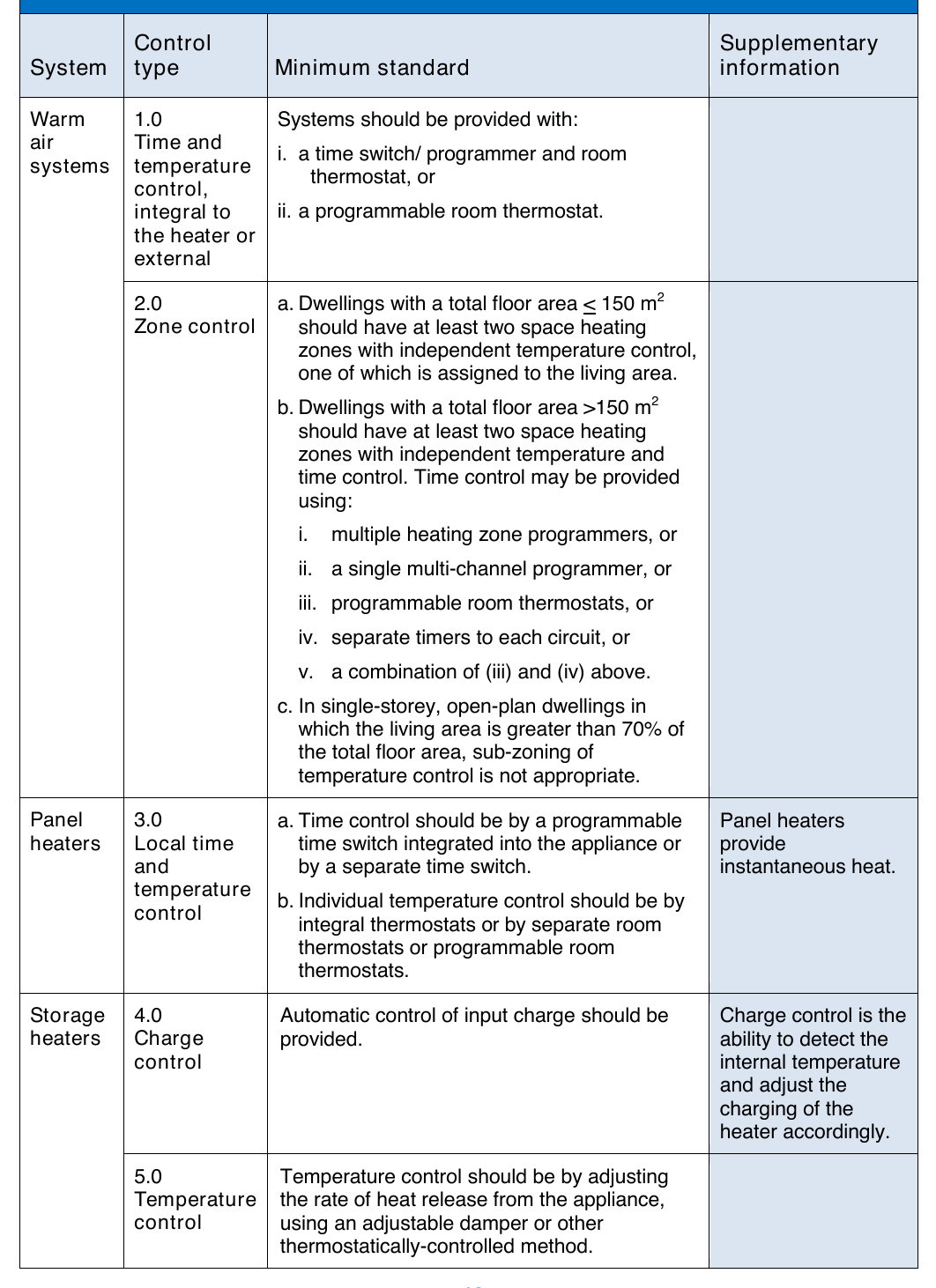
Fixed electric heating systems (other than with electric boilers) should meet the minimum standards for time and temperature control in Table 20.
Page 44
#Source page 44
Table 20: Recommended minimum standards for control of primary and secondary electric heating systems (other than with electric boilers)
Section 5: Solid fuel heating
#Source page 45
5.1Scope of guidance
This section provides guidance on meeting the energy efficiency standards in the building regulations for the following types of solid fuel heating appliances and systems used to deliver primary and secondary heating:
• batch-fed open fires
• batch-fed and automatic-feed dry room heaters/stoves
• batch-fed log and multi-fuel appliances
• automatic-feed pellet stoves with and without boilers
• batch-fed and automatic-feed room heaters with boilers
• batch-fed cookers with boilers not exceeding 7.5kW
• batch-fed independent boilers and automatic-feed anthracite, wood pellet, wood chip and wood log fired independent boilers
• central heating systems using certain types of solid fuel appliances.
The guidance covers the following types of solid fuel: coal, anthracite, manufactured smokeless fuel, dual-fuel, wood logs, wood pellets and wood chips.
5.2Solid fuel appliances for primary heating
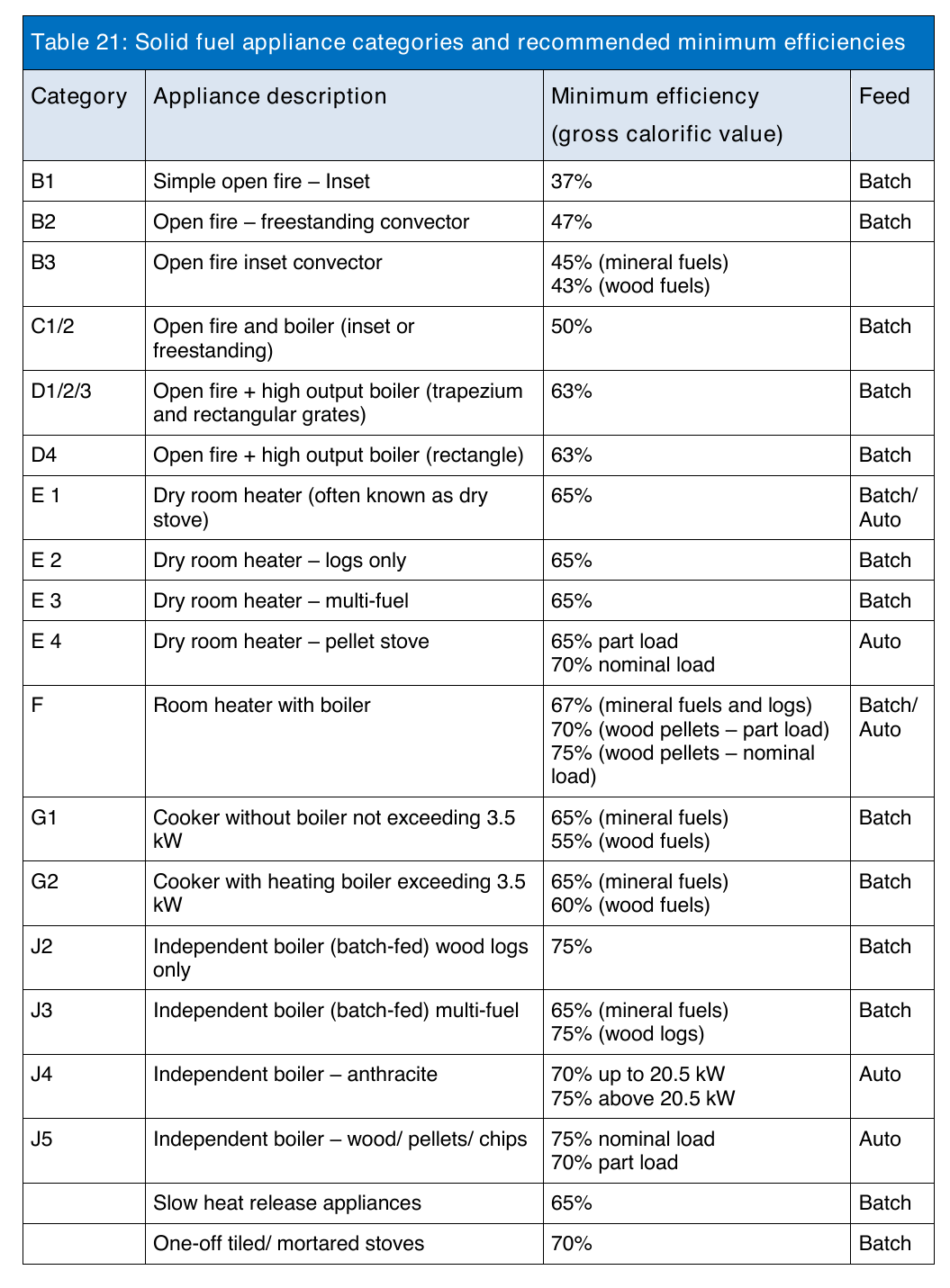
Solid fuel appliances provided as part of new systems or as a replacement appliance in existing systems for primary heating in dwellings should have an efficiency (gross calorific value) not less than specified in Table 21 for that category of appliance.
Page 46
#Source page 46
Table 21: Solid fuel appliance categories and recommended minimum efficiencies
Page 47
#Source page 47
| Supplementary information Minimum efficiencies Minimum efficiencies for solid fuel appliances are published in the ‘HETAS Official guide to approved solid fuel products and services’, and on the website www.hetas.co.uk. Manufacturers’ efficiency figures may be higher than those indicated and should be used where independently certified against the harmonised European Standards now in place. Carbon emission factors Solid fuels include wood in various forms, different types of coal, and manufactured solid fuels, and consequently there is a range of associated CO2 emission factors. These factors are as important as appliance efficiency when selecting a boiler. CO2 emission factors (kg CO2/kWh) for generic types of solid fuel recognised in SAP are: | |
| House coal: traditional British coal, burns with smoky flame Anthracite: mineral fuel with high carbon content, burns very cleanly Manufactured smokeless fuel: mineral fuel usually made from anthracite Wood logs: renewable wood logs either purchased or from own land Wood pellets in bags: mechanically compressed sawdust Bulk wood pellets: as above, delivered in bulk Wood chips: chipped wood, processed on site Dual-fuel: UK ‘typical blend’ of logs and mineral fuel as burnt on a dual-fuel stove | 0.394 0.394 0.433 0.019 0.039 0.039 0.016 0.226 |
| Smoke control Within local authority smoke control areas, only anthracite or other authorised smokeless fuels may be used, unless the property is fitted with an exempted appliance. An exempted appliance is one that has been approved by Parliamentary Statutory Instrument for installation in smoke control areas and prospective purchasers should check that the appliance and intended fuel are permitted. A list of currently authorised fuels and exempted appliances is given on the web site www.uksmokecontrolareas.co.uk. Outside a smoke control area, house coal or wood can be burnt on non-exempted appliances. Wood should always be seasoned to a moisture content appropriate to the design and performance of the appliance, for example log wood not exceeding 20% to ensure maximum performance and limit the occurrence of condensation and deposits in the chimney system. All solid fuel appliances require appropriate soot-fire resistant chimneys discharging at high level locations as defined within the building regulations. Details of HETAS-approved chimney products independently tested and approved to accepted standards can be found on the HETAS website. The natural ventilation rates of these chimneys may be less than the default values listed within SAP 2012; the use of these more accurate values will reduce SAP calculated CO2 emissions. |
Page 48
#Source page 48
5.3Central heating systems using certain types of solid fuel appliances
This section provides guidance on the following types of solid fuel appliance used to deliver primary heating as part of a central heating system:
• batch-fed open fires with high output boilers (appliance types D1 to D4 in Table 21)
• batch-fed and automatic-feed room heaters and stoves with boilers (appliance type F in Table 21)
• batch-fed cookers with boilers (appliance type G2 in Table 21)
• batch-fed independent boilers and automatic-feed anthracite, wood log, wood pellet and wood chip-fired independent boilers (appliance types J1 to J5 in Table 21).
Unless stated otherwise, the guidance applies equally to appliances that burn wood, wood pellets, house coal, manufactured smokeless fuels and anthracite.
For central heating systems with a solid fuel appliance installed as part of a new system or as a replacement component in an existing system:
a.the appliance should be from HETAS categories D, F, G and J in Table 21 and have a minimum efficiency (gross calorific value) which is not less than the value specified for its category
b.the ratio of room heat to water heat should be appropriate for the room and total property. This will require reference to installation practice guidelines and calculation of room and property heat loss. Advice on this is given in the HETAS Guide and website
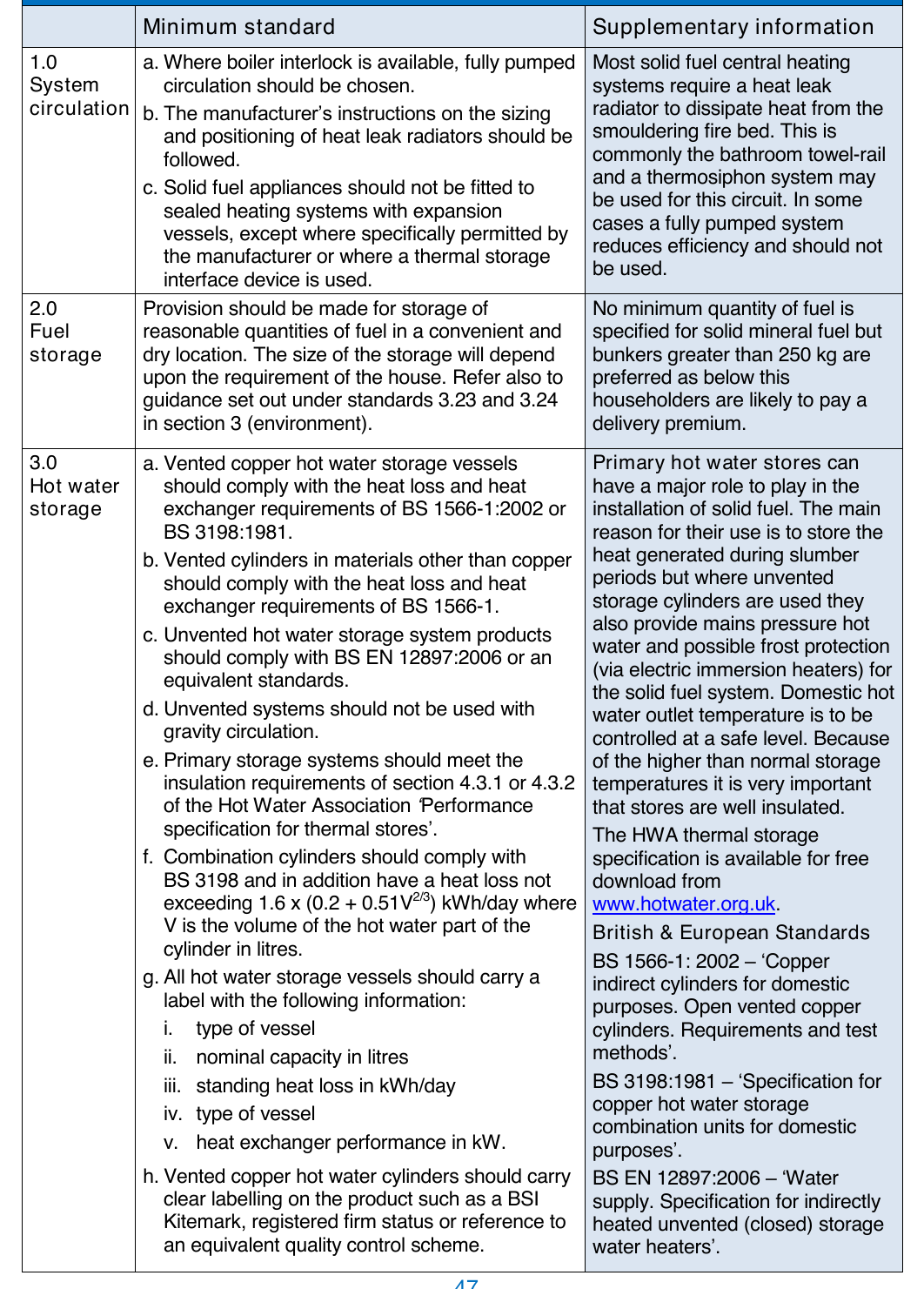
c.circulation, fuel storage, hot water storage, system preparation, water treatment and commissioning should be to the standards in Table 22
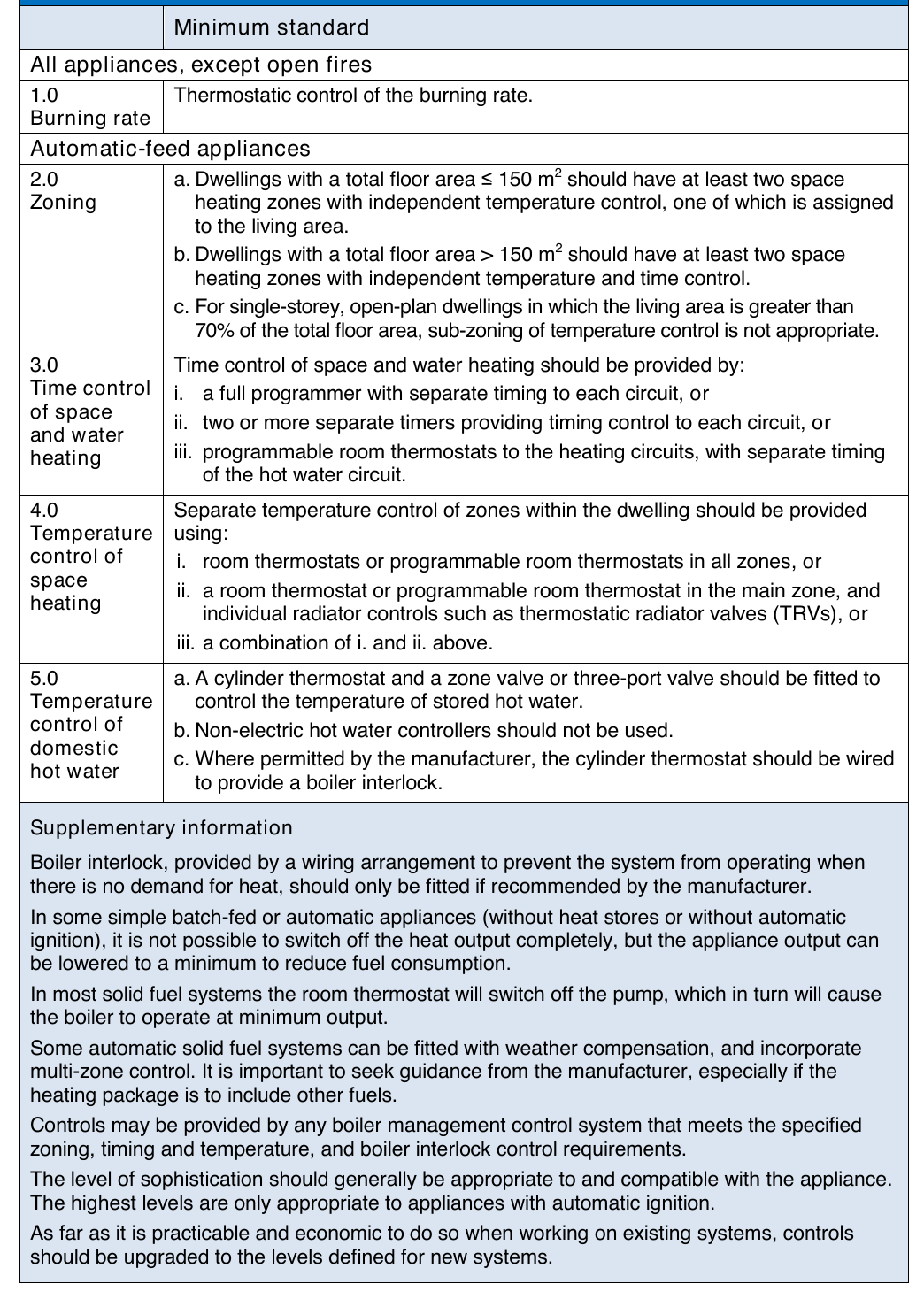
d.control of heating and hot water circuits should be to the standards in Table 23
e.pipework should be insulated to the standards in Table 24.
Supplementary information
Turn-down values (i.e. the ratio of high to low output)
Turn-down ratios are generally very good (>10:1) for automatic-feed appliances with small firebeds.
Turn-down ratios are poorer with large batch-fed appliances unless the latter are used in conjunction with a hot water accumulator.
Automatic appliances are likely to require less frequent refuelling. Automatic (e.g. electric or gas) ignition is now available for certain designs and reduces energy usage at times of low demand allowing boiler interlock.
Some boilers have both auto-ignition and fire-extinguishing features.
Link-up systems
It is possible to connect together two or more heating appliances with boilers (at least one of which can be solid fuel-fired), to maximise flexibility and efficiency. For example, an oil or gas boiler could be combined with a wood burning stove with boiler sited in the living room. This combination with wood burning appliances will reduce overall carbon emissions. Both systems should be designed to appropriate installation codes.
Page 49
#Source page 49
Table 22: Recommended minimum standards for system circulation, fuel storage, hot water storage, system preparation and commissioning for solid fuel central heating
Page 50
#Source page 50
Table 22: Recommended minimum standards for system circulation, fuel storage, hot water storage, system preparation and commissioning for solid fuel central heating
| Minimum standard | Supplementary information | |
|---|---|---|
| 4.0 System preparation and water treatment | a. Central heating systems should be thoroughly cleaned and flushed out before installing a new boiler. b. During final filling of the system a chemical water treatment formulation should be added to the primary circuit to control corrosion and the formation of scale and sludge. Reasonable provision would be to follow the guidance on how to prepare and commission systems given in BS 7593:2006 – ‘Code of practice for treatment of water in domestic hot water central heating systems’. c. Installers should also refer to the boiler manufacturer’s installation instructions for appropriate treatment products and special requirements for individual boiler models. d. Where the mains total water hardness exceeds 200 parts per million, provision should be made to treat the feed water to water heaters and the hot water circuit to reduce the rate of accumulation of limescale. | BS 7593 notes that “naturally soft waters of low alkalinity or those supplied via a base-exchange resin softener have an increased potential for corrosion, and, if they are used in any central heating system, a corrosion inhibitor specifically formulated for the purpose should be added and properly maintained.” Manufacturers should be consulted for advice, paying particular attention to dosage levels. Special radiator valves are available that will seal off the radiator as well as the heating circuit to prevent loss of inhibitor when removing a radiator for service or maintenance. A filter can also be fitted to the central heating circuit to help maintain the efficiency and reliability of the system. |
| 5.0 Commiss- sioning | a. On completion of the installation of a boiler or hot water storage system, together with associated equipment such as pipework, pumps and controls, the equipment should be commissioned in accordance with the manufacturer’s instructions. These instructions will be specific to the particular boiler or hot water storage system used. b. The installer should explain fully to the user how to operate the system in an energy efficient manner, and behind any user manuals provided by manufacturers. | Only persons who are competent should carry out the installation, e.g. installers who are registered with HETAS. Such persons will certify that they have carried out installation and commissioning in accordance with requirements in the building regulations and in the manufacturer’s instructions (which may be more stringent). Note that the delivery of wood or coal without appropriate documentation into a smoke- control area is an offence under the Clean Air Act. |
Page 51
#Source page 51
Table 23: Recommended minimum standards for control of solid fuel central heating systems
Page 52
#Source page 52
Table 24: Recommended minimum standards for insulation of pipework in solid fuel central heating systems
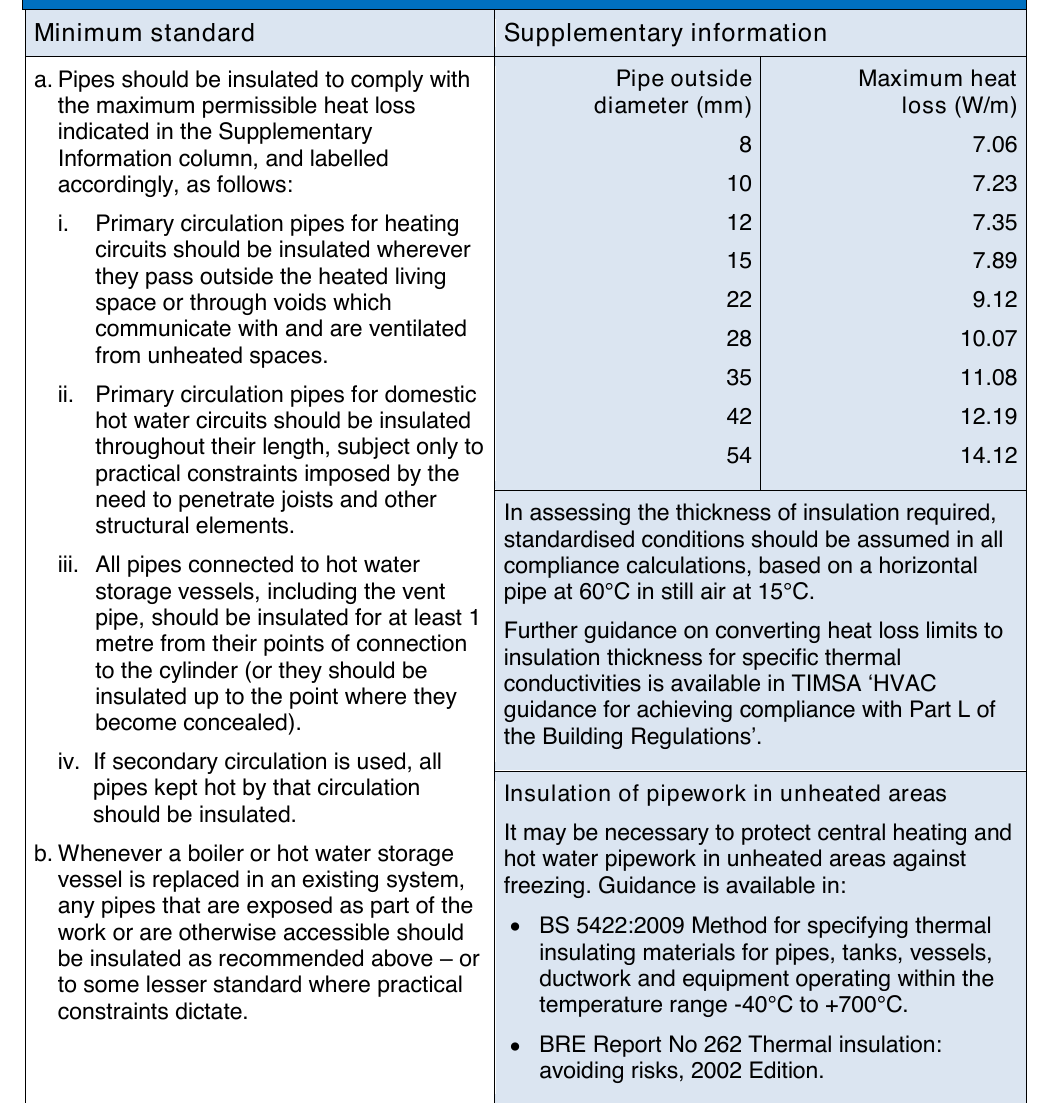
Page 53
#Source page 53
5.4Solid fuel appliances for secondary heating
Solid fuel appliances in new and existing dwellings that provide secondary heating and are not part of a central heating system should have the minimum efficiency (gross calorific value) specified in Table 21 for the category of appliance.
Supplementary information
Minimum efficiencies
Minimum efficiencies for solid fuel appliances are published in the HETAS ‘Official guide to approved solid fuel products and services’, and on the website www.hetas.co.uk. Manufacturers’ figures may be higher but should be used only where independently certified against the harmonised European Standards now in place.
Appliance types
The types of appliance most suitable for providing secondary heating are:
• Open-fire with high output boiler, when used with ‘link-up’
• Small solid fuel room heaters (stoves), especially wood-fired
These can be a dedicated wood burner or burn logs in a multi-fuel appliance or use pellets. They can be matched with a main heating system fired by the same or a different primary fuel or off-peak electricity to reduce carbon emissions, especially wood-fired, with or without thermostatic control. Many designs can provide heating during power cuts. Mineral fuel appliances can be chosen but the attention of designers is drawn to the probable need to supply additional measures, as the carbon emission values of these tend to be high. Mineral fuel appliances may often have slightly higher efficiencies than their wood burning counterparts. Multi-fuel room heaters can enable the user to burn renewable wood as well as an alternative to mineral fuels outside smoke control areas.
• Small solid fuel stoves with boilers
The efficiency of these can be higher than that of dry appliances. They can be integrated with the primary wet heating system. Multi-fuel appliances enable the householder to burn renewable wood outside smoke control areas.
• Range cookers
Typically appliances which are installed in a ‘living area’ and are designed to provide some useful heat from their case into the space in which they are located. They are available in a variety of shapes and sizes and can incorporate a boiler which can be connected to dual-fuel integrated systems (e.g. link-up). Multi-fuel versions are also available.
• Open fires (HETAS categories B1, B2 and B3)
Where requested, these can be fitted. They do not have thermostatic control of the burning rate and so have lower efficiencies, but they are able to burn wood logs with correspondingly low net carbon emissions. It must be stressed that large open fires with a large free face area (opening width times opening height) usually have a need for ventilation well in excess of that available in a property built to modern standards of air tightness. This is likely to lead to severe operational problems unless special steps are taken to provide the required air supply. The use of such large (simple) open fires is penalised in the SAP calculations.
Controls
Wherever possible, solid fuel appliances should have thermostatic control. (These are usually integral to appliances in categories E, F and G.) Controls should be appropriate to the level of sophistication of the appliance; automatic appliances can benefit from advanced controls.
Page 54
#Source page 54
Provision of fuel storage
The quantity of fuel consumed by secondary heating appliances is likely to be less than 1 tonne per year. However it should be stored in a dry and convenient location.
Smoke control areas
The location of the appliance within or without a smoke control area is critical to the process of optimising the choice of appliance and fuel.
For further information on solid fuel appliances, see CE47 –‘Energy Efficiency Best Practice in Housing – Domestic heating by solid fuel: Boiler systems’.
Standards
BS EN 12809:2001 + A1:2004 + AC: 2006/2007 – ‘Residential Independent boilers fired by solid fuel. Nominal output up to 50kW. Requirements and test methods’.
BS EN 12815:2001 A1:2004/2006/2007 – ‘Residential cookers fired by solid fuel. Requirements and test methods’.
BS EN 13229:2001 + A1:2003/ A2:2004 + AC:2006/2007 – ‘Inset appliances including open fires fired by solid fuel. Requirements and test methods’.
BS EN 13240:2001 +A2:2004 + AC2006/2007 – ‘Room heaters fired by solid fuel. Requirements and test methods’.
BS EN 15250:2007 – ‘Slow heat release appliances fired by solid fuel. Requirements and test methods’.
BS EN 15544:2009 – ‘One-off tiled/ mortared stoves – Calculation method’.
BS EN 14785:2006 - Residential space heating appliances fired by wood pellets’.
Section 6: Community heating
#Source page 55
6.1Scope of guidance
This section provides guidance on the specification of community heating systems for dwellings to meet relevant energy efficiency requirements in the building regulations.
A community heating system is one that supplies heat to a number of dwellings from a common heat source. A system may heat a small block of flats or a large number of buildings.
The guidance in this section applies to systems that:
• supply 15 or more dwellings from a central boiler, or from a low carbon source such as combined heat and power (CHP), biofuels, heat pumps and solar panels
• distribute heat from the central source using a wet radiator system (although warm air heating and underfloor heating systems may also be used).
Metering requirements for community heating schemes are being introduced, starting in June 2014, as a result of the EU Energy Efficiency Directive. See the DECC website16 for details of the requirements and the technical standards that apply (for example on meter specifications).
6.2New and existing community heating schemes
The central heat source should comply with the requirements in the Non-domestic Building Services Compliance Guide for Scotland17 except where specified in this section.
Guidance is provided for two scenarios:
• connecting dwellings to a new community heating scheme
• connecting dwellings to an existing community heating scheme.
Connecting dwellings to a new community heating scheme
New community heating systems for both new and existing dwellings should meet the minimum standards for:
a.energy efficiency in Table 25
b.low-carbon heat sources in Table 26
c.system control in Table 27
d.hot water production, storage and treatment, heat metering and commissioning in Table 28
e.insulation of pipework in Table 29.
Page 56
#Source page 56
Connecting dwellings to an existing community heating scheme
Where existing community heating systems are connected to new or existing dwellings:
a.If the existing community heating system is in need of replacement or improvement, a study should be carried out to assess the economic and environmental benefits of a range of options, including the use of CHP and other low carbon heat sources, especially where individual heating systems are being considered as an alternative to continuing with the community heating system.
b.Replacement boilers should meet the minimum standards for boiler efficiency in the Non-domestic Building Services Compliance Guide for Scotland.
c.If thermal energy is purchased from an existing district or community heating system, an assessment of the carbon intensity of the scheme should be carried out. Emission factors should be determined based on the particular details of the scheme, but should take account of the annual average performance of the whole system – that is, of the distribution circuits and all the heat generating plant, including any CHP, and any waste heat recovery or heat dumping. The calculation of the Dwelling CO2 Emission Rate should be carried out by a person who is familiar with the calculation methodology and can explain how the emission factors were derived.
d.Controls should meet the minimum standards in Table 27.
e.Pipework insulation should meet the minimum standards in Table 29 and Table 30.
Page 57
#Source page 57
Table 25: Recommended minimum standards for the design of new community heating systems to maximise efficiency of heat generation and minimise energy use by pumps
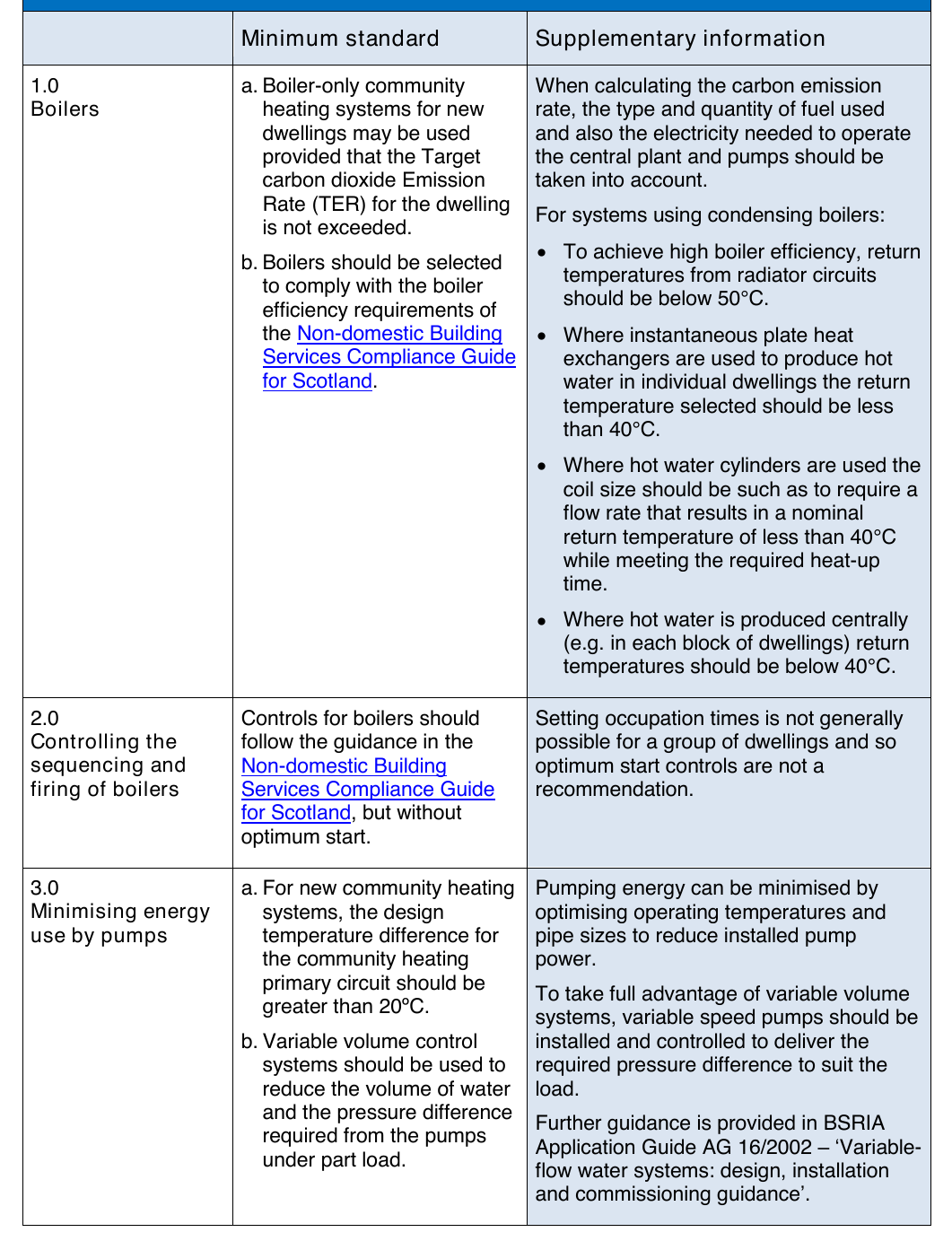
Page 58
#Source page 58
Table 26: Recommended minimum standards for design of low-carbon heat sources where these are included in community heating systems
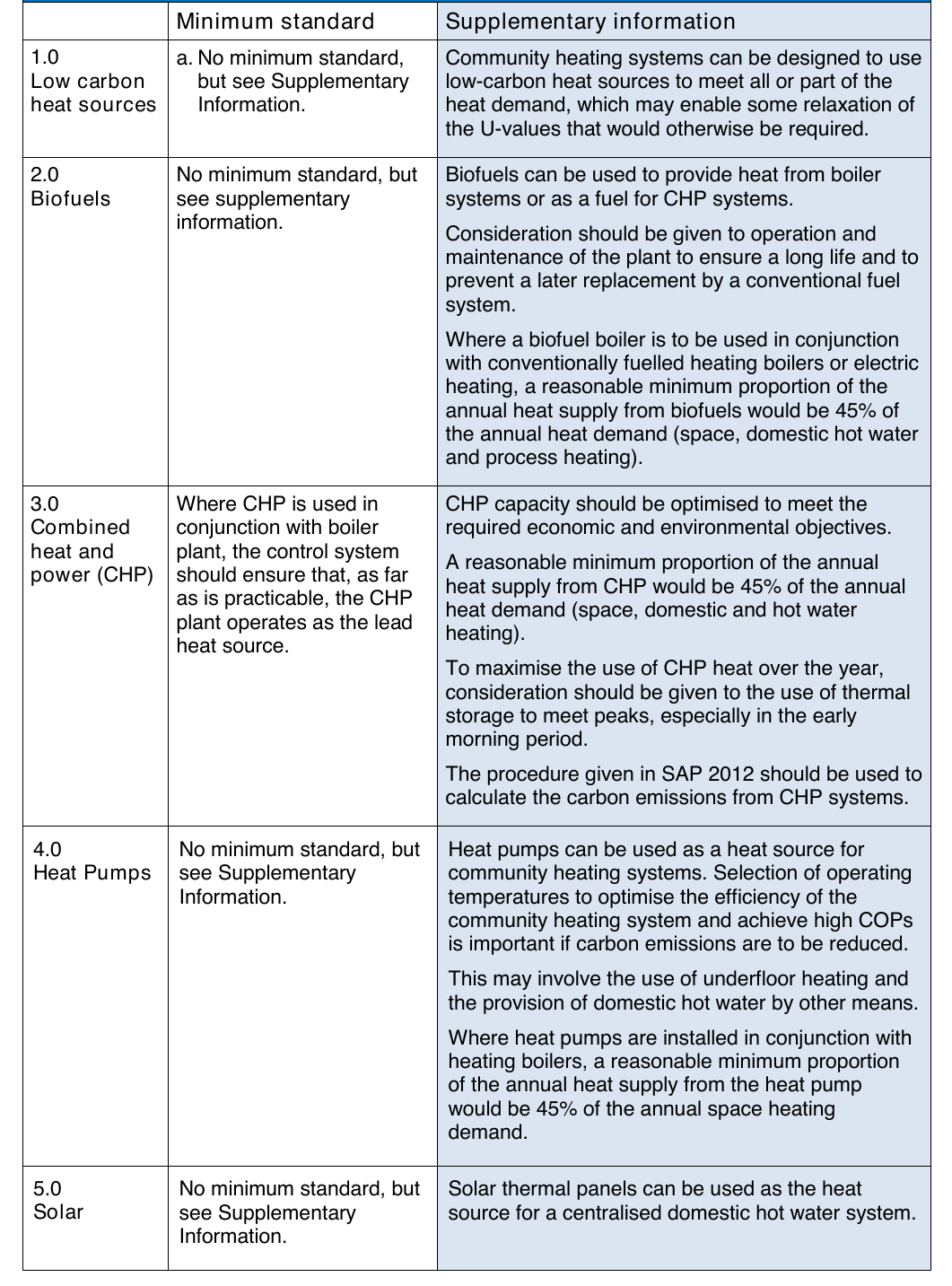
Page 59
#Source page 59
Table 27: Recommended minimum standards for control of systems within dwellings for community heating
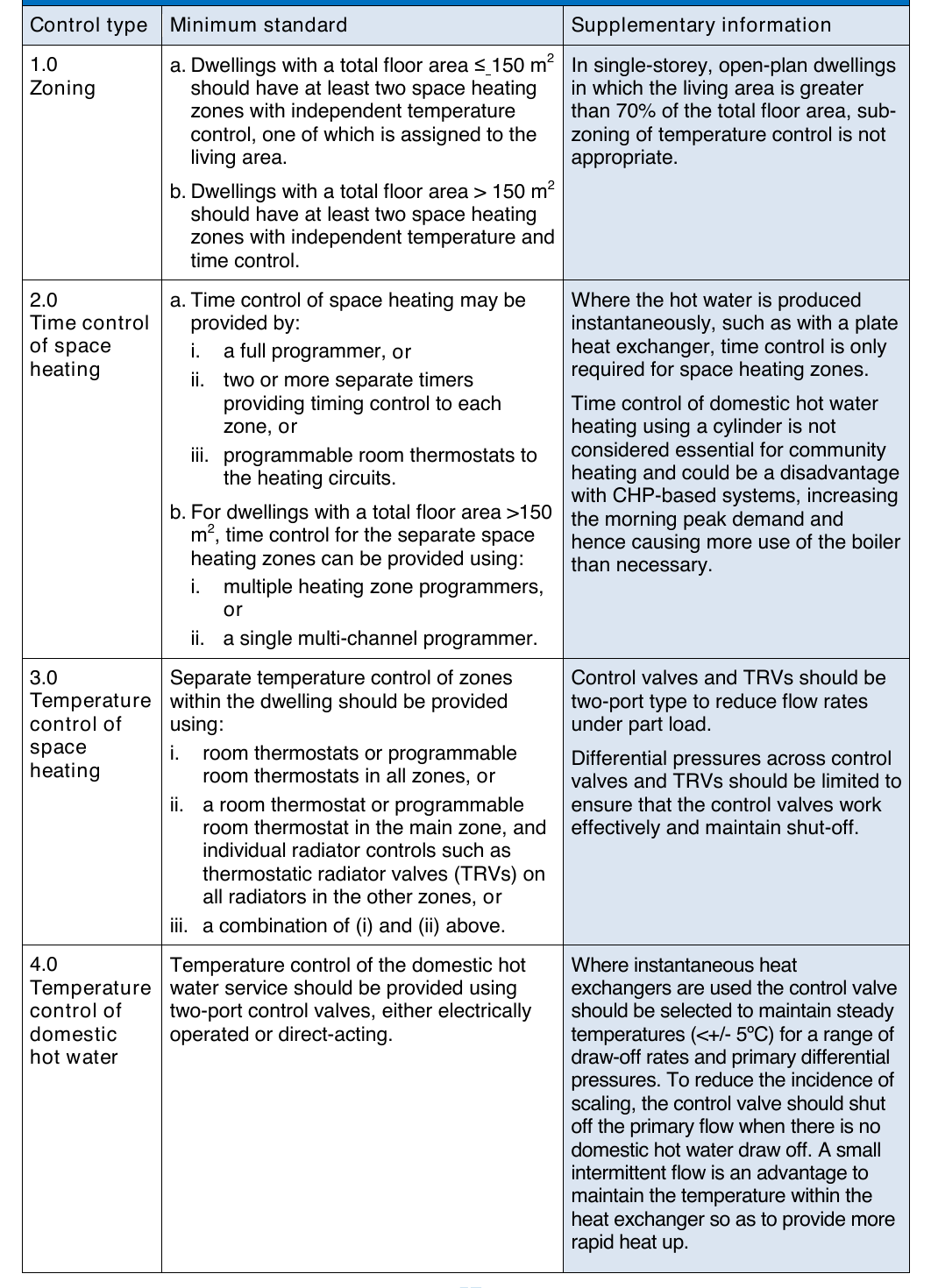
Page 60
#Source page 60
Table 27: Recommended minimum standards for control of systems within dwellings for community heating
| Control type | Minimum standard | Supplementary information |
|---|---|---|
| 5.0 Limitation of maximum flow rate into building or dwelling | a. The maximum design flow rate into the dwelling heating system should be limited by suitable control and balancing valves to maintain the overall balance in the network and to avoid excessive pumping energy. |
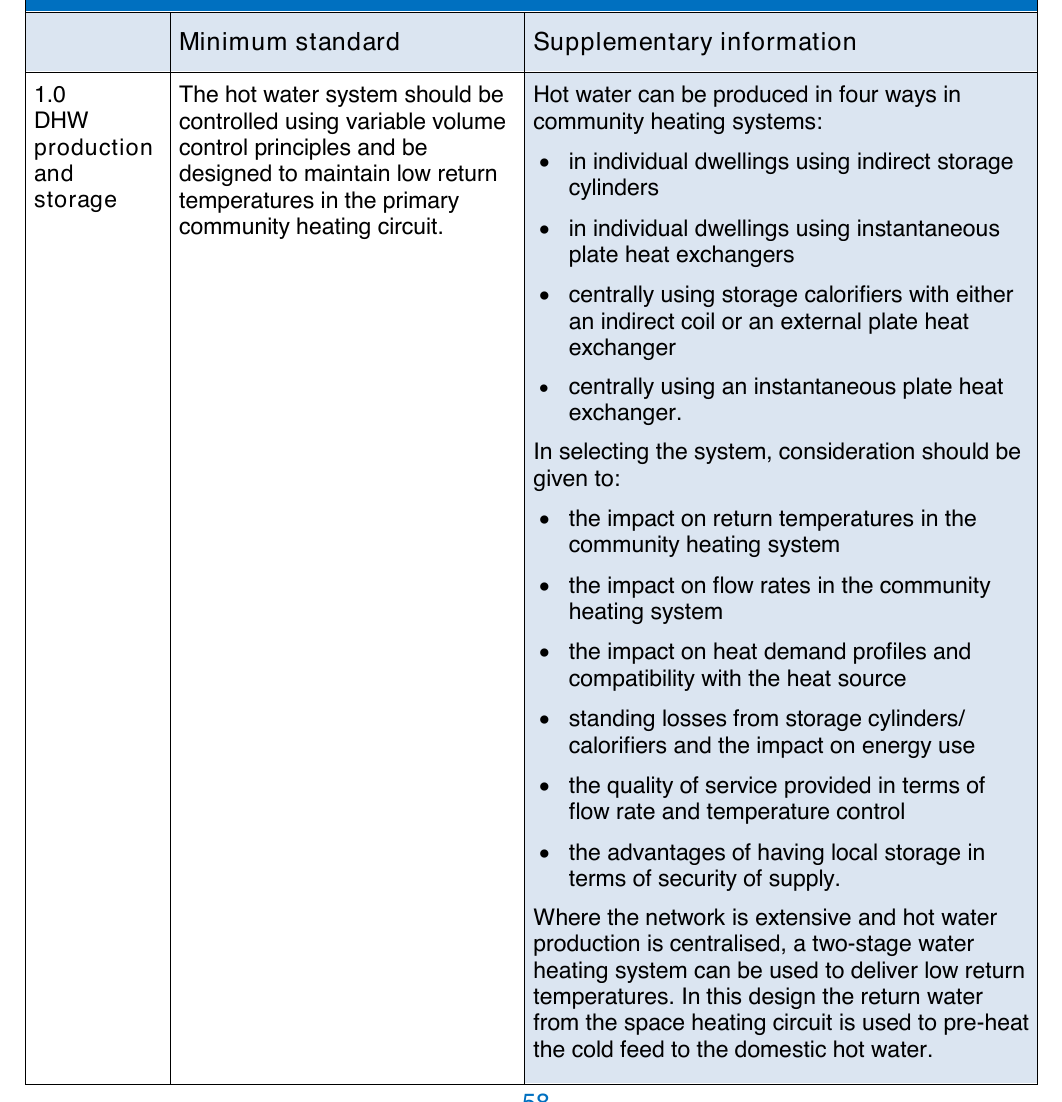
Table 28: Recommended minimum standards for domestic hot water production, storage and water treatment, heat meters and commissioning for community heating
Page 61
#Source page 61
Table 28: Recommended minimum standards for domestic hot water production, storage and water treatment, heat meters and commissioning for community heating
| Minimum standard | Supplementary information | |
|---|---|---|
| 2.0 Water treatment | A suitable system for introduction of water treatment chemicals into the community heating system in a controlled manner with facility for monitoring of water quality should be provided. | A suitable long-term programme of water treatment is essential to preserve the life of the community heating system by limiting internal corrosion. Additional chemical and physical treatment should be evaluated especially for larger systems, including: removal of oxygen by physical means softened water supply side-stream filtration biocide. |
| 3.0 Heat meters | Provision should be made in the design for including heat meters either at the time of installation or at a later date without major pipework changes. | The Energy Efficiency Directive will set stronger requirements. For up-to-date information, see https://www.gov.uk/decc. |
| 4.0 Commiss- ioning | a. The community heating system should be commissioned so that the design volume flow rates are supplied to each dwelling and there is no excessive bypassing of water that would lead to higher pumping energy use. b. The flow rates in individual heat emitters should be balanced using appropriate return temperatures or by using calibrated control valves. c. The systems within the dwellings should be demonstrated to the resident and suitable information provided on the operation of the controls. | Where the central heat source includes a low- carbon heat source, the control system should be proven by demonstrating that the low-carbon heat source will normally act as the lead heat source. |
Page 62
#Source page 62
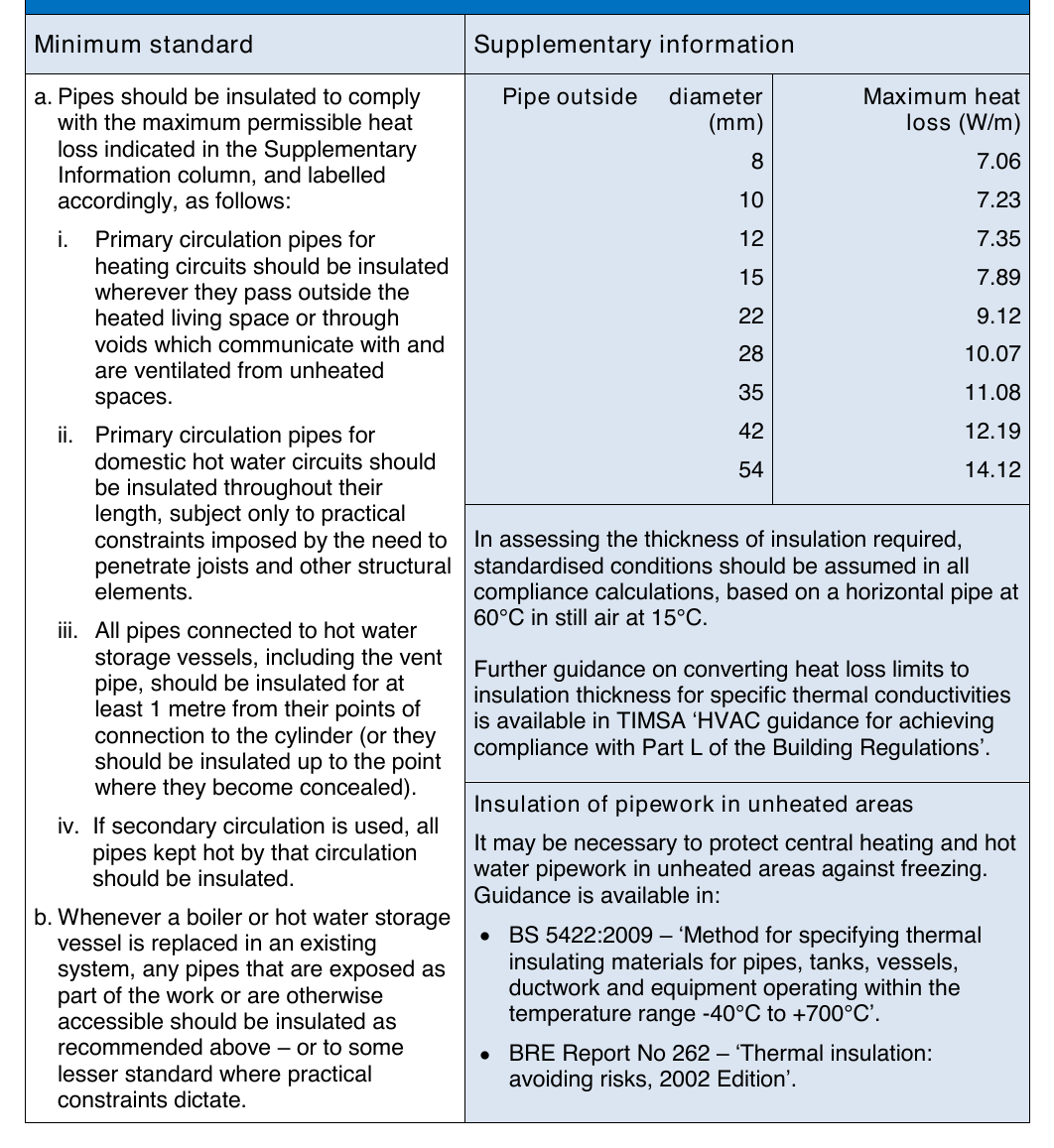
Table 29: Recommended minimum standards for insulation of internal pipework in community heating systems
Page 63
#Source page 63
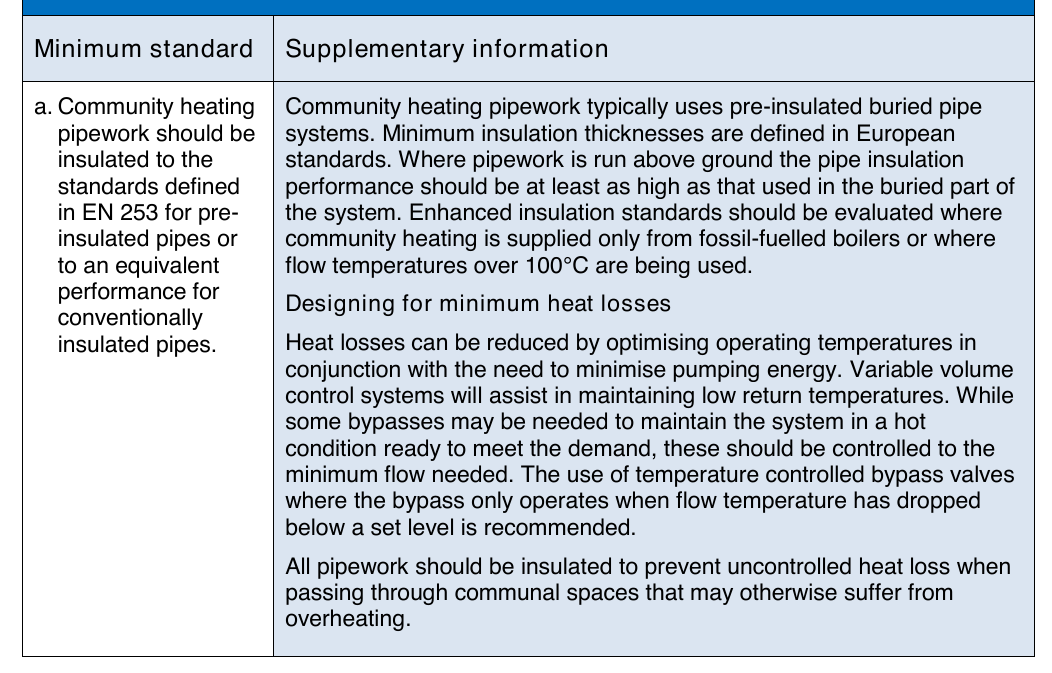
Table 30: Recommended minimum standards for insulation of external pipework in community heating systems
Supplementary information
Good Practice Guide GPG234 – ‘Guide to community heating and CHP – Commercial, public and domestic applications’. Available from the Carbon Trust.
BS EN 13941:2009 + A1 2010 – ‘Design and installation of pre-insulated bonded pipe systems for direct heating’.
BS EN 14419:2009 – ‘District heating pipes. Pre-insulated bonded pipe systems for directly buried hot water networks. Surveillance systems’.
BS EN 253:2009 + A1:2013 – ‘District heating pipes. Pre-insulated bonded pipe systems for directly buried hot water networks. Pipe assembly of steel service pipe, polyurethane thermal insulation and outer casing of polyethylene’.
BS EN 448:2009 – ‘District heating pipes. Pre-insulated bonded pipe systems for directly buried hot water networks. Fitting assemblies of steel service pipes, polyurethane thermal insulation and outer casing of polyethylene’.
BS EN 488:2011 – ‘District heating pipes. Pre-insulated bonded pipe systems for directly buried hot water networks. Steel valve assembly for steel service pipes, polyurethane thermal insulation and outer casing of polyethylene’.
BS EN 489:2009 – ‘District heating pipes. Pre-insulated bonded pipe systems for directly buried hot water networks. Joint assembly for steel service pipes, polyurethane thermal insulation and outer casing of polyethylene’.
Section 7: Underfloor heating
#Source page 64
7.1Scope of guidance
This section provides guidance on the specification of underfloor heating systems in new dwellings to meet relevant energy efficiency requirements in the building regulations.
The guidance covers the use of hot water pipes or electric heating elements as the underfloor heat source.
7.2Underfloor heating in new dwellings
Underfloor heating in new dwellings should meet the minimum standards for:
a.system control and safe operating temperatures in Table 31
b.floor insulation and system design to minimise distribution losses in Table 32
c.in the case of electric underfloor heating systems in new dwellings, construction and controls in Table 33.
Page 65
#Source page 65
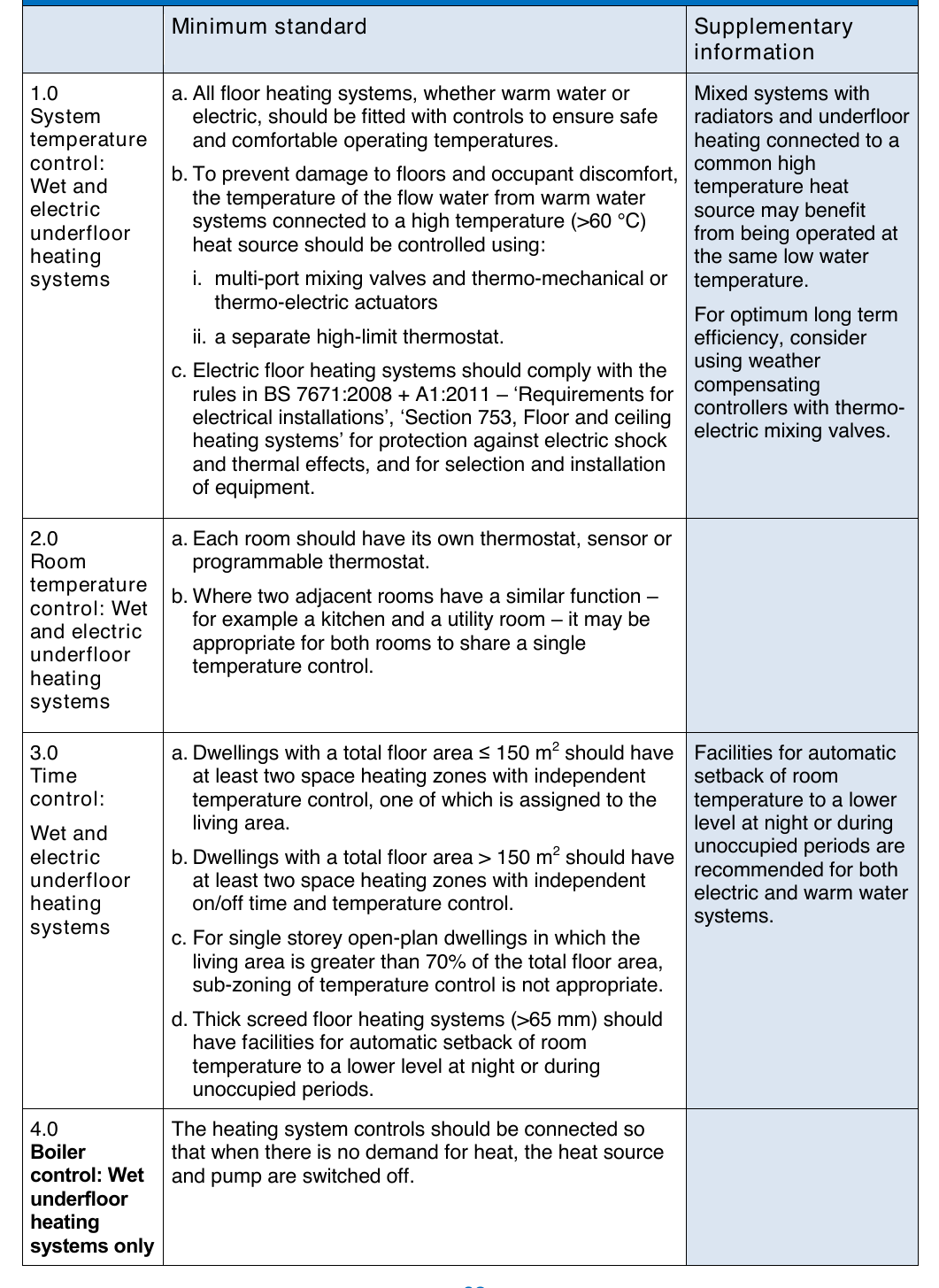
Table 31: Recommended minimum standards for control of wet and electric underfloor heating systems
Page 66
#Source page 66
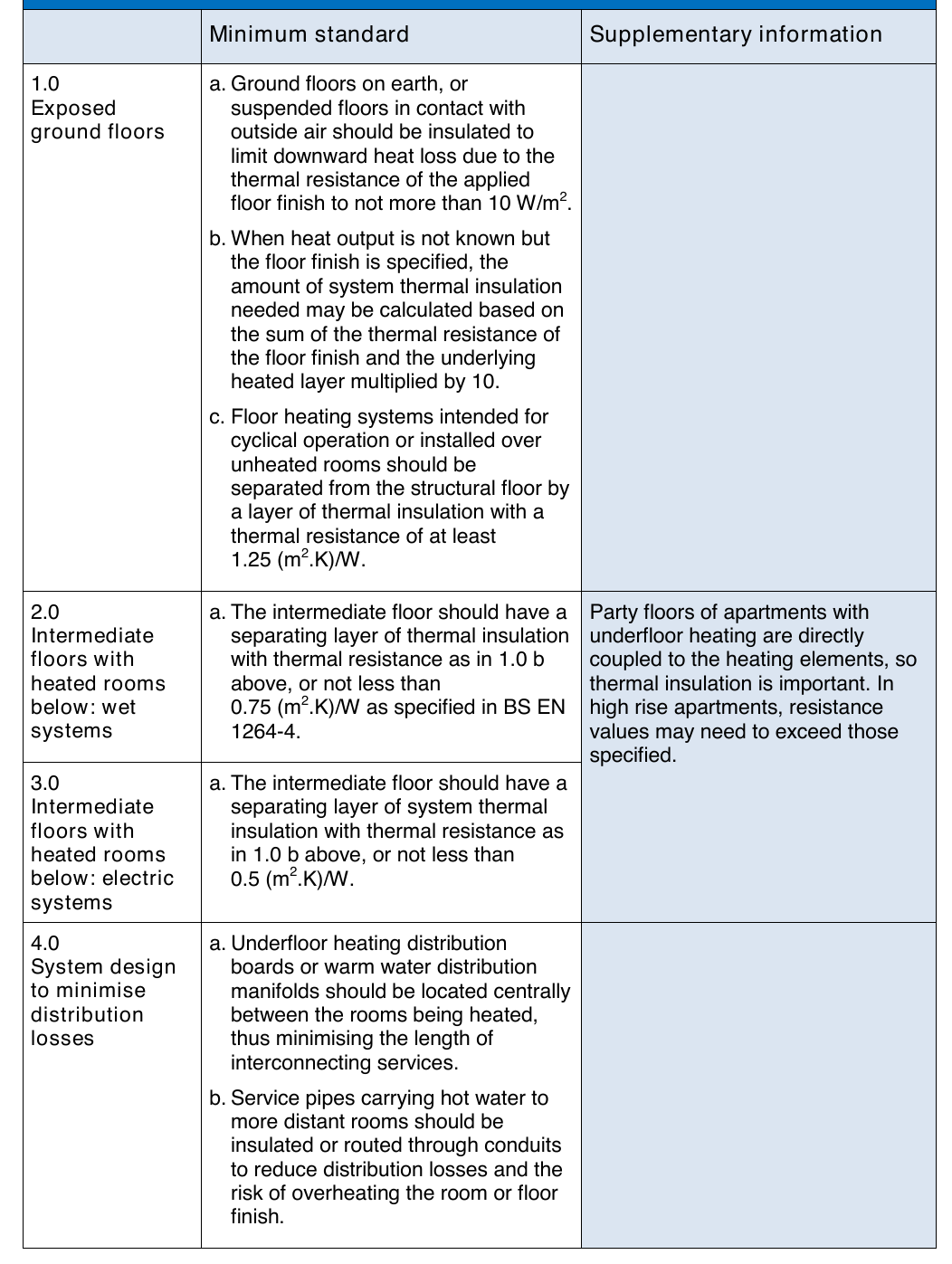
Table 32: Recommended minimum standards for floor insulation and minimising distribution losses in wet and electric underfloor heating systems
Page 67
#Source page 67
Table 32: Recommended minimum standards for floor insulation and minimising distribution losses in wet and electric underfloor heating systems
| Minimum standard | Supplementary information | |
|---|---|---|
| 5.0 System commissioning and corrosion protection Control of oxidation, biofilm, scale and sludge in warm water heating systems | a. Commissioning warm water floor heating systems should be carried out in accordance with BS EN 1264- 4. Even where plastic tubes contain oxygen gas barriers, the control of corrosion in mixed product heating systems must be addressed carefully. b. After testing and flushing with clean water, the system circulating fluid should be treated with a suitable corrosion inhibitor approved by the tube manufacturer and complying with BS 7593:2006 or DIN 4726/6 (2008-2010), and applied strictly in accordance with the additive manufacturer’s instructions. | British and European Standards BS BS EN 1264-4:2009 – ‘Water based surface embedded heating and cooling systems. Installation’. BS 7593:2006 – ‘Code of practice for treatment of water in domestic hot water central heating systems’. DIN 4726 (2008-2010) – ‘Warm water surface heating systems and radiator connecting systems. Plastic piping systems and multilayering piping systems’. Inhibitors should be BuildCert approved or equivalent. |
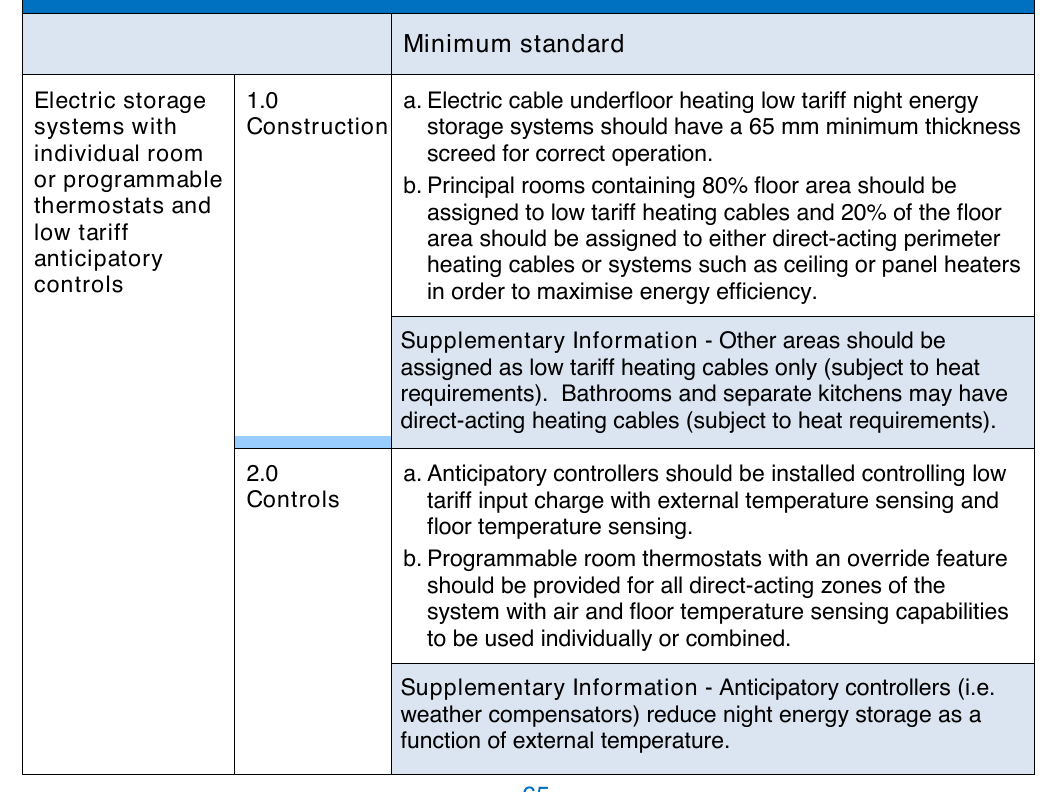
Table 33: Recommended minimum standards for construction and control of electric underfloor heating systems
Page 68
#Source page 68
Table 33: Recommended minimum standards for construction and control of electric underfloor heating systems
| Minimum standard | ||
|---|---|---|
| Electric cable, direct-acting (non-storage) systems with individual room timer or thermostat control in screeded floors | 3.0 Construction | a. Direct-acting electric underfloor heating cables should be installed within screeds of thickness not exceeding 60 mm. b. All heated floors should be insulated in accordance with Table 32. |
| 4.0 Controls | Programmable room thermostats with a manual override feature for all heating zones with air or floor temperature sensing capabilities should be used individually or combined. | |
| Electric cable, direct-acting systems with individual room timer or thermostat control in timber floors | 5.0 Construction | Direct-acting electric underfloor heating cables installed below floor boards in voids between floor joists should be insulated in accordance with Table 32. |
| 6.0 Controls | Programmable room thermostats with a manual override feature should be provided to control space temperature and limit floor void temperature for safety and comfort in each area. | |
| Under-tile electric floor heating systems | 7.0 Construction | Direct-acting electric underfloor heating cables should be provided with a pre-fabricated mattress, or equivalent IEC 60800:2009 approved heating cable product, of thickness less than 4 mm encapsulated in tile bedding adhesive or mortar, below a ceramic or other equivalent floor finish on a thermally resistive insulation layer as in Table 32 1.0 b. |
| 8.0 Controls | Programmable room thermostats with a manual override feature should be provided to control space temperature and limit floor temperature for safety and comfort in each area. |
Section 8: Mechanical ventilation
#Source page 69
8.1Scope of guidance
This section provides guidance on the specification of mechanical ventilation systems in dwellings to meet relevant energy efficiency requirements in the building regulations.
The guidance covers the following types of mechanical ventilation:
• intermittent extract
• continuous extract
• continuous supply
• continuous supply and extract with heat recovery.
8.2Energy efficiency of mechanical ventilation systems
Mechanical ventilation systems should:
a. follow the guidance in Building Standards Division ‘Domestic Ventilation Guide’ - http://www.scotland.gov.uk/Topics/BuiltEnvironment/Building/Buildingstandards/te chbooks/techhandbooks/domventguide;
b.meet the minimum standards for specific fan power, heat recovery efficiency and controls in Table 34; and
c.comply with European Commission Regulation No 327/2011 implementing Directive 2009/125/EC with regard to ecodesign requirements for fans driven by motors with an electric input power between 125 W and 500 kW.
Table 34: Recommended minimum standards for mechanical ventilation systems
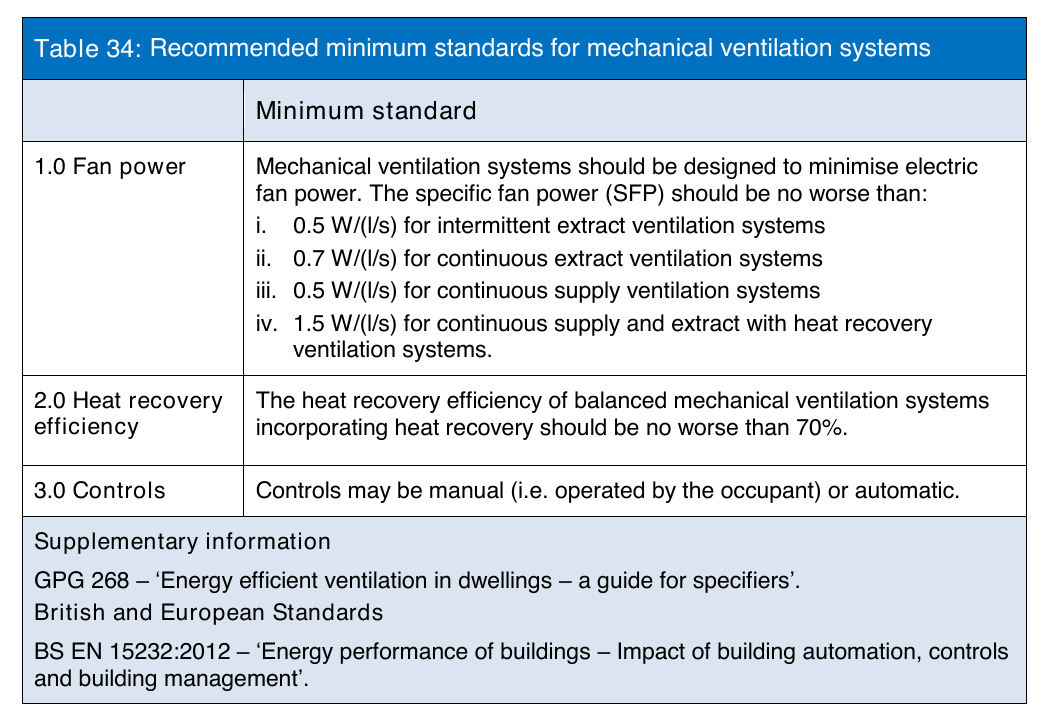
Section 9: Heat pumps
#Source page 70
9.1Scope of guidance
This section provides guidance on the specification of heat pump systems in dwellings for the provision of space heating and domestic hot water to meet relevant energy efficiency requirements in the building regulations.
A heat pump is a device which takes heat energy from a low temperature source and upgrades it to a higher temperature at which it can be usefully employed for heating or hot water. Heat pumps may supply all or part of the heating load.
The guidance in this section applies to the types of electrically-driven heat pump in Table 35 used as the heat generator in underfloor, warm air and medium temperature radiator heating systems, etc.
Table 35: Heat pump technologies
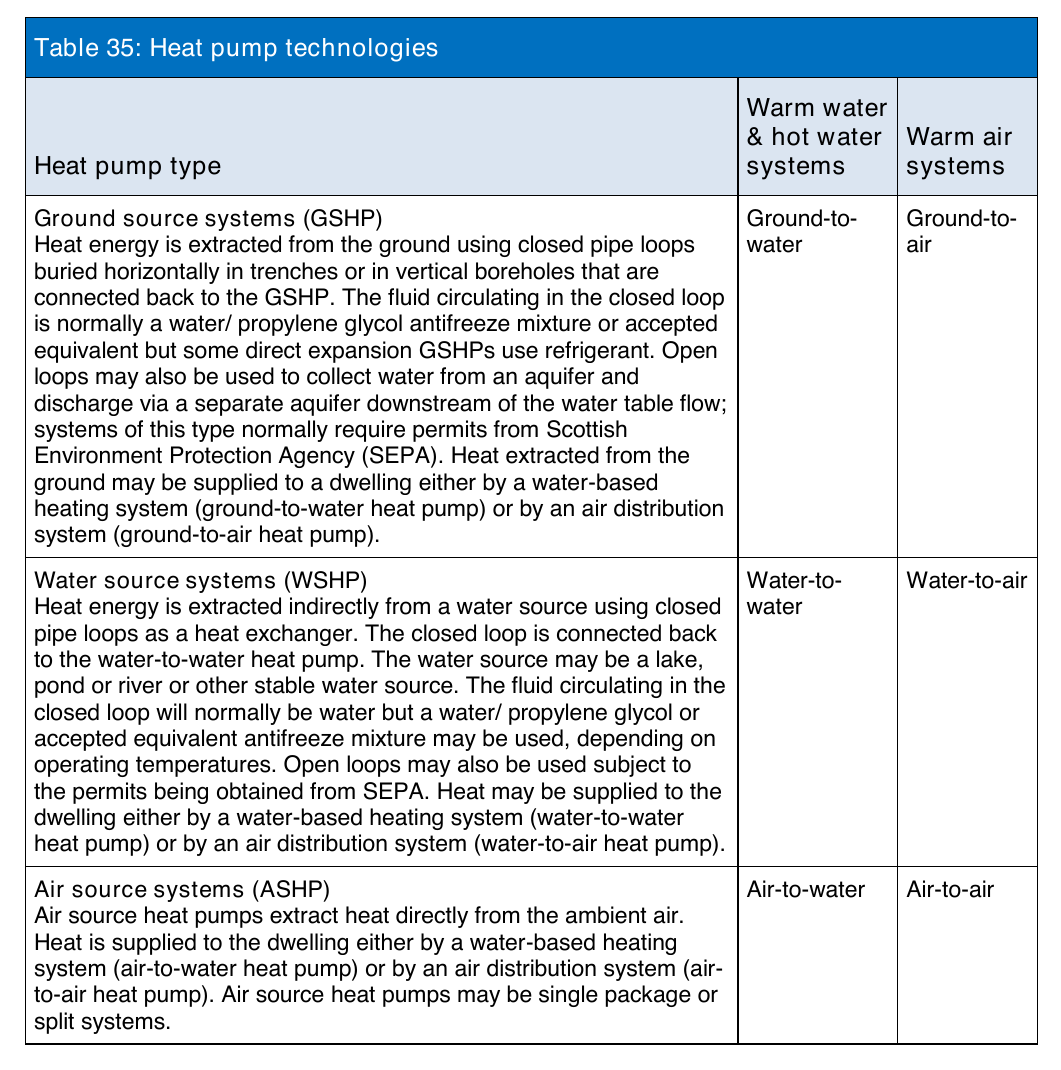
Page 71
#Source page 71
Supplementary information
All heat pump systems are at their most efficient when the source temperature is as high as possible, the heat distribution temperature is as low as possible and pressure losses in air and water systems are kept to a minimum. If installed in a new dwelling, heat pumps should use refrigerants complying with the provisions of EU Directive 2037:2000. Heat pumps should be CE marked in accordance with applicable EU Directives: e.g. the machinery safety, low voltage, pressure equipment and electromagnetic compatibility Directives. If summer cooling is provided by the heat pump, it is recommended that condensate drainage from the indoor units is provided.
9.2Key terms
Coefficient of performance (COP) is a measure of the efficiency of a heat pump at specified source and sink temperatures, but may not accurately represent installed performance:
Heating COP = heat output / power input
% COP (COP x 100) is the heat generator efficiency.
COP is measured in accordance with the procedures in EN 14511:2013, Air conditioners, liquid chilling packages and heat pumps with electrically driven compressors for space heating and cooling.
Seasonal coefficient of performance (SCOP) is the overall coefficient of performance of the heat pump over the designated heating season. It makes general assumptions about the amount of auxiliary heating needed to top up the space and water heating available from the heat pump.
SCOP is measured in accordance with the procedures in BS EN 14825:2013 – ‘Air conditioners, liquid chilling packages and heat pumps with electrically driven compressors for space heating and cooling – Testing and rating at part load conditions and calculation of seasonal performance’.
The National Calculation Methodology for calculating carbon dioxide emission rates from buildings uses SCOP.
Seasonal performance factor (SPF) is another measure of the operating performance of an electric heat pump over the season. It is the ratio of the heat delivered to the total electrical energy supplied over the season, but there are seven different ways to draw the system boundaries. For example, SPFH2 (which is SCOP) excludes auxiliary resistance heating whereas SPFH4 includes it – making a large difference.
SAP 2012 calculations use SPF – either measured values for products listed in the Product Characteristics Database, or the default values in Table 4a for products not listed there.
The Microgeneration Certification Scheme installation standard MIS 3005 uses SPF to calculate system performance (although the heat pump product standard, MCS 007, currently specifies a minimum COP).
Seasonal primary energy efficiency ratio (SPEER) is an emerging rating figure reflecting the use of primary energy for all types of heat pump, fossil fuel boiler and gas-driven cogeneration technologies, as well as hybrid systems where solar heating or a heat pump is backed up with electric heating or a fossil fuel boiler.
Page 72
#Source page 72
Energy labelling with the SPEER will be mandatory from 2015 under the Energy Labelling Directive. Testing and rating will be in accordance with EN 14825, as for SCOP.
9.3Warm water and hot water heat pumps
At the time of preparation of this guide, European Commission Regulation No 206/2012 sets standards for the SCOP of electrically-driven air-to-air heat pumps with an output ≤ 12 kW. There are currently no European test standards for part-load testing of air-to-air heat pumps with an output > 12 kW or for other types of heat pump, and the performance of these must be specified using COP obtained at the heating system rating conditions.
The current recommendations in this guide, therefore, are that electrically-driven heat pumps should:
a.if air-to-air with an output ≤ 12 kW, have at least a SCOP ‘D’ rating for the median temperature range in EN 14825
b.or else have a COP which is not less than:
i.2.5 for space heating in new dwellings
ii.2.2 for space heating in existing dwellings
iii.2.0 for heating domestic hot water
c.meet the minimum standards for supply temperature, wet system radiator efficiency, installation and commissioning, hot water and controls in Table 36 for warm water and hot water heat pumps
d.meet the minimum standards for installation and controls in Table 37 for warm air heat pumps.
Table 36: Recommended minimum standards for warm water and hot water heat pumps (ground-to-water, water-to-water and air-to-water systems)
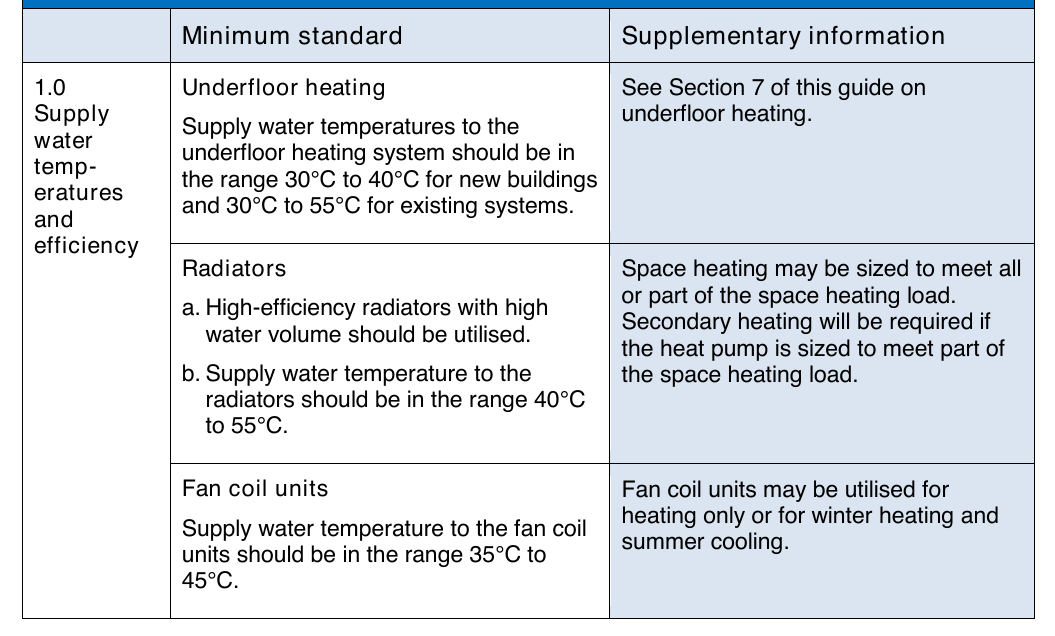
Page 73
#Source page 73
Table 36: Recommended minimum standards for warm water and hot water heat pumps (ground-to-water, water-to-water and air-to-water systems)
| Minimum standard | Supplementary information | |
|---|---|---|
| 2.0 Installation and commissio n-ing | a. The water distribution system should be arranged for reverse return operation or arranged with a low loss manifold system to maximise efficiency and ease commissioning and future maintenance. b. Pipework not contributing to the space heating should be insulated to prevent heat loss, following the guidance in the TIMSA guide. c. If summer cooling is provided by the heat pump, all water distribution pipework should be insulated to prevent condensation, following the guidance in the TIMSA guide. d. External pipework between the dwelling and the ground heat exchanger should be insulated, following the TIMSA guidance. e. The ground loop water circuit should be protected with an anti-freeze solution and inhibitor as recommended by the heat pump manufacturer. f. Ground loops should be cleaned with a cleaning fluid and biocide as part of the commissioning process. g. The internal water distribution circuit should contain an inhibitor and may be protected by an anti-freeze solution as recommended by the heat pump manufacturer. h. Ground loops should be filled with a heat transfer fluid. Installers should also refer to the equipment manufacturer’s installation instructions for appropriate treatment products and special requirements for individual appliance models. | Design A pressurised water distribution system with expansion vessel is recommended. Constant water flow should be maintained through the heat pump. Pipe sizes should be in accordance with the manufacturer’s recommendations. Installation Installation should be carried out by an installer approved by the manufacturer. If during installation access to the refrigeration circuit is needed, a competent refrigeration and air conditioning engineer (with a valid refrigerant handling certificate or an Engineering Services Skillcard) should carry out the work. Exposed refrigeration pipework should be insulated and enclosed in protective trunking to limit accidental damage. Installation of the dwelling’s water distribution system should be undertaken by a competent central heating specialist. Guidance and standards TIMSA ‘HVAC guidance for achieving compliance with Part L of the Building Regulations’. BS EN 378:2008 – ‘Specification for refrigerating systems and heat pumps’. TR30 - ‘Guide to good practice – heat pumps’, HVCA July 2007. MIS 3005 – ‘Requirements for contractors undertaking the supply, design, installation, set to work, commissioning and handover of microgeneration heat pump systems’, DECC. |
Page 74
#Source page 74
Table 36: Recommended minimum standards for warm water and hot water heat pumps (ground-to-water, water-to-water and air-to-water systems)
| Minimum standard | Supplementary information | |
|---|---|---|
| 3.0 Domestic hot water (DHW) | a. For full heating, the heat pump and any supplementary domestic hot water heating should be capable of supplying water in the range 60°C to 65°C. This is applicable to ground-to- water, water-to-water and air-to-water type heat pumps. b. If the heat pump is not capable of supplying water at these temperatures, supplementary heating should be provided and controlled as described in other sections of this guide. Controls should include an auxiliary heating regime to 60°C or more for disinfection purposes. c. The domestic hot water system should have temperature control (e.g. a tank thermostat) and time control to optimise the time taken to heat the water. | The heat pump may be utilised for all or part of the DHW load. During the DHW heating period the heat pump may not necessarily be providing heated water to the space heating system. |
| 4.0 Controls | a. Heat pump unit controls should include: i. control of water pump operation (internal and external as appropriate) ii. control of water temperature for the distribution system iii. control of outdoor fan operation for air-to-water units iv. defrost control of external airside heat exchanger for air-to-water systems v. protection for water flow failure vi. protection for high water temperature vii. protection for high refrigerant pressure viii. protection for air flow failure on air- to-water units. b. External controls should include: i. weather compensation or internal temperature control ii. timer or programmer for space heating. c. Minimum heat pump flow rates or volume requirements should be met. If all zones are thermostatically controlled, then a buffer would be an acceptable method of compliance. |
Page 75
#Source page 75
Table 37: Recommended minimum standards for warm air heat pumps (ground-to-air, water-to-air and air-to-air systems)
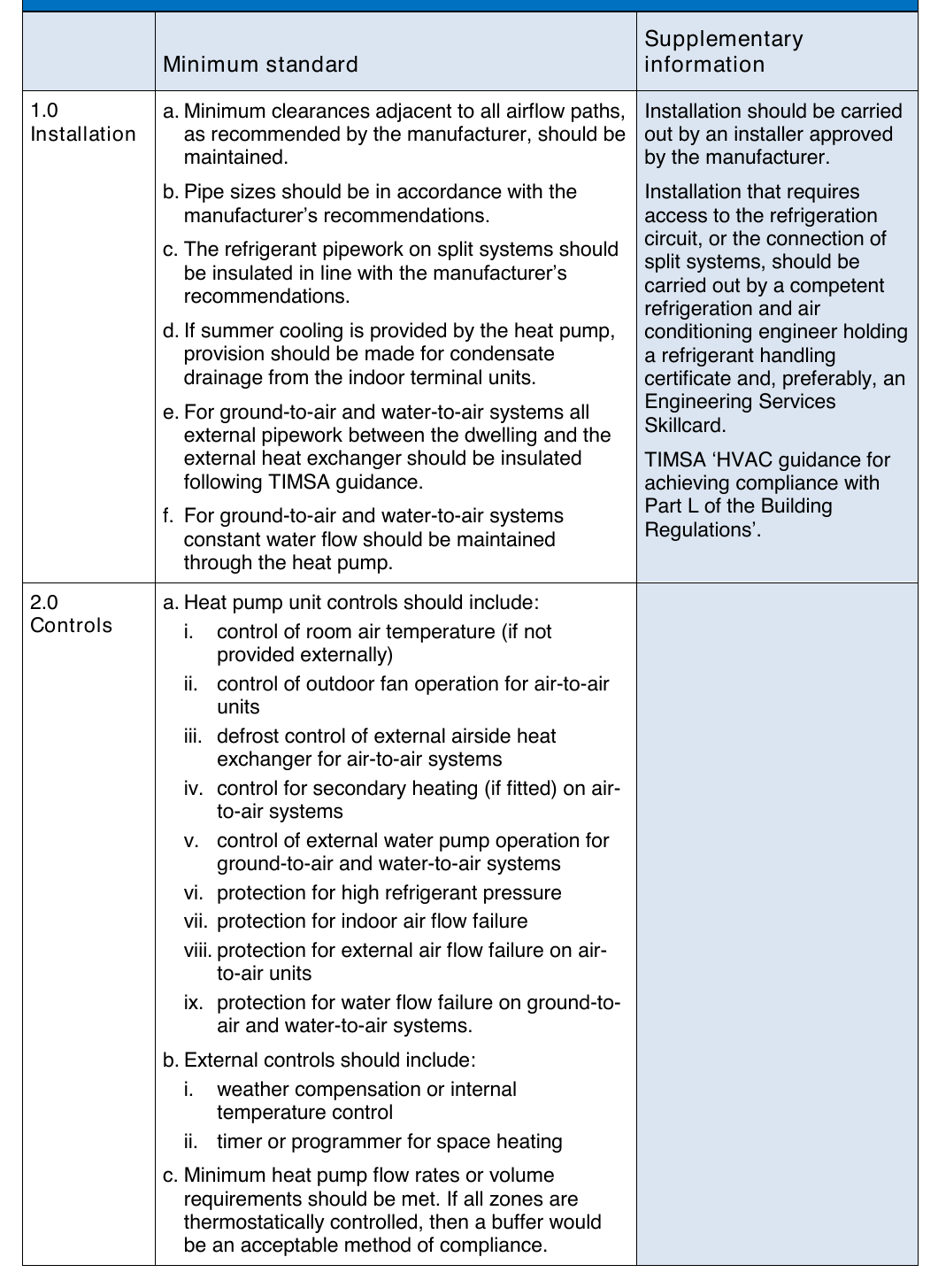
Page 76
#Source page 76
Supplementary information
Guidance
Microgeneration Certification Scheme standard MIS 3005 – ‘Requirements for contractors undertaking the supply, design, installation, set to work, commissioning and handover of microgeneration heat pump systems’.
Microgeneration Certification Scheme standard MIS 3007 – ‘Product certification scheme requirements – heat pumps’.
CE 82 – ‘Energy Efficiency Best Practice in Housing: Domestic ground source heat pumps: design and installation of closed-loop systems’.
Heat Pump Association data sheet – ‘Air-to-water heat pumps’.
HVCA TR30 – ‘Guide to good practice: Heat pumps’.
British and European Standards
BS EN 15450:2007 – ‘Heating systems in buildings. Design of heat pump heating systems’.
BS EN 15316-4-2:2008 – ‘Heating systems in buildings. Method for calculation of system energy requirements and system efficiencies. Space heating generation systems, heat pump systems’.
BS EN 378-1 2008 +(A1)(A2):2012 – ‘Refrigerating systems and heat pumps. Safety and environmental requirements and system efficiencies - Basic requirements, definitions, classifications and selection criteria’
BS EN 378-2 2008 +(A1)(A2):2012 – ‘Refrigerating systems and heat pumps. Safety and environmental requirements and system efficiencies - Design, construction, testing, marking and documentation’.
BS EN 378-3 2008 +(A1)(A2):2012 – ‘Refrigerating systems and heat pumps. Safety and environmental requirements and system efficiencies - Installation site and personal protection’.
BS EN 378-4 2008 +(A1)(A2):2012 – ‘Refrigerating systems and heat pumps. Safety and environmental requirements and system efficiencies - Operation, maintenance, repair and recovery’
ISO 13256-1: 1998 – ‘Water-source heat pumps. Testing and rating for performance - Water-to-air and brine-to-air heat pumps’.
ISO 13256-1: 1998 – ‘Water-source heat pumps. Testing and rating for performance - Water-to- water and brine-to-water heat pumps’.
Section 10: Comfort cooling
#Source page 77
10.1Scope of guidance
This section provides guidance on the specification of fixed mechanical comfort cooling systems and fans in dwellings to meet relevant energy efficiency requirements in the building regulations.
(Dwellings should always be designed to avoid or minimise the need for cooling through the appropriate use of solar control, secure ventilation and thermal mass).
10.2Air-cooled and water-cooled air conditioners
Cooling systems in new and existing dwellings should:
a.meet the minimum standards for efficiency in Table 38
b.be controlled to prevent simultaneous heating and cooling of the same space within the dwelling
c.comply with European Commission Regulation No 327/2011 for fans driven by motors with an electric input power between 125 W and 500 kW, and Regulation No 206/2012 for systems with a cooling capacity of up to 12 kW, both implementing Directive 2009/125/EC with regard to ecodesign requirements for energy-related products.
Table 38: Recommended minimum standards for comfort cooling
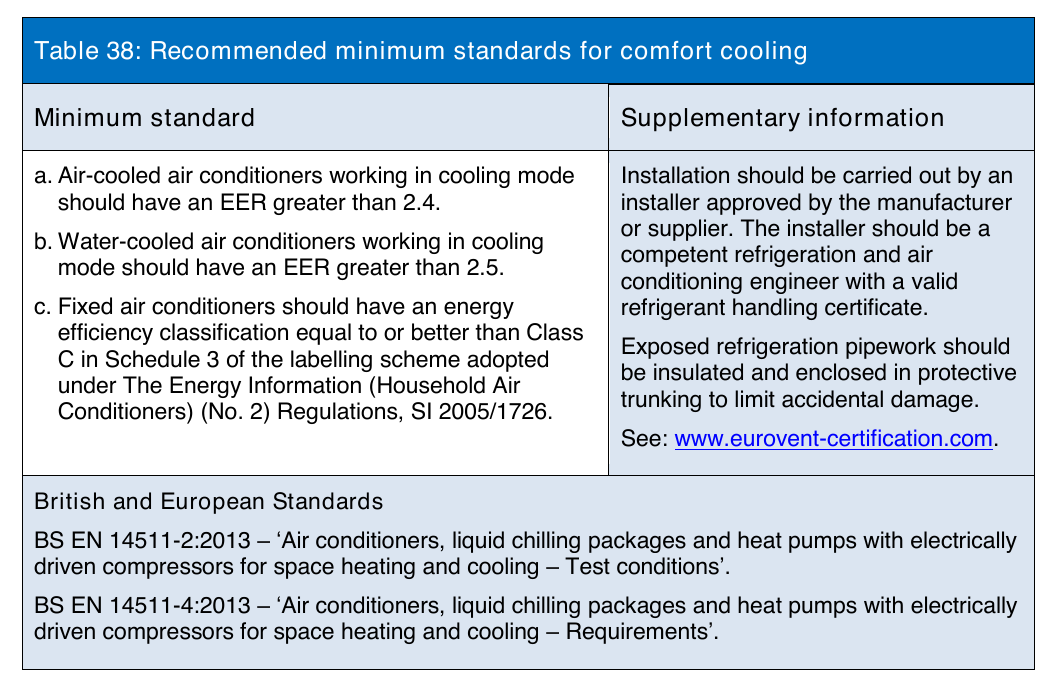
Section 11: Solar water heating
#Source page 78
11.1Scope of guidance
This section provides guidance on the specification of solar water heating for dwellings to meet relevant energy efficiency requirements in the building regulations.
The guidance in this section covers indirect solar systems with a collector area of less than 20 m2 and solar heated water storage of less than 440 litres. It does not cover ‘direct’ solar systems18 or systems intended to contribute exclusively to space heating or systems providing heat exclusively to heat swimming pools. It should be used in conjunction with the guidance on water heating contained in the fuel-based sections of this guide.
11.2Indirect systems
Indirect solar heating systems installed as new systems and replacement systems should meet the minimum standards for:
a.collector certification, identification and testing, collector primary loop transfer fluid, circulation pump power, heat-exchanger sizing, system control, solar pre-heated water storage, and system preparation in Table 39
b.system labelling and commissioning in Table 40
c.insulating pipes in a solar primary system in Table 41.
Supplementary information
When work is carried out on an existing indirect solar hot water system, it is recommended that the system controls and insulation should be upgraded in line with the standards for new systems.
Table 39: Recommended minimum standards for indirect solar water heating
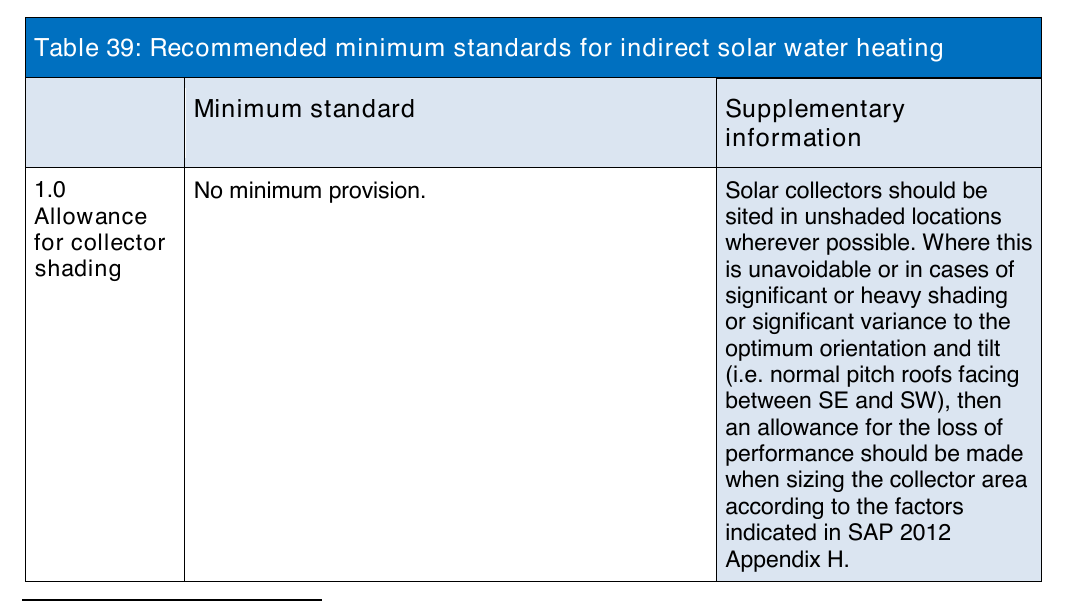
Page 79
#Source page 79
Table 39: Recommended minimum standards for indirect solar water heating
| Minimum standard | Supplementary information | |
|---|---|---|
| 2.0 Solar collector certification | Collectors should be independently certified to comply with all required tests for safety and thermal performance, and for reporting and identification according to BS EN 12975- 1:2006+A1:2010 – ‘Thermal solar systems and components. Solar collections. General requirements’. | Copies of the full test report should be made available upon request. |
| 3.0 Primary circuit fluid | The transfer fluid in the collector primary loop should be chosen so as not to deposit limescale, sludge, ice or other solids that could either restrict circulation or impair the rate of heat transfer within the absorber. | In secondary systems, measures to reduce the formation of limescale should be considered so that performance is not significantly affected. |
| 4.0 Circulation pump power | The electrical input power of the primary pump in the solar system should be less than 50 W or 2% of peak thermal power of collector, whichever is the higher. | |
| 5.0 Heat- exchanger sizing | The heat exchanger between a solar primary and secondary system should be sized so that not less than 0.1 m² or equivalent of heat exchanger area is provided per 1 m² of solar collector net absorber area. | A heat exchanger reduces the possibility of clogging and deposition due to dirt, scale or similar impurities that could reduce the system performance. Heat exchangers and store connections should be sized and located to promote a low return temperature to the solar collector. Solar heat exchangers are often sized larger than those usually used on gas- or oil-based primary systems owing to the lower temperature of transfer. |
Page 80
#Source page 80
Table 39: Recommended minimum standards for indirect solar water heating
| Minimum standard | Supplementary information | |
|---|---|---|
| 6.0 System control | Solar domestic hot water (DHW) system controls should be fitted to: i. maximise the useful energy gain from the solar collectors into the system’s dedicated storage ii. minimise the accidental loss of stored energy by the solar DHW system, whether originating from solar collectors, cold intake or auxiliary heat sources iii. ensure that hot water produced by back-up (auxiliary) heat sources is not used when adequate grade solar pre-heated water is available iv. provide a means of control consistent with the solar system being hydraulically (inherently) secure against the adverse effects of excessive primary temperatures and pressures v. where a separate DHW heating appliance is pre-heated by a solar system, control the appliance where possible such that no extra heat is added if the target temperature is already satisfied from the pre-heat vessel vi. inform the end user of the system’s correct function and performance at all times. | |
| 7.0 Solar pre- heated water storage | a. Vented copper hot water storage vessels should comply with the heat loss and back-up heating heat exchanger requirements of BS 1566- 1:2002 – ‘Copper indirect cylinders for domestic purposes. Open vented copper cylinders. Requirement and test methods. b. Unvented hot water storage system products should: i. comply with BS EN 12897:2006, or ii. be certified by the British Board of Agrément, the Water Research Council or other accredited body as complying with the building regulations. c. Primary storage systems should meet the insulation requirements of sections 4.3.1 or 4.3.2 of the Hot Water Association – ‘Performance specification for thermal stores’. | Vented copper hot water cylinders should carry clear labelling on the product such as a BSI Kitemark, registered firm status or reference to an equivalent quality control scheme. Vented cylinders which are not of copper construction should be labelled as complying with the heat loss and heat exchanger requirements of BS 1566- 1:2002. Due to the higher than normal storage temperatures in primary stores, it is very important that they are well insulated. |
Page 81
#Source page 81
Table 39: Recommended minimum standards for indirect solar water heating
| Minimum standard | Supplementary information | |
|---|---|---|
| 8.0 Volume of solar pre- heated water | The ratio of solar heated water storage volume to collector area should be as follows: i. The dedicated solar storage volume, Vs, should be at least 25 litres (or equivalent heat capacity) per net square metre of the solar collector absorber area. ii. Alternatively, Vs should be a volume (or equivalent heat capacity) which is equivalent to at least 80% of the daily hot water demand, Vd (as defined by SAP 2012). | Collector area is measured as effective aperture or net absorber area, whichever is smaller. A separate pre-heat storage vessel should be considered wherever possible. |
| 9.0 System preparation and water treatment | New build a. Solar primary circuits should be thoroughly cleaned with an appropriate cleaner and flushed through with solar heat transfer fluid before filling with the solar heat transfer fluid. b. Systems should be filled with a heat transfer fluid containing a volatile inhibitor package, capable of protecting the system from frost and corrosion at all operating temperatures. c. Installers should refer to the equipment manufacturer’s installation instructions for appropriate treatment products and special requirements for individual appliance models. d. Where mains water is used to fill the solar primary circuit and the total water hardness exceeds 200 parts per million, provision should be made to reduce the limescale. Existing installations e. Solar thermal systems should be cleaned with an appropriate cleaner formulated to remove build-up of degradation films from exhausted heat transfer fluids, then flushed through with fresh solar heat transfer fluid. f. Systems should be filled with a heat transfer fluid containing a volatile inhibitor package, capable of protecting the system from frost and corrosion at all operating temperatures. g. Installers should refer to the equipment manufacturer’s installation instructions for appropriate treatment products and special requirements for individual appliance models. | Parts of BS 7593:2006 – ‘Code of practice for treatment of water in domestic hot water central heating systems’ may assist in flushing and cleaning procedures. ‘Legionnaire’s disease: The control of legionella bacteria in water systems. Approved code of practice and guidance’, HSE Books. |
Page 82
#Source page 82
Table 40: Recommended minimum standards for labelling, commissioning and documentation for solar hot water systems
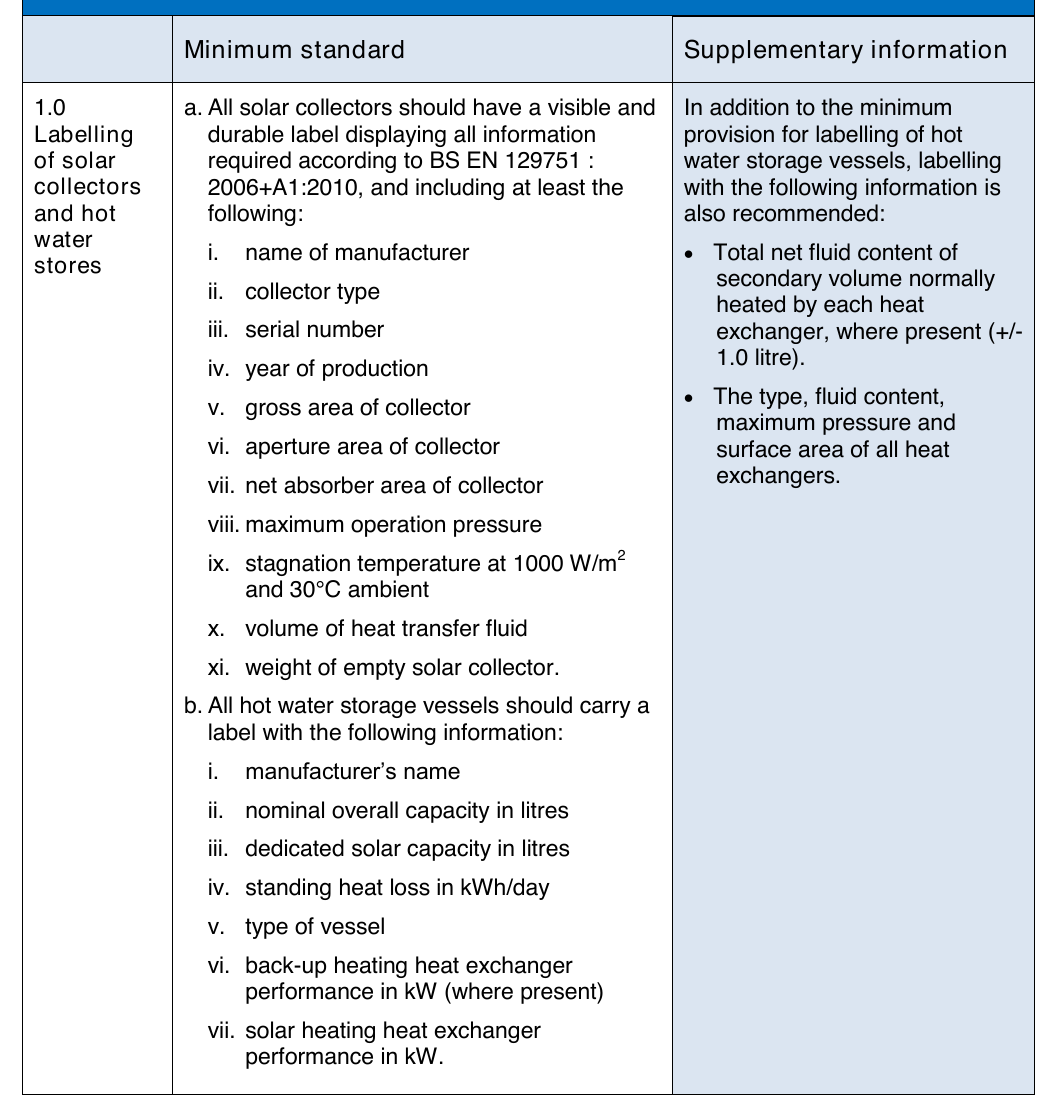
Page 83
#Source page 83
Table 40: Recommended minimum standards for labelling, commissioning and documentation for solar hot water systems
| Minimum standard | Supplementary information | |
|---|---|---|
| 2.0 Commiss- ioning | a. A signed and dated commissioning certificate should be completed to confirm the equipment has been correctly installed and to record key safety and operational features. b. As a minimum, the commissioning certificate should record the following details of the solar system: i. net or aperture area of solar collector ii. minimum ambient temperature without freeze damage to components iii. location of device and method for controlling over-pressure iv. location of the electrical isolating switch v. type of circulation fluid vi. circulation rate of collector circuit vii. location of device for protecting against overheating of solar heated water. | A signed commissioning certificate, certifying that the equipment is safe, legal and fit for its intended purpose, should be handed over to the dwelling owner or user as applicable. A separate certificate is required to cover the installation and commissioning of the hot water storage vessels and appliances within a solar DHW system. A commissioning engineer should be a competent person who can personally testify by signature and date that the equipment has been commissioned. |
| 3.0 Document- ation | Information provided to the dwelling owner or user should include: user manual warranty information a recommended maintenance schedule commissioning certificate full contact details of the installer. |
Page 84
#Source page 84
Table 41: Recommended minimum standards for insulation of pipework in solar hot water systems
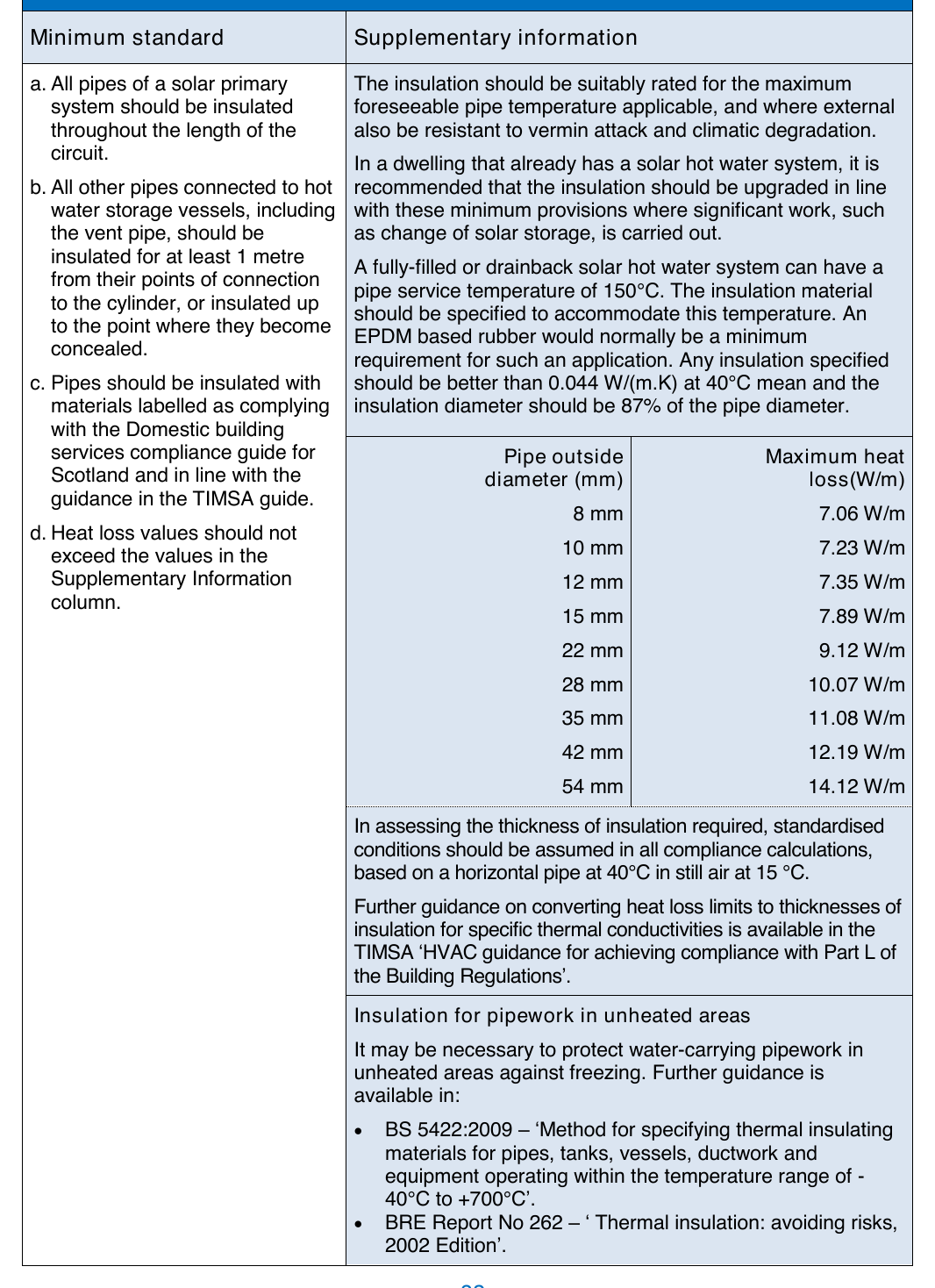
Page 85
#Source page 85
Supplementary Information
Further guidance and standards
Microgeneration Certification Scheme standard MIS3001 - ‘Requirements for contractors undertaking the supply, design, installation, set to work, commissioning and handover of solar heating microgeneration systems’.
Energy Efficiency Best Practice in Housing CE131 – ‘Solar water heating systems. Guidance for professionals, conventional indirect models’.
CIBSE ‘Solar heating design and installation guide’.
CE 51/GIL59 – ‘Central Heating System Specifications’ (CHeSS), 2005.
Section 12: Lighting
#Source page 86
12.1Scope of guidance
This section provides guidance on the specification of fixed internal and external lighting for new and existing dwellings to meet relevant energy efficiency requirements in the building regulations.
12.2Key terms
Circuit-watt means the power consumed in lighting circuits by lamps and, where applicable, their associated control gear (including transformers and drivers) and power factor correction equipment.
Light fitting means a fixed light or lighting unit that can comprise one or more lamps and lampholders, control gear and an appropriate housing. The control gear may be integrated in the lamp or located elsewhere in or near to the fixed light.
Fixed external lighting means lighting fixed to an external surface of the dwelling supplied from the occupier’s electrical system. It excludes lighting in common areas of blocks of flats and in other communal accessways.
12.3Internal and external lighting
Fixed internal and external lighting should meet the minimum standards for efficacy and controls in Table 42.
Page 87
#Source page 87
Table 42: Recommended minimum standards for fixed internal and external lighting
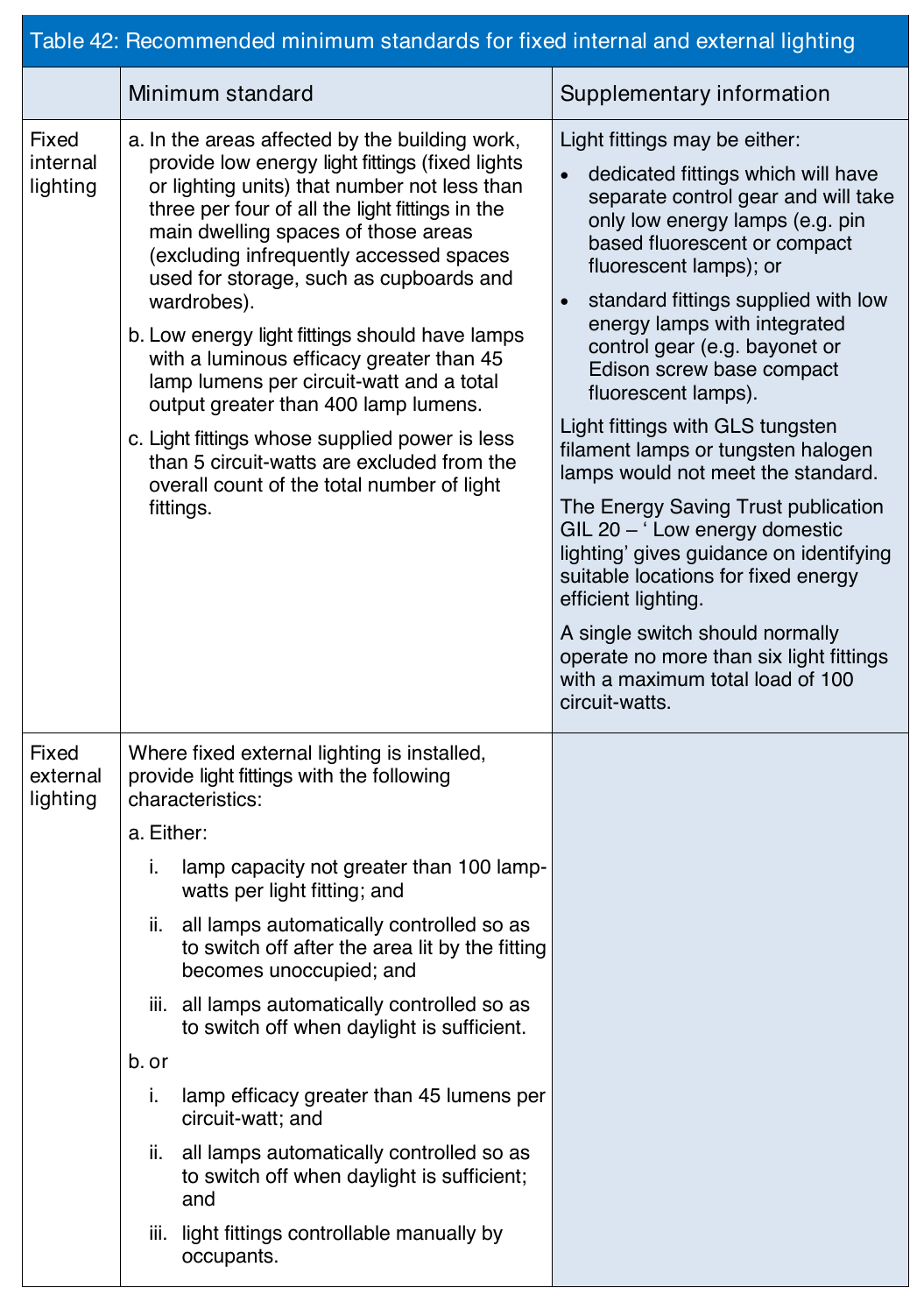
Page 88
#Source page 88
Supplementary information
British and European Standards
BS EN 15193:2007 – ‘Energy performance of buildings – Energy requirements for lighting’.
Other related documents
CE80 – ‘Domestic lighting innovations’, Energy Efficiency Best Practice in Housing.
CE61 – ‘Energy efficient lighting – guidance for installers and specifiers’, Energy Saving Trust.
EP84 – ‘Housing for people with sight loss’, Thomas Pocklington Trust Design Guide.
IP412 – ‘Making the most of your sight: Improve the lighting in your home’, RNIB and Thomas Pocklington Trust.
Energy Saving Trust best practice standards
The Energy Saving Trust sets best practice ‘Energy Saving Recommended’ (ESR) standards for lamps that cover not only energy efficiency, but also other aspects of quality including colour rendering, warm-up time, product life and power factor. It is advisable to install only ESR low energy lamps in dwellings.
Section 13: Micro-combined heat and power
#Source page 89
13.1Scope of guidance
This section provides guidance on the specification of micro-combined heat and power (micro-CHP) packages for dwellings to meet relevant energy efficiency requirements in the building regulations.
The guidance covers micro-CHP systems with an electrical output less than 5 kWe which are:
• heat-led
• capable of exporting electricity to the grid, and
• controlled in such a way as to avoid heat dumping.
13.2Key terms
Heating plant emission rate (HPER) is the annual CO2 emissions from fuel and power consumed by the heating plant, offset by the emissions saved as a result of any electricity generated by the heating plant, divided by the heat output over a year. It is measured in units of kg of CO2 per kWh. To calculate HPER it is necessary to know the plant size ratio.
Note: The HPER includes any auxiliary space and water heating that may be necessary, i.e. it represents the performance of all heating plant needed to provide space and water heating service to the building, assuming a standard demand pattern.
Plant size ratio (PSR) is defined as the nominal heat output of the heating plant divided by the design heat loss (the average heat loss of the building on a cold day with a temperature differential of 24.2 °C). Note: For a given heat demand, the PSR determines the part-load condition for the heating plant.
13.3Micro-CHP systems
a.For new systems and alterations to existing systems, the HPER of the micro-CHP package (calculated as in sub-paragraph c. below) should be no greater than the carbon emission factor for the fuel divided by the minimum efficiency for a regular boiler using that fuel, at the PSR determined as in sub-paragraph b. below. The design heat loss of the dwelling should be calculated using the Energy Saving Trust’s Whole house boiler sizing method for houses and flats19.
b.The PSR for the micro-CHP system when operating in the intended dwelling should be calculated as defined in paragraph 13.2 above.
Page 90
#Source page 90
c.The HPER of the micro-CHP system should be calculated at the PSR determined in sub- paragraph b. above, using the methodology set out in DECC’s Annual Performance Method (APM)20, and the performance data for the micro-CHP package established by testing according to BSI PAS 6721.
Supplementary information
British and European Standards
BS EN 15316-4-4:2007 – ‘Heating systems in buildings – method for calculation of system energy requirements and system efficiencies – Heat generation systems, building-integrated cogeneration systems’.
Other documents
Appendix N of SAP 2012 - ‘Method to evaluate the annual energy performance of micro- cogeneration heating systems in dwellings’.
BSRIA BG 2/2007 – ‘CHP for existing buildings: Guidance on design and installation’.
Microgeneration Certification Scheme standard, MIS 3007-2 – ‘Requirements for contractors undertaking the design, supply, installation, set to work, commissioning and handover of a domestic hot water system containing an electricity-led micro-cogeneration package’.
‘Connecting a microgeneration system to a domestic or similar electrical installation (in parallel with the mains supply)’, Best Practice Guide, the Electrical Safety Council.
Section 14: Heating system circulators
#Source page 91
14.1Scope of guidance
This section provides guidance on the specification of heating system glandless circulators, both standalone and integrated in products, to meet relevant energy efficiency requirements in the building regulations.
14.2Circulators
Heating system glandless circulators up to 2.5 kW, provided with new systems or as replacements in existing systems in dwellings, should meet the minimum standards for energy efficiency in Table 43.
Table 43: Recommended minimum standards for glandless heating system circulators
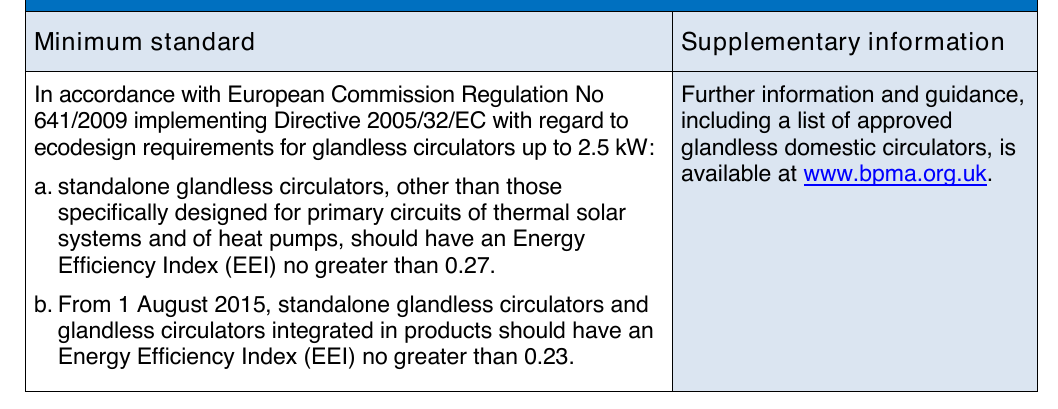
Appendix A: Abbreviations
#Source page 92
APM Annual Performance Method
ASHP Air Source Heat Pump
BS British Standard
BSD Building Standards Division
BSI British Standard Institute
CHeSS Central Heating System Specification
CHP Combined Heat And Power
CO2 Carbon Dioxide
COP Coefficient Of Performance
DECC Department For Energy And Climate Change
DHW Domestic Hot Water
EEI Energy Efficiency Index
EER Energy Efficiency Ratio
EN European Norm (Standard)
ESR Energy Saving Recommended
GSP Ground Source Heatpump
HPER Heating Plant Emission Rate
HVAC Heating Ventilation And Air Conditioning
LPG Liquefied Petroleum Gas
PAS Publicly Available Specification
PCDB Product Characteristic Database
PSR Plant Size Ratio
RHI Renewable Heat Incentive
SAP Standards Assessment Procedure
SCOP Seasonal Coefficient Of Performance
SG Scottish Government
SEDBUK Seasonal Efficiency Of Domestic Boilers In The UK
SEER Seasonal Energy Efficiency Ratio
SFP Specific Fan Power
SI Statutory Instrument
SPEER Seasonal Primary Energy Efficiency Ratio
SPF Seasonal Performance Factor
TER Target (Carbon Dioxide) Emission Rate
TRV Thermostatic Radiator Valve
WSHP Water Source Heat Pump
Page 93
#Source page 93