
How to specify blinds
What an internal blind clause has to cover, from cord safety and fabric to solar performance, operation and fixing, and how to write it in CAWS and in Uniclass.
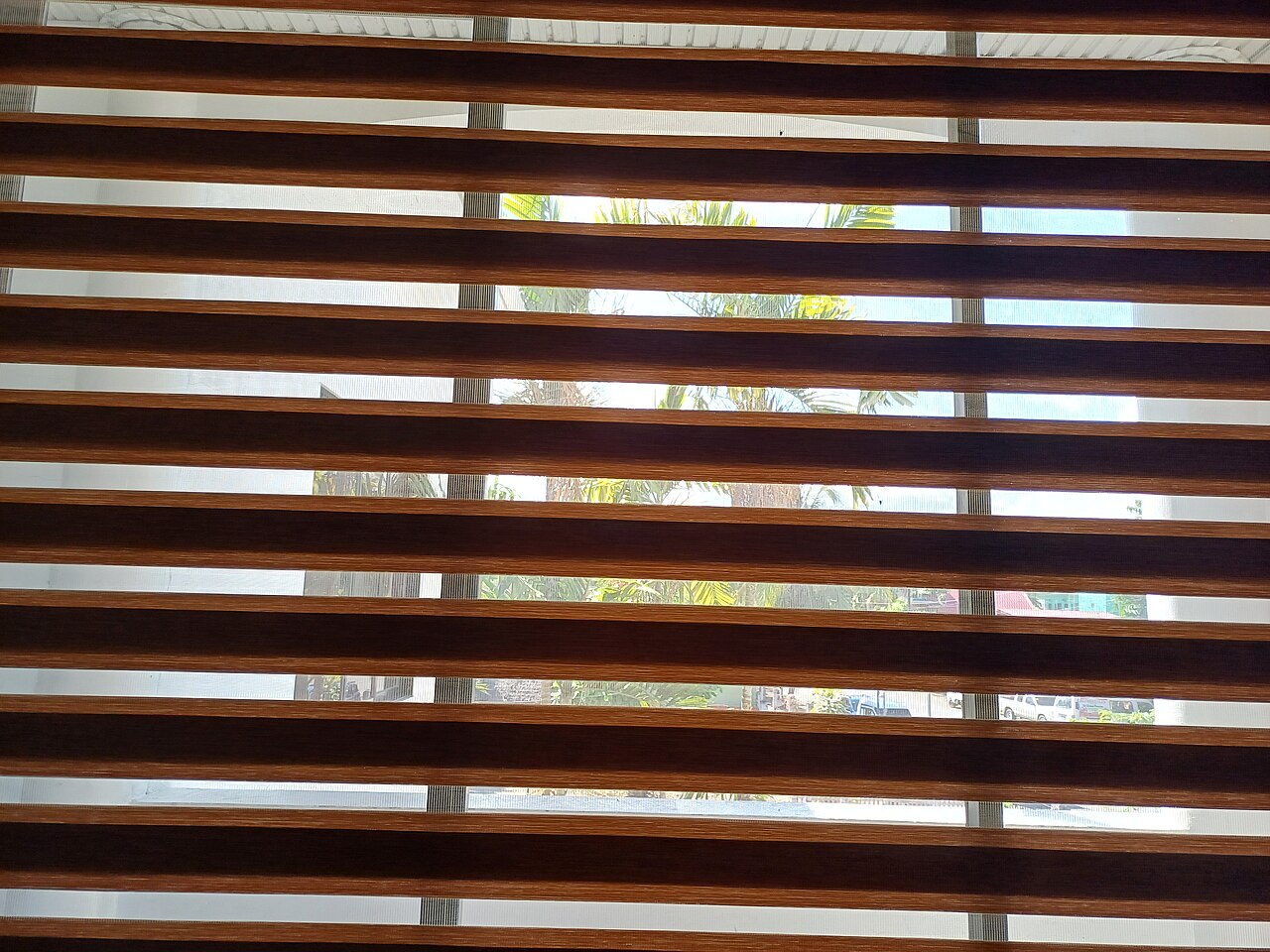
Photo: Curpharar, CC BY-SA 4.0, via Wikimedia Commons.

How do you specify blinds?
To specify internal blinds, name the blind type, fabric (composition, openness or blackout, colour) and operation, and require the blinds to meet BS EN 13120, including its protection against strangulation, with cordless, motorised or tensioned operation where children may be present. Add the fabric fire performance the fire strategy or client asks for, the solar and glare performance where the blinds matter to comfort, and the mounting position and headrail, and leave sizes and window references to the blind schedule.
Blinds are often treated as an FF&E item and bought late, but a blind clause carries real risks. Looped cords and chains have caused deaths of young children, which is why the internal blinds standard now has specific strangulation protection. Fabrics may need a fire performance. Blinds that clash with window handles, trickle vents or radiators are a coordination failure that shows up on the first day.
This guide uses Uniclass Pr_30_59_07_72 Roller blinds, the most common internal blind in UK projects. Venetian, vertical, pleated and blackout blinds have their own codes in the same group, such as Pr_30_59_07_94 Venetian blinds and Pr_30_59_07_07 Blackout blinds, and the same properties apply.
What does a blind clause need to cover?
Some properties are specific to blinds. Others belong in every product clause. A clause that leaves either out gives the contractor room to substitute.
Properties of blinds
- Product typeRoller, venetian, vertical, pleated or Roman.
- Fabric specificationComposition, openness factor, blackout, colour.
- Operation methodChain, spring, crank, wand or motorised.
- Child safetyNever guessStrangulation protection to BS EN 13120.
- Operating force classForce needed to operate, relevant to accessibility.
- DurabilityMechanical endurance for frequent use.
- Track and support systemHeadrail, cassette and side channels.
- Blade profile and spacingVenetian and vertical slat widths only.
- Mounting typeReveal, face or ceiling fixed; clear of handles and vents.
- AccessoriesCassettes, side channels, pelmets, bottom bars.
- Solar performanceSolar and light transmittance and gtot to BS EN 14501.
- Reaction to fire classificationNever guessFabric fire performance where the fire strategy or client asks.
- Electrical ratingMotorised blinds: supply, controls and interface.
What every product clause needs
- Manufacturer and product referenceNamed blind system and fabric range.
- Product standardBS EN 13120 for internal blinds.
- Installation methodMeasured on site, fixed to the reveal, head or ceiling.
- Technical submittalsFabric data, fire and solar test reports, safety device details.
- Operation and maintenance informationCleaning, safety device checks and motor settings.
- MaterialHeadrail and bottom bar material, usually aluminium.
- FinishHeadrail and cassette colour, RAL or range reference.
Uniclass Pr_30_59_07_72 Blinds. Not every property applies to every project; where one does not, say so rather than leaving it blank.
Fields marked Never guess (child safety and reaction to fire classification) depend on the project and should never be filled from a default or a previous job. If the information is not available yet, the clause should say so with a TBC and a reason.
Which decisions does the clause depend on?
Most properties follow from the product you choose. These depend on the project, so they need a decision from the designer before the clause is written.
- 01
Cord and chain safety
Never guessLooped cords and chains on internal blinds are a strangulation risk to young children. BS EN 13120 includes requirements to protect against strangulation, BS EN 16433 gives the test methods and BS EN 16434 covers safety devices such as chain tensioners and breakaway connectors. A safety device only works if it is fitted: a chain tensioner left in the box is the most common failure. In homes, schools, nurseries, hotels and healthcare buildings, cordless, spring, crank or motorised operation removes the loop altogether.
How to decide
- Where children may be present, choose operation with no accessible loop: spring, crank, wand or motorised.
- Where chains are used, require a chain tensioner fixed to the wall or reveal as part of installation, not supplied loose.
- Ask for evidence that the blind, as installed, meets BS EN 13120 strangulation requirements.
- Check that the installer leaves the safety warning labels the standard requires.
Write it asChild safety: To BS EN 13120, tested to BS EN 16433. Chain-operated blinds fitted with tensioning devices to BS EN 16434, fixed to the reveal during installation. - 02
Fire performance of the fabric
Never guessBlinds are not wall or ceiling linings, so the lining classes in Approved Document B do not apply to them. That does not mean fabric fire performance can be ignored. Fire strategies for some building types, health and education clients, and hotel operators often ask for blind fabrics to meet a fabric flammability standard, commonly BS 5867-2 for non-domestic curtains, drapes and window blinds, or for a Euroclass to BS EN 13501-1. Many blind fabrics are sold in standard and flame-retardant versions that look identical.
How to decide
- Check the fire strategy and the client's design guide for a fabric requirement.
- Health, education and hospitality: expect a requirement; confirm whether it is BS 5867-2 Type B or a Euroclass.
- Ask for the test report for the exact fabric and colour supplied, not the range.
- Do not assume a flame-retardant fabric stays so after washing; check the manufacturer's care instructions.
Write it asFabric fire performance: To BS 5867-2, Type B. Submit test report for the fabric supplied. - 03
Solar control and glare
ComfortInternal blinds control glare well and solar gain less well, because the heat has already passed through the glass. BS EN 14501 classifies blinds for thermal and visual comfort, including gtot, the total solar energy transmittance of the blind and glazing together, and glare control. Approved Document O does not allow internal blinds to be counted in its dynamic thermal modelling route, so they cannot be used to show compliance with the overheating requirement, though they still matter to occupants. Fabric colour and openness factor decide most of the performance.
How to decide
- Offices and schools with screens: a screen fabric with an openness factor chosen for glare and outward view.
- Bedrooms and AV rooms: blackout fabric with side channels to stop light leakage.
- Where the M&E engineer's model assumed a blind, ask for the gtot and fabric data it used and specify to match.
- Do not rely on internal blinds for Approved Document O compliance.
Write it asSolar performance: Screen fabric, openness factor and gtot as the M&E engineer's thermal model; classes declared to BS EN 14501. - 04
Manual or motorised
OperationOperation decides safety, accessibility and coordination. Manual chain operation is cheap but carries the cord risk and needs a free hand and a reach. Spring blinds suit small windows. Crank operation suits high windows. Motorised blinds remove the cord, suit large or high windows and can be grouped or linked to building controls, but they need power at the head of every window, a control interface and someone to commission them. Accessible rooms need controls a wheelchair user can reach and operate.
How to decide
- High or inaccessible windows: motorised or crank operation.
- Accessible bedrooms and staff areas: controls within reach, with low operating force or motorised.
- Motorised blinds: confirm supply positions, switching and any building management system interface with the electrical engineer.
- Large runs in one room: group control so blinds move together.
Write it asOperation: Motorised, 230 V tubular motor, wall switch per group; supply and controls as electrical specification. - 05
Mounting position and coordination
CoordinationWhere the blind goes decides whether it works. Reveal-fixed blinds look neat but need enough reveal depth and must clear window handles, opening lights and trickle vents. Face-fixed blinds overlap the opening and block more light. Ceiling-fixed and recessed pockets need coordinating with the ceiling grid. Blinds that hit an inward-opening window, or that sit over a radiator, will be damaged quickly. The blind supplier measures on site, but the architect has to provide space for the blind in the window and ceiling details.
How to decide
- Check reveal depth against the cassette or roller size before choosing reveal fixing.
- Keep blinds clear of window handles, restrictors and trickle vents on inward-opening windows.
- Recessed blind pockets: detail them with the ceiling and allow access to the motor.
- State that sizes are taken on site after windows are installed.
Write it asMounting: Reveal fixed, clear of window handles and trickle vents. Sizes measured on site after window installation.
The values under "Write it as" are examples. The right value depends on the location, the use and the fire strategy.
Which standards should the clause cite?
Cite the product standard the declaration of performance refers to, the code of practice for installation, and the test method behind each value you set. A value without its test method cannot be checked against a submittal.
- BS EN 13120
- Internal blinds. Performance requirements including safety
Requirements for internal blinds as installed, including protection against strangulation, for roller, venetian, vertical, pleated, Roman and other types.
In the clause "Blinds: to BS EN 13120."
- BS EN 16433
- Internal blinds. Protection from strangulation hazards. Test methods
Test methods for checking compliance with the strangulation protection requirements.
In the clause "Strangulation protection: tested to BS EN 16433."
- BS EN 16434
- Internal blinds. Protection from strangulation hazards. Requirements and test methods for safety devices
Safety devices such as chain tensioners, breakaway connectors and cord accumulators.
In the clause "Chain tensioners: to BS EN 16434, fixed during installation."
- BS EN 14501
- Blinds and shutters. Thermal and visual comfort. Performance characteristics and classification
Classes for solar control, thermal and visual comfort, including gtot and glare control.
In the clause "Solar and visual performance: classes declared to BS EN 14501."
- BS 5867-2
- Fabrics for curtains, drapes and window blinds. Flammability requirements. Specification
Flammability requirements for fabrics for non-domestic curtains, drapes and window blinds.
In the clause "Fabric: to BS 5867-2, Type B."
- BS EN 13501-1
- Fire classification of construction products and building elements. Classification using data from reaction to fire tests
Euroclasses that some fabric manufacturers declare and some fire strategies ask for.
In the clause "Fabric: Class B-s1, d0 to BS EN 13501-1, where the fire strategy asks for a Euroclass."
- BS EN 13561
- External blinds and awnings. Performance requirements including safety
External blinds and awnings, including wind resistance classes. Not used for internal blinds.
In the clause Cite it only for external blinds and awnings.
- BS EN 13659
- Shutters and external venetian blinds. Performance requirements including safety
Shutters and external venetian blinds, including wind resistance. Not used for internal blinds.
In the clause Cite it only for external venetian blinds and shutters.
Confirm the current edition of each standard at every issue. Avoice's State of UK Specifications 2026 found a withdrawn standard cited in 40% of specifications at contract issue.
For the regulations behind these choices, see Approved Document O explained, or search the Avoice Regulations library.
How do you write it in CAWS?
In CAWS, internal blinds are a product clause in N10, General fixtures/ furnishings/ equipment. NBS gives blinds the reference N10/240, and further blind types get their own clauses alongside it. A project with screen roller blinds in offices and blackout blinds in meeting rooms needs two clauses, each with a type mark the blind schedule uses.
The N10 general and execution clauses, such as installation generally and completion, apply to every blind. The blind clause states the product, operation and safety requirements, and points to the electrical specification for motor supplies and controls.
- Manufacturer
- Submit proposals
- Product reference
- Submit proposals
- Type
- Roller blind, internal
- Standard
- To BS EN 13120
- Fabric
- Screen fabric, glass fibre and PVC, openness factor as M&E thermal model
- Fabric colour
- TBC Interior designer's colour selection outstanding; affects glare and gtot. Resolve before ordering.
- Fabric fire performance
- To BS 5867-2, Type B
- Headrail
- Aluminium cassette, powder-coated, colour to match window frames
- Operation
- Chain, with tensioning device to BS EN 16434 fixed to the reveal
- Child safety
- Strangulation protection to BS EN 13120, tested to BS EN 16433
- Bottom bar
- Weighted aluminium, enclosed
- Mounting
- Reveal fixed, clear of window handles and trickle vents
- Sizes
- Measured on site after window installation, as blind schedule
- Submittals
- Fabric data, fire test report and safety device details
Illustrative, not from a real project. One property is left as a TBC with a reason so it can be tracked and closed before issue.
Clauses the type clause relies on
- N10/720
- Installation generally Fixing to the manufacturer's instructions, level, with protection until handover.
- N10/770
- Trims Pelmets and cover trims where blinds are recessed or boxed in.
- N10/910
- General Completion: checking operation and safety devices before handover.
Clause numbers vary between NBS versions and practice masters. The 240 number follows the N10 reference NBS gives for blinds, and 720, 770 and 910 are those listed for N10 in an NBS section index.
How do you write it in Uniclass?
Uniclass puts internal blinds in Ss_40_15_35_19 Curtain and blind systems. The system clause describes the blinds for a room type or area: which windows, how they are operated and controlled, and what the installation has to achieve for safety and comfort.
The blind itself is a product clause, here Pr_30_59_07_72 Roller blinds. Office floors and meeting rooms can share one blind product with different fabrics, or use two products, with each system clause pointing to the right one. Motor and control requirements belong in the system clause, because they depend on the room.
- Description
- Internal roller blinds to office windows
- Blinds
- Pr_30_59_07_72 Roller blinds (BL01)
- Locations
- As blind schedule
- Operation
- Chain with tensioning device fixed to reveal
- Child safety
- To BS EN 13120 as installed
- Coordination
- Clear of window handles, restrictors and trickle vents
- Manufacturer
- Submit proposals
- Product reference
- Submit proposals
- Standard
- BS EN 13120
- Fabric
- Screen fabric, glass fibre and PVC
- Fabric colour
- TBC Interior designer's colour selection outstanding; affects glare and gtot. Resolve before ordering.
- Fabric fire performance
- BS 5867-2, Type B
- Solar performance
- Classes declared to BS EN 14501
- Headrail
- Aluminium cassette, powder-coated
- Safety device
- Chain tensioner to BS EN 16434
Illustrative. Performance of the finished system sits in the system clause; properties of the product sit in the product clause.
In NBS Chorus, roller blinds also carry the NBS reference 45-25-10/360. Use whichever your practice's masters use, but do not mix CAWS and Uniclass references in one specification.
What goes in the spec, and what goes in the schedule?
The specification defines each type once. The schedule and drawings say where each type goes.
In the specification
What the product is and how it performs and is installed. Written once per type.
In the schedule or drawings
Where each type goes and how much of it. Changes with every plan revision.
Write each blind type once with a type mark (BL01) and let the blind schedule and window references say where it goes. Final sizes come from site measurement, so the schedule should not pretend to be a cutting list.
What are the common mistakes?
Most problems are a missing property, a property filled with the wrong kind of value, or a decision left silently open.
- Chain tensioners supplied loose. A tensioner in the box protects nobody. Require it fixed during installation and check it at handover.
- No fabric fire requirement checked. Health, education and hotel clients often need one. Ask before the fabric is chosen, not after.
- Blinds counted for Part O. Approved Document O does not let internal blinds be included in the dynamic thermal model. Do not rely on them for compliance.
- Blinds clashing with window handles. Reveal-fixed blinds on inward-opening windows get torn. Check clearances in the window details.
- Motorised blinds with no supply. Every motor needs power and a control. Coordinate with the electrical engineer before first fix.
- Citing the external blind standard. BS EN 13561 is for external blinds and awnings. Internal blinds are covered by BS EN 13120.
How Avoice helps
Avoice's spec writer drafts blind clauses from your window drawings and schedules, and marks what still needs a decision.
- Drafts from your drawings and schedules
It reads blind types (BL01, BL02) from the blind schedule and window elevations, picks the N10 or Uniclass heading, and fills in type, fabric and operation from the information you have given it.
- Leaves a TBC where your information does not settle it
If the fabric colour or fire requirement is still open, the clause says TBC with the reason, and the item goes into the project TBC register to close before tender.
- Writes in your format and your style
Choose CAWS or Uniclass. Avoice adapts your practice's own N10 masters rather than replacing them with generic text.
- Checks the clause against everything else
QA/QC flags a BL03 on the schedule that the specification never defines, an external blind standard cited for internal blinds, or a withdrawn standard.
- Keeps product data in one place
Fabric data sheets and fire test reports sit in the Product Room linked to the clause, so a substitute fabric can be checked against the fire and solar values the clause asks for.
Related guides: How to specify aluminium windows, How to specify curtain walling.
Software can draft and check. The designer still chooses the product and is responsible for the specification.
Draft your blind clause in Avoice
Upload your drawings and schedules. Avoice drafts the clause in CAWS or Uniclass, cites the standards and flags anything your information does not settle.
This guide is for general education and is not professional advice. Check current editions of standards and Approved Documents, the manufacturer's data, and the requirements of your project before relying on any clause.