
How to specify linoleum
What a linoleum clause has to say, the decisions that sit behind it, the standards to cite, and how to write it in CAWS and in Uniclass.
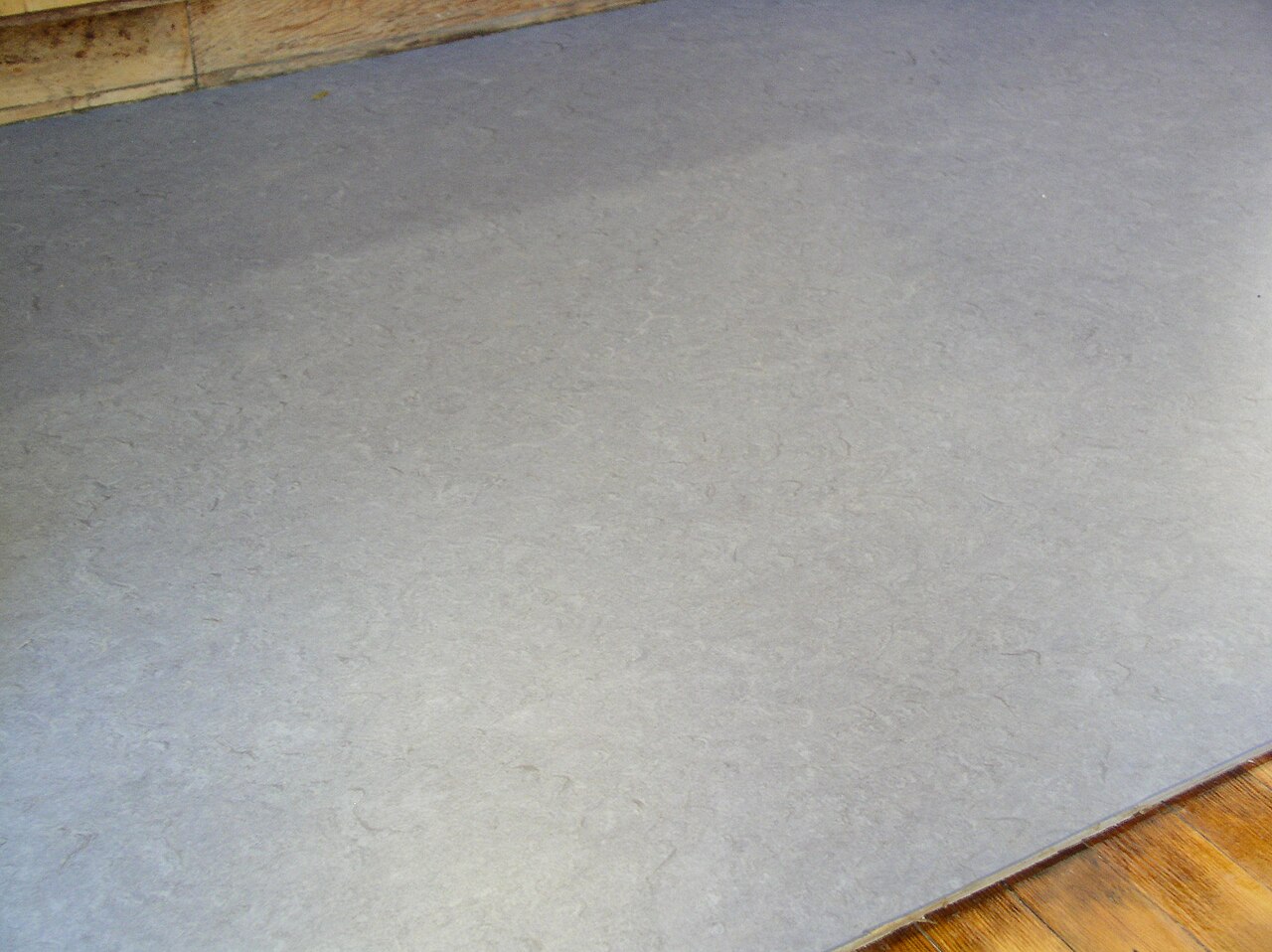
Photo: blahedo, CC BY-SA 2.5, via Wikimedia Commons.

How do you specify linoleum?
To specify linoleum, name the product standard, BS EN ISO 24011, the form (sheet or tile) and thickness, and the use class to BS EN ISO 10874, then state the wet slip resistance as a pendulum value and the reaction to fire class. Put the subfloor moisture limit, adhesive, heat-welded seams and cove skirting in the same clause, and leave room-by-room locations to the finishes schedule.
Linoleum is chosen as often for what it is made of as for how it performs: linseed oil, wood flour, limestone and pigment on a jute backing. That tends to push the clause towards the colour card and away from the properties that make it last, and linoleum is less forgiving than vinyl in a few specific ways. It reacts badly to damp, alkaline screeds and to strong alkaline cleaners, and fresh sheet has a yellow cast that worries clients who have not been warned about it.
This guide covers Uniclass Pr_35_57_71_46 Linoleum sheets. Tiles are Pr_35_57_71_49 Linoleum tiles, and foam-backed and cork-backed sheets each have their own codes, so a clause that changes the backing should also change the heading.
What does a linoleum sheet clause need to cover?
Some properties are specific to linoleum. Others belong in every product clause. A clause that leaves either out gives the contractor room to substitute.
Properties of linoleum
- Product typeSheet or tile, and plain, marbled or patterned.
- Nominal sizeRoll width or tile size sets seam layout and wastage.
- ThicknessOverall thickness, matched to adjoining finishes and thresholds.
- Mass per unit areaChecks the product delivered matches the one specified.
- FinishColourway, pattern and factory surface treatment.
- Use classBS EN ISO 10874 class matched to the traffic.
- Wear resistanceRead from the declared use class for linoleum.
- Slip resistanceNever guessWet PTV by pendulum, not a dry value or ramp rating.
- Reaction to fire classificationFloor Euroclass to BS EN 13501-1, often Cfl-s1.
- Residual indentationResistance to dents under furniture legs and equipment.
- Dimensional stabilityLimits shrinkage and opening of seams after laying.
- Castor chair suitabilityNeeded for office chairs and trolleys.
- Chemical resistanceLinoleum is damaged by strongly alkaline cleaners and spills.
- LightfastnessColour stability next to glazing; separate from drying-room yellowing.
- Electrostatic behaviourBody voltage for offices with sensitive equipment.
- Infection controlWelded seams and a cleaning regime agreed with the client.
- EmissionsLow VOC from flooring and adhesive, to a recognised scheme.
- Acoustic performanceImpact sound reduction, mainly for foam or cork backed products.
- Thermal performanceThermal resistance and suitability over underfloor heating.
- Recycled contentFor sustainability targets and reporting.
- Moisture content before coveringSubfloor relative humidity by hygrometer to BS 8203.
- AdhesiveLinoleum adhesive named by the flooring manufacturer.
- Joint treatmentHeat welded with matching rod for sheet; tiles butt jointed.
- Laying patternSheet direction, or tile layout and pattern direction.
- AccessoriesCove formers, cap strips, skirtings, nosings and edge trims.
- Sample approvalAgree colourway and batch before ordering.
What every product clause needs
- Manufacturer and product referenceNamed range and colourway, or a performance description.
- Product standardBS EN ISO 24011, with a declaration of performance to BS EN 14041.
- Installation methodBS 8203 and the manufacturer's linoleum instructions.
- Technical submittalsData sheet, DoP, wet slip test and fire classification.
- Operation and maintenance informationInitial clean, protective treatment and pH-neutral cleaning products.
- MaterialLinseed oil binder, fillers and pigment on a jute backing.
- SubstrateSmoothed, dry screed or panel; no residual alkaline moisture.
Uniclass Pr_35_57_71_46 Linoleum. Not every property applies to every project; where one does not, say so rather than leaving it blank.
Fields marked Never guess (slip resistance) depend on the project and should never be filled from a default or a previous job. If the information is not available yet, the clause should say so with a TBC and a reason.
Which decisions does the clause depend on?
Most properties follow from the product you choose. These depend on the project, so they need a decision from the designer before the clause is written.
- 01
Wet slip resistance
Never guessManufacturers often give a dry pendulum value, a ramp R rating and a dry friction result to BS EN 13893, and none of these tells you how the floor behaves when it is wet. The value to specify is the wet pendulum test value (PTV) to BS EN 16165 Annex C. UK Slip Resistance Group guidance treats a wet PTV of 36 or more as low slip potential. Standard linoleum is a smooth floor, so for kitchens, entrances and other areas that will be wet in use, check the wet value before writing linoleum into those rooms at all.
How to decide
- List the rooms that will be wet in use: entrances, tea points, kitchens, WCs and areas next to external doors.
- Use slider 96 for shod areas; for barefoot areas the UK foreword to BS EN 16165 prefers slider 55 to the slider 57 named in the standard.
- Ask for the wet PTV for the exact surface finish supplied, not a range-wide brochure figure.
- Where linoleum cannot reach the value, make that area a separate floor type with safety flooring.
Write it asSlip resistance: Wet PTV not less than 36, tested to BS EN 16165 Annex C using slider 96. Submit test report for the finish supplied. - 02
Subfloor moisture and alkalinity
SubfloorLinoleum adhesive and the linoleum itself are vulnerable to moisture coming up from the base, and moisture rising from a cement screed carries alkalinity with it, which attacks the binder and the adhesive. The usual results are bubbling, lifting edges and discoloured patches, often within the first year. BS 8203 asks for a hygrometer test showing 75% relative humidity or less before laying. A clause that just says the screed must be dry gives nobody a number to test against.
How to decide
- Allow screed drying time in the programme, then require hygrometer readings to BS 8203 before laying.
- Where the programme will not allow drying, specify a surface damp-proof membrane compatible with the smoothing compound and the linoleum adhesive.
- Specify a smoothing underlayment so trowel marks and ridges do not read through the sheet.
- Use only the adhesive the linoleum manufacturer names, because linoleum adhesives are formulated for the material.
Write it asMoisture before covering: Not more than 75% RH, tested by hygrometer to BS 8203 Annex B. Submit readings before laying. - 03
Use class and thickness
TrafficBS EN ISO 24011 sets the requirements for plain and decorative linoleum, and BS EN ISO 10874 gives the use classes that tell you whether a product is made for the space. Thickness matters more with linoleum than with many floors because it sets both the use class a product can claim and the indentation resistance under furniture. The thinner sheets are cheaper and lighter to handle and will be offered as equivalents. State the class and the thickness together so a substitution has to meet both.
How to decide
- Offices, classrooms and hotel rooms: a commercial class of 32 or 33 is typical.
- Corridors, retail and heavily trafficked healthcare areas: a higher commercial class and the thicker gauge in the range.
- Where trolleys, beds or castor chairs are part of the use, check the castor chair result and residual indentation on the DoP.
Write it asClassification: Use class 33 to BS EN ISO 10874. Thickness: 2.5 mm. Product standard: BS EN ISO 24011. - 04
Welded seams and cove skirtings
SeamsSheet linoleum is laid with the seams cut tight and then heat welded with a matching welding rod, which closes the joint against dirt and water. In healthcare, food preparation and other hygiene-sensitive rooms the floor is usually coved up the wall with a cove former and capping strip so there is no joint at the floor-wall junction to clean. Both are labour-heavy and change the price, so the clause has to say whether seams are welded and whether skirtings are coved, set-in or sit-on, room type by room type.
How to decide
- Healthcare, kitchens, toilets and cleaners' stores: welded seams and a coved skirting with cove former.
- Offices and classrooms: welded seams are still normal for sheet; sit-on skirtings are acceptable.
- Tiles: butt jointed; check the manufacturer's guidance on sealing joints where wet cleaning is used.
Write it asJoints: Heat welded using manufacturer's matching welding rod. Skirting: Coved 100 mm high on cove former with capping strip, as clause 770. - 05
Cleaning regime and protective finish
MaintenanceLinoleum tolerates normal cleaning well but is damaged by strongly alkaline cleaners, which degrade the linseed binder and dull the surface. Most products now have a factory-applied surface treatment, and manufacturers set the products and pH range their warranty depends on. If the client's facilities team or cleaning contractor uses a single high-alkaline floor cleaner across the building, the problem will appear quickly. The cleaning regime belongs in the O&M information and should be agreed before handover, not after the first complaint.
How to decide
- Ask the client which cleaning products and machines their cleaning contractor uses.
- Require the manufacturer's initial cleaning and maintenance instructions, including the products to avoid.
- In healthcare, check the disinfectants in use against the manufacturer's chemical resistance data.
Write it asChemical resistance: Resistant to the client's cleaning agents as confirmed by the manufacturer in writing. Initial clean and maintenance instructions to be included in O&M information.
The values under "Write it as" are examples. The right value depends on the location, the use and the fire strategy.
Which standards should the clause cite?
Cite the product standard the declaration of performance refers to, the code of practice for installation, and the test method behind each value you set. A value without its test method cannot be checked against a submittal.
- BS EN ISO 24011
- Resilient floor coverings. Specification for plain and decorative linoleum
The product standard for linoleum, setting composition, dimensional and performance requirements for plain and decorative sheet and tiles.
In the clause "Product standard: BS EN ISO 24011".
- BS EN 14041
- Resilient, textile, laminate and modular multilayer floor coverings. Essential characteristics
The harmonised standard behind the declaration of performance, including reaction to fire, slip resistance and electrical behaviour.
In the clause "Submit declaration of performance to BS EN 14041."
- BS EN ISO 10874
- Resilient, textile and laminate floor coverings. Classification
The use classes 21 to 23, 31 to 34 and 41 to 43 that match a floor covering to the intensity of use.
In the clause "Use class: 33 to BS EN ISO 10874."
- BS 8203
- Code of practice for installation of resilient floor coverings
UK code of practice for base preparation, moisture testing by hygrometer, adhesives, welding and protection.
In the clause "Moisture before covering: not more than 75% RH, tested to BS 8203 Annex B".
- BS EN 16165
- Determination of slip resistance of pedestrian surfaces. Methods of evaluation
Annex C is the pendulum test, with slider 96 for shod use and slider 57 or, as the UK foreword prefers, slider 55 for barefoot use. It replaced BS 7976-2, which older reports may still cite.
In the clause "Wet PTV not less than 36, tested to BS EN 16165 Annex C using slider 96".
- BS EN 13501-1
- Fire classification of construction products and building elements. Classification using data from reaction to fire tests
The Euroclass system; floorings carry the fl suffix, for example Cfl-s1.
In the clause "Reaction to fire: Class Cfl-s1 to BS EN 13501-1."
- BS EN ISO 4918
- Resilient, textile and laminate floor coverings. Castor chair test
The test for floor coverings used with castor chairs, reported on the declaration of performance.
In the clause "Castor chair suitability: suitable for continuous use, tested to BS EN ISO 4918."
Confirm the current edition of each standard at every issue. Avoice's State of UK Specifications 2026 found a withdrawn standard cited in 40% of specifications at contract issue.
For the regulations behind these choices, see Approved Document M explained, Approved Document B explained, or search the Avoice Regulations library.
How do you write it in CAWS?
Linoleum is written in M50, the section that also covers vinyl, rubber, cork and carpet. Manufacturers' NBS clauses put linoleum sheet under clause 150, Sheeting, and each linoleum type on the project gets its own type clause: the product, the base, the preparation, the adhesive, the seam treatment and the skirting, so one clause prices one complete floor.
Workmanship common to every resilient floor sits further down M50 and is written once. Base suitability, the moisture test, smoothing compound, adhesive fixing, colour batches, edgings, skirtings and protection all live there, and the type clause refers to them by number. A welded sheet to the wards and a tile to the offices are two type clauses sharing the same general clauses.
- Base
- Sand and cement screed, as clause 410
- Preparation
- Smoothing underlayment compound, as clause 460
- Flooring
- Decorative linoleum sheet to BS EN ISO 24011
- Manufacturer
- Submit proposals
- Product reference
- Submit proposals
- Classification
- Use class 33 to BS EN ISO 10874
- Width
- 2 m rolls
- Thickness
- 2.5 mm
- Colour and pattern
- TBC Client finishes selection outstanding. Resolve before ordering.
- Slip resistance
- Wet PTV not less than 36 to BS EN 16165 Annex C, slider 96
- Reaction to fire
- Class Cfl-s1 to BS EN 13501-1
- Adhesive
- Linoleum manufacturer's recommended adhesive, as clause 640
- Joints
- Heat welded with manufacturer's matching welding rod
- Skirting
- Coved 100 mm high on cove former with capping strip, as clause 770
- Accessories
- Edge trims at changes of finish, as clause 740
Illustrative, not from a real project. One property is left as a TBC with a reason so it can be tracked and closed before issue.
Clauses the type clause relies on
- M50/410
- Suitability of new bases and conditions Starting work is taken as acceptance that the base and site conditions are suitable.
- M50/430
- Dampness Hygrometer readings to BS 8203 at 75% RH or less before laying.
- M50/460
- Smoothing underlayment compound Product and thickness of the smoothing layer over the screed.
- M50/620
- Colour consistency Sheet from one production batch per room or area.
- M50/640
- Adhesive fixing generally Adhesive coverage, rolling and removal of surplus adhesive.
- M50/870
- Protection Covering the finished floor until handover.
Clause numbers vary between NBS versions and practice masters; these follow the M50 layout in published NBS manufacturer clauses, so check that each clause the type clause refers to exists in your M50.
How do you write it in Uniclass?
In Uniclass the finished floor is Ss_30_42_72_72 Resilient sheet floor covering systems. The system clause carries the build-up and the performance of the floor once laid: base, preparation, moisture limit, adhesive, seams, skirting and the finished floor's slip resistance.
The linoleum itself is a product clause under Pr_35_57_71_46, called up by the system. Where the project also has linoleum tiles in offices, they belong in a separate tile system, Ss_30_42_72_75 Resilient tile floor covering systems, calling up a Pr_35_57_71_49 product clause, so sheet and tile do not share one clause with exceptions.
- Description
- Heat-welded linoleum sheet adhered to smoothed sand and cement screed
- Base
- Sand and cement screed, as the screed system clause
- Preparation
- Smoothing underlayment, flatness to suit the covering
- Moisture before covering
- Not more than 75% RH by hygrometer to BS 8203
- Covering
- Pr_35_57_71_46 Linoleum sheets (F03)
- Adhesive
- Linoleum manufacturer's recommended adhesive
- Joints and skirting
- Heat welded seams, coved skirting on cove former
- Slip resistance of finished floor
- Wet PTV not less than 36 to BS EN 16165 Annex C, slider 96
- Manufacturer
- Submit proposals
- Product reference
- Submit proposals
- Standard
- BS EN ISO 24011, declaration of performance to BS EN 14041
- Use class
- 33 to BS EN ISO 10874
- Width
- 2 m
- Thickness
- 2.5 mm
- Colour and pattern
- TBC Client finishes selection outstanding. Resolve before ordering.
- Reaction to fire
- Class Cfl-s1 to BS EN 13501-1
- Castor chair suitability
- Suitable for continuous use, tested to BS EN ISO 4918
- Recycled content
- Submit manufacturer's declared value
Illustrative. Performance of the finished system sits in the system clause; properties of the product sit in the product clause.
In NBS Chorus the product clause also carries an NBS reference (for linoleum sheet, 45-20-70/320); use whichever your masters use, but keep CAWS and Uniclass references out of the same specification.
What goes in the spec, and what goes in the schedule?
The specification defines each type once. The schedule and drawings say where each type goes.
In the specification
What the product is and how it performs and is installed. Written once per type.
In the schedule or drawings
Where each type goes and how much of it. Changes with every plan revision.
Write each linoleum type once with a type mark (for example F03) and let the finishes schedule say where it goes. Where seam positions matter, for example across a ward or a classroom, show them on the finishes plan rather than describing them in the clause.
Photo: Martin Strachoň, CC BY-SA 3.0, via Wikimedia Commons.

What are the common mistakes?
Most problems are a missing property, a property filled with the wrong kind of value, or a decision left silently open.
- A dry PTV taken as the slip value. Linoleum data sheets often quote dry pendulum or ramp values. Specify the wet PTV, and test it for the finish supplied.
- "Screed to be dry". It cannot be checked. Require hygrometer readings to BS 8203 before laying, or specify a surface DPM.
- Any adhesive. Linoleum needs the adhesive its manufacturer names. A general resilient flooring adhesive can fail or discolour the sheet.
- Seams left to the installer. Unwelded seams collect dirt and let water in. Say heat welded with matching rod wherever sheet is used.
- High-alkaline cleaners after handover. The building's cleaning contractor may use one product everywhere. Put the manufacturer's maintenance instructions in the O&M and tell the client.
- A silent default on colour. If the client has not chosen, say TBC with a reason so it is resolved before ordering rather than on site.
How Avoice helps
Avoice's spec writer drafts linoleum clauses from the finishes information on the project and shows clearly what it could not settle.
- Drafts from your drawings and schedules
It reads the floor types (F03 linoleum sheet, F04 linoleum tile) from the finishes schedule and plans, picks the M50 type clause or the Uniclass system and product headings, and fills in what your information supports.
- Leaves a TBC with a reason
If the colourway is still open, or nobody has confirmed whether the treatment rooms need coved skirtings, the line says TBC and why. Every TBC joins one project register to close before tender.
- Works from your own masters
Choose CAWS or Uniclass. Avoice adapts your practice's M50 clauses and wording rather than replacing them with generic text.
- Checks the spec against the drawings
QA/QC flags a linoleum type on the schedule with no clause behind it, a clause that cites BS 7976-2 for the slip test, or a reference to a skirting clause that has been deleted from your M50.
- Links product data to the clause
Declarations of performance, slip test reports and the manufacturer's cleaning instructions sit in the Product Room against the clause. Edit a linked product once and every clause that uses it updates.
Related guides: How to specify vinyl flooring, How to specify rubber flooring, How to specify screeds.
Software can draft and check. The designer still chooses the product and is responsible for the specification.
Draft your linoleum sheet clause in Avoice
Upload your drawings and schedules. Avoice drafts the clause in CAWS or Uniclass, cites the standards and flags anything your information does not settle.
This guide is for general education and is not professional advice. Check current editions of standards and Approved Documents, the manufacturer's data, and the requirements of your project before relying on any clause.