
How to specify lockers
What a locker clause has to settle, from the body material and duty level to locks, keying and fixing, and how to write it in CAWS and in Uniclass.
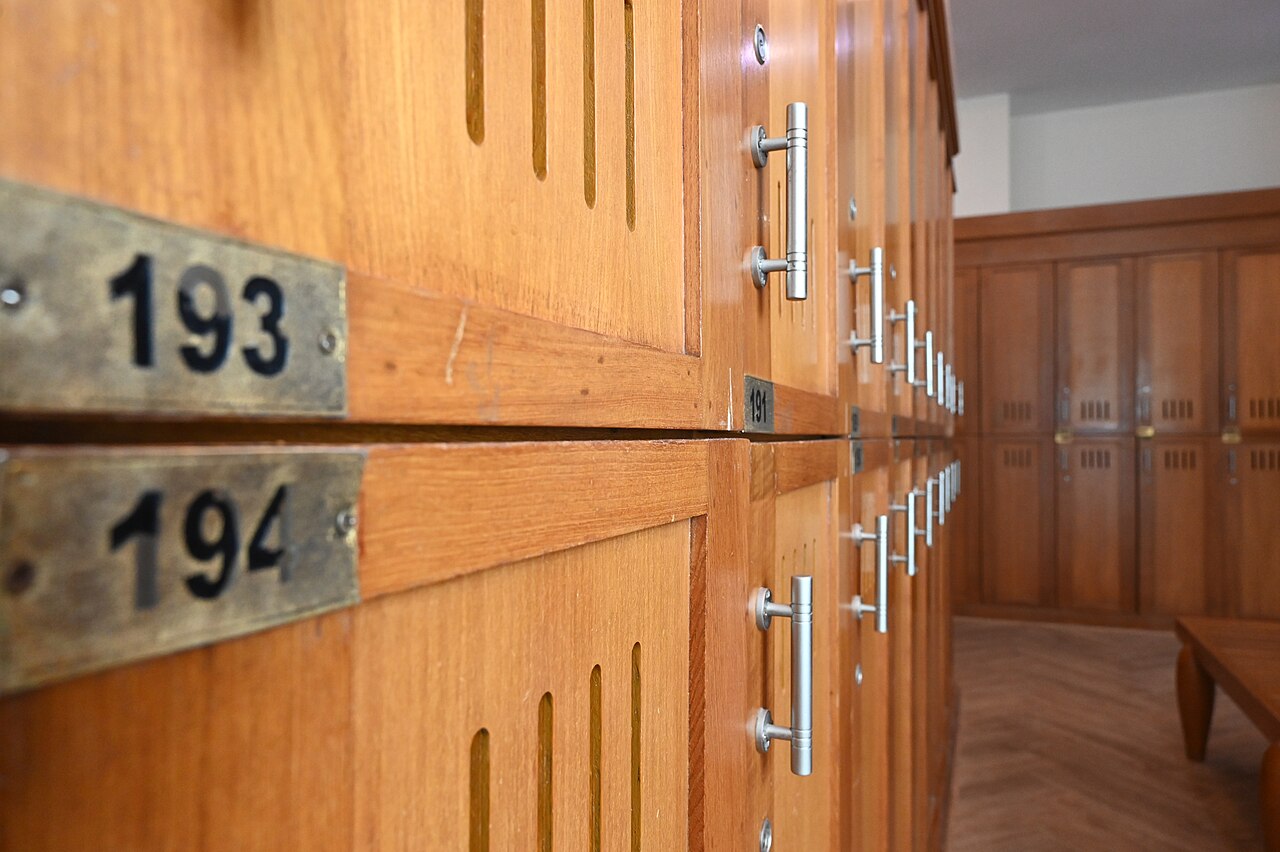
Photo: PattayaPatrol, CC BY-SA 4.0, via Wikimedia Commons.

How do you specify lockers?
To specify lockers, choose the body and door material for the environment (powder-coated steel for dry areas, compact laminate for wet changing rooms), state the duty level to BS 4680 for clothes lockers, and set the lock type and keying strategy with the client's facilities team. Say how the lockers are fixed so they cannot tip, whether they stand on stands, plinths or benches, and how they are numbered, and leave quantities and compartment configurations to the schedule.
Lockers look like a furniture order, and that is how they end up under-specified. The problems show up in use: steel lockers rusting in a pool changing room, a lock system the facilities team cannot manage, a bank of tall lockers that tips when a child climbs it, or a row that narrows a corridor below the width the fire strategy relied on.
This guide uses Uniclass Pr_40_30_87_48 Lockers. Smart lockers with electronic allocation have their own code, Pr_40_30_87_83 Smart lockers, and cycle lockers sit in a different group altogether, so check which one the scheduled item really is.
What does a locker clause need to cover?
Some properties are specific to lockers. Others belong in every product clause. A clause that leaves either out gives the contractor room to substitute.
Properties of lockers
- Product typeSingle, two-tier, multi-tier or Z-door lockers.
- MaterialSteel, compact laminate, MFC or timber body and doors.
- Carcass constructionWelded or bolted steel, or laminate panels and joints.
- Moisture resistanceWet changing areas need materials that do not swell or rust.
- Door and drawer front constructionDoor material, ventilation slots and edge finish.
- FinishPowder coat colour or laminate decor.
- Edge treatmentPolished compact edges or banded board edges.
- HardwareHinges and hooks that survive repeated forced use.
- Internal fittingsShelf, hanging rail, hooks, charging points.
- PlinthPlinth, stand with feet, or bench and stand.
- AccessoriesSloping tops, end panels, numbering and benches.
- Structural performanceDuty level to BS 4680 to suit the users.
- StabilityNever guessTall banks tip if not fixed; climbing is foreseeable.
- Formaldehyde emission classE1 or lower where wood-based boards are used.
- LockingCam, combination, coin or electronic, and the keying strategy.
- Timber speciesTimber-faced lockers only.
- Moisture contentTimber-faced lockers conditioned to the building.
What every product clause needs
- Manufacturer and product referenceNamed locker range and configuration, or a performance description.
- Product standardBS 4680 for clothes lockers.
- Installation methodLevelled, joined in banks and fixed to the structure.
- Technical submittalsData sheets, test evidence and keying schedule.
- Operation and maintenance informationMaster key procedures, lock spares, cleaning.
- FixingsWall and floor fixings, tamper-resistant in public areas.
Uniclass Pr_40_30_87_48 Lockers. Not every property applies to every project; where one does not, say so rather than leaving it blank.
Fields marked Never guess (stability) depend on the project and should never be filled from a default or a previous job. If the information is not available yet, the clause should say so with a TBC and a reason.
Which decisions does the clause depend on?
Most properties follow from the product you choose. These depend on the project, so they need a decision from the designer before the clause is written.
- 01
Stability and fixing
Never guessA bank of full-height lockers is tall, narrow and often loaded unevenly, with heavy bags in the top compartments. In schools and leisure buildings, people will pull on open doors and climb. Freestanding lockers that are not fixed to the wall or floor, or that stand on stands with adjustable feet that were never fixed down, can tip. The clause has to say how banks are joined and fixed, and the partition details have to provide something to fix to.
How to decide
- Join adjacent lockers into banks with the manufacturer's connectors.
- Fix every bank to the wall, and to the floor where it stands on a stand or plinth.
- On plasterboard partitions, show backing at fixing height on the partition details.
- In schools and public changing rooms, add sloping tops so the top cannot be used as a shelf or step.
Write it asStability: Lockers joined into banks and fixed to the wall and floor with tamper-resistant fixings, into backing shown on the partition details. - 02
Material for the environment
MaterialThe material follows the room. Powder-coated steel is the default for offices, schools and staff areas, and is cheap and robust, but it corrodes in wet changing rooms and around pools once the coating is chipped. Compact laminate does not rust or swell and suits wet and partially wet areas. Melamine-faced board lockers are cheaper but should be kept to dry rooms. Timber-faced lockers suit high-end gyms and hotels but need sealed edges and some ventilation.
How to decide
- Offices, schools, staff areas: powder-coated steel.
- Pool and wet-side changing rooms: compact laminate with stainless or non-corroding hinges and fixings.
- Dry changing and leisure areas on a budget: melamine-faced board, kept off wet floors.
- Match the locker material to the cubicles and benches in the same room.
Write it asMaterial: Compact laminate to BS EN 438-4, 12 mm doors and body panels, polished edges; hinges and fixings stainless steel. - 03
Locks and keying
SecurityThe lock is the part users interact with every day and the part facilities teams have to manage. Cam locks with keys get lost; combination locks need resetting; coin-return locks suit public pools; electronic and smart locks need power or batteries and a management system. Whatever the type, the client needs a master key or override, and someone has to decide who holds it. Leaving this to the manufacturer's default means the client discovers at handover that every lock is keyed differently with no master.
How to decide
- Agree the lock type with the client's facilities team before tender, not after.
- Staff lockers: cam or combination locks with master key override.
- Public pools and leisure: coin-return or wristband electronic locks.
- Require a keying schedule and spare keys as a submittal.
Write it asLocking: Four-digit combination locks with master key override. Submit keying schedule for approval. - 04
Duty level and construction
DutyClothes lockers have their own British Standard, BS 4680, which covers dimensions, materials, fitments, finishes and type performance testing for three types of locker for industrial and commercial use. Manufacturers' data sheets and certificates describe the level the locker was tested to in different terms, such as "standard duty" or a Kitemark "Level H", and an issued UK specification for changing rooms cites "Test level: Heavy". Lockers in an office tea point and lockers in a secondary school are different products, even if they look alike. The clause should name the standard and the level, so a light-duty range in the same colour cannot be substituted.
How to decide
- Schools, leisure centres, transport and industrial staff areas: the heavy duty level.
- Offices and low-use staff areas: a lighter level may be acceptable.
- Ask for the test certificate or Kitemark for the configuration supplied, and check the level named on it matches the clause.
- Check hinge and lock durability claims separately, as they fail first.
Write it asStandard: To BS 4680, heavy duty level. Submit certification for the configuration supplied. - 05
Configuration, numbers and accessible lockers
AccessCompartment height decides how many lockers fit in a bank and who can use them. Full-height single lockers take coats and kit; multi-tier lockers fit more users but the top compartments are out of reach for some people. Where the access strategy asks for it, some compartments should be at heights a wheelchair user can reach and with locks that can be operated with one hand. Numbering, contrasting or tactile numbers, and the position of the bench all affect whether the lockers work for everyone.
How to decide
- Count users and peak occupancy with the client, then choose tiers.
- Provide some compartments at accessible heights, with suitable locks, where the access strategy asks for them.
- Leave clear space in front of lockers for doors to open with benches in place.
- Number every compartment to match the keying schedule.
Write it asConfiguration: As locker schedule. Accessible compartments at low level as the access strategy, with locks operable with one hand.
The values under "Write it as" are examples. The right value depends on the location, the use and the fire strategy.
Which standards should the clause cite?
Cite the product standard the declaration of performance refers to, the code of practice for installation, and the test method behind each value you set. A value without its test method cannot be checked against a submittal.
- BS 4680
- Specification for clothes lockers
Overall dimensions, materials, fitments, finishes and type performance testing for three types of clothes locker for industrial and commercial use.
In the clause "Standard: To BS 4680, heavy duty level."
- BS EN 16121
- Non-domestic storage furniture. Requirements for safety, strength, durability and stability
Safety, strength, durability and stability of non-domestic storage furniture, with test levels for general and severe use. The current edition is the 2023 one; check its scope covers the lockers before relying on it.
In the clause Cite it for general storage units in the same package; use BS 4680 for clothes lockers.
- BS EN 16122
- Domestic and non-domestic storage furniture. Test methods for the determination of strength, durability and stability
The test methods behind stability and strength claims for storage furniture.
In the clause "Stability: tested to BS EN 16122, submit report."
- BS EN 438-4
- High-pressure decorative laminates (HPL). Sheets based on thermosetting resins (usually called laminates). Classification and specifications for compact laminates of thickness 2 mm and greater
Compact laminate used for wet-area locker doors and bodies.
In the clause "Doors: Compact laminate to BS EN 438-4, 12 mm."
- BS EN 14322
- Wood-based panels. Melamine faced boards for interior uses. Definition, requirements and classification
Melamine-faced board used for dry-area locker bodies and doors.
In the clause "Body: 18 mm melamine-faced board to BS EN 14322."
- BS 8300-2
- Design of an accessible and inclusive built environment. Buildings. Code of practice
Guidance on accessible changing facilities and reach ranges, which informs how many lockers are at accessible heights.
In the clause "Accessible lockers: positions and heights as the access strategy, with reference to BS 8300-2."
Confirm the current edition of each standard at every issue. Avoice's State of UK Specifications 2026 found a withdrawn standard cited in 40% of specifications at contract issue.
For the regulations behind these choices, see Approved Document M explained, or search the Avoice Regulations library.
How do you write it in CAWS?
In CAWS, lockers are a product clause in N10, General fixtures/ furnishings/ equipment, where NBS lists lockers at 220. Each locker type gets its own clause: changing room lockers and staff lockers in an office are usually 220 and 220A or 221, with type marks the locker schedule uses. Benches that go with the lockers can be in the same clause or a separate one.
The N10 execution clauses apply to every item: moisture content of wood and wood-based boards, installation generally, and sealant and trims where they are used. The locker clause should describe the product and its fixing, and leave general workmanship to those clauses.
- Manufacturer
- Submit proposals
- Product reference
- Submit proposals
- Standard
- To BS 4680, heavy duty level
- Configuration
- Two-tier, 300 mm wide, as locker schedule
- Doors
- Compact laminate to BS EN 438-4, 12 mm, polished edges, ventilation slots
- Body
- Compact laminate to BS EN 438-4, polished edges
- Colour
- TBC Client colour selection to match cubicles outstanding. Resolve before ordering.
- Hinges
- Stainless steel, full height
- Internal fittings
- Coat hook and hanging rail to each compartment
- Locking
- Four-digit combination locks with master key override
- Numbering
- Engraved numbers to each door, matching keying schedule
- Stand
- Powder-coated steel stand with adjustable feet, fixed to floor
- Accessories
- Sloping tops, end panels to exposed ends of banks
- Fixing
- Joined into banks, fixed to wall and floor with tamper-resistant fixings
- Submittals
- BS 4680 certification and keying schedule
Illustrative, not from a real project. One property is left as a TBC with a reason so it can be tracked and closed before issue.
Clauses the type clause relies on
- N10/710
- Moisture content of wood and wood-based boards Applies where lockers have wood-based or timber components.
- N10/720
- Installation generally Fixing to the manufacturer's instructions, level and plumb, with protection until handover.
- N10/910
- General Completion: checking operation, adjusting doors and handing over keys.
Clause numbers vary between NBS versions and practice masters. The 220 number follows the N10 reference NBS gives for lockers, and the 710, 720 and 910 numbers are those listed for N10 in an NBS section index.
How do you write it in Uniclass?
In Uniclass, lockers sit within Ss_40_15_35_80 Shelving, storage and enclosures systems. The system clause describes the locker installation for a space: how many, how they are grouped into banks, the benches and stands, how they are fixed and what accessibility they provide.
The locker itself is a product clause using Pr_40_30_87_48 Lockers. A building with staff lockers and changing room lockers can have two system clauses pointing to two locker products, or to one product where the same locker is used in both places.
- Description
- Changing room lockers with benches
- Lockers
- Pr_40_30_87_48 Lockers (LK01)
- Arrangement
- Banks as locker layout, joined and fixed to wall and floor
- Benches
- Compact laminate seat on steel stand, as bench clause
- Accessibility
- Low-level compartments as the access strategy
- Keying
- Master key override, keying schedule submitted for approval
- Manufacturer
- Submit proposals
- Product reference
- Submit proposals
- Standard
- BS 4680, heavy duty level
- Doors and body
- Compact laminate to BS EN 438-4, 12 mm, polished edges
- Colour
- TBC Client colour selection to match cubicles outstanding. Resolve before ordering.
- Hinges
- Stainless steel, full height
- Locking
- Four-digit combination with master key override
- Internal fittings
- Coat hook and hanging rail
- Accessories
- Sloping tops and end panels
Illustrative. Performance of the finished system sits in the system clause; properties of the product sit in the product clause.
In NBS Chorus, lockers also carry the NBS reference 45-35-80/380. Use whichever your practice's masters use, but do not mix CAWS and Uniclass references in one specification.
What goes in the spec, and what goes in the schedule?
The specification defines each type once. The schedule and drawings say where each type goes.
In the specification
What the product is and how it performs and is installed. Written once per type.
In the schedule or drawings
Where each type goes and how much of it. Changes with every plan revision.
Write each locker type once with a type mark (LK01, LK02) and let the locker layout and schedule set quantities and arrangements. Quantities in the clause are the first thing to go wrong when the brief changes.
What are the common mistakes?
Most problems are a missing property, a property filled with the wrong kind of value, or a decision left silently open.
- Steel lockers in a pool changing room. Powder-coated steel rusts once chipped in wet areas. Use compact laminate with non-corroding hardware.
- Lockers not fixed. Freestanding banks on adjustable feet tip when loaded or climbed. Say how they are joined and fixed, and provide backing.
- No master key. The client finds out at handover. Agree the lock type and master override with facilities before tender.
- Flat tops in schools. Flat tops collect bags and are climbed. Specify sloping tops where children or the public use the lockers.
- Lockers in the corridor without checking widths. A row of lockers and open doors narrows an escape route. Check the clear width the fire strategy relies on.
- Quantities in the clause. Numbers change with the brief. Keep them in the locker schedule and layout.
How Avoice helps
Avoice's spec writer drafts locker clauses from the layouts and schedules, and shows you what the client still has to decide.
- Drafts from your drawings and schedules
It reads locker types and banks from the changing room layouts and the FF&E schedule, picks the N10 or Uniclass heading, and fills in material, configuration and fixing from the information you have given it.
- Leaves a TBC where the client has not decided
If the lock type or keying strategy has not been agreed with facilities, the clause says TBC with the reason, and the item goes into the project TBC register to close before tender.
- Writes in your format and your style
Choose CAWS or Uniclass. Avoice adapts your practice's own N10 masters rather than replacing them with generic text.
- Checks the clause against everything else
QA/QC flags an LK02 on the layout that the specification never defines, a cross-reference to a bench clause that no longer exists, or a withdrawn standard.
- Keeps product data in one place
Locker certification and data sheets sit in the Product Room linked to the clause, so an alternative range can be checked against the duty level and materials the clause asks for.
Related guides: How to specify toilet cubicles, How to specify wall panelling.
Software can draft and check. The designer still chooses the product and is responsible for the specification.
Draft your locker clause in Avoice
Upload your drawings and schedules. Avoice drafts the clause in CAWS or Uniclass, cites the standards and flags anything your information does not settle.
This guide is for general education and is not professional advice. Check current editions of standards and Approved Documents, the manufacturer's data, and the requirements of your project before relying on any clause.