
How to specify terrazzo
What a terrazzo clause has to say, for factory-made tiles and for in-situ terrazzo, the decisions behind it, the standards to cite, and how to write it in CAWS and in Uniclass.
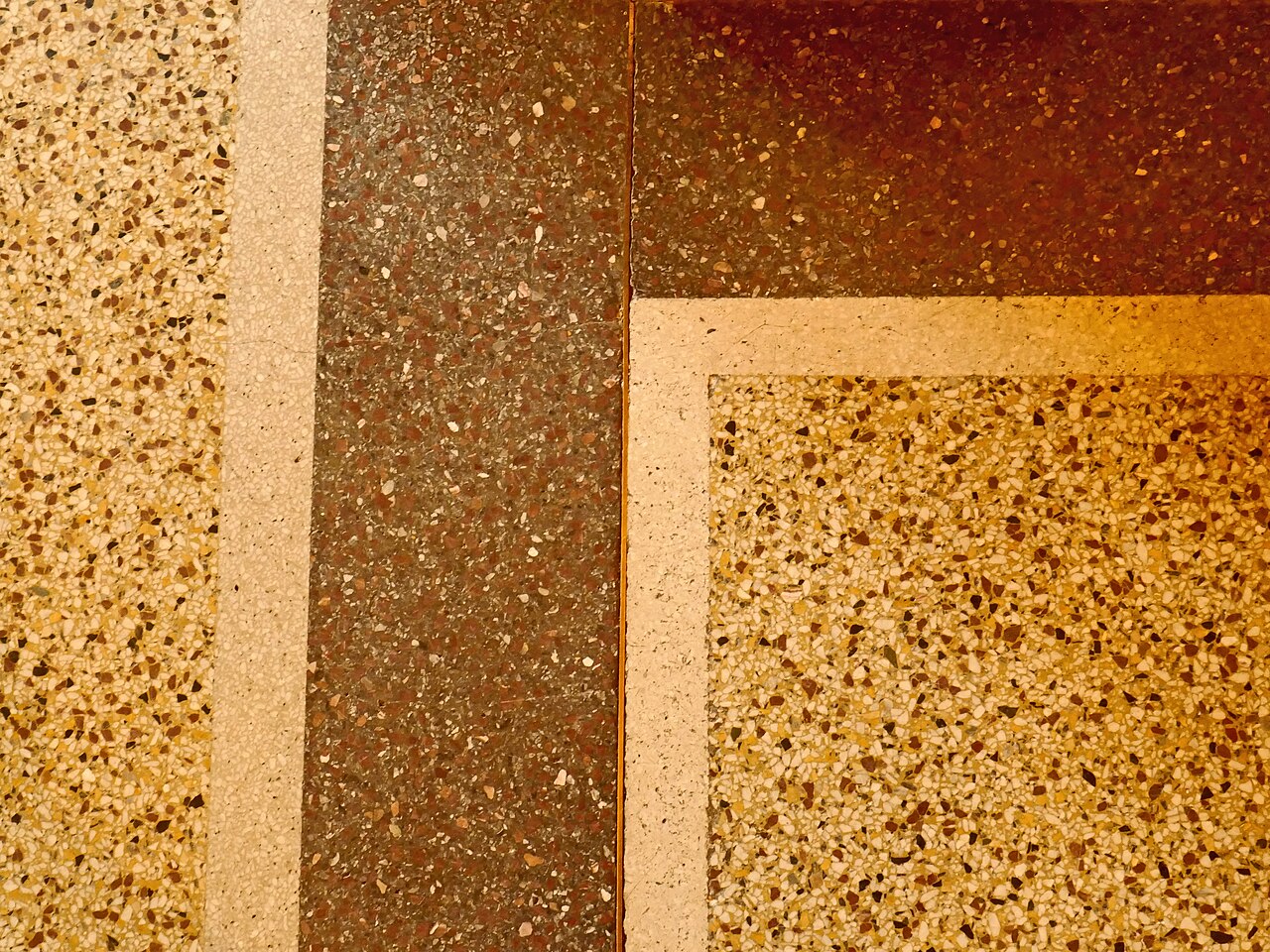
Photo: Geolina163, CC BY-SA 4.0, via Wikimedia Commons.

How do you specify terrazzo?
To specify terrazzo, first decide between factory-made tiles to BS EN 13748-1 (internal) or BS EN 13748-2 (external) and in-situ terrazzo laid to BS 8204-4, because they are different products with different clauses. Then state the mix, chip size and colour against an approved sample, the tile format and thickness, the bedding, the grinding and sealing after laying, the wet slip resistance of the finished surface, and the movement joints.
Terrazzo arrives on most projects as an image: a colour, a chip size, a sense of polish. The clause has to turn that into something a terrazzo contractor can price and an inspector can check. Two things decide most outcomes. One is whether the floor is tiles laid like stone or terrazzo cast and ground in place. The other is what happens after laying: grinding, grouting, polishing and sealing change the appearance and the slip resistance of the floor you actually walk on.
This guide covers Uniclass Pr_35_93_96_90 Terrazzo tiles, with notes on in-situ work, whose mix has its own code, Pr_20_31_53_86 Terrazzo mix. Terrazzo skirtings and larger precast units also have their own codes next door, so they can be scheduled as separate types.
What does a terrazzo tile clause need to cover?
Some properties are specific to terrazzo. Others belong in every product clause. A clause that leaves either out gives the contractor room to substitute.
Properties of terrazzo
- Product typeTile, slab, skirting or step unit; cement or resin bound.
- MaterialBinder, aggregate type and chip sizes in the wearing layer.
- ThicknessTile thickness; thicker units for larger formats and heavy loads.
- TolerancesDimensional tolerances from BS EN 13748; drives lippage before grinding.
- Slip resistanceNever guessWet PTV of the finish as laid, after grinding and sealing.
- Wear resistanceAbrasion resistance declared under BS EN 13748-1.
- Freeze-thaw resistanceExternal use only, to BS EN 13748-2.
- Reaction to fire classificationNever guessA1fl for cement terrazzo; resin terrazzo needs a test class.
- Recycled contentRecycled glass or stone chips, where the project reports it.
- AdhesiveCement mortar bed or deformable adhesive to suit tile and base.
- GroutMatching cement grout, ground flush with the tiles.
- Joint widthNarrow joints, set by tile tolerance and grinding.
- Movement jointsOver base joints and at perimeters, with matching sealant or strips.
- Laying patternGrid, offset or with divider strips between colours.
- AccessoriesTerrazzo skirtings, step units, divider strips and edge trims.
What every product clause needs
- Manufacturer and product referenceNamed manufacturer, mix reference and chip grading.
- Product standardBS EN 13748-1 internal or BS EN 13748-2 external tiles.
- Installation methodBedding, grouting, grinding and sealing, as this specification.
- Technical submittalsData sheet, DoP, slip test for the finish, sealer data.
- Operation and maintenance informationCleaning products, resealing interval and what etches the surface.
- Nominal sizeTile format sets layout, weight and bedding method.
- FinishHoned, polished or textured, and whether ground after laying.
- SubstrateScreed or slab, its curing and its movement joints.
- Sample approvalReference panel for chip size, colour and polish.
Uniclass Pr_35_93_96_90 Terrazzo. Not every property applies to every project; where one does not, say so rather than leaving it blank.
Fields marked Never guess (slip resistance and reaction to fire classification) depend on the project and should never be filled from a default or a previous job. If the information is not available yet, the clause should say so with a TBC and a reason.
Which decisions does the clause depend on?
Most properties follow from the product you choose. These depend on the project, so they need a decision from the designer before the clause is written.
- 01
Slip resistance of the finished floor
Never guessPolished terrazzo is one of the floors most often criticised for being slippery when wet, and the finish is the main reason. A tile tested in a honed or brushed finish at the factory can end up glossier after site grinding, polishing and sealing, and a sealer can lower the wet value further. The value that matters is the wet pendulum test value (PTV) of the floor as handed over. UK Slip Resistance Group guidance treats a wet PTV of 36 or more as low slip potential. Write the requirement against the finished surface and test it on site.
How to decide
- Identify areas that will be wet in use: entrances, lobbies near external doors, WCs, kitchens and ramps.
- Choose the finish for those areas first: honed or textured rather than high polish.
- Require the manufacturer's wet PTV for the finish supplied and a site test to BS EN 16165 Annex C after grinding and sealing.
- Confirm the sealer manufacturer's data shows the sealer does not reduce slip resistance below the requirement.
Write it asSlip resistance: Wet PTV not less than 36 on the finished floor after grinding and sealing, tested on site to BS EN 16165 Annex C using slider 96. - 02
Tiles or in-situ terrazzo
Tiles or in-situFactory-made terrazzo tiles are cement-bound units made to BS EN 13748-1 for internal use or BS EN 13748-2 for external use, laid on a bed like stone and usually ground and polished after laying to remove lippage. In-situ terrazzo is mixed and laid on the floor, cured, ground and polished in place; its code of practice is BS 8204-4. In-situ gives large areas without tile joints and inlaid patterns with divider strips, at the cost of a wet trade, long curing and more risk of cracking. Choosing one sets the whole clause.
How to decide
- Large continuous floors with inlaid patterns and few joints: in-situ terrazzo to BS 8204-4.
- Programmes that cannot carry a long wet trade, or phased work: factory tiles to BS EN 13748-1.
- External areas: tiles to BS EN 13748-2, with frost resistance declared.
- Resin-bound terrazzo: treat as a different product with its own fire, slip and chemical data.
Write it asTiles: Cement-bound terrazzo tiles to BS EN 13748-1, internal use, ground and polished after laying. - 03
Reaction to fire
Never guessCement-bound terrazzo is generally class A1fl, the highest floor class, but resin-bound terrazzo is not, because the epoxy or polyester binder burns. Both are sold as terrazzo and look similar on a sample board. Approved Document B's lining classes apply to walls and ceilings, not floors, so the floor class matters where the fire strategy or the client's standard sets one, and where terrazzo is also used as a wall lining, stair cladding or bench top on an escape route. Record the binder and the class together.
How to decide
- Cement-bound terrazzo floor: record A1fl as declared by the manufacturer.
- Resin-bound terrazzo: require a classification report to BS EN 13501-1 for the product and thickness.
- Wall or stair cladding on escape routes: check the class the fire strategy sets for linings, including the bedding.
Write it asReaction to fire: Class A1fl to BS EN 13501-1. Cement-bound terrazzo only; resin-bound alternatives not accepted without a classification report. - 04
Grinding, grouting and sealing
GrindingTerrazzo tiles are typically laid, grouted with a matching cement grout and then ground and polished as a whole floor, so lippage and grout lines disappear into one surface. The clause has to say whether that happens, to what grit or finish, and how the floor is sealed, because a factory-finished tile laid without grinding gives a different floor at a lower price. Grinding generates slurry that has to be controlled around drains and finished joinery, and it needs the bed to have cured first.
How to decide
- Decide whether tiles are ground after laying or supplied factory-finished; say which in the clause.
- Set the final finish against the approved reference panel, not by a grit number alone.
- Specify the sealer and its manufacturer, or require the terrazzo manufacturer's recommended sealer, and the resealing interval for the O&M.
Write it asFinish: Grouted with matching cement grout, ground and honed after laying to match approved reference panel. Sealed with terrazzo manufacturer's recommended penetrating sealer. - 05
Movement joints and the base
CrackingTerrazzo is rigid and shows every crack in the base. Shrinkage of a young screed, deflection of a suspended slab or movement at a structural joint will crack tiles or in-situ terrazzo along the same line. In-situ terrazzo uses divider strips to break the floor into bays, and both forms need movement joints over the joints in the base and at perimeters and columns. The base has to be cured and stable before the terrazzo goes down, which affects the programme as much as the specification.
How to decide
- Carry every structural and screed joint through the terrazzo, at the same position.
- For in-situ terrazzo, set the bay layout and divider strip material on the drawings.
- Allow screed curing time in the programme before laying, and consider a decoupling layer over young or crack-prone bases.
- Specify movement joint sealant or strips that match the terrazzo colour.
Write it asMovement joints: Over all base joints and at perimeters, positions as setting-out drawing, preformed joint profiles to match.
The values under "Write it as" are examples. The right value depends on the location, the use and the fire strategy.
Which standards should the clause cite?
Cite the product standard the declaration of performance refers to, the code of practice for installation, and the test method behind each value you set. A value without its test method cannot be checked against a submittal.
- BS EN 13748-1
- Terrazzo tiles. Terrazzo tiles for internal use
The product standard for factory-made, unreinforced cement-bound terrazzo tiles for internal use, covering materials, properties such as flexural strength, water absorption and abrasion resistance, and test methods.
In the clause Cite it as the product standard: "Terrazzo tiles to BS EN 13748-1".
- BS EN 13748-2
- Terrazzo tiles. Terrazzo tiles for external use
The equivalent standard for terrazzo tiles used outside, including resistance to frost.
In the clause For external types: "Terrazzo tiles to BS EN 13748-2".
- BS 8204-4
- Screeds, bases and in situ floorings. Cementitious terrazzo wearing surfaces. Code of practice
The UK code of practice for in-situ cementitious terrazzo: materials, design, laying, inspection and testing, cleaning and maintenance. It is read with BS 8204-1 for the base.
In the clause For in-situ work: "In-situ terrazzo to BS 8204-4".
- BS EN 16165
- Determination of slip resistance of pedestrian surfaces. Methods of evaluation
Annex C is the pendulum test used on site and in the laboratory. It replaced BS 7976-2.
In the clause "Wet PTV not less than 36 on the finished floor, tested to BS EN 16165 Annex C using slider 96".
- BS EN 13501-1
- Fire classification of construction products and building elements. Classification using data from reaction to fire tests
The Euroclass system, with the fl suffix for floorings.
In the clause "Reaction to fire: Class A1fl to BS EN 13501-1."
- BS EN 12004-1
- Adhesives for ceramic tiles. Requirements, assessment and verification of constancy of performance, classification and marking
Classes for cementitious tile adhesives, used where terrazzo tiles are bonded rather than bedded in mortar.
In the clause "Adhesive: Class C2 S1 to BS EN 12004-1, where thin-bed fixing is approved."
- BS EN 13888-1
- Grouts for ceramic tiles. Requirements, classification, designation, marking and labelling
Grout classes, useful where a proprietary grout is used instead of the terrazzo manufacturer's matching cement grout.
In the clause "Grout: terrazzo manufacturer's matching grout, or Class CG2 to BS EN 13888-1."
Confirm the current edition of each standard at every issue. Avoice's State of UK Specifications 2026 found a withdrawn standard cited in 40% of specifications at contract issue.
For the regulations behind these choices, see Approved Document M explained, Approved Document B explained, or search the Avoice Regulations library.
How do you write it in CAWS?
CAWS gives terrazzo its own work section, M41, separate from ceramic and stone tiling in M40. Manufacturers' NBS clauses use M41/110 Terrazzo tiling for tiles, M41/120 for in-situ terrazzo, M41/130 for precast terrazzo and M41/160 for terrazzo tile skirtings. Each terrazzo type on the project is one type clause in the 100s that brings together the units, the base, the bedding, the grouting, the grinding and the movement joints.
The general and execution clauses later in M41 hold what applies to every type: base suitability, the reference panel, setting out, bedding, grinding and polishing, sealing and protection. The type clause refers to them by number, so a polished floor in the lobby and a honed floor in the WCs are two short type clauses sharing one set of workmanship clauses.
- Tiles
- Cement-bound terrazzo tiles to BS EN 13748-1, internal use
- Manufacturer
- Submit proposals
- Product reference
- Submit proposals
- Size
- 400 x 400 mm
- Thickness
- 30 mm
- Colour and chip grading
- TBC Client selection between two reference samples outstanding. Resolve before ordering.
- Finish
- Ground and honed after laying to match approved reference panel
- Slip resistance
- Wet PTV not less than 36 on finished floor to BS EN 16165 Annex C, slider 96
- Reaction to fire
- Class A1fl to BS EN 13501-1
- Base
- Sand and cement screed, cured and accepted as suitable
- Bedding
- Semi-dry cement and sand mortar bed, to terrazzo manufacturer's recommendations
- Joint width
- Narrow joints to suit tile tolerance, grouted with matching cement grout
- Movement joints
- Over all base joints and at perimeters, positions as setting-out drawing
- Sealing
- Terrazzo manufacturer's recommended penetrating sealer after grinding
- Accessories
- Matching terrazzo skirtings, as clause 160
Illustrative, not from a real project. One property is left as a TBC with a reason so it can be tracked and closed before issue.
Clauses the type clause relies on
- M41/160
- Terrazzo tile skirtings Skirtings from the same mix, written as their own type.
- M41/210
- Suitability of bases Curing, flatness and moisture of the base before bedding starts.
- M41/250
- Reference panel A laid, ground and sealed panel that the finish is judged against.
- M41/530
- Setting out Joint alignment, cuts at margins and alignment with divider strips.
- M41/700
- Grinding and polishing Timing after bedding, sequence of grits and control of slurry.
- M41/870
- Protection Covering the floor until handover once sealed.
Clause numbers vary between NBS versions and practice masters; the 100s follow manufacturers' M41 clauses on NBS Source, and the later numbers are typical rather than fixed, so check each one exists in your M41.
How do you write it in Uniclass?
Uniclass has a single system code for terrazzo floors, Ss_30_42_90_90 Terrazzo floor covering systems, under Terrazzo floor tiling and screed systems. The system clause describes the build-up, the bedding, the grinding and sealing, and the finished floor's performance, including its wet slip resistance on site.
The tile is a product clause under Pr_35_93_96_90. For in-situ terrazzo the same system code calls up Pr_20_31_53_86 Terrazzo mix instead, with the chip and binder written into the product clause. Skirtings and precast step units are products too, Pr_35_93_96_89 Terrazzo tile skirtings and Pr_35_93_96_88 Terrazzo precast units, so they can be called up once and changed in one place.
- Description
- Cement-bound terrazzo tiles bedded on screed, ground and sealed in situ
- Base
- Sand and cement screed, as the screed system clause
- Tiles
- Pr_35_93_96_90 Terrazzo tiles (T05)
- Bedding
- Semi-dry cement and sand mortar bed
- Grout
- Matching cement grout, ground flush
- Finish
- Ground and honed after laying, penetrating sealer
- Movement joints
- Over all base joints and at perimeters
- Slip resistance of finished floor
- Wet PTV not less than 36 to BS EN 16165 Annex C, slider 96, tested on site
- Manufacturer
- Submit proposals
- Product reference
- Submit proposals
- Standard
- BS EN 13748-1, internal use
- Binder
- Cement-bound
- Nominal size
- 400 x 400 mm
- Thickness
- 30 mm
- Colour and chip grading
- TBC Client selection between two reference samples outstanding. Resolve before ordering.
- Abrasion resistance
- Manufacturer's declared value to BS EN 13748-1
- Reaction to fire
- Class A1fl to BS EN 13501-1
- Recycled content
- Submit manufacturer's declared value
Illustrative. Performance of the finished system sits in the system clause; properties of the product sit in the product clause.
In NBS Chorus the product clause also carries an NBS reference (for terrazzo tiles, 45-80-95/340); use whichever your masters use, but keep CAWS and Uniclass references out of the same specification.
What goes in the spec, and what goes in the schedule?
The specification defines each type once. The schedule and drawings say where each type goes.
In the specification
What the product is and how it performs and is installed. Written once per type.
In the schedule or drawings
Where each type goes and how much of it. Changes with every plan revision.
Write each terrazzo type once with a type mark (for example T05) and let the finishes schedule and drawings say where it goes. Patterns, borders and divider strips are drawn information; describe them in the clause only by reference to the drawing.
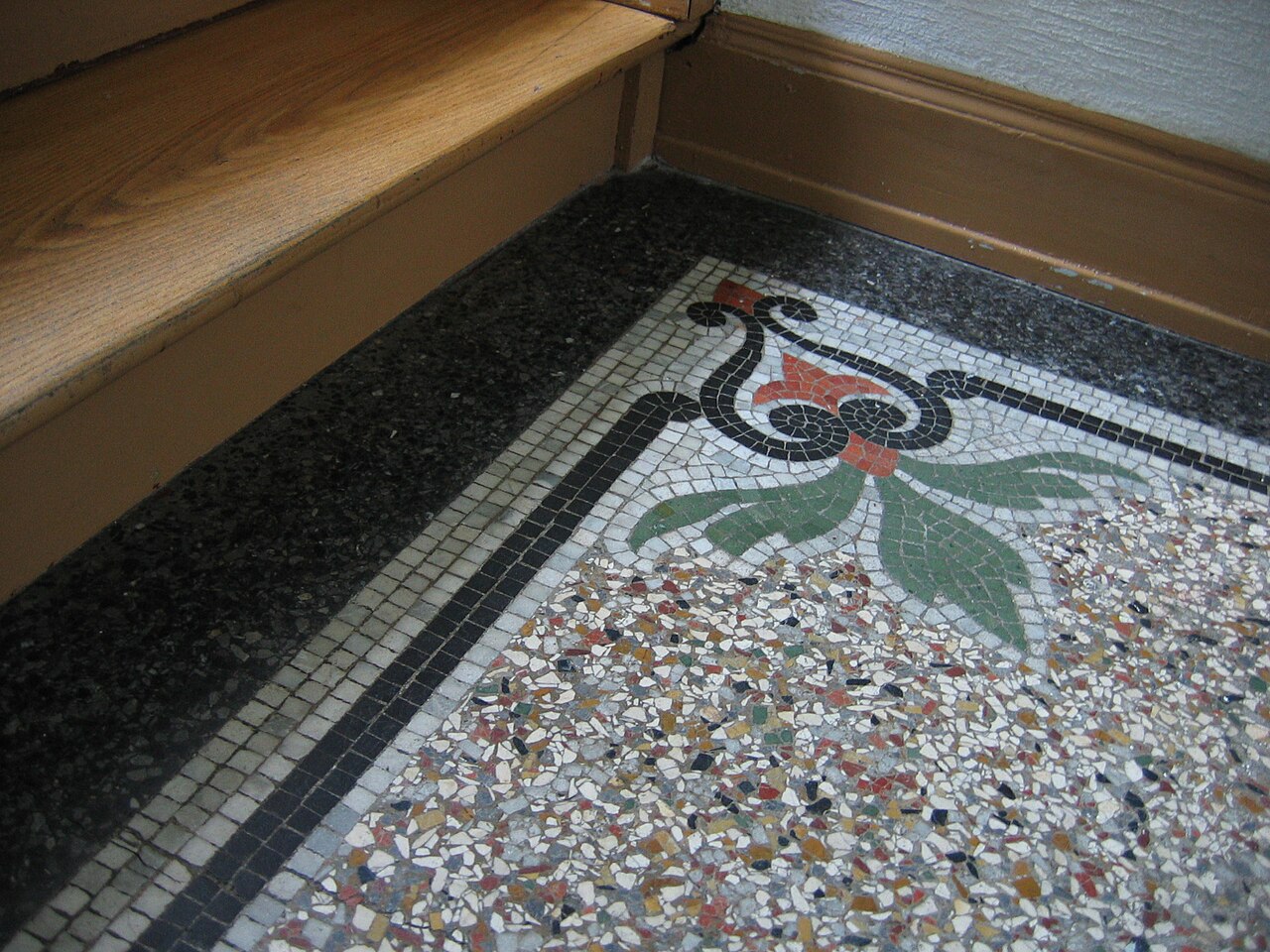
Photo: Stephan Schildberg (scoid), CC BY-SA 3.0, via Wikimedia Commons.

What are the common mistakes?
Most problems are a missing property, a property filled with the wrong kind of value, or a decision left silently open.
- A slip value for the wrong finish. A honed tile's test report says nothing about the same tile after polishing and sealing on site. Test the finished floor.
- Tiles and in-situ in one clause. They are different products with different standards and trades. Give each its own type clause and type mark.
- "Terrazzo" with no binder stated. Resin terrazzo can be offered against a cement terrazzo clause, with a different fire class and chemical behaviour. Say cement-bound.
- No reference panel. Chip size, colour and polish cannot be described precisely in words. Require a laid, ground and sealed panel and approve against it.
- Base joints ignored. Cracks in the screed come through rigid terrazzo. Carry every base joint through the finish.
- Acidic cleaners in the O&M. Acids etch cement terrazzo and dull the polish. Put the manufacturer's cleaning products and resealing interval in the O&M information.
How Avoice helps
Avoice's spec writer drafts terrazzo clauses from the finishes information on the project and shows clearly what it could not settle.
- Drafts from your drawings and schedules
It reads the terrazzo types (T05 tiles to the lobby, T06 in-situ to the atrium) from the finishes schedule and plans, picks the M41 type clause or the Uniclass system and product headings, and fills in what your information supports.
- Leaves a TBC with a reason
If the client has not chosen between two chip samples, or the finish for the entrance has not been agreed against the slip requirement, the line says TBC and why. Every TBC joins one project register to close before tender.
- Works from your own masters
Choose CAWS or Uniclass. Avoice adapts your practice's M41 clauses rather than replacing them with generic text.
- Checks the spec against the drawings
QA/QC flags a terrazzo type on the schedule with no clause behind it, a clause citing a withdrawn tiling standard, or a type clause that refers to a skirting clause your M41 no longer contains.
- Links product data to the clause
Declarations of performance, slip test reports and sealer data sheets sit in the Product Room against the clause. Edit a linked product once and every clause that uses it updates.
Related guides: How to specify ceramic tiles, How to specify natural stone tiles, How to specify screeds.
Software can draft and check. The designer still chooses the product and is responsible for the specification.
Draft your terrazzo tile clause in Avoice
Upload your drawings and schedules. Avoice drafts the clause in CAWS or Uniclass, cites the standards and flags anything your information does not settle.
This guide is for general education and is not professional advice. Check current editions of standards and Approved Documents, the manufacturer's data, and the requirements of your project before relying on any clause.