
How to Set and Enforce Technical Standards Across a Multi-Office Practice
What a technical standards framework contains, who owns it, how to enforce it without a bottleneck, and how to measure it
In a practice with several offices and sectors, technical standards fail quietly. Each office has a version of the master, a folder of favourite details and its own habits for review. This guide is for technical directors who need one standard of technical quality across the practice: what the framework contains, how to govern it, how to enforce it without becoming the bottleneck, and how to tell whether it works.
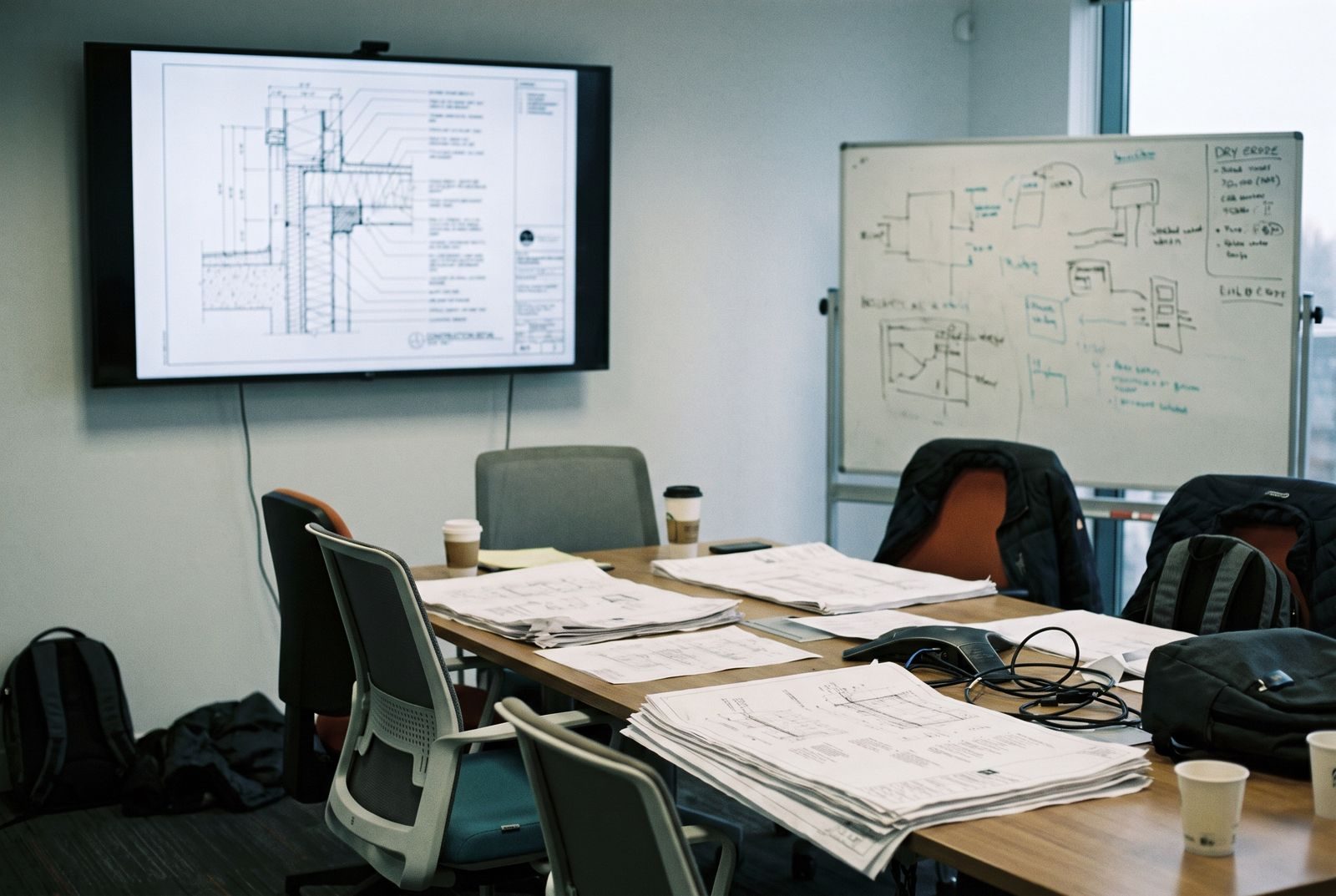
A technical standard needs a definition people can find, an owner who can change it, and a check that tells you whether it was followed.
What does a technical standards framework include?
A technical standards framework has eight working parts: a master specification, standard details, rules, a standards register, review gates, ownership by office and sector, a technical forum and a lessons-learned loop. Build the parts that remove the most rework first.
A technical standards framework is the set of controlled documents and routines that make a practice resolve technical questions the same way on every project. It is not a single manual. It is a small number of working parts, each with an owner, that point at each other. Practices that try to hold everything in one large technical manual usually end up with a document nobody opens.
- 01
Master specification
The practice's controlled library of clauses, preferred systems and products.
- Answers
- What do we write by default?
- Failure
- Several copies in circulation
- 02
Standard details
Approved construction details with the specification clauses they depend on.
- Answers
- How do we build it?
- Failure
- Details drawn fresh on every job
- 03
Rules
The values, standards and words the practice requires or forbids.
- Answers
- What must always be true?
- Failure
- Rules held in people's heads
- 04
Standards register
The list of standards, guidance and regulations the practice cites, with status and review date.
- Answers
- What may we cite?
- Failure
- Withdrawn standards carried forward
- 05
Review gates
Defined checks at stages, with who reviews, what is compared and what passes.
- Answers
- When do we check?
- Failure
- Review as a proofread
- 06
Ownership
Named owners for each standard by office and sector, with decision rights.
- Answers
- Who can change it?
- Failure
- Everyone edits, nobody reviews
- 07
Technical forum
A regular meeting of office technical leads that agrees changes and resolves conflicts.
- Answers
- How do we agree?
- Failure
- Offices drift apart
- 08
Lessons-learned loop
A route from project problems and site findings back into the standards.
- Answers
- How do we improve?
- Failure
- Lessons stay on one project
Parts 01 to 04 are what people use. Parts 05 to 08 are what keeps them current. A framework with only the first four becomes stale, and one with only the last four has nothing to enforce.
The master specification is the centre
Most of the framework hangs off the master specification, because it is the place where standards become clauses that people actually use. A master that is controlled, owned and drawn on by every office makes the rest easier: rules can be attached to its clauses, standard details can refer to its sections, and the standards register can tell you which clauses cite which standard. A practice with several competing masters has no framework, however many procedures it has written. The Office Master Specification: A Technical Director's Guide covers how to build and own it, and How to Keep an Office Master Specification Up to Date covers the maintenance routine.
Rules and the register keep the master honest
Rules and the standards register do different jobs. A rule is a requirement of the practice: the minimum cover, the acceptable fixing, the word that must not appear. The register is a record of what the practice cites and the status of each item: current, superseded, withdrawn, or awaiting review. A rule can be checked against a specification as it is written. The register is checked on a cycle by its owner. Between them they stop the two commonest ways a master goes wrong: a requirement that nobody enforces, and a reference that nobody maintains.
Start with what causes the most rework
Do not build all eight parts at once. Take the last three issued specifications from different offices and find the defects that recur. Why Specifications Fail the Same Way in Every Practice sets out the eight practice-level root causes that audits keep finding. Whichever of those your offices share points to the first part of the framework to build. If leftover master content and stale standards dominate, begin with the master and the register. If contradictions between drawings, schedules and specification dominate, begin with review gates and rules.
How should technical standards be governed across offices?
Give the framework one accountable owner, name an owner for every standard, tier each standard as mandatory, default or guidance, and write down who can change what. A technical forum that makes decisions keeps offices aligned.
Governance answers three questions for every standard: who owns it, who can change it, and what happens when a project needs to do something different. If the answers are not written down, offices will settle them locally, and the practice will end up with as many standards as offices.
One accountable owner and many named owners
A single person, in most practices the technical director, is accountable for the framework. That person decides the tier of each standard, chairs the technical forum and answers to the partners for the outcome. Day-to-day ownership is spread. Each master section, standard detail and register entry has a named owner who revises it on the review cycle. Owners should be chosen for knowledge of the subject, not seniority. A senior associate who has detailed the same junction for ten years will keep that standard better than a director who has not.
Scroll horizontally to view all columns.
| Role | Owns | Decides | Does not decide |
|---|---|---|---|
| Technical director | The framework as a whole and the tier of every standard | What is mandatory, what is default, what is guidance | Day-to-day project choices within a default |
| Sector lead | Standards specific to a sector, such as residential, education or healthcare | Sector additions and the case for a variation | Anything that changes a practice-wide mandatory standard |
| Office technical lead | Adoption in their office and the local deviation record | Whether a project deviation is justified | Changes to the master |
| Standard owner | One named standard, detail or master section | Revisions to that item on the review cycle | Items they do not own |
| Project lead | The project's specification and its use of the standards | Which defaults apply and which are varied with reason | Waiving a mandatory standard |
| Technical forum | The agenda for change across offices | Recommendations to the technical director | Anything outside its remit |
Decision rights are written down so that a project team knows whether it needs permission, a recorded reason or nothing at all.
Tier the standards
The most useful single decision in governance is to give every standard a tier. A mandatory standard must be followed and departure needs approval. A default is the expected choice and may be varied with a reason. Guidance is advice. Practices that treat everything as mandatory find that teams route around the framework, because they cannot comply with all of it. Practices that treat everything as guidance find that nothing is ever enforced. A short mandatory tier, a large default tier and a visible guidance tier is a workable balance. The same tiered approach underlies the protected, controlled and open clauses described in the office master guide.
- 01
Mandatory
Required on every project. Departure needs written approval from the technical director.
- Examples
- Life-safety and liability items, regulatory references, agreed warranties
- Control
- Hard gate
- 02
Default
The expected choice. A project may vary it with a recorded reason and an office lead's approval.
- Examples
- Preferred systems, products, details and finishes
- Control
- Comply or explain
- 03
Guidance
Advice that helps a project decide. No approval is needed to depart from it.
- Examples
- Background notes, options, lessons from past projects
- Control
- None, but visible
Most standards should be defaults. Keeping the mandatory tier short is what makes it credible and keeps enforcement manageable.
Give office and sector ownership real content
Multi-office practices have two natural axes: geography and sector. Office technical leads own adoption: they make sure the standards are used, they hold the local deviation record, and they bring local issues to the forum. Sector leads own content: a healthcare lead owns the clauses and details that only healthcare needs. Keep the two apart. An office lead should not rewrite a practice standard to suit a local supplier, and a sector lead should not decide how a different office runs its reviews. A sector standard sits on top of the practice standard and may add to it. It does not weaken a mandatory standard.
Run a technical forum with a real agenda
A technical forum is the place where offices agree changes and resolve conflicts, and it only works if it decides things. Meet on a fixed cycle, monthly or every two months for most practices. Take items from the deviation register, the lessons-learned intake and the standards watch. For each item, record a decision, an owner and a date. A forum that only shares news becomes optional, and offices stop attending. Keep the notes short and publish the decisions to the whole practice, because a change that only the forum knows about has not happened.
How do you enforce standards without becoming a bottleneck?
Scale control to risk. Make most standards defaults with a comply-or-explain route, keep hard gates for the few mandatory items, automate the checks that can be compared mechanically, and time-box every review.
Enforcement fails in two directions. If it is too light, offices ignore the standards and the framework is decoration. If it is too heavy, every specification waits for the technical director and project teams learn to submit late and hope. The way through is to match the control to the risk, to automate what a machine can compare, and to make the route for variation quick and visible.
Control by exception, not by reading everything
A technical director cannot read every specification in a multi-office practice, and should not try. Review the things that matter. Mandatory items are checked against a short list at the gate. Deviations are reviewed because they are the points where the project has chosen to differ. Everything else is a default the project has taken as given. That reduces the technical director's reading from the whole document to a page of exceptions, and it makes a deviation visible when it happens, instead of at the end of the job.
- 2
Stage 2: Concept
Project lead confirms the master section choices and the outline specification structure. Self-check against the mandatory list.
- 3
Stage 3: Spatial coordination
Peer review by a second office or senior colleague. Rules run on the draft. Deviations logged.
- 4
Stage 4: Technical design
Pre-issue review by comparison: specification against drawings and schedules, then against the register.
- 5
Before tender and contract issue
Technical lead sign-off on mandatory items and open deviations. Open TBCs counted.
- 6
After issue
Sample audit of issued specifications. Findings go to the forum.
Gates are lighter early and heavier at issue. The technical director signs off only the mandatory items and the deviations, not every clause.
The stage structure is the RIBA Plan of Work 2020, which most UK practices already use for project programmes. Project Programme by RIBA Stage and RIBA Stage 4: Technical Design set out where specification work sits. The principle is that checks move with the work, so that a standard departed from at Stage 3 is found at Stage 3 and not at tender.
Use comply or explain for defaults
A comply-or-explain route lets a project vary a default with a recorded reason, an approver and a date. It is quick for the project team and visible to the practice. Keep the deviation register simple: the clause or detail, what was changed, why, who approved it and whether it is project-specific or a candidate for the standard. The register is a source of change. Three projects varying the same default for the same reason are telling you the default is wrong. That is a revision for the owner to make, not a compliance failure to chase.
Automate the comparable checks
Many of the things a reviewer checks can be compared mechanically: that a value agrees across the specification, schedule and drawing, that a cited standard is current, that a forbidden word is absent, that a cross-reference resolves, that no TBC remains. Those checks are slow and tedious for a person and quick for software. Use people for what needs judgement: whether a detail suits the building, whether a deviation is justified, whether a specialist's design portion is properly defined. The Pre-Issue Technical Review Checklist sets out the comparisons worth automating, and Specification Change Control covers how changes after issue are tracked.
Four ways to keep a review from becoming a bottleneck
- Time-box it. Publish a turnaround, such as two working days for a Stage 4 review, and meet it. A review with no deadline expands to fill the programme.
- Review early and small. Check the master choices at Stage 2 and the rules at Stage 3. A late review that finds early problems is the slowest kind.
- Delegate with a list. Give office technical leads the authority to approve deviations to defaults, within written limits. Keep the director for the mandatory tier.
- Let the checks run before the reviewer arrives. A reviewer handed a clean comparison report spends the time on judgement, not on finding orphan references.
How do you measure whether technical standards are being followed?
Count outcomes and adoption together: defects per hundred clauses and open TBCs at pre-issue review, the number of master copies in use, the age of the oldest standard reference, and review turnaround. Report the trend each quarter.
Measure two things together: the quality of what the framework produces and the extent to which offices use it. Quality alone tells you nothing about cause, and adoption alone tells you nothing about benefit. Both should be counted on a fixed cycle, quarterly for most practices, and reported to the partners with the trend.
Scroll horizontally to view all columns.
| Measure | What it tells you | How to count it | Direction |
|---|---|---|---|
| Defects per 100 clauses at pre-issue review | Quality of what reaches the gate | Defects found by the review divided by clauses reviewed | Down |
| Open TBCs at tender | Whether decisions reach the document | TBCs remaining in the issued specification | Towards zero |
| Master copies in use | Adoption of a single master | Count of live projects not drawn from the current master | One |
| Age of oldest standard reference | Whether the register is maintained | Oldest review date of any standard cited in the master | Under a year |
| Deviations logged and approved | Where standards meet resistance | Deviation register entries per office per quarter | Visible, with trends |
| Review turnaround | Whether enforcement is a bottleneck | Working days from request to response | Within the published time |
The first two measure the quality of the output. The next three measure adoption. The last measures whether the control is costing the projects too much.
Prefer measures that move quickly
Measures that depend on site outcomes, such as variations or defects at completion, are real but slow, and have many causes besides the specification. Measures taken at pre-issue review respond within one project cycle. Defects per hundred clauses and open TBCs at tender are cheap to count and the partners understand them without explanation. State the baseline before changing anything, so the first quarter's figures have something to compare against. The Avoice State of UK Specifications 2026 review found internal contradictions in 94% of specifications at contract issue, orphan references in 88%, leftover master content in 82% and open TBCs in 76% (Common Specification Defects at Contract Issue). Those are population figures, not a target. Your own baseline is the one that matters.
Compare offices as a diagnostic, not a league table
Comparing offices on the same measures shows where the framework is working and where it is not. An office with a high deviation rate may be doing difficult work, or may have a local habit the standards do not suit. An office with no deviations at all may be using the standards well, or may not be logging. Ask before concluding. If the comparison is used to rank offices, they will log fewer deviations, and the signal will disappear.
Run a sample audit
Counting only what teams report leaves a gap. Take a sample of issued specifications from each office each quarter and audit them against the same defect types. A sample of three per office is enough to see the pattern. The audit checks the framework from the outside and gives the technical director an independent view of whether the numbers reported by the offices match the documents issued. It also feeds the forum with real examples.
How do you keep technical standards alive once they are set?
Run a loop: capture lessons at the point they are learned, verify them, change the standard through its owner and the forum, release the change with a version and a note, and retire the stray copies. Each step needs a named mechanism.
A framework is not finished when it is launched. It is kept alive by a loop: problems and lessons on projects reach the owners, owners revise the standards, revisions reach the offices, and offices use them. Each link in the loop needs a mechanism, or it will break at the weakest one.
Capture lessons at the point they are learned
The most useful lessons arrive during the project: an RFI that exposed an ambiguous clause, a site inspection that found a detail that does not work, a contractor query that showed a standard was unclear. If capture waits for a post-project review, most of them are lost. Provide a one-line route that any team member can use to flag an issue against a specific clause or detail: what happened, which standard, what should change. The owner of that standard triages the flags on the review cycle and takes the verified ones to the forum.
Verify before changing
Not every lesson deserves to change a standard. A site problem may be a one-off, a contractor's error or a project-specific constraint. The owner checks the evidence, confirms the cause and decides whether to change the standard, add guidance or take no action. A lesson that changes a clause on the strength of one project can do more harm than the original problem. Record the decision, whatever it is, so the same flag does not return unanswered.
Release changes like software
Every change to a standard should be published with a version, a date and a short note of what changed and why. Send the release note to the whole practice, and say whether live projects must adopt the change, may adopt it, or should finish on the old version. A practice that changes the master without telling anyone has changed it for the new projects only, and the live projects will carry the old text to tender. How to Keep an Office Master Specification Up to Date covers version control and release notes for the master in detail.
Retire the stray copies
Every multi-office practice has local copies of the master, folders of old details and templates that predate the framework. They are the main way the framework is bypassed, and they are not malicious. They exist because they were the fastest route when the new one was not ready. When the controlled version is easy to start from, retire the copies: archive them read-only, record where they went and tell the offices on a date. If the controlled version is slower than the stray copy, people will keep using the copy, and no amount of policy will change it.
- A one-line route for flagging a problem against a named standard.
- A named owner who triages flags on a fixed cycle.
- A forum that decides which flags change a standard.
- A release note, version and date for every change.
- A date after which stray copies are archived.
- A sample audit each quarter that checks the loop is working.
Questions technical directors ask about technical standards
What is a technical standards framework in an architecture practice?
A technical standards framework is the set of controlled documents and routines that define how a practice resolves technical questions the same way on every project. It normally includes a master specification, standard details, rules for values and wording, a register of the standards and guidance the practice cites, review gates, named owners, a technical forum and a way of feeding project lessons back into the standards.
Who should own technical standards in a multi-office practice?
One person, usually the technical director, owns the framework as a whole and has the final say on what is mandatory. Sector leads or office technical leads own the standards for their area and propose changes. Ownership works when each standard has a named owner, a review date and a route for changes, and fails when ownership is shared by everyone.
How do you enforce standards without slowing projects down?
Scale the control to the risk. Make most standards defaults that a project can vary with a recorded reason, reserve hard gates for the few things that carry real liability, and automate the checks that can be compared mechanically. Time-box reviews and publish the turnaround so project teams know what to expect.
How should a practice handle a project that needs to deviate from a standard?
Use a comply-or-explain route. The project records the deviation, the reason and the approver in a deviation register, and the technical lead reviews the register on a cycle. Repeated deviations on the same standard are a signal that the standard needs revising, not that the projects are wrong.
How do you measure whether technical standards are being followed?
Measure outcomes and adoption together. Useful measures are defects per hundred clauses found at pre-issue review, open TBCs at tender, the number of master copies in use, the number of deviations and how many were approved, and review turnaround time. Count them on a fixed cycle and report the trend to the partners.
How often should technical standards be reviewed?
Set a regular cycle with defined triggers between reviews. A quarterly review of standards watch items and a full annual review is a realistic rhythm for most practices, with immediate changes for withdrawn standards, regulatory amendments and product withdrawals. Each standard should carry the date of its last review.
Where Avoice fits
Most of a technical standards framework is a set of rules, a master and a review. Avoice holds all three in the place the specification is written, so the standard is the starting point and not a document to remember.
In Avoice the office master is a governed library with an owner, and projects draw from it instead of copying the last job. Practice Rules hold the values, standards and words the practice requires, and are applied while the specification is written. Standards sets in the clause library hold the standards and guidance a specification may cite. The pre-issue Technical Review then compares the specification against schedules and drawings and runs the rule check as one of its criteria, so a technical director sees a report of exceptions and not a document to read from the front.
That supports the enforcement model in this guide. Mandatory and default rules can be applied in the same way across every office, the comparable checks run before a reviewer opens the document, and deviations show up as findings. Avoice does not decide what the practice standard is, or which tier a standard belongs in. That remains the technical director's call. The office master guide and the pre-issue review checklist cover the two parts of the framework Avoice supports most directly.