
How to specify automatic doors
What an automatic door clause has to settle, from safety in use and escape to clear width, activation and glazing, and how to write it in CAWS and in Uniclass.
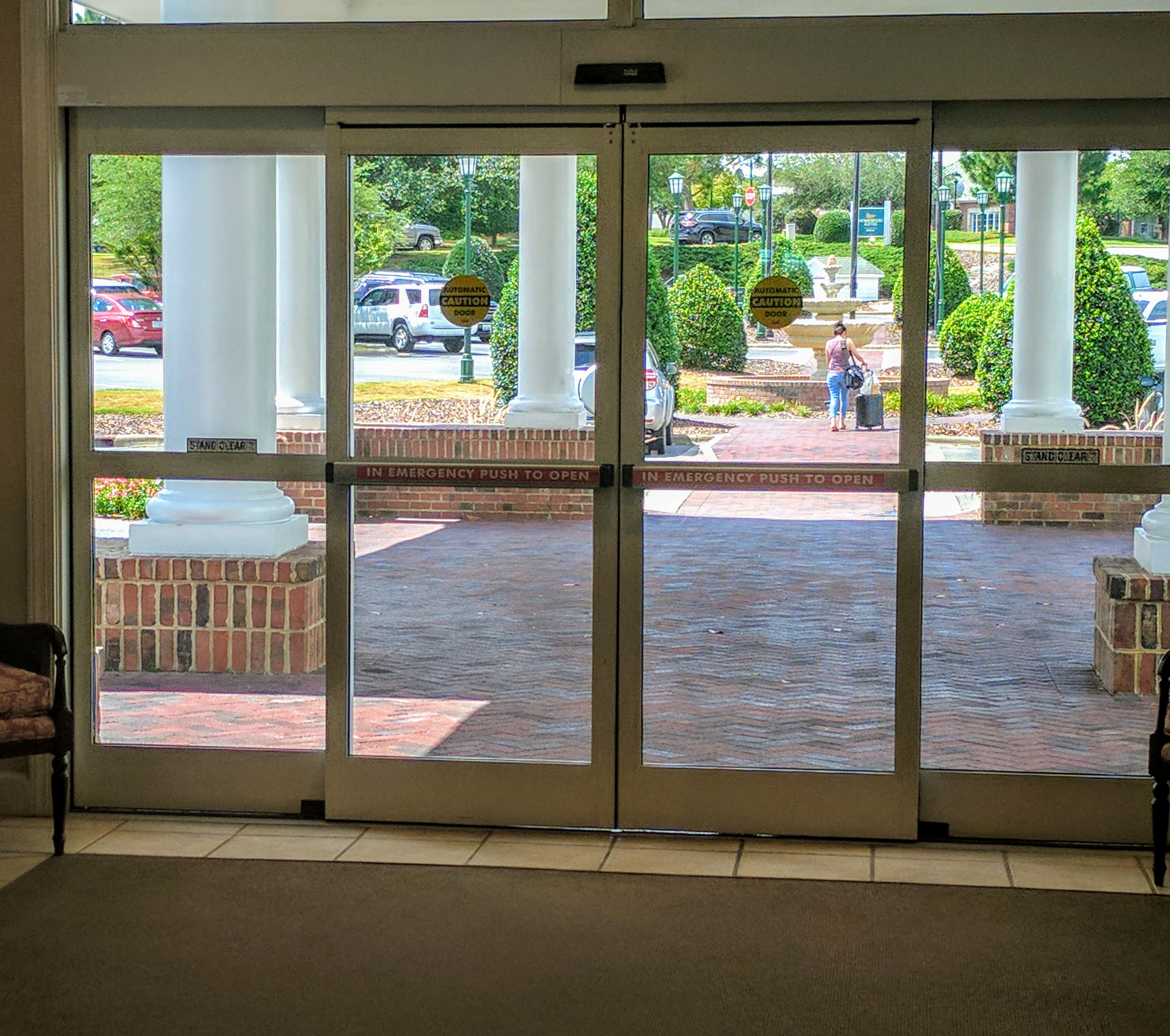
Photo: Scott Brody, CC BY-SA 4.0, via Wikimedia Commons.

How do you specify automatic doors?
To specify automatic doors, specify a complete power operated pedestrian doorset that meets BS EN 16005, with a site risk assessment to BS 7036-0 and the sensors and safeguards it calls for. State how the door behaves on power failure and in a fire, because Approved Document B only accepts automatic doors across escape routes if they fail safe open or have a breakout or adjacent swing door, and set the clear width, activation and control positions from Approved Document M.
An automatic door is a machine that people walk through, so the specification has two jobs. It has to describe a doorset like any other: frame, leaves, glass, weathering, thermal and security performance. It also has to describe a moving product that must not hit, trap or shut in the people using it, including someone who walks slowly or cannot see the door coming. Most problems on site come from the second job being left to the installer's standard settings.
This guide uses Uniclass Pr_30_59_24_05 Automatic swing doorsets, the only automatic doorset in Uniclass apart from Pr_30_59_24_04 Automatic revolving doorsets. Automatic sliding doors have no code of their own; NBS Source files them under Pr_30_59_24_80 Sliding door and partition sets with an operator from Pr_75_30_23_05 Automatic sliding door operators. The decisions below apply to both.
What does a automatic door clause need to cover?
Some properties are specific to automatic doors. Others belong in every product clause. A clause that leaves either out gives the contractor room to substitute.
Properties of automatic doors
- Threshold detailLevel threshold; total upstand not more than 15 mm.
- Operation methodAutomatic swing, full energy or low energy.
- Smoke controlNever guessOnly where the doorset is also a smoke control door.
- AccessoriesActivation units, signage, canopy heaters, guard screens.
- Third-party certificationNever guessFire doors with operators need certification covering the operator.
- Safety glazing classificationNever guessBS EN 12600 class for glazed leaves and screens.
- Frame profileAluminium frame section to suit leaf and operator.
- AccessibilityClear width, control positions and warning signals.
- FixingsNever guessFrame and operator fixings into each wall type.
- Acoustic performanceRarely needed; quiet operators for libraries and wards.
- Weather resistanceExternal doorsets: air, water and wind classes.
- Emergency operationNever guessBehaviour on power failure and on fire alarm.
- Glazing specificationLaminated or toughened units, double glazed externally.
- Fire resistanceNever guessOnly where the automatic door is also a fire door.
- IronmongeryLocks and handles that work with the operator.
- FacingGlazed or solid infill panels.
- Category of useOperator duty to suit the number of cycles a day.
- Opening configurationSingle or pair, swing direction, sidelights.
- ThicknessNever guessLeaf thickness matters for fire evidence only.
- Door leaf constructionFramed glazed leaf, or solid leaf on internal doors.
- Security ratingNever guessNight locking and any rating the security brief sets.
- Glass manifestationNever guessGlazed leaves and screens in buildings other than dwellings.
- Thermal performanceExternal doors to heated spaces.
- Track and support systemSliding doorsets; swing doors hang on pivots or hinges.
- Powered operation safetyNever guessBS EN 16005 safeguards from a site risk assessment.
- Perimeter sealsNever guessWeather seals externally; smoke and intumescent seals on fire doors.
- Solar controlLarge glazed entrances facing south or west.
- Coat build-upPowder coat thickness for external exposure.
What every product clause needs
- Manufacturer and product referenceNamed doorset and operator, or submit proposals.
- Product standardBS EN 16005 for safety in use, plus the doorset product standard.
- Installation methodInstalled, set up and commissioned by a trained installer.
- Technical submittalsRisk assessment, safety device data and declaration of conformity.
- Operation and maintenance informationService intervals, daily checks and the maintenance log.
- MaterialAluminium framed glazed leaves are usual.
- FinishPowder coat or anodised, with colour reference.
Uniclass Pr_30_59_24_05 Automatic swing doorsets. Not every property applies to every project; where one does not, say so rather than leaving it blank.
Fields marked Never guess depend on the project and should never be filled from a default or a previous job. If the information is not available yet, the clause should say so with a TBC and a reason.
Which decisions does the clause depend on?
Most properties follow from the product you choose. These depend on the project, so they need a decision from the designer before the clause is written.
- 01
Safety in use and the risk assessment
Never guessBS EN 16005 sets the safety requirements for power operated pedestrian doorsets: limits on forces and speeds, presence sensors and safeguarding of the zones where a door can hit or trap someone. It does not choose the safeguards for a particular entrance. That comes from a risk assessment, for which BS 7036-0 gives the method, and it depends on who uses the door: children, older people, people with visual impairments or crowds. Approved Document K also asks power-operated doors to have safety features, a readily identifiable stop switch and a way to open on power failure.
How to decide
- Describe the users and the traffic in the clause, so the installer's risk assessment starts from the right facts.
- Decide between full energy operation with presence sensors and low energy operation, which moves slowly enough to need fewer safeguards.
- Require the risk assessment to BS 7036-0 to be submitted and the safeguards it identifies to be included in the tender price.
- Ask for guard screens at the hinge side of swing doors where people pass close by.
Write it asPowered operation safety: To BS EN 16005. Submit site risk assessment to BS 7036-0 and include all safeguards it identifies. - 02
Power failure, fire alarm and escape
Never guessApproved Document B treats automatic doors across escape routes with caution. They are acceptable only if they fail safe to outward opening from any position, have a monitored failsafe system to open them if the mains supply fails, fail safe to the open position on power failure, or have non-automatic swing doors of the required width immediately next to them. Approved Document M separately asks powered entrance doors to revert to manual control or fail safe open on power failure. Night-time electric locking and any security rating sit on top of this and must not stop people getting out.
How to decide
- Ask the fire engineer whether the door is on an escape route and which of the Approved Document B options the strategy relies on.
- For swing doors opening in the direction of escape, check they can be pushed open manually with the operator unpowered.
- Specify the fire alarm interface and its release behaviour to BS 7273-4, and who provides the wiring.
- Check that any locking for security releases on fire alarm and on power failure.
Write it asEmergency operation: On power failure, door reverts to manual operation and opens in the direction of escape. On fire alarm signal, door opens and stays open, interface to BS 7273-4. - 03
Automatic doors that are also fire doors
Never guessAn operator fitted to a fire door is only acceptable if the fire evidence covers it. Swing door operators add weight and fixings to the leaf and frame, and some need a particular hinge or arm. Where the fire strategy asks for fire resistance or smoke control, the third-party certification has to cover the leaf, its thickness, the glass, the perimeter seals, the operator and the fixings into the wall type. Without that, the door is no longer the door that was tested.
How to decide
- Check the fire strategy for each automatic door: fire resistance period, smoke control class, or neither.
- Where either is needed, ask for certification or an assessment that names the operator model.
- Require the door to close under fire alarm and power failure in the way the evidence assumes.
- Check the fixings into each wall type are the ones in the evidence.
Write it asFire resistance: Not required for AD01; confirmed against fire strategy revision C. Where required on other types, operator to be covered by the doorset's third-party certification. - 04
Clear width, activation and warnings
AccessApproved Document M sets minimum effective clear widths, with 1000 mm for external doors to buildings used by the general public. For swing doors, the effective width is measured past the open leaf and the operator arm, which is often less than the structural opening suggests. Sensors need to open the door early enough and keep it open long enough for slow users. Swing doors that open towards people need visual and audible warnings, and any manual controls go 750 to 1000 mm above floor level, operable with a closed fist and set back 1400 mm from the leading edge of the open door when on the opening side.
How to decide
- Check the effective clear width with the operator fitted, against Table 2 of Approved Document M.
- Decide activation: motion sensor, push pad, or both. Push pads suit internal doors that should not open for passers-by.
- Specify the warnings for swing doors opening towards approaching people.
- Position push pads and access control readers to the Approved Document M heights and set-back.
Write it asAccessibility: Effective clear width not less than 1000 mm per leaf with operator fitted; push pads 750 to 1000 mm above floor, set back 1400 mm from leading edge of open leaf; audible and visual warning on opening and closing. - 05
Glass and manifestation
Never guessAutomatic doors are usually mostly glass, so the glazing specification does a lot of the safety work. Glass in doors and side panels is in a critical location under Approved Document K, so leaves and adjacent screens need a safety glazing class to BS EN 12600. Large clear panes in buildings other than dwellings need glass manifestation at the heights Approved Document K sets, and a door that moves on its own needs it as much as a fixed screen. Laminated glass holds together if broken, which matters more on a door that keeps cycling.
How to decide
- Set the BS EN 12600 class for leaves and sidelights; laminated glass for leaves is the safer default.
- Show manifestation on the door elevations and state the heights in the clause.
- For external doors, state the insulating glass unit and its thermal performance.
- Check that the glass weight is within the operator's rating.
Write it asGlazing: Laminated safety glass, class 1(B)1 to BS EN 12600. Manifestation to leaves and sidelights at heights to Approved Document K.
The values under "Write it as" are examples. The right value depends on the location, the use and the fire strategy.
Which standards should the clause cite?
Cite the product standard the declaration of performance refers to, the code of practice for installation, and the test method behind each value you set. A value without its test method cannot be checked against a submittal.
- BS EN 16005:2023+A1:2024
- Power operated pedestrian doorsets. Safety in use. Requirements and test methods
Safety of sliding, swing, revolving and folding power operated pedestrian doors, including forces, safeguarding and use on escape routes.
In the clause "Powered operation safety: To BS EN 16005."
- BS 7036-0:2014
- Power operated pedestrian doorsets. Safety in use. Code of practice for risk assessment and risk reduction
How to carry out the site risk assessment that decides which safeguards a particular door needs. A revision is in development at BSI.
In the clause "Submit site risk assessment to BS 7036-0."
- BS EN 16361:2013+A1:2016
- Power operated pedestrian doors. Product standard, performance characteristics. Pedestrian doorsets, other than swing type, initially designed for installation with power operation without resistance to fire and smoke leakage characteristics
The product standard for automatic sliding doors and other power operated doorsets that are not swing type. It does not cover automatic swing doors.
In the clause For sliding doors: "Product standard: BS EN 16361."
- BS EN 14351-1
- Windows and doors. Product standard, performance characteristics. Windows and external pedestrian doorsets
Performance characteristics such as air permeability, water tightness and resistance to wind load for external pedestrian doorsets.
In the clause "Weather performance: classes to BS EN 14351-1 as clause lines."
- BS 7273-4
- Code of practice for the operation of fire protection measures. Actuation of release mechanisms for doors
How doors with powered or electrically held mechanisms are released by the fire detection system, and the reliability category of that interface.
In the clause "Fire alarm interface: to BS 7273-4, category as fire strategy."
- BS EN 12600
- Glass in building. Pendulum test. Impact test method and classification for flat glass
Impact classification of glass in the leaves and side panels.
In the clause "Laminated safety glass, class 1(B)1 to BS EN 12600."
- BS 8300-2:2018
- Design of an accessible and inclusive built environment. Buildings. Code of practice
More detailed guidance on entrance doors, activation and opening times for disabled people than the Approved Documents give.
In the clause Use where the brief asks for it: "Entrance doors to BS 8300-2."
Confirm the current edition of each standard at every issue. Avoice's State of UK Specifications 2026 found a withdrawn standard cited in 40% of specifications at contract issue.
For the regulations behind these choices, see Approved Document M explained, Approved Document B explained, or search the Avoice Regulations library.
How do you write it in CAWS?
In CAWS, automatic doors are written in L20. NBS Source files manufacturers' automatic doors under 490 Automatic doors, a product clause for the complete doorset with its operator, safety devices and controls. Automatic sliding doors also appear under 520 Sliding doors, but the automatic doors clause keeps the safety and emergency lines in one place. Each automatic door type gets its own clause, 490 for the main entrance and 491 for an internal swing door, for example.
The general clauses at the start of L20 set the evidence of performance the doorset must have and the procedure for site dimensions, and the ironmongery fixing clause at the back applies to any locks fitted. The automatic door clause refers to them rather than repeating them. Activation devices, access control and fire alarm wiring often come from other trades, so the clause also has to say who supplies each.
- Manufacturer
- Submit proposals
- Product reference
- Submit proposals
- Type
- Automatic swing doorset, pair of leaves, full energy operation
- Safety in use
- To BS EN 16005; site risk assessment to BS 7036-0 submitted, safeguards included
- Doorset performance
- Evidence to clause 120
- Leaves and frame
- Aluminium framed, polyester powder coated
- Colour
- TBC Lobby finishes palette not yet issued. Resolve before ordering.
- Glazing
- Laminated safety glass, class 1(B)1 to BS EN 12600
- Manifestation
- To leaves and sidelights, heights to Approved Document K
- Effective clear width
- Not less than 1000 mm per leaf with operator fitted
- Activation
- Motion sensors both sides; push pads 750 to 1000 mm above floor
- Warnings
- Audible and visual warning on opening and closing
- Emergency operation
- Reverts to manual on power failure, opens in direction of escape; opens and stays open on fire alarm, interface to BS 7273-4
- Fire resistance
- Not required; confirmed against fire strategy
- Threshold
- Level, total upstand not more than 15 mm
- Duty
- Operator rated for the cycles per day in the brief
- Handover
- Commissioning certificate, user instructions and maintenance log
Illustrative, not from a real project. One property is left as a TBC with a reason so it can be tracked and closed before issue.
Clauses the type clause relies on
- L20/110
- Evidence of performance Certified evidence that each doorset meets the stated performance.
- L20/120
- Non fire resisting doors/ door assemblies/ doorsets Evidence of performance for doorsets with no fire rating, including their ironmongery and glazing.
- L20/150
- Site dimensions Openings measured and recorded on shop drawings before fabrication.
- L20/830
- Fixing ironmongery generally Fitting locks and accessories without affecting the operator or certification.
Clause numbers vary between NBS versions and practice masters. 490 Automatic doors is the number NBS Source gives for automatic doors, and 110, 120, 150 and 830 were taken from published NBS-format L20 specifications; check them against your own L20.
How do you write it in Uniclass?
In a Uniclass specification the automatic door is a doorset system and a doorset product. The system clause, here Ss_25_30_20_39 Hinged doorset systems for a swing door, states where the door goes and what the installed door must achieve: clear width, emergency behaviour, interfaces and safety in use. The product clause holds the doorset and operator the manufacturer supplies.
For an automatic sliding door use Ss_25_30_20_77 Sliding doorset systems instead. In both cases the operator can be written as its own product clause under Pr_75_30_23 Door and gate-operating hardware when the doorset and operator come from different suppliers, with the system clause tying the two together.
- Description
- Automatic swing doors to reception lobby inner screen
- Doorset
- Pr_30_59_24_05 Automatic swing doorsets (AD01)
- Safety in use
- BS EN 16005; risk assessment to BS 7036-0
- Effective clear width
- Not less than 1000 mm per leaf with operator fitted
- Emergency operation
- Manual on power failure; opens on fire alarm, interface to BS 7273-4
- Fire alarm wiring
- By fire alarm contractor to door controller
- Threshold
- Level, total upstand not more than 15 mm
- Manufacturer
- Submit proposals
- Product reference
- Submit proposals
- Opening configuration
- Pair of leaves, full energy operation
- Material
- Aluminium framed
- Finish
- Polyester powder coated
- Colour
- TBC Lobby finishes palette not yet issued. Resolve before ordering.
- Glazing
- Laminated, class 1(B)1 to BS EN 12600
- Activation
- Motion sensors both sides; push pads
- Presence safety sensors
- As risk assessment
- Category of use
- Operator rated for cycles per day in the brief
Illustrative. Performance of the finished system sits in the system clause; properties of the product sit in the product clause.
Automatic swing doorsets carry no NBS reference in Avoice's data, so head the product clause with the Pr code alone, and keep CAWS and Uniclass references out of the same specification.
What goes in the spec, and what goes in the schedule?
The specification defines each type once. The schedule and drawings say where each type goes.
In the specification
What the product is and how it performs and is installed. Written once per type.
In the schedule or drawings
Where each type goes and how much of it. Changes with every plan revision.
Door schedules already carry clear widths and fire ratings, so add the automatic operation, activation and locking there too. The clause holds the safety, emergency and evidence rules that apply to every automatic door on the project.
For coordination between these documents, see Why your window and door schedules don’t match your specification.
What are the common mistakes?
Most problems are a missing property, a property filled with the wrong kind of value, or a decision left silently open.
- "Automatic door to BS EN 16005" and nothing else. The standard does not pick the safeguards. Without a risk assessment in the scope, the cheapest sensor set gets priced.
- Clear width measured on the structural opening. The operator arm and open leaf eat into it. Check the effective clear width with everything fitted.
- Electric locks that do not release. A night lock that holds the door shut in a fire is the worst outcome. Specify release on fire alarm and power failure.
- Fire alarm interface with no owner. The door supplier, electrician and alarm contractor each assume another does it. Name who wires the interface.
- An operator added to a fire door later. If the operator was not in the fire evidence, the door has lost its certification.
- No maintenance at handover. Sensors drift out of adjustment. Make the first year's service and a maintenance log part of the contract.
How Avoice helps
Avoice drafts automatic door clauses from your door schedule, plans and fire strategy, and marks what still needs deciding.
- Drafts from your door schedule
It reads which doors are automatic, their widths and fire ratings from the schedule, and writes a clause per type with the safety, emergency and accessibility lines filled in.
- Leaves a reasoned TBC
If the colour or the escape strategy for an entrance is not settled, the line says TBC with the reason and goes into the project TBC register to close before tender.
- Writes in your format
CAWS L20 or Uniclass, adapted from your practice's own master clauses.
- Checks across the set
QA/QC flags an automatic door on an escape route with no failsafe line, a clear width that differs between schedule and clause, a clause pointing at a deleted L20 clause, or a withdrawn standard.
- Keeps evidence with the clause
Data sheets, declarations of conformity and fire certificates sit in the Product Room linked to the doorset, so a substitute operator can be checked against the evidence.
Related guides: How to specify fire doors, How to specify door closers, How to specify sliding doors.
Software can draft and check. The designer still chooses the product and is responsible for the specification.
Draft your automatic door clause in Avoice
Upload your drawings and schedules. Avoice drafts the clause in CAWS or Uniclass, cites the standards and flags anything your information does not settle.
This guide is for general education and is not professional advice. Check current editions of standards and Approved Documents, the manufacturer's data, and the requirements of your project before relying on any clause.