
How to specify cork flooring
What a cork floor tile clause has to say, the decisions about finish, traffic and slip that make or break it, the standards to cite, and how to write it in CAWS and in Uniclass.
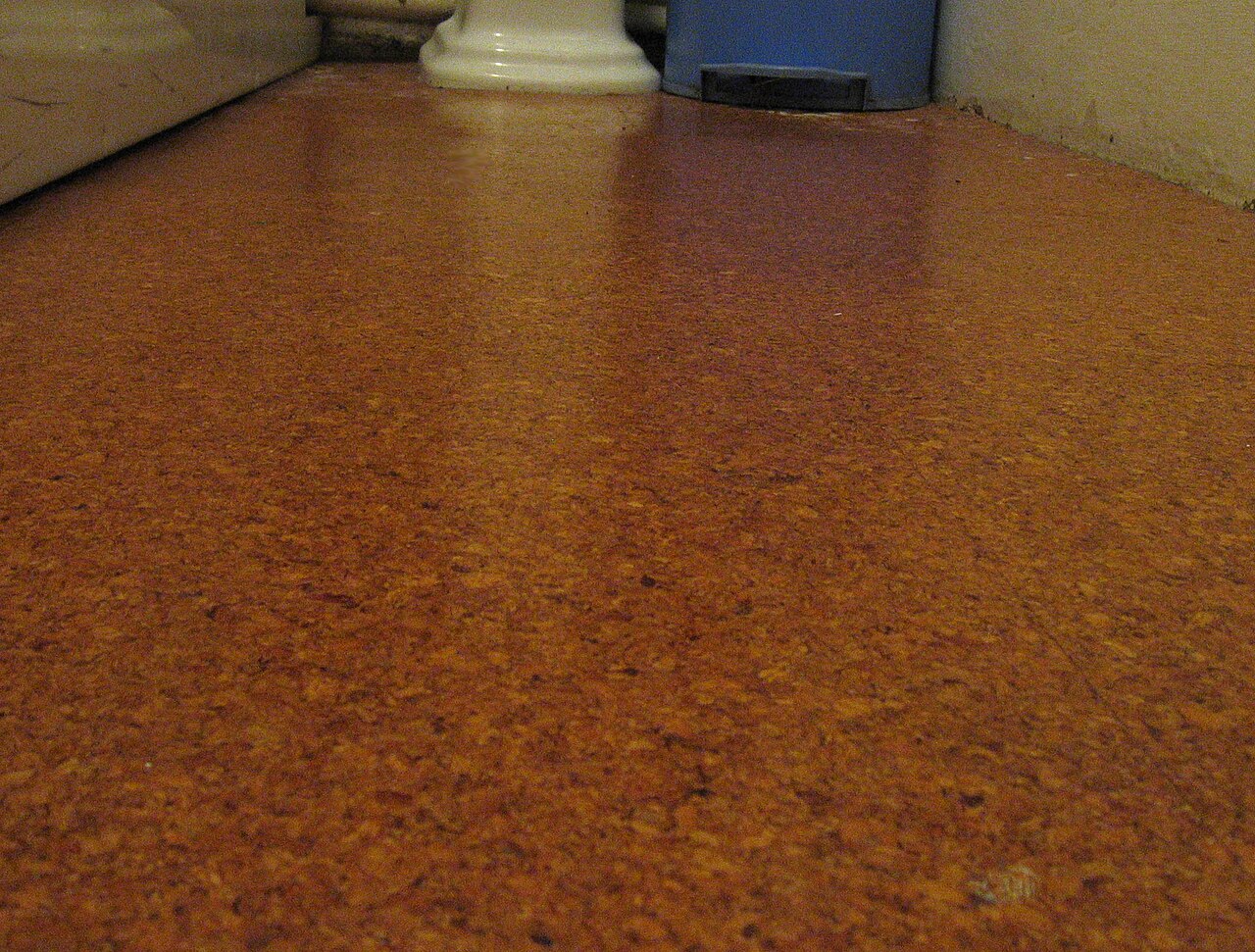
Photo: Mike1024, Public domain, via Wikimedia Commons.

How do you specify cork flooring?
To specify cork flooring, name agglomerated cork tiles to BS EN 12104 by thickness, density or range, and say whether they are factory finished or sealed on site, with the finish system. Set the use class to BS EN ISO 10874 for the traffic, a wet slip resistance where the floor can get wet, and the base moisture limit and adhesive to BS 8203, and leave room extents to the finishes schedule.
Cork is warm and quiet underfoot, and it is back in specifications for its low embodied carbon and its acoustic benefit. It is also a soft, porous material that relies entirely on its surface finish. A cork floor that is under-sealed absorbs spills and dirt; one with a thick glossy lacquer can be slippery when wet. Most problems trace back to a clause that said "cork tiles" and left the finish, the traffic class and the adhesive to the flooring contractor.
This guide covers solid agglomerated cork tiles under Uniclass Pr_35_57_71_02 Agglomerated composition cork tiles, glued to a screed or board base. Cork tiles with a PVC wear layer have their own code, Pr_35_57_71_04, and their own product standard. Click-fit cork floating floors are a different build-up again, closer to laminate flooring than to glued tiles.
What does a cork floor tile clause need to cover?
Some properties are specific to cork flooring. Others belong in every product clause. A clause that leaves either out gives the contractor room to substitute.
Properties of cork flooring
- EmissionsLow-emission binder, adhesive and finish.
- LightfastnessCork changes colour in sunlight; agree what is acceptable.
- Dimensional stabilityLimits gaps opening between tiles.
- Use classBS EN ISO 10874 class for the traffic.
- Nominal sizeTile format, often 300 x 300 or 600 x 300 mm.
- Thermal performanceThermal resistance, which matters over underfloor heating.
- AccessoriesCork or timber skirtings, edge trims, thresholds.
- Residual indentationHow well the cork recovers under furniture.
- Slip resistanceNever guessWet PTV of the finished surface.
- Product typeSolid cork tile, cork with PVC wear layer, or floating panel.
- AdhesiveContact or dispersion adhesive the cork maker approves.
- Mass per unit areaChecks density and product identity.
- Chemical resistanceFinish resistance to cleaning agents.
- Wear resistanceLinked to the use class and the finish.
- Moisture content before coveringBase RH limit tested to BS 8203.
- Acoustic performanceImpact sound reduction where the floor helps meet a target.
- Reaction to fire classificationEuroclass with fl suffix, where the fire strategy sets one.
- Laying patternStraight, staggered or quarter-turned.
- Joint treatmentButt-jointed tiles, sealed by the finish.
- Recycled contentShare of recycled or by-product cork.
- Wear layer thicknessPVC or factory finish layer, where present.
- Castor chair suitabilityOffice chairs wear soft floors quickly.
- FinishFactory lacquer, site-applied seal, or wax.
- ThicknessTile thickness, which affects comfort and acoustic benefit.
- Sample approvalColour and grain vary; approve a range sample.
What every product clause needs
- Manufacturer and product referenceCork maker and range, or a performance description.
- Product standardBS EN 12104, with essential characteristics to BS EN 14041.
- Installation methodBS 8203 and the cork and adhesive makers' instructions.
- Technical submittalsDeclaration of performance, slip report, finish data.
- Operation and maintenance informationCleaning products and resealing interval.
- MaterialAgglomerated cork granules with binder.
- SubstrateScreed or ply base, smoothed and dry.
Uniclass Pr_35_57_71_02 Agglomerated composition cork tiles. Not every property applies to every project; where one does not, say so rather than leaving it blank.
Fields marked Never guess (slip resistance) depend on the project and should never be filled from a default or a previous job. If the information is not available yet, the clause should say so with a TBC and a reason.
Which decisions does the clause depend on?
Most properties follow from the product you choose. These depend on the project, so they need a decision from the designer before the clause is written.
- 01
Slip resistance of the finished surface
Never guessThe slip resistance of a cork floor is the slip resistance of whatever is on top of it. Raw cork has good grip, but almost every cork floor is lacquered or sealed, and a smooth, high-build lacquer can be slippery when wet. That makes kitchens, entrances and bathrooms the places to be careful. The pendulum test value (PTV) in BS EN 16165 Annex C measures the finished surface, and it should be the test report for the exact finish being supplied, not for raw cork or for another lacquer in the range.
How to decide
- Mark which rooms can be wet in use on the finishes schedule.
- For those rooms, ask for a wet PTV of 36 or more with slider 96, the UK Slip Resistance Group threshold for low slip potential.
- Ask for the test report on the specified finish, at its specified sheen.
- Where a site-applied seal is used, say that slip tests may be taken on the finished floor.
Write it asSlip resistance: Wet PTV not less than 36, tested to BS EN 16165 Annex C with slider 96, on the specified finish. Submit test report. - 02
Factory finished or sealed on site
FinishCork tiles come either factory finished, with a lacquer or other surface layer already applied, or unfinished for sealing after laying. Factory finishes are more consistent and the floor is usable sooner, but the joints between tiles are not sealed, so spills can get into them. Site sealing after laying fills the joints and gives a continuous surface, but depends on the weather, the applicator and the drying time. Tiles with a PVC wear layer are a third option, tougher but no longer a cork surface. The choice affects the product code, the standard and the maintenance regime, so it has to be made before the clause is written.
How to decide
- Use site-sealed tiles where water may sit on the floor, such as bathrooms, so the joints are sealed.
- Use factory-finished tiles where a quick handover matters and spills are unlikely.
- Consider PVC wear-layer tiles only where the client accepts a vinyl surface for durability.
- Specify the seal or lacquer system by product and number of coats, not just "sealed".
Write it asProduct type: Agglomerated cork tiles to BS EN 12104, unfinished, sealed after laying with three coats of water-based polyurethane floor seal approved by the tile maker. - 03
Use class for the traffic
TrafficBS EN 12104 classifies cork tiles by intensity of use with reference to BS EN ISO 10874, the same domestic (2x), commercial (3x) and light industrial (4x) classes used for other resilient floors. A tile class suitable for a bedroom will wear through quickly in a corridor or a classroom, and castor chairs on a soft cork floor need either a harder finish or chair mats. Thickness and density come into it too: thicker, denser tiles last longer and give more comfort and sound benefit.
How to decide
- Set the BS EN ISO 10874 class for the busiest room the tile type covers.
- Where office chairs are used, ask whether the tile and finish are rated for castor chairs, tested to BS EN ISO 4918.
- Choose a thicker tile in commercial areas and check residual indentation for rooms with heavy furniture.
- Use entrance matting at external doors so grit does not wear the finish.
Write it asUse class: 32 to BS EN ISO 10874, as declared by the tile maker. Castor chair suitability: Suitable, tested to BS EN ISO 4918. - 04
Base dryness and adhesive
BaseCork tiles are thin and glued, so the base shows through and any moisture in it attacks the adhesive. BS 8203 covers base preparation for resilient floors, including measuring the relative humidity of a screed with a hygrometer to its Annex B, and asks for 75% RH or less before laying. The adhesive has to be one the cork maker approves: some tiles are laid in contact adhesive, applied to both faces, and others in a dispersion adhesive. A smoothing underlay is usually needed because cork will telegraph every trowel mark.
How to decide
- Specify hygrometer testing of the base to BS 8203 and a maximum RH, usually 75% unless the adhesive maker asks for less.
- Where the screed cannot dry in time, specify a surface damp-proof membrane approved by the adhesive maker.
- Require a smoothing underlay to the surface regularity the cork maker needs.
- Name the adhesive type the cork maker approves for the base and any underfloor heating.
Write it asMoisture content before covering: Not more than 75% RH, measured by hygrometer to BS 8203. Adhesive: Type approved by tile maker for the base, full spread. - 05
Impact sound and thermal comfort
SoundCork is often chosen to soften impact sound, but a thin glued tile on its own makes only a modest difference. If the floor is relied on to help meet a sound insulation target between flats or classrooms, the acoustic consultant needs a tested impact sound reduction for that build-up, rated to BS EN ISO 717-2. Cork's thermal resistance is also relevant over underfloor heating: thick cork slows heat transfer, so check the heating design allows for it.
How to decide
- Decide whether the cork is a comfort choice or part of an acoustic design.
- Where it is part of an acoustic design, ask for a laboratory impact sound reduction (ΔLw) for the full build-up.
- Over underfloor heating, give the tile thermal resistance to the heating designer.
- Do not count a separate acoustic underlay unless it is in the tested build-up.
Write it asAcoustic performance: Impact sound reduction ΔLw as declared, rated to BS EN ISO 717-2, for the tile and adhesive on a concrete base. Submit test report.
The values under "Write it as" are examples. The right value depends on the location, the use and the fire strategy.
Which standards should the clause cite?
Cite the product standard the declaration of performance refers to, the code of practice for installation, and the test method behind each value you set. A value without its test method cannot be checked against a submittal.
- BS EN 12104
- Resilient floor coverings. Cork floor tiles. Specification
Requirements for agglomerated cork floor tiles supplied with a factory finish, for site finishing or both, including a classification by intensity of use. The 2023 edition replaced the 2018 edition.
In the clause "Tiles: Agglomerated cork to BS EN 12104."
- BS EN 14041
- Resilient, textile, laminate and modular multilayer floor coverings. Essential characteristics
The standard behind the declaration of performance for resilient floor coverings, covering reaction to fire, slip resistance and emissions among other characteristics.
In the clause "Submit declaration of performance to BS EN 14041."
- BS EN ISO 10874
- Resilient, textile and laminate floor coverings. Classification
Use classes for domestic, commercial and light industrial traffic, such as 23, 32 and 41.
In the clause "Use class: 32 to BS EN ISO 10874."
- BS 8203
- Code of practice for installation of resilient floor coverings
UK code of practice for bases, moisture testing, smoothing underlays, adhesives and laying of resilient floors, cork included.
In the clause "Laying: To BS 8203. Base moisture measured by hygrometer."
- BS EN 16165
- Determination of slip resistance of pedestrian surfaces. Methods of evaluation
Annex C is the pendulum test, with slider 96 for shod areas and slider 57 or, as the UK foreword prefers, slider 55 for barefoot areas.
In the clause "Wet PTV not less than 36, tested to BS EN 16165 Annex C with slider 96."
- BS EN 655
- Resilient floor coverings. Tiles of agglomerated composition cork with polyvinyl chloride wear layer. Specification
The product standard for cork tiles with a PVC wear layer. Cite it instead of BS EN 12104 if that product type is chosen.
In the clause "Tiles: Cork with PVC wear layer to BS EN 655."
- BS EN ISO 717-2
- Acoustics. Rating of sound insulation in buildings and of building elements. Impact sound insulation
The single-number rating for impact sound, including the reduction ΔLw a floor covering gives.
In the clause "Impact sound reduction ΔLw rated to BS EN ISO 717-2."
- BS EN 13501-1
- Fire classification of construction products and building elements. Classification using data from reaction to fire tests
Euroclasses for floorings carry the fl suffix. Approved Document B lining classes do not apply to floors, but a fire strategy may set one.
In the clause "Reaction to fire: As declared to BS EN 13501-1, where required by the fire strategy."
Confirm the current edition of each standard at every issue. Avoice's State of UK Specifications 2026 found a withdrawn standard cited in 40% of specifications at contract issue.
How do you write it in CAWS?
In CAWS, cork tiles are written in M50, the same section as vinyl, rubber, linoleum and carpet. Each floor type gets a clause in the 100s naming the base, the preparation, the tiles, the adhesive, the laying pattern, the finish and the accessories. A cork floor in bedrooms and a different cork in a studio are two type clauses.
The general and execution clauses later in M50 do the shared work: suitability of bases, dampness testing, smoothing underlayment, colour consistency, adhesive fixing and protection. Site sealing is not part of most other M50 floors, so if the tiles are sealed after laying, the type clause needs a line for the seal system and number of coats.
- Base
- Sand and cement screed, as M10
- Preparation
- Smoothing underlayment as clause 460
- Manufacturer
- Submit proposals
- Tiles
- Agglomerated cork to BS EN 12104, unfinished for site sealing
- Size
- 300 x 300 mm
- Thickness
- 6 mm
- Colour
- TBC Client choice of natural or tinted cork outstanding. Resolve before ordering.
- Use class
- 32 to BS EN ISO 10874
- Laying pattern
- Straight, joints aligned
- Adhesive
- Type approved by tile maker for the base, full spread
- Sealing
- Three coats water-based polyurethane floor seal approved by tile maker, after laying
- Slip resistance
- Wet PTV not less than 36 to BS EN 16165 Annex C, slider 96, on the sealed surface
- Accessories
- Timber skirtings as K-section joinery; metal edge trims at changes of floor finish
Illustrative, not from a real project. One property is left as a TBC with a reason so it can be tracked and closed before issue.
Clauses the type clause relies on
- M50/410
- Suitability of new bases and conditions Base checked for flatness, soundness and site conditions before laying.
- M50/430
- Dampness Hygrometer testing of the base and the limit to achieve.
- M50/460
- Smoothing underlayment compound Preparation so the thin tiles do not show trowel marks.
- M50/620
- Colour consistency Tiles from one batch per area, mixed during laying.
- M50/640
- Adhesive fixing generally Adhesive coverage and rolling.
- M50/870
- Protection Keeping traffic off until the seal has cured.
Clause numbers vary between NBS versions and practice masters; these follow the M50 layout used in published NBS manufacturer clauses, so check that each clause the type clause refers to exists in your M50.
How do you write it in Uniclass?
In Uniclass the laid floor is Ss_30_42_72_75 Resilient tile floor covering systems. The system clause describes the base, preparation, adhesive, laying, sealing and the performance of the finished floor, including slip resistance measured on the sealed surface.
The tile is a product clause under Pr_35_57_71_02 Agglomerated composition cork tiles, with its standard, size, thickness, use class and declared properties. If the seal is specified as a product, it has its own code, Pr_35_31_77_16 Cork flooring sealers, and the system clause points to it.
- Description
- Cork tiles bonded to smoothed screed and sealed on site
- Base
- Sand and cement screed, not more than 75% RH by hygrometer to BS 8203
- Preparation
- Smoothing underlayment
- Tiles
- Pr_35_57_71_02 Agglomerated composition cork tiles (F07)
- Adhesive
- Type approved by tile maker, full spread
- Sealing
- Pr_35_31_77_16 Cork flooring sealers, three coats after laying
- Slip resistance of finished floor
- Wet PTV not less than 36 to BS EN 16165 Annex C, slider 96
- Manufacturer
- Submit proposals
- Standard
- BS EN 12104, declared to BS EN 14041
- Size
- 300 x 300 mm
- Thickness
- 6 mm
- Surface
- Unfinished, for site sealing
- Colour
- TBC Client choice of natural or tinted cork outstanding. Resolve before ordering.
- Use class
- 32 to BS EN ISO 10874
- Reaction to fire
- As declared to BS EN 13501-1
- Recycled content
- Submit manufacturer's declared value
Illustrative. Performance of the finished system sits in the system clause; properties of the product sit in the product clause.
In NBS Chorus, Uniclass product clauses also carry an NBS reference (for agglomerated cork tiles, 45-20-70/410); keep CAWS and Uniclass references out of the same specification.
What goes in the spec, and what goes in the schedule?
The specification defines each type once. The schedule and drawings say where each type goes.
In the specification
What the product is and how it performs and is installed. Written once per type.
In the schedule or drawings
Where each type goes and how much of it. Changes with every plan revision.
Write each cork type once with a type mark (F07) and let the finishes schedule say where it goes. Mark the wet rooms on the schedule, because they are the ones where the seal system and slip report matter most.
What are the common mistakes?
Most problems are a missing property, a property filled with the wrong kind of value, or a decision left silently open.
- "Sealed cork" with no seal named. Any floor varnish can be called a seal. Name the seal system the tile maker approves and the number of coats.
- A slip report for raw cork. Raw cork tests well; a high-build lacquer can test much lower when wet. Ask for the report on the specified finish.
- Domestic tiles in a commercial room. Thin, low-density tiles wear through quickly in corridors and classrooms. Set the use class for the busiest room on the type.
- Laying straight onto the screed. Cork is thin enough to show every trowel line. Specify a smoothing underlay.
- No allowance for colour change. Cork darkens or fades in sunlight, so patches under rugs show later. Tell the client at sample stage and record it with the approved sample.
- Cork counted as an acoustic layer without evidence. A 4 mm tile does little on its own. If it is part of the acoustic design, ask for a test of the build-up.
How Avoice helps
Avoice drafts cork flooring clauses from your finishes schedule and plans, and marks the finish and slip decisions it could not settle.
- Drafts from your schedule
It reads cork floor types and rooms from your finishes schedule, picks the M50 or Uniclass heading, and fills in tile, adhesive and finish lines from what you have provided.
- Leaves a TBC where a choice is open
If the client has not chosen natural or tinted cork, or nobody has said whether a room can get wet, the clause says TBC with the reason. TBCs go into one register for the project, closed before tender.
- Writes in your format
CAWS M50 type clauses or Uniclass resilient tile floor covering systems with the tile and seal as product clauses, adapted from your practice's master clauses.
- Checks the clause against the drawings
QA/QC flags an F07 on the plans with no clause, a cork floor in a room the schedule marks as wet with no slip requirement, a cross-reference to an M50 clause that is not in your master, or a withdrawn standard such as BS 7976-2.
- Keeps product data in one place
Declarations of performance, slip reports and seal data sheets sit in the Product Room, linked to the clause. Edit the linked tile once and every clause that uses it updates.
Related guides: How to specify linoleum, How to specify vinyl flooring, How to specify parquet flooring.
Software can draft and check. The designer still chooses the product and is responsible for the specification.
Draft your cork floor tile clause in Avoice
Upload your drawings and schedules. Avoice drafts the clause in CAWS or Uniclass, cites the standards and flags anything your information does not settle.
This guide is for general education and is not professional advice. Check current editions of standards and Approved Documents, the manufacturer's data, and the requirements of your project before relying on any clause.