
How to specify door handles
What a lever handle clause has to say, from the BS EN 1906 grade and fire door suitability to accessible design and contrast, and how to write it in CAWS and in Uniclass.
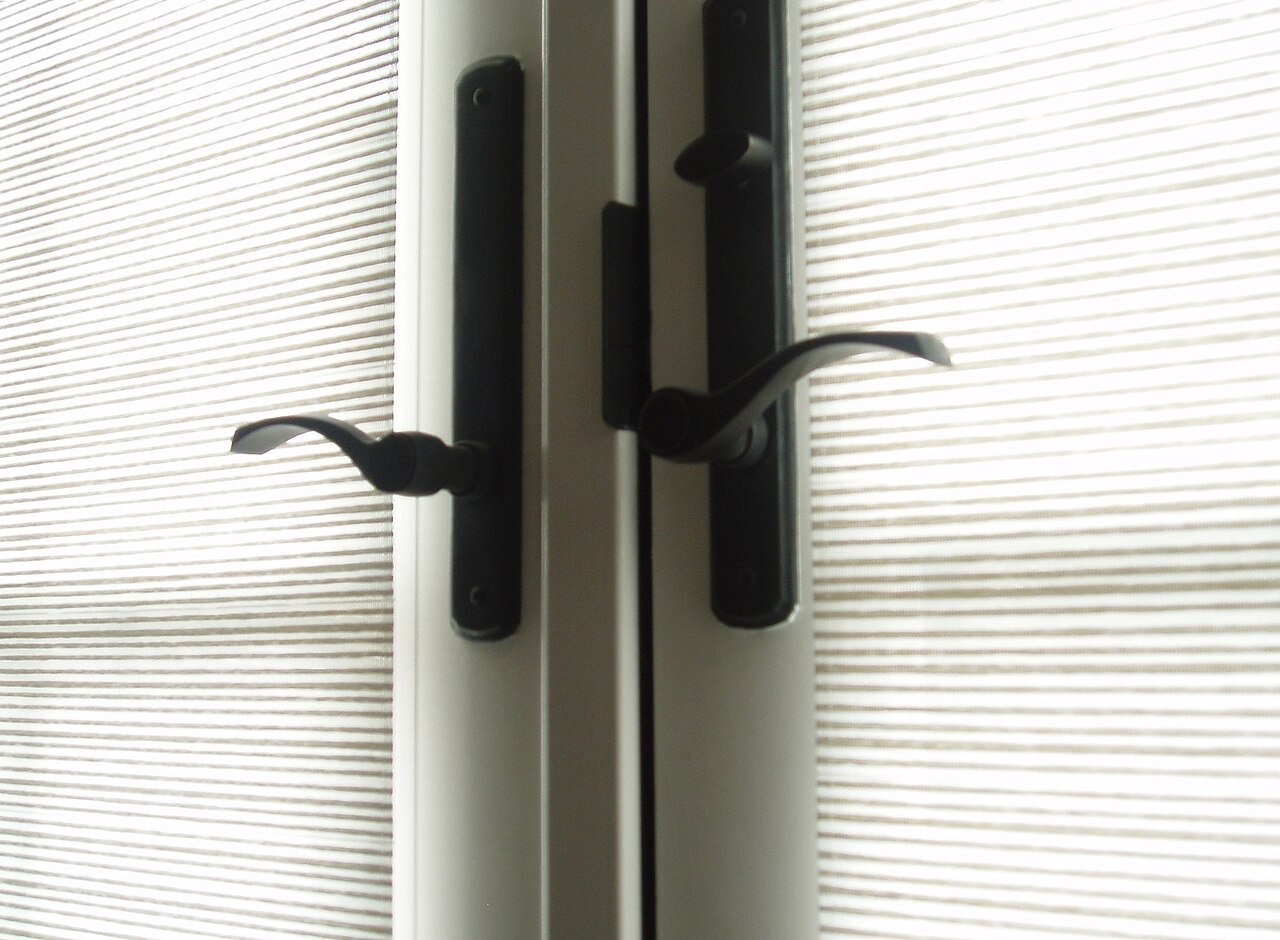
Photo: marya from San Luis Obispo, USA, CC BY 2.0, via Wikimedia Commons.

How do you specify door handles?
To specify door handles, give the BS EN 1906 classification for the use (category of use, durability, fire suitability, safety and corrosion), the handle design and rose type, the material and finish, and how it is fixed. On fire doors the handle must be within the doorset's fire evidence, and on accessible routes Approved Document M asks for furniture that works with one hand and a closed fist and contrasts visually with the door, and at entrances for furniture that is not cold to the touch.
Lever handles get chosen for how they look and then specified by catalogue number, which leaves most of what matters unsaid. A handle on a school corridor door, a hotel bedroom door and a WC in a house all look similar in a schedule, but they need very different grades, and the one on the corridor is probably on a fire door as well. BS EN 1906 gives a classification that captures most of this in one line, and the clause should ask for it.
This guide covers Uniclass Pr_30_36_59_25 Door lever handle sets, meaning a pair of levers on roses or backplates with the spindle and fixings. The lock or latch the handle operates is a separate product in Pr_30_36_08 Bolting, latching and locking hardware, and knobs and pull handles have their own codes.
What does a door handle clause need to cover?
Some properties are specific to door handles. Others belong in every product clause. A clause that leaves either out gives the contractor room to substitute.
Properties of door handles
- Third-party certificationCertification for use on fire doors, where needed.
- AccessoriesEscutcheons, turn and release, spindle and grub screw.
- Mounting typeLever on rose or backplate; sprung or unsprung.
- Hardware classificationBS EN 1906 grades for use, cycles, fire, safety, corrosion.
- Nominal sizeLever length, grip diameter and rose size.
- Product typeLever on rose, lever on backplate, or lever pad.
- Handle designReturn-to-door lever, not knobs, on accessible routes.
- Fire resistanceNever guessWithin the fire evidence of the doorset it goes on.
- Light reflectance valueContrast with the door face it is fitted to.
- AccessibilityClosed-fist operation and contrast to Approved Document M.
- Operation methodManual; sprung to suit the latch.
What every product clause needs
- Manufacturer and product referenceNamed range and design, or a performance description.
- Product standardBS EN 1906, with its classification declared.
- Installation methodManufacturer's template, aligned with the latch follower.
- Technical submittalsBS EN 1906 classification and fire test evidence.
- Operation and maintenance informationTightening fixings and cleaning the finish.
- MaterialStainless steel, aluminium, brass or nylon-coated steel.
- FinishSame finish across the ironmongery set.
- FixingsBolt-through or screw fixing to suit the leaf.
Uniclass Pr_30_36_59_25 Door lever handle sets. Not every property applies to every project; where one does not, say so rather than leaving it blank.
Fields marked Never guess (fire resistance) depend on the project and should never be filled from a default or a previous job. If the information is not available yet, the clause should say so with a TBC and a reason.
Which decisions does the clause depend on?
Most properties follow from the product you choose. These depend on the project, so they need a decision from the designer before the clause is written.
- 01
The BS EN 1906 classification
GradeBS EN 1906 classifies lever handles with a code that covers category of use (grades 1 to 4, from residential doors to heavy public use with a high chance of misuse), durability (grade 7 is tested for more cycles than grade 6), suitability for fire and smoke doors, safety, corrosion resistance to BS EN 1670, security and the type of operation. A catalogue picture shows none of this. Asking for the grades you need lets a substitute be checked line by line, and stops a domestic-grade lever reaching a school corridor because it looked the same.
How to decide
- Pick the category of use from who uses the door: grade 3 or 4 for public and institutional buildings.
- Ask for durability grade 7 on doors in heavy daily use.
- Ask for the fire digit to show suitability for fire doors wherever the handle goes on one.
- Set corrosion resistance by exposure, with a higher BS EN 1670 grade for external, pool or coastal doors.
Write it asClassification: To BS EN 1906, category of use 4, durability 7, suitable for fire and smoke doors, safety 1, corrosion resistance 4. - 02
Handles on fire doors
Never guessA lever handle on a fire door is part of the doorset's fire evidence. The handle itself should be classified as suitable for fire doors under BS EN 1906 and should have been tested, or assessed, on a door of the same construction and period, because a set tested on a steel door does not prove it on a timber one. Fixings matter too: through-bolts and rose fixings go through the leaf, so they have to be ones the doorset evidence allows. Where a lever operates an emergency exit lock to BS EN 179, the lever is part of that certified device and cannot be swapped for another design.
How to decide
- Mark every fire door on the ironmongery schedule and check the handle against that doorset's evidence.
- Ask for test or assessment evidence for the door type and period: timber or steel, 30 or 60 minutes.
- Use fixings permitted by the doorset certificate.
- On escape doors with BS EN 179 devices, specify the lever as part of the device, not separately.
Write it asFire doors: Lever handle sets suitable for fire doors to BS EN 1906, with evidence on the door construction and period, fixings as the doorset certification. - 03
Accessible design and visual contrast
AccessApproved Document M Volume 2 asks that latched entrance and internal doors have opening furniture that can be used with one hand and a closed fist, such as a lever handle, and that all door opening furniture contrasts visually with the surface of the door. For entrance doors it also asks that the furniture is not cold to the touch. Knobs fail the closed-fist test. A lever that returns towards the door face is less likely to catch clothing and bags. BS 8300-2 gives more detailed guidance on handle dimensions, mounting height and contrast. Contrast is easy to lose late, when the door colour changes after the handles have been chosen.
How to decide
- Use levers, not knobs, on every door on an accessible route.
- Choose a return-to-door design where people carry bags or use walking aids.
- Check contrast against the actual door finish, including any door colour changes.
- On entrance doors, consider a material or coating that is not cold to the touch.
Write it asDesign: Return-to-door lever on round rose, operable with a closed fist, contrasting visually with the door face to Approved Document M and BS 8300-2. - 04
Roses, springs and fixing
FixingA heavy lever on a light latch spring droops, and the handle then sits at an angle for the life of the building. Sprung roses, or a latch with a stronger spring, solve this, and the clause should say which. Bolt-through fixing, where the two roses are tied through the leaf, is stronger than screws into the face and is usual on heavily used doors, but on fire doors the bolts have to be allowed by the doorset evidence. The spindle has to suit the latch follower and the door thickness, which is worth checking where doors are thicker than standard.
How to decide
- Specify sprung roses for levers on latches without a strong return spring.
- Use bolt-through fixing on heavily used doors, within fire evidence where it applies.
- Check spindle length against door thickness for acoustic and fire doors.
- Keep the handle and latch from one supplier or check that they are listed together.
Write it asMounting: Lever on sprung round rose, bolt-through fixing, spindle to suit latch and door thickness. - 05
Material, finish and corrosion
MaterialSatin stainless steel is the default because it wears well and matches most other ironmongery, but it is not the only answer. Brass and bronze age and need care, aluminium scratches, and coated finishes can chip on heavily used doors. The finish should be the same across the ironmongery set on each door, so it is usually written once at the top of the section or set, not repeated in every clause. For external and wet areas the BS EN 1670 corrosion grade in the classification is more useful than the word "stainless", because grades of stainless steel differ.
How to decide
- Pick the material from use and appearance, then check the BS EN 1670 grade for exposure.
- Give the stainless steel grade where it matters, for example 316 for coastal or pool areas.
- Keep the finish consistent across the ironmongery set on each door.
- Ask for a sample of the finish if it is not a standard satin or polished stainless steel.
Write it asMaterial and finish: Stainless steel grade 304, satin finish, to match the ironmongery set.
The values under "Write it as" are examples. The right value depends on the location, the use and the fire strategy.
Which standards should the clause cite?
Cite the product standard the declaration of performance refers to, the code of practice for installation, and the test method behind each value you set. A value without its test method cannot be checked against a submittal.
- BS EN 1906
- Building hardware. Lever handles and knob furniture. Requirements and test methods
The product standard and classification code for lever handles: category of use, durability, fire suitability, safety, corrosion, security and type of operation.
In the clause "Standard: To BS EN 1906, category of use 4, durability 7, suitable for fire and smoke doors."
- BS EN 1670
- Building hardware. Corrosion resistance. Requirements and test methods
The corrosion test and grades used in the BS EN 1906 classification.
In the clause "Corrosion resistance: Grade 4 to BS EN 1670."
- BS EN 1634-1
- Fire resistance and smoke control tests for door and shutter assemblies, openable windows and elements of building hardware. Fire resistance test for door and shutter assemblies and openable windows
The fire test of the doorset that the handle has to sit within, including tests with hardware fitted.
In the clause "Within the scope of the doorset's fire evidence to BS EN 1634-1."
- BS EN 179
- Building hardware. Emergency exit devices operated by a lever handle or push pad, for use on escape routes. Requirements and test methods
Emergency exit devices for escape doors used by people familiar with them, certified with their lever or pad.
In the clause "Escape doors: Emergency exit device to BS EN 179, lever handle as certified with the device."
- BS EN 12209
- Building hardware. Mechanically operated locks and locking plates. Requirements and test methods
The locks and latches the lever operates, including their own classification and spring strength.
In the clause Coordinate the two: "Latch: To BS EN 12209, compatible with lever handle set LH01."
- BS 8300-2
- Design of an accessible and inclusive built environment. Buildings. Code of practice
Detailed guidance on door furniture for accessible buildings, including handle form, mounting height and visual contrast.
In the clause "Design and position: To Approved Document M and BS 8300-2."
Confirm the current edition of each standard at every issue. Avoice's State of UK Specifications 2026 found a withdrawn standard cited in 40% of specifications at contract issue.
For the regulations behind these choices, see Approved Document M explained, Approved Document B explained, or search the Avoice Regulations library.
How do you write it in CAWS?
In CAWS, lever handles go in P21 as a product clause. P21 does not bundle items into "type of" system clauses. Each kind of ironmongery has its own clause, and NBS references lever handles at clause 610. A project with a heavy-duty lever for public areas and a lighter one for back-of-house has two clauses, 610 and 611, with type marks the ironmongery schedule uses.
The general clauses at the front of P21 apply to every item: quantities and locations by reference to the schedule, whether items come from one range, samples, ironmongery on fire doors and category of duty. The lever clause relies on those rather than repeating them. Fitting is covered in L20, so the fixing clause there has to exist as well.
- Standard
- To BS EN 1906
- Category of use
- 4
- Durability
- 7
- Fire and smoke doors
- Suitable, with evidence for timber and steel doors of the periods on the door schedule
- Safety
- 1
- Corrosion resistance
- Grade 4 to BS EN 1670
- Manufacturer
- Submit proposals
- Product reference
- Submit proposals
- Design
- Return-to-door lever, operable with a closed fist
- Mounting
- Sprung round rose, bolt-through fixing
- Material
- Stainless steel grade 304
- Finish
- TBC Client choice of satin or polished finish outstanding; must match the ironmongery set. Resolve before ordering.
- Contrast
- Contrasting visually with the door face, to Approved Document M and BS 8300-2
- Accessories
- Matching escutcheons and turn and release where scheduled
- Submittals
- BS EN 1906 classification and fire evidence for the door types
Illustrative, not from a real project. One property is left as a TBC with a reason so it can be tracked and closed before issue.
Clauses the type clause relies on
- P21/10
- Quantities and locations Points to the ironmongery schedule for which doors get LH01.
- P21/120
- Ironmongery range selected by contractor Lets the contractor propose a range that meets the clauses, for approval.
- P21/140
- Samples A sample lever approved before the order is placed.
- P21/170
- Ironmongery for fire doors Requires evidence that every item on a fire door is within the doorset's evidence.
- P21/180
- Category of duty for door ironmongery Sets the duty items must suit across the project.
Clause numbers vary between NBS versions and practice masters. The 610 clause follows the P21 reference NBS gives for lever handles, and the general clauses follow the P21 section of an issued UK ironmongery specification; check them against your own P21.
How do you write it in Uniclass?
In Uniclass, the handles on a door belong to a hardware set: Ss_25_38_20_20 Door hardware systems. The system clause describes what the set on a type of door must do: fire suitability, accessible operation, contrast and how the lever, latch and other items work together. The lever handle itself is a product clause that the system points to.
This works well for handles because one lever is usually used on many door types. A corridor fire door, an office door and a store all point to LH01, with each hardware set adding its own requirements. Change the lever once in the product clause and every set picks it up, while each set keeps its own fire and access requirements.
- Description
- Ironmongery set for single-leaf FD30S corridor doors on accessible routes
- Lever handles
- Pr_30_36_59_25 Door lever handle sets (LH01)
- Latch
- Mortice latch to BS EN 12209, compatible with LH01
- Fire performance
- Every item within the scope of the doorset's fire evidence
- Accessibility
- Operable with a closed fist to Approved Document M; contrasting visually with the door, to BS 8300-2
- Category of duty
- Heavy
- Manufacturer
- Submit proposals
- Product reference
- Submit proposals
- Hardware classification
- To BS EN 1906, category of use 4, durability 7, fire suitable, safety 1, corrosion 4
- Fire resistance
- Evidence for the door constructions and periods on the door schedule
- Handle design
- Return-to-door lever
- Mounting type
- Sprung round rose, bolt-through
- Material
- Stainless steel grade 304
- Finish
- TBC Client choice of satin or polished finish outstanding; must match the ironmongery set. Resolve before ordering.
Illustrative. Performance of the finished system sits in the system clause; properties of the product sit in the product clause.
In NBS Chorus, Uniclass product clauses also carry an NBS reference (for lever handle sets, 45-25-60/315). Use whichever your practice's masters use, but keep CAWS and Uniclass references out of the same specification.
What goes in the spec, and what goes in the schedule?
The specification defines each type once. The schedule and drawings say where each type goes.
In the specification
What the product is and how it performs and is installed. Written once per type.
In the schedule or drawings
Where each type goes and how much of it. Changes with every plan revision.
Write each lever once with a type mark and let the ironmongery schedule say which doors it goes on and what it is paired with. The same lever usually appears in several sets, so describing door locations in the clause only creates a second list to keep up to date.
For coordination between these documents, see Why your window and door schedules don’t match your specification.
What are the common mistakes?
Most problems are a missing property, a property filled with the wrong kind of value, or a decision left silently open.
- A catalogue number and nothing else. A substitute can only be checked against a classification. Give the BS EN 1906 grades.
- Knobs on accessible routes. They cannot be turned with a closed fist. Use levers wherever Approved Document M applies.
- A handle tested on steel used on a timber fire door. Fire evidence is for a door construction and period. Check it against each door type.
- Drooping levers. A heavy lever on a weak latch spring sags. Specify sprung roses or a matching latch.
- No contrast check after a door colour change. Satin steel on a pale grey door can disappear. Recheck contrast when the door finish changes.
- Lever specified apart from the exit device. On BS EN 179 escape doors the lever is part of the certified device. Specify them together.
How Avoice helps
Avoice drafts lever handle clauses from your ironmongery schedule and door schedule, and shows what it could not settle.
- Drafts from your schedules
It reads the lever types (LH01, LH02) from the ironmongery schedule and the fire rating of each door from the door schedule, and drafts the P21 or Uniclass clause with the grades those documents support.
- Marks open decisions
If the finish has not been chosen, the line says TBC with the reason and the item joins the project TBC register to close before tender.
- Keeps your house style
CAWS or Uniclass, adapted from your practice's own P21 masters and numbering.
- Checks the set
QA/QC flags a lever type on the schedule that the specification never defines, a fire door whose handle has no fire suitability, a cross-reference to a missing P21 clause, or a withdrawn standard.
- Holds the evidence
Classification data and fire test evidence sit in the Product Room linked to the clause. Edit the linked lever once and every clause using it updates.
Related guides: How to specify door closers, How to specify door hinges, How to specify fire doors.
Software can draft and check. The designer still chooses the product and is responsible for the specification.
Draft your door handle clause in Avoice
Upload your drawings and schedules. Avoice drafts the clause in CAWS or Uniclass, cites the standards and flags anything your information does not settle.
This guide is for general education and is not professional advice. Check current editions of standards and Approved Documents, the manufacturer's data, and the requirements of your project before relying on any clause.