
How to specify door hinges
What a door hinge clause has to fix, from the BS EN 1935 grade and fire door evidence to size, number, bearings and security, and how to write it in CAWS and in Uniclass.
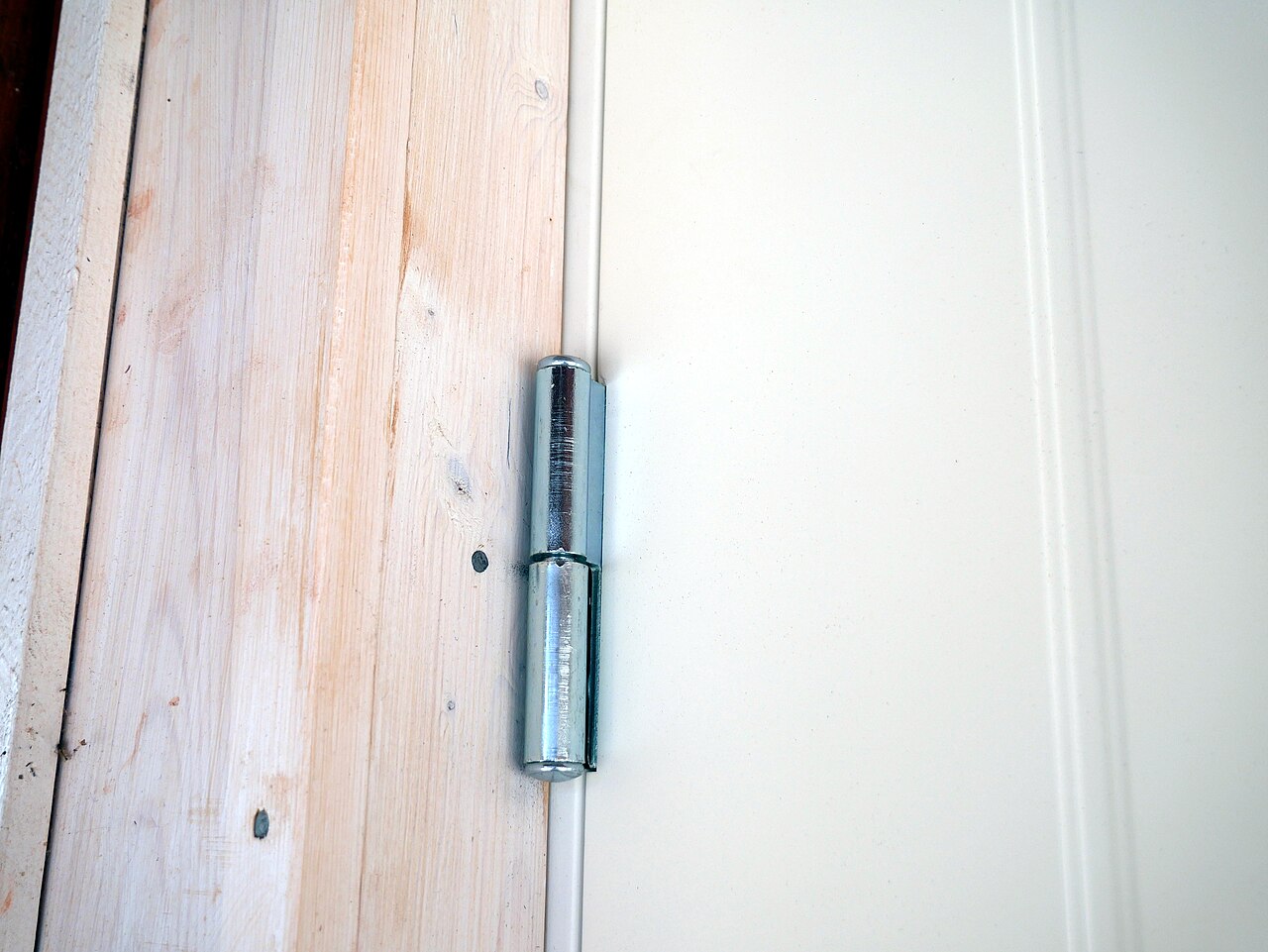
Photo: Santeri Viinamäki, CC BY-SA 4.0, via Wikimedia Commons.

How do you specify door hinges?
To specify door hinges, give the BS EN 1935 classification, including the hinge grade, test door mass and whether the hinge is suitable for fire and smoke doors, then the size, material, bearing type and number per leaf. On fire doors the hinge must be within the doorset's fire evidence, and Approved Document B expects hinges not tested with the doorset to be made of materials that melt at 800°C or more.
Hinges carry the door, take every slam and closer cycle, and on a fire door hold the leaf in its frame while the timber around them burns. They are also the item most often written as "3 no. hinges to suit", which leaves the grade, the size and the fire evidence to whoever orders the ironmongery. BS EN 1935 gives each hinge a classification code, and asking for it is the simplest way to make a hinge clause checkable.
This guide covers Uniclass Pr_30_36_36_79 Single axis door hinges, the group BS EN 1935 deals with. Uniclass also has narrower codes, such as Pr_30_36_36_09 Butt door hinges and Pr_30_36_36_06 Ball bearing hinges, which some masters use instead. Other hanging hardware has separate codes: rising butts are Pr_30_36_36_71 Rising butt door hinges, and floor springs and pivots have their own, each with different evidence on fire doors.
What does a door hinge clause need to cover?
Some properties are specific to door hinges. Others belong in every product clause. A clause that leaves either out gives the contractor room to substitute.
Properties of door hinges
- Acoustic performanceMust not reduce the doorset's rated sound insulation.
- Opening angleClearance from architraves and walls; affects clear width.
- Product typeButt hinge, concealed bearing or lift-off.
- Material gradeStainless 304 inside; 316 outside or in aggressive areas.
- Security ratingHinge bolts or studs on outward-opening external doors.
- Fire resistanceNever guessWithin the doorset's fire evidence; 800°C rule otherwise.
- Hardware classificationBS EN 1935 code including hinge grade.
- Nominal sizeBlade size and thickness against leaf thickness and mass.
- CompatibilityLeaf thickness, mass, frame rebate and closer.
- Structural performanceTest door mass grade against the actual leaf.
- Mounting typeMortice into leaf and frame, or surface.
- Hinge bearing typeBall bearing on fire doors and doors with closers.
What every product clause needs
- Manufacturer and product referenceNamed hinge, or a performance description.
- Product standardBS EN 1935, with its classification declared.
- Installation methodRecessed flush, positions as the doorset evidence.
- Technical submittalsDeclaration of performance and fire evidence for the door types.
- Operation and maintenance informationChecking screws and wear on heavily used doors.
- MaterialStainless steel or steel; aluminium needs fire test evidence.
- FinishMatch the ironmongery set on the door.
- FixingsScrew type, length and number to suit the leaf and frame.
Uniclass Pr_30_36_36_79 Single axis door hinges. Not every property applies to every project; where one does not, say so rather than leaving it blank.
Fields marked Never guess (fire resistance) depend on the project and should never be filled from a default or a previous job. If the information is not available yet, the clause should say so with a TBC and a reason.
Which decisions does the clause depend on?
Most properties follow from the product you choose. These depend on the project, so they need a decision from the designer before the clause is written.
- 01
The BS EN 1935 classification and hinge grade
GradeBS EN 1935 gives single axis hinges an eight-part code: category of use, durability, test door mass, suitability for fire and smoke doors, safety, corrosion resistance, security and hinge grade. The last digit, from grade 1 to grade 14, is the one people quote, and it summarises how heavy and how busy a door the hinge can carry. A grade 13 hinge is common on fire doors, but the grade follows from the leaf mass and the use, not from the word "fire". Industry guidance on BS EN 1935 recommends the higher grades for doors with closers, especially where the closer has back check, because the closer adds load at the top hinge.
How to decide
- Work out the leaf mass from the door construction, including glazing and lead lining if any.
- Choose a test door mass grade at or above that mass, with an allowance where a closer is fitted.
- Use a high hinge grade (12 to 14) on doors with closers in public or heavy use.
- Ask for the full eight-part code on the data sheet, not just the hinge grade.
Write it asClassification: To BS EN 1935, category of use 4, durability 7, suitable for fire and smoke doors, hinge grade 13, test door mass to suit the heaviest leaf. - 02
Hinges on fire doors
Never guessA hinge on a fire door is part of the doorset's fire evidence. It should be classified as suitable for fire and smoke doors under BS EN 1935, and tested or assessed on a door of the same construction and period. Approved Document B adds a fallback: unless the hinge has been shown to work when tested as part of the fire doorset, its essential parts should be made of materials with a melting point of at least 800°C. That rules out untested aluminium or plastic-bodied hinges. Some evidence also requires intumescent pads behind the hinge blades, and they are easy to leave out on site.
How to decide
- Check each fire door type's evidence for the hinges it lists, or ask for an assessment for the one proposed.
- Match the evidence to the door: timber or steel, and the period on the door schedule.
- Include intumescent pads where the doorset evidence calls for them.
- Ask for the declaration of performance, as BS EN 1935 hinges for fire and smoke doors carry one.
Write it asFire doors: Hinges suitable for fire and smoke doors to BS EN 1935, within the doorset's fire evidence, with intumescent pads where the evidence requires. - 03
Size, number and position
SizingHinge size has to suit the leaf thickness and mass, and the number per leaf has to suit the height, weight and use. Timber doors with closers normally need at least three hinges, and fire doorset evidence usually states the number, size and positions that were tested. Positions belong to the doorset evidence or a general L20 clause, not to the hinge clause. Heavy or tall leaves, acoustic doors and doors with closers in constant use may need a fourth hinge, which should be checked against the fire evidence before it is added.
How to decide
- Size the blade to the leaf thickness, with blade thickness and knuckle to suit the mass.
- Use at least three hinges per leaf on doors with closers and on fire doors, or the number the evidence states.
- Take positions from the doorset evidence and refer to the L20 hinge location clause.
- Check compatibility with the frame rebate depth and the closer arm.
Write it asSize and number: 102 x 76 x 3 mm, three per leaf, positions as the doorset evidence. - 04
Bearings, material and corrosion
BearingsBall bearing hinges are normal on fire doors and on any door with a closer, because they keep the door swinging freely against the closer's force and wear slowly. Washered or self-lubricating hinges suit light domestic doors. Material and grade matter for corrosion: grade 304 stainless steel is the usual choice inside, and grade 316 suits external, coastal and pool areas. The corrosion digit in the BS EN 1935 code, tested to BS EN 1670, is the checkable figure, and it is more reliable than a finish description.
How to decide
- Use ball bearing hinges on fire doors and doors with closers.
- Pick stainless steel grade 304 internally and 316 externally or in aggressive environments.
- Set the corrosion grade in the classification to the exposure.
- Keep the finish consistent with the rest of the ironmongery set.
Write it asType: Ball bearing butt hinge, stainless steel grade 304, satin finish, corrosion resistance grade 3 to BS EN 1670. - 05
Outward-opening external doors
SecurityOn an outward-opening external door the hinge knuckles face outside, and a hinge pin knocked out or the knuckles cut leave the hinge side free. Hinge bolts or security studs that engage the frame when the door is shut stop the leaf being lifted out. BS EN 1935 has a security digit in its code, and doorsets tested for security, such as PAS 24 or LPS 1175 doorsets, are tested with particular hinges, so the hinge on those doors should be the one in the test, not a substitute from the general ironmongery range.
How to decide
- List every outward-opening external door on the ironmongery schedule.
- Add hinge bolts or security studs where the door is not a tested security doorset.
- For security-tested doorsets, use the hinges the evidence lists.
- Consider non-removable pins where hinge bolts are not practical.
Write it asSecurity: On outward-opening external doors, hinges with non-removable pins and a pair of hinge bolts per leaf, unless supplied as part of a tested security doorset.
The values under "Write it as" are examples. The right value depends on the location, the use and the fire strategy.
Which standards should the clause cite?
Cite the product standard the declaration of performance refers to, the code of practice for installation, and the test method behind each value you set. A value without its test method cannot be checked against a submittal.
- BS EN 1935
- Building hardware. Single-axis hinges. Requirements and test methods
The product standard and eight-part classification for single axis hinges, including hinge grade, test door mass and suitability for fire and smoke doors.
In the clause "Standard: To BS EN 1935, hinge grade 13, suitable for fire and smoke doors."
- BS EN 1670
- Building hardware. Corrosion resistance. Requirements and test methods
The corrosion test and grades quoted in the BS EN 1935 code.
In the clause "Corrosion resistance: Grade 3 to BS EN 1670."
- BS EN 1634-1
- Fire resistance and smoke control tests for door and shutter assemblies, openable windows and elements of building hardware. Fire resistance test for door and shutter assemblies and openable windows
The fire test of doorsets with hardware fitted, which is the evidence a hinge has to be covered by.
In the clause "Within the scope of the doorset's fire evidence to BS EN 1634-1."
- BS 476-22
- Fire tests on building materials and structures. Methods for determination of the fire resistance of non-loadbearing elements of construction
The national fire resistance test still cited in many hinge and doorset certificates. Approved Document B in England accepts it until its 2029 amendments take effect on 2 September 2029.
In the clause Accept existing evidence with an end date in mind: "Fire evidence to BS EN 1634-1, or BS 476-22 where accepted by Approved Document B at the time of building control approval."
- BS 8214
- Timber-based fire door assemblies. Code of practice
Specification, hanging and maintenance of timber fire doors, including guidance on hinges and their fitting.
In the clause "Hang timber fire doors to BS 8214 and the doorset evidence."
- BS EN 1154
- Building hardware. Controlled door closing devices. Requirements and test methods
Door closers, whose power size and back check add load to the hinges and so influence the hinge grade.
In the clause Coordinate: "Hinge grade to suit closer DC01 to BS EN 1154."
Confirm the current edition of each standard at every issue. Avoice's State of UK Specifications 2026 found a withdrawn standard cited in 40% of specifications at contract issue.
For the regulations behind these choices, see Approved Document B explained, or search the Avoice Regulations library.
How do you write it in CAWS?
In CAWS, hinges go in P21 as their own product clause. NBS references single axis door hinges at clause 310, and a project with a heavy-duty fire door hinge and a lighter hinge for cupboards has two clauses, 310 and 311, with type marks the ironmongery schedule uses.
The P21 general clauses cover quantities and locations through the schedule, the range, samples, fire doors and category of duty, and the hinge clause relies on them. Where the hinges go on the leaf is not in P21. It belongs to the L20 clause on location of hinges, so check that clause exists and says positions follow the doorset evidence.
- Standard
- To BS EN 1935
- Category of use
- 4
- Durability
- 7
- Test door mass
- To suit the heaviest leaf, with allowance for the closer
- Fire and smoke doors
- Suitable, within the doorset's fire evidence for each door type
- Corrosion resistance
- Grade 3 to BS EN 1670
- Hinge grade
- 13
- Manufacturer
- Submit proposals
- Product reference
- Submit proposals
- Type
- Ball bearing butt hinge
- Size
- 102 x 76 x 3 mm
- Number
- Three per leaf, positions as L20 clause 850
- Material
- Stainless steel grade 304
- Finish
- TBC Client choice of satin or polished finish outstanding; must match the ironmongery set. Resolve before ordering.
- Intumescent pads
- Where required by the doorset's fire evidence
- Submittals
- Declaration of performance and fire evidence for each door type
Illustrative, not from a real project. One property is left as a TBC with a reason so it can be tracked and closed before issue.
Clauses the type clause relies on
- P21/10
- Quantities and locations Points to the ironmongery schedule for which doors get HG01.
- P21/140
- Samples A sample hinge approved before ordering.
- P21/170
- Ironmongery for fire doors Every item on a fire door within the doorset's evidence.
- P21/180
- Category of duty for door ironmongery The duty the hinges must suit across the project.
- P21/L20/850
- Location of hinges Hinge positions per leaf, as the door leaf manufacturer's recommendations or evidence.
Clause numbers vary between NBS versions and practice masters. The 310 clause follows the P21 reference NBS gives for single axis door hinges, and the general clauses follow issued UK P21 and L20 specifications; check them against your own masters.
How do you write it in Uniclass?
In Uniclass, hinges belong to the hardware set for a type of door, Ss_25_38_20_20 Door hardware systems. The system clause says what the set on that door must achieve for fire, security and use, and the hinge is a product clause it points to, along with the lever, latch and closer.
Because the same hinge is usually fitted to many door types, this keeps the hinge in one place. The hardware set for a fire door adds the fire evidence and intumescent pads, the set for an outward-opening external door adds hinge bolts, and both point to HG01.
- Description
- Ironmongery set for single-leaf FD30S corridor doors with closers
- Hinges
- Pr_30_36_36_79 Single axis door hinges (HG01), three per leaf
- Closer
- Pr_30_36_59_15 Controlled door closers (DC01)
- Fire performance
- Every item within the scope of the doorset's fire evidence
- Intumescent protection
- Pads behind hinge blades where the evidence requires
- Category of duty
- Heavy
- Manufacturer
- Submit proposals
- Product reference
- Submit proposals
- Hardware classification
- To BS EN 1935, category of use 4, durability 7, fire suitable, hinge grade 13
- Fire resistance
- Evidence for the door constructions and periods on the door schedule
- Nominal size
- 102 x 76 x 3 mm
- Hinge bearing type
- Ball bearing
- Material grade
- Stainless steel grade 304
- Finish
- TBC Client choice of satin or polished finish outstanding; must match the ironmongery set. Resolve before ordering.
Illustrative. Performance of the finished system sits in the system clause; properties of the product sit in the product clause.
In NBS Chorus, Uniclass product clauses also carry an NBS reference (for single axis door hinges, 45-25-42/420). Use whichever your practice's masters use, but keep CAWS and Uniclass references out of the same specification.
What goes in the spec, and what goes in the schedule?
The specification defines each type once. The schedule and drawings say where each type goes.
In the specification
What the product is and how it performs and is installed. Written once per type.
In the schedule or drawings
Where each type goes and how much of it. Changes with every plan revision.
Write each hinge type once with a type mark and let the ironmongery schedule say which doors use it and how many per leaf. Hinge positions belong to the doorset evidence and the L20 location clause, not to a list of doors in P21.
For coordination between these documents, see Why your window and door schedules don’t match your specification.
What are the common mistakes?
Most problems are a missing property, a property filled with the wrong kind of value, or a decision left silently open.
- "Hinges to suit". Grade, size and fire suitability are left to the order. Give the BS EN 1935 code.
- Two hinges on a fire door with a closer. Closers load the top hinge. Use at least three, or the number the doorset evidence states.
- Hinge grade picked from the word "fire". Grade follows leaf mass and use. A heavy acoustic fire door may need more than the usual grade.
- Intumescent pads left out. If the evidence used them, the door without them is outside its evidence. Put them in the clause.
- Untested aluminium hinges on fire doors. Approved Document B expects essential hinge parts to melt at 800°C or more unless tested with the doorset.
- Substitute hinges on security doorsets. PAS 24 and LPS 1175 doorsets are tested with specific hinges. Keep them.
How Avoice helps
Avoice drafts hinge clauses from your ironmongery and door schedules, and tells you what is still undecided.
- Drafts from your schedules
It reads the hinge types and counts per leaf from the ironmongery schedule and the fire rating of each door from the door schedule, then drafts the P21 or Uniclass clause with the grades those documents support.
- Marks what is open
If the finish has not been chosen, the clause says TBC with the reason, and the item joins the project TBC register to close before tender.
- Uses your masters
CAWS or Uniclass, adapted from your practice's own P21 clauses and numbering.
- Checks the doors
QA/QC flags a fire door scheduled with two hinges, a hinge type the specification never defines, a reference to a missing L20 hinge location clause, or a withdrawn standard.
- Keeps evidence with the clause
Declarations of performance and fire test evidence sit in the Product Room linked to the hinge clause. Edit the linked hinge once and every clause using it updates.
Related guides: How to specify fire doors, How to specify door closers, How to specify door handles.
Software can draft and check. The designer still chooses the product and is responsible for the specification.
Draft your door hinge clause in Avoice
Upload your drawings and schedules. Avoice drafts the clause in CAWS or Uniclass, cites the standards and flags anything your information does not settle.
This guide is for general education and is not professional advice. Check current editions of standards and Approved Documents, the manufacturer's data, and the requirements of your project before relying on any clause.