
How to specify floor paints
What a floor paint clause has to say for concrete floors in stores, plant rooms and back-of-house areas, the decisions behind it, the standards to cite, and how to write it in CAWS and in Uniclass.
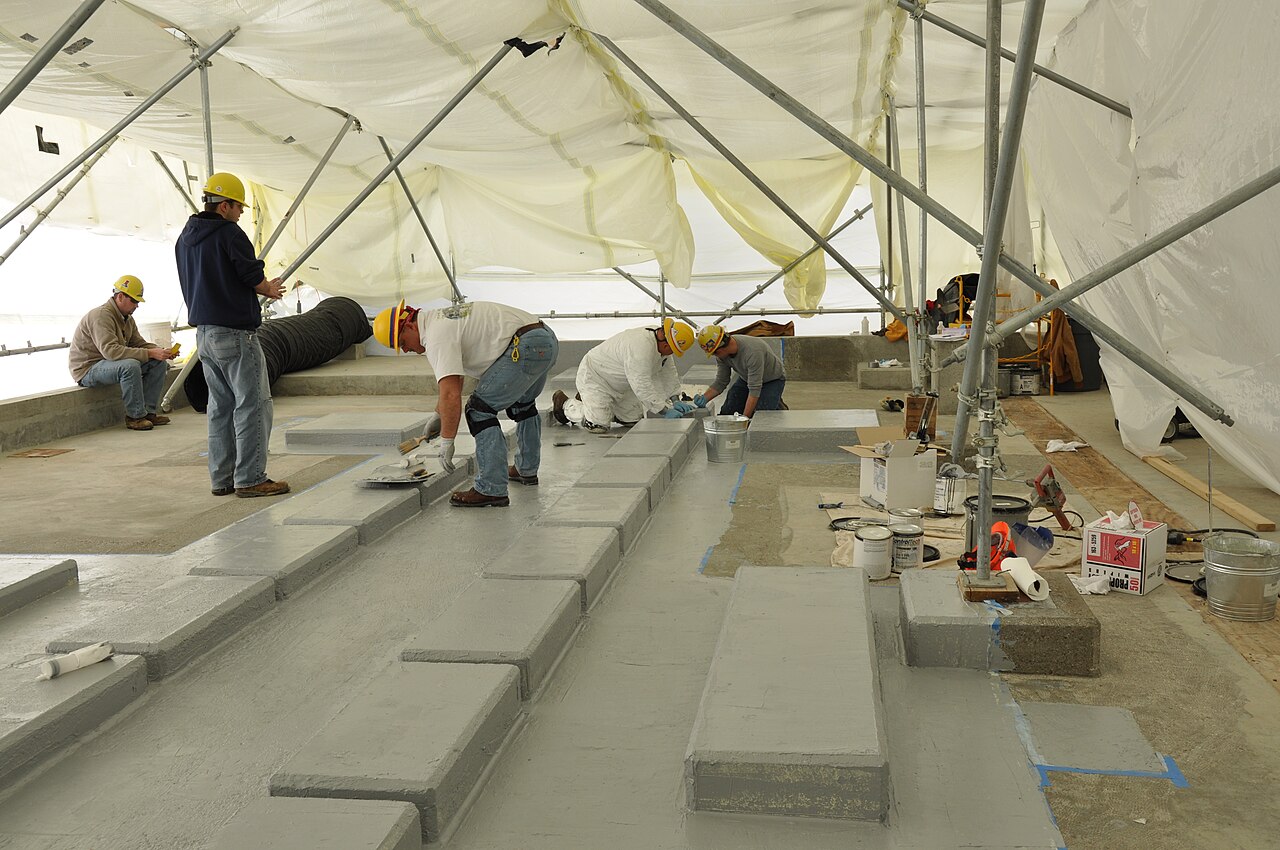
Photo: PEO ACWA, CC BY 2.0, via Wikimedia Commons.
.jpg)
How do you specify floor paints?
To specify floor paint, first confirm that a thin coating is enough for the traffic, then name the product or its binder (single-pack, water-based epoxy, two-pack epoxy or polyurethane), the coat system and dry film build, the colour and the slip resistance as a wet pendulum value where the floor may be wet. Set the substrate preparation and moisture limit, and require a test area on the actual slab.
Floor paint is usually specified for the rooms nobody draws carefully: plant rooms, bin stores, cleaners' cupboards, garages, back-of-house corridors. The clause is often one line saying "two coats of floor paint", and the floor peels within a year because the slab was damp, power-floated or dusty, or because forklifts and pallet trucks were never mentioned. A paint film is a fraction of a millimetre thick, so it depends almost entirely on what is under it and what goes over it.
This guide covers Uniclass Pr_35_31_22_18 Concrete floor paints. Thicker resin systems, from high-build coatings to flow-applied floors and screeds, are a different product and clause, covered in the resin flooring guide. Clear seals and varnishes for timber floors sit under Pr_35_31_68 Protective coatings.
What does a floor paint clause need to cover?
Some properties are specific to floor paints. Others belong in every product clause. A clause that leaves either out gives the contractor room to substitute.
Properties of floor paints
- Product typeFloor paint, not a high-build or self-smoothing resin.
- MaterialBinder: acrylic, water-based epoxy, solvent epoxy or polyurethane.
- FinishColour reference and any line marking colours.
- Gloss levelGloss shows wear and is slippery when wet.
- Moisture resistanceWash-down and standing water in plant rooms.
- Chemical resistanceOils, fuels, cleaners and battery acid where relevant.
- Water vapour permeabilityTight epoxy films can blister on damp ground slabs.
- Volume solidsSets dry film thickness per coat.
- Coat build-upPrimer and number of finish coats.
- Coating systemPrimer, finish and anti-slip aggregate from one maker.
- Application rateSpreading rate per coat to reach the film build.
- Curing timeFoot traffic, vehicle traffic and full cure times.
- Reaction to fire classificationNever guessFloor class only where the fire strategy sets one.
- VOC contentWithin the 2012 VOC Regulations; solvent epoxies are higher.
- Third-party certificationFood-area or indoor air certification where required.
- Sample approvalTest area on the actual slab, including adhesion.
- Slip resistanceWet PTV with the anti-slip aggregate as laid.
What every product clause needs
- Manufacturer and product referenceNamed floor paint and primer from one system.
- Product standardRarely declared to a product standard; rely on test data.
- Installation methodManufacturer's preparation, mixing and recoat instructions.
- Technical submittalsData sheet, slip test report, fire classification if needed.
- Operation and maintenance informationCleaning products, recoat interval and colour references.
- SubstrateConcrete or screed, its age, finish and moisture.
- Application conditionsSlab temperature above dew point, ventilation for two-pack.
Uniclass Pr_35_31_22_18 Floor paint. Not every property applies to every project; where one does not, say so rather than leaving it blank.
Fields marked Never guess (reaction to fire classification) depend on the project and should never be filled from a default or a previous job. If the information is not available yet, the clause should say so with a TBC and a reason.
Which decisions does the clause depend on?
Most properties follow from the product you choose. These depend on the project, so they need a decision from the designer before the clause is written.
- 01
Is floor paint enough?
Paint or resinFeRFA, the UK resin flooring trade association, classifies resin floors into eight types by build. Type 1 is a floor seal, Type 2 a floor coating up to 300 microns and Type 3 a high-build coating up to 1 mm; Types 4 to 8 are millimetres thick. Most floor paints sit in the first two. They suit foot traffic, light trolleys and dust-proofing, and they need recoating every few years. Pallet trucks, forklifts, steel wheels and dropped tools go through a thin film quickly. If the room will see those, the answer is a thicker resin system or a hardened concrete finish, not a better paint.
How to decide
- Stores, plant rooms, cleaners' rooms, domestic garages: a floor paint system is usually right.
- Pallet trucks, forklifts, workshop trolleys: a FeRFA Type 3 or thicker system, specified as resin flooring.
- Car parks and ramps: a deck coating system designed for vehicles, not a floor paint.
- Record the expected traffic in the clause so the choice can be checked.
Write it asProduct type: Two-pack water-based epoxy floor coating, FeRFA Type 2. Traffic: pedestrian and light hand trolleys only. - 02
Slip resistance with aggregate
SlipA smooth floor paint is low slip risk when dry and can be very slippery once wet, oily or dusty. Plant rooms get condensation and leaks, garages get rainwater off tyres, and bin stores get washed down. Manufacturers add slip resistance by broadcasting aggregate into a wet coat or by supplying a pre-mixed anti-slip grade. The test that matters is the wet pendulum test value (PTV) to BS EN 16165 Annex C, on the textured finish actually being laid. A brochure figure for the smooth grade says nothing about the textured one, and the reverse.
How to decide
- Any area that may be wet in use: require a wet PTV of 36 or more, the UK Slip Resistance Group threshold for low slip potential.
- Ramps, steps and external areas: consider a higher target, and check the stair nosings separately.
- Ask for the aggregate grade and spreading rate that achieved the reported PTV, and write them into the clause.
- Balance texture against cleaning: coarse aggregate holds dirt.
Write it asSlip resistance: Wet PTV not less than 36, tested to BS EN 16165 Annex C using slider 96, on the specified anti-slip finish. - 03
Preparing the slab and checking moisture
SubstrateFloor paint fails at the interface far more often than in the film. New concrete carries laitance and curing compounds; power-floated slabs are dense and smooth; old floors carry oil and previous coatings. Manufacturers' M60 masters call for weak or power-floated concrete to be mechanically prepared, by grit blasting or similar, rather than painted as found. Moisture matters too. A tight epoxy film over a ground-bearing slab with a poor or missing membrane will blister as vapour pushes up, so either test the slab or choose a breathable or moisture-tolerant system.
How to decide
- New slabs: allow curing time, remove laitance and curing compound mechanically, and test moisture before coating.
- Ground-bearing slabs with doubtful membranes: use a moisture-tolerant primer or a vapour-permeable system from the same manufacturer.
- Existing painted floors: test the old coating for adhesion and compatibility, or remove it.
- Fill cracks and joints that are not moving; carry live joints through.
Write it asPreparation: Mechanically prepare to remove laitance and curing compounds, vacuum clean. Substrate moisture within manufacturer's limit, tested by hygrometer, results submitted before priming. - 04
Binder, chemicals and cure time
BinderSingle-pack acrylic and alkyd floor paints are easy to apply and recoat, and suit light use and quick refreshes. Two-pack epoxies, water-based or solvent-based, are harder and resist oils and cleaning chemicals much better, but have a pot life and a longer cure before full traffic. Polyurethane topcoats hold colour better under daylight, where epoxies tend to yellow and chalk. In plant rooms, check what can spill: glycol, diesel, battery acid. In occupied buildings, check how long the room can be out of use and whether solvent odour is acceptable.
How to decide
- Light use and quick turnaround: single-pack, with a short recoat time.
- Plant rooms, workshops, oil or chemical risk: two-pack epoxy, with the manufacturer's resistance chart checked against the actual chemicals.
- Areas in daylight where colour matters: epoxy with a polyurethane topcoat.
- Occupied buildings: water-based two-pack, with ventilation stated.
Write it asBinder: Two-pack water-based epoxy. Chemical resistance: to lubricating oil and glycol, as manufacturer's resistance chart. Full traffic: after manufacturer's full cure time. - 05
Reaction to fire of the painted floor
Never guessApproved Document B sets lining classes for walls and ceilings, not floors, so in most buildings floor paint has no regulatory fire class to meet. Some fire strategies still set a floor covering class, for example in escape stairs, protected corridors or particular occupancies, and BS EN 13501-1 gives floorings their own classes with the fl suffix. A thin paint on concrete usually performs very differently from the same resin built up thickly. Where a class is required, the evidence has to be for the coating at the build and on the substrate specified.
How to decide
- Check whether the fire strategy sets any floor covering class for the areas being painted.
- If it does, ask for a classification report for the coating on a concrete substrate at the specified film build.
- If it does not, record that no floor class is required so the line is not left blank.
Write it asReaction to fire: No floor covering class required by fire strategy. Where a class is set, classified to BS EN 13501-1 on a concrete substrate at the specified build.
The values under "Write it as" are examples. The right value depends on the location, the use and the fire strategy.
Which standards should the clause cite?
Cite the product standard the declaration of performance refers to, the code of practice for installation, and the test method behind each value you set. A value without its test method cannot be checked against a submittal.
- BS EN 16165
- Determination of slip resistance of pedestrian surfaces. Methods of evaluation
Annex C is the pendulum test used for wet PTV, with slider 96 for shod areas and slider 57 for barefoot areas. It replaced BS 7976-2, which BSI withdrew in 2022.
In the clause "Wet PTV not less than 36, tested to BS EN 16165 Annex C using slider 96, on the specified finish."
- BS 8204-6
- Screeds, bases and in situ floorings. Synthetic resin floorings. Code of practice
The UK code of practice for in situ synthetic resin floorings on concrete and screed bases, including the condition of the base. Useful where the coating is resin-based; for a thin floor paint the manufacturer's preparation and moisture requirements still govern.
In the clause "Base preparation: to the coating manufacturer's instructions and, for resin-based coatings, BS 8204-6."
- BS 6150
- Painting of buildings. Code of practice
The UK code of practice for selecting paint systems, preparing substrates, applying and maintaining paint, including on concrete.
In the clause "Workmanship: to BS 6150 and the coating manufacturer's instructions."
- BS EN 13501-1
- Fire classification of construction products and building elements. Classification using data from reaction to fire tests
Euroclasses for construction products, with separate classes for floorings marked fl. Only relevant where the fire strategy sets a floor class.
In the clause "Reaction to fire: Class Cfl-s1 to BS EN 13501-1 on concrete substrate, where required by fire strategy."
- SI 2012/1715
- The Volatile Organic Compounds in Paints, Varnishes and Vehicle Refinishing Products Regulations 2012
The regulations that cap VOC content of decorative paints sold in the UK by product category, including floor coatings.
In the clause "VOC content: within the 2012 Regulations limit for the product category."
- FeRFA classification
- FeRFA resin flooring types 1 to 8
The UK trade association's classification of resin floors by build, from Type 1 floor seal and Type 2 floor coating up to heavy-duty Type 8. Not a British Standard, but widely used to describe what is being asked for.
In the clause "Product type: floor coating, FeRFA Type 2."
Confirm the current edition of each standard at every issue. Avoice's State of UK Specifications 2026 found a withdrawn standard cited in 40% of specifications at contract issue.
For the regulations behind these choices, see Approved Document B explained, or search the Avoice Regulations library.
How do you write it in CAWS?
In CAWS, floor paint is written in M60 alongside the other paint systems, as a coating clause in the 100s. Manufacturers' M60 masters group their floor coatings together, for example at 180, with lines for the surfaces, preparation, initial coats and finishing coats and the number of each. Resin floors thicker than a coating belong in M12 instead.
The type clause refers to the general M60 clauses for handling, compatibility, preparation and application. For a floor, the clause that matters most is the one for uncoated concrete: real M60 masters call for release agents to be removed and weak or power-floated concrete to be prepared mechanically. Check that clause is kept and says what the floor paint manufacturer actually requires.
- Description
- Two-pack water-based epoxy floor coating, anti-slip finish
- Manufacturer
- Submit proposals
- Product reference
- Submit proposals
- Surfaces
- Power-floated concrete slabs and sand and cement screeds, as decorations schedule
- Preparation
- As clauses 400 and 560, plus mechanical preparation to remove laitance
- Substrate moisture
- Within manufacturer's limit, tested by hygrometer before priming
- Initial coats
- Manufacturer's primer for concrete, one coat
- Finishing coats
- Two coats, anti-slip aggregate broadcast into the second coat at manufacturer's rate
- Dry film thickness
- As manufacturer's data for FeRFA Type 2 coating
- Colour
- TBC Client to confirm colour and safety line marking scheme for plant rooms. Resolve before ordering.
- Gloss
- Satin
- Slip resistance
- Wet PTV not less than 36, tested to BS EN 16165 Annex C using slider 96
- Chemical resistance
- To lubricating oil and glycol, as manufacturer's resistance chart
- Return to traffic
- Foot traffic and full cure as manufacturer's data at site temperature
- Test area
- One test area per substrate type, adhesion checked before full application
Illustrative, not from a real project. One property is left as a TBC with a reason so it can be tracked and closed before issue.
Clauses the type clause relies on
- M60/215
- Handling and storage Sealed, labelled containers with batch numbers, and batches kept to separate areas.
- M60/220
- Compatibility Primer, coating and aggregate recommended by the manufacturer for the substrate and exposure.
- M60/400
- Preparation generally Surfaces clean, sound and dry, and the order of preparation work.
- M60/560
- Uncoated concrete Release agents removed and weak or power-floated concrete mechanically prepared.
- M60/711
- Coating generally Conditions during application, no thinning unless the manufacturer recommends it.
Clause numbers vary between NBS versions and practice masters. The numbers here follow a manufacturer's NBS-format M60 master; what matters is that the type clause refers to clauses that exist in your M60.
How do you write it in Uniclass?
Uniclass has a system code for exactly this: Ss_30_42_30_30 Floor coating systems. The system clause describes the base, the preparation, the coat build-up and what the finished floor has to achieve, including slip resistance on the floor as laid.
The paint itself is a product clause under Pr_35_31_22_18 Concrete floor paints, holding the binder, colour, chemical resistance and data. The primer can be a second product clause from the same manufacturer, or a line in the system clause if it is always supplied as part of the system.
- Description
- Anti-slip epoxy floor coating to plant rooms and stores
- Base
- Power-floated concrete slab and sand and cement screed
- Preparation
- Mechanical, to remove laitance and curing compounds; moisture tested before priming
- Primer
- Coating manufacturer's concrete primer
- Coating
- Two coats of Pr_35_31_22_18 Concrete floor paints (FP01)
- Anti-slip finish
- Aggregate broadcast into second coat at manufacturer's rate
- Slip resistance of finished floor
- Wet PTV not less than 36 to BS EN 16165 Annex C, slider 96
- Joints
- Live joints carried through; dormant cracks filled before coating
- Manufacturer
- Submit proposals
- Product reference
- Submit proposals
- Binder
- Two-pack water-based epoxy
- Product type
- Floor coating, FeRFA Type 2
- Colour
- TBC Client to confirm colour and safety line marking scheme. Resolve before ordering.
- Gloss
- Satin
- Chemical resistance
- To lubricating oil and glycol, as manufacturer's resistance chart
- VOC content
- Within the 2012 VOC Regulations limit for the product category
- Technical submittals
- Data sheet, slip test report on the anti-slip finish, resistance chart
Illustrative. Performance of the finished system sits in the system clause; properties of the product sit in the product clause.
In NBS Chorus the Uniclass product clause for floor paints also carries the NBS reference 45-35-84/346. Use whichever your practice's masters use, but do not mix CAWS and Uniclass references in one specification.
What goes in the spec, and what goes in the schedule?
The specification defines each type once. The schedule and drawings say where each type goes.
In the specification
What the product is and how it performs and is installed. Written once per type.
In the schedule or drawings
Where each type goes and how much of it. Changes with every plan revision.
Write each floor coating system once with a type mark (FP01, FP02) and let the decorations or floor finishes schedule say where it goes and in what colour. Line marking layouts belong on a drawing, not in the clause.
What are the common mistakes?
Most problems are a missing property, a property filled with the wrong kind of value, or a decision left silently open.
- "Two coats of floor paint". No binder, no primer, no preparation and no slip resistance. Name the system or describe it fully.
- Paint where vehicles run. Pallet trucks and forklifts wear through a thin film fast. Specify a thicker resin system or hardened concrete instead.
- Painting a power-floated slab as found. The smooth, dense surface gives poor adhesion. Call for mechanical preparation.
- Smooth gloss finish in a wet plant room. Condensation and leaks make it a slip hazard. Specify an anti-slip finish with a wet PTV.
- No moisture check on a ground slab. Vapour under an epoxy film causes blisters. Test, or use a moisture-tolerant system.
- Room names in the clause. "Floor paint to plant room B04" goes out of date. Use a type mark and the schedule.
How Avoice helps
Avoice's spec writer drafts floor coating clauses from your finishes information, and shows what it could not settle.
- Drafts from your drawings and schedules
It reads the floor finish types from the finishes schedule (FP01 anti-slip epoxy to plant rooms, FP02 single-pack to stores), picks the M60 coating clause or the Uniclass floor coating system and product headings, and fills in what your information supports.
- Leaves a TBC with a reason
If the line marking scheme or colours have not been agreed with the facilities team, the line says TBC and why. Every TBC joins one project register to close before tender.
- Writes in your format and style
Choose CAWS or Uniclass. Avoice adapts your practice's own M60 masters rather than replacing them with generic text.
- Checks the clause against everything else
QA/QC flags a floor paint scheduled in a room the drawings show as a loading bay, a coating clause pointing at a deleted preparation clause, or a slip test cited to the withdrawn BS 7976-2.
- Keeps product data in one place
Data sheets, slip test reports and chemical resistance charts sit in the Product Room, linked to the clause, so a substitute product can be checked against the finish actually asked for.
Related guides: How to specify resin flooring, How to specify screeds, How to specify emulsion paint.
Software can draft and check. The designer still chooses the product and is responsible for the specification.
Draft your floor paint clause in Avoice
Upload your drawings and schedules. Avoice drafts the clause in CAWS or Uniclass, cites the standards and flags anything your information does not settle.
This guide is for general education and is not professional advice. Check current editions of standards and Approved Documents, the manufacturer's data, and the requirements of your project before relying on any clause.