
How to specify emulsion paint
What an emulsion paint clause has to say for interior walls and ceilings, the decisions behind it, the standards to cite, and how to write it in CAWS and in Uniclass.
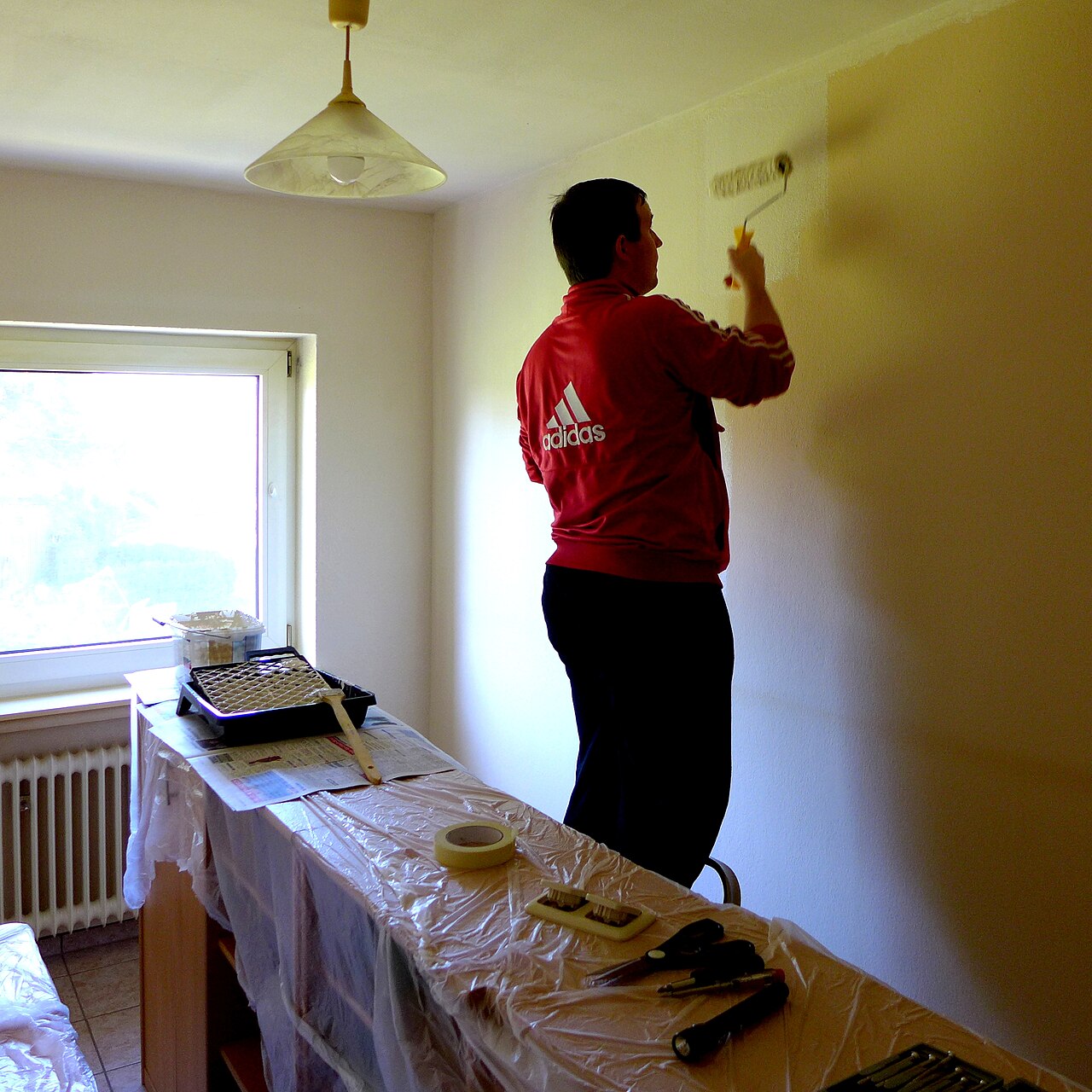
Photo: Oxfordian Kissuth, CC BY-SA 3.0, via Wikimedia Commons.
_02.jpg)
How do you specify emulsion paint?
To specify emulsion paint, name the product or its performance by the BS EN 13300 classes: wet scrub resistance class, hiding power (opacity) class at a stated spreading rate, and gloss level. State the coating system (mist coat and finish coats, all from one manufacturer), the substrate preparation to BS 6150, the colour reference and the reaction to fire class where the fire strategy sets a lining class, and leave room-by-room colours to the decorations schedule.
Emulsion is the most frequently specified finish on a project and one of the least specified properly. A clause that names a brand of vinyl matt and a colour covers the look on handover day. It says nothing about whether the walls in a school corridor will survive two years of cleaning, whether two coats will hide a dark colour, or whether the paint has a fire classification on the board it is going on. BS EN 13300 gives a classification for interior paints that answers most of those questions, and data sheets increasingly quote it.
This guide covers Uniclass Pr_35_31_22_97 Water-based matt and flat finishes, the code for matt emulsion. Sheen emulsions are Pr_35_31_22_98 Water-based mid-sheen finishes, and contract-grade paints with high pigment content are Pr_35_31_22_37 High-pigment water-based paint, so a change of sheen or grade should change the heading too.
What does a emulsion paint clause need to cover?
Some properties are specific to emulsion paint. Others belong in every product clause. A clause that leaves either out gives the contractor room to substitute.
Properties of emulsion paint
- Product typeWater-based emulsion for interior walls and ceilings.
- MaterialBinder type, usually acrylic or vinyl copolymer.
- FinishColour reference: BS 4800, NCS, RAL or manufacturer's.
- Gloss levelDead matt, matt, mid sheen or gloss to BS EN 13300.
- Wet scrub resistance classBS EN 13300 class 1 to 5 matched to the wear.
- Moisture resistanceKitchens, bathrooms and other humid rooms.
- Chemical resistanceResistance to the cleaning and disinfecting products in use.
- Water vapour permeabilityVapour-open paint over new plaster and lime.
- Volume solidsSets dry film per coat and the real coverage.
- Coat build-upMist coat and number of full coats.
- Coating systemAll coats from one manufacturer's system.
- Application rateSpreading rate at which opacity is declared.
- Curing timeRecoat and handover times for the programme.
- Reaction to fire classificationNever guessMust not lower the lining class ADB requires.
- VOC contentWithin the 2012 VOC Regulations, lower where targets require.
- Third-party certificationEcolabel or indoor air certification where targets require.
- Sample approvalSample areas on the real substrate before full application.
What every product clause needs
- Manufacturer and product referenceNamed manufacturer and product, or a performance description.
- Product standardClassified to BS EN 13300 on the data sheet.
- Installation methodBS 6150 and the manufacturer's application instructions.
- Technical submittalsData sheet, BS EN 13300 classes, fire classification, safety data.
- Operation and maintenance informationColour references, batch numbers and touch-up and cleaning advice.
- SubstrateNew plaster, plasterboard or existing paint, and its preparation.
- Application conditionsAir and surface temperature, humidity and plaster dryness.
Uniclass Pr_35_31_22_97 Emulsion paint. Not every property applies to every project; where one does not, say so rather than leaving it blank.
Fields marked Never guess (reaction to fire classification) depend on the project and should never be filled from a default or a previous job. If the information is not available yet, the clause should say so with a TBC and a reason.
Which decisions does the clause depend on?
Most properties follow from the product you choose. These depend on the project, so they need a decision from the designer before the clause is written.
- 01
Reaction to fire and wall linings
Never guessApproved Document B sets reaction to fire classes for wall and ceiling linings by room and circulation type, and the paint is part of the lining. On plasterboard or plaster a thin water-based emulsion rarely changes the outcome, but the classification belongs to the paint on a particular substrate, and data sheets still often quote a national test result rather than a European class. Specialist, textured or multi-layer finishes, and repainting over many old coats on an escape route, can change it. This is a Never guess field because nobody checks it unless the clause asks.
How to decide
- Check the lining class the fire strategy sets for each space, especially escape routes and circulation.
- Ask for a classification to BS EN 13501-1 for the paint system on a substrate that represents the wall or ceiling.
- On refurbishment escape routes with heavy existing paint build-up, ask the fire engineer whether the old coats need removing or assessing.
Write it asReaction to fire: Paint system on plasterboard to achieve the lining class stated in the fire strategy, classified to BS EN 13501-1. Submit classification report. - 02
Wet scrub resistance
DurabilityBS EN 13300 sorts interior paints into five wet scrub classes from a test in BS EN ISO 11998, which measures how much film is lost after repeated wet scrubbing. Class 1 loses the least and class 5 the most. Trade matt emulsions are sold across the range of classes, and two products that look identical on the wall can sit several classes apart. Corridors, stair cores, schools and healthcare spaces are cleaned hard and marked often, so a poor class shows as burnished patches and wear through to the substrate within months.
How to decide
- Bedrooms, offices and low-traffic ceilings: class 2 or 3 is usually adequate.
- Corridors, stairs, classrooms, kitchens and hotel circulation: class 1 or 2.
- Healthcare and areas cleaned with disinfectants: class 1, and check chemical resistance to the products used.
Write it asWet scrub resistance: Class 1 to BS EN 13300, tested to BS EN ISO 11998. - 03
Hiding power and the coat system
OpacityBS EN 13300 classifies hiding power by contrast ratio from class 1, the best, at 99.5% or more, down to class 4, and the class is only meaningful at the spreading rate the manufacturer states. A paint that hides well at 7 m2 per litre may not at 12. Specifying two coats without a hiding power class lets a thin, cheap product meet the clause on paper and leave the old colour showing through. Strong colours and deep bases often need an extra coat or a tinted undercoat whatever the class.
How to decide
- Ask for the hiding power class and the spreading rate it was tested at.
- Specify a mist coat on new plaster, then at least two full coats, increased where the colour change needs it.
- For deep colours, ask the manufacturer for the system they recommend, including any tinted undercoat.
- Keep all coats from one manufacturer's system so the classes stated still apply.
Write it asCoating system: One mist coat and two full coats, hiding power class 1 to BS EN 13300 at the manufacturer's stated spreading rate. - 04
Sheen and the substrate
SheenSheen changes how the wall looks and how it behaves. A dead matt finish hides plastering defects and board joints and reflects less glare, but marks more easily. A mid-sheen or eggshell finish wipes clean and resists moisture better, but shows every ripple in the plaster under raking light from windows and wall washers. BS EN 13300 defines gloss levels by measurement, so a clause can ask for matt or dead matt and mean the same thing to every supplier.
How to decide
- Most walls and ceilings: matt.
- Walls lit by grazing light from windows or wall washers: dead matt, and check the plaster tolerance clause.
- Kitchens, bathrooms and areas that are wiped down: a mid-sheen or a matt with a high scrub class and moisture resistance.
Write it asSheen: Matt, as classified in BS EN 13300. Colour: As decorations schedule. - 05
New plaster and preparation
PreparationMost emulsion failures are preparation failures. New plaster that is painted before it is dry traps moisture and causes flaking and efflorescence; a full-strength first coat on fresh plaster can sit on the surface rather than bonding; and painting over dust, sanding residue or unprimed filler shows through as patchy sheen. BS 6150 is the code of practice for painting buildings and gives the preparation sequence. The clause should name the substrate and its preparation so the decorator does not have to guess.
How to decide
- Allow new plaster to dry to the plaster and paint manufacturers' limits before painting; build drying time into the programme.
- Use a thinned mist coat or the manufacturer's sealer on new plaster and plasterboard, as the paint system specifies.
- Spot-prime fillers and any stains that bleed, and sand and dust off before the full coats.
- Require a sample area on the actual substrate, lit as it will be, before full application.
Write it asPreparation: To BS 6150 and manufacturer's recommendations. New plaster dry before painting; mist coat as manufacturer's instructions.
The values under "Write it as" are examples. The right value depends on the location, the use and the fire strategy.
Which standards should the clause cite?
Cite the product standard the declaration of performance refers to, the code of practice for installation, and the test method behind each value you set. A value without its test method cannot be checked against a submittal.
- BS EN 13300
- Paints and varnishes. Paints and varnishes for interior walls and ceilings. Classification
The classification system for interior wall and ceiling paints, including wet scrub resistance, hiding power, gloss and grain size. The 2022 edition replaced the 2001 edition.
In the clause Cite the classes: "Wet scrub resistance class 1, hiding power class 1, matt, to BS EN 13300".
- BS 6150
- Painting of buildings. Code of practice
The UK code of practice for painting, covering selection of paint systems, preparation of substrates, application and maintenance.
In the clause Use it for workmanship: "Preparation and application: to BS 6150".
- BS EN ISO 11998
- Paints and varnishes. Determination of wet-scrub resistance and cleanability of coatings
The test behind the BS EN 13300 wet scrub classes, measuring the loss of film thickness after wet scrubbing.
In the clause "Wet scrub resistance: Class 1 to BS EN 13300, tested to BS EN ISO 11998."
- BS EN ISO 6504-3
- Paints and varnishes. Determination of hiding power. Determination of hiding power of paints for masonry, concrete and interior use
The contrast ratio test behind the BS EN 13300 hiding power classes, carried out at a fixed spreading rate.
In the clause "Hiding power: class 1, at the manufacturer's stated spreading rate."
- BS EN ISO 2813
- Paints and varnishes. Determination of gloss value at 20°, 60° and 85°
The gloss measurement method used to place a paint in a BS EN 13300 gloss category.
In the clause Refer to it through BS EN 13300 rather than by gloss units: "Sheen: matt, as classified in BS EN 13300".
- BS EN 13501-1
- Fire classification of construction products and building elements. Classification using data from reaction to fire tests
The Euroclass system used for wall and ceiling lining classes in Approved Document B. The class relates to the paint on a stated substrate.
In the clause "Reaction to fire: paint system on plasterboard classified to BS EN 13501-1."
- SI 2012/1715
- The Volatile Organic Compounds in Paints, Varnishes and Vehicle Refinishing Products Regulations 2012
The regulations that cap the VOC content of decorative paints sold in the UK, by product category.
In the clause "VOC content: within the 2012 Regulations limit for the product category, or lower where the project's targets require."
Confirm the current edition of each standard at every issue. Avoice's State of UK Specifications 2026 found a withdrawn standard cited in 40% of specifications at contract issue.
For the regulations behind these choices, see Approved Document B explained, Fire strategy reports explained, or search the Avoice Regulations library.
How do you write it in CAWS?
Emulsion is written in M60. Each paint finish on the project is a coating clause in the 100s: in manufacturers' NBS clauses, water-based finishing coats to walls and ceilings sit at 110. The clause names the product, its sheen and colour, the surfaces it goes on, the initial or mist coat and the number of finishing coats, so one clause prices one complete paint system.
Preparation and application are written once in the 200 to 700 clauses and apply to every system. Compatibility, protection, preparation generally, the treatment of uncoated plaster and plasterboard, and coating generally are all there, and they usually refer back to BS 6150. A corridor wall in a scrubbable matt and a bedroom ceiling in a standard matt are two coating clauses sharing the same preparation clauses.
- Manufacturer
- Submit proposals
- Product reference
- Submit proposals
- Type
- Water-based emulsion for interior walls
- Classification
- Wet scrub resistance class 1, hiding power class 1, to BS EN 13300
- Sheen
- Matt, as classified in BS EN 13300
- Colour
- TBC Client colour scheme outstanding for corridor feature walls. Resolve before ordering.
- Surfaces
- Gypsum plaster skim and taper-edge plasterboard, as decorations schedule
- Preparation
- As clauses 400 and 580
- Initial coats
- One mist coat, thinned as manufacturer's instructions
- Finishing coats
- Two full coats, more where needed for even colour
- Reaction to fire
- Paint system to achieve the lining class in the fire strategy, classified to BS EN 13501-1
- VOC content
- Within the 2012 VOC Regulations limit; submit declared value
- Sample area
- One sample area per colour on the actual substrate, approved before full application
Illustrative, not from a real project. One property is left as a TBC with a reason so it can be tracked and closed before issue.
Clauses the type clause relies on
- M60/215
- Handling and storage Storing paint within the manufacturer's temperature limits.
- M60/220
- Compatibility All coats in a system from one manufacturer and compatible with the substrate.
- M60/280
- Protection Protecting finished work and adjacent surfaces until handover.
- M60/400
- Preparation generally Cleaning, making good and preparation to BS 6150.
- M60/580
- Uncoated plaster Dryness of new plaster and treatment before the first coat.
- M60/711
- Coating generally Application conditions, intervals between coats and finished appearance.
Clause numbers vary between NBS versions and practice masters; these follow a published manufacturer's M60 specification, so check each clause the coating clause refers to exists in your M60.
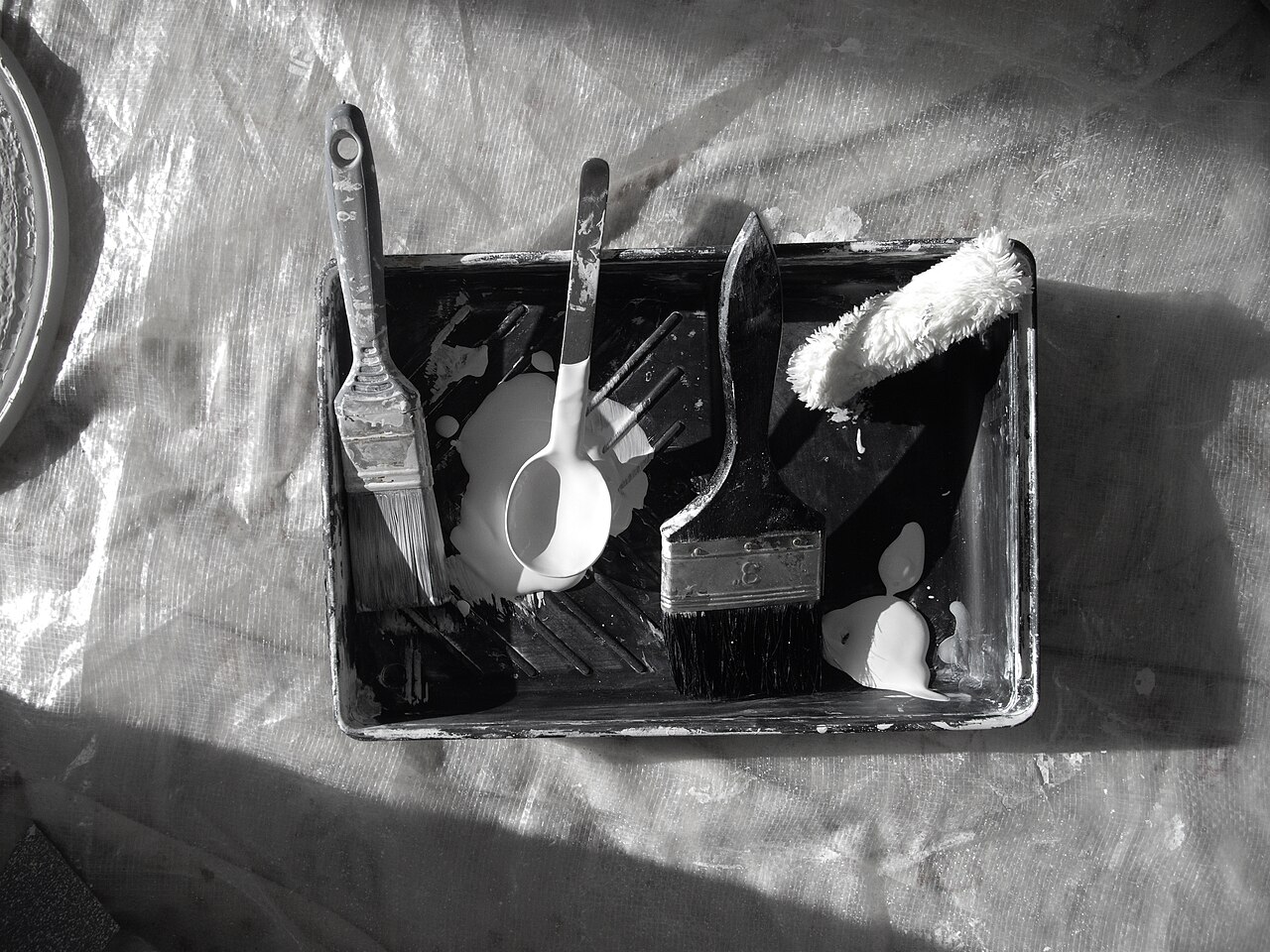
Photo: whereareyousimon, CC BY 2.0, via Wikimedia Commons.
.jpg)
How do you write it in Uniclass?
In Uniclass the painted finish is Ss_40_90_60_95 Waterborne paint systems, under painting and clear finishing systems. The system clause describes the whole coating system on a given substrate: preparation, mist coat, finishing coats, and the performance of the finished surface, including its fire classification.
The paint itself is a product clause under Pr_35_31_22_97. Where the same emulsion goes on plaster in one area and on plasterboard in another, two system clauses call up one product clause, so a change of product or colour range is made once. Preparation for each substrate belongs in the system clause, not the product clause.
- Description
- Emulsion paint system to internal plastered and plasterboard walls
- Substrate
- Gypsum plaster skim and taper-edge plasterboard
- Preparation
- To BS 6150; new plaster dry before painting
- Initial coat
- Mist coat of Pr_35_31_22_97 Water-based matt and flat finishes (PT01)
- Finishing coats
- Two full coats of Pr_35_31_22_97 Water-based matt and flat finishes (PT01)
- Reaction to fire of finished lining
- As fire strategy, classified to BS EN 13501-1
- Sample area
- Approved on the actual substrate before full application
- Manufacturer
- Submit proposals
- Product reference
- Submit proposals
- Type
- Water-based emulsion for interior walls
- Wet scrub resistance
- Class 1 to BS EN 13300
- Hiding power
- Class 1 to BS EN 13300 at the stated spreading rate
- Sheen
- Matt
- Colour
- TBC Client colour scheme outstanding for corridor feature walls. Resolve before ordering.
- VOC content
- Within the 2012 VOC Regulations limit; submit declared value
- Third-party certification
- Submit any ecolabel or indoor air certificate held
Illustrative. Performance of the finished system sits in the system clause; properties of the product sit in the product clause.
No NBS reference is listed for this Uniclass code, so use the Uniclass heading on its own, and keep CAWS and Uniclass references out of the same specification.
What goes in the spec, and what goes in the schedule?
The specification defines each type once. The schedule and drawings say where each type goes.
In the specification
What the product is and how it performs and is installed. Written once per type.
In the schedule or drawings
Where each type goes and how much of it. Changes with every plan revision.
Write each paint system once with a type mark (for example PT01) and let the decorations schedule give colours by room and surface. Colours change late and often; keeping them in the schedule means the clause does not need reissuing every time.
What are the common mistakes?
Most problems are a missing property, a property filled with the wrong kind of value, or a decision left silently open.
- Brand and colour only. "Vinyl matt, brilliant white" leaves the scrub resistance and opacity open. State the BS EN 13300 classes so an alternative can be checked.
- Two coats as the whole system. Two coats of a low-opacity paint may not hide the substrate. Give a hiding power class and require more coats where needed.
- Painting wet plaster. Trapped moisture causes flaking and efflorescence. Make plaster dryness a condition and allow time for it in the programme.
- A national fire test on the data sheet accepted as the lining class. Ask for a BS EN 13501-1 classification of the paint on a representative substrate.
- Colours written into the clause. They will change. Keep colours in the decorations schedule against a type mark.
- A silent default on colour. If the scheme is not agreed, say TBC with a reason so it is resolved before ordering rather than on site.
How Avoice helps
Avoice's spec writer drafts emulsion clauses from the decorations information already on the project and marks clearly what it could not settle.
- Drafts from your drawings and schedules
It reads the paint types (PT01 scrubbable matt to corridors, PT02 standard matt to bedrooms) from the decorations schedule, picks the M60 coating clause or the Uniclass system and product headings, and fills in what your information supports.
- Leaves a TBC with a reason
If the colour scheme is still with the client, or the fire strategy has not yet set the lining class for a stair, the line says TBC and why. Every TBC joins one project register to close before tender.
- Works from your own masters
Choose CAWS or Uniclass. Avoice adapts your practice's M60 clauses and preparation wording rather than replacing them with generic text.
- Checks the spec against the drawings
QA/QC flags a paint type on the decorations schedule with no clause behind it, a coating clause referring to a preparation clause that is not in your M60, or a superseded edition of BS EN 13300.
- Links product data to the clause
Data sheets, BS EN 13300 classifications and fire classification reports sit in the Product Room against the clause. Edit a linked product once and every clause that uses it updates. Approved Document B is to hand in the Avoice Regulations library.
Related guides: How to specify plasterboard, How to specify lime plaster, How to specify masonry paint.
Software can draft and check. The designer still chooses the product and is responsible for the specification.
Draft your emulsion paint clause in Avoice
Upload your drawings and schedules. Avoice drafts the clause in CAWS or Uniclass, cites the standards and flags anything your information does not settle.
This guide is for general education and is not professional advice. Check current editions of standards and Approved Documents, the manufacturer's data, and the requirements of your project before relying on any clause.