
How to specify radon and gas membranes
How the site's radon and ground gas risk turns into a membrane clause, what makes a membrane count as gas protection, how it is carried across cavities and penetrations, and how to write it in CAWS and in Uniclass.
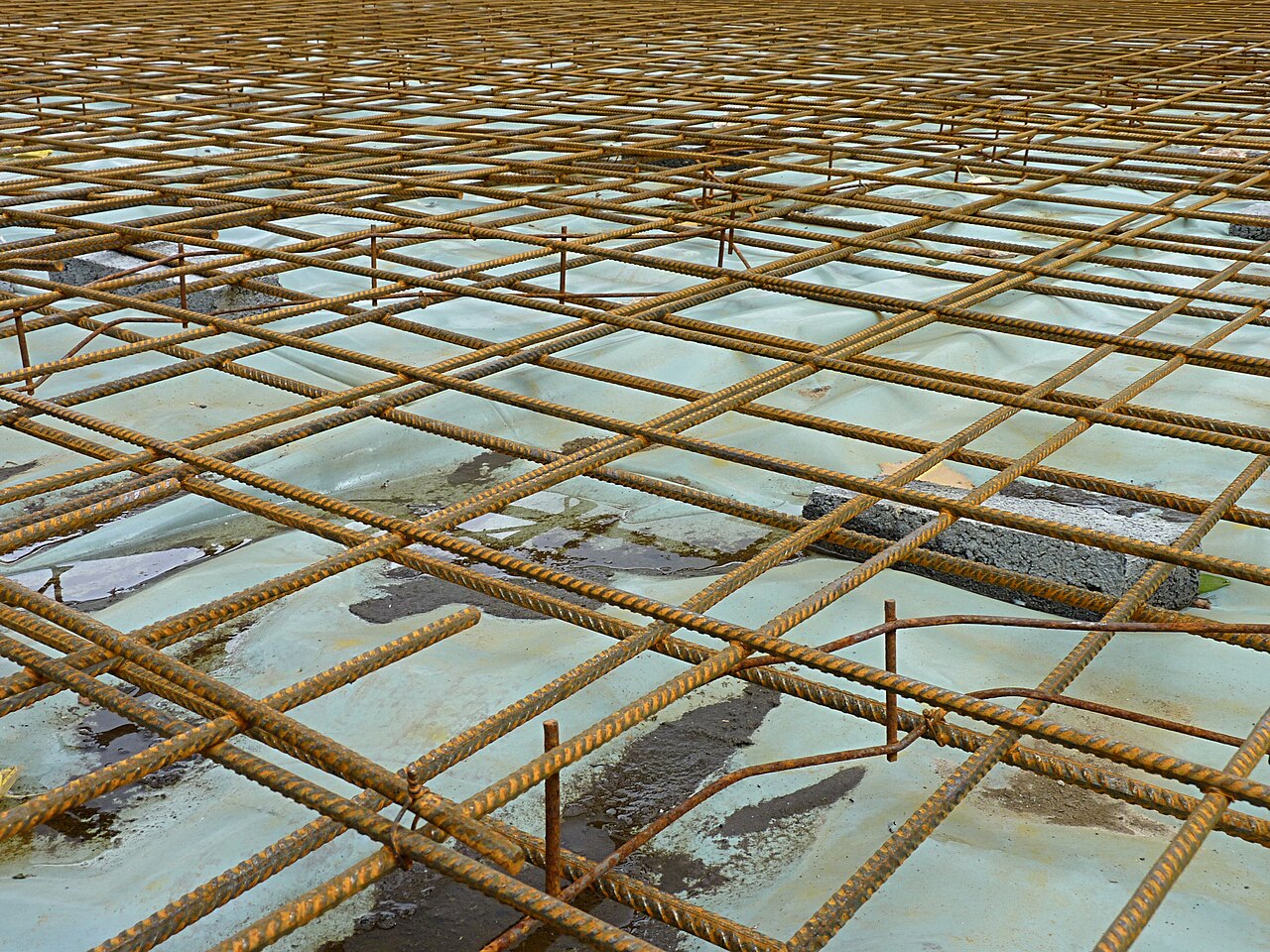
Photo: Jamain, CC BY-SA 3.0, via Wikimedia Commons.

How do you specify radon and gas membranes?
To specify a radon barrier or gas membrane, start from the site: the radon potential sets basic or full protection under BRE's radon guidance (BR 211), and a ground gas risk assessment sets methane and carbon dioxide measures under BS 8485. Then name a membrane with test evidence and third-party certification for that gas, and specify how it is carried across cavity walls, sealed at every lap and penetration, protected and verified before it is covered, following CIRIA C735.
A gas membrane only works as a continuous sheet. On a typical ground floor it is cut around dozens of pipes, folded into corners, carried through the cavity of every external wall and walked over by the steel fixers before the concrete arrives. Any one of those can leave a gap that lets radon or ground gas into the building, and once the slab is poured it is too late to look. That is why the clause matters more than the product name: it has to fix the junctions, the inspection and who signs it off.
This guide covers the membrane under Uniclass Pr_25_57_65_60 Plastics sheets, the code NBS Source uses for proprietary radon and gas barriers, many of which are reinforced polyethylene with an aluminium foil layer. Plain polyethylene damp-proof membranes sit under Pr_25_57_65_63 Polyethylene sheets and are covered in the damp-proof membrane guide; a DPM is not a gas barrier unless it has evidence for that use.
What does a gas membrane clause need to cover?
Some properties are specific to radon and gas membranes. Others belong in every product clause. A clause that leaves either out gives the contractor room to substitute.
Properties of radon and gas membranes
- Product typeLoose-laid sheet, self-adhesive or liquid-applied.
- FunctionRadon only, or methane and carbon dioxide too.
- Gas resistanceNever guessRadon diffusion and methane transmission, from test reports.
- ThicknessMust survive installation; check the certificate.
- Nominal sizeRoll width sets the number of laps.
- FinishColoured faces help identify the gas membrane on site.
- SubstrateBlinded hardcore, slab or beam and block.
- PrimerOnly for bonded or self-adhesive membranes.
- Laps and jointsTaped or welded gas-tight laps.
- AccessoriesTop hats, cavity trays, tapes and corner units.
- Vapour resistanceUsually also acts as the floor DPM.
- Tensile strengthResistance to tearing as it is laid.
- Elongation at breakAccommodates settlement without splitting.
- Puncture resistanceHardcore, chairs and boots puncture membranes.
- Impact resistanceDamage from following trades before the pour.
- UV resistanceLimits how long it can be left uncovered.
- Waterproofing gradeNever guessOnly where it is also the BS 8102 barrier in a basement.
- Recycled contentOnly where the certificate covers it.
- Third-party certificationCertificate for use as a radon or gas barrier.
What every product clause needs
- Manufacturer and product referenceNamed gas membrane; test evidence belongs to it.
- Product standardBS EN 13967 for the sheet, plus gas test evidence.
- Installation methodManufacturer's details for laps, top hats and cavities.
- Technical submittalsGas transmission data, certificate and verification plan.
- Operation and maintenance informationVerification report and any sump or vent to maintain.
- MaterialLDPE, HDPE or composite with aluminium foil.
Uniclass Pr_25_57_65_60 Radon and gas membranes. Not every property applies to every project; where one does not, say so rather than leaving it blank.
Fields marked Never guess (gas resistance and waterproofing grade) depend on the project and should never be filled from a default or a previous job. If the information is not available yet, the clause should say so with a TBC and a reason.
Which decisions does the clause depend on?
Most properties follow from the product you choose. These depend on the project, so they need a decision from the designer before the clause is written.
- 01
Which gas, and how much protection
Never guessRadon and ground gases are assessed separately and lead to different measures. For radon, the site's radon potential from the UK radon maps or a radon report decides whether no protection, basic protection or full protection is needed under BRE's radon guidance, now the 2023 edition covering all four UK nations. Basic protection is a radon-resistant membrane across the whole footprint; full protection adds a sump or ventilated subfloor that can be activated later. For methane and carbon dioxide, the ground gas risk assessment sets a characteristic situation, and BS 8485 gives the protection score needed, with the membrane as one element of it.
How to decide
- Get the radon potential for the footprint and confirm basic or full protection with BRE's radon guidance.
- If ground gas monitoring finds methane or carbon dioxide, take the measures and score from the BS 8485 design.
- Choose a membrane with test evidence for the gases found: radon diffusion and, where needed, methane transmission rate.
- Show protection zones and any sump or venting layer on the ground floor plan.
Write it asGas protection: Full radon protection to BRE BR 211 (2023 edition); radon-resistant membrane with sump and capped extract pipe. Gas resistance: Submit test evidence for radon diffusion. - 02
Across the cavity and around every penetration
CavitiesMost failures are at the edges. In cavity wall construction the membrane has to continue across the cavity, usually by lapping onto a gas-resistant cavity tray or DPC in the outer leaf, otherwise gas travels up the cavity and into the building. Every service entry needs a preformed top hat or collar sealed to the pipe and the sheet, and internal and external corners need preformed units rather than folds. Each of these components should come from the membrane manufacturer, or be named in its certificate, so the whole layer has been tested together.
How to decide
- Detail the junction at each external wall type, showing the cavity tray and how the membrane laps and seals to it.
- List the penetrations and specify a preformed top hat for each, sized to the pipe.
- Specify preformed corner units at internal and external corners.
- Use tapes and accessories from the membrane manufacturer's system.
Write it asCavity walls: Membrane carried across cavity and lapped and sealed to gas-resistant cavity tray, as clause 360. Penetrations: Manufacturer's preformed top hat units, as clause 370. - 03
Gas-tight joints and verification
VerificationA sheet that passes a laboratory gas test can still leak at a poorly sealed lap. Gas membrane laps are taped with the manufacturer's double-sided gas-resistant tape, rolled to full contact, or welded where the product allows. BS 8485 expects gas protection to be verified, and CIRIA C735 sets out good practice for inspecting and testing the installed membrane, from visual inspection to integrity tests. On many sites the local authority's planning condition also asks for a verification report. The clause should name who verifies, when, and what record is produced before the membrane is covered.
How to decide
- Specify laps and the sealing method from the manufacturer's certificate, not a generic overlap.
- Appoint an independent verifier or set out the contractor's verification duties, following CIRIA C735.
- Require inspection, any integrity testing and photographs before the slab or screed covers the membrane.
- Make the verification report part of the handover information.
Write it asLaps: Manufacturer's minimum, two strips of double-sided gas-resistant tape, rolled. Verification: Inspected and verified to CIRIA C735 before covering; submit report with photographs. - 04
Thickness and surviving the pour
DurabilityThe membrane has to stay intact through steel fixing, concrete pumping and foot traffic. BS 8485 sets criteria for a membrane to count as gas-resistant, and its 2019 amendment clarified those criteria and the method for measuring thickness. Thicker and reinforced sheets survive better, but the larger risk is the substrate and the following trades. Blinding should leave a smooth surface free of sharp stones, reinforcement chairs should not cut the sheet, and damage found at inspection has to be patched with the manufacturer's method and rechecked.
How to decide
- Check the membrane meets the BS 8485 criteria the design relies on, as shown in its certificate.
- Specify a smooth blinding layer and, where needed, a protection layer above the membrane.
- Ask for chairs or spacers that do not cut the sheet.
- Require repairs to be made with the manufacturer's patches and reinspected.
Write it asSubstrate: Sand blinding over compacted hardcore, free of sharp protrusions, as clause 110. Damage: Patched with manufacturer's membrane and tape, extending beyond the damage, and reinspected. - 05
When the gas membrane is also the basement barrier
Never guessIn a basement on a gassy site the same membrane may be asked to keep out water under pressure as well as gas. That makes it a Type A barrier under BS 8102, and the waterproofing design then sets the grade, the design water level and whether combined protection is needed. A loose-laid gas membrane under a ground-bearing slab is not a waterproofing system for a basement, and BS 8485 and BS 8102 need to be read together. The two designers, ground gas and waterproofing, should agree one build-up rather than each adding a layer.
How to decide
- If there is a basement, ask whether the gas membrane also forms part of the BS 8102 design.
- Take the grade and design water level from the waterproofing design.
- Use a product with evidence for both gas resistance and water pressure where it does both jobs.
- Coordinate the gas and waterproofing details at the same junctions.
Write it asWaterproofing grade: Grade 3 to BS 8102, combined Type A and Type B protection, as the waterproofing design; membrane also to BS 8485 gas-resistant criteria.
The values under "Write it as" are examples. The right value depends on the location, the use and the fire strategy.
Which standards should the clause cite?
Cite the product standard the declaration of performance refers to, the code of practice for installation, and the test method behind each value you set. A value without its test method cannot be checked against a submittal.
- BS 8485:2015+A1:2019
- Code of practice for the design of protective measures for methane and carbon dioxide ground gases for new buildings
The design method for methane and carbon dioxide protection: characteristic situations, the protection score needed and the points each measure contributes, including the criteria a gas-resistant membrane must meet.
In the clause "Gas protection: To the BS 8485 design; membrane meets the BS 8485 criteria for a gas-resistant membrane."
- BRE BR 211 (2023 edition)
- Radon: guidance on protective measures for new buildings (including supplementary advice for extensions, conversions and refurbishment projects)
BRE's radon guidance for new buildings, extensions, conversions and refurbishment, now combined for England, Wales, Scotland and Northern Ireland. It sets out basic and full protection and includes a quality management record.
In the clause "Radon protection: Full protection to BRE BR 211 (2023 edition)."
- CIRIA C735
- Good practice on the testing and verification of protection systems for buildings against hazardous ground gases
How installed gas protection is inspected, tested and recorded, and who should do it.
In the clause "Verification: To CIRIA C735 before covering; submit report."
- BS EN 13967
- Flexible sheets for waterproofing. Plastic and rubber damp proof sheets including plastic and rubber basement tanking sheet. Definitions and characteristics
The harmonised product standard many gas membranes are declared against as damp-proof sheets. It does not by itself show gas resistance.
In the clause "Standard: BS EN 13967, with third-party certificate for use as a radon and gas membrane."
- BS ISO 15105-1
- Plastics. Film and sheeting. Determination of gas-transmission rate. Differential-pressure methods
A laboratory method manufacturers use to measure methane transmission through the sheet.
In the clause "Methane transmission rate: Tested to BS ISO 15105-1; submit report."
- BS 8102:2022
- Protection of below ground structures against water ingress. Code of practice
Waterproofing design for basements, relevant where the gas membrane also forms a Type A barrier.
In the clause "Waterproofing grade: To BS 8102 as the waterproofing design."
Confirm the current edition of each standard at every issue. Avoice's State of UK Specifications 2026 found a withdrawn standard cited in 40% of specifications at contract issue.
How do you write it in CAWS?
In CAWS, gas membranes are written in J40 alongside damp-proof membranes and sheet tanking. J40 has separate product clauses for loose-laid gas-retardant membranes in the 100s, apart from the plain polyethylene damp-proofing clause, and NBS Source lists proprietary radon and gas barriers against clause 140, Loose-laid plastics or rubber sheet gas-retardant membranes.
The type clause names the membrane, the protection it provides and the joint method, and relies on the J40 workmanship and junction clauses for the blinding, the condition of the membrane at completion, the junctions with DPCs and cavity trays and the preformed collars. The verification requirement is best written into the type clause, because it is specific to gas protection and gets lost in a general inspection clause.
- Substrate
- Sand blinding over compacted hardcore, as clause 110
- Manufacturer
- Submit proposals
- Product reference
- Submit proposals
- Membrane
- Reinforced polyethylene with aluminium foil layer
- Standard
- BS EN 13967, with current third-party certificate for use as a radon and gas membrane
- Radon protection
- Full protection to BRE BR 211 (2023 edition)
- Ground gas protection
- TBC Ground gas monitoring not complete and BS 8485 score not set. Resolve before ordering.
- Gas resistance
- Test evidence for radon diffusion and methane transmission; submit
- Laps
- Manufacturer's minimum; two continuous strips of double-sided gas-resistant tape, rolled to full contact
- Cavity walls
- Carried across the cavity, lapped and sealed to gas-resistant cavity tray, as clause 360
- Penetrations
- Manufacturer's preformed top hat units, as clause 370
- Corners
- Manufacturer's preformed corner units
- Radon sump
- Below membrane, with extract pipe capped for future fan
- Damage
- Patched with manufacturer's membrane and tape, and reinspected
- Verification
- Inspected and verified to CIRIA C735 before covering; submit report with photographs
Illustrative, not from a real project. One property is left as a TBC with a reason so it can be tracked and closed before issue.
Clauses the type clause relies on
- J40/110
- Soft blinding to hardcore beds The smooth bed the membrane is laid on, free of sharp stones.
- J40/310
- Workmanship generally Condition of substrate, temperature limits and the membrane complete, continuous and undamaged before covering.
- J40/360
- Junctions with projecting DPCs/ cavity trays Lapping and sealing the membrane to the cavity tray at external walls.
- J40/370
- Preformed collars for pipes, ducts, cables, etc. Sealed collars or top hats at every service entry.
Clause numbers vary between NBS versions and practice masters; some J40 sections split gas-retardant membranes between clauses 140 and 145 by jointing method, so check which your master uses.
How do you write it in Uniclass?
Uniclass has no system code dedicated to ground gas protection, so the membrane is written within the floor's damp-proofing system. For a loose-laid sheet under a ground-bearing slab that is Ss_32_20_30_51 Loose-laid polyethylene membrane underslab damp-proofing systems, and the system clause describes the whole layer: blinding, membrane, cavity junctions, penetrations, sump or venting and verification.
The membrane is a product clause under Pr_25_57_65_60 Plastics sheets, holding the product, its gas test evidence and certificate. Keep the protection level (basic or full radon protection, and any BS 8485 score) in the system clause, because it is a design decision about the floor, not a property of the sheet.
- Description
- Radon and gas-resistant membrane under ground-bearing slab
- Protection
- Full radon protection to BRE BR 211 (2023 edition), and ground gas measures as the BS 8485 design
- Substrate
- Sand blinding over compacted hardcore
- Membrane
- Pr_25_57_65_60 Plastics sheets (GM01)
- Cavity walls
- Lapped and sealed to gas-resistant cavity trays
- Penetrations
- Preformed top hat units
- Radon sump
- Below membrane, extract pipe capped for future fan
- Verification
- To CIRIA C735 before covering; report submitted
- Manufacturer
- Submit proposals
- Product reference
- Submit proposals
- Material
- Reinforced polyethylene with aluminium foil layer
- Standard
- BS EN 13967
- Certification
- Current third-party certificate for use as a radon and gas membrane
- Gas resistance
- Test evidence for radon diffusion and methane transmission
- Ground gas criteria
- TBC Ground gas monitoring not complete and BS 8485 score not set. Resolve before ordering.
- Laps
- Double-sided gas-resistant tape, rolled
- Accessories
- Manufacturer's top hats, corner units and tapes
Illustrative. Performance of the finished system sits in the system clause; properties of the product sit in the product clause.
In NBS Chorus the Uniclass product clause also carries the NBS reference 45-65-50/325 for plastics sheets; use one referencing system throughout the specification.
What goes in the spec, and what goes in the schedule?
The specification defines each type once. The schedule and drawings say where each type goes.
In the specification
What the product is and how it performs and is installed. Written once per type.
In the schedule or drawings
Where each type goes and how much of it. Changes with every plan revision.
Write the membrane once with a type mark and show the protected area, junctions and penetrations on the ground floor plan and details. A list of penetrations taken from the services drawings is the simplest way to price the top hats properly.
What are the common mistakes?
Most problems are a missing property, a property filled with the wrong kind of value, or a decision left silently open.
- A DPM called a radon barrier. Plain polyethylene with taped laps is not evidence of gas resistance. Ask for gas test data and a certificate for gas use.
- Membrane stops at the inner leaf. Gas finds its way up the cavity. Carry the membrane across and seal it to a gas-resistant cavity tray.
- Folded corners and taped pipes. Site-made details leak. Specify preformed corners and top hats from the membrane system.
- No verification before the pour. Once concrete is placed the membrane cannot be checked. Require inspection and a report to CIRIA C735 first.
- Full protection without the sump. Full radon protection needs provision for extraction. Show the sump and capped pipe and where a fan could go.
- Gas and waterproofing designed separately. In a basement the two can conflict. Agree one build-up that meets BS 8485 and BS 8102.
How Avoice helps
Avoice's spec writer drafts gas membrane clauses from the ground floor plans, details and site investigation information, and keeps the gas design inputs visible until they are settled.
- Drafts from your drawings and schedules
It reads the membrane type marks, protected zones and wall junctions from your plans and details, picks the J40 or Uniclass heading, and fills in what your information supports.
- Leaves a TBC where the gas assessment is open
If ground gas monitoring has not finished, the protection line says TBC with the reason, and it goes into the project TBC register to be closed before ordering.
- Writes in your format and your style
Choose CAWS or Uniclass. Avoice adapts your own J40 clauses, including your verification wording, rather than replacing them with generic text.
- Checks the clause against everything else
QA/QC flags a detail showing the membrane stopping at the inner leaf, a clause referring to a cavity tray clause that is not in the specification, or a superseded edition of the radon guidance.
- Keeps product data in one place
Gas test reports, certificates and data sheets sit in the Product Room linked to the clause, so a substitute membrane can be checked against the gas resistance the clause asks for.
Related guides: How to specify damp-proof membranes, How to specify basement tanking, How to specify cavity drain membranes.
Software can draft and check. The designer still chooses the product and is responsible for the specification.
Draft your gas membrane clause in Avoice
Upload your drawings and schedules. Avoice drafts the clause in CAWS or Uniclass, cites the standards and flags anything your information does not settle.
This guide is for general education and is not professional advice. Check current editions of standards and Approved Documents, the manufacturer's data, and the requirements of your project before relying on any clause.