
How to specify gates
What a gate clause has to cover, from leaf type and posts to powered gate safety and hardware, the standards that apply, and how to write it in CAWS and in Uniclass.
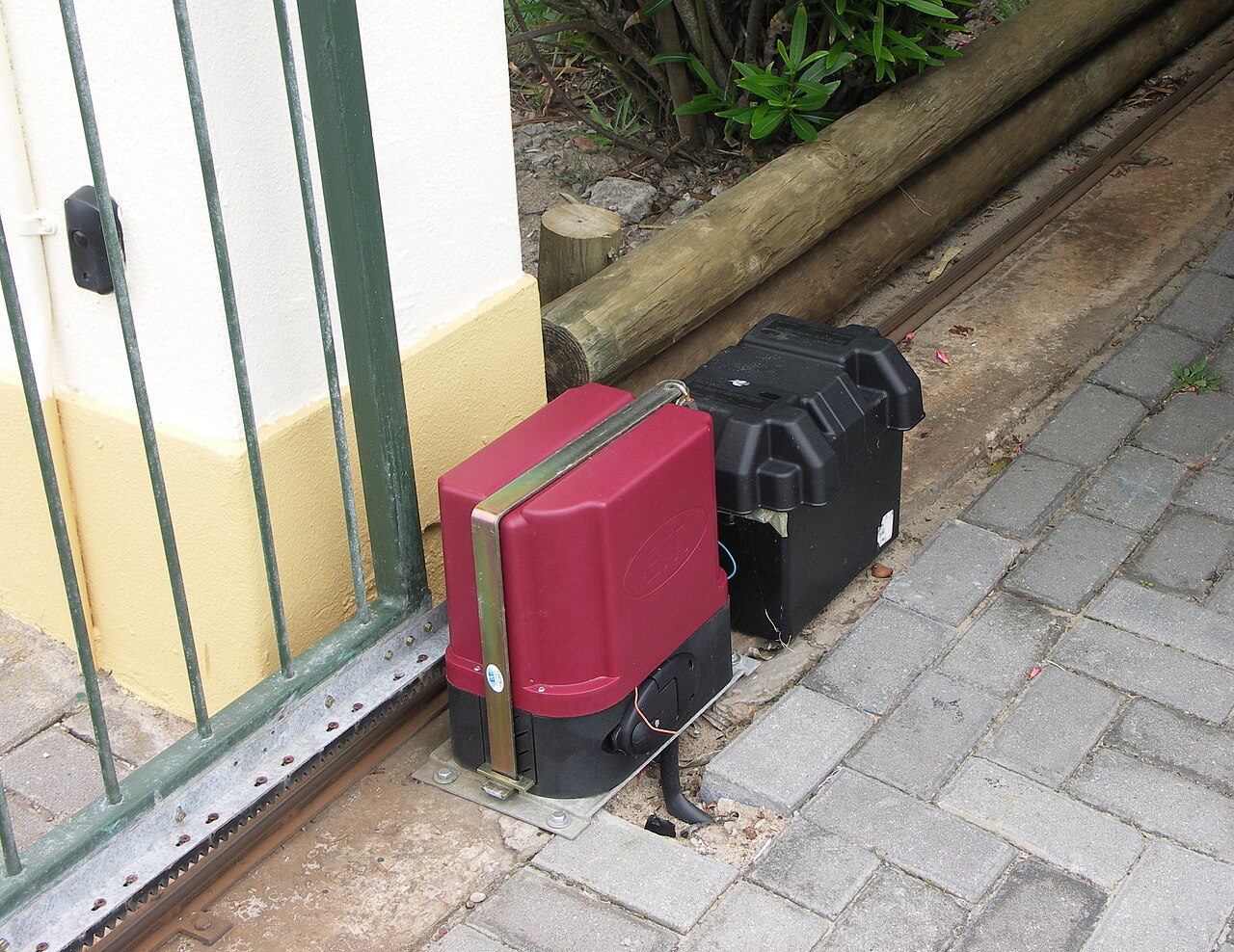
Photo: NJR ZA, CC BY-SA 3.0, via Wikimedia Commons.

How do you specify gates?
To specify a gate, decide how it opens (swing, sliding or folding) and whether it is powered, then state the clear opening, height, infill and the post and foundation design. A powered gate is machinery: specify it to BS EN 13241 with safety in use to BS EN 12453, and make the installer responsible for the risk assessment, declaration of conformity and handover documents. Match manual gates to the fence they sit in.
Gates are often specified as an afterthought to the fence, a line saying "vehicle gate to match". That works for a pedestrian gate in a garden wall. It does not work for a 6 m automated sliding gate across a car park entrance, which is a piece of machinery with crushing and shearing hazards, an electrical supply, a control system and a legal duty on whoever puts it into service.
This guide uses Uniclass Pr_30_59_33_15 Carbon steel vertical section gate leaves, the bar-style leaf used for most powered vehicle gates. Mesh gates in a mesh fence line use Pr_30_59_33_16 Carbon steel welded mesh gate leaves, and timber gates have their own codes such as Pr_30_59_33_95 Wood gate leaves.
What does a gate clause need to cover?
Some properties are specific to gates. Others belong in every product clause. A clause that leaves either out gives the contractor room to substitute.
Properties of gates
- Infill designBar spacing and pattern; avoid finger traps and footholds.
- Material gradeSteel grade for frame and infill sections.
- Corrosion protectionGalvanized after fabrication, then powder coated.
- HardwareHinges or rollers, locks, stops and manual release.
- Structural performanceNever guessLeaf, posts and foundation sized for span, wind and drive.
What every product clause needs
- Manufacturer and product referenceNamed gate and operator, or a performance description.
- Product standardBS EN 13241 for powered vehicle gates; BS 1722 for manual.
- Installation methodBS EN 12635 and the gate manufacturer's instructions.
- Technical submittalsStructural design, risk assessment, force test plan, DoC.
- Operation and maintenance informationUser instructions, manual release, service and force test log.
- MaterialCarbon steel, aluminium or timber leaf.
- FinishPowder coat colour to match the fence.
Uniclass Pr_30_59_33_15 Gates. Not every property applies to every project; where one does not, say so rather than leaving it blank.
Fields marked Never guess (structural performance) depend on the project and should never be filled from a default or a previous job. If the information is not available yet, the clause should say so with a TBC and a reason.
Which decisions does the clause depend on?
Most properties follow from the product you choose. These depend on the project, so they need a decision from the designer before the clause is written.
- 01
Leaf size, posts and foundations
Never guessA gate leaf is a cantilever from its hinges or its rollers, and it is pushed by the wind, by people leaning on it and, if powered, by a motor. Wide leaves sag, drop onto their stops and wear out hinges and operators. A cantilever sliding gate also needs a counterbalance tail and a straight run-back the same length or more beside the opening. BS 1722-14 gives typical frame and gate post sizes for leaf widths in mesh fences, but anything wide, solid-infilled, powered or exposed needs designing for the actual case, including the foundation for the posts or the cantilever track.
How to decide
- Fix the clear opening first, from the vehicle swept paths and any fire appliance or refuse vehicle access.
- Check run-back space for a sliding gate, or the swing arc and slope for a swing gate, on the plan.
- Ask the gate manufacturer for leaf, post and foundation design, and coordinate the foundation with drainage and services.
- Where the gate carries signs, solid panels or screening, include them in the wind load.
Write it asStructural performance: Leaf, posts and foundations designed by manufacturer for clear opening, site wind exposure and operator forces. Submit calculations before fabrication. - 02
Powered gate safety
Gate safetyA powered gate is machinery. HSE guidance is that new powered gates, and manual gates converted to powered operation, must meet the Supply of Machinery (Safety) Regulations 2008 when first put into service, and that the converter or installer usually becomes the manufacturer. That person carries out the risk assessment, applies conformity marking and issues a declaration of conformity and user instructions. The product standard is BS EN 13241, and safety in use, including force limits and protection at crushing, shearing and drawing-in points, is BS EN 12453. Approved Document K also asks for safety features, an accessible stop switch and opening in a power failure on buildings other than dwellings.
How to decide
- Name one party as responsible for the complete powered gate, normally the gate installer, not the electrician or the groundworker.
- Require the safety measures to follow from the installer's risk assessment to BS EN 12453, including safety edges and photocells where needed.
- Ask for force measurements at handover and a record of them in the O&M manual.
- Make the manual release and the power isolation point accessible to the people who will use them.
Write it asPowered operation: Complete gate to BS EN 13241, safety in use to BS EN 12453. Installer to act as manufacturer: provide risk assessment, conformity marking, declaration of conformity, force test results and user instructions. - 03
Swing, sliding or folding
OperationThe way the gate opens is decided by the site more than by taste. A swing gate needs a clear arc, ideally on level ground, and cannot open uphill without lifting hinges or cutting the slope. A sliding gate needs a straight run-back beside the opening and either a ground track, which collects grit and leaves, or a cantilever frame that keeps the opening clear. Bi-folding gates fit tight sites but have more moving parts and more pinch points. Each type has a different operator, and the operator decides the power supply and ducting the electrical and groundworks packages must provide.
How to decide
- Level ground with space either side: a swing gate is simplest and cheapest.
- Sloping drive or restricted swing space: sliding, cantilever if the opening must stay clear of tracks.
- No run-back space and no swing space: folding or telescopic, accepting more maintenance.
- Confirm power, control cabling and loop detector positions with the electrical designer before the drawings are issued.
Write it asOperation: Cantilever sliding gate, opening to the left viewed from outside, run-back as drawing. Operator: electromechanical, by gate manufacturer. - 04
Infill, gaps and trap points
InfillThe infill decides what the gate keeps out and also how dangerous it is to move. Vertical bars resist climbing better than horizontal rails. On a sliding gate, gaps between the moving leaf and fixed posts or the fence can trap fingers, hands or a child's arm, so they are designed out by guarding or by close infill near the closing edge. Mesh on the leaf can stop fingers reaching through at those points. Solid infill gives privacy and blocks views but raises the wind load considerably.
How to decide
- Match bar spacing and height to the adjoining fence so the gate is not the easiest point to climb.
- Ask the installer to identify crushing and shearing points and show how they are guarded.
- Use solid infill only where privacy or screening is needed, and feed it back into the structural design.
- Where children use the area, check gaps and openings against the client's or operator's requirements.
Write it asInfill: Vertical steel bars at centres to match fence F01, with mesh guarding to the closing edge and run-back as risk assessment. - 05
Coatings and matching the fence
CoatingsGate frames are welded fabrications, so they are galvanized after fabrication and then powder coated if a colour is needed. If the leaf is galvanized before the last welds are made, the welds are left unprotected. Matching the colour of the gate to the fence sounds obvious, but the fence and the gate are often bought from different suppliers and arrive in slightly different shades or gloss levels. Naming one RAL reference and gloss level for both, and asking for samples together, avoids that.
How to decide
- Galvanize after all welding is complete, to BS EN ISO 1461.
- Use the same powder coating specification as the fence, with the same RAL and gloss level.
- Where the gate and fence come from different suppliers, ask for both to approve one colour sample.
- Specify touch-up for site damage, and ban site welding of galvanized parts without repair.
Write it asCorrosion protection: Hot-dip galvanized after fabrication to BS EN ISO 1461, then polyester powder coated, colour and gloss to match fence F01.
The values under "Write it as" are examples. The right value depends on the location, the use and the fire strategy.
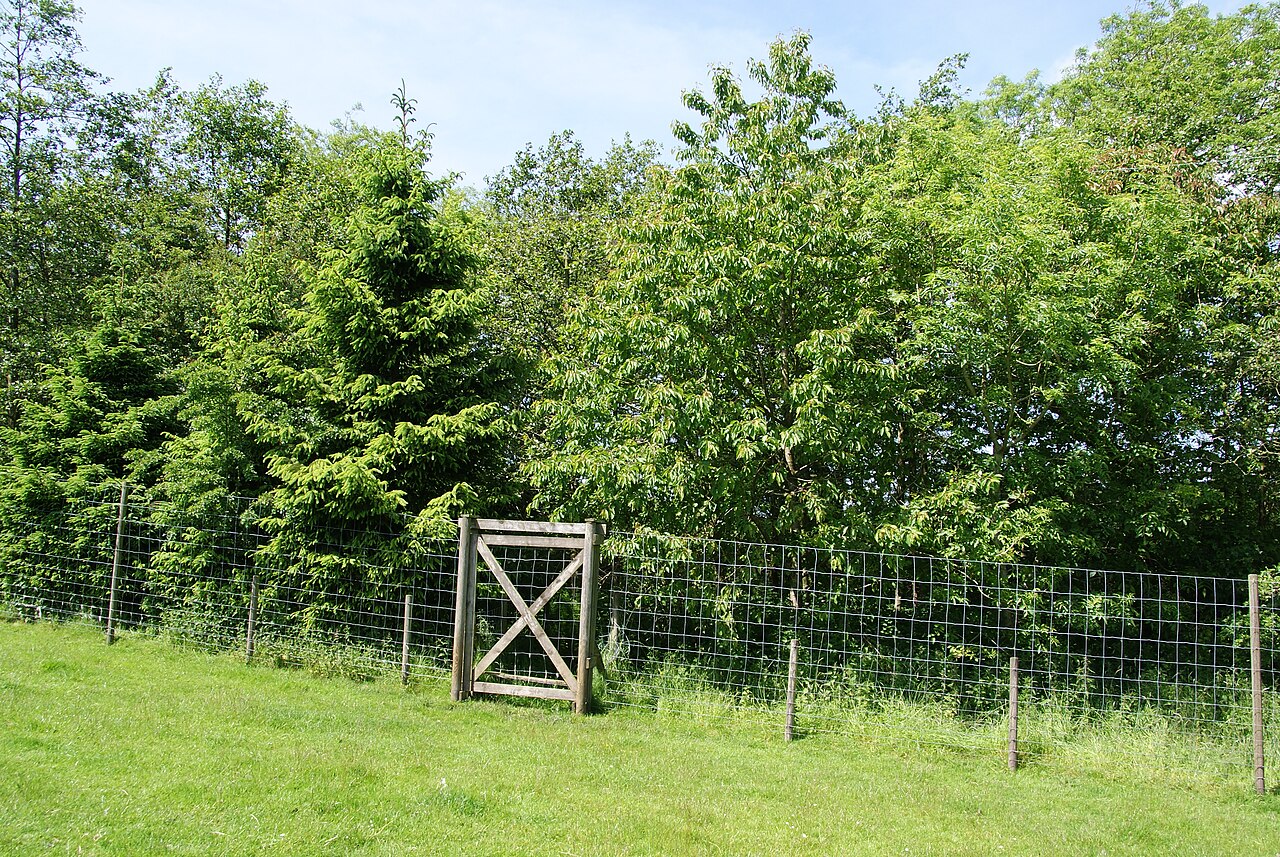
Photo: Bill Boaden, CC BY-SA 2.0, via Wikimedia Commons.

Which standards should the clause cite?
Cite the product standard the declaration of performance refers to, the code of practice for installation, and the test method behind each value you set. A value without its test method cannot be checked against a submittal.
- BS EN 13241
- Industrial, commercial, garage doors and gates. Product standard, performance characteristics
The product standard for industrial, commercial and garage doors and gates intended for vehicles and goods, including those that are power operated. Where a gate is within its scope, a declaration of performance is also needed.
In the clause "Gate: To BS EN 13241, power operated."
- BS EN 12453
- Industrial, commercial and garage doors and gates. Safety in use of power operated doors. Requirements and test methods
Safety requirements for power operated doors and gates, including protection against crushing, shearing and impact, force limitation and how it is tested.
In the clause "Safety in use: To BS EN 12453, safeguarding as installer's risk assessment."
- BS EN 12604
- Industrial, commercial and garage doors and gates. Mechanical aspects. Requirements and test methods
Mechanical safety of the gate itself, such as resistance to falling, derailing and failure of suspension or rollers.
In the clause "Mechanical safety: To BS EN 12604."
- BS EN 12635
- Industrial, commercial and garage doors and gates. Installation and use
Installation, handover and user information for doors and gates, including the documents to be left with the owner.
In the clause "Installation and handover: To BS EN 12635."
- BS 1722-14
- Fences. Specification for open mesh steel panel
Includes a section on the construction of gates in mesh fences, with typical frame sizes, hinges, drop bolts, locking bars and gate post sizes for leaf widths.
In the clause For manual gates in a mesh fence: "Gate construction: To BS 1722-14."
- BS EN ISO 1461
- Hot dip galvanized coatings on fabricated iron and steel articles. Specifications and test methods
Galvanizing of fabricated steel such as gate frames and posts after welding.
In the clause "Leaf and posts: Hot-dip galvanized after fabrication to BS EN ISO 1461."
- BS 7671
- Requirements for Electrical Installations. IET Wiring Regulations
The electrical installation feeding the gate operator, controls and safety devices.
In the clause "Power supply: Dedicated isolated supply to BS 7671, by electrical contractor, terminated at gate controller."
Confirm the current edition of each standard at every issue. Avoice's State of UK Specifications 2026 found a withdrawn standard cited in 40% of specifications at contract issue.
For the regulations behind these choices, see Approved Document K explained, or search the Avoice Regulations library.
How do you write it in CAWS?
Gates sit in CAWS section Q40 with the fences they belong to. They are written as their own product clauses, usually in the 500s, because a gate brings its own posts, foundations, hinges or rollers and locks. A gate clause refers to the fence type it sits in for finish and appearance, but should not rely on the fence clause for its structure.
For a powered gate, the Q40 clause carries the gate, the operator and the safety devices as one item from one supplier, and refers to the electrical section for the incoming supply. The Q40 execution and completion clauses still apply: setting posts in concrete, making good galvanizing and adjusting gates before handover. The powered gate adds testing, commissioning and handover documents, which are best written into the gate clause itself so they are not lost.
- Type
- Cantilever sliding vehicle gate, power operated
- Manufacturer
- Submit proposals
- Product reference
- Submit proposals
- Standard
- BS EN 13241; safety in use to BS EN 12453
- Clear opening
- 6000 mm
- Height
- 2400 mm, to match fence F01
- Leaf
- Steel frame with vertical bar infill, mesh guarding at closing edge
- Structural design
- Leaf, posts and foundations by manufacturer for site wind exposure
- Operator
- Electromechanical, with manual release
- Safety devices
- As installer's risk assessment to BS EN 12453
- Controls
- TBC Access control method awaiting client's security brief. Resolve before tender.
- Corrosion protection
- Hot-dip galvanized after fabrication to BS EN ISO 1461
- Finish
- Polyester powder coated, colour and gloss to match fence F01
- Power supply
- By electrical contractor to isolator adjacent to gate
- Completion
- Force testing, declaration of conformity, user instructions and training
Illustrative, not from a real project. One property is left as a TBC with a reason so it can be tracked and closed before issue.
Clauses the type clause relies on
- Q40/710
- Installation generally Setting out the gate line and levels with the fence.
- Q40/720
- Setting posts in concrete Foundations for gate posts and cantilever track bases.
- Q40/780
- Making good galvanized surfaces Repair of cut or damaged galvanizing.
- Q40/920
- Fixings Checking fixings, including operator and track fixings.
- Q40/930
- Gates Adjusting and lubricating hinges, rollers and latches before handover.
Clause numbers vary between NBS versions and practice masters. The 560 number follows the NBS Source listing for sliding automated gates and the 700s and 900s follow published NBS landscape specifications; check each referenced clause exists in your Q40.
How do you write it in Uniclass?
Uniclass treats the gate as a system in its own right, separate from the fence. Ss_25_32_35_80 Sliding gate systems holds the opening, the operator, the safety devices, the controls and the performance of the whole installed gate. Swing gates use Ss_25_32_35_37 Hinged gate systems.
The leaf is a product clause, here Pr_30_59_33_15 Carbon steel vertical section gate leaves, and the operator can be its own product clause under Pr_75_30_23_76 Sliding gate automation mechanisms. Keeping the operator separate helps when a client has a preferred operator brand across an estate, but the system clause must still make one party responsible for the complete powered gate.
- Description
- Cantilever sliding vehicle gate, power operated, in fence F01
- Clear opening
- 6000 mm
- Gate leaf
- Pr_30_59_33_15 Carbon steel vertical section gate leaves (G01)
- Operator
- Pr_75_30_23_76 Sliding gate automation mechanisms
- Safety in use
- To BS EN 12453, safeguarding as installer's risk assessment
- Structural design
- By manufacturer for site wind exposure
- Responsibility
- Installer to act as manufacturer and issue declaration of conformity
- Manufacturer
- Submit proposals
- Product reference
- Submit proposals
- Leaf size
- 6000 mm clear opening x 2400 mm high, with counterbalance tail
- Frame
- Steel hollow sections, size by manufacturer
- Infill
- Vertical steel bars, mesh guarding at closing edge
- Corrosion protection
- Hot-dip galvanized after fabrication to BS EN ISO 1461
- Finish
- Polyester powder coated, colour and gloss to match fence F01
- Hardware
- Cantilever rollers, end stops, retaining guides, lockable manual release
- Access control
- TBC Access control method awaiting client's security brief. Resolve before tender.
Illustrative. Performance of the finished system sits in the system clause; properties of the product sit in the product clause.
In NBS Chorus the leaf product clause also carries the NBS reference 45-25-35/369 for carbon steel vertical section gate leaves. Use one classification throughout and do not mix CAWS and Uniclass references in one specification.
What goes in the spec, and what goes in the schedule?
The specification defines each type once. The schedule and drawings say where each type goes.
In the specification
What the product is and how it performs and is installed. Written once per type.
In the schedule or drawings
Where each type goes and how much of it. Changes with every plan revision.
Give each gate a mark (G01, G02) and show it with its opening direction on the plan and on an elevation. The access control device positions and cable routes belong on the electrical drawings, cross-referenced from the gate clause.
What are the common mistakes?
Most problems are a missing property, a property filled with the wrong kind of value, or a decision left silently open.
- "Gate to match fence" for a powered gate. A powered vehicle gate is machinery, not a fence panel. It needs its own clause, product standard and safety requirements.
- No one responsible for the whole gate. If the gate, motor and electrics come from three trades, nobody issues the declaration of conformity. Make the gate installer responsible for the complete installation.
- No run-back on the plan. A cantilever sliding gate needs a straight run beside the opening. If the plan shows a tree, a kerb or a wall there, the gate cannot be built as drawn.
- Galvanized before welding. Welds made after galvanizing are left bare and rust first. Galvanize after all fabrication.
- Manual release out of reach. Users must be able to open the gate in a power failure. Put the release and the isolator where the people responsible for the gate can reach them.
- No force test at handover. Force limits set on site drift with wear and adjustment. Require measured results at handover and in the maintenance log.
How Avoice helps
Avoice drafts gate clauses from the external works drawings and gate schedule, and keeps the powered gate requirements together in one place.
- Drafts from your drawings and schedules
It reads gate marks such as G01 and G02 with their openings from the plans, writes the Q40 clause or the Uniclass system and product pair, and fills in the type, size and finish your information supports.
- Leaves a TBC with a reason
If the access control method is waiting on the client's security brief, the clause says TBC with the reason, and the item joins the project TBC register to close before tender.
- Works from your own masters
Choose CAWS or Uniclass. Avoice adapts your practice's Q40 gate clauses rather than replacing them with generic text.
- Checks the clause against the drawings
QA/QC flags a G03 on the plan with no clause, a gate whose height differs from the fence it sits in, or a withdrawn edition of a gate standard.
- Keeps product data and regulations linked
Operator data sheets and declarations sit in the Product Room against the clause, and the Avoice Regulations library holds Approved Document K for the powered door and gate guidance.
Related guides: How to specify fencing, How to specify bollards, How to specify automatic doors.
Software can draft and check. The designer still chooses the product and is responsible for the specification.
Draft your gate clause in Avoice
Upload your drawings and schedules. Avoice drafts the clause in CAWS or Uniclass, cites the standards and flags anything your information does not settle.
This guide is for general education and is not professional advice. Check current editions of standards and Approved Documents, the manufacturer's data, and the requirements of your project before relying on any clause.