
How to specify hand dryers
What a hand dryer clause has to decide, from drying method and power to noise and position, the standards to cite, and how to write it in CAWS and in Uniclass.
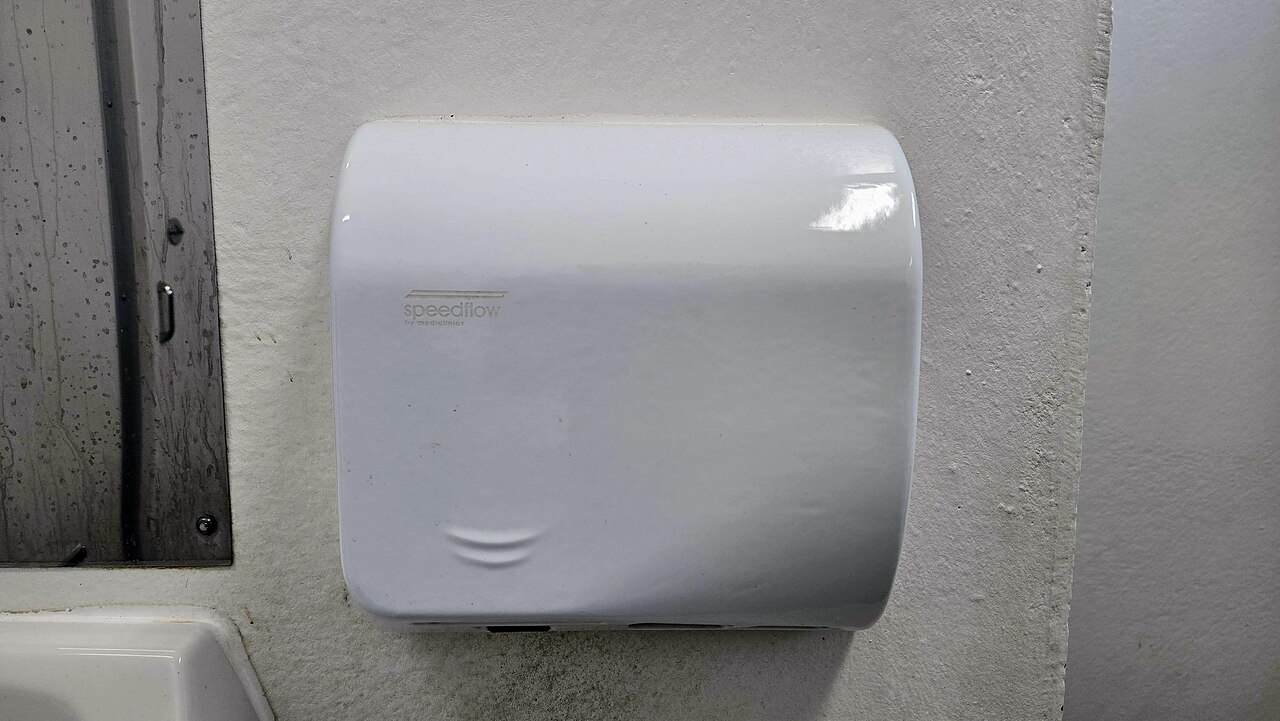
Photo: Baron Maddock, CC BY 4.0, via Wikimedia Commons.

How do you specify hand dryers?
To specify a hand dryer, state the drying method (warm air, high-speed jet or hands-in blade), the electrical rating and supply, compliance with BS EN 60335-2-23, the casing material and finish, the operation (usually sensor), the mounting and the noise level at a stated distance. In accessible WCs, position the dryer so it can be reached from the WC as Approved Document M expects, and coordinate the circuit, isolation and any IP rating with the electrical design.
Hand dryers sit between two trades. The architect picks one for its look and footprint; the electrical engineer finds out about it when the load schedule is checked. In between, nobody asks how loud it is in a small washroom, whether it can be reached from the WC in the accessible room, or whether a recessed model fits in the partition. The clause is the place to bring those together.
This guide covers Uniclass Pr_40_70_62_37 Hand dryers, which Uniclass treats as equipment rather than sanitaryware. Dryers built into other products have their own codes, such as Pr_40_20_87_15 Combined tap and hand dryers and Pr_40_20_96_97 Wash basin, soap dispenser and hand dryer units. Use those where the dryer is part of the tap or basin.
What does a hand dryer clause need to cover?
Some properties are specific to hand dryers. Others belong in every product clause. A clause that leaves either out gives the contractor room to substitute.
Properties of hand dryers
- MaterialStainless steel for vandal resistance; ABS for light use.
- Electrical ratingNever guessPower and circuit, agreed with the electrical engineer.
- Acoustic performanceNoise at a stated distance; matters in small rooms.
- FinishSatin or polished steel, or coloured casing.
- Ingress protection ratingIP code to BS EN 60529, to suit the location.
- Mounting typeSurface, semi-recessed or recessed in a partition.
- Operating mechanismSensor normally; push button where sensors are abused.
- Drying methodWarm air, high-speed jet or hands-in blade.
- Nominal sizeProjection into circulation and accessible space.
- AccessibilityReachable from the WC in accessible rooms.
What every product clause needs
- Manufacturer and product referenceNamed dryer, or performance description for proposals.
- Product standardBS EN 60335-2-23 for electrical safety.
- Installation methodManufacturer's fixing template and electrical connection.
- Technical submittalsPower, noise, IP rating and dimensions.
- Operation and maintenance informationFilter changes, cleaning and sensor adjustment.
- WarrantyPeriod, and whether parts and labour are both covered.
Uniclass Pr_40_70_62_37 Hand dryers. Not every property applies to every project; where one does not, say so rather than leaving it blank.
Fields marked Never guess (electrical rating) depend on the project and should never be filled from a default or a previous job. If the information is not available yet, the clause should say so with a TBC and a reason.
Which decisions does the clause depend on?
Most properties follow from the product you choose. These depend on the project, so they need a decision from the designer before the clause is written.
- 01
Electrical rating and supply
Never guessHand dryers range from under a kilowatt for some high-speed units to well over two kilowatts for traditional warm air dryers with heaters. Several in one washroom can need their own circuit. If the clause leaves the rating open, a substitution at tender can change the electrical design after the cables are sized. The dryer also needs a local means of isolation for maintenance, usually a fused connection unit, and someone has to provide it. BS EN 60335-2-23 covers the dryer's own electrical safety; the installation is BS 7671 work.
How to decide
- Get the maximum rated power from the chosen model and give it to the electrical engineer.
- Put a maximum power in the clause so alternatives can be checked.
- Agree who supplies the fused connection unit and where it goes.
- Heater-off modes reduce power but not peak load; design for the maximum.
Write it asElectrical rating: 230 V single phase, maximum 1.0 kW. Supply via fused connection unit by electrical contractor, position as electrical drawings. - 02
Drying method
PerformanceWarm air dryers are quieter and cheaper to buy but slow, so users leave with wet hands and queues form in busy washrooms. High-speed jet dryers dry faster with less energy but are much louder. Hands-in blade dryers dry fastest and contain some water, but they project further from the wall and need a drip tray emptied and cleaned. None of these is right everywhere. The washroom's use pattern and the people using it should drive the choice, and the clause should record it.
How to decide
- Busy public or school washrooms: high-speed units, with noise checked.
- Small offices and quiet buildings: lower-noise warm air or high-speed units with speed control.
- Healthcare clinical areas: check infection control policy; paper towels are often required instead.
- Hands-in blade units: confirm the projection and the cleaning regime.
Write it asDrying method: High-speed air, hands under, adjustable speed, heater optional and off by default. - 03
Noise
NoiseHand dryers are among the loudest things in many buildings, and in a small tiled room the sound builds up. Children, people with autism or sensory processing differences and people who use hearing aids can find them distressing, which is why some schools and venues now choose quieter models or provide a paper towel alternative. Manufacturers publish sound levels, but measured at different distances and in different ways. Ask for the figure at a stated distance and compare like with like.
How to decide
- Ask for sound pressure level in dB(A) at a stated distance from the unit.
- Schools, healthcare and venues with sensory-friendly aims: set a maximum or choose low-noise models.
- Small hard rooms: expect it to sound louder than the data sheet figure.
- Consider a paper towel dispenser as well where some users will avoid the dryer.
Write it asNoise: Not more than 80 dB(A) at 2 m from the unit, measured to the manufacturer's stated method. Submit test data. - 04
Position in accessible WCs and washrooms
AccessApproved Document M Volume 2 expects a wheelchair user to be able to wash and dry their hands while still seated on the WC. Diagram 19 places the towel and soap dispensers so they can be used from the WC and from the wheelchair, and a dryer used instead of towels needs the same reach. In general washrooms the dryer should be near the basins so people do not drip across the floor, and it should not project into the circulation route at head or shoulder height for someone with a visual impairment. BS 8300-2 gives the detail on heights and positions.
How to decide
- Accessible WC: position the dryer as the AD M Volume 2 diagrams show, reachable from the WC.
- Washrooms: place dryers beside the basins, with a drip-resistant floor finish below.
- Avoid projecting units on circulation routes; consider recessed models.
- Provide dryers at more than one height where children or wheelchair users are expected.
Write it asPosition: As drawings. In accessible WCs, within reach from the WC to Approved Document M Volume 2 and BS 8300-2. - 05
Surface or recessed
Build-upA surface-mounted dryer is simple but projects from the wall, sometimes by 200 mm or more, which matters in narrow washrooms and accessible rooms. Recessed and semi-recessed models solve that but need a cavity of the right depth, often more than a standard stud partition gives, plus a back box or frame and a fire-stopping check if the partition is fire-resisting. Once the walls are built, changing from surface to recessed is expensive. Decide it with the partition design.
How to decide
- Check the projection against corridor and accessible space requirements.
- Recessed: confirm the partition depth and who supplies the back box.
- Fire-resisting partitions: check the recess against the partition's fire evidence before choosing.
- Masonry walls: recessing means chasing or forming an opening; draw it.
Write it asMounting: Surface mounted on masonry with manufacturer's fixings; maximum projection 120 mm from finished wall face.
The values under "Write it as" are examples. The right value depends on the location, the use and the fire strategy.
Which standards should the clause cite?
Cite the product standard the declaration of performance refers to, the code of practice for installation, and the test method behind each value you set. A value without its test method cannot be checked against a submittal.
- BS EN 60335-2-23
- Household and similar electrical appliances. Safety. Particular requirements for appliances for skin or hair care
The electrical safety standard for hand dryers, which are named in its scope. Read with BS EN 60335-1, the general requirements.
In the clause "Standard: to BS EN 60335-2-23".
- BS EN 60529
- Degrees of protection provided by enclosures (IP code)
The IP code system for protection against solids and water.
In the clause "Ingress protection: not less than IP24 to BS EN 60529" where the location needs it.
- BS 7671
- Requirements for electrical installations. IET Wiring Regulations
The installation of the dryer's supply. Section 701 sets zones and IP requirements in locations containing a bath or shower, such as changing rooms.
In the clause "Electrical installation: to BS 7671, by electrical contractor".
- BS 8300-2
- Design of an accessible and inclusive built environment. Buildings. Code of practice
Guidance on the position and height of hand drying facilities in accessible WCs and washrooms, behind Approved Document M.
In the clause "Position: to Approved Document M Volume 2 and BS 8300-2".
- BS 6465 series
- Sanitary installations
Scales of provision (Part 1) and the activity space around washroom appliances (Part 2). The number of basins and the space in front of them decide how many dryers fit and where.
In the clause Use it for layout rather than the product: "Activity spaces: to BS 6465-2".
Confirm the current edition of each standard at every issue. Avoice's State of UK Specifications 2026 found a withdrawn standard cited in 40% of specifications at contract issue.
For the regulations behind these choices, see Approved Document M explained, or search the Avoice Regulations library.
How do you write it in CAWS?
Hand dryers are written in N13 as a product clause among the accessories, under a hand driers clause in the 360s in NBS layouts. One clause per dryer type is enough: a high-speed dryer in public washrooms and a low-noise one in the nursery are two clauses. The clause covers the product, its rating, noise and mounting.
The electrical connection is not N13 work. The dryer clause should say the supply and fused connection unit are provided under the electrical specification, so the electrical engineer sees the load. Fixing and support are covered by the shared N13 execution clauses, including noggings and bearers in partitions.
- Standard
- BS EN 60335-2-23
- Manufacturer
- Submit proposals
- Product reference
- Submit proposals
- Drying method
- High-speed air, hands under, adjustable speed
- Heater
- Optional, off by default
- Electrical rating
- 230 V single phase, maximum 1.0 kW
- Operation
- Infrared sensor with automatic cut-off
- Noise
- Not more than 80 dB(A) at 2 m; submit test data
- Casing
- Stainless steel, vandal resistant
- Finish
- TBC Satin or polished finish to match washroom accessories awaits client. Resolve before ordering.
- Mounting
- Surface mounted, maximum projection 120 mm
- Ingress protection
- Manufacturer's declared IP rating, suitable for location
- Position
- As drawings; in accessible WCs within reach from the WC
- Electrical connection
- Fused connection unit and supply by electrical contractor
- Warranty
- Manufacturer's warranty covering parts and labour; state period
Illustrative, not from a real project. One property is left as a TBC with a reason so it can be tracked and closed before issue.
Clauses the type clause relies on
- N13/610
- Installation generally Fix securely to structure; working correctly on completion; labels removed.
- N13/613
- Compatibility of components Washroom accessories functionally compatible, preferably from one range.
- N13/620
- Noggings and bearers Support in partitions positioned and fixed before boarding.
Clause numbers vary between NBS versions and practice masters. The 360 hand driers reference follows NBS-based manufacturer clauses; the execution clauses follow an issued NBS N13 section from a 2018 Scottish housing tender. Check them against your own N13.
How do you write it in Uniclass?
In Uniclass, a hand dryer installed in a washroom belongs to Ss_40_15_75_75 Sanitary accessory systems, alongside dispensers, mirrors and bins. The system clause covers what the set of accessories in a room must do and where it goes; the dryer is a product clause at Pr_40_70_62_37 Hand dryers.
Because Uniclass files hand dryers under equipment rather than sanitary fittings, it is easy to miss them when assembling a washroom. Pointing to the dryer from the sanitary accessory system keeps it in the room's description. The system clause is also the right place for position rules, such as reach from the WC, so the product clause stays about the dryer itself.
- Description
- Washroom accessories for public washrooms
- Hand dryers
- Pr_40_70_62_37 Hand dryers (HD01)
- Number
- As drawings, beside basins
- Position in accessible WCs
- Within reach from the WC, to Approved Document M Volume 2
- Electrical supply
- Fused connection unit by electrical contractor
- Fixing
- Into masonry or pattress board in partitions
- Manufacturer
- Submit proposals
- Product reference
- Submit proposals
- Standard
- BS EN 60335-2-23
- Drying method
- High-speed air, hands under
- Electrical rating
- 230 V single phase, maximum 1.0 kW
- Operation
- Infrared sensor
- Noise
- Not more than 80 dB(A) at 2 m
- Casing
- Stainless steel
- Finish
- TBC Satin or polished finish to match washroom accessories awaits client. Resolve before ordering.
- Mounting
- Surface mounted, maximum projection 120 mm
Illustrative. Performance of the finished system sits in the system clause; properties of the product sit in the product clause.
In NBS Chorus, hand dryers carry the NBS reference 45-35-72/334. Use whichever your practice's masters use, but do not mix CAWS and Uniclass references in one specification.
What goes in the spec, and what goes in the schedule?
The specification defines each type once. The schedule and drawings say where each type goes.
In the specification
What the product is and how it performs and is installed. Written once per type.
In the schedule or drawings
Where each type goes and how much of it. Changes with every plan revision.
Write each dryer type once and let the washroom layouts and the accessories schedule place it. Fused connection unit positions belong on the electrical drawings, and the clause should say so rather than repeating them.
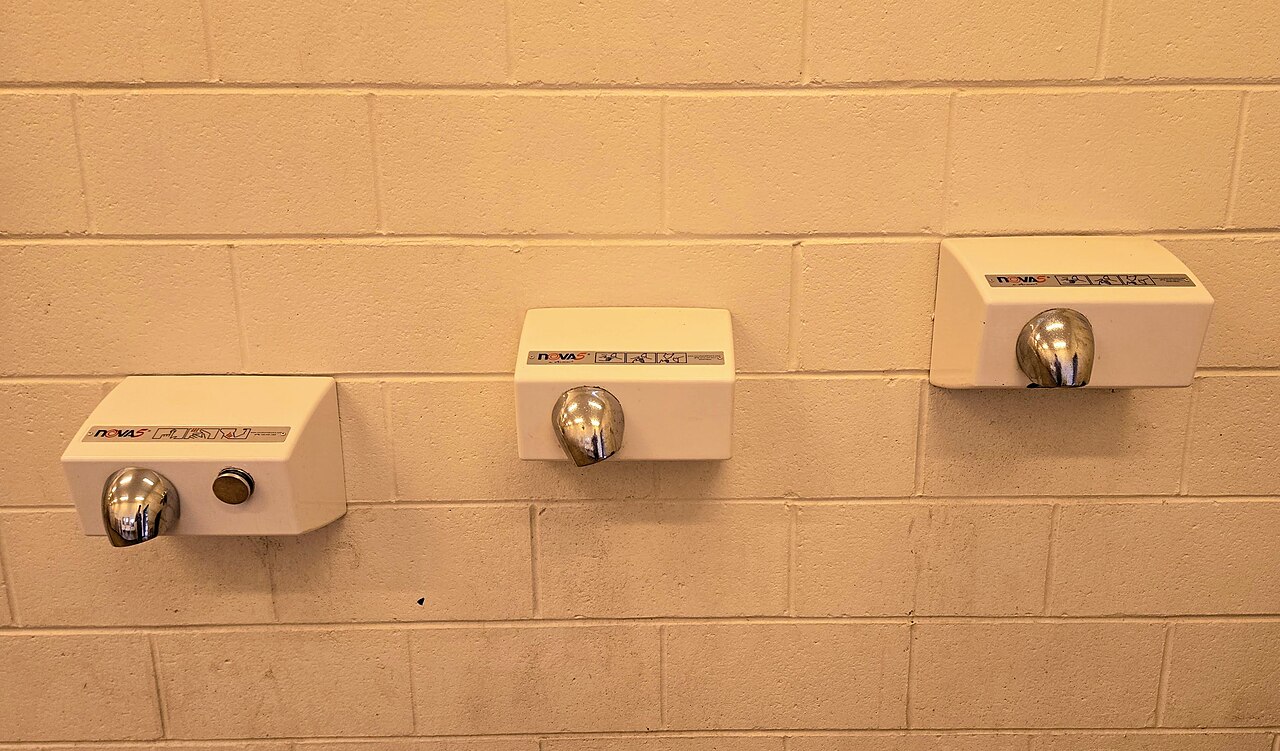
Photo: Baron Maddock, CC BY 4.0, via Wikimedia Commons.

What are the common mistakes?
Most problems are a missing property, a property filled with the wrong kind of value, or a decision left silently open.
- No power limit. A substitute dryer with a bigger heater can overload a circuit sized for the original. Put a maximum rating in the clause.
- Supply nobody owns. If the dryer clause does not say who provides the fused connection unit, it is often missing from both the electrical and sanitary packages.
- Noise ignored. A high-speed dryer in a small tiled washroom next to a quiet space causes complaints. Set a limit or choose the model with that in mind.
- Out of reach in the accessible WC. Fixed at the general washroom position, the dryer cannot be reached from the WC as AD M expects.
- Recessed unit, shallow partition. A recessed model needs more depth than many stud walls give. Choose it with the partition, not after.
- Room names in the clause. "Hand dryers to WCs 1.04 to 1.10" goes out of date at the next plan change. Use type marks and the schedule.
How Avoice helps
Avoice drafts hand dryer clauses from your washroom drawings and schedules and checks they line up with the electrical and access information.
- Drafts from your drawings
It reads HD01 and other accessory types from your washroom layouts and schedules, and writes an N13 hand driers clause or a Uniclass sanitary accessory system and hand dryer product clause.
- Leaves TBCs where the choice is open
If the finish or noise limit is undecided, the clause says TBC with the reason and the item joins the project TBC register, to be closed before tender.
- Uses your practice's clauses
Choose CAWS or Uniclass. Avoice adapts your own N13 accessory clauses rather than inserting generic text.
- Cross-checks with other information
QA/QC flags a dryer type on the drawings that the specification never defines, a clause that relies on an electrical clause that is not there, or a withdrawn standard in the standard line.
- Keeps product data in one place
Data sheets with power, noise and IP figures sit in the Product Room linked to the clause, so an alternative dryer can be checked against the same limits.
Related guides: How to specify toilet cubicles, How to specify washbasins, How to specify Doc M packs.
Software can draft and check. The designer still chooses the product and is responsible for the specification.
Draft your hand dryer clause in Avoice
Upload your drawings and schedules. Avoice drafts the clause in CAWS or Uniclass, cites the standards and flags anything your information does not settle.
This guide is for general education and is not professional advice. Check current editions of standards and Approved Documents, the manufacturer's data, and the requirements of your project before relying on any clause.