
How to specify liquid applied roofs
What a liquid applied roof clause has to say about chemistry, assessment, thickness, substrate and fire, and how to write it in CAWS and in Uniclass.
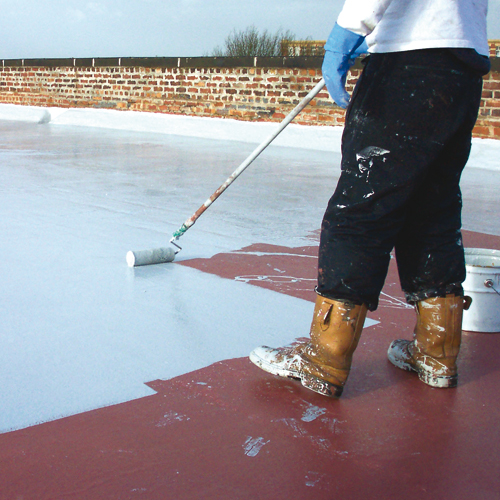
Photo: Waller42, CC BY-SA 3.0, via Wikimedia Commons.

How do you specify liquid applied roofs?
To specify liquid roofing, name a certified liquid applied waterproofing kit and its chemistry (for example PMMA, polyurethane or glass reinforced polyester), the European Technical Assessment or third-party certificate it holds, and the categories that assessment gives for working life and user load. Then state the substrate preparation and adhesion testing, primer, reinforcement and minimum cured thickness, any wearing or anti-slip finish, and the external fire performance of the whole roof build-up.
Liquid roofing is chosen for the jobs a sheet membrane does badly: crowded roofs full of penetrations, balconies with awkward thresholds, gutters, and refurbishment over an existing covering that is too sound to strip. Those same conditions are where a liquid system goes wrong if the clause does not control thickness, reinforcement and the bond to what is underneath.
Uniclass codes the product as Pr_35_31_77_46 Liquid-applied membranes, which sits in the surface sealers group rather than with the sheet membranes. Do not confuse it with Pr_35_31_06_49 Liquid-applied insulating underlays, which are a different product.
What does a liquid applied roof clause need to cover?
Some properties are specific to liquid applied roofs. Others belong in every product clause. A clause that leaves either out gives the contractor room to substitute.
Properties of liquid applied roofs
- CompatibilityWith the existing covering, primer and adjoining materials.
- DurabilityAssessed working life category and user load category.
- Product typePMMA, polyurethane, GRP or bitumen-based kit.
- MaterialThe resin system and its reinforcement fleece.
- Slip resistanceNever guessBalconies and walkways need a tested anti-slip finish.
- Coating systemPrimer, coats, reinforcement and top coat in order.
- Application rateSets the cured thickness the assessment relies on.
What every product clause needs
- Manufacturer and product referenceNamed kit, not a generic coating.
- Product standardEuropean Technical Assessment to EAD 030350-00-0402, or a UK certificate.
- Installation methodManufacturer's method by an approved, trained applicator.
- Technical submittalsAssessment, fire classification, details and adhesion test results.
- Operation and maintenance informationInspection, recoating of wearing or UV coats, repair method.
- SubstrateDeck or existing covering, and how it is prepared.
- Application conditionsAir and surface temperature, dew point and rain limits.
Uniclass Pr_35_31_77_46 Liquid roofing. Not every property applies to every project; where one does not, say so rather than leaving it blank.
Fields marked Never guess (slip resistance) depend on the project and should never be filled from a default or a previous job. If the information is not available yet, the clause should say so with a TBC and a reason.
Which decisions does the clause depend on?
Most properties follow from the product you choose. These depend on the project, so they need a decision from the designer before the clause is written.
- 01
Which liquid system
ChemistryLiquid kits are not interchangeable. Reactive PMMA systems cure fast, even in cold weather, which suits refurbishment of occupied buildings and short programmes, but they have a strong smell during application. Polyurethane systems are common for roofs and balconies. Glass reinforced polyester is rigid and is usually laid on a boarded deck as a new covering. Bitumen-based and hot-applied systems are often used under ballast, green roofs and paving. Each has its own primers, details and certified substrates, so the chemistry is a design decision to make before tender, not something to leave to the applicator.
How to decide
- Short programme, cold season or occupied building: consider a fast-curing PMMA system.
- Buried under paving, ballast or a green roof: a system assessed for that use, often hot-applied or bitumen based.
- New small roof on a boarded deck: GRP is common, but check fire classification for the build-up.
Write it asWaterproof coating: Reinforced, reactive PMMA liquid applied roof waterproofing kit with European Technical Assessment to EAD 030350-00-0402. - 02
Assessment, working life and fire
AssessmentLiquid kits are assessed against EAD 030350-00-0402, which replaced ETAG 005. The assessment puts each kit into categories for expected working life (5, 10 or 25 years), climatic zone, user load, roof slope and surface temperatures. Those categories are what you are buying, and a cheaper kit from the same manufacturer may only be assessed for a 10 year life or a non-accessible roof. External fire performance to BS EN 13501-5 is separate again and belongs to the build-up, including deck and insulation. UK certificates from bodies such as BBA usually state similar limits.
How to decide
- Set the working life you need, often the 25 year category for new roofs.
- Set the user load from how the roof will be used: maintenance only, or a balcony or terrace.
- Ask for the external fire classification for the specified deck and insulation.
Write it asAssessment: ETA to EAD 030350-00-0402, working life category 25 years, user load suitable for pedestrian access. External fire performance: BROOF(t4) to BS EN 13501-5. - 03
Coats, reinforcement and cured thickness
ThicknessA liquid membrane is only as thick as the applicator makes it. The assessment assumes a minimum application rate and reinforcement fleece in a given coat, and the performance falls away quickly if the coating is thin at angles, upstands and around penetrations. The clause should state the coating system in order, primer, base coat with fleece, top coat and any wearing or UV coat, and require wet film or depth checks during application. Real NBS-format clauses ask for exactly this.
How to decide
- Take the application rate and reinforcement from the assessed system, not a data sheet minimum.
- Require full reinforcement at upstands, outlets, penetrations and substrate joints.
- Ask for recorded wet film or depth checks and a test area before the main roof.
Write it asApplication: As assessed system, reinforced throughout. Monitor thickness by wet film readings; maintain full thickness at angles and details. Submit records. - 04
Existing roof, adhesion and conditions
SubstrateMany liquid roofs go over an existing covering. That only works if the old roof is sound, dry and compatible with the primer, and if the insulation under it is not wet. The specification should ask for a survey, moisture testing and adhesion tests on each substrate before the system is confirmed. Liquid systems are also sensitive to weather during application: surface temperature, dew point and rain set the working window, and the manufacturer's limits should be written in rather than assumed.
How to decide
- Survey the existing roof and test for trapped moisture before choosing overlay or strip.
- Require adhesion tests on each substrate type, recorded on a roof plan.
- Write in the manufacturer's limits for air and surface temperature and dew point.
Write it asPreparation: Adhesion tests on each substrate before application, results submitted. Apply within the manufacturer's stated limits for surface temperature and dew point. - 05
Balconies, walkways and slip resistance
Never guessOn a roof that people walk on, the waterproofing is also the floor. Most systems offer a textured wearing coat or aggregate broadcast into the top coat, and the slip resistance depends on that finish, not on the membrane. Ask for a pendulum test value measured wet to BS EN 16165 Annex C on the finish being supplied. A smooth top coat on a balcony is a slip risk, and a heavily textured one holds dirt and is harder to clean, so the right finish depends on the use.
How to decide
- Maintenance-only roofs: define walkways and specify a textured finish on those routes.
- Balconies and terraces: set a wet pendulum value and ask for the test report for the finish.
- Check the wearing coat is part of the assessed system and how often it needs renewing.
Write it asWalkway finish: Manufacturer's anti-slip wearing coat. Slip resistance: wet pendulum test value not less than 36 to BS EN 16165 Annex C, slider 96. Submit test report.
The values under "Write it as" are examples. The right value depends on the location, the use and the fire strategy.
Which standards should the clause cite?
Cite the product standard the declaration of performance refers to, the code of practice for installation, and the test method behind each value you set. A value without its test method cannot be checked against a submittal.
- EAD 030350-00-0402
- Liquid applied roof waterproofing kits
The European Assessment Document that replaced ETAG 005. It sets the use categories (working life, climatic zone, user load, slope, surface temperatures) that appear on a kit's European Technical Assessment.
In the clause "Assessment: European Technical Assessment to EAD 030350-00-0402".
- BS 6229
- Flat roofs with continuously supported flexible waterproof coverings. Code of practice
Design of flat roofs, including falls, drainage, deck types, insulation position and access, which applies to liquid systems as to sheet membranes.
In the clause "Falls: to achieve a finished fall of not less than 1:80 to BS 6229".
- BS EN 13501-5
- Fire classification of construction products and building elements. Classification using data from external fire exposure to roofs tests
External fire performance classes for roofs, such as BROOF(t4), which Approved Document B uses for roof coverings.
In the clause "External fire performance: BROOF(t4) to BS EN 13501-5 for the specified build-up".
- BS EN 13501-1
- Fire classification of construction products and building elements. Classification using data from reaction to fire tests
Reaction to fire Euroclasses, relevant where the membrane runs onto walls or forms part of a balcony.
In the clause "Reaction to fire: as declared, to BS EN 13501-1".
- BS EN 16165
- Determination of slip resistance of pedestrian surfaces. Methods of evaluation
Annex C is the pendulum test now used in the UK in place of the withdrawn BS 7976-2.
In the clause "Wet PTV not less than 36 to BS EN 16165 Annex C, slider 96".
- BS 5250
- Management of moisture in buildings. Code of practice
Condensation risk in flat roofs, which decides the vapour control layer and whether an overlay traps moisture.
In the clause "Build-up: as condensation risk assessment to BS 5250".
Confirm the current edition of each standard at every issue. Avoice's State of UK Specifications 2026 found a withdrawn standard cited in 40% of specifications at contract issue.
For the regulations behind these choices, see Approved Document B explained, Part L and the Future Homes Standard, or search the Avoice Regulations library.
How do you write it in CAWS?
Liquid roofing is CAWS section J31. It is written as type clauses by roof type, such as 110 for a cold deck, 120 Warm deck roof coating and 130 Inverted roof coating. The type clause carries the substrate and its preparation, any vapour control layer and insulation, then the waterproof coating with its manufacturer, primer, reinforcement, application rate and surface finish.
General clauses later in J31 cover what every type shares: performance and design requirements, adverse weather, suitability of substrates, adhesion tests, primers, applying the coating, skirtings and upstands, and inspection and testing at completion. Short refurbishment specifications in NBS Chorus often collapse this into a handful of clauses, but the adhesion test and thickness checks are worth keeping.
- Substrate
- Existing reinforced bitumen membrane on PIR insulation, retained after survey
- Preparation
- Clean, cut and repair blisters, adhesion tests as clause 710
- Waterproof coating
- Reinforced reactive PMMA liquid applied kit
- Manufacturer
- Submit proposals
- Product reference
- Submit proposals
- Assessment
- ETA to EAD 030350-00-0402, working life category 25 years
- Primer
- As manufacturer for the substrate, applied as clause 720
- Reinforcement
- Manufacturer's polyester fleece throughout, embedded in base coat
- Application
- As assessed system; thickness monitored by wet film readings, as clause 760
- Top coat colour
- TBC Colour is subject to the conservation officer's comments on views from the street. Resolve before ordering.
- Walkways
- Anti-slip wearing coat on routes shown on roof plan
- Upstands
- Reinforced coating carried 150 mm above finished roof level, as clause 770
- External fire performance
- BROOF(t4) to BS EN 13501-5 for this build-up
- Installer
- Approved and trained by the system manufacturer
Illustrative, not from a real project. One property is left as a TBC with a reason so it can be tracked and closed before issue.
Clauses the type clause relies on
- J31/410
- Adverse weather No application in wet conditions, below the manufacturer's temperature limits or in high winds.
- J31/420
- Suitability of substrates Substrate secure, clean, dry and within tolerance before coating.
- J31/710
- Adhesion tests Bond tests on each substrate before application, recorded.
- J31/720
- Applying primers/ conditioners Coverage rates by substrate, and drying before the coating.
- J31/760
- Application of roof coatings Reinforcement, coats, thickness checks and continuity at details.
- J31/770
- Skirtings and upstands Reinforcement strips, upstand height and termination.
Clause numbers vary between NBS versions and practice masters; the related clauses here follow a manufacturer's NBS-format J31 and the type clause titles follow NBS's own guidance on flat roofs.
How do you write it in Uniclass?
In Uniclass the roof is the system Ss_30_40_30_43 Liquid-applied warm roof covering systems, with Ss_30_40_30_40 for cold roofs and Ss_30_40_30_42 for inverted roofs. The system clause holds the build-up and the finished performance: falls, external fire performance, upstand heights and testing at completion.
The coating is a product clause under Pr_35_31_77_46 Liquid-applied membranes. Primers and reinforcement fleece are part of the assessed kit, so list them in the product clause rather than as separate products that a contractor might source elsewhere.
- Description
- Reinforced PMMA liquid waterproofing over retained bitumen roof
- Substrate
- Existing reinforced bitumen membrane on PIR insulation, retained after survey
- Coating
- Pr_35_31_77_46 Liquid-applied membranes (LM01)
- Adhesion
- Tests on each substrate before application, results submitted
- Upstands
- 150 mm above finished roof level
- Walkways
- Anti-slip wearing coat on routes shown on roof plan
- External fire performance
- BROOF(t4) to BS EN 13501-5
- Completion
- Integrity test of the completed membrane, report submitted
- Manufacturer
- Submit proposals
- Product reference
- Submit proposals
- Type
- Reactive PMMA, reinforced
- Assessment
- ETA to EAD 030350-00-0402
- Working life category
- 25 years
- Kit components
- Primer, base coat, polyester fleece, top coat, all from the same kit
- Application rate
- As assessed system
- Colour
- TBC Colour is subject to the conservation officer's comments on views from the street. Resolve before ordering.
- Slip resistance of walkway finish
- Wet PTV not less than 36 to BS EN 16165 Annex C, slider 96
Illustrative. Performance of the finished system sits in the system clause; properties of the product sit in the product clause.
The Uniclass product code sits in the surface sealers group, and the product has no NBS reference in our database; cite the code and the kit's assessment rather than mixing referencing systems.
What goes in the spec, and what goes in the schedule?
The specification defines each type once. The schedule and drawings say where each type goes.
In the specification
What the product is and how it performs and is installed. Written once per type.
In the schedule or drawings
Where each type goes and how much of it. Changes with every plan revision.
Write the roof type once and show walkways, outlets and upstand heights on the roof plan. Balcony thresholds need their own details on the drawings; the clause should refer to them, not describe each one.
What are the common mistakes?
Most problems are a missing property, a property filled with the wrong kind of value, or a decision left silently open.
- "Liquid coating" with no assessment. Paint-like roof coatings are sold alongside assessed waterproofing kits. Ask for an ETA to EAD 030350-00-0402 or a third-party certificate, and say which categories you need.
- No thickness control. The membrane is only as thick as it is applied. Require recorded wet film or depth checks, especially at details.
- Overlay without a moisture survey. Coating over wet insulation traps the water. Survey and test before deciding to overlay.
- Mixing components from different kits. Primer, fleece and top coat are assessed together. A substituted primer can lose the bond and the certificate.
- A smooth finish on a balcony. Specify the anti-slip wearing coat and a wet pendulum value where people walk.
- Upstands too low at thresholds. Liquid systems make low thresholds possible, but the upstand still needs a designed detail. Draw it rather than leaving it to site.
How Avoice helps
Avoice drafts liquid roofing clauses from your roof plans and survey information, and marks what still has to be decided.
- Drafts from your drawings and schedules
It reads roof and balcony types from the plans, picks J31 or the matching Uniclass liquid system, and fills in substrate, walkways and upstands from what is drawn.
- Leaves a TBC where the information is not there
If the top coat colour waits on the conservation officer or the overlay depends on a moisture survey, the clause says TBC with the reason, and it joins the project TBC register.
- Writes in your format and your style
Choose CAWS or Uniclass. Avoice adapts your practice's J31 master instead of replacing it with generic wording.
- Checks the clause against everything else
QA/QC flags a balcony with no slip requirement, a walkway on the plan that the clause does not mention, or a withdrawn reference such as BS 7976-2.
- Keeps product data in one place
The kit's ETA, fire classification and data sheets live in the Product Room, linked to the clause, so a proposed alternative can be checked against the same categories.
Related guides: How to specify felt roofs, How to specify single ply roofing membranes.
Software can draft and check. The designer still chooses the product and is responsible for the specification.
Draft your liquid applied roof clause in Avoice
Upload your drawings and schedules. Avoice drafts the clause in CAWS or Uniclass, cites the standards and flags anything your information does not settle.
This guide is for general education and is not professional advice. Check current editions of standards and Approved Documents, the manufacturer's data, and the requirements of your project before relying on any clause.