
How to specify resin bound gravel
What a resin bound gravel clause has to say, the decisions about the base, binder and drainage behind it, the standards and rules to cite, and how to write it in CAWS and in Uniclass.
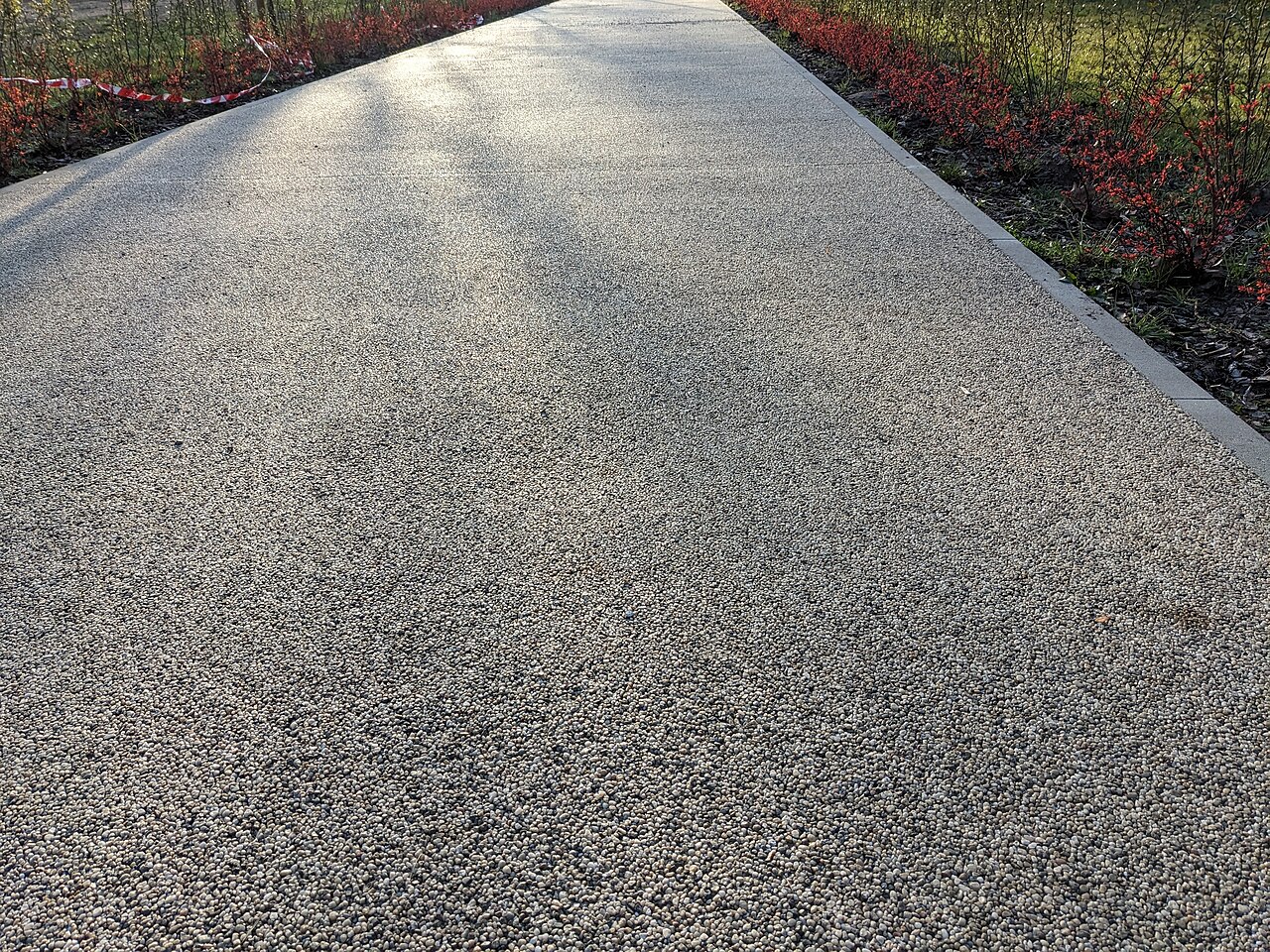
Photo: NieWnen, CC0, via Wikimedia Commons.

How do you specify resin bound gravel?
To specify resin bound gravel, specify the whole system: the base it is laid on, the binder type, the aggregate grading and colour, the laid thickness for the traffic, and the wet slip resistance. Say whether the surface must be permeable, and if so make sure the base below is permeable too. Use a UV-stable binder where colour matters, and set the weather limits for laying.
Resin bound gravel is a mix of dried aggregate and resin, trowelled to a smooth, porous finish. It is popular for drives, paths and tree pits because it looks like loose gravel without the loose stones. It is often confused with resin bonded surfacing, where gravel is scattered onto a coat of resin. That one has a loose, textured top and is not permeable. Writing "resin gravel" in a clause without saying which can give either.
This guide covers Uniclass Pr_35_31_05_71 Resin-bound mixed aggregate surfacings. The bonded type has its own code, Pr_35_31_05_70 Resin-bonded aggregate surfacings, and the two should never share a clause.
What does a resin bound surfacing clause need to cover?
Some properties are specific to resin bound gravel. Others belong in every product clause. A clause that leaves either out gives the contractor room to substitute.
Properties of resin bound gravel
- Binder type and gradeUV-stable aliphatic or aromatic polyurethane resin.
- ThicknessLinked to aggregate size and traffic by the system.
- PrimerOnly where the system requires it on a closed base.
- FinishAggregate blend and colour from the approved sample.
- Mix designationResin bound, not resin bonded or asphalt.
- Slip resistanceNever guessWet pendulum value; anti-slip grit on slopes.
- Aggregate type and sizeDried natural or recycled aggregate, sizing per system.
- TolerancesLevel and regularity; no ponding on the surface.
What every product clause needs
- Manufacturer and product referenceNamed system, installed by an approved installer.
- Product standardNo product standard; use system data and test reports.
- Installation methodSystem manufacturer's method statement and this specification.
- Technical submittalsPermeability, slip and UV stability data for the system.
- Operation and maintenance informationSweeping, jet washing and repair method; spare batch details.
- SubstratePermeable base or sound existing surface; sets drainage.
- Application conditionsDry base, temperature and rain limits for curing.
Uniclass Pr_35_31_05_71 Resin bound gravel. Not every property applies to every project; where one does not, say so rather than leaving it blank.
Fields marked Never guess (slip resistance) depend on the project and should never be filled from a default or a previous job. If the information is not available yet, the clause should say so with a TBC and a reason.
Which decisions does the clause depend on?
Most properties follow from the product you choose. These depend on the project, so they need a decision from the designer before the clause is written.
- 01
The base decides whether it drains
BaseThe resin layer is only a wearing course. It is laid on a base, usually porous asphalt or a no-fines concrete over an open-graded sub-base when the surface has to drain, or on a sound existing tarmac or concrete when it does not. If the surfacing is sold as permeable but laid on dense tarmac, the water just runs off the top layer. On front gardens of houses in England, a new hard surface over 5 m² between the house and the highway needs planning permission unless it is porous or drains to a permeable area within the curtilage. That rule is about the whole construction, not the top layer.
How to decide
- Ask whether the surface must be permeable: SuDS strategy, planning condition, or permitted development on a front garden.
- Permeable: specify a porous asphalt or no-fines concrete base on an open-graded sub-base, designed by the engineer.
- Impermeable overlay on an existing surface: survey it for cracks and movement first, and provide falls to drainage.
- Check the subgrade can take infiltrated water, or provide a lined and drained build-up.
Write it asBase: Porous asphalt to BS EN 13108-7 on open-graded sub-base, as engineer's design. Whole construction to be permeable. - 02
UV-stable or standard resin
BinderResin bound systems use polyurethane resins. Aliphatic resins are UV stable and keep their clarity in sunlight. Aromatic resins are cheaper but yellow and darken over time with UV exposure, which shows most on pale aggregates. In shade or with dark aggregate the difference may not matter, but on a sunny drive with a light blend it decides how the surface looks after a few years. The binder also has to suit the aggregate, so this is a system choice rather than a mix-and-match.
How to decide
- Pale or bright aggregates in sunlight: specify a UV-stable aliphatic binder.
- Dark aggregates or shaded areas: an aromatic binder may be acceptable if the client accepts some darkening.
- Specify a named system so binder and aggregate are tested together.
- Ask for evidence of UV stability, not just a product name.
Write it asBinder: UV-stable aliphatic polyurethane resin, as system manufacturer, mixed by weight in the manufacturer's stated ratio. - 03
Thickness and aggregate size for the traffic
TrafficLaid thickness is tied to the aggregate size and the traffic. A path with fine aggregate can be quite thin; a drive with cars turning on it needs a thicker layer and usually a larger aggregate. Systems publish their own combinations, and installers who lay a thinner coat than the system calls for save material but lose durability. Thickness also affects levels at thresholds, manhole covers and edgings, which have to be set for it.
How to decide
- Take the thickness and aggregate size combination from the system manufacturer for the stated traffic.
- Driveways and vehicle areas: use the manufacturer's vehicular specification, not the pedestrian one.
- Set edgings, covers and thresholds to suit the finished thickness.
- Allow core samples or depth checks during laying if the area is large.
Write it asThickness: 18 mm with 6 mm aggregate, as system manufacturer's specification for pedestrian use. - 04
Slip resistance on paths and slopes
Never guessResin bound surfaces feel textured underfoot but the resin coats each stone, and the wet slip resistance depends on the aggregate, the resin content and the finishing. On slopes and ramps, systems usually add a fine anti-slip grit scattered on the wet surface. The value should be measured, not assumed: a wet pendulum test gives a comparable figure, and UK Slip Resistance Group guidance treats a wet value of 36 or more as low slip potential. Highway or adopted areas may have their own skid criteria, set by the highway authority.
How to decide
- Pedestrian areas: set a minimum wet pendulum value of 36 and ask for test evidence for the system and aggregate proposed.
- Slopes, ramps and steps: require the manufacturer's anti-slip grit dressing.
- Adopted or highway areas: ask the highway authority for its skid resistance criteria.
- Consider site testing after installation on ramps and busy routes.
Write it asSlip resistance: Wet PTV not less than 36, tested to BS EN 16165 Annex C using slider 96. Anti-slip grit dressing to slopes and ramps. - 05
Weather, moisture and curing
WeatherPolyurethane resins react with moisture. Laid on a damp base, in rain or with wet aggregate, the resin can foam or fail to cure, leaving a weak, cloudy surface that sheds stones. Cold slows the cure, and some systems also have upper temperature limits. The manufacturer's limits for air and base temperature, humidity and base moisture should be written into the clause, with protection and a programme that allows for weather delays.
How to decide
- Copy the system's temperature and moisture limits into the clause rather than referring to them vaguely.
- Programme the work outside the wettest months where possible, with covered protection ready.
- Specify kiln-dried aggregate supplied in sealed bags.
- Keep traffic off until the stated cure times have passed.
Write it asApplication: Within system manufacturer's limits for air and base temperature, humidity and base moisture. Do not lay in rain or on a damp base.
The values under "Write it as" are examples. The right value depends on the location, the use and the fire strategy.
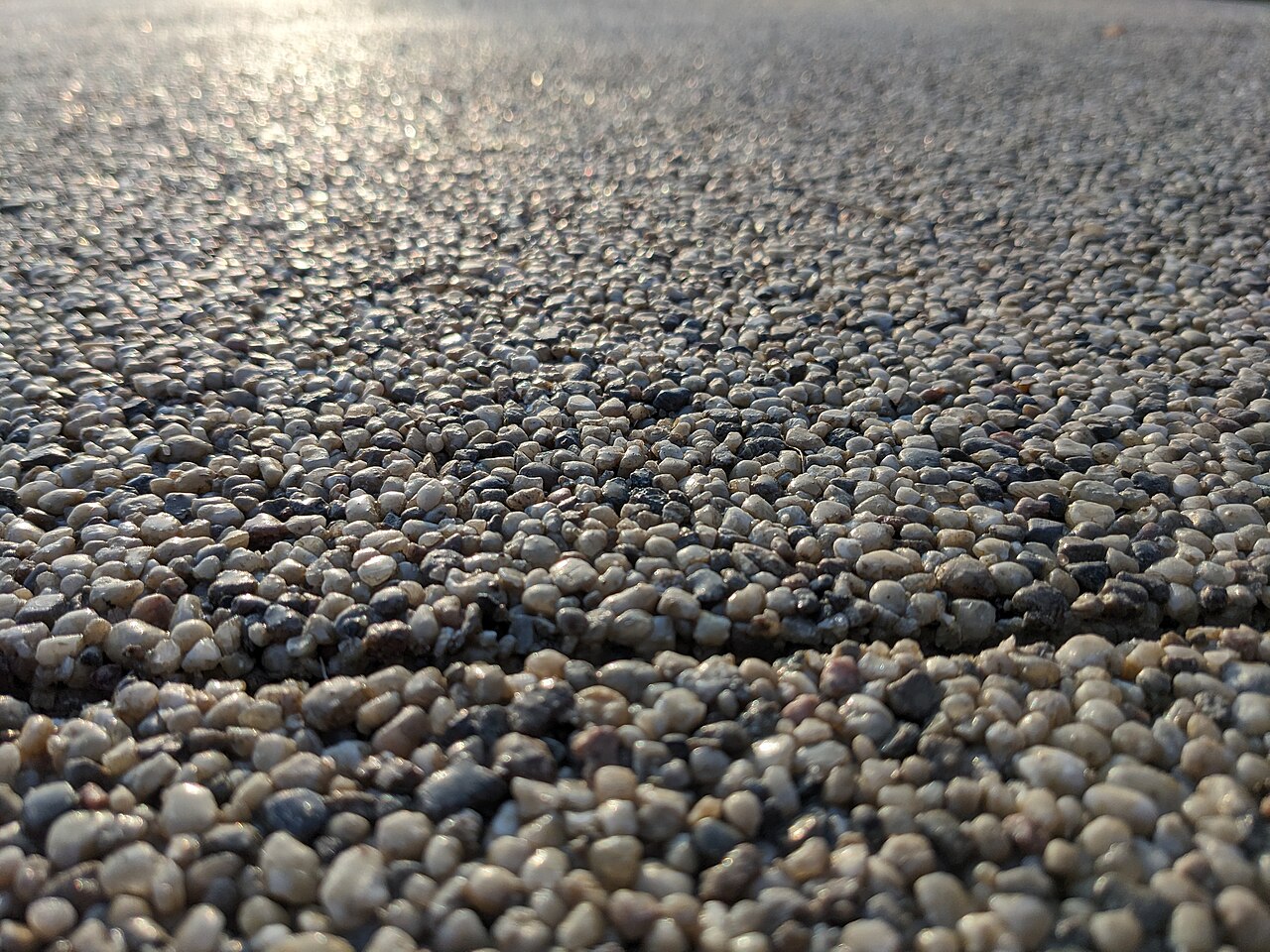
Photo: NieWnen, CC0, via Wikimedia Commons.

Which standards should the clause cite?
Cite the product standard the declaration of performance refers to, the code of practice for installation, and the test method behind each value you set. A value without its test method cannot be checked against a submittal.
- Town and Country Planning (General Permitted Development) (England) Order 2015, Schedule 2, Part 1, Class F
- Hard surfaces incidental to the enjoyment of a dwellinghouse
Where a hard surface over 5 m² lies between a house's principal elevation and a highway, it is permitted development only if it is porous or drains to a permeable area within the curtilage.
In the clause Record the reason in the description line: "Permeable construction, to meet Class F condition F.2".
- BS EN 16165
- Determination of slip resistance of pedestrian surfaces. Methods of evaluation
Annex C is the pendulum test, with slider 96 for shod use. BSI withdrew BS 7976-2 in 2022, so older data sheets may still quote it.
In the clause "Slip resistance: Wet PTV not less than 36, tested to BS EN 16165 Annex C using slider 96."
- BS EN 13108-7
- Bituminous mixtures. Material specifications. Porous asphalt
Porous asphalt, a common permeable base for resin bound surfacing.
In the clause "Base: Porous asphalt to BS EN 13108-7, as engineer's design."
- BS EN 13108-1
- Bituminous mixtures. Material specifications. Asphalt concrete
Dense asphalt concrete, used as a base where the resin bound layer is an impermeable overlay.
In the clause "Base: Asphalt concrete to BS EN 13108-1, laid to falls."
- BS EN 13242
- Aggregates for unbound and hydraulically bound materials for use in civil engineering work and road construction
The aggregate standard behind open-graded and dense granular sub-bases under the base course.
In the clause "Sub-base: Open-graded aggregate to BS EN 13242, as section Q20 and engineer's design."
- BS 8582
- Code of practice for surface water management for development sites
Surface water management on development sites, including permeable surfaces within the drainage strategy.
In the clause "Drainage: As drainage strategy prepared to BS 8582."
- CIRIA C753
- The SuDS Manual
Industry guidance on the planning, design, construction and maintenance of sustainable drainage systems, used by drainage engineers designing permeable pavements.
In the clause Usually referenced through the drainage strategy rather than in the surfacing clause.
- BS 8300-1
- Design of an accessible and inclusive built environment. External environment. Code of practice
Accessible external routes, where firm, even, slip-resistant surfaces are needed and loose gravel is not suitable.
In the clause "Surfaces on accessible routes: To BS 8300-1."
Confirm the current edition of each standard at every issue. Avoice's State of UK Specifications 2026 found a withdrawn standard cited in 40% of specifications at contract issue.
For the regulations behind these choices, see Approved Document M explained, or search the Avoice Regulations library.
How do you write it in CAWS?
Resin bound surfacing is written in CAWS section Q23, which also covers loose gravel, hoggin and woodchip. Real NBS-format specifications use a proprietary surfacing type clause in the 200s, one for each build-up, listing the sub-base, geotextile, base course and the surface course with its manufacturer, binder, aggregate, colour, thickness and slip requirement. A permeable drive and a resin bound tree pit are two clauses.
The execution clauses that follow are short and shared: materials compatibility, laying generally, cold weather working, drainage falls and protection from traffic. For resin bound work most of the method comes from the system manufacturer, so the type clause needs to name the system and make the manufacturer's limits contractual.
- Description
- Permeable footpaths, pedestrian traffic
- Granular sub-base
- Open-graded aggregate as section Q20, thickness as engineer's design
- Geotextile
- As engineer's design
- Base course
- Porous asphalt to BS EN 13108-7, thickness as engineer's design
- Surface course manufacturer
- Submit proposals for a named system and approved installer
- Type
- Resin bound, trowelled, permeable
- Binder
- UV-stable aliphatic polyurethane resin
- Aggregate
- Kiln-dried natural aggregate, 6 mm nominal
- Colour
- TBC Two aggregate blends shortlisted, client to choose from laid samples. Resolve before ordering.
- Mix ratio
- As system manufacturer
- Thickness
- 18 mm, as system manufacturer for pedestrian use
- Slip resistance
- Wet PTV not less than 36 to BS EN 16165 Annex C, slider 96
- Application
- Within manufacturer's temperature and moisture limits, base dry
- Edges
- Steel edging as section Q10
- Accessories
- Anti-slip grit dressing to slopes
Illustrative, not from a real project. One property is left as a TBC with a reason so it can be tracked and closed before issue.
Clauses the type clause relies on
- Q23/315
- Materials Aggregates and binders to be compatible, as one system.
- Q23/340
- Laying generally Channels and gullies kept clear, even texture, clean at completion.
- Q23/350
- Cold weather working No frozen materials or laying in freezing conditions; other limits as manufacturer.
- Q23/360
- Drainage falls Minimum falls and cross falls so surface water does not pond.
- Q23/390
- Protection from traffic and plant Keeping vehicles and site plant off the surfacing while it cures.
Clause numbers vary between NBS versions and practice masters; these follow recent NBS-format landscape specifications, so check each referenced clause exists in your Q23.
How do you write it in Uniclass?
In Uniclass the build-up is a system and the resin surfacing is a product. Ss_30_14_02_71 Resin-bound aggregate light-duty paving systems covers footpaths and similar areas, Ss_30_14_02_72 Resin-bound aggregate heavy-duty paving systems covers vehicle areas, and Ss_30_14_02_73 Resin-bound aggregate overlay systems covers resin bound laid over an existing surface.
The system clause holds the sub-base, base, drainage intent and finished performance. The Pr_35_31_05_71 product clause holds the binder, aggregate, colour and thickness. Choosing the system code forces the question of whether the surface is new and permeable, or an overlay on an existing base.
- Description
- Permeable footpaths, pedestrian traffic
- Sub-base
- Open-graded aggregate, thickness as engineer's design
- Base
- Porous asphalt to BS EN 13108-7
- Surfacing
- Pr_35_31_05_71 Resin-bound mixed aggregate surfacings (RB01)
- Edges
- Steel edging
- Drainage
- Whole construction permeable, as drainage strategy
- Slip resistance of finished surface
- Wet PTV not less than 36 to BS EN 16165 Annex C
- Manufacturer
- Submit proposals for a named system
- Binder
- UV-stable aliphatic polyurethane resin
- Aggregate
- Kiln-dried natural aggregate, 6 mm nominal
- Colour
- TBC Two aggregate blends shortlisted, client to choose from laid samples. Resolve before ordering.
- Thickness
- 18 mm
- Primer
- Not required on porous asphalt unless the system requires it
- Slip resistance
- Wet PTV not less than 36
- Application conditions
- As system manufacturer's limits
Illustrative. Performance of the finished system sits in the system clause; properties of the product sit in the product clause.
In NBS Chorus the product clause also carries an NBS reference (for resin bound mixed aggregate surfacing, 45-20-00/415). Use one classification throughout and do not mix CAWS and Uniclass references.
What goes in the spec, and what goes in the schedule?
The specification defines each type once. The schedule and drawings say where each type goes.
In the specification
What the product is and how it performs and is installed. Written once per type.
In the schedule or drawings
Where each type goes and how much of it. Changes with every plan revision.
Give each resin build-up a type mark (RB01 permeable path, RB02 driveway) and show them on the landscape layout. A colour change between areas is easiest to control as a scheduled variant of one product clause.
What are the common mistakes?
Most problems are a missing property, a property filled with the wrong kind of value, or a decision left silently open.
- Resin bonded supplied for resin bound. The bonded type is a scatter coat and is not permeable. Say resin bound, trowelled, and use the right Uniclass code.
- A permeable top on a dense base. If the base is dense tarmac, water runs off the resin layer. Make the whole construction permeable, or provide falls and drainage.
- Standard resin on pale aggregate. Non-UV-stable binders yellow in sunlight. On light blends, specify an aliphatic binder.
- Laying in damp conditions. Moisture stops the resin curing properly, and stones loosen within months. Write the moisture and temperature limits into the clause.
- Thin layers to save resin. Laying below the system thickness shortens life and causes cracking under vehicles. State the thickness and check it on site.
- No allowance for sample panels. Aggregate blends look different laid than in the jar. Ask for laid samples before the client chooses.
How Avoice helps
Avoice drafts resin bound surfacing clauses from the landscape drawings and drainage information on the project, and marks what still needs a decision.
- Drafts from your drawings and schedules
It reads the surfacing types such as RB01 and RB02 from the landscape layout, writes the Q23 type clause or the Uniclass system and product pair, and fills in the base, binder, aggregate and thickness it can support.
- Leaves a TBC with a reason
If the client has not chosen between aggregate blends, or the drainage engineer has not confirmed whether the area infiltrates, the clause says TBC with the reason, and it joins the project TBC register to close before tender.
- Works from your own masters
Choose CAWS or Uniclass. Avoice adapts your practice's Q23 and Q20 clauses rather than replacing them with generic text.
- Checks the clause against the drawings
QA/QC flags a permeable surfacing type laid on a dense base clause, a resin bonded product named in a resin bound clause, or a slip test citing the withdrawn BS 7976-2.
- Keeps product data linked
The system's data sheets and slip and permeability test reports sit in the Product Room against the product clause, so an alternative system can be checked against what the clause asks for.
Related guides: How to specify block paving, How to specify natural stone paving, How to specify porcelain paving.
Software can draft and check. The designer still chooses the product and is responsible for the specification.
Draft your resin bound surfacing clause in Avoice
Upload your drawings and schedules. Avoice drafts the clause in CAWS or Uniclass, cites the standards and flags anything your information does not settle.
This guide is for general education and is not professional advice. Check current editions of standards and Approved Documents, the manufacturer's data, and the requirements of your project before relying on any clause.