
How to specify tile grouts
What a tile grout clause has to say, whether the joints are cementitious or epoxy, the decisions behind it, the standards to cite, and how to write it in CAWS and in Uniclass.
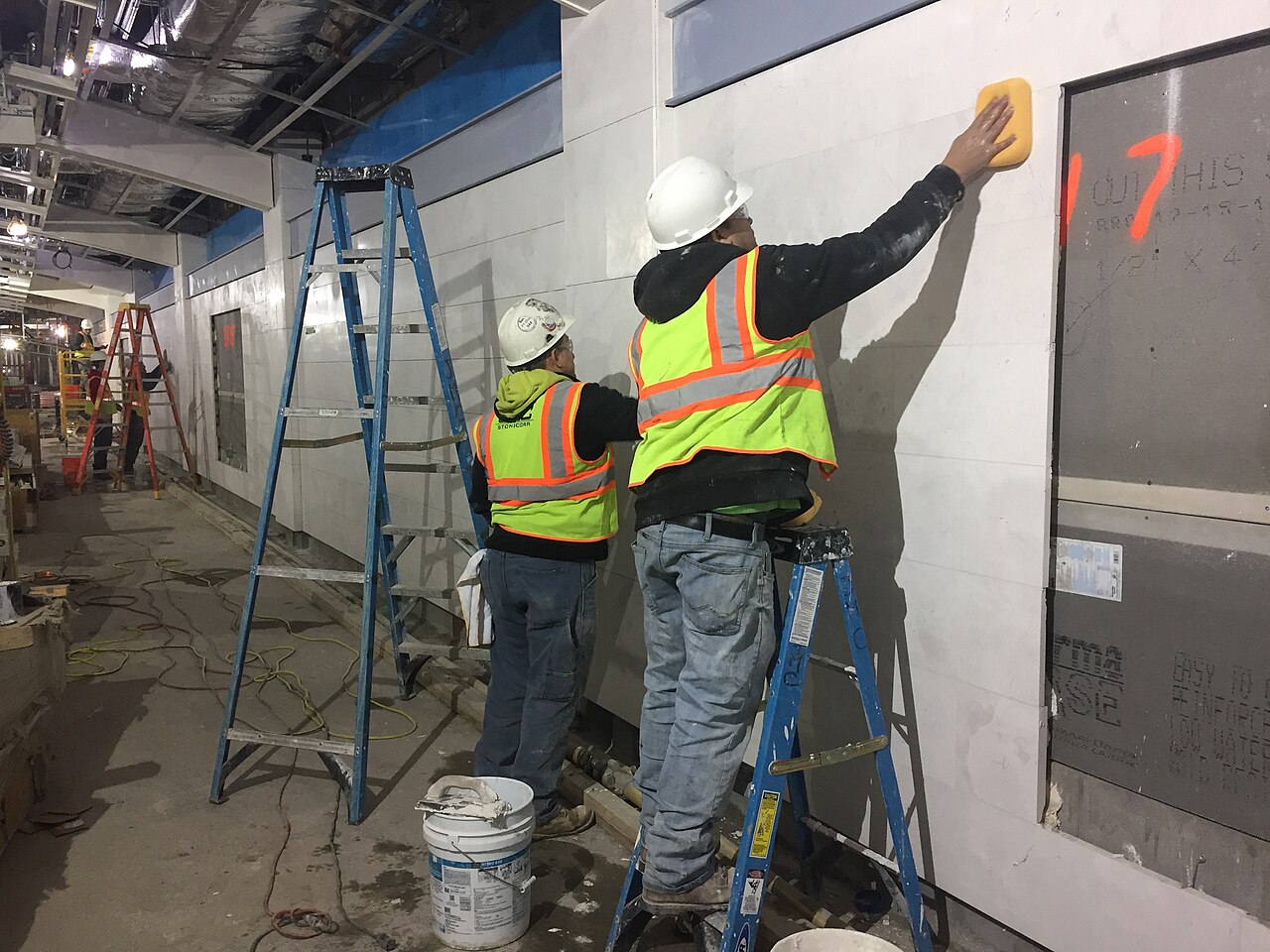
Photo: MTA Capital Construction Mega Projects, CC BY 2.0, via Wikimedia Commons.
_(31660454047).jpg)
How do you specify tile grouts?
To specify tile grout, give its BS EN 13888-1 designation: CG1 or CG2 for cementitious grout, with W for reduced water absorption, A for high abrasion resistance and F for fast setting, or RG for reaction resin (epoxy) grout. Add the colour reference, the joint width range it must suit, and any chemical or hygiene requirement, and check it against the tile, the cleaning regime and the movement joint layout.
Grout is usually the last line of a tiling clause and the first thing a client notices when it goes wrong: dark lines in a shower, crumbling joints in a busy corridor, or a commercial kitchen floor that will not come clean. Most of that is decided at specification stage by choosing the grout class and type, not by workmanship. A line reading "grout to match tiles" leaves all of it to whoever buys the bags.
This guide covers Uniclass Pr_20_31_53_12 Cementitious and reaction resin grouts, the code that matches how BS EN 13888-1 treats tile grout. Uniclass also has narrower codes, Pr_20_31_53_16 Cementitious tiling grouts and Pr_20_31_53_27 Epoxy resin grouts, which some manufacturers use on NBS Source; the properties to specify are the same.
What does a tile grout clause need to cover?
Some properties are specific to tile grouts. Others belong in every product clause. A clause that leaves either out gives the contractor room to substitute.
Properties of tile grouts
- Joint profileFlush or slightly recessed, finished consistently.
- Application conditionsTemperature limits; epoxy is sensitive to cold.
- Freeze/thaw resistanceDeclared frost resistance for external tiling.
- Particle size gradingFine for narrow joints, coarser for wide joints.
- Material gradeBS EN 13888-1 class, e.g. CG2WA or RG.
- ThicknessJoint width range the grout is made for.
- FinishColour reference from the manufacturer's range.
- Reaction to fire classificationNever guessPart of the tiled lining class on escape routes.
- AdmixturesManufacturer's own additive only, never site additions.
- PigmentsFactory-coloured; no site-added pigment.
- Binder type and gradePolymer-modified cement or epoxy resin.
- Product typeCG cementitious or RG reaction resin.
- Compressive strengthNever guessSet by the BS EN 13888-1 class, not a free number.
- Open timePot life of mixed epoxy limits batch size.
What every product clause needs
- Manufacturer and product referenceNamed grout, or a BS EN 13888-1 designation if open.
- Product standardBS EN 13888-1, shown on the declared designation.
- Installation methodBS 5385 and the grout manufacturer's mixing and cleaning instructions.
- Technical submittalsData sheet, designation, chemical resistance table and colour card.
- Operation and maintenance informationGrout product, colour and approved cleaning agents.
- MaterialCementitious or reaction resin.
Uniclass Pr_20_31_53_12 Tile grout. Not every property applies to every project; where one does not, say so rather than leaving it blank.
Fields marked Never guess (reaction to fire classification and compressive strength) depend on the project and should never be filled from a default or a previous job. If the information is not available yet, the clause should say so with a TBC and a reason.
Which decisions does the clause depend on?
Most properties follow from the product you choose. These depend on the project, so they need a decision from the designer before the clause is written.
- 01
Cementitious or epoxy
Grout typeCementitious grout (CG) is what most tiling gets: easy to work, cheap, and fine for domestic bathrooms, offices and most walls. Reaction resin grout (RG), almost always epoxy in practice, is close to impermeable and stands up to acids, fats and repeated cleaning, which is why it goes into commercial kitchens, food production, hospital wet areas and laboratories. It costs more, has a short pot life, and has to be washed off the tile face before it cures. On textured or unglazed tiles it can leave a film that is hard to remove, so a trial panel matters.
How to decide
- Commercial kitchens, food areas, chemical exposure: RG, with the chemical resistance checked against the actual cleaning products.
- Showers and wet rooms with intensive use: CG2WA at least; consider RG where hygiene is a client requirement.
- General walls and floors: CG2 is the normal choice; CG1 only where there is no wear or wetting.
- Unglazed, textured or porous tiles with RG: require a trial area and the tile manufacturer's agreement.
Write it asGrout: Reaction resin (epoxy), Class RG to BS EN 13888-1. Chemical resistance to client's cleaning schedule, tested to BS EN 13888-2. - 02
Writing the cementitious class in full
ClassBS EN 13888-1 starts with CG1 for a normal cementitious grout and CG2 for an improved one. CG2 carries extra letters for its additional characteristics: W for reduced water absorption, A for high abrasion resistance, and F where the grout is fast setting. A product declared CG2WA has met both the water absorption and the abrasion requirements; a product declared CG2W has not been declared for high abrasion resistance. Writing "CG2" alone lets either through, which matters on a floor that takes trolleys or in a shower that gets daily use.
How to decide
- Floors with any real traffic: include A.
- Showers, wet rooms, external tiling: include W.
- Fast return to use, for example overnight works in a live building: add F and check the manufacturer's time to foot traffic.
- Ask for the declaration of performance, not the bag label, and check the letters match.
Write it asGrout: Cementitious, Class CG2WA to BS EN 13888-1. - 03
Strength comes with the class
Never guessCompressive and flexural strength are among the properties BS EN 13888-1 sets minimums for, and the minimums for RG are far higher than for CG. A product that carries the class has been tested to them. Writing a separate strength figure into the clause, often copied from a masonry or repair mortar clause in the same section, sets a number that the grout manufacturer may not declare and that nobody will test on site. Specify the class, and only add a figure where the engineer has a specific reason, such as a heavily trafficked industrial floor.
How to decide
- Normal tiling: let the BS EN 13888-1 class carry the strength requirement.
- Industrial or vehicle-trafficked tiling: ask the tile and grout manufacturers for a system recommendation and use RG where they advise it.
- Check the clause does not carry over masonry mortar classes such as M4 or M6, which do not apply to tile grout.
Write it asCompressive strength: As required for Class RG by BS EN 13888-1. Submit declaration of performance. - 04
Reaction to fire of the tiled lining
Never guessGrout is a small part of a tiled wall, but Approved Document B looks at the lining as a whole. Cementitious grout is mineral and adds little to the fire load. Epoxy grout is organic, and on a tiled wall in a protected escape route the fire strategy may set a lining class that the tile, adhesive, grout and backing board together have to achieve. Few grout manufacturers publish a classification for the grout alone, so the question is usually answered by a classification of the tiled system or by the fire engineer's judgement, and the clause should say which.
How to decide
- Floors: Approved Document B lining classes do not apply to floors, so this rarely governs.
- Walls and ceilings on escape routes with cementitious grout: record the class required and the system evidence.
- Walls on escape routes with epoxy grout: ask the manufacturer for classification evidence of a tiled system and refer it to the fire engineer.
Write it asReaction to fire: Tiled wall lining to achieve the class in the fire strategy, classified to BS EN 13501-1. Submit evidence for the grout type proposed. - 05
Colour, staining and the sample panel
ColourGrout colour changes how a tiled surface reads more than most people expect, and pale cementitious grout on a floor darkens with use. Colours come from the manufacturer's range, so a colour name in the clause is meaningless without the product. Dark or strongly coloured grout can stain the arrises of polished porcelain or porous natural stone. Epoxy colours tend to stay truer because the grout does not absorb dirt, but epoxy can still haze a matt tile if it is not cleaned off quickly.
How to decide
- Name the manufacturer's colour reference, or say "to be selected from manufacturer's standard range" with a TBC.
- Floors that take dirty traffic: choose a mid-tone, or use RG if a pale grout must stay pale.
- Contrasting grout on porous or polished tiles: require a trial panel and a pre-sealer if the tile manufacturer recommends one.
Write it asColour: Manufacturer's standard colour as decorations schedule. Trial panel to be approved before general grouting.
The values under "Write it as" are examples. The right value depends on the location, the use and the fire strategy.
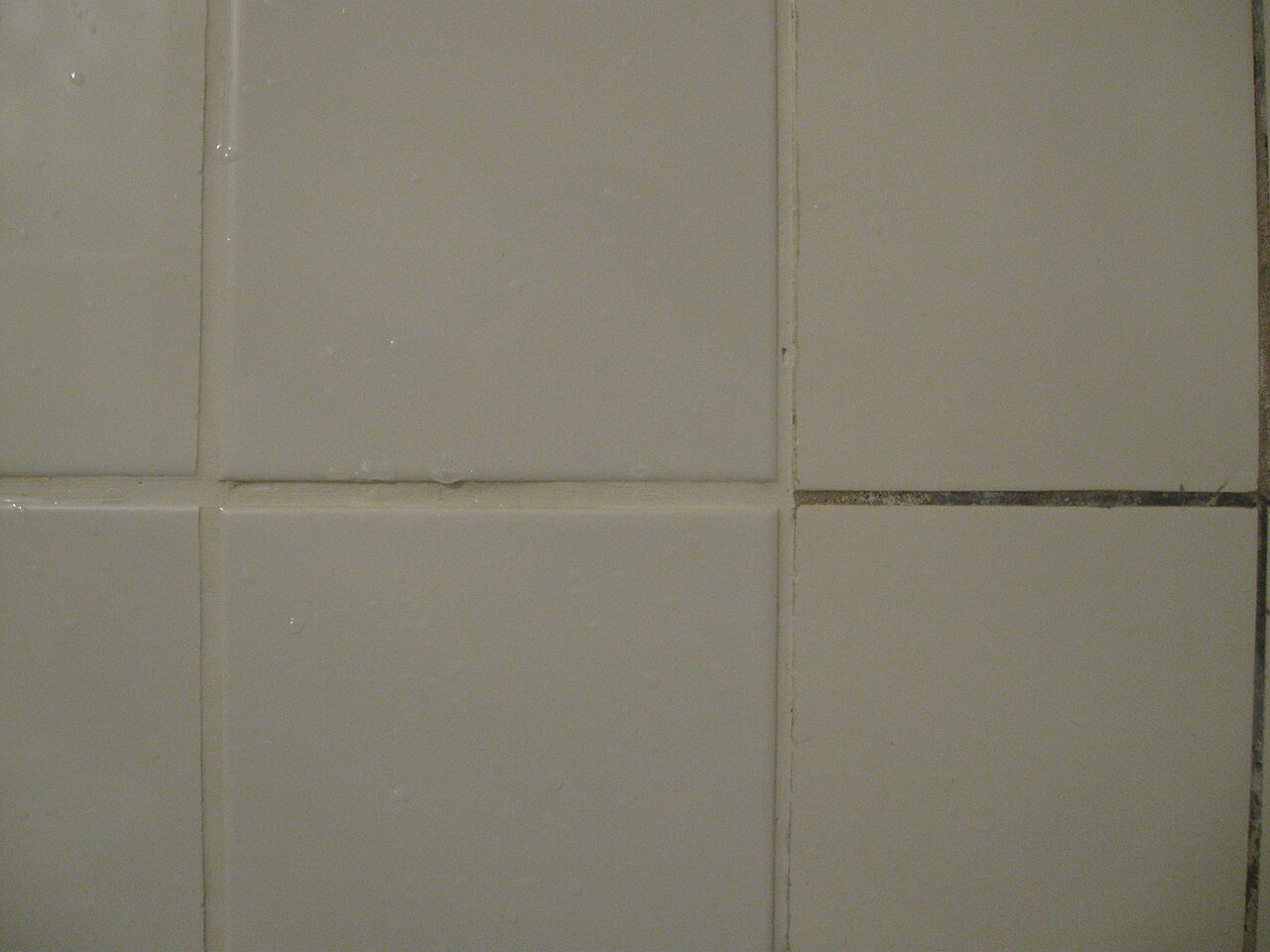
Photo: Juan de Vojníkov, CC BY-SA 3.0, via Wikimedia Commons.

Which standards should the clause cite?
Cite the product standard the declaration of performance refers to, the code of practice for installation, and the test method behind each value you set. A value without its test method cannot be checked against a submittal.
- BS EN 13888-1
- Grouts for ceramic tiles. Requirements, classification, designation, marking and labelling
The product standard for cementitious (CG) and reaction resin (RG) tile grouts, with the CG1 and CG2 classes and the additional characteristics W, A and F. It replaced the single-part BS EN 13888.
In the clause Give the full designation: "Class CG2WA to BS EN 13888-1" or "Class RG to BS EN 13888-1".
- BS EN 13888-2
- Grouts for ceramic tiles. Test methods
The test methods behind the declared values, including strength, water absorption, shrinkage, abrasion and chemical resistance.
In the clause Use it where a property is asked for beyond the class: "chemical resistance tested to BS EN 13888-2".
- BS 5385 series
- Wall and floor tiling
The UK code of practice for tiling design and installation, including grouting and movement joints. Part 1 internal walls, Part 2 external walls, Part 3 floors, Part 4 specific conditions such as wet areas.
In the clause "Grouting: to BS 5385-3 and manufacturer's instructions."
- BS EN 12004-1
- Adhesives for ceramic tiles. Requirements, assessment and verification of constancy of performance, classification and marking
Tile adhesive classes. The adhesive and the grout should be from systems the manufacturer accepts together, particularly where RG grout goes over a cementitious bed.
In the clause "Adhesive: Class C2 S1 to BS EN 12004-1, compatible with the grout."
- BS EN 15651-4
- Sealants for non-structural use in joints in buildings and pedestrian walkways. Sealants for pedestrian walkways
Sealants for floor movement joints. Movement joints are filled with sealant, not grout.
In the clause "Movement joints: sealant to BS EN 15651-4, colour to match grout."
- BS EN 13501-1
- Fire classification of construction products and building elements. Classification using data from reaction to fire tests
The Euroclass system used where the fire strategy sets a class for a tiled wall or ceiling lining.
In the clause "Reaction to fire: tiled lining to achieve the class in the fire strategy, classified to BS EN 13501-1."
Confirm the current edition of each standard at every issue. Avoice's State of UK Specifications 2026 found a withdrawn standard cited in 40% of specifications at contract issue.
For the regulations behind these choices, see Approved Document B explained, or search the Avoice Regulations library.
How do you write it in CAWS?
In CAWS, grout is not usually a clause of its own. It is a line in each M40 tiling type clause in the 100s, alongside the tile, bedding and joint width, so the contractor prices one complete build-up. Where a project has a CG2WA grout to bathrooms and an epoxy to the kitchen, those are two tiling types, each naming its own grout.
How grouting is done is written once in the later M40 clauses, chiefly the grouting clause, which covers timing after fixing, joint depth, finishing and cleaning off. That clause is usually written for cementitious grout. Where the project has epoxy, check the grouting clause allows for its working method or add an RG-specific line to the type clause.
- Tiles
- Porcelain, unglazed, BS EN 14411 Group BIa, as tile product clause
- Base
- Sand and cement screed laid to falls, as clause 210
- Bedding
- Solid bed of adhesive, as clause 510
- Adhesive
- Class C2 S1 to BS EN 12004-1
- Joint width
- 5 mm
- Grout
- Reaction resin (epoxy), Class RG to BS EN 13888-1
- Grout manufacturer
- Submit proposals
- Product reference
- Submit proposals
- Chemical resistance
- TBC Operator's cleaning and sanitising products not yet confirmed. Resolve before grout is ordered.
- Colour
- Manufacturer's standard mid grey
- Joint profile
- Flush with tile surface
- Application conditions
- Within manufacturer's temperature limits; mix full units only
- Cleaning off
- Residue removed from tile face within manufacturer's stated time
- Movement joints
- To BS 5385-3, sealant to BS EN 15651-4, not grouted
- Trial area
- One trial area on the actual tile, approved before general grouting
Illustrative, not from a real project. One property is left as a TBC with a reason so it can be tracked and closed before issue.
Clauses the type clause relies on
- M40/210
- Suitability of backgrounds/ bases Screed dry and sound before tiling, so moisture does not come up through the joints.
- M40/250
- Samples Grout colour samples with the tile, approved before ordering.
- M40/510
- Fixing generally Adhesive kept out of the joints, leaving depth for grout.
- M40/875
- Grouting Timing after fixing, full joint depth, finishing and cleaning off.
Clause numbers vary between NBS versions and practice masters. The numbers here follow a typical NBS Building M40 layout; what matters is that the type clause refers to clauses that exist in your M40.
How do you write it in Uniclass?
In Uniclass the floor tiling system clause, Ss_30_42_32_40 Internal floor tiling systems, describes the build-up and what the finished floor has to do. The grout appears as one line pointing to its own product clause, next to the tile and the adhesive.
The grout product clause under Pr_20_31_53_12 Cementitious and reaction resin grouts holds the designation, colour and chemical resistance. If the same epoxy grout is used on the kitchen walls, the wall tiling system Ss_25_45_88_40 Internal wall tiling systems refers to the same product clause, so a change of colour is made once.
- Description
- Porcelain floor tiling to commercial kitchen, epoxy grouted
- Base
- Sand and cement screed laid to falls
- Tiles
- Pr_35_93_96_63 Porcelain tiles (T04)
- Adhesive
- Class C2 S1 to BS EN 12004-1
- Joint width
- 5 mm
- Grout
- Pr_20_31_53_12 Cementitious and reaction resin grouts (G02)
- Movement joints
- To BS 5385-3, sealant to BS EN 15651-4
- Execution
- To BS 5385-3 and grout manufacturer's instructions
- Manufacturer
- Submit proposals
- Product reference
- Submit proposals
- Product type
- Reaction resin (epoxy) tile grout
- Classification
- Class RG to BS EN 13888-1
- Joint width range
- To suit 5 mm joints
- Colour
- Manufacturer's standard mid grey
- Chemical resistance
- TBC Operator's cleaning and sanitising products not yet confirmed. Resolve before grout is ordered.
- Pot life
- Manufacturer's stated value at site temperature
- Technical submittals
- Data sheet, declaration of performance and chemical resistance table
Illustrative. Performance of the finished system sits in the system clause; properties of the product sit in the product clause.
In NBS Chorus the Uniclass product clause for cementitious and reaction resin grouts also carries the NBS reference 45-55-50/400. Use whichever your practice's masters use, but do not mix CAWS and Uniclass references in one specification.
What goes in the spec, and what goes in the schedule?
The specification defines each type once. The schedule and drawings say where each type goes.
In the specification
What the product is and how it performs and is installed. Written once per type.
In the schedule or drawings
Where each type goes and how much of it. Changes with every plan revision.
Name the grout inside each tiling type (T01, T04) and let the finishes schedule carry colours. Grout colour is often chosen late with the tile, so keeping it on the schedule avoids reissuing the clause.
What are the common mistakes?
Most problems are a missing property, a property filled with the wrong kind of value, or a decision left silently open.
- "Grout to match tiles". It gives no class and no product. State the BS EN 13888-1 designation and a colour reference from a named range.
- CG2 without its letters. A CG2 grout may not have been tested for abrasion or water absorption. Write CG2WA where the floor or shower needs both.
- Cementitious grout in a commercial kitchen. Fats, acids and daily sanitising break down cement-based joints. Use RG and check it against the cleaning products.
- Grout in movement joints. Grout cannot take movement. Movement joints are sealant, and the clause should say so.
- Masonry mortar classes in a grout line. M4 or M6 belong to masonry mortar. They have no meaning for tile grout and confuse the submittal check.
- No trial on textured tiles with epoxy. Epoxy haze on a matt or structured surface can be permanent. Ask for a trial area first.
How Avoice helps
Avoice's spec writer drafts grout lines inside each tiling clause from your finishes information, and marks what it could not settle.
- Drafts from your drawings and schedules
It reads the tiling types from the finishes schedule (T01 bathroom walls with CG2WA, T04 kitchen floor with epoxy), picks the M40 type clause or the Uniclass system and product headings, and fills in the grout lines your information supports.
- Leaves a TBC with a reason
If the kitchen operator has not confirmed the cleaning chemicals, the chemical resistance line says TBC and why. Every TBC joins one project register to close before tender.
- Writes in your format and style
Choose CAWS or Uniclass. Avoice adapts your practice's own M40 masters rather than replacing them with generic text.
- Checks the clause against everything else
QA/QC flags a grout colour on the finishes schedule for a tile type the spec does not define, a grouting clause written only for cementitious grout when a type clause calls for epoxy, or a superseded standard.
- Keeps product data in one place
Grout data sheets, declarations of performance and chemical resistance tables sit in the Product Room, linked to the clause, so a substitute can be checked against the designation asked for.
Related guides: How to specify tile adhesives, How to specify ceramic tiles, How to specify cement boards.
Software can draft and check. The designer still chooses the product and is responsible for the specification.
Draft your tile grout clause in Avoice
Upload your drawings and schedules. Avoice drafts the clause in CAWS or Uniclass, cites the standards and flags anything your information does not settle.
This guide is for general education and is not professional advice. Check current editions of standards and Approved Documents, the manufacturer's data, and the requirements of your project before relying on any clause.