
How to specify wood stains
What an exterior wood stain clause has to say for cladding, joinery and other external timber, the decisions behind it, the standards to cite, and how to write it in CAWS and in Uniclass.
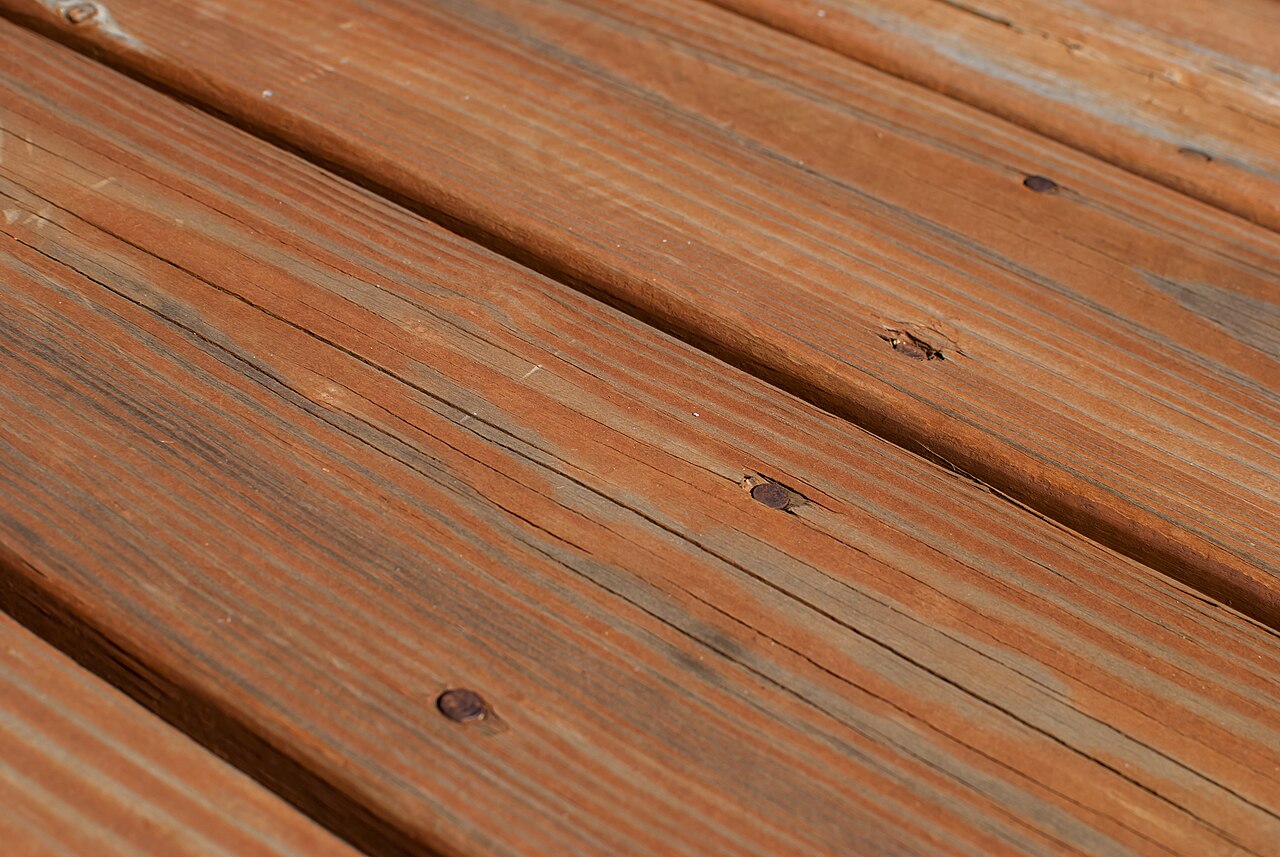
Photo: Shadowmeld Photography, CC BY-SA 4.0, via Wikimedia Commons.

How do you specify wood stains?
To specify wood stain for exterior timber, classify the job the way BS EN 927-1 does: the end use (stable joinery, semi-stable or non-stable cladding and fencing), the exposure, and the appearance you want, translucent or opaque and at what build and gloss. Then name a coating system that meets BS EN 927-2 for that end use, state the timber preparation, moisture content and factory or site application, and write the maintenance cycle into the O&M requirement.
Exterior wood stain is a maintenance commitment as much as a finish. A low-build translucent stain on sawn larch cladding behaves nothing like a high-build stain on a hardwood window, and both will need recoating on a cycle that depends on how hard the elevation is exposed. Clauses that say "two coats of exterior woodstain, colour to be agreed" leave every one of those choices to the decorator and the client finds out at the first maintenance visit.
This guide covers Uniclass Pr_35_31_95_98 Wood stains. Wood oils and dyes have neighbouring codes, Pr_35_31_95_97 and Pr_35_31_95_96. Clear varnishes are protective coatings under Pr_35_31_68, and fire-retardant coatings on timber are covered in the fire retardant paint guide.
What does a wood stain clause need to cover?
Some properties are specific to wood stains. Others belong in every product clause. A clause that leaves either out gives the contractor room to substitute.
Properties of wood stains
- VOC contentWithin the 2012 VOC Regulations for the product category.
- Coating systemPreservative base, stain coats and compatibility with treatment.
- DurabilityBS EN 927 end use and exposure class.
- Gloss levelMatt or satin; gloss shows weathering sooner.
- FinishTranslucent or opaque, and the colour reference.
- Sample approvalSamples on the specified timber and surface finish.
What every product clause needs
- Manufacturer and product referencePrimer, base stain and finish from one named system.
- Product standardBS EN 927-2 performance for the stated end use.
- Installation methodBS 6150 and the manufacturer's application guide.
- Technical submittalsData sheet, BS EN 927 classification and maintenance advice.
- Operation and maintenance informationRecoat interval by elevation, product and colour references.
- SubstrateSpecies, sawn or planed, moisture content, preservative treatment.
- Application conditionsFactory or site; temperature, humidity and no rain.
Uniclass Pr_35_31_95_98 Wood stain. Not every property applies to every project; where one does not, say so rather than leaving it blank.
Which decisions does the clause depend on?
Most properties follow from the product you choose. These depend on the project, so they need a decision from the designer before the clause is written.
- 01
End use: how much the timber may move
End useBS EN 927-1 starts with the component, not the paint. Non-stable components, where free movement is acceptable, include overlapping cladding and fencing. Semi-stable components, with some movement permitted, include tongued and grooved cladding. Stable components, where movement must be minimal, are joinery such as windows and doors. The stain follows from that: low-build, penetrating stains suit cladding that moves and is easy to recoat, while joinery needs a medium or high build that limits moisture uptake and keeps the joints and ironmongery working. BS EN 927-2 sets performance requirements for each of the three end uses.
How to decide
- Overlapping or open-jointed sawn cladding, fencing: non-stable, low-build stain.
- Tongued and grooved cladding and planed boarding: semi-stable, low or medium build.
- Windows, doors and other joinery: stable, medium or high build system recommended by the joinery manufacturer.
- Ask the manufacturer which BS EN 927-2 end use the system meets, and check it matches.
Write it asDurability: Coating system meeting BS EN 927-2 for semi-stable end use, as classified in BS EN 927-1. - 02
Exposure and the maintenance cycle
ExposureBS EN 927-1 grades exposure from mild to severe by combining the local climate with how sheltered the surface is. A sheltered elevation under deep eaves in a moderate climate is mild; an unsheltered south or west elevation in a hard or extreme climate is severe. The same stain lasts much longer on the first than the second, and translucent finishes weather faster than opaque ones. The clause cannot change the weather, but it can make the client's maintenance obligation explicit by asking the manufacturer for recoat intervals by elevation and putting them in the O&M information.
How to decide
- Map the elevations by shelter: overhangs, recesses and orientation.
- Severe exposure with a translucent finish: expect a short maintenance cycle and tell the client, or move to a more opaque or higher build product.
- Require the manufacturer's maintenance schedule for each elevation as an O&M submittal.
Write it asMaintenance: Submit manufacturer's maintenance and recoating schedule for each elevation, by exposure, for inclusion in O&M information. - 03
Translucent or opaque
AppearanceTranslucent stains colour the timber and let the grain show; opaque stains hide it much as a paint does. Translucent finishes rely on the wood underneath, so the same colour reference looks different on sawn and planed faces, on heartwood and sapwood, and on different species. They also let ultraviolet light through to the wood surface, which shortens their life. Opaque stains hide variation and last longer between recoats but commit the client to keeping that colour. Very pale and clear translucent finishes give the least UV protection, and some manufacturers advise against them on exposed elevations.
How to decide
- Where grain and natural variation are wanted: translucent, with samples on the actual timber and face.
- Where uniform colour and a longer cycle matter more: opaque.
- Check the manufacturer's guidance on very pale or clear translucent colours outside.
Write it asFinish: Translucent, matt. Colour as decorations schedule, approved on sample boards of the specified timber and face. - 04
The timber under the stain
TimberMost stain failures start with the timber. Wet timber blisters and flakes the film; resinous knots bleed through pale colours; tannin-rich species such as oak and western red cedar can discolour water-borne stains. Preservative-treated softwood needs a stain that will not inhibit the treatment, and real M60 masters require selected materials to be compatible with preservative or fire-retardant pretreatments. Sawn faces hold more stain and last longer than planed ones, so the face the stain goes on is a specification decision, not a site one.
How to decide
- State the species, sawn or planed face, and any preservative treatment, and refer to the cladding or joinery clause.
- Set a maximum moisture content at the time of coating and require it to be measured.
- Tannin-rich species: use a primer or stain the manufacturer recommends for them.
- Treated timber: confirm in writing that the stain is compatible with the treatment.
Write it asSurfaces: Sawn larch cladding, as H21 clause. Moisture content at time of coating within manufacturer's limit, measured and recorded. - 05
Factory or site application
Factory or siteStain applied in a factory or workshop, to all faces and edges before fixing, lasts better than stain brushed on site after the boards are up. The backs and laps get coated, end grain is sealed, and the work is not done in the rain. Site application leaves the hidden faces bare unless the clause asks for them. Either way, every cut end made on site needs sealing, which manufacturers' clauses cover with flood-coating cut ends of preservative-treated timber. Factory-applied systems also bring a stated number of coats and film build that site work rarely matches.
How to decide
- Cladding and joinery: prefer factory or workshop application to all faces and edges, with a site finishing coat if the manufacturer recommends one.
- Site application: require all faces coated before fixing, end grain sealed, and no work in rain or below the minimum temperature.
- Require cut ends made on site to be treated and stained before fixing.
Write it asApplication: Base coat and first finishing coat applied off site to all faces and edges before fixing. Site cut ends treated and coated before fixing. Final coat on site.
The values under "Write it as" are examples. The right value depends on the location, the use and the fire strategy.
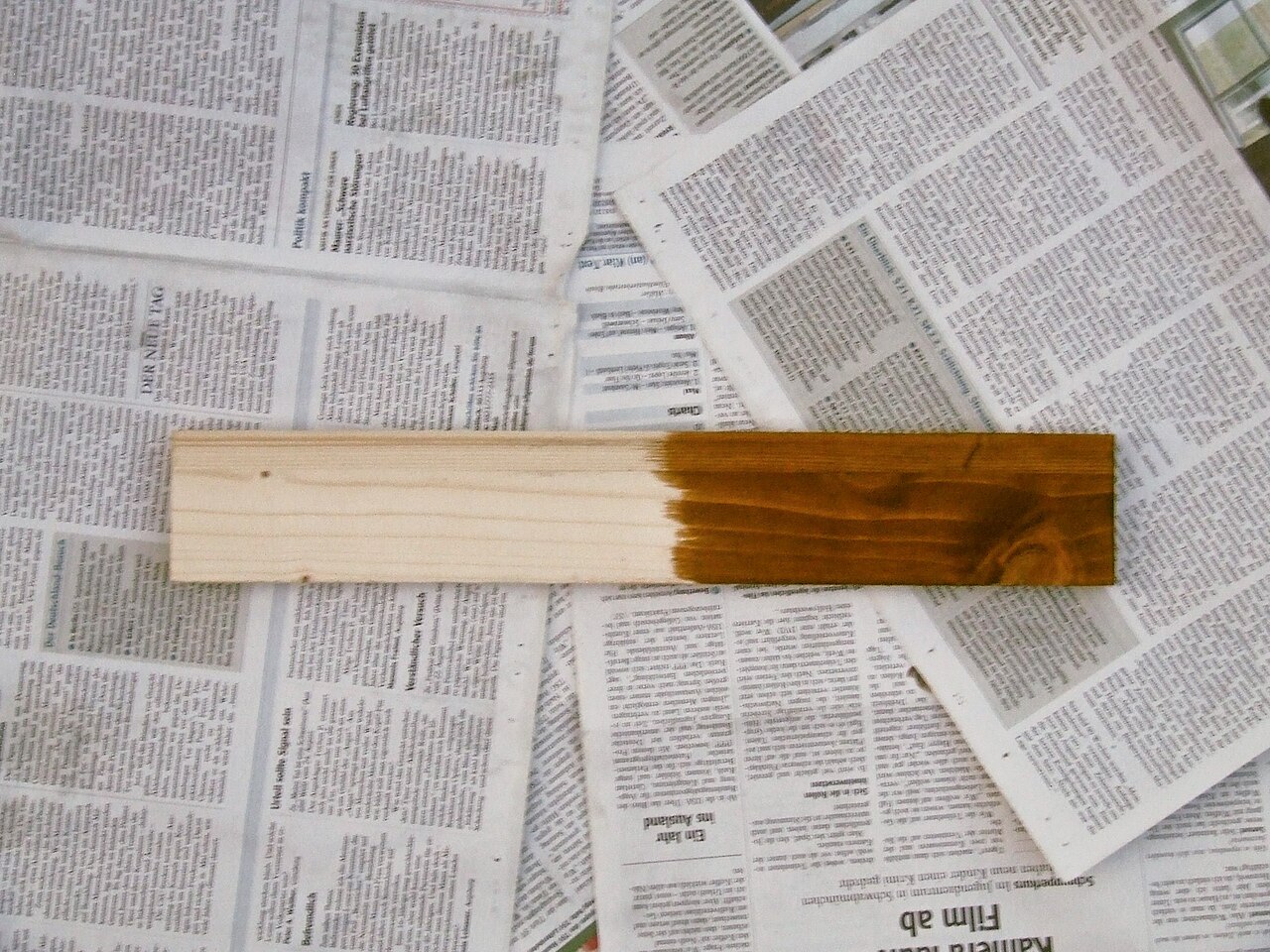
Photo: Neitram, CC BY-SA 3.0, via Wikimedia Commons.

Which standards should the clause cite?
Cite the product standard the declaration of performance refers to, the code of practice for installation, and the test method behind each value you set. A value without its test method cannot be checked against a submittal.
- BS EN 927-1
- Paints and varnishes. Coating materials and coating systems for exterior wood. Classification and selection
Classifies exterior wood coatings by end use (stable, semi-stable, non-stable), appearance and exposure conditions, with guidance on selection.
In the clause Use it to define the job: "End use: semi-stable, as BS EN 927-1. Exposure: severe."
- BS EN 927-2
- Paints and varnishes. Coating materials and coating systems for exterior wood. Performance specification
Performance criteria for each end use category. Natural weathering (Part 3) and liquid water permeability (Part 5) are the mandatory tests.
In the clause "Coating system: meeting BS EN 927-2 for semi-stable end use. Submit evidence."
- BS EN 927-5
- Paints and varnishes. Coating materials and coating systems for exterior wood. Assessment of the liquid water permeability
The test behind how well a stain system keeps liquid water out of the timber, one of the two mandatory tests in Part 2.
In the clause Cite it only if the clause asks for a reported value: "liquid water permeability tested to BS EN 927-5".
- BS 6150
- Painting of buildings. Code of practice
The UK code of practice for selecting paint and stain systems, preparing substrates, applying and maintaining them, including timber.
In the clause "Workmanship: to BS 6150 and manufacturer's instructions."
- BS 8417
- Preservation of wood. Code of practice
Preservative treatment where the timber's natural durability does not meet the service life. The stain has to be compatible with it.
In the clause "Preservative-treated timber: stain system confirmed compatible with the treatment to BS 8417."
- BS EN 335
- Durability of wood and wood-based products. Use classes: definitions, application to solid wood and wood-based products
Use classes by exposure. External timber above ground is Use Class 3. The use class drives treatment; the stain does not change it.
In the clause "Timber for staining: Use Class 3 to BS EN 335, as cladding clause."
- SI 2012/1715
- The Volatile Organic Compounds in Paints, Varnishes and Vehicle Refinishing Products Regulations 2012
Caps the VOC content of decorative coatings sold in the UK by product category, including exterior wood stains.
In the clause "VOC content: within the 2012 Regulations limit for the product category."
Confirm the current edition of each standard at every issue. Avoice's State of UK Specifications 2026 found a withdrawn standard cited in 40% of specifications at contract issue.
How do you write it in CAWS?
Wood stain is written in M60 as a coating clause in the 100s, one for each stain system on the project. Manufacturers' M60 masters list their woodstains in the 160s, with lines for the surfaces, preparation, initial coats and finishing coats and the number of each. A translucent stain to cladding and a high-build stain to windows are two clauses.
The type clause relies on the general M60 clauses: compatibility with preservative and fire-retardant pretreatments, preparation of uncoated wood, priming and end-grain treatment of joinery, workshop coating of concealed surfaces, and the staining method itself. Those are where factory coating and cut-end sealing actually get required, so check they are kept and not deleted as "painting" clauses.
- Description
- Low-build translucent woodstain, semi-stable end use
- Manufacturer
- Submit proposals
- Product reference
- Submit proposals
- Surfaces
- Sawn larch cladding boards, as H21 clause
- Durability
- Coating system meeting BS EN 927-2 for semi-stable end use
- Exposure
- Severe to south and west elevations, as elevation drawings
- Preparation
- As clauses 400 and 481; moisture content within manufacturer's limit
- Initial coats
- Manufacturer's base coat, one coat, all faces and edges before fixing
- Finishing coats
- Two coats; first off site to all faces, second on site after fixing
- Colour
- TBC Client choosing between two colours from sample boards. Resolve before ordering.
- Gloss
- Matt
- Cut ends
- Treated and coated before fixing, as clause 720
- VOC content
- Within the 2012 VOC Regulations limit for the product category
- Samples
- Sample boards of the specified timber and face, approved before ordering
- Maintenance information
- Manufacturer's recoating schedule by elevation, for O&M manual
Illustrative, not from a real project. One property is left as a TBC with a reason so it can be tracked and closed before issue.
Clauses the type clause relies on
- M60/220
- Compatibility Materials compatible with each other and not inhibiting preservative or fire-retardant pretreatments.
- M60/481
- Uncoated wood Preparation of new timber before the first coat.
- M60/720
- Priming joinery Cut surfaces of treated timber flood-coated with preservative, end grain coated generously.
- M60/730
- Workshop coating of concealed joinery surfaces All faces coated before installation.
- M60/751
- Staining wood Primer only if the stain manufacturer recommends it; stain applied in flowing coats and brushed out.
Clause numbers vary between NBS versions and practice masters. The numbers here follow a manufacturer's NBS-format M60 master; what matters is that the type clause refers to clauses that exist in your M60.
How do you write it in Uniclass?
In Uniclass the stain system is Ss_40_90_60_22 Decorative wood stain or dye systems. The system clause describes the substrate, preparation, coat sequence, where coats are applied, and what the finished system has to achieve for its end use and exposure.
The stain itself is a product clause under Pr_35_31_95_98 Wood stains, holding the product, colour, gloss and BS EN 927 evidence. If the base coat is a separate product, give it its own product clause and point to both from the system, so a substitution of either can be checked.
- Description
- Translucent woodstain system to external sawn larch cladding
- Substrate
- Sawn larch boards, preservative treatment as cladding clause
- End use
- Semi-stable, as BS EN 927-1
- Base coat
- Manufacturer's base coat, all faces and edges before fixing
- Finishing coats
- Two coats of Pr_35_31_95_98 Wood stains (WS01), first off site
- Cut ends
- Treated and coated before fixing
- Workmanship
- To BS 6150 and manufacturer's instructions
- Maintenance
- Manufacturer's recoating schedule by elevation, in O&M information
- Manufacturer
- Submit proposals
- Product reference
- Submit proposals
- Type
- Low-build translucent exterior woodstain
- Performance
- BS EN 927-2, semi-stable end use
- Colour
- TBC Client choosing between two colours from sample boards. Resolve before ordering.
- Gloss
- Matt
- Compatibility
- Confirmed in writing with the cladding's preservative treatment
- VOC content
- Within the 2012 VOC Regulations limit for the product category
- Technical submittals
- Data sheet, BS EN 927-2 evidence and maintenance guide
Illustrative. Performance of the finished system sits in the system clause; properties of the product sit in the product clause.
In NBS Chorus the Uniclass product clause for wood stains also carries the NBS reference 45-35-84/418. Use whichever your practice's masters use, but do not mix CAWS and Uniclass references in one specification.
What goes in the spec, and what goes in the schedule?
The specification defines each type once. The schedule and drawings say where each type goes.
In the specification
What the product is and how it performs and is installed. Written once per type.
In the schedule or drawings
Where each type goes and how much of it. Changes with every plan revision.
Write each stain system once with a type mark (WS01 for cladding, WS02 for joinery) and let the elevations and decorations schedule say where it goes and in what colour. Marking the severe elevations on a drawing is clearer than listing them in the clause.
What are the common mistakes?
Most problems are a missing property, a property filled with the wrong kind of value, or a decision left silently open.
- One stain for cladding and windows. Cladding and joinery are different BS EN 927 end uses. Give each its own system.
- Staining wet timber. Moisture trapped behind the film lifts it. Set a moisture limit and have it measured.
- Site-only application. Backs, laps and end grain stay bare. Require all faces coated before fixing.
- A pale translucent colour on a severe elevation. It gives little UV protection and greys quickly. Check the manufacturer's colour guidance.
- Colour chosen from a chart. Translucent colours depend on the timber. Approve samples on the actual species and face.
- No maintenance information. The client learns the recoat cycle when the cladding fails. Make the schedule a submittal.
How Avoice helps
Avoice's spec writer drafts wood stain clauses from your elevations and schedules, and shows what it could not settle.
- Drafts from your drawings and schedules
It reads the finish types (WS01 translucent to larch cladding, WS02 opaque to joinery) from the elevations and decorations schedule, picks the M60 coating clause or the Uniclass system and product headings, and fills in what your information supports.
- Leaves a TBC with a reason
If the client has not chosen between sample colours, or the cladding treatment is not yet known, the line says TBC and why. Every TBC joins one project register to close before tender.
- Writes in your format and style
Choose CAWS or Uniclass. Avoice adapts your practice's own M60 masters rather than replacing them with generic text.
- Checks the clause against everything else
QA/QC flags a stain clause that names planed boards while the H21 cladding clause says sawn, a WS02 on the window schedule with no clause, or a deleted end-grain clause still referenced.
- Keeps product data in one place
Stain data sheets, BS EN 927 evidence and maintenance guides sit in the Product Room, linked to the clause, so a substitute can be checked against the end use asked for.
Related guides: How to specify timber cladding, How to specify timber windows, How to specify fire retardant paints.
Software can draft and check. The designer still chooses the product and is responsible for the specification.
Draft your wood stain clause in Avoice
Upload your drawings and schedules. Avoice drafts the clause in CAWS or Uniclass, cites the standards and flags anything your information does not settle.
This guide is for general education and is not professional advice. Check current editions of standards and Approved Documents, the manufacturer's data, and the requirements of your project before relying on any clause.