
The Temporary Works Design Brief: What Permanent Works Engineers Must Provide
How the permanent works designer's information feeds the contractor's brief, and what to put in it
Temporary works fail when the person designing them does not know what the permanent structure assumes. The brief is the contractor's document, but the facts in it come from the permanent works designer: the sequence the design assumes, what stabilises the structure at each stage, what it can carry and what risks remain. This guide covers the roles, the current BS 5975 position, the design check categories and what a structural designer should put in the information that feeds the brief.
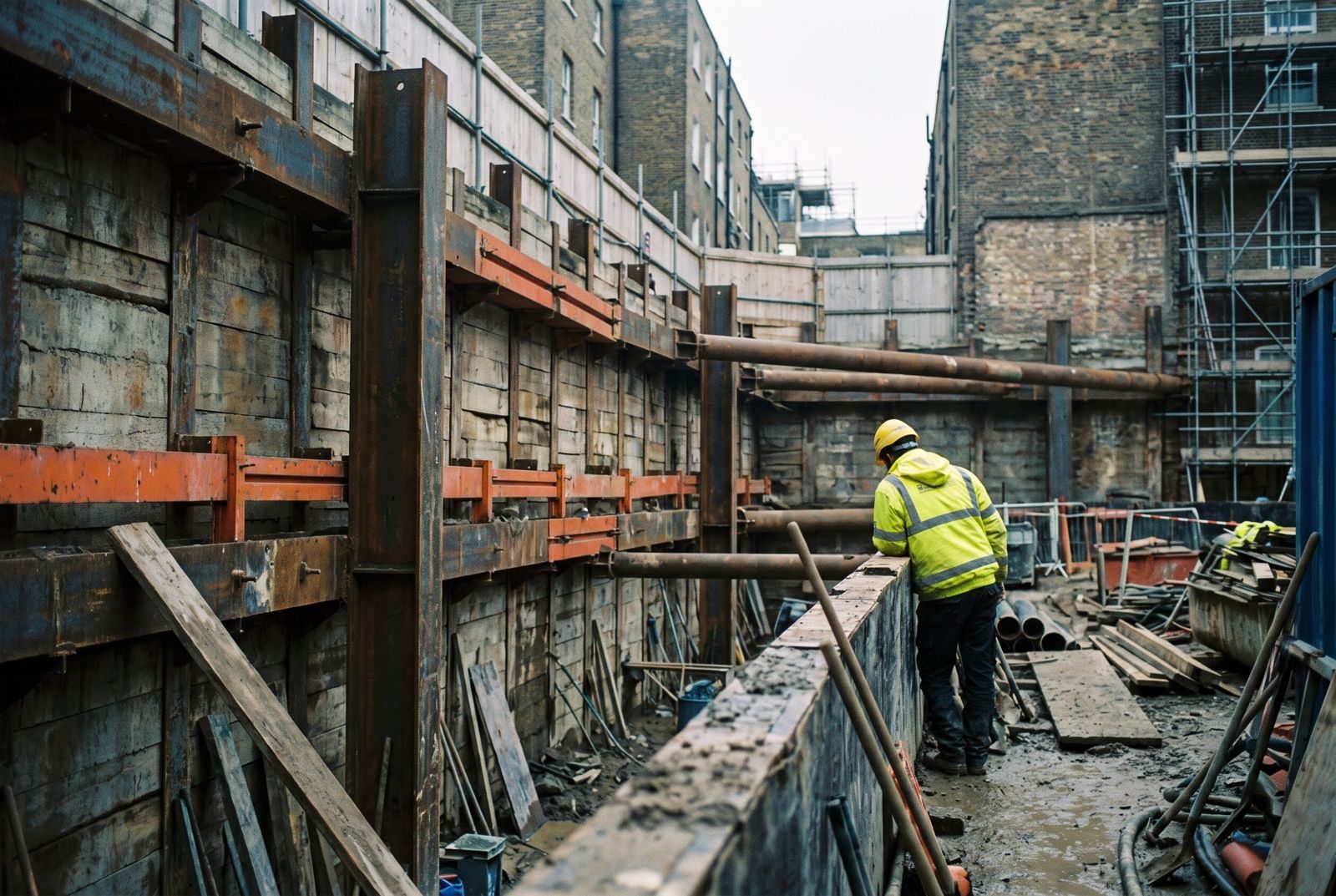
The contractor's coordinator issues the brief, and the permanent works designer supplies the facts it rests on: the sequence assumed, what stabilises the structure at each stage and what it can carry.
What is a temporary works design brief, and who writes it?
It is the contractor's controlled instruction to the temporary works designer, issued by the temporary works coordinator after consulting the permanent works designer. It turns a site need into a defined engineering problem, and its quality depends on the information the permanent works designer provides.
The brief is a contractor document. The Temporary Works Forum's sample procedure has the temporary works coordinator (TWC) ensure that a design brief is prepared for each item on the temporary works register, after consulting all relevant parties, including the permanent works designer (PWD) where required. The brief must contain enough information for the temporary works designer (TWD) to prepare an appropriate solution, and the TWC signs it before it is issued. One brief can cover several similar items. At the lowest implementation risk, the sample procedure relies on risk assessment and worker briefings and does not call for a formal design cycle. See the Temporary Works Forum for the template.
That makes the brief the contractor's, and the PWD's information the input that decides whether it is any good. A brief that says only 'design propping to level 3 slab' leaves the TWD guessing the strength of the slab, the sequence it relies on and the loads it can take. The PWD holds those facts, and under CDM 2015 the PWD has a duty to pass on the information that matters, as the later sections show.
Which edition of BS 5975 applies
BSI published BS 5975-1:2024, Temporary works: management procedures for the control of temporary works, on 31 December 2024, and BS 5975-2:2024, Temporary works: falsework design and implementation. Together they replace BS 5975:2019, which BSI has split into two parts. Part 1 covers procedural controls and names permanent works designers among its intended users. Part 2 covers falsework design. Check any transitional wording with the contractor.
The Temporary Works Forum sample procedure, last revised in May 2023, still refers to the 2019 edition and notes that it is to become BS 5975-1. A contractor's procedure may therefore cite the earlier edition. When a contractor's procedure and the specification cite different editions, say which governs. The design check categories discussed below come from the 2019 edition's table as reproduced by the Temporary Works Forum. Check the category definitions in the current edition of BS 5975-1.
Who does what: the TWC, TWS, TWD, checker and permanent works designer?
The coordinator owns the process, the designer owns the temporary works design, the checker verifies it independently and the permanent works designer supplies the permanent works information and reviews effects on the permanent works.
Six roles touch the brief. The coordinator owns the process, the designer owns the temporary works design, the checker provides independent verification, and the PWD supplies the information on the permanent works. The principal designer sits across all of them for CDM purposes.
Scroll horizontally to view all columns.
| Role | Responsibility | Link to the permanent works designer |
|---|---|---|
| Temporary works coordinator (TWC) | Implements the contractor's procedure, keeps the register, ensures a design brief is prepared, appoints supervisors, agrees check categories, issues permits | Consults the PWD on the brief. Takes deviations and design changes back to the PWD where they affect the permanent works |
| Temporary works supervisor (TWS) | Ensures the as-built temporary works comply with the design during construction, use and dismantling | Raises deviations with the TWC, who consults the TWD and the PWD |
| Temporary works designer (TWD) | Prepares a design in accordance with the brief. Has CDM duties and records residual risks on drawings | Liaises with the PWD and principal designer as required |
| Temporary works design checker (TWDC) | Checks the design is safe, fit for purpose and complies with the brief, at the agreed category and with the independence that category needs | Needs the PWD's information in the brief to check against |
| Permanent works designer (PWD) | Designs the permanent works and assists the contractor on the intended construction methods. Must provide information on assumed construction sequence and significant residual risks | Supplies the inputs listed in this guide |
| Principal designer | Plans, manages, monitors and coordinates health and safety in the pre-construction phase | Receives residual risk information from designers, including the PWD |
Roles as described in the Temporary Works Forum sample procedure. The PWD role in a given project is whatever the appointment makes it, so confirm the scope in writing.
HSE's guidance on temporary works puts the choice of how to organise management with each organisation, and describes the TWC as an effective way to ensure suitable designs are prepared, checked and correctly erected. It also lists permanent works used for temporary purposes during construction as temporary works, which matters to the PWD: a floor slab used to carry a crane, or a basement slab acting as a prop to a retaining wall, is temporary works designed against permanent works capacity. See HSE on temporary works.
Design check categories
The category sets how independent the check must be, and the TWC assigns it after consulting the temporary works designer. The PWD is entitled to a view, because the consequence of failure depends on the permanent structure, adjacent buildings and the public.
- 01
Category 0
Standard solutions only, checked to make sure the site conditions fit the limits of the chosen solution. A standard trench box is an example.
- Independence
- May be checked by another member of the site or design team
- Note
- Applies to using the standard solution, and does not cover its original design
- 02
Category 1
Simple designs such as formwork, falsework, and needling and propping to brickwork openings in single storey construction.
- Independence
- May be checked by another member of the design team
- Basis
- Simple analysis to relevant standards or supplier data
- 03
Category 2
More complex designs: excavation support using sheet piles, foundations, steel connections, reinforced concrete, and falsework restrained at the top.
- Independence
- An individual not involved in the design and not consulted by the designer
- Basis
- Considerable interpretation of loads or ground information
- 04
Category 3
Complex or innovative designs with complex sequences in the temporary or permanent works, including basement excavations and tunnels.
- Independence
- Another organisation, including an overall check of the coordinated design
- Basis
- Unusual designs or significant departures from standards
The independence rises with the complexity. A PWD asked to carry out the temporary works design as well needs to be clear who checks it, and whether that check can be independent at the category assigned.
What should the permanent works designer put into the brief?
The assumed construction sequence, what stabilises the structure at each stage, propping assumptions, the loads and capacities the permanent works can take, interfaces, existing structure and ground assumptions and significant residual risks.
The PWD should provide the sequence the design assumes, what stabilises the structure at each stage, the propping and loading the permanent works can accept, the interfaces, the existing-structure and ground assumptions and the significant residual risks. The Temporary Works Forum sample procedure states that under CDM 2015 the PWD must provide information on the assumed construction sequence and the significant residual risks.
Scroll horizontally to view all columns.
| Information | Why the temporary works designer needs it | Record it in |
|---|---|---|
| Assumed construction sequence | Stability and member capacity often depend on the order of works. If the contractor plans a different order, the temporary works have to compensate | Drawing note or sequence drawing, and the specification |
| What stabilises the structure at each stage | Cores, shear walls, bracing and floor plates only stabilise the frame once they exist and have developed strength. The designer needs to know what is relied on, and when | Structural drawings, stability statement |
| Propping and back-propping assumed | The slab, beam or wall may be designed on the assumption that props stay in until a stated condition is met | Drawings, specification clause, striking criteria |
| Capacity of the permanent works for construction loads | Crane bases, hoists, stacked materials, plant and formwork loads need to be checked against what the permanent structure can carry, including at early age | Loading note, capacity limits by area |
| Interfaces and fixings | Where temporary works bear on, fix to or pass through the permanent works, and what local effects the permanent works can accept | Drawings, specification |
| Existing structure and ground assumptions | Surveys, condition, unknowns, assumed ground and groundwater models, and movement limits on adjacent structures | Pre-construction information, survey reports |
| Tolerances and movement limits | Deflection, camber, settlement and monitoring triggers that the design relies on | Drawings and specification |
| Significant residual risks | Risks the design could not remove, which the TWD and TWC must carry into their own risk assessments | Design risk register, pre-construction information |
Illustrative content for a structural designer's temporary works information. Adapt it to the structure type and project, and keep each item specific to the design.
Sequence assumptions
Every structure is designed with a construction method in mind, even when the drawings do not say so. A transfer structure designed as a propped cantilever until the upper floors are cast, a retaining wall designed on the basis that the ground floor slab is in place before excavation continues, or a steel frame whose stability depends on a core built ahead of it: each carries an assumption that the contractor cannot see unless it is written. State it. Where an assumption is critical, say what happens if the contractor wants to depart from it: the PWD is consulted, and the temporary works design includes an assessment of the permanent works for the revised stages. Secondary summaries of BS 5975 attribute this requirement to the 2019 edition. Check the equivalent requirement in the current edition of BS 5975-1.
Stability during construction
Temporary stability is the most common reason the PWD's information is thin. A frame, wall or floor is stable in the completed state, and in the construction state it is a different structure with different restraints. For each critical stage, say what provides lateral stability, what provides robustness and what the contractor must not remove. Include concrete strength conditions: the strength at which a prop can be struck, or at which a slab can take the load of the next pour, is a property of the permanent works that only the PWD can set.
Propping and loads
Where the design assumes propping or back-propping, give the assumption, the limits on the loads that may be placed on the permanent structure and the area they apply to. Give capacities as numbers a TWD can use, with the basis stated, not as a general instruction not to overload the structure. If part of a slab or wall is not available for construction loads, say so on a drawing.
What the PWD does not do
Supplying information does not make the PWD the temporary works designer. The contractor's TWD designs the temporary works to the brief, and the TWDC checks them. If the PWD takes on temporary works design, for example needling and propping or façade retention, that needs a separate appointment and its own check at the right category. Blurring the two is how a brief ends up accepted by nobody.
How does the brief tie to the specification and CDM?
The permanent works designer's information goes in the specification, drawings and pre-construction information so the contractor's coordinator finds it at tender, and CDM 2015 regulation 9 requires the designer to reduce, control and pass on the risks that remain.
The permanent works designer's information belongs in the specification, on the drawings and in the pre-construction information, where the contractor's TWC will find it at tender. CDM 2015 regulation 9 then requires the designer to eliminate, reduce or control foreseeable risks and to give information on those that remain to the principal designer and in the health and safety file.
Regulation 9 applies to the PWD like any other designer. A designer must, when preparing or modifying a design, take into account the general principles of prevention and pre-construction information to eliminate foreseeable risks so far as is reasonably practicable. Where risks cannot be eliminated, the designer must take steps to reduce or control them, provide information about them to the principal designer and ensure appropriate information goes into the health and safety file. And the designer must take all reasonable steps to provide, with the design, sufficient information about its construction to help clients, other designers and contractors meet their own duties. The wording is in regulation 9. Temporary stability, sequence assumptions and propping requirements are textbook cases of information that helps contractors, and of risk that a structural designer has introduced or can reduce by design.
- 1
Tender
PWD information is in the pre-construction information and specification. The bidder starts a temporary works register from it, which is what the sample procedure's project timeline expects.
- 2
Appointment
The contractor appoints the TWC and TWDs. The TWC consults the PWD and issues a brief for each register item.
- 3
Design and check
The TWD designs to the brief and the TWDC checks at the assigned category. Residual risks are recorded on the drawings.
- 4
PWD review of effects
Where the temporary works load, restrain or alter the permanent works, the PWD reviews the effects by agreement.
- 5
Permit to load
The TWC issues the permit when the works are erected to the certified design.
- 6
Change
Any deviation or alteration goes back to the TWC, who consults the TWD and the PWD where the permanent works are affected.
The brief is issued by the contractor, but each stage draws on something the PWD supplied before or during construction.
Tying it to the specification
The structural specification, usually in preliminaries or a general section, should require the contractor to operate a temporary works procedure, to appoint a TWC, to issue the PWD's information to the TWD, and to submit temporary works that affect the permanent works for the PWD's review of those effects. It should also say what that review does and does not mean, so it is not read as approval of the temporary works design. The wording below is illustrative.
Illustrative wording, not a standard clause: The Contractor shall operate a temporary works procedure in accordance with BS 5975-1. The permanent works have been designed on the construction sequence and stability assumptions shown on drawing [reference]. The Contractor shall provide the information on those drawings to each temporary works designer. Where the Contractor proposes a different sequence, or temporary works that bear on or fix to the permanent works, the Contractor shall submit details to the Engineer, together with the temporary works designer's assessment of the permanent works at each stage. The Engineer's review of that assessment does not relieve the Contractor of responsibility for the temporary works.
Drawing
Assumed sequence, stabilising elements, strength conditions for striking props and limits on construction loading, by area.
Specification
Contractor operates the procedure, passes the drawing information to each designer, submits changes for review of effects on the permanent works.
The specification should point to the drawing for the assumptions, and the drawing should say what the contractor must pass on. If either is silent, the information stays in the engineer's head.
CDM, the risk register and the golden thread
Entries in the designer's risk register should be specific, such as temporary instability of a particular wall during excavation next to a party wall, with a pointer to the sequence drawing and a note that temporary works design is required. The guide to the structural designer's risk assessment under CDM 2015 sets out what belongs in the register, and the general guide to the designer's risk assessment covers the principles. On higher-risk buildings, the construction-stage assumptions form part of the design record that feeds the golden thread, so changes to them need the same control as changes to the permanent design. The principal designer duties guide covers how the information reaches the principal designer.
How should the permanent works designer review temporary works proposals and changes?
By reviewing the effects of the temporary works on the permanent works against the stated assumptions, as defined in the appointment and the specification. That review sits alongside the independent check of the temporary works design, and does not replace it.
The PWD reviews the effects of the temporary works on the permanent works, against the assumptions already given, and does not check the temporary works design. The TWDC checks the design, the TWC controls the process and the TWD remains responsible for the design. The PWD's review should be defined in the appointment.
A review for effects looks at four things: whether the loads and restraints the temporary works impose on the permanent works are within the stated capacities; whether any fixings or penetrations are acceptable; whether the stability assumptions still hold at each stage; and whether the change of sequence, if any, creates a stage the permanent works were not designed for. It does not look at the sizes of props, the adequacy of foundations to temporary works or the details of formwork, which belong to the designer and checker.
The sample procedure requires that any alteration or deviation found on site goes to the TWC, who consults the TWD and, where it affects the permanent works, the PWD. The PWD's duty is to respond to what is put to them. Responses should be written and dated, tied to the brief number or register item so the record can be followed. The same discipline applies to the specification, where the review comment and its status can be tracked as part of the change record.
Checklist before issuing the information to the contractor
- The assumed construction sequence is shown on a drawing or in the specification, with the stages that matter.
- Each critical stage states what provides lateral stability and what must not be removed.
- Striking and loading criteria are stated, including concrete strength conditions where they apply.
- Capacity limits for construction loads are given by area, with their basis.
- Interfaces, fixings and penetrations the permanent works can accept are stated.
- Existing structure and ground assumptions are recorded, with the survey or investigation they came from.
- Significant residual risks are on the register and in the pre-construction information.
- The specification requires the contractor to pass the information to each temporary works designer and defines what the PWD's review means.
- The edition of BS 5975 cited in the specification matches the contractor's procedure, or the difference is resolved.
The pre-issue technical review checklist is a suitable place to add the last two items, and the guide to steel connection design responsibility shows how the same allocation logic applies to the temporary stability the fabricator is asked to consider during erection.
Questions engineers ask about the temporary works design brief
What is a temporary works design brief?
A controlled instruction from the temporary works coordinator to the temporary works designer. It defines what the temporary works must achieve and gives the loads, constraints, interfaces, sequence and design check category the designer needs. The contractor issues it, with input from the permanent works designer.
Who writes the design brief, the temporary works coordinator or the permanent works designer?
The coordinator ensures it is prepared and signs it, after consulting relevant parties including the permanent works designer. The permanent works designer supplies the information on sequence, stability, capacity and residual risks that the brief depends on.
What is the current edition of BS 5975?
BSI published BS 5975-1:2024 (management procedures) on 31 December 2024 with BS 5975-2:2024 (falsework design). They replace BS 5975:2019, which was split into two parts. A contractor's procedure may still cite the 2019 edition.
What design check categories are there?
Four: Category 0 for standard solutions, Category 1 for simple designs, Category 2 for more complex designs, and Category 3 for complex or innovative designs checked by another organisation. The coordinator assigns the category after consulting the designer. Check the 2024 edition for the current table.
What must the permanent works designer provide under CDM 2015?
Regulation 9 requires designers to eliminate or reduce foreseeable risks, pass information on remaining risks to the principal designer and the health and safety file, and give enough information with the design to help others comply. That includes assumed sequence and significant residual risks.
Does the permanent works designer check the contractor's temporary works design?
No, unless separately appointed. The temporary works design checker checks the design. The permanent works designer reviews the effects on the permanent works, as agreed in the appointment and the specification.
Where Avoice fits
The permanent works designer's temporary works information is scattered across drawings, specification notes and the risk register, and it has to be consistent in all three.
Avoice now writes structural specifications alongside architectural and building services work. Practice Rules can require that a structural specification states the construction sequence assumptions, the edition of BS 5975 cited and the temporary works clause, and the clause library can hold the practice's standard wording for the temporary works section so it is not rewritten for each project. The pre-issue Technical Review compares the specification against the drawings and schedules, which catches a specification that points to a sequence drawing that has been superseded. The Compliance module keeps the CDM risk register alongside the design, with entries linked to the drawing or clause they refer to, and Construction Admin tracks submittals and changes through construction.
The engineering judgement stays with the engineer. Software can hold the information, check that the documents agree and keep a record of change. The permanent works designer decides what the structure assumes, and the contractor's procedure decides how temporary works are controlled.