
How to specify carpet tiles
What a carpet tile clause has to say, the decisions behind it, the standards to cite, and how to write it in CAWS and in Uniclass.
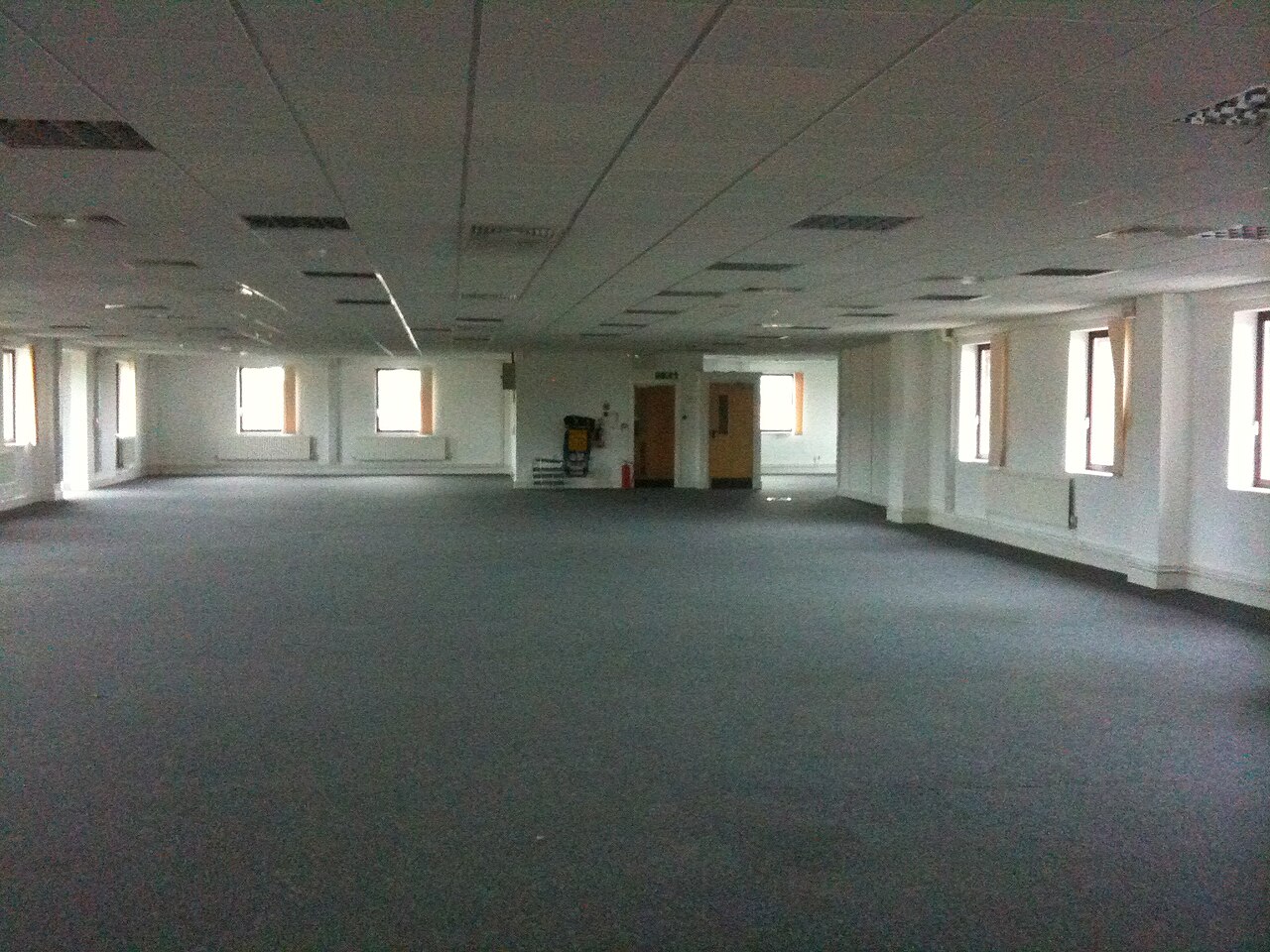
Photo: Ged Carroll, CC BY 2.0, via Wikimedia Commons.

How do you specify carpet tiles?
To specify carpet tiles, name the construction, pile fibre, tile size and the BS EN 1307 use class for the traffic, then state the castor chair suitability, reaction to fire class and electrostatic behaviour the space needs. Specify the installation method and tackifier or adhesive in the same clause, and leave room-by-room colours and laying direction to the finishes schedule.
Carpet tiles are usually chosen from a sample book in a client meeting, and the clause that follows often records exactly that: a range, a colourway and a tile size. What it leaves out is the class of wear the tile is built for, whether it will stand up to office chairs, how it is fixed to the floor below and which fire class it has to keep. Those are what decide whether a floor plate still looks presentable five years in, and whether a cheaper alternative can be rejected.
This guide covers Uniclass Pr_35_57_11_62 Pile carpet tiles, the code for tufted and woven pile tiles. Broadloom carpet and entrance matting sit in the same Uniclass group, Pr_35_57_11 Carpets, carpet tiles, coverings, underlays and mats, but they are separate products with separate clauses.
What does a carpet tile clause need to cover?
Some properties are specific to carpet tiles. Others belong in every product clause. A clause that leaves either out gives the contractor room to substitute.
Properties of carpet tiles
- Carpet constructionTufted or woven; loop, cut or cut-and-loop pile.
- MaterialPile fibre, e.g. polyamide, wool or wool blend.
- Nominal size500 x 500 mm square or plank format.
- ThicknessOverall thickness, matched to adjoining finishes and thresholds.
- Mass per unit areaPile or total mass; checks the submittal matches.
- FinishColour and design reference from the range.
- Wear resistanceBS EN 1307 use class matched to the traffic.
- Castor chair suitabilityOffices: rated for continuous castor chair use.
- Reaction to fire classificationFloor Euroclass to BS EN 13501-1, per fire strategy.
- Electrostatic behaviourBody voltage limit where static would cause shocks.
- Acoustic performanceImpact sound improvement where the floor relies on it.
- Recycled contentDeclared percentage for sustainability targets.
- Mounting typeSurface laid on tackifier, or recessed where in matwells.
- Laying patternMonolithic, quarter-turn, ashlar or brick bond.
- AccessoriesTackifier or adhesive, edge trims and transition strips.
- Sample approvalAgree colour and dye lot before ordering.
What every product clause needs
- Manufacturer and product referenceNamed range and colourway, or a performance description.
- Product standardBS EN 1307 classification, with a BS EN 14041 DoP.
- Installation methodBS 5325 and the manufacturer's instructions.
- Technical submittalsData sheet, DoP, classification and fire test evidence.
- Operation and maintenance informationCleaning regime, spare tiles and tile replacement method.
- SubstrateScreed or raised access floor, clean, dry and smooth.
Uniclass Pr_35_57_11_62 Carpet tiles. Not every property applies to every project; where one does not, say so rather than leaving it blank.
Which decisions does the clause depend on?
Most properties follow from the product you choose. These depend on the project, so they need a decision from the designer before the clause is written.
- 01
Use class for the traffic
TrafficBS EN 1307 classifies pile carpets by how well they keep their appearance under foot traffic: classes 21 to 23 for domestic use and 31 to 33 for commercial. The class is the one number that lets a contractor's alternative be compared with the product you named. Ranges are often sold in several weights under one name, so the range name alone does not fix the class. Set it for the area, because a meeting room, an open-plan floor and the main route through it see very different traffic.
How to decide
- Cellular offices and meeting rooms with light traffic: class 32 is often enough.
- Open-plan floors, corridors and lift lobbies: class 33.
- Where one tile is used across the whole floor plate, specify the class for the busiest area it covers.
- Ask for the classification on the declaration of performance or the manufacturer's label, not a sales sheet.
Write it asUse class: 33 to BS EN 1307. Submit evidence of classification. - 02
Castor chairs
OfficesAn office chair on castors does more damage to carpet than people walking, and the result shows within a year as flattened, fluffed tracks around each desk. BS EN 1307 states whether a carpet is suitable for occasional or continuous castor chair use, based on the castor chair test in BS EN ISO 4918. Wherever desks are planned the floor should be rated for continuous use. The alternative is chair mats, which clients rarely like and tenants often remove.
How to decide
- Check the furniture layout or the tenant's brief for desking areas.
- Require continuous castor chair suitability wherever chairs on castors are expected.
- In shell and core, where layouts are unknown, assume desking across the office floor.
- Where a lighter product is used in meeting rooms, make it a separate type with its own rating.
Write it asCastor chair suitability: Suitable for continuous use to BS EN 1307, tested to BS EN ISO 4918. - 03
Reaction to fire class
FireCarpet tiles are classified as floorings under BS EN 13501-1, commonly Bfl-s1 or Cfl-s1, and the result depends on the backing and on how the tile was mounted for the test. Approved Document B's lining classes apply to walls and ceilings rather than floors, so the requirement for a carpet normally comes from the fire strategy, the client's insurer or a corporate standard. State the class either way. A change of backing to save cost can drop the class without anyone noticing.
How to decide
- Check the fire strategy and the client's design guide for a stated flooring class.
- If nothing is stated, specify the class of the product you have selected so a substitute cannot fall below it.
- Ask for the classification report for the backing being supplied, tested in the mounting that matches the installation.
Write it asReaction to fire: Class Bfl-s1 to BS EN 13501-1. Submit classification report for the backing supplied. - 04
Static and sensitive equipment
StaticSynthetic pile can build up charge as people walk, which shows up as small shocks from door handles and, near sensitive kit, as something more serious. A body voltage below 2 kV measured to BS EN 1815 is the usual threshold for an antistatic carpet in offices. Server rooms, laboratories and control rooms may need a static-dissipative floor with a defined resistance to earth, which is a different product with different installation and should be its own type.
How to decide
- General offices: ask for antistatic performance with body voltage below 2 kV to BS EN 1815.
- Rooms with sensitive equipment: get the requirement from the client's IT or M&E engineer and specify a dissipative product as a separate type.
- Note that low humidity in heated buildings makes static worse, so do not rely on a borderline result.
Write it asElectrostatic behaviour: Body voltage less than 2 kV, tested to BS EN 1815. - 05
Laying pattern and fixing
LayoutQuarter-turn laying hides tile edges and small shade differences. Monolithic laying gives a continuous field but shows every change of dye lot and pile direction. Both change how much stock is ordered and how much is wasted, so say which. Over raised access floors the fixing matters as much as the pattern: tiles should sit on a releasable tackifier with their joints offset from the panel joints, so that a panel can be lifted without tearing up the floor around it.
How to decide
- Choose quarter-turn, monolithic, ashlar or brick bond with the designer and record it per type.
- Over access floors, specify a releasable tackifier and offset tile joints from panel joints.
- On screed, follow the manufacturer's fixing method and BS 5325.
- Require one dye lot per area and spare tiles from the installed lot at handover.
Write it asFixing: Releasable tackifier to manufacturer's recommendation. Tile joints offset from access floor panel joints. Laying pattern: Quarter-turn.
The values under "Write it as" are examples. The right value depends on the location, the use and the fire strategy.
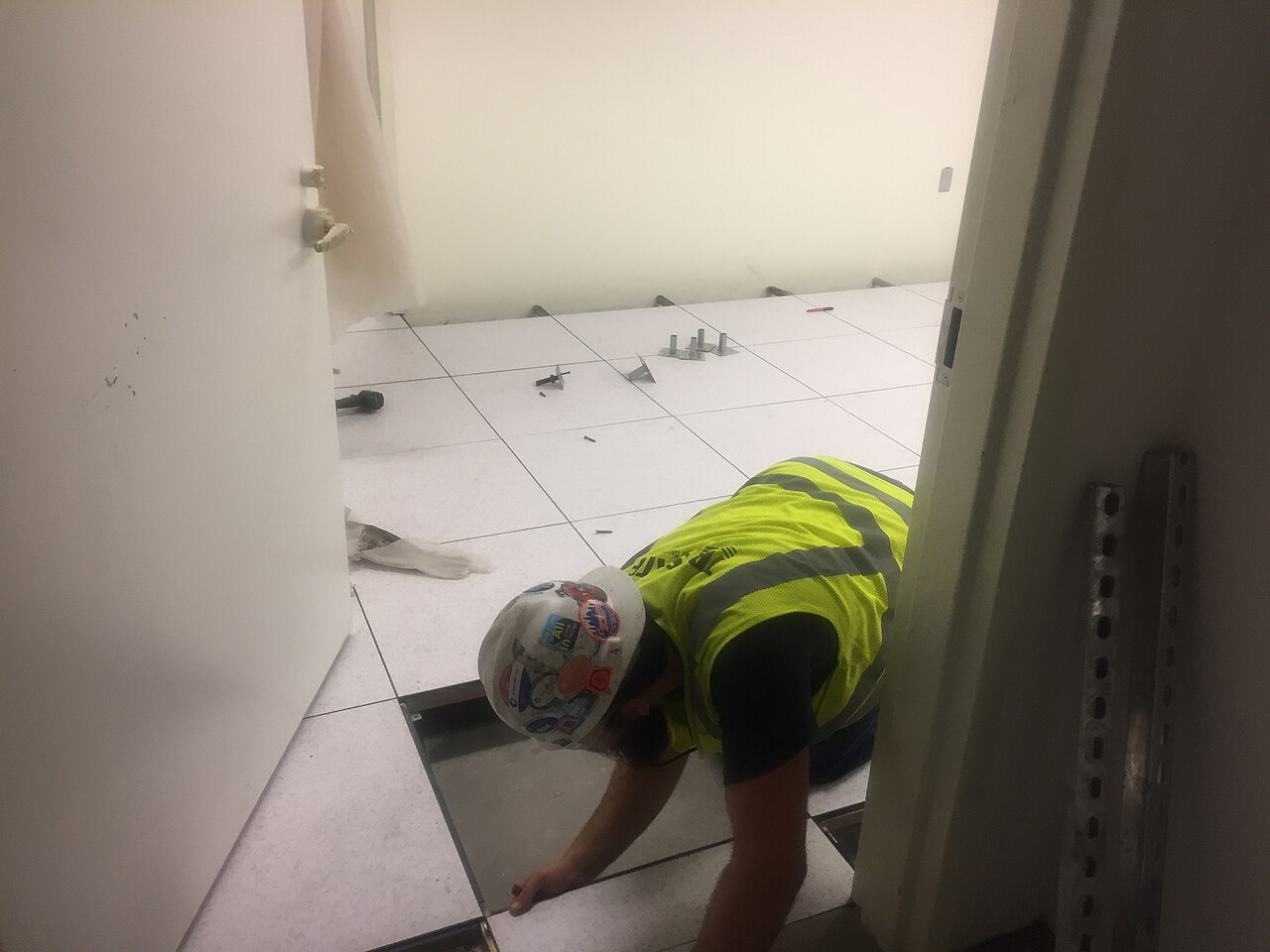
Photo: MTA Capital Construction Mega Projects, CC BY 2.0, via Wikimedia Commons.
_(48607808746).jpg)
Which standards should the clause cite?
Cite the product standard the declaration of performance refers to, the code of practice for installation, and the test method behind each value you set. A value without its test method cannot be checked against a submittal.
- BS EN 1307
- Textile floor coverings. Classification
Classifies pile carpets by use class and states additional suitability, including castor chair use, for the classified product.
In the clause Cite it with the class: "Use class: 33 to BS EN 1307".
- BS EN 14041
- Resilient, textile, laminate and modular multilayer floor coverings. Essential characteristics
The harmonised standard behind the declaration of performance for carpet tiles, covering reaction to fire, slip and electrical behaviour.
In the clause "Submit declaration of performance to BS EN 14041."
- BS 5325
- Installation of textile floor coverings. Code of practice
UK code of practice for base preparation, moisture checks, fixing methods and laying of carpet and carpet tiles.
In the clause Use it for workmanship: "Laying: to BS 5325 and the manufacturer's instructions".
- BS EN ISO 4918
- Resilient, textile and laminate floor coverings. Castor chair test
The test method that sits behind the castor chair rating given under BS EN 1307.
In the clause Name it with the rating: "Suitable for continuous castor chair use, tested to BS EN ISO 4918".
- BS EN 1815
- Resilient and textile floor coverings. Assessment of static electrical propensity
The walking test that measures body voltage generated on a floor covering.
In the clause "Body voltage less than 2 kV, tested to BS EN 1815."
- BS EN ISO 717-2
- Acoustics. Rating of sound insulation in buildings and of building elements. Impact sound insulation
Gives the single-number rating for impact sound improvement that manufacturers declare for carpet.
In the clause Only where the acoustic report relies on the carpet: "Impact sound improvement: as acoustic report, rated to BS EN ISO 717-2".
- BS EN 13501-1
- Fire classification of construction products and building elements. Classification using data from reaction to fire tests
The Euroclass system; floorings carry the fl suffix, for example Bfl-s1 or Cfl-s1.
In the clause "Reaction to fire: Class Bfl-s1 to BS EN 13501-1."
Confirm the current edition of each standard at every issue. Avoice's State of UK Specifications 2026 found a withdrawn standard cited in 40% of specifications at contract issue.
For the regulations behind these choices, see Approved Document B explained, or search the Avoice Regulations library.
How do you write it in CAWS?
Carpet tiles are written in CAWS section M50, alongside vinyl, rubber, linoleum and cork. Each covering gets a type clause in the 100s, and in published NBS clauses carpet tiling is commonly clause 130. The type clause describes one covering from base to finish: where it goes by type mark, the base and its preparation, the tile, its classification, the fixing and the accessories.
Everything that applies to every covering is written once in the later M50 clauses: workmanship, samples, extra material for the client, base suitability, the moisture test, colour consistency and protection. The type clause refers to them by number. If the project has a heavy-duty tile in circulation and a lighter tile in meeting rooms, that is two type clauses, for example 130 and 135, using the same general clauses.
- Base
- Raised access floor panels, as clause 410
- Carpet tiles
- Tufted level loop pile
- Manufacturer
- Submit proposals
- Product reference
- Submit proposals
- Pile fibre
- 100% solution-dyed polyamide
- Size
- 500 x 500 mm
- Classification
- Use class 33 to BS EN 1307
- Castor chair suitability
- Continuous use, tested to BS EN ISO 4918
- Colour
- TBC Client colour selection outstanding. Resolve before ordering.
- Reaction to fire
- Class Bfl-s1 to BS EN 13501-1
- Electrostatic behaviour
- Body voltage less than 2 kV to BS EN 1815
- Method of laying
- Releasable tackifier, to BS 5325 and manufacturer's instructions
- Setting out
- Quarter-turn, tile joints offset from panel joints
- Accessories
- Edge trims at changes of finish, as clause 740
- Extra material
- As clause 270, from the installed dye lot
Illustrative, not from a real project. One property is left as a TBC with a reason so it can be tracked and closed before issue.
Clauses the type clause relies on
- M50/210
- Workmanship generally Laying by an installer experienced with the product, to the manufacturer's instructions.
- M50/270
- Extra material Spare tiles from the same dye lot handed over to the client at completion.
- M50/410
- Suitability of new bases and conditions Starting work is taken as acceptance that the base and conditions are suitable.
- M50/430
- Dampness Hygrometer readings on screeded areas before laying.
- M50/620
- Colour consistency One production batch per room or area.
- M50/870
- Protection Keeping the finished carpet covered and clean until handover.
Clause numbers vary between NBS versions and practice masters. These follow the M50 layout used in published NBS manufacturer clauses; check that each clause the type clause refers to exists in your own M50.
For more on clause structure and checks, see NBS clause writing: common mistakes.
How do you write it in Uniclass?
In Uniclass 2015 the finished floor is a system and the tile is a product. The system clause, Ss_30_42_72_10 Carpet tile systems, describes what the tiles are laid on, how they are fixed and how the finished floor has to behave. The tile is written once as a Pr_35_57_11_62 Pile carpet tiles clause and called up from the system by its code and type mark.
The split suits carpet tiles well, because the same tile is often laid in more than one way. On a raised access floor it goes down on a releasable tackifier; on a screeded core area it may be fully adhered. That is two system clauses pointing at one product clause, so a change of colour or range is made in one place.
- Description
- Pile carpet tiles on raised access floor
- Base
- Raised access floor panels, joints level and clean
- Covering
- Pr_35_57_11_62 Pile carpet tiles (F02)
- Fixing
- Releasable tackifier to manufacturer's recommendation
- Setting out
- Quarter-turn, joints offset from panel joints
- Installation
- To BS 5325 and manufacturer's instructions
- Spare stock
- Hand over tiles from the installed dye lot
- Manufacturer
- Submit proposals
- Product reference
- Submit proposals
- Construction
- Tufted level loop pile
- Pile fibre
- 100% solution-dyed polyamide
- Nominal size
- 500 x 500 mm
- Use class
- 33 to BS EN 1307
- Castor chair suitability
- Continuous use, tested to BS EN ISO 4918
- Colour
- TBC Client colour selection outstanding. Resolve before ordering.
- Reaction to fire
- Class Bfl-s1 to BS EN 13501-1
- Electrostatic behaviour
- Body voltage less than 2 kV to BS EN 1815
- Recycled content
- Submit manufacturer's declared value
Illustrative. Performance of the finished system sits in the system clause; properties of the product sit in the product clause.
In NBS Chorus the product clause also carries an NBS reference (for pile carpet tiles, 45-20-15/380); use one system or the other consistently, not CAWS and Uniclass references side by side.
What goes in the spec, and what goes in the schedule?
The specification defines each type once. The schedule and drawings say where each type goes.
In the specification
What the product is and how it performs and is installed. Written once per type.
In the schedule or drawings
Where each type goes and how much of it. Changes with every plan revision.
Write each carpet tile type once with a type mark (for example F01) and let the finishes schedule say where it goes. Where colours change across a floor plate, keep one technical clause and put the colours in the schedule.
What are the common mistakes?
Most problems are a missing property, a property filled with the wrong kind of value, or a decision left silently open.
- No use class. A range name does not fix performance; ranges come in several qualities. State the BS EN 1307 class so any substitute can be checked.
- Castor chairs ignored. Desking areas wear out first. Require continuous castor chair suitability where chairs will be used.
- Permanent adhesive on access floors. Fully bonding tiles to raised floor panels stops anyone lifting a panel cleanly. Specify a releasable tackifier.
- Mixed dye lots. Tiles from different batches can differ in shade. Require one dye lot per area and spare tiles from the same lot.
- Room names in the clause. "Carpet to meeting rooms 3.01 to 3.06" goes out of date at the next plan revision. Use a type mark and the schedule.
- A silent default on colour. If the colour has not been chosen, say so with a TBC and a reason, so it is resolved before ordering rather than on site.
How Avoice helps
Avoice's spec writer drafts carpet tile clauses from the finishes information on the project and shows plainly what is still undecided.
- Drafts from your drawings and schedules
It reads the carpet types from the finishes schedule and general arrangement plans, notes where they sit on access floor, writes the M50 type clause or the Uniclass system and product clauses, and fills in what your information supports.
- Leaves a TBC with a reason
An unchosen colourway, or a static requirement nobody has confirmed for the comms room, becomes a TBC with its reason. All TBCs go into one project register to close before tender.
- Works from your own masters
Choose CAWS or Uniclass. Avoice adapts your practice's own clauses and house wording rather than starting from generic text.
- Checks the spec against the drawings
QA/QC flags a carpet type on the schedule that has no clause, a type clause pointing at a general clause that is not in your M50, a fire class that differs from the fire strategy note, or a withdrawn standard.
- Links product data to the clause
Data sheets, classification evidence and declarations of performance are held in the Product Room against the clause. A linked product edited once updates in every clause that uses it.
Related guides: How to specify entrance matting, How to specify vinyl flooring, How to specify rubber flooring.
Software can draft and check. The designer still chooses the product and is responsible for the specification.
For more on the evidence behind product choices, see the role of manufacturer product data in specification writing.
Draft your carpet tile clause in Avoice
Upload your drawings and schedules. Avoice drafts the clause in CAWS or Uniclass, cites the standards and flags anything your information does not settle.
This guide is for general education and is not professional advice. Check current editions of standards and Approved Documents, the manufacturer's data, and the requirements of your project before relying on any clause.