
How to specify rubber flooring
What a rubber flooring clause has to say, the decisions behind it, the standards to cite, and how to write it in CAWS and in Uniclass.
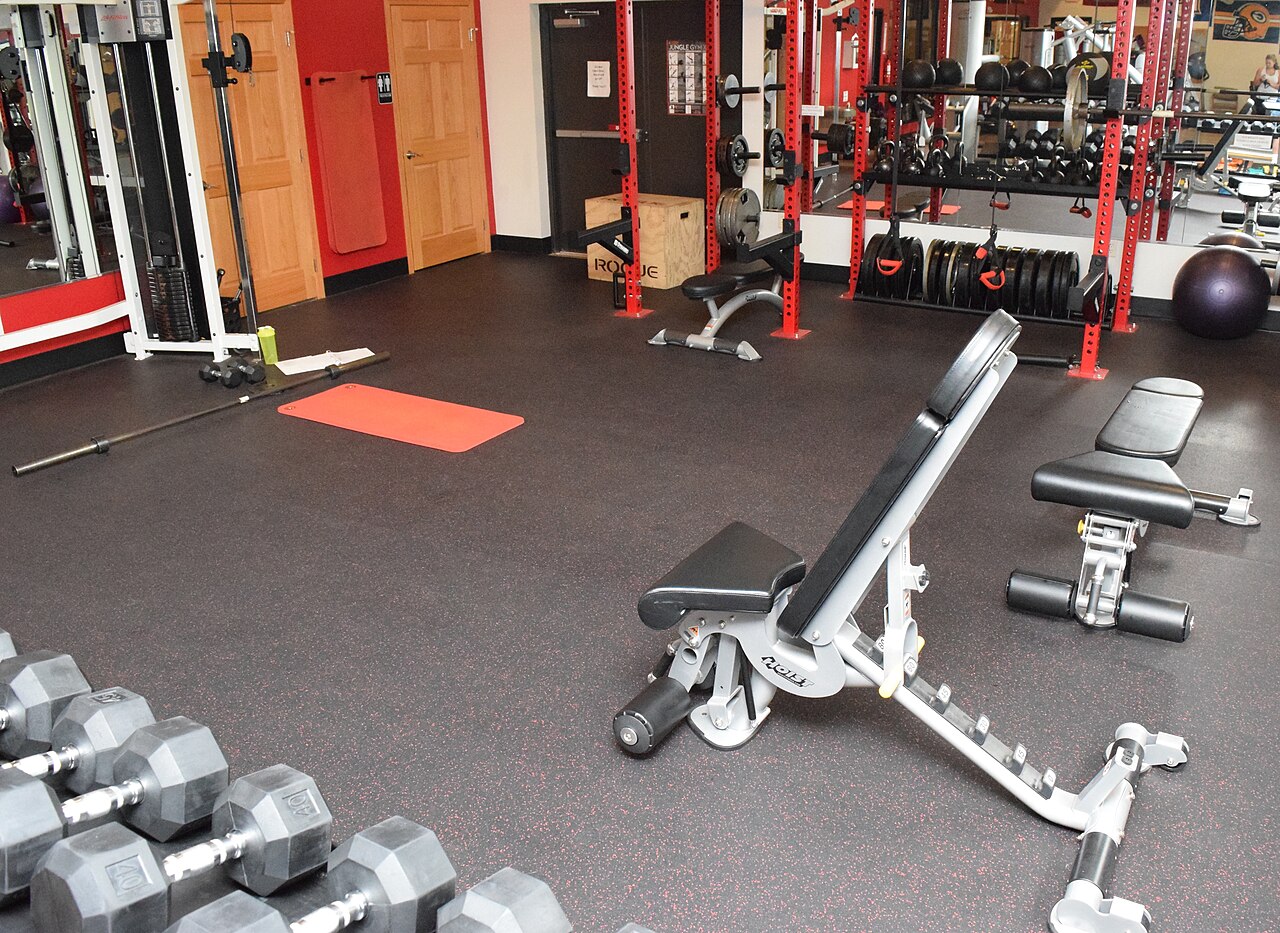
Photo: Greatmats, CC BY-SA 4.0, via Wikimedia Commons.

How do you specify rubber floor tiles?
To specify rubber flooring, say whether it is smooth or relief, homogeneous or heterogeneous, and cite BS EN 1817 or BS EN 12199 accordingly. Then state the tile size and thickness, the BS EN ISO 10874 use class, slip resistance as a wet PTV and the reaction to fire class, with the adhesive, subfloor moisture limit and accessories in the same clause.
Rubber goes into schools, hospitals, stations and busy offices because it is hard-wearing, quiet underfoot and needs little in the way of polish. It is also one of the floor finishes most often specified by brand alone. A brand covers smooth and studded surfaces, recycled and virgin compounds and several thicknesses, and the clause has to say which, along with how the floor performs once it is wet and how it is stuck down.
This guide covers Uniclass Pr_35_57_71_75 Rubber tiles. Uniclass also gives the two surface types their own codes, Pr_35_57_71_84 Smooth rubber tiles and Pr_35_57_71_73 Relief rubber tiles, and using the specific code makes it clear from the heading which product standard applies.
What does a rubber floor tile clause need to cover?
Some properties are specific to rubber floor tiles. Others belong in every product clause. A clause that leaves either out gives the contractor room to substitute.
Properties of rubber floor tiles
- Product typeSmooth or relief; homogeneous or heterogeneous; tile or sheet.
- Nominal sizeTile format sets joint layout and wastage.
- ThicknessOverall thickness, matched to adjoining finishes and thresholds.
- Wear layer thicknessHeterogeneous rubber only; homogeneous wears through its thickness.
- Mass per unit areaChecks the submitted product matches the one specified.
- FinishColour, pattern and surface: smooth, studded or hammered.
- Use classBS EN ISO 10874 class matched to the traffic.
- Wear resistanceAbrasion resistance as the product standard requires.
- Slip resistanceNever guessWet PTV by pendulum for the finish actually supplied.
- Reaction to fire classificationFloor Euroclass to BS EN 13501-1, e.g. Bfl-s1.
- Residual indentationRecovery from beds, trolleys and point loads.
- Dimensional stabilityLimits shrinkage that opens butt joints.
- Castor chair suitabilityNeeded where office chairs or trolleys are used.
- Chemical resistanceResistance to disinfectants; some oils and greases stain rubber.
- LightfastnessColour stability next to glazing and rooflights.
- Electrostatic behaviourAntistatic or conductive grades for sensitive equipment.
- Infection controlCleanable surface and sealed joints in clinical areas.
- EmissionsLow VOC, certified to a recognised indoor air scheme.
- Acoustic performanceImpact sound reduction where the build-up relies on it.
- Thermal performanceSuitability over underfloor heating.
- Recycled contentFor sustainability targets and reporting.
- Moisture content before coveringSubfloor relative humidity tested by hygrometer to BS 8203.
- AdhesiveDispersion or two-part reactive, to suit traffic and wetting.
- Joint treatmentTight butt joints; sealed or welded where hygiene requires.
- Laying patternStraight or quarter-turned to suit the surface pattern.
- AccessoriesStair treads, nosings, skirtings, coves and edge trims.
- Sample approvalAgree colour and batch before ordering.
What every product clause needs
- Manufacturer and product referenceNamed range and colour, or a performance description.
- Product standardBS EN 1817 smooth or BS EN 12199 relief.
- Installation methodBS 8203 and the manufacturer's instructions.
- Technical submittalsData sheet, DoP, slip and fire test evidence.
- Operation and maintenance informationInitial clean and maintenance; many rubbers need no polish.
- MaterialNatural or synthetic rubber compound, or recycled granulate.
- SubstrateScreed or panel, smoothed and level before laying.
Uniclass Pr_35_57_71_75 Rubber flooring. Not every property applies to every project; where one does not, say so rather than leaving it blank.
Fields marked Never guess (slip resistance) depend on the project and should never be filled from a default or a previous job. If the information is not available yet, the clause should say so with a TBC and a reason.
Which decisions does the clause depend on?
Most properties follow from the product you choose. These depend on the project, so they need a decision from the designer before the clause is written.
- 01
Slip resistance when wet
Never guessSmooth rubber can test well dry and poorly once wet or contaminated with something greasy, and a relief surface behaves differently again. The figure to specify is the wet pendulum test value (PTV) to BS EN 16165 Annex C on the surface actually being supplied. UK Slip Resistance Group guidance treats a wet PTV of 36 or more as low slip potential. Entrances, ramps and areas that are wet in normal use may need a different surface or product, and entrance matting in front of the rubber does a lot of the work.
How to decide
- Identify the areas that will be wet in use, including the zone inside each external door.
- Ask for the wet PTV using slider 96 for shod areas; slider 57 where people will be barefoot.
- Where the smooth surface cannot show a wet PTV of 36 or more, choose a relief surface or another product for that area, as a separate type.
- Specify entrance matting long enough to take most of the water off shoes before they reach the rubber.
Write it asSlip resistance: Wet PTV not less than 36, tested to BS EN 16165 Annex C using slider 96, on the surface supplied. - 02
Smooth or relief surface
SurfaceSmooth rubber is specified to BS EN 1817 and relief rubber, studded or hammered, to BS EN 12199. Relief surfaces disguise scuffs and help on stairs and in transport settings, but they hold dirt and are slower to clean, which counts against them in clinical rooms and kitchens. The two are different products under different standards, so make each surface its own type rather than writing "smooth or studded" into one clause.
How to decide
- Clinical and hygiene-sensitive rooms: smooth, with sealed or welded joints where the infection control brief asks for them.
- Stairs, transport areas and heavy circulation: relief is often preferred; check it suits the cleaning regime.
- Use matching stair treads and nosings from the same range, as their own clauses.
Write it asProduct type: Homogeneous smooth rubber tiles to BS EN 1817. - 03
Use class for the traffic
TrafficBS EN ISO 10874 groups floor coverings into domestic, commercial and light industrial classes. Most rubber ranges sit at the top of the commercial scale, which tempts specifiers to leave the class out. Recycled-content and thinner products can be classified lower, and they are the usual substitutions when a contractor is looking for savings. Stating the class for each area gives you a fixed point to check an alternative against, and it makes the contractor show the evidence rather than assume it.
How to decide
- General offices and education corridors: class 33 or 34.
- Hospital corridors, station concourses and other heavy pedestrian routes: class 34, and check the light industrial class where trolleys and beds are part of the use.
- Where one product covers several areas, state the class for the busiest of them.
Write it asUse class: 34 to BS EN ISO 10874, declared on the declaration of performance. - 04
Adhesive for the conditions
FixingRubber is commonly laid on a dispersion adhesive. Areas that are heavily wet-cleaned, that carry rolling loads such as beds and catering trolleys, or that sit in strong sun often need a two-part reactive adhesive, polyurethane or epoxy, to stop tiles moving and joints opening. The installer will price the cheaper adhesive unless the clause says otherwise, so name the adhesive for each condition or make the flooring manufacturer confirm in writing which one goes where.
How to decide
- Mark heavy rolling-load routes, wet-cleaned areas and strips of floor in direct sun on the finishes drawings.
- Specify the manufacturer's two-part adhesive for those zones and the standard adhesive elsewhere.
- Check open time and cure time against the programme; two-part adhesives may need longer before traffic.
Write it asAdhesive: Flooring manufacturer's two-part polyurethane adhesive on bed and trolley routes; manufacturer's dispersion adhesive elsewhere. - 05
Subfloor moisture
SubfloorMoisture moving up from a screed attacks the adhesive bond, and with rubber the result is blistering, lifting tiles and open joints. BS 8203 asks for a hygrometer test showing 75% relative humidity or less before laying. Where the programme does not allow the screed to dry, a surface damp-proof membrane compatible with the smoothing compound and adhesive is the dependable answer, not a note asking for the screed to be dry.
How to decide
- Build the drying time for the screed into the programme and require the hygrometer test before laying.
- If drying time is not available, specify a surface damp-proof membrane from the adhesive or flooring manufacturer's system.
- Require readings to be recorded and handed over with the commissioning information.
Write it asMoisture before covering: Not more than 75% RH, tested by hygrometer to BS 8203 Annex A. Submit readings before laying.
The values under "Write it as" are examples. The right value depends on the location, the use and the fire strategy.
Which standards should the clause cite?
Cite the product standard the declaration of performance refers to, the code of practice for installation, and the test method behind each value you set. A value without its test method cannot be checked against a submittal.
- BS EN 1817
- Resilient floor coverings. Specification for homogeneous and heterogeneous smooth rubber floor coverings
The product standard for smooth rubber tiles and sheet, homogeneous or heterogeneous.
In the clause Cite it as the product standard: "Product standard: BS EN 1817".
- BS EN 12199
- Resilient floor coverings. Specification for homogeneous and heterogeneous relief rubber floor coverings
The product standard for studded, hammered and other relief rubber floorings.
In the clause For relief types only: "Product standard: BS EN 12199".
- BS EN 14041
- Resilient, textile, laminate and modular multilayer floor coverings. Essential characteristics
The harmonised standard behind the declaration of performance, including reaction to fire, slip resistance and electrical behaviour.
In the clause "Submit declaration of performance to BS EN 14041."
- BS EN ISO 10874
- Resilient, textile and laminate floor coverings. Classification
Use classes 21 to 23, 31 to 34 and 41 to 43, matching a floor covering to its traffic.
In the clause "Use class: 34 to BS EN ISO 10874."
- BS 8203
- Code of practice for installation of resilient floor coverings
UK code of practice for base preparation, moisture testing, adhesives and laying of resilient floors, rubber included.
In the clause For the moisture test and workmanship: "Not more than 75% RH, tested to BS 8203 Annex A".
- BS EN 16165
- Determination of slip resistance of pedestrian surfaces. Methods of evaluation
Annex C is the pendulum test, including slider choice: slider 96 for shod use and slider 57 for barefoot use. BSI withdrew BS 7976-2 in 2022, so older test reports may still quote it.
In the clause Name the annex and the slider: "Wet PTV not less than 36, tested to BS EN 16165 Annex C using slider 96".
- BS EN 13501-1
- Fire classification of construction products and building elements. Classification using data from reaction to fire tests
The Euroclass system; floorings carry the fl suffix, for example Bfl-s1.
In the clause "Reaction to fire: Class Bfl-s1 to BS EN 13501-1."
Confirm the current edition of each standard at every issue. Avoice's State of UK Specifications 2026 found a withdrawn standard cited in 40% of specifications at contract issue.
For the regulations behind these choices, see Approved Document M explained, Approved Document B explained, or search the Avoice Regulations library.
How do you write it in CAWS?
Rubber flooring sits in CAWS section M50 with vinyl, linoleum, cork and carpet. Each rubber floor on the project is written as a type clause under "Type(s) of covering" in the 100s, and published NBS clauses for rubber tiles commonly use 110. The type clause holds the base, the preparation, the tile, its standard and class, the adhesive and the accessories for that one floor.
Base suitability, the moisture test, smoothing compound, adhesive fixing, colour batches and protection are written once in the general M50 clauses and referred to from the type clause by number. Matching stair treads, nosings and coved skirtings are normally covered by the stair covering and skirting clauses later in M50, so the type clause just points to them.
- Base
- Sand and cement screed, as clause 410
- Preparation
- Smoothing underlayment compound, as clause 460
- Tiles
- Homogeneous smooth rubber to BS EN 1817
- Manufacturer
- Submit proposals
- Product reference
- Submit proposals
- Classification
- Use class 34 to BS EN ISO 10874
- Size
- 610 x 610 mm
- Thickness
- 3.0 mm
- Colour
- From manufacturer's standard range, to approved sample
- Slip resistance
- Wet PTV not less than 36 to BS EN 16165 Annex C, slider 96
- Reaction to fire
- Class Bfl-s1 to BS EN 13501-1
- Acoustic performance
- TBC Impact sound requirement awaiting the acoustic consultant's report. Resolve before ordering.
- Adhesive
- Manufacturer's two-part polyurethane, as clause 640
- Joints
- Tight butt joints
- Accessories
- Matching stair treads and coved skirtings, as clauses 760 and 770
Illustrative, not from a real project. One property is left as a TBC with a reason so it can be tracked and closed before issue.
Clauses the type clause relies on
- M50/410
- Suitability of new bases and conditions Starting work is taken as joint acceptance that the base and conditions are suitable.
- M50/430
- Dampness Hygrometer readings of 75% RH or less before laying.
- M50/460
- Smoothing underlayment compound Product and minimum thickness of the smoothing layer.
- M50/640
- Adhesive fixing generally Adhesive application, rolling and removal of surplus adhesive.
- M50/760
- Stair coverings Treads, risers and nosings laid to match the floor type.
- M50/870
- Protection Keeping the finished floor covered until handover.
Clause numbers vary between NBS versions and practice masters. These follow the M50 layout in published NBS manufacturer clauses; confirm every clause the type clause refers to is in your own M50.
For more on clause structure and checks, see NBS clause writing: common mistakes.
How do you write it in Uniclass?
Uniclass 2015 writes the floor as a system and the tile as a product. The system, Ss_30_42_72_75 Resilient tile floor covering systems, describes the base, its preparation, the adhesive and how the finished floor performs, including its slip resistance once laid. The tile is a product clause with its own Pr code, called up from the system by code and type mark.
Rubber projects often use one tile in more than one build-up: adhered to screed on the ground floor, on an acoustic underlay upstairs. Two system clauses can point to the same product clause, so the tile is described once and changed once. The matching stair treads and skirtings are their own product clauses, called up from the stair and floor systems.
- Description
- Smooth rubber tiles adhered to smoothed screed
- Base
- Sand and cement screed, as the screed system clause
- Preparation
- Smoothing underlayment, flatness to suit the covering
- Moisture before covering
- Not more than 75% RH by hygrometer to BS 8203
- Covering
- Pr_35_57_71_84 Smooth rubber tiles (F04)
- Adhesive
- Manufacturer's two-part polyurethane
- Joints
- Tight butt joints
- Slip resistance of finished floor
- Wet PTV not less than 36 to BS EN 16165 Annex C, slider 96
- Manufacturer
- Submit proposals
- Product reference
- Submit proposals
- Standard
- BS EN 1817, declaration of performance to BS EN 14041
- Product type
- Homogeneous
- Nominal size
- 610 x 610 mm
- Thickness
- 3.0 mm
- Use class
- 34 to BS EN ISO 10874
- Colour
- From manufacturer's standard range, to approved sample
- Reaction to fire
- Class Bfl-s1 to BS EN 13501-1
- Acoustic performance
- TBC Impact sound requirement awaiting the acoustic consultant's report. Resolve before ordering.
- Recycled content
- Submit manufacturer's declared value
Illustrative. Performance of the finished system sits in the system clause; properties of the product sit in the product clause.
In NBS Chorus the product clause also carries an NBS reference (for rubber tiles, 45-20-70/452); pick CAWS or Uniclass for the whole specification rather than mixing references.
What goes in the spec, and what goes in the schedule?
The specification defines each type once. The schedule and drawings say where each type goes.
In the specification
What the product is and how it performs and is installed. Written once per type.
In the schedule or drawings
Where each type goes and how much of it. Changes with every plan revision.
Write each rubber flooring type once with a type mark (for example F01) and let the finishes schedule and drawings say where it goes. Stair treads and nosings are separate products and should have their own clauses, cross-referenced to the floor type they match.
What are the common mistakes?
Most problems are a missing property, a property filled with the wrong kind of value, or a decision left silently open.
- Brand name only. Ranges include smooth, relief, recycled and acoustic products with different standards and classes. Name the type, standard and use class as well.
- Dry slip figures. A good dry result says little about the floor once wet. Ask for the wet PTV on the finish actually supplied.
- Relief rubber in clinical rooms. Studded surfaces hold dirt and are harder to clean. Keep relief rubber for circulation, stairs and transport areas.
- Wrong adhesive for the traffic. Dispersion adhesives can let tiles move under rolling loads or heavy wet cleaning. Specify the reactive adhesive where it is needed.
- No moisture test. "Screed to be dry" cannot be checked. Require a hygrometer reading to BS 8203 before laying, or specify a surface DPM.
- Room names in the clause. "Rubber to corridors on levels 1 and 2" goes out of date at the next plan revision. Use a type mark and the schedule.
How Avoice helps
Avoice's spec writer drafts rubber flooring clauses from the project's drawings and schedules, and leaves a clear marker wherever a decision is missing.
- Drafts from your drawings and schedules
It reads the rubber types from the finishes schedule, spots stairs and landings that need matching treads, and writes the M50 type clause or the Uniclass system and product clauses with the properties your information supports.
- Leaves a TBC with a reason
If the acoustic report has not set an impact sound requirement, or the client has not decided between smooth and studded on the stairs, the line says TBC and why. All TBCs collect in one project register to close before tender.
- Works from your own masters
Choose CAWS or Uniclass. Avoice adapts your practice's existing M50 clauses rather than overwriting them.
- Checks the spec against the drawings
QA/QC flags a relief rubber scheduled in a clinical room the clause says is smooth, a stair on the plans with no tread clause, a cross-reference to a clause missing from your M50, or a withdrawn standard.
- Links product data to the clause
Data sheets, slip test reports and declarations of performance sit in the Product Room against the clause, and a linked product edited once updates everywhere. Approved Document M and K guidance is in the Avoice Regulations library.
Related guides: How to specify vinyl flooring, How to specify stair nosings, How to specify entrance matting.
Software can draft and check. The designer still chooses the product and is responsible for the specification.
For more on the evidence behind product choices, see the role of manufacturer product data in specification writing.
Draft your rubber floor tile clause in Avoice
Upload your drawings and schedules. Avoice drafts the clause in CAWS or Uniclass, cites the standards and flags anything your information does not settle.
This guide is for general education and is not professional advice. Check current editions of standards and Approved Documents, the manufacturer's data, and the requirements of your project before relying on any clause.