
How to specify ceramic tiles
What a ceramic or porcelain tile clause has to say, the decisions behind it, the standards to cite, and how to write it in CAWS and in Uniclass.
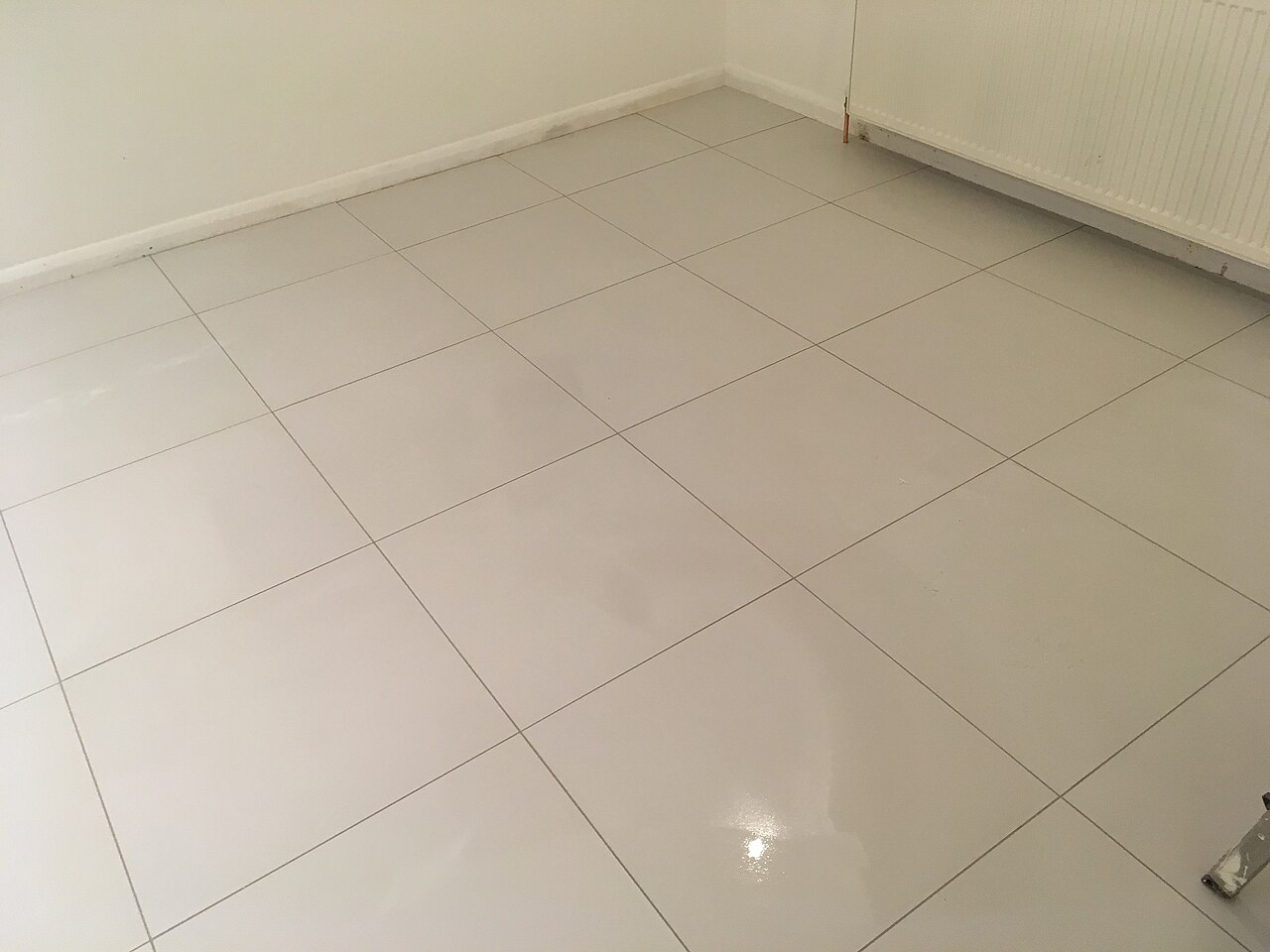
Photo: ColumbD, CC BY-SA 4.0, via Wikimedia Commons.

How do you specify ceramic tiles?
To specify ceramic tiles, name the tile by its BS EN 14411 water absorption group, format, thickness and finish, then state the performance the location needs: slip resistance for floors, wear class for traffic, frost resistance outside and reaction to fire where the fire strategy sets a class. Specify the adhesive, grout, movement joints and substrate preparation as part of the same clause, and leave room-by-room locations to the finishes schedule.
Most tile clauses we see in UK specifications go wrong in one of two ways. Some name a range and a colour and stop there, which leaves the contractor free to price any tile that looks similar. Others copy a list of performance values from a previous job that the chosen tile does not actually meet.
This guide works through what the clause has to cover for Uniclass Pr_35_93_96_19 Ceramic tiles, and for porcelain, which Uniclass gives its own code, Pr_35_93_96_63 Porcelain tiles. The properties are the same for both; only the code in the clause heading changes.
What does a ceramic tile clause need to cover?
Some properties are specific to ceramic tiles. Others belong in every product clause. A clause that leaves either out gives the contractor room to substitute.
Properties of ceramic tiles
- Product typeWall tile, floor tile, slab or mosaic.
- MaterialPorcelain or other ceramic body.
- Water absorption groupBS EN 14411 group, e.g. BIa for porcelain.
- ThicknessAffects weight, strength and edge trims.
- TolerancesSize and flatness deviation; drives lippage.
- Slip resistanceNever guessWet PTV by pendulum for floors, stairs and wet areas.
- Wear resistanceAbrasion class matched to the traffic.
- Freeze-thaw resistanceFrost resistant for external use.
- Reaction to fire classificationNever guessEuroclass to BS EN 13501-1; walls on escape routes.
- Recycled contentFor sustainability targets and reporting.
- AdhesiveBS EN 12004-1 class to suit tile and background.
- GroutBS EN 13888 class and colour.
- Joint widthSet by tile tolerance and format.
- Movement jointsPositions and sealant to BS 5385.
- Laying patternStack, half bond, herringbone.
- AccessoriesTrims, edge profiles, skirtings.
What every product clause needs
- Manufacturer and product referenceNamed manufacturer and range, or a performance description if not named.
- Product standardBS EN 14411, evidenced by the declaration of performance.
- Installation methodManufacturer's instructions plus this specification.
- Technical submittalsData sheets, DoP and test evidence before ordering.
- Operation and maintenance informationCleaning and maintenance regime at handover.
- Nominal sizeFormat identifies the product and sets the layout.
- FinishSurface finish and colour with the range reference.
- SubstrateBackground and its preparation.
- Sample approvalAgree shade and batch variation before ordering.
Uniclass Pr_35_93_96_19 Ceramic tiles. Not every property applies to every project; where one does not, say so rather than leaving it blank.
Fields marked Never guess (slip resistance and reaction to fire classification) depend on the project and should never be filled from a default or a previous job. If the information is not available yet, the clause should say so with a TBC and a reason.
Which decisions does the clause depend on?
Most properties follow from the product you choose. These depend on the project, so they need a decision from the designer before the clause is written.
- 01
Slip resistance
Never guessSlip resistance is the property most often specified badly. A tile's R rating comes from a laboratory ramp test with an oily boot and tells you little about how the floor behaves wet in use. The pendulum test value (PTV) measured by the pendulum method in BS EN 16165 Annex C is what UK guidance and the HSE rely on, and it can be measured again on site after installation.
How to decide
- Decide whether the floor will be wet in use: entrances, kitchens, shower rooms, external areas.
- Pick the slider that matches the use: slider 96 for shod areas, slider 57 for barefoot areas.
- Use the UK Slip Resistance Group threshold of a wet PTV of 36 or more for low slip potential, and set a higher target for ramps, stairs and wet barefoot areas if your client or the brief asks for it.
- Ask for the manufacturer's test report, not a brochure claim.
Write it asSlip resistance: Wet pendulum test value not less than 36, tested to BS EN 16165 Annex C using slider 96. Submit test report. - 02
Tile body and water absorption group
Tile bodyBS EN 14411 sorts ceramic tiles by how they are formed (A for extruded, B for dry pressed) and by how much water they absorb. Porcelain is group BIa, with absorption of 0.5% or less. Wall tiles with a porous body are group BIII and are not made for floors or for external use. Stating the group is the simplest way to stop a wall tile chosen for its colour ending up on a floor.
How to decide
- Floors, external areas and wet rooms: BIa porcelain, or BIb for some glazed floor tiles.
- Internal walls only: BIII is fine and usually cheaper and lighter.
- Frost exposure: check the frost resistance declaration to BS EN ISO 10545-12 as well as the group.
Write it asProduct standard: BS EN 14411, Group BIa. - 03
Wear resistance for the traffic
TrafficGlazed and unglazed tiles are tested differently. For glazed floor tiles you state the surface abrasion class to BS EN ISO 10545-7, often still called the PEI class. Unglazed porcelain has no glaze to wear through, so it is tested for deep abrasion to BS EN ISO 10545-6 instead. Quoting a PEI class for an unglazed tile is a sign the clause was copied.
How to decide
- Domestic bathrooms and bedrooms: a lower class is acceptable.
- Corridors, shops, offices and entrances: a high class for glazed tiles, or choose unglazed porcelain.
- If the tile is unglazed, ask for the deep abrasion value from the declaration of performance.
Write it asWear resistance: Unglazed porcelain, deep abrasion to BS EN ISO 10545-6, manufacturer's declared value. Submit declaration of performance. - 04
Reaction to fire
Never guessCeramic tiles are normally class A1 (walls) or A1fl (floors) without further testing, so the field is easy to fill but should still be stated. Approved Document B's lining classes apply to walls and ceilings, not floors, so for wall tiling on escape routes check the class the fire strategy sets, and remember the backing board and adhesive form part of the lining.
How to decide
- Floors: state A1fl unless the tile has an unusual backing or coating.
- Walls on escape routes: check the class in the fire strategy and that the board behind the tile meets it.
- External walls on relevant buildings: check how regulation 7(2) applies to the whole build-up, not just the tile.
Write it asReaction to fire: Class A1fl to BS EN 13501-1. - 05
Adhesive and grout classes
Fixing"Flexible adhesive" cannot be checked against a submittal. BS EN 12004-1 gives adhesives a class: C for cementitious, then 2 for improved, with optional letters for fast setting (F), reduced slip on walls (T), extended open time (E) and deformability (S1 or S2). Grout has its own classes in BS EN 13888-1, CG for cementitious and RG for reaction resin.
How to decide
- Large-format porcelain, heated screeds and timber or board backgrounds: a deformable C2 S1 or S2 adhesive.
- Walls: add T so tiles do not slip before the adhesive sets.
- Commercial kitchens or chemical exposure: consider RG resin grout and check the cleaning regime.
Write it asAdhesive: Class C2 S1 to BS EN 12004-1, compatible with the base. Grout: Class CG2WA to BS EN 13888-1.
The values under "Write it as" are examples. The right value depends on the location, the use and the fire strategy.
Which standards should the clause cite?
Cite the product standard the declaration of performance refers to, the code of practice for installation, and the test method behind each value you set. A value without its test method cannot be checked against a submittal.
- BS EN 14411
- Ceramic tiles. Definition, classification, characteristics, assessment and verification of constancy of performance and marking
The product standard for ceramic tiles, including the water absorption groups (AIa to BIII) and the characteristics a declaration of performance has to cover.
In the clause Cite it as the product standard, with the group: "BS EN 14411, Group BIa".
- BS 5385 series
- Wall and floor tiling
The UK code of practice for design and installation. Part 1 covers internal walls, Part 2 external walls, Part 3 floors and Part 4 tiling in specific conditions such as wet areas and heated floors.
In the clause Use it for workmanship and movement joints: "Movement joints: to BS 5385-3".
- BS EN 12004-1
- Adhesives for ceramic tiles. Requirements, assessment and verification of constancy of performance, classification and marking
Adhesive types (C, D, R) and the classes and optional characteristics that go after them.
In the clause Give the class, not the brand description: "Class C2 S1 to BS EN 12004-1".
- BS EN 13888-1
- Grouts for ceramic tiles. Requirements, classification, designation, marking and labelling
Cementitious (CG) and reaction resin (RG) grouts and their designations.
In the clause "Grout: Class CG2WA to BS EN 13888-1, colour to match tile."
- BS EN 16165
- Determination of slip resistance of pedestrian surfaces. Methods of evaluation
Annex C is the pendulum test, including slider choice: slider 96 for shod use and slider 57 for barefoot use. BSI withdrew BS 7976-2 in 2022, so older test reports may still quote it.
In the clause Name the annex and the slider: "Wet PTV not less than 36, tested to BS EN 16165 Annex C using slider 96".
- BS EN ISO 10545 series
- Ceramic tiles. Test methods
The test methods behind each declared value: Part 2 dimensions and surface quality, Part 6 deep abrasion (unglazed), Part 7 surface abrasion (glazed), Part 12 frost resistance.
In the clause Cite the part that matches the property you set, for example "frost resistant when tested to BS EN ISO 10545-12".
- BS EN 13501-1
- Fire classification of construction products and building elements. Classification using data from reaction to fire tests
The Euroclass system (A1 to F, with the fl suffix for floorings).
In the clause "Reaction to fire: Class A1fl to BS EN 13501-1."
- BS EN 15651 series
- Sealants for non-structural use in joints in buildings and pedestrian walkways
Sealant types for facades, glazing, sanitary joints and pedestrian walkways.
In the clause For floor movement joints, specify a sealant to BS EN 15651-4 (pedestrian walkways).
Confirm the current edition of each standard at every issue. Avoice's State of UK Specifications 2026 found a withdrawn standard cited in 40% of specifications at contract issue.
For the regulations behind these choices, see Approved Document B explained, Approved Document M explained, or search the Avoice Regulations library.
How do you write it in CAWS?
In CAWS, ceramic tiling sits in work section M40. The section is built around "type of tiling" clauses in the 100s, one for each tiling type on the project. Each type clause brings together the tile, the background, the bedding, the grout, the movement joints and any accessories, so a contractor can price one complete build-up from one clause.
Everything that applies to all types (suitability of backgrounds, samples, setting out, flatness, grouting) is written once in the later clauses of M40 and referred to from the type clause. If the project has a porcelain floor and a glazed wall tile, that is two type clauses, for example 110 and 120, sharing the same general and execution clauses.
- Tiles
- Porcelain, unglazed, through-body
- Manufacturer
- Submit proposals
- Product reference
- Submit proposals
- Standard
- BS EN 14411, Group BIa
- Size
- 600 x 600 mm, rectified
- Thickness
- 10 mm
- Colour
- TBC Client finishes selection outstanding. Resolve before ordering.
- Finish
- Matt
- Slip resistance
- Wet PTV not less than 36, tested to BS EN 16165 Annex C using slider 96
- Reaction to fire
- Class A1fl to BS EN 13501-1
- Base
- Sand and cement screed, as clause 210
- Bedding
- Solid bed of adhesive, as clause 510
- Adhesive
- Class C2 S1 to BS EN 12004-1
- Joint width
- 3 mm
- Grout
- Class CG2WA to BS EN 13888-1, colour to match tile
- Movement joints
- To BS 5385-3, positions as setting-out drawing, sealant to BS EN 15651-4
- Accessories
- Stainless steel edge trims at changes of floor finish
Illustrative, not from a real project. One property is left as a TBC with a reason so it can be tracked and closed before issue.
Clauses the type clause relies on
- M40/210
- Suitability of backgrounds/ bases Moisture, strength and flatness checks on the screed before tiling starts.
- M40/250
- Samples Production-batch samples to be approved before ordering.
- M40/510
- Fixing generally Adhesive coverage, cutting and adjustment while the bed is workable.
- M40/530
- Setting out Joint alignment, cut tiles at margins and centring on features.
- M40/550
- Flatness/ regularity of tiling Permitted deviation under a straightedge, and lippage between tiles.
- M40/875
- Grouting Timing, joint depth and cleaning off.
Clause numbers vary between NBS versions and practice masters. The numbers here follow a typical NBS Building layout; what matters is that the type clause refers to clauses that actually exist in your M40.
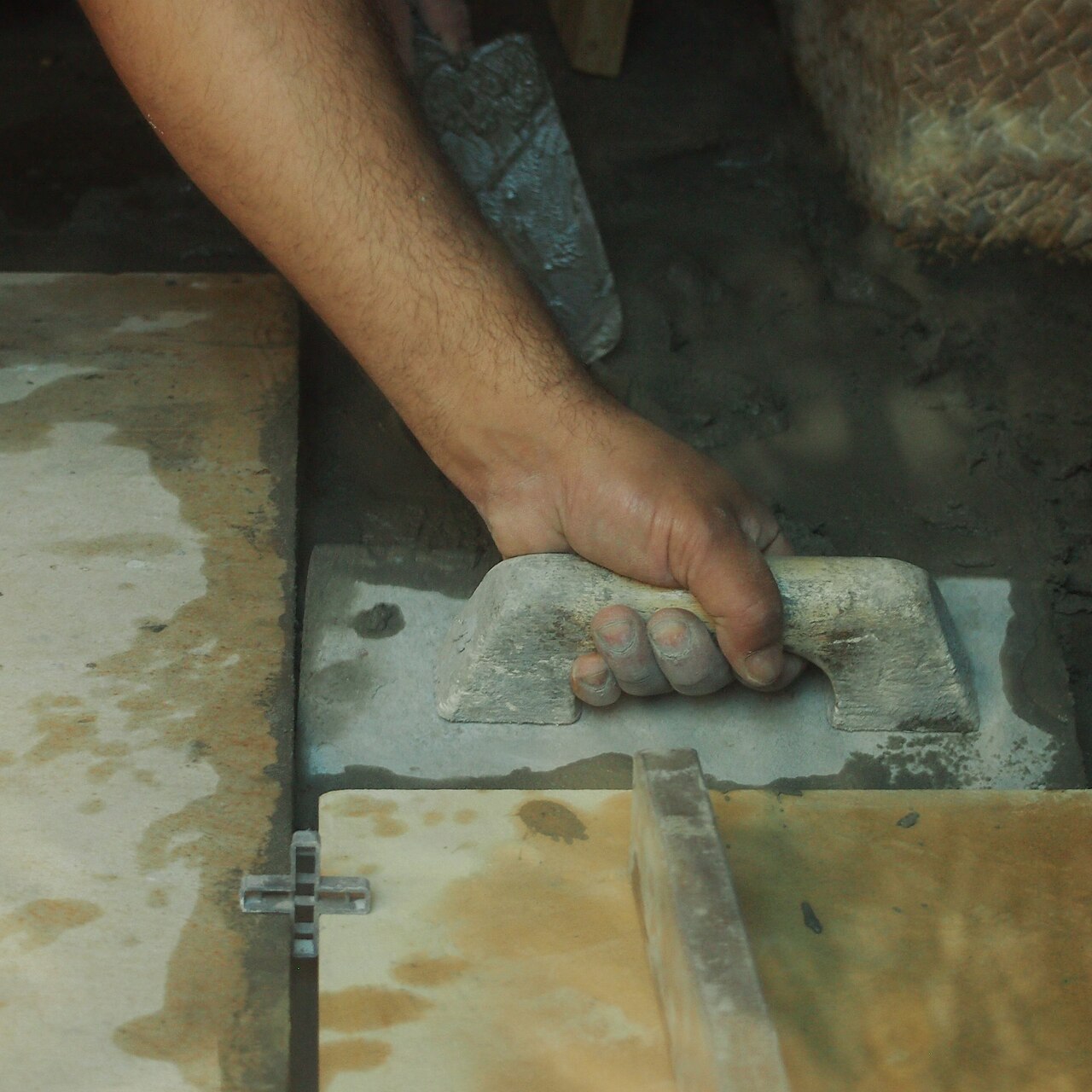
Photo: Francisco Gonzalez, CC BY 2.0, via Wikimedia Commons.

For more on clause structure and checks, see NBS clause writing: common mistakes.
How do you write it in Uniclass?
Uniclass 2015 splits the same information in two. The system clause, for example Ss_30_42_32_40 Internal floor tiling systems, describes the build-up and what it has to achieve. The tile itself is written as a separate product clause with its Pr code, and the system clause points to it.
The advantage is that each product is written once. If the same porcelain tile is used on floors and as a wall upstand, the wall tiling system Ss_25_45_88_40 Internal wall tiling systems points to the same product clause. Change the tile once and both systems follow. Execution and completion clauses sit inside each system section.
- Description
- Porcelain floor tiling bonded to sand and cement screed
- Base
- Sand and cement screed, as the screed system clause
- Tiles
- Pr_35_93_96_63 Porcelain tiles (T01)
- Bedding
- Solid bed, Class C2 S1 adhesive to BS EN 12004-1
- Joint width
- 3 mm
- Grout
- Class CG2WA to BS EN 13888-1
- Movement joints
- To BS 5385-3, sealant to BS EN 15651-4
- Slip resistance of finished floor
- Wet PTV not less than 36 to BS EN 16165 Annex C, slider 96
- Manufacturer
- Submit proposals
- Product reference
- Submit proposals
- Standard
- BS EN 14411, Group BIa
- Nominal size
- 600 x 600 mm, rectified
- Thickness
- 10 mm
- Colour
- TBC Client finishes selection outstanding. Resolve before ordering.
- Finish
- Matt, unglazed, through-body
- Wear resistance
- Deep abrasion to BS EN ISO 10545-6, manufacturer's declared value
- Reaction to fire
- Class A1fl to BS EN 13501-1
- Recycled content
- Submit manufacturer's declared value
Illustrative. Performance of the finished system sits in the system clause; properties of the product sit in the product clause.
In NBS Chorus, Uniclass product clauses also carry an NBS reference (for ceramic tiles, 45-80-95/310). Use whichever your practice's masters use, but do not mix CAWS and Uniclass references in one specification.
What goes in the spec, and what goes in the schedule?
The specification defines each type once. The schedule and drawings say where each type goes.
In the specification
What the product is and how it performs and is installed. Written once per type.
In the schedule or drawings
Where each type goes and how much of it. Changes with every plan revision.
Write each tile type once as a product with a type mark (for example T01) and let the finishes schedule and drawings say where it goes. If the spec names rooms, it will drift from the drawings by the next revision.
What are the common mistakes?
Most problems are a missing property, a property filled with the wrong kind of value, or a decision left silently open.
- An R rating instead of a PTV. Ramp test (R) values come from a shod, oily-boot test in a lab and do not tell you how the floor performs wet on site. Specify the pendulum value.
- Wall tiles on floors. A BIII wall tile chosen for its colour ends up in the floor finish schedule. State the product type and group so the mismatch is visible.
- "Flexible adhesive" with no class. It cannot be checked against a submittal. Give the BS EN 12004-1 class and whether it must be deformable.
- No movement joints. Tiled floors over heated or large screeds crack and tent without them. Say where they go, or state the BS 5385 rule and require them on the setting-out drawing.
- Room names in the clause. "Tiles to WC 1.04 and 1.05" goes out of date at the next plan revision. Use a type mark and the schedule.
- A silent default on colour or format. If a decision has not been made, say so with a TBC and a reason, so it is resolved before ordering rather than discovered on site.
How Avoice helps
Avoice's spec writer drafts tile clauses from the information already on the project, and shows you exactly what it could not work out.
- Drafts from your drawings and schedules
It reads the tile types (T01, T02) from your finishes schedule and drawings, picks the Uniclass or CAWS heading, and fills in the properties it can support from the information you have given it.
- Leaves a TBC where your information does not settle it
If the colour or the slip requirement for a wet area has not been decided, the clause says TBC with the reason, and the item goes into one TBC register for the project so it is closed before tender.
- Writes in your format and your style
Choose CAWS or Uniclass. Avoice adapts your practice's own master clauses rather than replacing them with generic text.
- Checks the clause against everything else
QA/QC flags a T03 on the finishes schedule that the specification never defines, a withdrawn standard, or a tile clause that says porcelain while the drawing note says natural stone.
- Keeps product data in one place
Data sheets and declarations of performance live in the Product Room, linked to the clause, so a substitution can be checked against the properties the clause actually asks for.
Related guides: How to specify natural stone tiles, How to specify vinyl flooring, How to specify tile adhesives.
Software can draft and check. The designer still chooses the product and is responsible for the specification.
For more on the evidence behind product choices, see the role of manufacturer product data in specification writing.
Draft your ceramic tile clause in Avoice
Upload your drawings and schedules. Avoice drafts the clause in CAWS or Uniclass, cites the standards and flags anything your information does not settle.
This guide is for general education and is not professional advice. Check current editions of standards and Approved Documents, the manufacturer's data, and the requirements of your project before relying on any clause.