
How to specify natural stone tiles
What a natural stone floor or wall clause has to say, the test data that stands in for a tile group, the standards to cite, and how to write it in CAWS and in Uniclass.
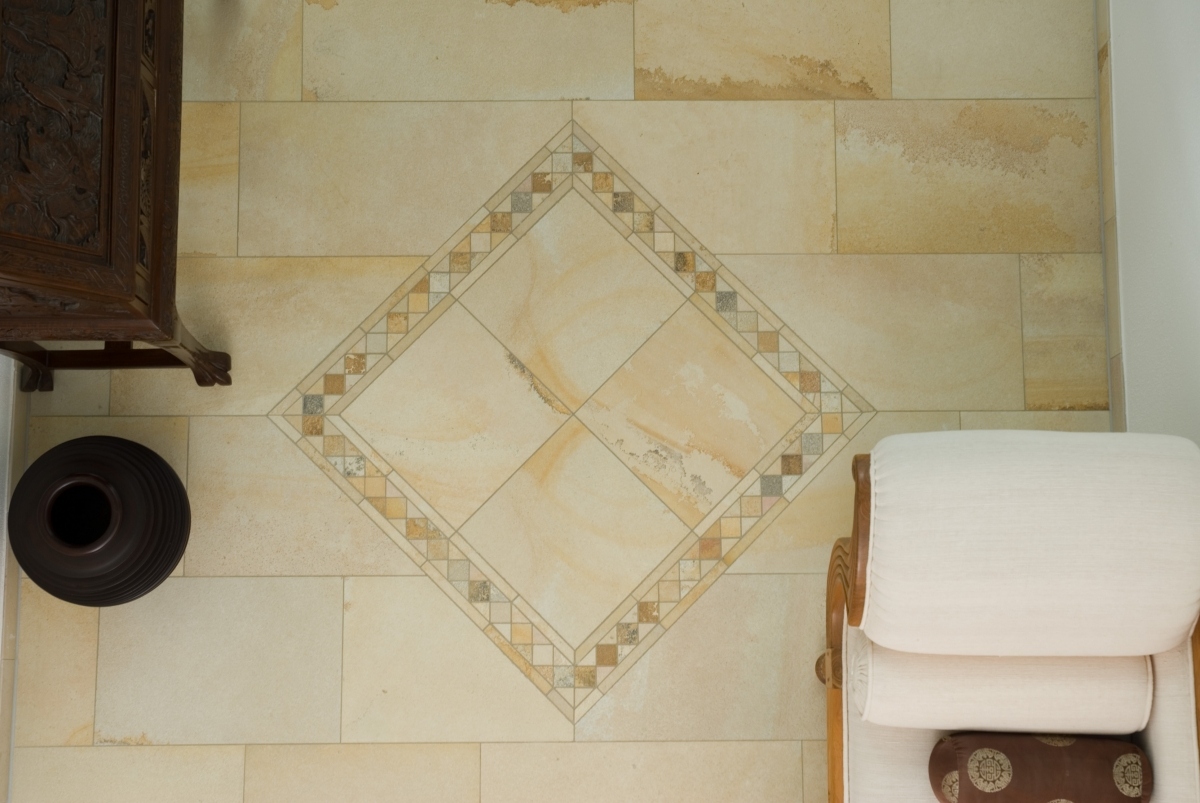
Photo: J.Stiegler, CC BY-SA 3.0, via Wikimedia Commons.

How do you specify natural stone tiles?
To specify natural stone tiles, name the stone by its petrographic and commercial name and its source, then state format, thickness, finish and the declared test values that matter for the location: water absorption, flexural strength, abrasion, frost resistance and wet slip resistance. Cite BS EN 12057 for modular tiles or BS EN 12058 for slabs, and specify the adhesive, grout, sealer and movement joints with the stone.
Stone is a natural material, so the specification cannot lean on a manufacturer's product range the way a porcelain clause can. Two blocks from the same quarry can differ in colour, figuring and porosity, and the finish applied in the factory changes how the floor behaves when it is wet. A clause that reads "limestone, honed, colour to approval" tells the contractor almost nothing about whether the stone delivered will wear, stain or crack in the place it is going.
This guide covers what the clause needs for Uniclass Pr_35_93_96_57 Natural stone tiles. Thicker units for floors and stairs have their own code, Pr_35_93_96_56 Natural stone wall and floor slabs, and are tested and specified in much the same way, so the advice here applies to both.
What does a natural stone tile clause need to cover?
Some properties are specific to natural stone tiles. Others belong in every product clause. A clause that leaves either out gives the contractor room to substitute.
Properties of natural stone tiles
- Product typeWall tile, floor tile, slab or mosaic.
- MaterialStone type: limestone, marble, granite, slate, sandstone.
- ThicknessSet by format, strength and load; decides tile or slab.
- TolerancesCalibrated thickness and squareness limit lippage.
- Slip resistanceNever guessWet PTV for the finish actually supplied.
- Wear resistanceAbrasion resistance to BS EN 14157 for the traffic.
- Freeze-thaw resistanceFrost resistance to BS EN 12371 outside.
- Reaction to fire classificationNever guessNormally A1fl; confirm with substrate and finish.
- Recycled contentUsually nil; reclaimed stone is the exception.
- AdhesiveClass to suit stone; white or resin for sensitive stones.
- GroutBS EN 13888 class, non-staining, colour to stone.
- Joint widthSet by calibration and format.
- Movement jointsPositions to BS 5385, non-staining sealant.
- Laying patternStack, half bond, opus or vein direction.
- AccessoriesTrims, skirtings, thresholds, stair nosings.
What every product clause needs
- Manufacturer and product referenceSupplier, stone name and quarry source.
- Product standardBS EN 12057 tiles or BS EN 12058 slabs, with DoP.
- Installation methodManufacturer's instructions, BS 5385 and this specification.
- Technical submittalsDeclared test values for the actual stone and batch.
- Operation and maintenance informationCleaning products that do not etch, resealing intervals.
- Nominal sizeFormat sets the layout and the thickness needed.
- FinishPolished, honed, flamed, brushed; changes slip and appearance.
- SubstrateBackground, its stiffness and preparation.
- Sample approvalRange samples to fix acceptable colour and veining.
Uniclass Pr_35_93_96_57 Natural stone tiles. Not every property applies to every project; where one does not, say so rather than leaving it blank.
Fields marked Never guess (slip resistance and reaction to fire classification) depend on the project and should never be filled from a default or a previous job. If the information is not available yet, the clause should say so with a TBC and a reason.
Which decisions does the clause depend on?
Most properties follow from the product you choose. These depend on the project, so they need a decision from the designer before the clause is written.
- 01
Naming the stone and asking for its test data
Stone"Limestone" covers dense, hard-wearing beds that have been laid in floors for centuries and soft oolitic stone that dishes in a busy corridor within a few years. BS EN 12440 sets out how a stone is named: its traditional or commercial name, its petrographic family, its colour and where it is quarried. With the stone identified, the supplier can give declared values for that stone, and those values are what tell you whether it suits the floor, the wall or the outside step it is meant for. Without them, any substitution looks like a like-for-like swap.
How to decide
- Name the stone as BS EN 12440 sets out: commercial name, petrographic family and place of origin.
- Ask for declared values for water absorption, flexural strength and abrasion resistance, and frost resistance for anything outside or in an unheated entrance.
- Check the values were measured on the bed or block being supplied, not on a different bed from the same quarry.
- If the client wants a particular appearance but has not chosen a stone, describe the performance and let the contractor propose, with samples.
Write it asStone: Portland limestone, Whitbed, origin Isle of Portland, Dorset, denomination to BS EN 12440. Submit declared values for the bed supplied. - 02
Slip resistance of the finish supplied
Never guessThe same stone can be polished, honed, brushed, sandblasted, flamed or left riven, and each finish gives a different wet pendulum value. A slip figure on a supplier's data sheet usually relates to one finish and says nothing about the others, so a honed limestone chosen for its looks may perform very differently from the flamed version the test report describes. Natural stone suppliers often declare slip resistance to BS EN 14231, the stone test method using the pendulum. For acceptance on site, the UK Slip Resistance Group threshold of a wet PTV of 36 or more for low slip potential is the usual benchmark.
How to decide
- Decide where the floor will be wet in use: entrances, wet rooms, external steps, areas cleaned by mopping.
- Choose the finish with that in mind; polished stone is rarely suitable where the floor gets wet.
- Set a minimum wet PTV measured by the pendulum method in BS EN 16165 Annex C, with slider 96 for shod areas and slider 57 for barefoot areas.
- Require test evidence for the stone and finish actually supplied, and consider a site test on the laid floor.
Write it asSlip resistance: Wet PTV not less than 36, slider 96, tested to BS EN 16165 Annex C on the finish supplied. Submit test report before ordering. - 03
Reaction to fire
Never guessNatural stone is generally class A1, or A1fl as a floor covering, without further testing, so the value is rarely in doubt for the stone itself. The field still needs filling, because a resin-backed or mesh-backed tile is no longer plain stone, and because on walls the stone is only one layer of the lining. Approved Document B's lining classes apply to walls and ceilings, not to floors. Where stone wall cladding sits on an escape route, the fire strategy sets the class, and the backing board and adhesive need to be checked against it too.
How to decide
- Floors: state A1fl to BS EN 13501-1 unless the tile has a resin or mesh backing.
- Resin-filled, mesh-backed or composite stone: ask for the classification of the product as supplied.
- Wall linings on escape routes: take the class from the fire strategy and check the substrate meets it.
Write it asReaction to fire: Class A1fl to BS EN 13501-1. Mesh-backed or resin-treated units: submit classification of product as supplied. - 04
Tile or slab, and how thick
FormatBS EN 12057 covers modular tiles, which are no more than 12 mm thick and no more than 610 mm in any dimension. A unit thicker than 12 mm is a slab under BS EN 12058, and the standard you cite should match what you are buying. Thickness follows from the format, the flexural strength of the stone and the load. A large thin tile of a weaker stone can crack over a slightly hollow bed where a smaller or thicker unit would not. Calibrated stock, ground to a consistent thickness, also matters on a thin adhesive bed, because uncalibrated stone has to be laid on a thick bed to take up the variation.
How to decide
- Cite BS EN 12057 for thin modular tiles and BS EN 12058 for floor and stair slabs.
- For large formats or heavy loads, ask the supplier to confirm thickness against the declared flexural strength.
- Specify calibrated thickness where a thin-bed adhesive is intended.
- Uncalibrated or riven stone: allow for a thick bed and say so in the bedding line.
Write it asFormat: 610 x 305 x 10 mm, calibrated. Product standard: BS EN 12057. - 05
Adhesive, grout and sealer suited to the stone
FixingPale marbles and limestones can show grey adhesive through the stone, which reads as dark patches once the floor is down. Some stones, including certain green marbles and some agglomerates, warp or stain when water-based adhesives are used and need a rapid-setting or reaction resin adhesive. Porous stone can also take up colour from grout. Whether the stone is sealed, when the sealer goes on in relation to grouting, and which cleaning products the client can use all affect how the floor looks after a year in use.
How to decide
- Pale or translucent stone: specify a white adhesive and a grout tested for staining on the stone.
- Water-sensitive stone: ask the supplier, and use a rapid-setting cementitious or reaction resin adhesive if they advise it.
- Give the BS EN 12004-1 class, including deformability where the base is heated or large.
- State whether a sealer is applied, which one, and whether before or after grouting.
Write it asAdhesive: White, Class C2F S1 to BS EN 12004-1, confirmed suitable by the stone supplier. Sealer: Impregnating sealer, applied before grouting.
The values under "Write it as" are examples. The right value depends on the location, the use and the fire strategy.
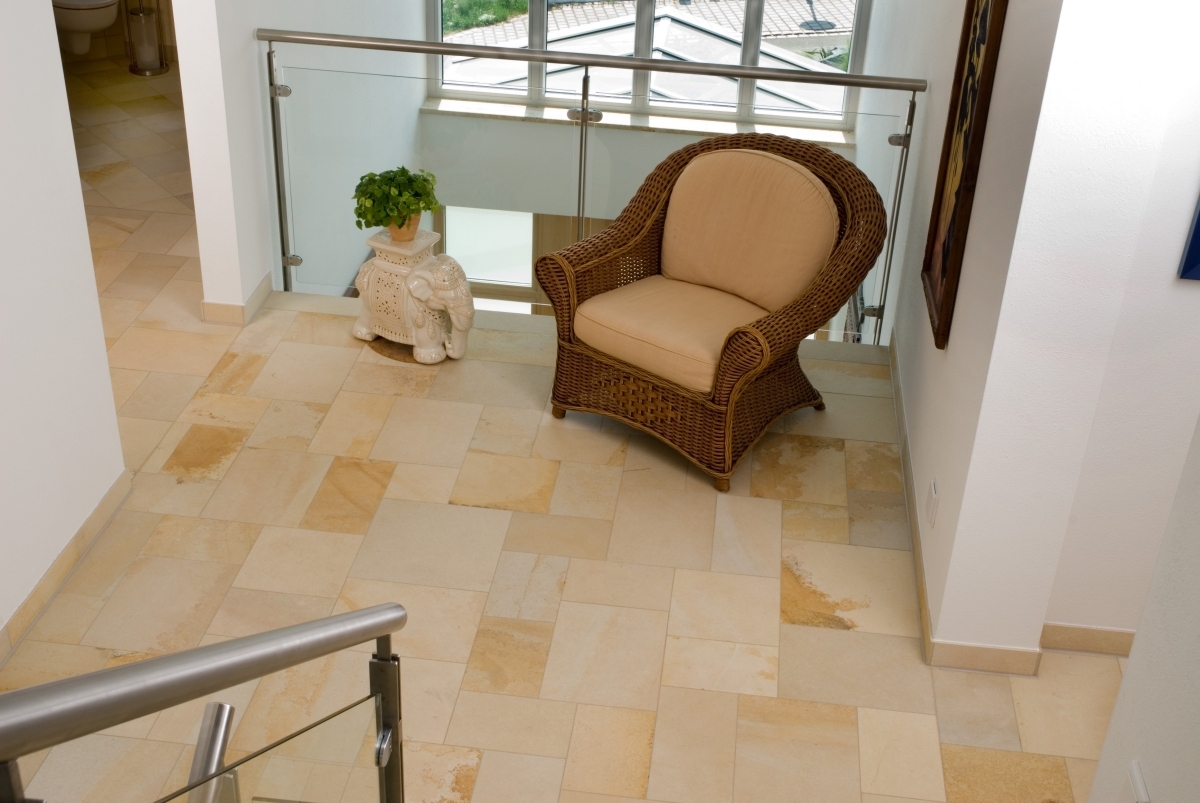
Photo: J.Stiegler, CC BY-SA 3.0, via Wikimedia Commons.

Which standards should the clause cite?
Cite the product standard the declaration of performance refers to, the code of practice for installation, and the test method behind each value you set. A value without its test method cannot be checked against a submittal.
- BS EN 12057
- Natural stone products. Modular tiles. Requirements
The product standard for thin, modular stone tiles: dimensional tolerances, and the characteristics a declaration of performance has to state.
In the clause Cite it as the product standard for tiles: "Product standard: BS EN 12057, declared values submitted".
- BS EN 12058
- Natural stone products. Slabs for floors and stairs. Requirements
The product standard for thicker floor and stair slabs, with its own tolerance classes and declared characteristics.
In the clause Use it in place of BS EN 12057 when the units are slabs: "BS EN 12058, tolerances as the standard".
- BS 5385-5
- Wall and floor tiling. Design and installation of terrazzo, natural stone and agglomerated stone tile and slab flooring. Code of practice
Design and installation of stone floors, including bedding methods, movement joints and protection after laying.
In the clause Use it for workmanship and joints: "Movement joints: positions to BS 5385-5".
- BS EN 12440
- Natural stone. Denomination criteria
How a stone is named so it can be identified: traditional name, petrographic family, colour and place of origin.
In the clause "Denomination to BS EN 12440: Portland limestone, Whitbed, Isle of Portland."
- BS EN 13755
- Natural stone test methods. Determination of water absorption at atmospheric pressure
The water absorption test for stone, which takes the place of the ceramic tile groups when judging porosity and staining risk.
In the clause Ask for the declared value: "Water absorption: declared value to BS EN 13755".
- BS EN 12371
- Natural stone test methods. Determination of frost resistance
Freeze-thaw cycling of stone, used where the stone is external or in an unheated entrance.
In the clause "Frost resistance: declared value to BS EN 12371 for external use."
- BS EN 14157
- Natural stone test methods. Determination of the abrasion resistance
The abrasion test behind a stone's wear performance, useful when comparing stones for busy floors.
In the clause "Abrasion resistance: declared value to BS EN 14157, submitted for approval."
- BS EN 14231
- Natural stone test methods. Determination of the slip resistance by means of the pendulum tester
The pendulum slip test for stone samples, which suppliers commonly use for their declared slip value.
In the clause Accept it as supplier evidence, then set the site requirement to BS EN 16165 Annex C: "declared value to BS EN 14231 for the finish supplied".
- BS EN 16165
- Determination of slip resistance of pedestrian surfaces. Methods of evaluation
Annex C is the pendulum test, including slider choice: slider 96 for shod use and slider 57 for barefoot use. BSI withdrew BS 7976-2 in 2022, so older test reports may still quote it.
In the clause Name the annex and the slider: "Wet PTV not less than 36, tested to BS EN 16165 Annex C using slider 96".
Confirm the current edition of each standard at every issue. Avoice's State of UK Specifications 2026 found a withdrawn standard cited in 40% of specifications at contract issue.
For the regulations behind these choices, see Approved Document B explained, Approved Document M explained, or search the Avoice Regulations library.
How do you write it in CAWS?
Stone tiling and stone slab flooring are written in CAWS section M40, the same section as ceramic and quarry tiling. Each stone and finish combination gets its own clause in the 100s. Stone suppliers' own NBS clauses use 115, Natural stone flooring, and keep the stone's identity, denomination, standard and declared values together in that one clause.
The type clause does not repeat how the stone is bedded, set out or grouted. It points to the general and execution clauses later in M40, which apply to every tiling type on the job. That keeps the stone clause short, but it only works if the referenced clauses are actually in the section and say what the stone needs, such as a thick bed for uncalibrated stone.
- Stone
- Limestone, denomination to BS EN 12440, origin to be stated
- Supplier
- Submit proposals
- Product standard
- BS EN 12057, declared values for the bed supplied
- Size
- 610 x 305 mm
- Thickness
- 10 mm, calibrated
- Finish
- Honed
- Colour and range
- TBC Range samples from the selected bed not yet approved by the client. Resolve before ordering.
- Slip resistance
- Wet PTV not less than 36, slider 96, tested to BS EN 16165 Annex C on the finish supplied
- Abrasion resistance
- Declared value to BS EN 14157
- Reaction to fire
- Class A1fl to BS EN 13501-1
- Base
- Sand and cement screed, as clause 210
- Bedding
- As clause 710
- Adhesive
- White, Class C2F S1 to BS EN 12004-1, approved by stone supplier
- Joint width
- 3 mm
- Grout
- Class CG2WA to BS EN 13888-1, non-staining, colour to match stone
- Movement joints
- To BS 5385-5, positions as setting-out drawing
- Sealer
- Impregnating sealer recommended by stone supplier, applied before grouting
Illustrative, not from a real project. One property is left as a TBC with a reason so it can be tracked and closed before issue.
Clauses the type clause relies on
- M40/210
- Suitability of backgrounds/ bases Base strength, flatness and dryness before any stone is laid.
- M40/260
- Control samples A sample area of finished floor, approved for appearance before the rest proceeds.
- M40/510
- Fixing generally Full adhesion over base and tile backs, and adjustment while the bed is workable.
- M40/560
- Level of tiling across joints Maximum lippage between adjacent units, which calibration helps to meet.
- M40/710
- Thick bed adhesive - solid (floors) Floated bed, back-buttered units and a solid bed with no voids.
- M40/875
- Grouting Timing, joint depth and cleaning off without staining the stone.
Clause numbers vary between NBS versions and practice masters. Check that the clauses your type clause refers to exist in your own M40 and cover stone, not only ceramic tiles.
For more on clause structure and checks, see NBS clause writing: common mistakes.
How do you write it in Uniclass?
In a Uniclass specification the floor is written as a system clause and the stone as a product clause. Ss_30_42_56_57 Natural stone tile flooring systems describes the build-up from the base upwards and what the finished floor has to achieve, including its slip resistance once laid. Thicker slab floors use Ss_30_42_56_56 Natural stone slab flooring systems instead.
The product clause carries what is true of the stone wherever it is used: its denomination, standard, size, finish and declared values. If the same limestone runs from a floor up a stair or onto a wall, each system points to the one product clause, so a change of bed or supplier is made once.
- Description
- Honed limestone floor bonded to sand and cement screed
- Base
- Sand and cement screed, as the screed system clause
- Stone
- Pr_35_93_96_57 Natural stone tiles (T02)
- Bedding
- Solid bed, white Class C2F S1 adhesive to BS EN 12004-1
- Joint width
- 3 mm
- Grout
- Class CG2WA to BS EN 13888-1, non-staining
- Movement joints
- To BS 5385-5
- Slip resistance of finished floor
- Wet PTV not less than 36 to BS EN 16165 Annex C, slider 96
- Stone
- Limestone, denomination to BS EN 12440
- Supplier
- Submit proposals
- Product standard
- BS EN 12057
- Nominal size
- 610 x 305 mm
- Thickness
- 10 mm, calibrated
- Finish
- Honed
- Colour and range
- TBC Range samples from the selected bed not yet approved by the client. Resolve before ordering.
- Water absorption
- Declared value to BS EN 13755
- Abrasion resistance
- Declared value to BS EN 14157
- Reaction to fire
- Class A1fl to BS EN 13501-1
- Sealer
- Impregnating sealer recommended by the stone supplier
Illustrative. Performance of the finished system sits in the system clause; properties of the product sit in the product clause.
In NBS Chorus, Uniclass product clauses also carry an NBS reference (for natural stone tiles, 45-80-95/325). Pick one system for the whole specification rather than mixing CAWS and Uniclass references.
What goes in the spec, and what goes in the schedule?
The specification defines each type once. The schedule and drawings say where each type goes.
In the specification
What the product is and how it performs and is installed. Written once per type.
In the schedule or drawings
Where each type goes and how much of it. Changes with every plan revision.
Write each stone and finish combination once as a product with a type mark (for example T02) and let the finishes schedule and drawings say where it goes. A honed floor and a polished wall in the same stone are two types, because their slip and maintenance differ.
What are the common mistakes?
Most problems are a missing property, a property filled with the wrong kind of value, or a decision left silently open.
- "Limestone" with no name or source. Limestones range from dense floor stone to soft beds that wear quickly. Name the stone to BS EN 12440 and ask for declared values for the bed supplied.
- Slip data for a different finish. A PTV for a flamed or riven sample tells you nothing about the honed or polished stone that was chosen. Ask for evidence on the finish supplied.
- Grey adhesive under pale marble. It shows through and the floor looks patchy. Specify white adhesive and a grout that has been tried on the stone.
- Uncalibrated stone on a thin bed. Thickness variation turns into lippage and hollow spots. Either specify calibrated stock or a thick bed that can take it up.
- One small sample as the colour standard. Stone varies, and a single piece will not represent a whole order. Approve range samples or a control area and keep them as the reference.
- No sealer or cleaning regime. Porous stone in kitchens and entrances marks quickly. Say whether it is sealed, with what, and which cleaning products the client should avoid.
How Avoice helps
Avoice's spec writer drafts stone clauses from the project information and tells you which decisions about the stone are still open.
- Drafts from your drawings and schedules
It picks up stone types such as T02 and T03 from the finishes schedule and drawings, and writes a clause for each stone and finish combination rather than one clause for "limestone".
- Marks what is undecided with a TBC
If the bed, the range samples or the slip requirement for an entrance has not been settled, the line says TBC with the reason, and it is listed in the project's TBC register so it is closed before tender.
- Works in your format
Write in CAWS or Uniclass. Avoice adapts your practice's own master clauses, including any stone clauses you already use, rather than swapping in generic text.
- Checks the stone clause against the rest of the set
QA/QC flags a stone type on the drawings that the specification never defines, a polished finish scheduled for an external step, a cross-reference to an M40 clause that does not exist, or a withdrawn standard.
- Holds the supplier's evidence with the clause
Declarations of performance, test reports and data sheets sit in the Product Room linked to the clause, so a proposed alternative stone can be checked against the declared values the clause asks for.
Related guides: How to specify ceramic tiles, How to specify tile adhesives, How to specify sealants.
Software can draft and check. The designer still chooses the product and is responsible for the specification.
For more on the evidence behind product choices, see the role of manufacturer product data in specification writing.
Draft your natural stone tile clause in Avoice
Upload your drawings and schedules. Avoice drafts the clause in CAWS or Uniclass, cites the standards and flags anything your information does not settle.
This guide is for general education and is not professional advice. Check current editions of standards and Approved Documents, the manufacturer's data, and the requirements of your project before relying on any clause.