
How to specify tile adhesives
What a tile adhesive clause has to say, the BS EN 12004-1 classes that make it checkable, the backgrounds that change the choice, and how to write it in CAWS and in Uniclass.
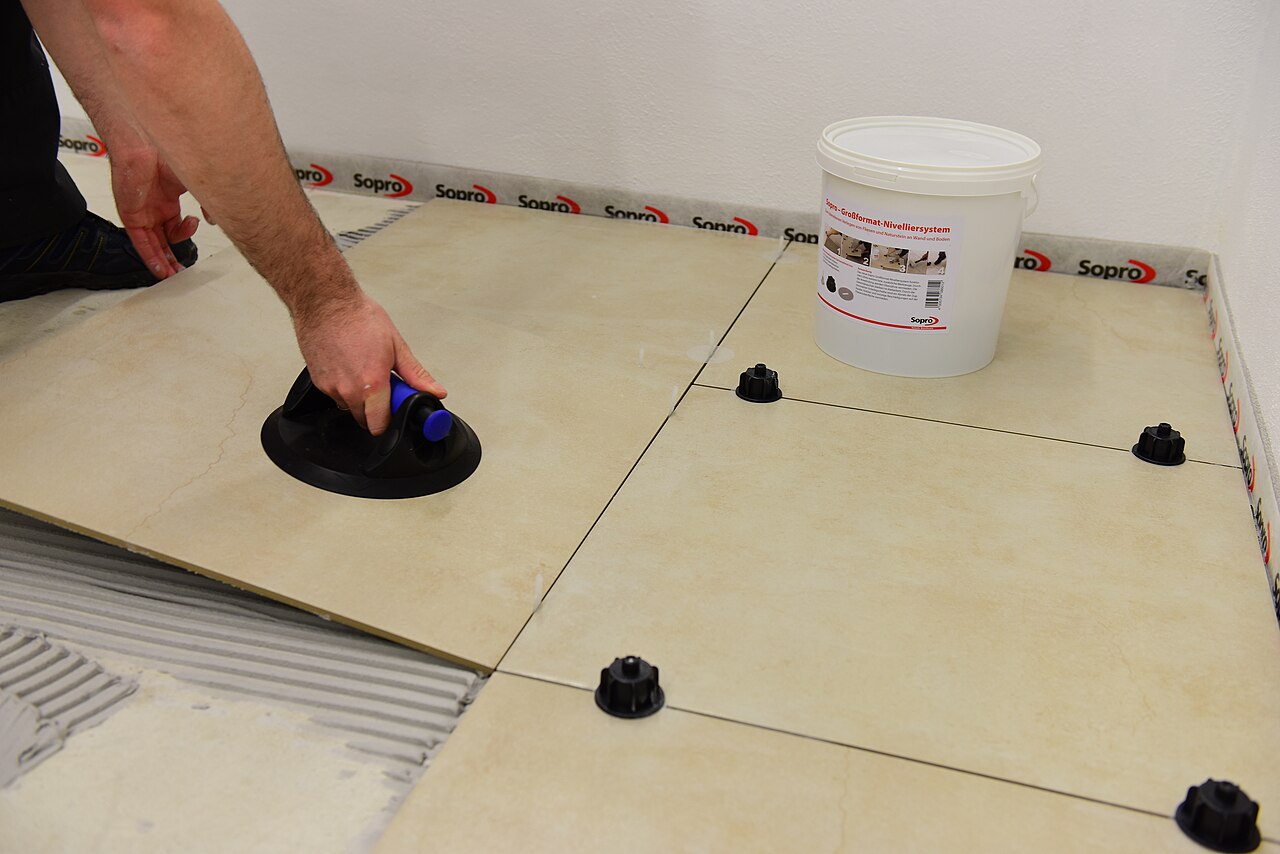
Photo: Frank Winkelmann, CC0, via Wikimedia Commons.

How do you specify tile adhesives?
To specify tile adhesive, give its BS EN 12004-1 classification (for example C2 TE S1), not a description like "flexible", and match it to the tile, the background and the exposure. State the substrate and its preparation, the bed coverage, and the reaction to fire where wall tiling sits on an escape route or an external wall. Write the adhesive as its own product clause and reference it from each tile type.
When tiles come away from a floor or a wall, the tile itself is rarely the cause. The adhesive could not take the movement of a heated screed, it was spread and left until it skinned, it went onto a gypsum-based screed without a primer, or it was simply never intended for the background it was used on. "Flexible adhesive to manufacturer's recommendations" leaves every one of those choices to whoever is on site that day.
This guide covers what the clause needs for Uniclass Pr_20_31_02_89 Tile adhesives. It applies to ceramic, porcelain and stone tiling alike; what changes from job to job is the background, the tile format and the exposure, and those decide the class.
What does a tile adhesive clause need to cover?
Some properties are specific to tile adhesives. Others belong in every product clause. A clause that leaves either out gives the contractor room to substitute.
Properties of tile adhesives
- Product typeOne-part powder, two-part or ready-mixed paste.
- Bond strengthTensile adhesion tested to BS EN 12004-2.
- Adhesive classificationFull class code, e.g. C2 TE S1.
- SubstrateBackground, its condition and any primer.
- FinishGrey or white; white under light stone and glass.
- Structural performanceNever guessHeavy or overhead tiling needs an engineered fixing approach.
- Open timeWorking time before skinning; E class extends it.
- Application conditionsTemperature and humidity limits during fixing and cure.
- Reaction to fire classificationNever guessEuroclass to BS EN 13501-1 where linings are controlled.
- Curing timeTime to grouting and traffic; F class shortens it.
- Moisture resistanceShowers, pools and external tiling need water-resistant adhesive.
- VOC contentLow-emission evidence for internal air quality targets.
- CompatibilitySuits the tile body, membranes and underfloor heating.
- Application rateTrowel notch and solid-bed coverage for the format.
What every product clause needs
- Manufacturer and product referenceNamed adhesive, or a classification and performance description.
- Product standardBS EN 12004-1, evidenced by the declaration of performance.
- Installation methodManufacturer's instructions, BS 5385 and this specification.
- Technical submittalsData sheet and DoP showing the declared class.
- Operation and maintenance informationProduct records for future repairs and retiling.
- MaterialCementitious, dispersion or reaction resin.
Uniclass Pr_20_31_02_89 Tile adhesives. Not every property applies to every project; where one does not, say so rather than leaving it blank.
Fields marked Never guess (structural performance and reaction to fire classification) depend on the project and should never be filled from a default or a previous job. If the information is not available yet, the clause should say so with a TBC and a reason.
Which decisions does the clause depend on?
Most properties follow from the product you choose. These depend on the project, so they need a decision from the designer before the clause is written.
- 01
Writing the full classification
ClassBS EN 12004-1 gives every adhesive a code that can be checked against its declaration of performance. The letter gives the type: C for cementitious, D for dispersion, R for reaction resin. The number gives the level, 1 for normal and 2 for improved. Optional letters follow: F for fast setting, T for reduced slip on walls, E for extended open time. Deformability is shown as S1 or S2. Written in full, as C2TE S1 for example, the code leaves nothing to interpretation, and a submittal either matches it or does not.
How to decide
- Start from the type: cementitious for most work, reaction resin for chemical exposure or difficult backgrounds such as metal.
- Use level 2 for floors, external work, large formats and anything heavier than a small wall tile.
- Add T on walls, F where tiles must be grouted or trafficked quickly, E for large formats and warm conditions.
- Add S1 or S2 where the background or the format puts strain on the bed.
Write it asClassification: C2E S1 to BS EN 12004-1. Submit declaration of performance showing the declared class. - 02
The background, the primer and deformability
BackgroundA cured sand and cement screed is the easy case. Heated screeds, timber and board backgrounds, render and large-format porcelain all put more strain on the adhesive bed, and that strain is what S1 and S2 deformability is for. Calcium sulfate screeds need particular care: a cementitious adhesive laid directly onto the gypsum surface can react with it and lose bond, so the adhesive manufacturer's primer is not optional. Waterproofing membranes and decoupling layers also need an adhesive that their manufacturer has approved, both underneath and on top.
How to decide
- Name the background in the clause so the primer and preparation follow from it.
- Calcium sulfate screeds: require the adhesive manufacturer's primer and confirm the screed is dry enough.
- Heated, timber or board backgrounds and large formats: ask for S1 or S2.
- Membranes and decoupling layers: use an adhesive the membrane manufacturer lists as compatible.
Write it asSubstrate: Calcium sulfate screed, laitance removed, dry, primed with adhesive manufacturer's primer. Deformability: S1. - 03
Bed method and coverage
CoverageA floor tile needs a solid bed with no voids. Voids under a floor tile let it crack when a point load lands on the unsupported area, and in wet areas they hold water. For large formats this normally means a notched trowel bed plus back-buttering of each tile, with the trowel size chosen for the format and the flatness of the base. Walls in dry areas can be more forgiving, but external walls, shower enclosures and heavy tiles need the same solid bed. Coverage is easy to check during the work and very hard to check afterwards.
How to decide
- Floors, external work and wet areas: solid bed, back-buttered where the format calls for it.
- Large formats or uneven tile backs: back-butter every tile and use the trowel the adhesive manufacturer recommends.
- Write in a check: lift a tile at intervals during the work and inspect the coverage.
Write it asBedding: Solid bed, notched trowel and back-buttering, no voids. Coverage to be checked by lifting tiles at intervals during the work. - 04
Heavy, external and overhead tiling
Never guessAdhesive is a bond, not a structural fixing, and on some work a default class should not be left to stand in for a design. Heavy large-format tiles on walls, tiling on external facades, soffits and other overhead tiling all carry a consequence if a tile lets go. BS 5385-2 treats external walls as their own design case. The adhesive manufacturer and, where the risk warrants it, an engineer should confirm whether adhesive alone is enough, or whether mechanical restraint is needed as well, and the clause should record that decision.
How to decide
- Identify any tiling over a walkway, at height, on a soffit or on an external wall.
- For those areas, ask the adhesive manufacturer to confirm the system for the tile weight, format and background.
- Where the consequence of a tile falling is serious, get an engineer to decide on mechanical restraint.
- Record the outcome in the clause rather than leaving it to a general note.
Write it asStructural performance: External wall tiling. Fixing method confirmed in writing by adhesive manufacturer and engineer, including any mechanical restraint. - 05
Reaction to fire
Never guessUnder ceramic tiles, a cementitious adhesive rarely changes the fire result, but dispersion and resin adhesives contain organic binders, and on walls the adhesive is part of the lining. Where Approved Document B sets a class for a wall or ceiling lining, or where the tiling is on an external wall, the classification has to cover the build-up as tested, not only the tile. Floor tiling is outside ADB's lining classes. The clause should state the class required or say that it follows the fire strategy, rather than staying silent.
How to decide
- Floors: state the declared class, and note that the lining classes do not apply.
- Wall linings on escape routes: take the class from the fire strategy and ask for evidence for the tile, adhesive and board together.
- External walls: check how the project's external wall requirements apply to the whole tiled build-up.
- Dispersion or resin adhesives on walls: ask for the classification before accepting a substitute.
Write it asReaction to fire: Wall lining build-up to achieve the class in the fire strategy. Submit classification covering tile, adhesive and board.
The values under "Write it as" are examples. The right value depends on the location, the use and the fire strategy.
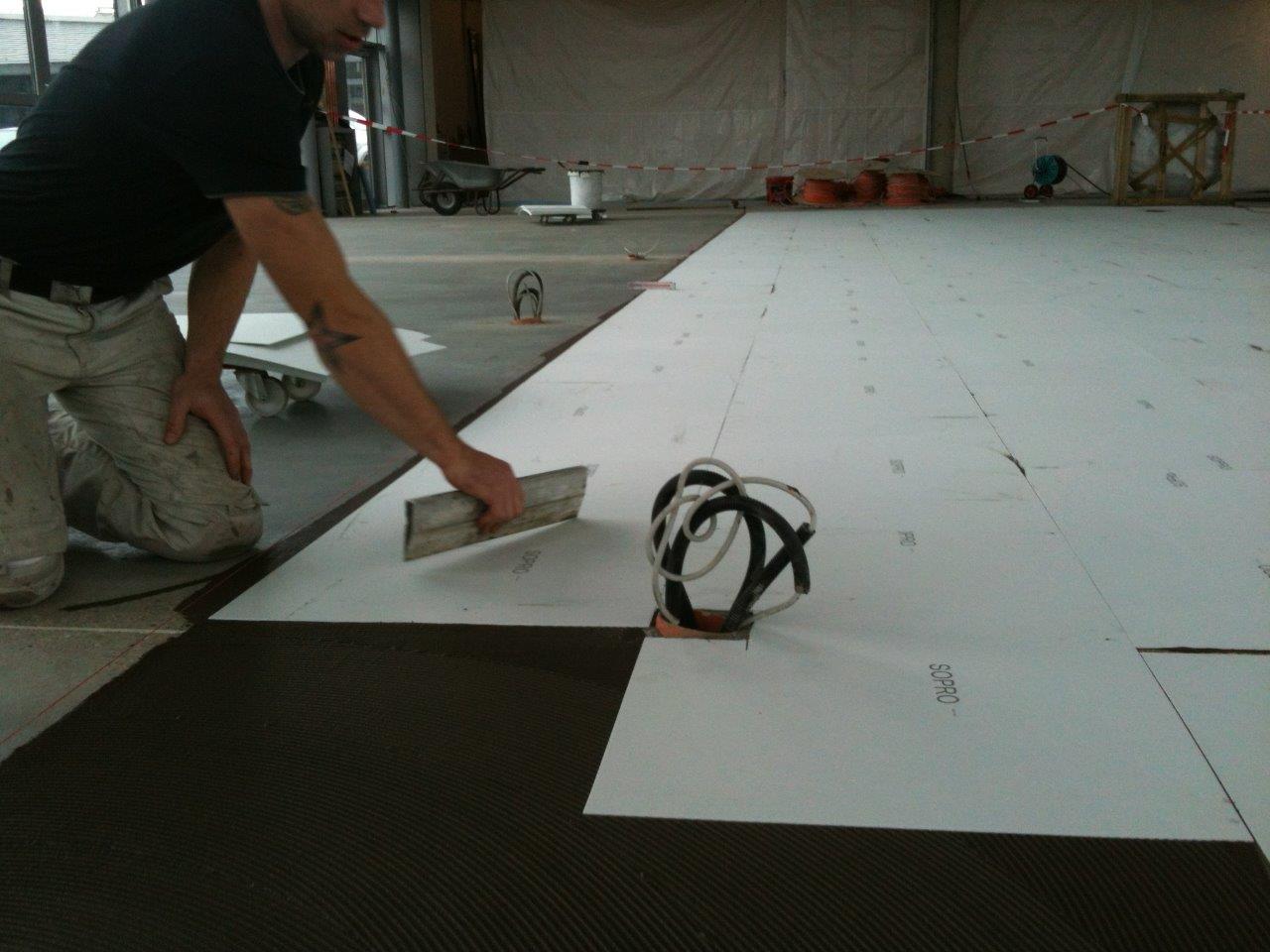
Photo: Frank Winkelmann, CC BY-SA 4.0, via Wikimedia Commons.

Which standards should the clause cite?
Cite the product standard the declaration of performance refers to, the code of practice for installation, and the test method behind each value you set. A value without its test method cannot be checked against a submittal.
- BS EN 12004-1
- Adhesives for ceramic tiles. Requirements, assessment and verification of constancy of performance, classification and marking
The product standard: adhesive types C, D and R, levels 1 and 2, and the optional characteristics F, T, E, S1 and S2.
In the clause Give the full code: "Classification: C2TE S1 to BS EN 12004-1".
- BS EN 12004-2
- Adhesives for ceramic tiles. Test methods
The tests behind the classes: tensile adhesion strength, open time, slip on walls and transverse deformation.
In the clause Use it when asking for declared values: "Open time: declared value to BS EN 12004-2".
- BS 5385 series
- Wall and floor tiling
The code of practice for tiling design and installation, including backgrounds, bed coverage and movement joints. Part 2 covers external walls; Part 3 covers floors.
In the clause "Bedding and coverage: to BS 5385-3 and the adhesive manufacturer's instructions."
- BS 8000-11
- Workmanship on building sites. Internal and external wall and floor tiling. Ceramic and agglomerated stone tiles, natural stone and terrazzo tiles and slabs, and mosaics. Code of practice
Site workmanship for ceramic, stone and terrazzo tiling and mosaics, including preparation and the fixing of tiles.
In the clause Cite it for workmanship generally: "Workmanship: to BS 8000-11".
- BS EN 14411
- Ceramic tiles. Definition, classification, characteristics, assessment and verification of constancy of performance and marking
The tile standard. The tile's water absorption group tells you how much the adhesive has to rely on adhesion rather than mechanical key.
In the clause Reference it through the tile clause: "Use with: Porcelain tiles, BS EN 14411 Group BIa".
- BS EN 13501-1
- Fire classification of construction products and building elements. Classification using data from reaction to fire tests
The Euroclass system used for the reaction to fire of the tiled build-up.
In the clause "Reaction to fire: Class to BS EN 13501-1 as fire strategy, for the tested build-up."
Confirm the current edition of each standard at every issue. Avoice's State of UK Specifications 2026 found a withdrawn standard cited in 40% of specifications at contract issue.
For the regulations behind these choices, see Approved Document B explained, or search the Avoice Regulations library.
How do you write it in CAWS?
CAWS has no separate product clause for tile adhesive. The adhesive is written inside each tiling type clause in M40, in the 100s, alongside the tile, the base, the bedding and the grout. Manufacturers' NBS clauses follow the same pattern: adhesive, bedding and grout lines sit inside the tiling clause, such as 110, rather than in a clause of their own. If two tiling types need different adhesives, because one is on a heated screed and the other on plasterboard, each type clause names its own.
The type clause states which adhesive. How it is applied comes from the general and execution clauses later in M40: suitability of the base, fixing generally, the bedding method and grouting. These carry rules that matter for adhesive, such as priming where the adhesive manufacturer recommends it and no admixtures other than those the manufacturer approves.
- Tiles
- Porcelain, BS EN 14411 Group BIa, 600 x 600 mm
- Base
- Floating sand and cement screed over underfloor heating, as section M10
- Preparation
- Laitance removed, primed as adhesive manufacturer recommends
- Bedding
- Solid bed, as clause 710
- Adhesive manufacturer
- Submit proposals
- Product reference
- Submit proposals
- Classification
- C2E S1 to BS EN 12004-1
- Colour
- Grey
- Compatibility
- TBC Heating system type and commissioning record not yet issued by the M&E engineer. Resolve before ordering.
- Coverage
- Notched trowel bed and back-buttering, no voids; lift tiles at intervals to check
- Open time
- Do not bed tiles into skinned adhesive; remove and respread
- Application conditions
- Within adhesive manufacturer's temperature limits; heating off during fixing and curing
- Joint width
- 3 mm
- Grout
- Class CG2WA to BS EN 13888-1
- Movement joints
- To BS 5385-3, including at heating zone boundaries
- Technical submittals
- Adhesive data sheet and declaration of performance before ordering
Illustrative, not from a real project. One property is left as a TBC with a reason so it can be tracked and closed before issue.
Clauses the type clause relies on
- M40/210
- Suitability of backgrounds/ bases Base strong, flat, dry and clean enough for the adhesive and bed thickness proposed.
- M40/510
- Fixing generally Adhesive compatible with the base, primed if recommended, only approved admixtures, full adhesion.
- M40/710
- Thick bed adhesive - solid (floors) Floated coat on the base, adhesive on tile backs, finished thickness in the manufacturer's range.
- M40/875
- Grouting Grout only once the adhesive has set enough that tiles will not move.
Clause numbers vary between NBS versions and practice masters. The numbers here follow an NBS-format M40; check your own section has a bedding clause that suits each adhesive you name.
For more on clause structure and checks, see NBS clause writing: common mistakes.
How do you write it in Uniclass?
Uniclass handles adhesive differently from CAWS. The tiling system clause, for example Ss_30_42_32_40 Internal floor tiling systems, describes the build-up and its performance and names the bedding. The adhesive is then written once as its own product clause with its own type mark, so it can be referenced from as many tiling systems as use it.
That suits adhesive well, because one product often serves several tile types. A floor system and a wall system such as Ss_25_45_88_40 Internal wall tiling systems can share an adhesive, or each can point to a different one where the backgrounds differ. The product clause holds what the adhesive is; the system clause holds how and where it is used.
- Description
- Porcelain floor tiling on floating heated screed
- Base
- Sand and cement screed, as the screed system clause
- Tiles
- Pr_35_93_96_63 Porcelain tiles (T02)
- Adhesive
- Pr_20_31_02_89 Tile adhesives (A01)
- Bedding
- Solid bed, back-buttered, no voids
- Grout
- Class CG2WA to BS EN 13888-1
- Movement joints
- To BS 5385-3, at heating zone boundaries
- Manufacturer
- Submit proposals
- Product reference
- Submit proposals
- Product standard
- BS EN 12004-1
- Classification
- C2E S1
- Material
- Polymer-modified cementitious, one-part powder
- Colour
- Grey
- Compatibility
- TBC Heating system type and commissioning record not yet issued by the M&E engineer. Resolve before ordering.
- Open time
- Declared value to BS EN 12004-2
- Reaction to fire
- Declared class to BS EN 13501-1
- VOC content
- Low-emission product, evidence to be submitted
Illustrative. Performance of the finished system sits in the system clause; properties of the product sit in the product clause.
In NBS Chorus, Uniclass product clauses also carry an NBS reference (for tile adhesives, 45-50-00/312). Use CAWS or Uniclass throughout a specification, not a mixture.
What goes in the spec, and what goes in the schedule?
The specification defines each type once. The schedule and drawings say where each type goes.
In the specification
What the product is and how it performs and is installed. Written once per type.
In the schedule or drawings
Where each type goes and how much of it. Changes with every plan revision.
Write each adhesive once as its own product with a type mark (for example A01) and reference it from the tile clauses. Where two tile types share a background they can share an adhesive, so the clause count stays small.
What are the common mistakes?
Most problems are a missing property, a property filled with the wrong kind of value, or a decision left silently open.
- "Flexible adhesive" with no class. It cannot be checked against anything. Give the full BS EN 12004-1 code, including S1 or S2 where deformability matters.
- Cementitious adhesive straight onto calcium sulfate screed. Without the right primer the bond at the interface can fail. Name the screed type in the clause so the primer follows.
- Spot fixing on floors. Voids under floor tiles crack under point loads and hold water in wet areas. State a solid bed and how coverage will be checked.
- Grey adhesive under pale stone or glass. It shows through. Specify a white adhesive wherever the tile clause calls for a pale or translucent finish.
- One adhesive line for every background. Plasterboard, render, screed, timber and membranes need different preparation and sometimes a different class. Split the clause where the backgrounds differ.
- A default where a decision is missing. If the fire strategy or the engineer has not confirmed the answer for external or wall tiling, record a TBC with a reason rather than copying the previous job.
How Avoice helps
Avoice's spec writer drafts the adhesive with the tiling it belongs to, and points out where the background has not been settled.
- Drafts from your drawings and schedules
It reads the tile types and the backgrounds from the finishes schedule and the floor and wall build-ups, and picks an adhesive class for each combination, such as S1 deformability over a heated screed.
- Leaves a TBC when the background is unknown
If the screed type, the heating or the membrane has not been confirmed, the adhesive line says TBC with the reason, and the item joins the project's TBC register so it is closed before tender.
- Writes it the way your format expects
In CAWS the adhesive goes inside each M40 type clause; in Uniclass it becomes a product clause the tiling systems refer to. Avoice adapts your practice's own master clauses either way.
- Checks the adhesive against the build-ups
QA/QC flags a cementitious adhesive specified straight onto a calcium sulfate screed with no primer, a tile type with no adhesive at all, a missing bedding clause, or a withdrawn standard.
- Keeps the declarations with the clause
Adhesive data sheets and declarations of performance live in the Product Room linked to the clause, so a substitute can be checked against the class the clause asks for. Edit the linked product once and every clause that uses it follows.
Related guides: How to specify ceramic tiles, How to specify natural stone tiles, How to specify screeds.
Software can draft and check. The designer still chooses the product and is responsible for the specification.
For more on the evidence behind product choices, see the role of manufacturer product data in specification writing.
Draft your tile adhesive clause in Avoice
Upload your drawings and schedules. Avoice drafts the clause in CAWS or Uniclass, cites the standards and flags anything your information does not settle.
This guide is for general education and is not professional advice. Check current editions of standards and Approved Documents, the manufacturer's data, and the requirements of your project before relying on any clause.