
How to specify damp-proof membranes
What a damp-proof membrane clause has to say beyond the gauge, the decisions behind it, the standards to cite, and how to write it in CAWS and in Uniclass.
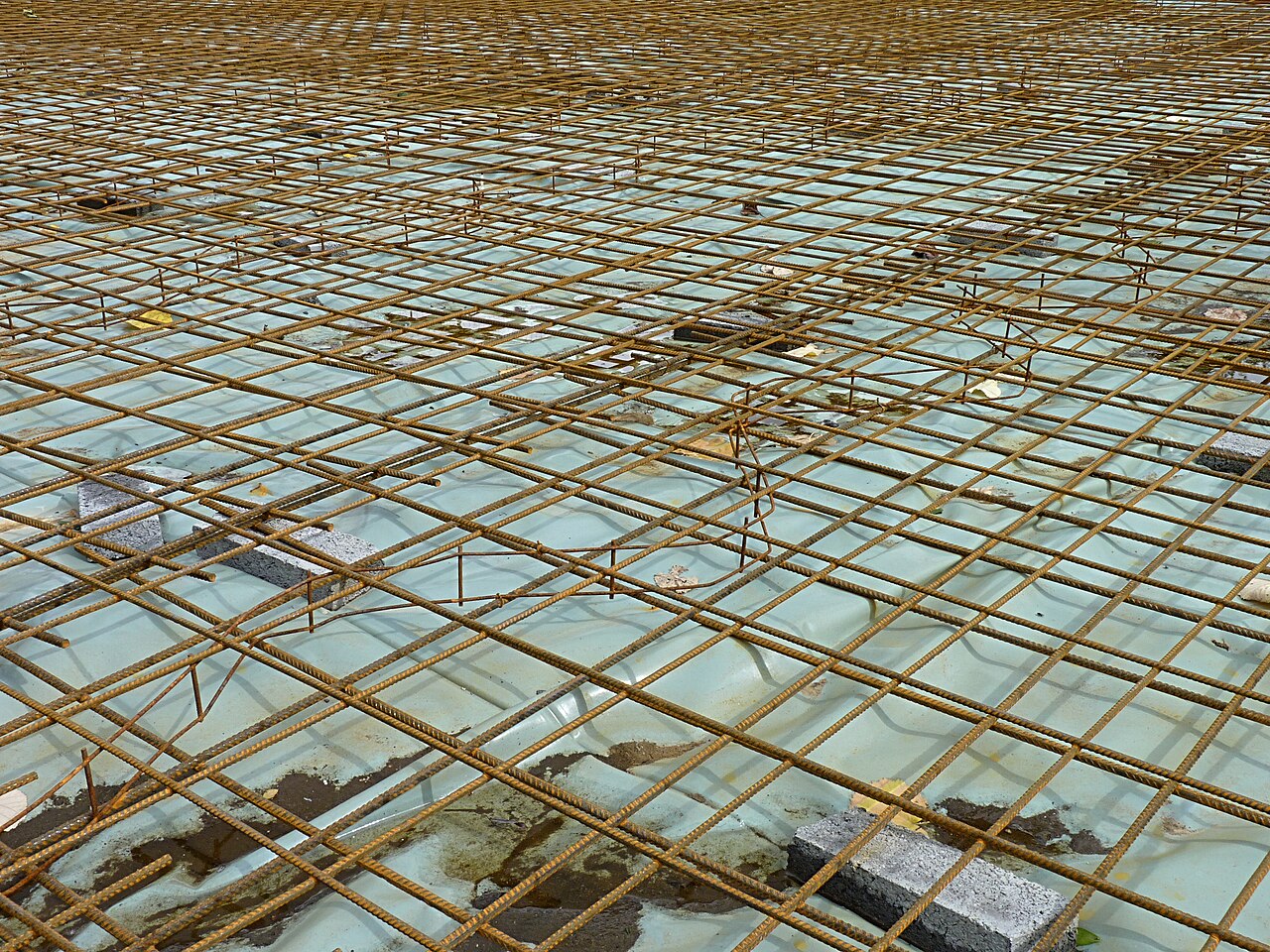
Photo: Jamain, CC BY-SA 3.0, via Wikimedia Commons.

How do you specify damp-proof membranes?
To specify a damp-proof membrane, state the material and thickness (Approved Document C gives polyethylene of at least 300 micrometres, often called 1200 gauge, with sealed joints), its position relative to the slab, and how it is lapped and joined to the damp-proof course in the walls. Then decide separately whether the floor also needs radon or ground gas protection, which comes from the site risk assessment, not from the DPM default.
Plenty of DPM clauses are a single line: "1200 gauge polythene DPM". That fixes the thickness and nothing else. It leaves out how the laps are sealed, how the membrane meets the DPC in the walls, what stops the hardcore puncturing it, and whether the site needs radon or ground gas protection, which a plain DPM does not provide. Those are the things that decide whether the floor stays dry and whether the building meets the site's gas risk assessment.
This guide covers the clause for a sheet membrane under or within a ground floor, coded in Uniclass as Pr_25_57_65_63 Polyethylene sheets. Some gas-resistant membranes are high-density polyethylene and sit under Pr_25_57_65_37 High-density polyethylene (PE-HD) sheets instead; others are composites, so check the product before choosing the heading.
What does a damp-proof membrane clause need to cover?
Some properties are specific to damp-proof membranes. Others belong in every product clause. A clause that leaves either out gives the contractor room to substitute.
Properties of damp-proof membranes
- Product typePlain DPM, radon barrier or ground gas membrane.
- FunctionDamp-proofing only, or also gas protection.
- Nominal sizeRoll width sets how many laps need sealing.
- ThicknessAt least 300 micrometres polyethylene per Approved Document C.
- FinishColour identifies DPM, radon or gas membrane on site.
- SubstrateBlinded hardcore, slab or screed; sets protection needed.
- PrimerNeeded where tapes bond to concrete or masonry.
- Vapour resistanceGround moisture held back from floor finishes.
- Gas resistanceNever guessRadon or ground gas protection from the site risk assessment.
- Waterproofing gradeNever guessBS 8102 grade only where the floor is below ground.
- Tensile strengthResists tearing when laid and concreted over.
- Elongation at breakAccommodates settlement of the sub-base.
- Puncture resistanceHardcore, reinforcement chairs and boots puncture it.
- Impact resistanceBarrows and placed concrete strike it during the pour.
- UV resistanceLimits how long it can lie exposed before concreting.
- Weather resistanceRetained strength if left exposed on site.
- Recycled contentRecycled polyethylene only where the certificate covers it.
- Reaction to fire classificationNever guessEuroclass to BS EN 13501-1; matters where not enclosed.
- Third-party certificationCertificate covering use as a DPM or gas barrier.
- Laps and jointsLaps taped; gas membranes need every joint sealed.
- AccessoriesTapes, preformed corners, top hats and pipe collars.
What every product clause needs
- Manufacturer and product referenceNamed manufacturer and product, or a performance description.
- Product standardBS EN 13967, evidenced by the declaration of performance.
- Installation methodManufacturer's instructions plus this specification.
- Technical submittalsData sheet, DoP, certificate and gas test evidence.
- Operation and maintenance informationRecord of membrane and gas measures for future alterations.
- MaterialPolyethylene, or a composite gas-resistant membrane.
Uniclass Pr_25_57_65_63 Polyethylene sheets. Not every property applies to every project; where one does not, say so rather than leaving it blank.
Fields marked Never guess (gas resistance, waterproofing grade and reaction to fire classification) depend on the project and should never be filled from a default or a previous job. If the information is not available yet, the clause should say so with a TBC and a reason.
Which decisions does the clause depend on?
Most properties follow from the product you choose. These depend on the project, so they need a decision from the designer before the clause is written.
- 01
Radon and ground gas
Never guessGas protection is set by the site, not by the product. Radon protection follows the site's radon potential, from the UK radon maps or a radon report, and the measures in BRE BR 211. Methane and carbon dioxide protection follows a ground gas risk assessment and the scoring approach in BS 8485, which also sets how much the membrane contributes. A DPM laid for damp-proofing is not automatically a gas barrier. If either kind of protection is needed, the clause has to call up a membrane with evidence for that use, with every joint and penetration sealed as the guidance requires.
How to decide
- Get the radon potential for the site and check whether basic or full protection is needed under BRE BR 211.
- If the site investigation finds ground gas, take the gas protection measures from the BS 8485 design, not from the floor specification.
- Where gas protection applies, specify a certified gas membrane and require inspection and sign-off before it is covered.
- Show any zones that need gas protection on the ground floor plan.
Write it asGas resistance: Radon-resistant membrane to full protection under BRE BR 211; all laps and penetrations sealed with the manufacturer's tapes and preformed units, inspected before covering. - 02
Ground floor or below ground
Never guessA ground-bearing slab at or close to external ground level is a damp-proofing problem, covered by Approved Document C. A floor below ground level is a waterproofing problem. BS 8102 asks for a grade of protection set by how the space will be used and for a design by someone with the right expertise, often combining more than one of barrier, structurally integral and drained protection. Using a DPM clause for a basement or a deep sunken floor is a common way for a ground-floor detail to end up somewhere it does not work.
How to decide
- Floor at or near ground level, no retained ground: damp-proofing to Approved Document C, and state that no waterproofing grade applies.
- Floor below ground with retained ground: take the grade and the system from the BS 8102 waterproofing design.
- Partly sunken floors and lift pits: treat as below ground and refer them to the waterproofing designer.
Write it asWaterproofing grade: Not applicable; ground-bearing slab with no retained ground. Damp-proofing to Approved Document C. - 03
Reaction to fire
Never guessUnder a slab or a screed the membrane is enclosed in concrete, and its fire classification rarely affects anything. It should still be stated, because a blank field invites a default, and because DPMs are not always buried. A membrane laid over the ground in the void under a suspended timber floor, turned up inside a wall or used as part of a lining can be exposed in a fire. In those places check the declared Euroclass against the fire strategy, along with the materials around it.
How to decide
- Fully enclosed below a slab: state the declared class and note that it is enclosed.
- Exposed in a void or turned up behind a lining: check the class with the fire strategy.
- Ask for the declaration of performance rather than a data sheet value.
Write it asReaction to fire: As declared to BS EN 13501-1; fully enclosed below ground-bearing slab. - 04
Thickness and certification
MaterialApproved Document C gives polyethylene of at least 300 micrometres with sealed joints, laid on a bed that will not damage it, as one way of meeting the requirement. On site the sheet is usually sold as 1200 gauge, and recycled sheet can be thinner or weaker than its nominal gauge suggests. Ask for a product with third-party certification for use as a DPM and a declaration of performance to BS EN 13967. A sheet sold only by gauge gives nothing to check against.
How to decide
- State the minimum thickness in micrometres, not just gauge.
- Require a current third-party certificate covering use as a DPM.
- Allow recycled content only where the certificate covers that product.
- Use a thicker or reinforced membrane where the substrate or site traffic will be rough on it.
Write it asThickness: Not less than 300 micrometres; product with current third-party certificate for use as a damp-proof membrane, to BS EN 13967. - 05
Laps, edges and the wall DPC
ContinuityThe DPM and the DPC in the walls have to form one continuous barrier, and the junction between them is where ground floors most often let damp through. The clause should say how the membrane is turned up at the perimeter, how it is lapped and sealed to the DPC, and how service pipes pass through. Sections at external walls, thresholds and internal walls need to show the same thing. A gas membrane raises the standard again: every lap and penetration sealed, then inspected before anything covers it.
How to decide
- Laps of a stated minimum, sealed with the manufacturer's double-sided tape.
- Perimeter turned up and lapped to the DPC, with the detail shown at each wall type.
- Preformed collars or top hats at service entries.
- Inspection and a record before the slab is poured.
Write it asJoints: Laps 150 mm minimum, sealed with double-sided tape; perimeter turned up and lapped and sealed to the wall DPC as clause 360.
The values under "Write it as" are examples. The right value depends on the location, the use and the fire strategy.
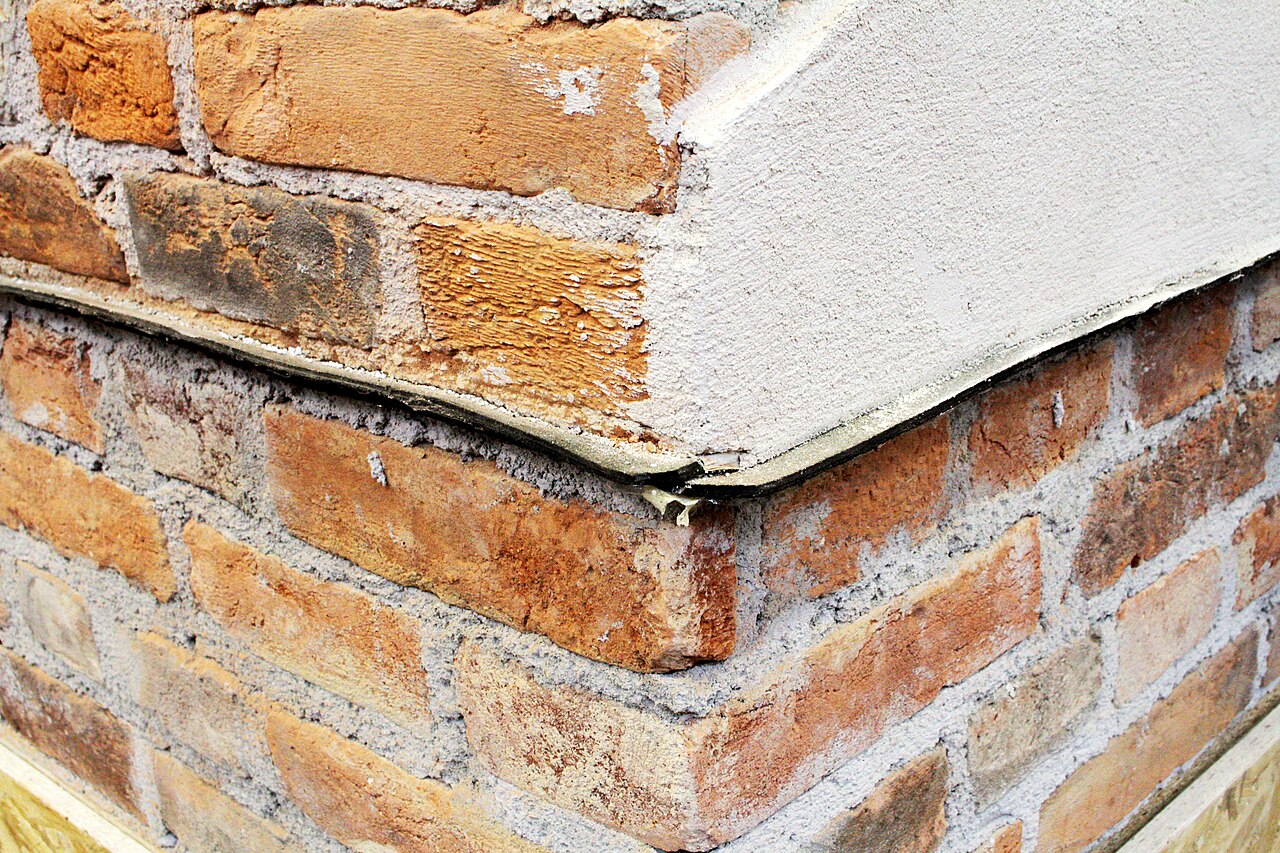
Photo: HTL-Mödchen23, CC BY-SA 4.0, via Wikimedia Commons.

Which standards should the clause cite?
Cite the product standard the declaration of performance refers to, the code of practice for installation, and the test method behind each value you set. A value without its test method cannot be checked against a submittal.
- BS EN 13967
- Flexible sheets for waterproofing: plastic and rubber damp proof sheets including plastic and rubber basement tanking sheet, definitions and characteristics
The product standard for plastic and rubber DPMs, setting what the declaration of performance must state, such as watertightness, tensile properties and resistance to impact.
In the clause Cite it as the product standard: "Damp-proof membrane: polyethylene to BS EN 13967".
- BS 8102
- Protection of below ground structures against water ingress: code of practice
Waterproofing grades and design for floors and walls below ground, including the need for a waterproofing design.
In the clause Only where below ground: "Waterproofing: grade as the waterproofing design to BS 8102".
- BS 8215
- Code of practice for design and installation of damp-proof courses in masonry construction
DPCs in masonry walls, which the floor membrane has to join to form a continuous barrier.
In the clause Use it for the wall side of the junction: "DPC to BS 8215, lapped and sealed to the DPM".
- BS 8485
- Code of practice for the design of protective measures for methane and carbon dioxide ground gases for new buildings
The design method for ground gas protection, including how membranes score as part of the protective measures.
In the clause "Ground gas protection: as the gas protection design to BS 8485."
- BRE BR 211
- Radon: guidance on protective measures for new buildings
When radon protection is needed and what basic and full protection involve.
In the clause "Radon protection: full protection to BRE BR 211."
- BS EN 13501-1
- Fire classification of construction products and building elements: classification using data from reaction to fire tests
The Euroclass system for the membrane's reaction to fire where it is not enclosed.
In the clause "Reaction to fire: as declared to BS EN 13501-1."
Confirm the current edition of each standard at every issue. Avoice's State of UK Specifications 2026 found a withdrawn standard cited in 40% of specifications at contract issue.
How do you write it in CAWS?
Sheet DPMs under ground floors go in CAWS work section J40, alongside tanking and other flexible sheet damp proofing. The section has type clauses in the 100s, and a loose laid polyethylene DPM is one of them, usually numbered 120 in recent NBS sections. Each type clause names the substrate, the product, the thickness, how the joints are made and what covers it. A gas-resistant membrane is a separate type clause (140 in the same NBS layout) even if it lies in the same place.
Preparation and workmanship clauses in J40 apply to every type: soft blinding to the hardcore, workmanship generally, inspection, primers, junctions with DPCs and cavity trays, and preformed collars at services. The DPM clause relies on them. The concrete section, E10, refers back to J40 for the membrane under the slab, so the slab clause and the DPM clause should agree on which comes first.
- Substrate
- Sand blinding over compacted hardcore, as clause 110
- Manufacturer
- Submit proposals
- Product reference
- Submit proposals
- Standard
- BS EN 13967, with current third-party certificate for use as a DPM
- Thickness
- Not less than 300 micrometres (1200 gauge)
- Recycled content
- Only where covered by the certificate
- Gas resistance
- TBC Site radon and ground gas risk assessment outstanding. Resolve before ordering.
- Surfaces to be joined
- Clean and dry beyond full width of joint
- Laps (minimum)
- 150 mm
- Sealing
- Double-sided tape between overlaps, rolled to full contact
- Edges
- Turned up at the perimeter and lapped and sealed to the wall DPC, as clause 360
- Penetrations
- Preformed collars, as clause 370
- Covering
- Ground-bearing slab, placed after inspection as clause 320
Illustrative, not from a real project. One property is left as a TBC with a reason so it can be tracked and closed before issue.
Clauses the type clause relies on
- J40/110
- Soft blinding to hardcore beds The blinding layer that stops sharp stone puncturing the membrane.
- J40/310
- Workmanship generally Conditions for laying, cleanliness of surfaces and handling of the sheet.
- J40/320
- Inspection Inspection of laps, edges and penetrations before the membrane is covered.
- J40/360
- Junctions with projecting DPCs/ cavity trays How the membrane is lapped and sealed to a DPC that projects into the floor zone.
- J40/365
- Junctions with flush DPCs/ cavity trays The alternative junction where the DPC finishes flush with the wall.
- J40/370
- Preformed collars for pipes, ducts, cables, etc. Sealing the membrane round services that pass through the floor.
Clause numbers vary between NBS versions and practice masters. The numbers here follow J40 sections in recent NBS-format specifications; older sections use two-digit numbers (10, 20, 50, 60), so check that the junction and inspection clauses you refer to exist in yours.
For more on clause structure and checks, see NBS clause writing: common mistakes.
How do you write it in Uniclass?
Uniclass has a system code for exactly this build-up: Ss_32_20_30_51 Loose-laid polyethylene membrane underslab damp-proofing systems. The system clause describes the preparation, the membrane's position under the slab, the laps, the junction with the wall DPC and the protection before concreting. The membrane is a product clause under Pr_25_57_65_63, and the system refers to it by type mark.
Splitting the two is useful when a site needs gas protection in some areas and not others. Each zone gets its own system clause pointing to the right product, so the plain DPM and the gas membrane are never written as one thing. The slab itself is a separate floor system that refers to the damp-proofing system beneath it.
- Description
- Polyethylene damp-proof membrane below ground-bearing slab
- Substrate
- Compacted hardcore with sand blinding
- Membrane
- Pr_25_57_65_63 Polyethylene sheets (DM01)
- Laps
- 150 mm minimum, sealed with double-sided tape
- Perimeter
- Turned up and lapped and sealed to the wall DPC
- Penetrations
- Preformed collars at all service entries
- Inspection
- Inspected and recorded before the slab is placed
- Manufacturer
- Submit proposals
- Product reference
- Submit proposals
- Standard
- BS EN 13967
- Material
- Polyethylene sheet
- Thickness
- Not less than 300 micrometres
- Gas resistance
- TBC Site radon and ground gas risk assessment outstanding. Resolve before ordering.
- Recycled content
- Only where covered by the certificate
- Third-party certification
- Current certificate covering use as a DPM
- Reaction to fire
- As declared to BS EN 13501-1
- Accessories
- Double-sided tape, preformed corners and collars from the same manufacturer
Illustrative. Performance of the finished system sits in the system clause; properties of the product sit in the product clause.
Use whichever of CAWS or Uniclass your practice's masters use, but do not mix CAWS and Uniclass references in one specification.
What goes in the spec, and what goes in the schedule?
The specification defines each type once. The schedule and drawings say where each type goes.
In the specification
What the product is and how it performs and is installed. Written once per type.
In the schedule or drawings
Where each type goes and how much of it. Changes with every plan revision.
Write each membrane type once with a type mark (for example DM01) and let the ground floor plan and sections show where it goes. If the site needs gas protection only in part, show the zones on the drawings rather than in the clause.
What are the common mistakes?
Most problems are a missing property, a property filled with the wrong kind of value, or a decision left silently open.
- "1200 gauge polythene" and nothing else. Thickness alone does not make a DPM. Say how laps are sealed, how it meets the DPC and what protects it from the hardcore.
- A plain DPM on a radon or gas site. Gas protection is designed from the site assessment. Specify a certified gas membrane and say how joints and penetrations are sealed and inspected.
- No link to the wall DPC. Damp bypasses the membrane at the perimeter. Detail the lap and seal between DPM and DPC and check it before concreting.
- Membrane laid straight on hardcore. Sharp stone punctures it as soon as it is walked on. Specify blinding, then inspect and patch before the pour.
- Treating a basement like a ground floor. A floor below ground needs a waterproofing design and a BS 8102 grade, not a DPM default.
- Recycled sheet bought by gauge. Recycled polyethylene can be thinner or weaker than its gauge suggests. Require a certified product and allow recycled content only where the certificate covers it.
How Avoice helps
Avoice's spec writer drafts DPM clauses from your ground floor drawings and keeps gas protection open until the site information supports a decision.
- Drafts from your ground floor plans and sections
It reads the floor build-ups (DM01 under the main slab, DM02 for a gas zone) from your drawings and schedules, and fills the J40 type clause or the Uniclass system and product clauses with what they support.
- Leaves a TBC until the site assessment is back
If the radon or ground gas assessment is outstanding, the gas resistance line says TBC with that reason. It goes into the project TBC register to close before tender, not after the slab is cast.
- Writes in CAWS or Uniclass, from your masters
Choose J40 or the Ss and Pr structure. Avoice adapts your practice's own clauses, so your standard wording on blinding and inspection stays in.
- Checks the DPM against the drawings and Approved Document C
QA/QC flags a section where the DPM stops short of the DPC, a gas zone on the plan with no gas membrane clause, or a withdrawn standard. The Avoice Regulations library holds Approved Document C for checking the floor requirements.
- Keeps certificates with the clause
Data sheets, certificates and declarations of performance sit in the Product Room, linked to the clause, so a proposed substitute can be checked against the thickness and certification the clause asks for.
Related guides: How to specify screeds, How to specify cavity trays, How to specify vapour control layers.
Software can draft and check. The designer still chooses the product and is responsible for the specification.
For more on the evidence behind product choices, see the role of manufacturer product data in specification writing.
Draft your damp-proof membrane clause in Avoice
Upload your drawings and schedules. Avoice drafts the clause in CAWS or Uniclass, cites the standards and flags anything your information does not settle.
This guide is for general education and is not professional advice. Check current editions of standards and Approved Documents, the manufacturer's data, and the requirements of your project before relying on any clause.