
How to specify door closers
What a door closer clause has to settle, the decisions behind power size, fire evidence and hold-open devices, the standards to cite, and how to write it in CAWS and in Uniclass.
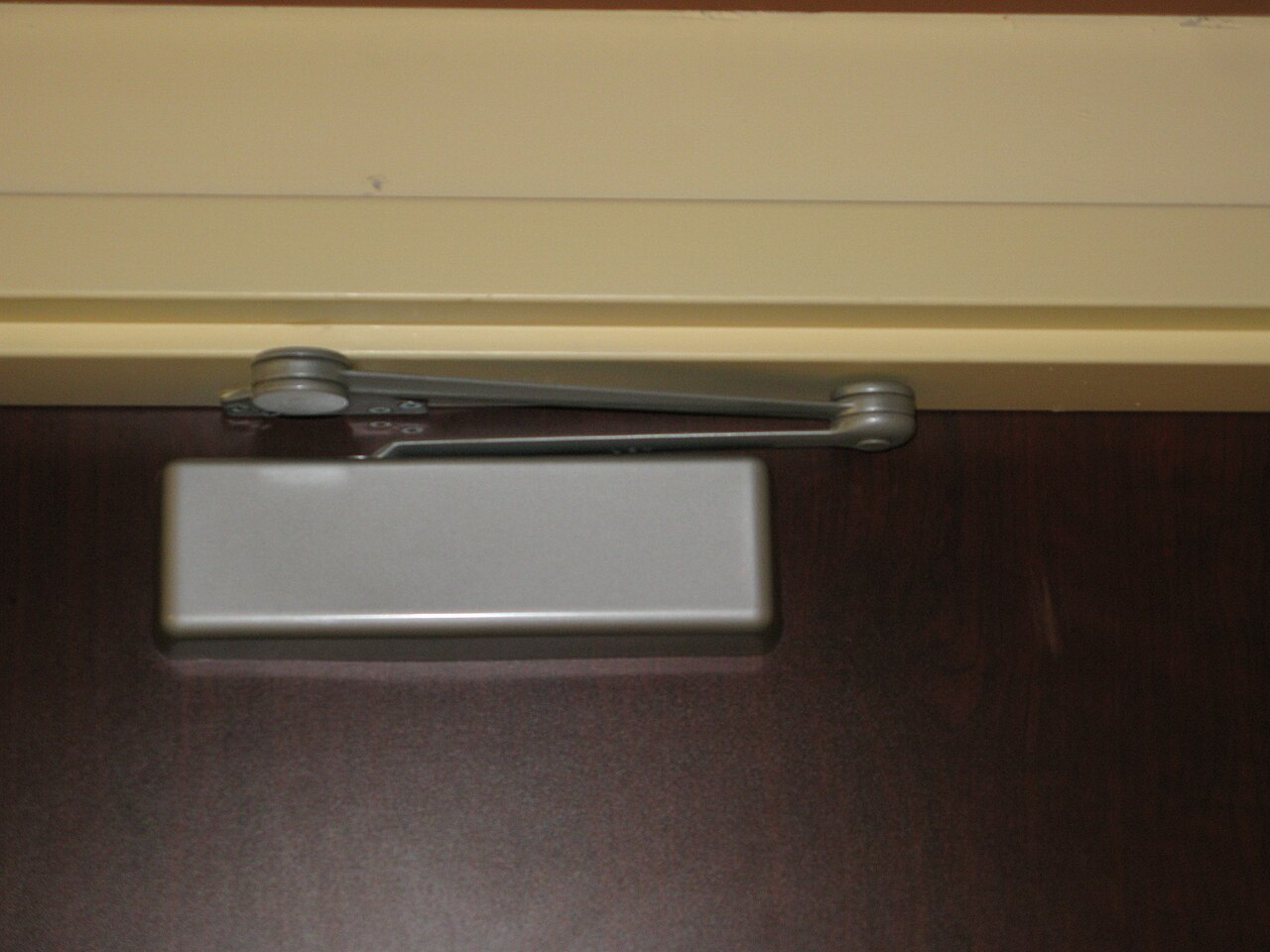
Photo: Wesha, Public domain, via Wikimedia Commons.

How do you specify door closers?
To specify a door closer, state the closer type and its BS EN 1154 classification, the power size for the leaf, and the functions it needs, such as back check and adjustable latching speed. On fire doors, require the closer to be within the doorset's fire evidence. Balance closing force against the opening forces Approved Document M sets, and specify hold-open devices with a fire alarm release.
Most closer problems are found at handover, with a force gauge. The fire door latches every time but a wheelchair user cannot open it, or the closer was backed off to pass the force test and the door now stops short of the frame. Neither shows up in a clause that says "overhead closer to suit door". The clause has to fix the closer's classification, its power range and how it is set on site, and it has to keep the closer inside the doorset's fire evidence.
This guide covers Uniclass Pr_30_36_59_15 Controlled door closers. A closer is never specified on its own: it belongs to the door it is fixed to, so in a Uniclass specification it sits under a door hardware system clause and is coordinated with the doorset, which Uniclass codes separately as Ss_25_30_20_25 Doorset systems.
What does a door closer clause need to cover?
Some properties are specific to door closers. Others belong in every product clause. A clause that leaves either out gives the contractor room to substitute.
Properties of door closers
- Third-party certificationCertification for use on fire doorsets.
- ControlsPush buttons or sensors, only for powered units.
- Closer power sizeNever guessSet by leaf width, mass, wind and fire duty.
- AccessoriesBrackets, mounting plates and parallel arm shoes.
- Mounting typePull face, push face, transom, floor or concealed.
- Power failure modeNever guessHold-open and powered units: what happens on mains failure.
- Hardware classificationBS EN 1154 code covering use, cycles and corrosion.
- Nominal sizeBody and arm size against leaf and frame.
- Powered operation safetyNever guessSensors and force limits where an operator is fitted.
- Product typeOverhead, cam-action, concealed or floor spring.
- Handle designCoordinate with the lever set on the same leaf.
- Ingress protection ratingFor electrical closers outside or in wet areas.
- Closer functionsBack check, delayed action, latching speed, hold-open.
- Keying systemUsually none; only for key-switched hold-open units.
- Fire resistanceNever guessCloser must be within the doorset's fire evidence.
- Light reflectance valueContrast for exposed bodies; usually not critical.
- Fire alarm releaseNever guessHold-open and free swing units must release on alarm.
- AccessibilityOpening force limits from Approved Document M.
- Operation methodManual, hold-open, free swing or powered.
- Electrical ratingSupply voltage for electromagnetic or powered units.
What every product clause needs
- Manufacturer and product referenceNamed closer model, or a performance description.
- Product standardBS EN 1154, with its six-digit classification declared.
- Installation methodManufacturer's template and the doorset's fire evidence.
- Technical submittalsTest evidence and fire door suitability before ordering.
- Operation and maintenance informationAdjustment settings and periodic checks at handover.
- MaterialBody and arm material, for durability and use.
- FinishCover and arm finish to match the ironmongery set.
- FixingsFixings permitted by the door and frame construction.
Uniclass Pr_30_36_59_15 Door closers. Not every property applies to every project; where one does not, say so rather than leaving it blank.
Fields marked Never guess depend on the project and should never be filled from a default or a previous job. If the information is not available yet, the clause should say so with a TBC and a reason.
Which decisions does the clause depend on?
Most properties follow from the product you choose. These depend on the project, so they need a decision from the designer before the clause is written.
- 01
Power size and opening force
Never guessBS EN 1154 grades closers by power size against leaf width, and a closer fitted to a fire door has to be power size 3 or more. Approved Document M then limits the opening force at the leading edge to 30 N from 0 to 30 degrees and 22.5 N from 30 to 60 degrees. The two pull in opposite directions, and seals, wind and stack pressure all add resistance. A fixed-power closer picked from the catalogue rarely lands in the gap. An adjustable closer, set on site and measured with a gauge, usually can.
How to decide
- Take the leaf width and mass from the door schedule and read the minimum power size off the manufacturer's BS EN 1154 table.
- On fire doors, set the minimum at power size 3 whatever the leaf size suggests.
- On accessible routes, prefer cam-action closers with slide arms, which open more easily for the same closing power.
- Require the installer to set each closer and record the opening force at the leading edge.
Write it asPower size: Adjustable EN 2 to 4, set on site to not less than EN 3. Opening force at leading edge to be measured and recorded. - 02
Staying inside the fire evidence
Never guessA fire doorset is tested or assessed with particular hardware, and the closer is part of that package. Swap it for a different model, or cut a concealed closer into the leaf and head, and the doorset may no longer be covered by its test evidence or certificate. The BS EN 1154 classification shows whether a closer is suitable for fire doors, but suitability in general is not the same as being covered for this doorset. Building control and the fire risk assessor will ask for the link between the two.
How to decide
- Ask the doorset manufacturer which closers fall within its fire test evidence or third-party certificate.
- Check the fourth digit of the BS EN 1154 classification shows the closer is suitable for fire doors.
- Treat concealed and floor-mounted closers on fire doors as needing specific evidence before they are accepted.
- Ask for the evidence as a submittal, not just a statement in a data sheet.
Write it asFire doors: Closer classified as suitable for fire doors to BS EN 1154 and within the scope of the doorset's fire test evidence or third-party certificate. Submit evidence. - 03
Hold-open and free swing closers
Never guessFire doors that are propped open end up wedged. Where the fire strategy allows a door to stand open, an electromagnetic hold-open or free swing closer does the job properly, but only if it releases when the alarm operates. Hold-open and free swing devices are tested to BS EN 1155. The connection to the alarm is designed to BS 7273-4, which sets the actuation category, so the ironmongery clause and the fire alarm specification have to agree. A hold-open closer with no alarm link is worse than a plain closer.
How to decide
- Take the list of doors that may be held open from the fire strategy, not from the client's wish list.
- Choose hold-open for doors that should stand fully open, free swing for doors people push through often, such as bedroom or care home doors.
- Coordinate the BS 7273-4 interface with the fire alarm designer and say who supplies and wires it.
- For every other closer, write "not required" against this field.
Write it asHold-open: Electromagnetic hold-open to BS EN 1155, released on fire alarm actuation through an interface to BS 7273-4. - 04
What happens when the power goes
Never guessAny closer that uses mains power has a failure state. A hold-open or free swing closer on a fire door has to close the door when power is lost, which is the normal fail-safe arrangement. A powered operator that replaces the closer on an entrance or an accessible door is different: the fire strategy may want it to open on alarm, or to close. Leaving the field blank hands the decision to the supplier. For a plain mechanical closer the answer is simply "not applicable".
How to decide
- Mechanical closer: write "not applicable".
- Hold-open or free swing on a fire door: closes the door on loss of power or alarm signal.
- Powered operator: take the fail-open or fail-closed requirement from the fire strategy and the security brief, and state it per door type.
Write it asPower failure mode: On loss of mains supply, hold-open releases and door closes under closer power. - 05
Powered operators and safety in use
Never guessWhen a low-energy or full-power operator takes the place of a closer, the door can trap or strike people. BS EN 16005 covers safety in use of power-operated pedestrian doorsets, including how risks at the closing and opening edges are dealt with by force limits or sensors. The installer should carry out a risk assessment for each door and commission it with the sensors set. If no operator is fitted, the field should still be answered, with "not applicable: manual closer".
How to decide
- Decide which doors need powered operation, usually main entrances and doors on accessible routes where opening force cannot be met manually.
- Require compliance with BS EN 16005 and a site risk assessment for each powered door.
- Specify how the operator is activated, for example push pads or sensors, and coordinate their positions with the door schedule.
Write it asPowered operation safety: Operator and doorset to BS EN 16005. Installer to carry out risk assessment and commission safety sensors for each door.
The values under "Write it as" are examples. The right value depends on the location, the use and the fire strategy.
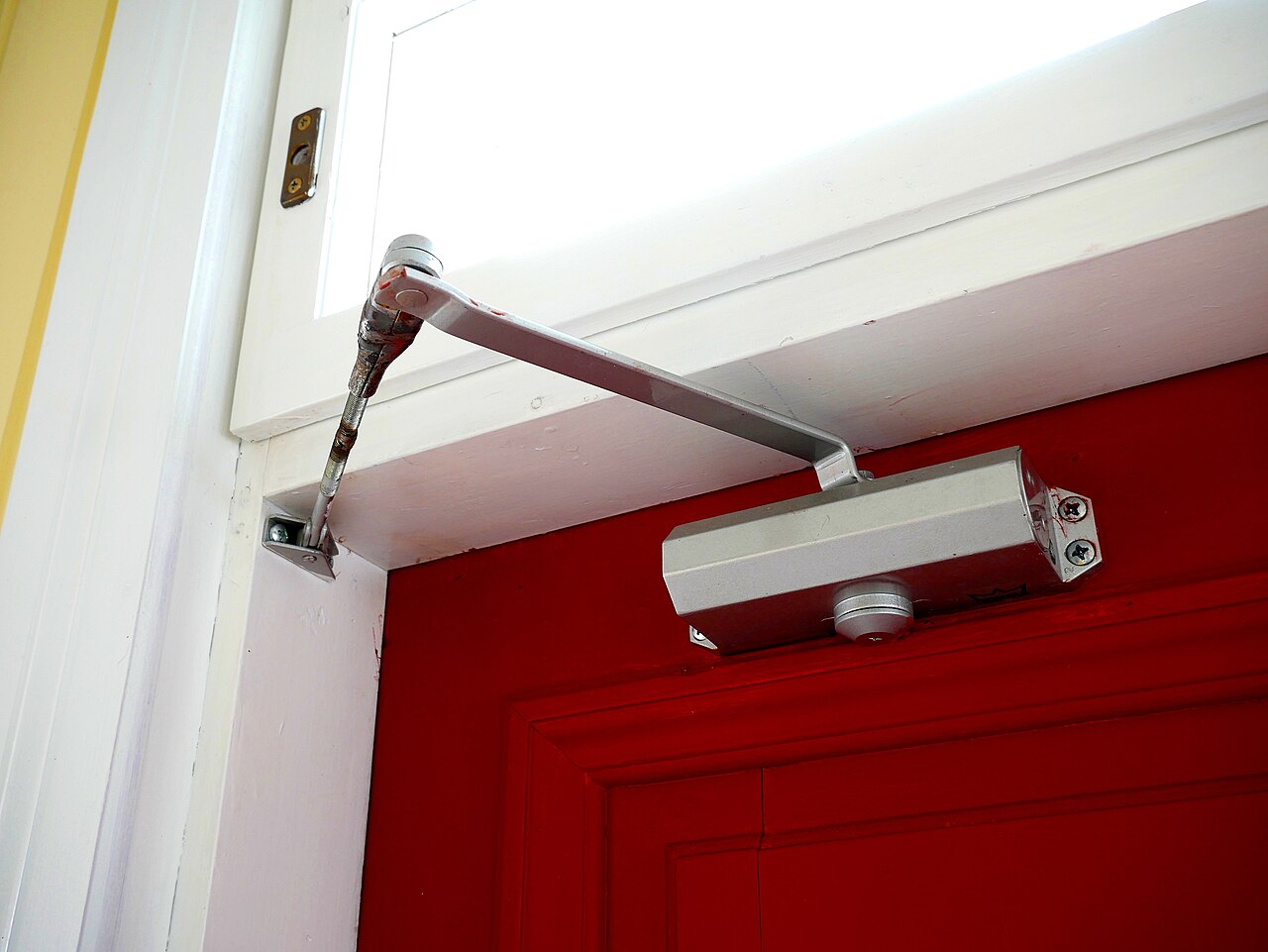
Photo: Santeri Viinamäki, CC BY-SA 4.0, via Wikimedia Commons.

Which standards should the clause cite?
Cite the product standard the declaration of performance refers to, the code of practice for installation, and the test method behind each value you set. A value without its test method cannot be checked against a submittal.
- BS EN 1154
- Building hardware. Controlled door closing devices. Requirements and test methods
Power sizes against leaf width, test cycles and the six-part classification code, including whether a closer is suitable for fire and smoke doors.
In the clause Cite it as the product standard and ask for the classification: "To BS EN 1154, classified as suitable for fire doors".
- BS EN 1155
- Building hardware. Electrically powered hold-open devices for swing doors. Requirements and test methods
Electromagnetic hold-open devices and free swing closers that hold a door open until a signal releases it.
In the clause "Hold-open: to BS EN 1155, released on fire alarm actuation."
- BS EN 1158
- Building hardware. Door coordinator devices. Requirements and test methods
Coordinators that make the leaves of a rebated pair close in the right order.
In the clause On pairs: "Door coordinator: to BS EN 1158, to suit closers DC01".
- BS 7273-4
- Code of practice for the operation of fire protection measures. Requirements for the actuation of release mechanisms for doors
How door release mechanisms are triggered by the fire alarm, including the actuation categories.
In the clause Name it for the interface, not the device: "Release on alarm through an interface to BS 7273-4".
- BS EN 16005
- Power operated pedestrian doorsets. Safety in use. Requirements and test methods
Safety of powered swing, sliding and revolving doors, including risk assessment and protection at the door edges.
In the clause "Powered operator and doorset to BS EN 16005; risk assessment for each door."
- BS 8300-2
- Design of an accessible and inclusive built environment. Buildings. Code of practice
Guidance on accessible doors, including opening force, power-assisted and powered doors and visibility of ironmongery.
In the clause Use it to back the opening force requirement: "Opening force to Approved Document M and BS 8300-2".
- BS EN 1634-1
- Fire resistance and smoke control tests for door and shutter assemblies, openable windows and elements of building hardware. Fire resistance test for door and shutter assemblies and openable windows
The fire resistance test for doorsets, which is the evidence a closer has to sit within.
In the clause Refer to the evidence rather than retesting: "within the scope of the doorset's test evidence to BS EN 1634-1".
Confirm the current edition of each standard at every issue. Avoice's State of UK Specifications 2026 found a withdrawn standard cited in 40% of specifications at contract issue.
For the regulations behind these choices, see Approved Document B explained, Approved Document M explained, or search the Avoice Regulations library.
How do you write it in CAWS?
In CAWS, door closers go in P21, the ironmongery section. Unlike a finishes section, P21 does not use a "type of" system clause in the 100s. Each kind of ironmongery gets its own product clause in the body of the section, so overhead closers have one clause, hinges another, pull handles another. NBS numbers the overhead closer clause 410, and practices add 411, 412 and so on when a project needs more than one closer type.
The general requirements sit at the front of P21: where the ironmongery goes, whether it all comes from one range, samples, what applies to fire doors and the category of duty. The closer clause leans on these rather than repeating them. Fixing is covered back in L20, the doors section, so check that the clause there for fixing ironmongery exists in your master too.
- Standard
- To BS EN 1154
- Closers to fire/ smoke control doors
- Classified as suitable for fire doors; within the scope of the doorset's fire test evidence or certificate
- Manufacturer
- Submit proposals
- Product reference
- Submit proposals
- Type
- Cam-action, slide arm and track, surface mounted on pull face
- Power size
- Adjustable EN 2 to 4, set to not less than EN 3 on fire doors
- Other functions
- Adjustable closing speed, latching action and back check
- Opening force
- Not more than 30 N from 0 to 30 degrees and 22.5 N from 30 to 60 degrees, measured at the leading edge
- Hold-open
- Not required
- Casing finish
- TBC Client ironmongery finish selection outstanding. Resolve before ordering.
- Fixings
- As permitted by the doorset certificate; through-bolted where leaf construction requires
- Variable power
- Matched to size, weight and location of doors
- Latched doors
- Override latches and door seals when fitted
- Closing against smoke seals of fire doors
- Positive. No gaps
- Submittals
- BS EN 1154 classification, fire evidence and recorded opening forces
Illustrative, not from a real project. One property is left as a TBC with a reason so it can be tracked and closed before issue.
Clauses the type clause relies on
- P21/10
- Quantities and locations Points to the door and ironmongery schedule for which doors get DC01.
- P21/121
- Ironmongery from single proprietary range Keeps closers, handles and hinges in one range and finish.
- P21/140
- Samples A sample closer approved before the order is placed.
- P21/170
- Ironmongery for fire doors Requires evidence that every item on a fire door is covered by the doorset's fire test or certificate.
- P21/180
- Category of duty for door ironmongery Sets the duty the closer and other items must suit, from light to severe.
Clause numbers vary between NBS versions and practice masters. The 410 closer clause and the general clauses listed here follow the NBS layout seen in issued UK tender specifications; check them against your own P21.
For more on clause structure and checks, see NBS clause writing: common mistakes.
How do you write it in Uniclass?
Uniclass separates what a door hardware set has to achieve from the products in it. The system clause, Ss_25_38_20_20 Door hardware systems, describes the ironmongery set for a type of door: what it must do on a fire door, the opening force on an accessible route, how hold-open devices are released. The closer itself is written once as a product clause and the system clause points to it.
This suits closers well. The same DC01 closer often appears on several door types, fire doors to corridors and plain doors to offices, with different requirements around it. Each door hardware system says what it needs and points to the one closer product clause, and the doorset system clause points to the hardware set. Change the closer model once and every door type picks it up.
- Description
- Ironmongery set for single-leaf FD30S doors on corridors and accessible routes
- Closer
- Pr_30_36_59_15 Controlled door closers (DC01)
- Fire performance
- All items within the scope of the doorset's fire test evidence or certificate
- Opening force
- Not more than 30 N from 0 to 30 degrees and 22.5 N from 30 to 60 degrees at the leading edge
- Hold-open
- Not required
- Category of duty
- Heavy
- Setting and testing
- Closers set on site; opening forces measured and recorded at handover
- Manufacturer
- Submit proposals
- Product reference
- Submit proposals
- Standard
- BS EN 1154, classified as suitable for fire doors
- Product type
- Cam-action overhead closer with slide arm and track
- Power size
- Adjustable EN 2 to 4
- Closer functions
- Adjustable closing speed, latching action and back check
- Mounting type
- Pull face of leaf, track to frame head
- Finish
- TBC Client ironmongery finish selection outstanding. Resolve before ordering.
- Power failure mode
- Not applicable: mechanical closer
- Powered operation safety
- Not applicable: mechanical closer
Illustrative. Performance of the finished system sits in the system clause; properties of the product sit in the product clause.
In NBS Chorus, Uniclass product clauses also carry an NBS reference (for door closers, 45-25-60/305). Use whichever your practice's masters use, but do not mix CAWS and Uniclass references in one specification.
What goes in the spec, and what goes in the schedule?
The specification defines each type once. The schedule and drawings say where each type goes.
In the specification
What the product is and how it performs and is installed. Written once per type.
In the schedule or drawings
Where each type goes and how much of it. Changes with every plan revision.
Write each closer type once with a type mark (for example DC01) and let the door and ironmongery schedule say which doors it goes on. If the clause lists door numbers, it will be wrong after the next door schedule revision.
What are the common mistakes?
Most problems are a missing property, a property filled with the wrong kind of value, or a decision left silently open.
- "Closer to suit door". Power size, function and fire suitability are left to whoever places the order. Give the BS EN 1154 classification and a power range.
- Power set high to make the latch. A closer turned up until the door latches through its seals often fails the Approved Document M opening force. Require adjustment and a measured force on site.
- A closer outside the fire evidence. A substitute closer, or a concealed one cut into the leaf, can take the doorset outside its certificate. Make the evidence a submittal.
- Hold-open devices with no alarm link. The door stays open in a fire. Specify the release to BS 7273-4 and agree in writing who wires it.
- No coordinator on rebated pairs. The leaves close in the wrong order and the pair never latches. Add a coordinator to BS EN 1158.
- Door numbers in the clause. "Closers to D1.04 to D1.12" is wrong after the next door schedule revision. Use a type mark and let the schedule carry locations.
How Avoice helps
Avoice's spec writer drafts closer clauses from the door schedule and fire strategy information already on the project, and marks what it cannot settle.
- Drafts from your door schedule
It reads the closer types (DC01, DC02) and the fire rating of each door from your door and ironmongery schedules, and drafts the P21 or Uniclass clause with the properties those documents support.
- Leaves a TBC where the decision is open
If the hold-open doors have not been agreed with the fire engineer, or the finish has not been chosen, the clause says TBC with the reason, and the item goes into the project TBC register to close before tender.
- Writes in your format
CAWS or Uniclass, built on your practice's own master clauses, so your P21 numbering and house wording stay as they are.
- Checks the closer against the drawings
QA/QC flags a fire door on the door schedule with no closer, a closer type the specification never defines, a cross-reference to a P21 clause that does not exist, or a withdrawn standard.
- Keeps the evidence with the clause
Data sheets, declarations of performance and certificates sit in the Product Room linked to the closer clause. Edit the linked product once and every clause that uses it updates. Approved Document M and B guidance is in the Avoice Regulations library.
Related guides: How to specify fire doors, How to specify toilet cubicles, How to specify access hatches.
Software can draft and check. The designer still chooses the product and is responsible for the specification.
For more on the evidence behind product choices, see the role of manufacturer product data in specification writing.
Draft your door closer clause in Avoice
Upload your drawings and schedules. Avoice drafts the clause in CAWS or Uniclass, cites the standards and flags anything your information does not settle.
This guide is for general education and is not professional advice. Check current editions of standards and Approved Documents, the manufacturer's data, and the requirements of your project before relying on any clause.