
How to specify lime plaster
What a lime plaster clause has to say for internal walls and ceilings, the decisions behind it, the standards to cite, and how to write it in CAWS and in Uniclass.
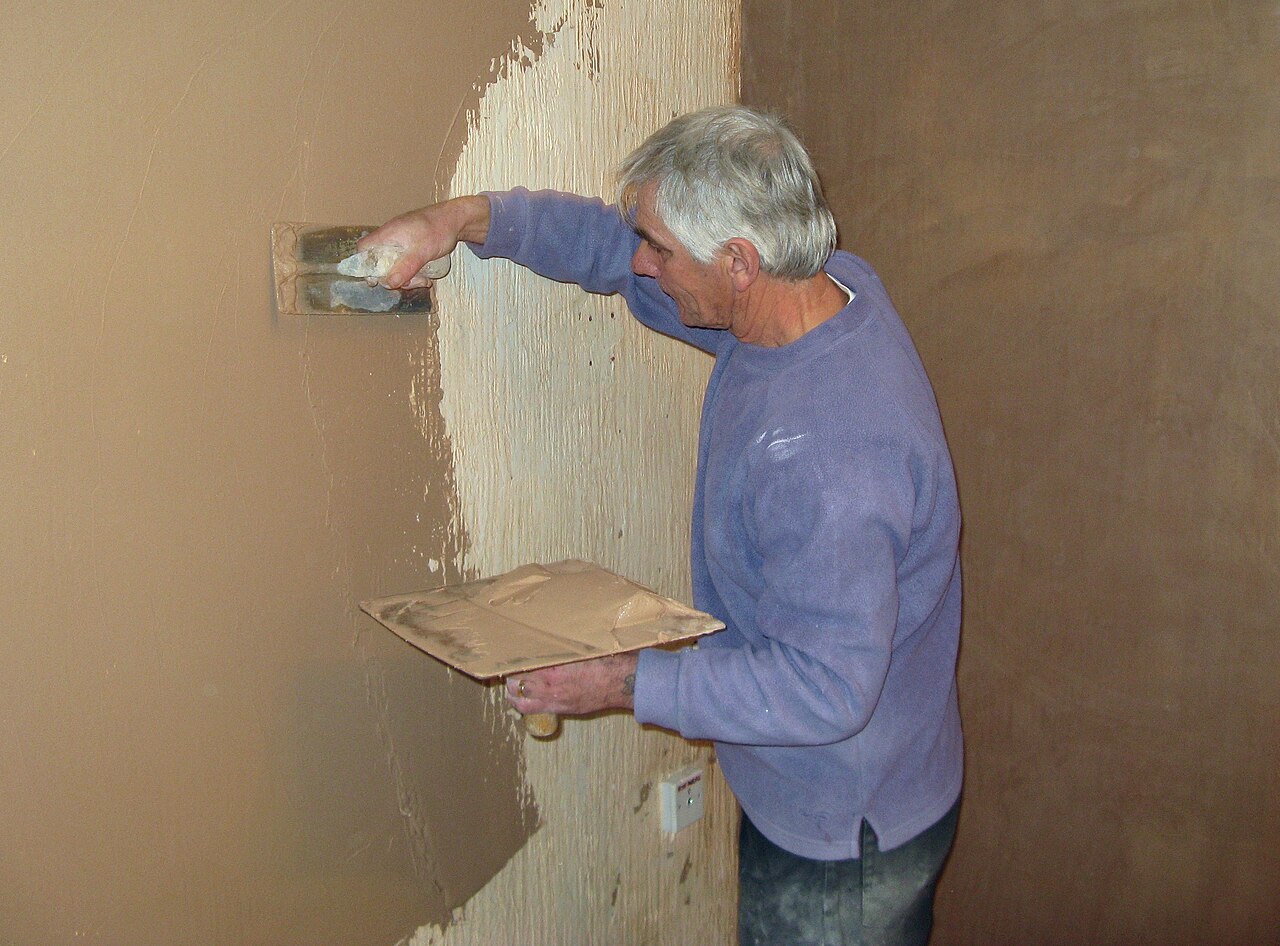
Photo: Adrian Pingstone (Arpingstone), Public domain, via Wikimedia Commons.

How do you specify lime plaster?
To specify lime plaster, name the binder by its BS EN 459-1 designation (for example CL 90-S PL lime putty or NHL 3.5), the mortar to BS EN 998-1 or the site mix and sand, and the coat build-up with thickness per coat. State the background and its preparation, hair or fibre reinforcement, curing and protection, the finish, and a vapour-permeable decoration, with workmanship to BS EN 13914-2 and a sample panel approved before the main work.
Lime plaster turns up in two kinds of project: repairs and alterations to older buildings with solid walls, and new work where the client wants a vapour-open, hand-finished wall. In both, the clause is often a heading and a supplier's name, and the decisions that matter are left to whoever turns up with a hawk and trowel. Which lime, how many coats, how long between them and how the work is protected while it cures all affect whether the plaster stays on the wall and whether the wall behind it stays dry.
This guide covers Uniclass Pr_35_31_64_47 Lime plasters. Lime renders for external walls are a separate code, Pr_35_31_64_48 Lime renders, and the binders themselves, such as Pr_20_31_12_39 Hydraulic limes and Pr_20_31_12_57 Non-hydraulic lime putties, have codes of their own where you want to write them as separate products.
What does a lime plaster clause need to cover?
Some properties are specific to lime plaster. Others belong in every product clause. A clause that leaves either out gives the contractor room to substitute.
Properties of lime plaster
- Product typeLime plaster rather than gypsum or cement-based plaster.
- MaterialBinder: lime putty, natural hydraulic lime or formulated lime.
- Mix proportionsBinder to sand ratio by volume, coat by coat.
- Coat build-upScratch, floating and setting coats, or a two-coat system.
- ThicknessThickness per coat and in total, to suit the background.
- PrimerUsually none; damping down controls suction instead.
- ReinforcementHair or fibre in undercoats; mesh over junctions and lath.
- Surface textureSmooth trowelled, floated or sponged finish.
- FinishNatural lime colour, or pigmented, ready for limewash.
- TolerancesFlatness to suit an old wall; often follows the background.
- Movement jointsAt junctions with dissimilar backgrounds and new structure.
- AccessoriesStainless or no beads; hand-formed arrises are common.
- Reaction to fire classificationNever guessA1 where organic content is 1% or less, per BS EN 998-1.
- Sample approvalSample panel to agree finish, texture and colour.
What every product clause needs
- Manufacturer and product referenceNamed premixed lime plaster, or the site mix and its constituents.
- Product standardBS EN 998-1 for the mortar, BS EN 459-1 for the lime.
- Installation methodBS EN 13914-2 and the lime supplier's instructions.
- Technical submittalsData sheets, DoP, lime type certificate and sand grading.
- Operation and maintenance informationCompatible decorations, repair mix and patching method.
- SubstrateSolid masonry, lath or board, and its suction and condition.
- Application conditionsFrost, heat and draughts; lime cures slowly and needs protection.
Uniclass Pr_35_31_64_47 Lime plaster. Not every property applies to every project; where one does not, say so rather than leaving it blank.
Fields marked Never guess (reaction to fire classification) depend on the project and should never be filled from a default or a previous job. If the information is not available yet, the clause should say so with a TBC and a reason.
Which decisions does the clause depend on?
Most properties follow from the product you choose. These depend on the project, so they need a decision from the designer before the clause is written.
- 01
Reaction to fire
Never guessPlastering mortars to BS EN 998-1 with an organic content of 1.0% or less by mass or volume can be classed A1 without testing; above that, the product needs a test classification to BS EN 13501-1. Traditional lime plaster usually sits comfortably within the limit, but some premixed lime plasters contain additives, and organic hair or fibre adds to the organic content. Approved Document B sets lining classes for walls and ceilings, so on escape routes the class of the plaster matters, and it has to be evidenced rather than assumed.
How to decide
- Check the lining class the fire strategy sets for each area.
- For a premixed plaster, ask for the declaration of performance and the reaction to fire class it states.
- For a site mix with hair or fibre, ask the supplier to confirm the organic content, or obtain a classification.
Write it asReaction to fire: Class A1 to BS EN 13501-1, organic content not more than 1.0%, as declared under BS EN 998-1. - 02
Choosing the lime
BinderBS EN 459-1 names building limes by type and, for hydraulic limes, by strength. CL 90-S is a calcium lime, supplied as dry hydrate or, designated CL 90-S PL, as matured putty, which sets only by carbonating and stays soft and very open. Natural hydraulic limes, NHL 2, NHL 3.5 and NHL 5, set partly by reaction with water and get stronger and faster-setting as the number rises. Formulated limes (FL) contain other materials and have to declare them. A stronger lime cures faster but is harder and less vapour-open, and a lime that is too strong for a soft background can cause the background to fail first.
How to decide
- Soft brick, old stone or lath on historic buildings: lime putty or NHL 2, agreed with the conservation officer where the building is listed.
- Damper walls, faster programmes or harder backgrounds: NHL 3.5, the most common internal choice.
- Avoid NHL 5 for internal plaster unless the background and exposure call for it.
- Name the lime by its BS EN 459-1 designation, not just "hydraulic lime".
Write it asLime: Natural hydraulic lime NHL 3.5 to BS EN 459-1. - 03
Coats, thickness and timing
CoatsLime plaster is built up in coats: a scratch coat keyed into the background, a floating coat that sets the line, and a thin setting coat for the finish. Each coat needs to firm up and shrink before the next goes on, and that can take days or weeks depending on the lime and the weather. Thick single coats slump and crack, and coats applied too quickly trap moisture and crack later. BS EN 13914-2 gives the design principles for internal plastering, but the timing has to come from the lime supplier and the conditions on site.
How to decide
- Uneven solid walls and lath: three coats; flatter modern backgrounds: two coats may do.
- Set the thickness of each coat in the clause, with a maximum for any single coat.
- Require each coat to be scratched or keyed and allowed to firm up before the next, to the supplier's guidance.
- Build the coat intervals into the programme rather than leaving them to the plasterer.
Write it asCoats: Three coats. Scratch coat 10 mm, scratched for key. Floating coat 10 mm. Setting coat 3 mm. Each coat to firm up before the next, as supplier's instructions. - 04
Curing and protection
CuringLime gains strength slowly and depends on moisture and air while it does. Fresh lime plaster that freezes is damaged; plaster that dries too fast in a heated building, in sun or in a draught crazes and loses strength. That makes lime a winter programme risk and puts it in conflict with the usual wish to heat buildings and dry them out quickly. The clause has to say how the work is protected and kept damp while it cures, because the plasterer cannot control the building's heating and ventilation.
How to decide
- Do not apply lime plaster when frost is expected during application or curing; set the supplier's minimum temperature in the clause.
- Keep each coat damp by misting as needed while it cures, and protect it from direct heat, sun and draughts.
- Coordinate with the main contractor so heaters and dehumidifiers are not used close to fresh plaster.
- Allow curing time in the programme before decoration.
Write it asCuring: Protect from frost, direct heat and draughts. Keep damp by light misting while curing, as clause 880 and supplier's instructions. - 05
The background and the finish
BackgroundLime plaster works with the wall it goes on. Old solid walls need loose material raked out, salts and gypsum patches removed, and suction controlled by damping down rather than with the PVA or bonding primers used under gypsum. Mixing systems causes problems: gypsum or cement patches under lime, or a gypsum skim over lime, can cause debonding and trap moisture. The decoration matters too: an impermeable paint over lime plaster undoes the reason for using it, so the clause should say what can go on top.
How to decide
- Survey the background first: brick, stone, lath or board, its condition, salts and existing plaster.
- Remove gypsum and cement patches from areas to be lime plastered, unless the supplier confirms they can stay.
- Use expanded metal or other lath only where specified, and stainless steel where metal is used.
- Specify a vapour-permeable decoration, such as limewash or a mineral paint confirmed suitable for lime.
Write it asBackground: Existing solid brick, loose material raked out and gypsum patches removed. Suction controlled by damping down. No bonding agent.
The values under "Write it as" are examples. The right value depends on the location, the use and the fire strategy.
Which standards should the clause cite?
Cite the product standard the declaration of performance refers to, the code of practice for installation, and the test method behind each value you set. A value without its test method cannot be checked against a submittal.
- BS EN 459-1
- Building lime. Definitions, specifications and conformity criteria
Defines the families of building lime (air limes and limes with hydraulic properties) and their types, including CL, NHL and FL, with strength classes for hydraulic limes.
In the clause Name the lime by its designation: "Lime: NHL 3.5 to BS EN 459-1" or "CL 90-S PL lime putty to BS EN 459-1".
- BS EN 998-1
- Specification for mortar for masonry. Rendering and plastering mortar
The product standard for factory-made rendering and plastering mortars, including the compressive strength categories CS I to CS IV and the reaction to fire rule for mortars with low organic content.
In the clause For a premixed plaster: "Premixed lime plastering mortar to BS EN 998-1, category CS I".
- BS EN 13914-2
- Design, preparation and application of external rendering and internal plastering. Internal plastering
The design and workmanship standard for internal plastering, covering backgrounds, preparation, coats and application.
In the clause "Workmanship: to BS EN 13914-2 and the lime supplier's instructions."
- BS EN 13139
- Aggregates for mortar
Requirements for sands used in mortars, including grading. Lime plaster depends heavily on a well-graded, sharp sand.
In the clause "Sand: sharp, well graded, to BS EN 13139, grading submitted."
- BS EN 13501-1
- Fire classification of construction products and building elements. Classification using data from reaction to fire tests
The Euroclass system used for wall and ceiling linings in Approved Document B.
In the clause "Reaction to fire: Class A1 to BS EN 13501-1."
- BS EN 13658-1
- Metal lath and beads. Definitions, requirements and test methods. Internal plastering
Requirements for metal lath and beads used in internal plastering.
In the clause Where beads are used: "Stainless steel beads to BS EN 13658-1".
Confirm the current edition of each standard at every issue. Avoice's State of UK Specifications 2026 found a withdrawn standard cited in 40% of specifications at contract issue.
For the regulations behind these choices, see Approved Document B explained, Fire strategy reports explained, or search the Avoice Regulations library.
How do you write it in CAWS?
Lime plaster is written in M20, the same section as gypsum plaster and render. Each plaster type is one type clause in the 100s or 200s, which in real M20 specifications reads like a recipe: the background, its preparation, the lime and sand, the mix for each coat, coat thicknesses, reinforcement, the finish and the curing. One clause describes one complete plaster on one kind of background.
Material and workmanship clauses later in M20 are written once and apply to every type: the control sample, sands and limes, mixing, suitability of backgrounds, beads, application, flatness, undercoats, the finish and curing. A lime type clause depends on these more than most, because lime work is defined as much by its timing and curing as by its mix.
- Background
- Existing solid brick walls, as clause 510
- Preparation
- Loose material raked out, gypsum patches removed, damped down to control suction
- Lime
- TBC Choice between NHL 2 and NHL 3.5 depends on the background survey. Resolve before ordering.
- Sand
- Sharp, well-graded sand to BS EN 13139, grading submitted
- Mix
- Lime to sand 1:2.5 by volume, all coats unless supplier advises otherwise
- Scratch coat
- 10 mm, haired, scratched for key
- Floating coat
- 10 mm, haired, rubbed up with a devil float
- Setting coat
- 3 mm, fine lime finish
- Intervals
- Each coat to firm up before the next, as supplier's instructions
- Reinforcement
- Stainless steel mesh over junctions of dissimilar backgrounds, as clause 646
- Arrises
- Hand-formed, no beads
- Finish
- Smooth trowelled, as clause 777
- Curing
- Protected from frost, heat and draughts and kept damp, as clause 880
- Reaction to fire
- Class A1 to BS EN 13501-1
- Decoration
- Limewash or vapour-permeable mineral paint only
Illustrative, not from a real project. One property is left as a TBC with a reason so it can be tracked and closed before issue.
Clauses the type clause relies on
- M20/418
- Control sample A sample panel of the full build-up, approved before the main work.
- M20/443
- Lime Lime type and standard, cross-checked against the type clause.
- M20/495
- Mixing Batching by volume, mixing time and use within the workable period.
- M20/510
- Suitability of substrates Checking the background is sound, clean and suitable before plastering.
- M20/710
- Application generally Application conditions and protection of adjacent work.
- M20/880
- Curing and drying Protection from frost and rapid drying while the plaster cures.
Clause numbers vary between NBS versions and practice masters; the numbers here follow published project M20 specifications, so check each clause the type clause refers to exists in your M20.
How do you write it in Uniclass?
In Uniclass the plastered finish is a system, Ss_32_46_65_55 Multicoat plaster systems, under plaster-coating systems. The system clause carries the background, the preparation, each coat with its thickness and mix, reinforcement, curing and the finished surface, which is where lime plaster's detail belongs.
The plaster itself is a product clause under Pr_35_31_64_47, and it can be written as a premixed product or as the lime and sand that make up a site mix. Where the same lime plaster goes on solid brick in one room and on lath in another, two system clauses with different preparation and reinforcement call up one product clause.
- Description
- Three-coat lime plaster to existing solid brick walls
- Background
- Solid brick, raked out, gypsum patches removed, damped down
- Plaster
- Pr_35_31_64_47 Lime plasters (P01)
- Coats
- Scratch 10 mm, floating 10 mm, setting 3 mm
- Reinforcement
- Hair in undercoats; stainless mesh over dissimilar backgrounds
- Curing
- Protected from frost, heat and draughts, kept damp
- Reaction to fire of finished lining
- Class A1 to BS EN 13501-1
- Decoration
- Limewash or vapour-permeable mineral paint
- Manufacturer
- Submit proposals
- Product reference
- Submit proposals
- Standard
- Premixed lime plaster to BS EN 998-1, or site mix as below
- Lime
- TBC Choice between NHL 2 and NHL 3.5 depends on the background survey. Resolve before ordering.
- Sand
- Sharp, well-graded sand to BS EN 13139
- Mix
- Lime to sand 1:2.5 by volume
- Hair or fibre
- Goat or horse hair, or supplier's approved fibre, in undercoats
- Organic content
- Not more than 1.0%, for Class A1 without testing
- Recycled content
- Submit supplier's declared value
Illustrative. Performance of the finished system sits in the system clause; properties of the product sit in the product clause.
In NBS Chorus the product clause also carries an NBS reference (for lime plaster, 45-55-60/376); use whichever your masters use, but keep CAWS and Uniclass references out of the same specification.
What goes in the spec, and what goes in the schedule?
The specification defines each type once. The schedule and drawings say where each type goes.
In the specification
What the product is and how it performs and is installed. Written once per type.
In the schedule or drawings
Where each type goes and how much of it. Changes with every plan revision.
Write each plaster type once with a type mark (for example P01) and let the schedule and survey drawings say where it goes. On refurbishment, the line between plaster to keep and plaster to replace is drawn information, not a clause.
What are the common mistakes?
Most problems are a missing property, a property filled with the wrong kind of value, or a decision left silently open.
- "Hydraulic lime" with no grade. NHL 2 and NHL 5 behave very differently. Name the BS EN 459-1 designation.
- Gypsum patches left under lime. Gypsum and lime do not work well together on damp walls. Remove gypsum patches from areas to be lime plastered.
- Bonding agents on the background. A PVA bond coat seals the wall. Control suction by damping down, as the lime supplier advises.
- No curing clause. Lime dries too fast near heaters and in sun, and frost damages it. Say how it is protected and kept damp.
- Vinyl emulsion on top. An impermeable finish undoes the point of lime. Specify limewash or a mineral paint confirmed for lime.
- A silent default on the lime. If the background survey has not settled the lime, say TBC with a reason so it is resolved before ordering.
How Avoice helps
Avoice's spec writer drafts lime plaster clauses from the survey and schedules on the project and marks clearly what it could not settle.
- Drafts from your drawings and schedules
It reads the plaster types (P01 lime to solid walls, P02 lime on lath to ceilings) from the schedules and survey drawings, picks the M20 type clause or the Uniclass system and product headings, and fills in what your information supports.
- Leaves a TBC with a reason
If the background survey has not settled the lime grade, or the conservation officer has not agreed the finish, the line says TBC and why. Every TBC joins one project register to close before tender.
- Works from your own masters
Choose CAWS or Uniclass. Avoice adapts your practice's M20 clauses, including any conservation wording, rather than replacing them with generic text.
- Checks the spec against the drawings
QA/QC flags a lime plaster type with a gypsum skim or vinyl emulsion scheduled over it, a type clause pointing to a curing clause that has been deleted, or a withdrawn standard.
- Links product data to the clause
Supplier data sheets, declarations of performance and sand grading certificates sit in the Product Room against the clause. Edit a linked product once and every clause that uses it updates. Approved Document B is to hand in the Avoice Regulations library.
Related guides: How to specify masonry paint, How to specify emulsion paint, How to specify plasterboard.
Software can draft and check. The designer still chooses the product and is responsible for the specification.
Draft your lime plaster clause in Avoice
Upload your drawings and schedules. Avoice drafts the clause in CAWS or Uniclass, cites the standards and flags anything your information does not settle.
This guide is for general education and is not professional advice. Check current editions of standards and Approved Documents, the manufacturer's data, and the requirements of your project before relying on any clause.