
How to specify geotextiles
How to choose and describe a geotextile by what it has to do, which test values to ask for, and how to write it in CAWS and in Uniclass.
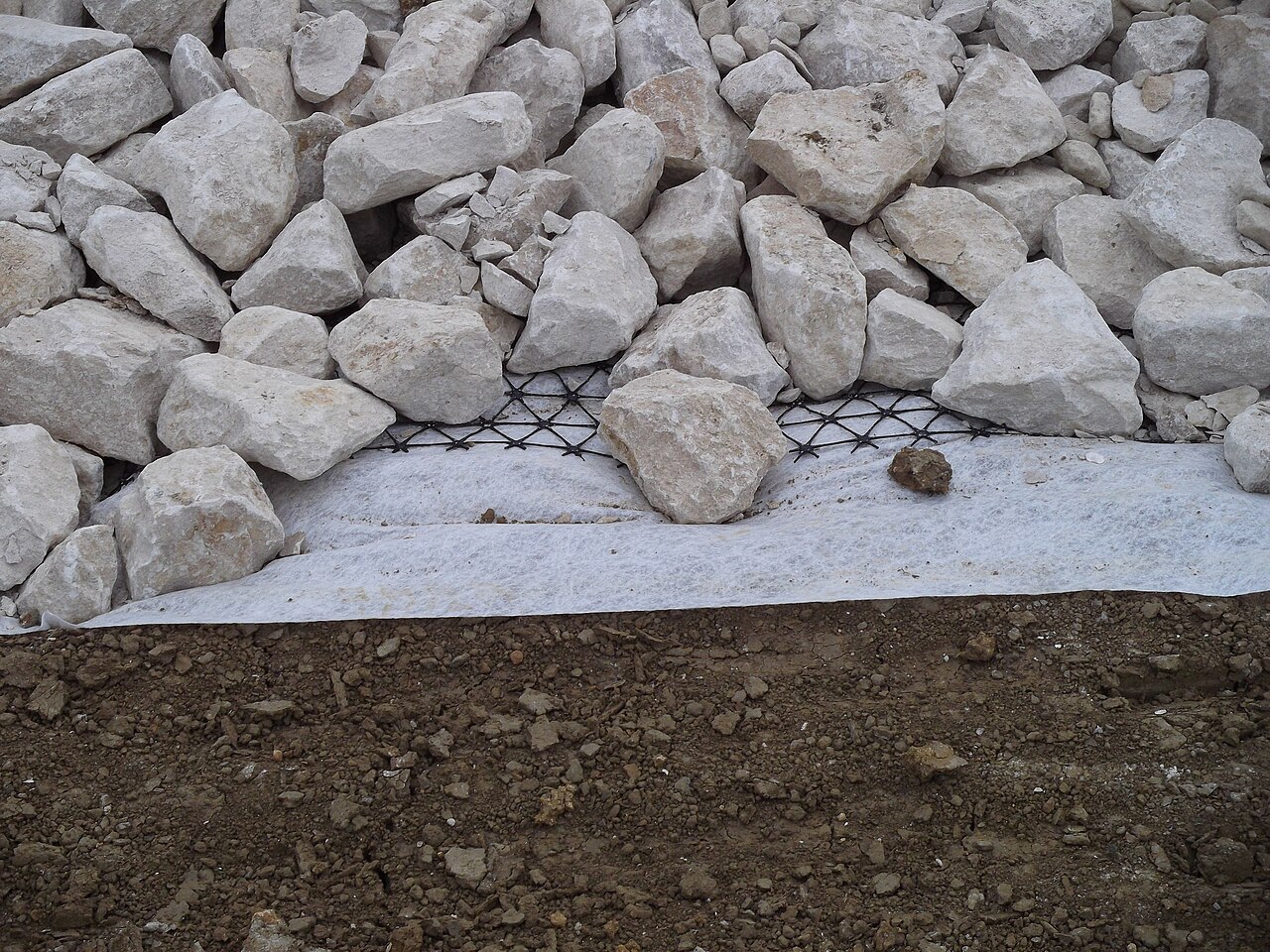
Photo: Su at Polish Wikipedia, CC BY 3.0, via Wikimedia Commons.

How do you specify geotextiles?
To specify a geotextile, state its function first (separation, filtration, drainage, protection or reinforcement) and the application standard that matches the use, such as BS EN 13249 for roads and trafficked areas. Then give the declared values that function depends on: static puncture (CBR) and cone drop resistance for robustness, characteristic opening size and water permeability for filtration, tensile strength, and durability for the design life, rather than a weight in grams per square metre.
"Geotextile membrane" is how most drawings label it, and the label is part of the problem. A geotextile is a permeable fabric. Its job is to let water through while keeping soil and stone apart, or to protect something else from damage. Specifications that call it a membrane, or describe it only by weight, invite a contractor to supply whatever roll is on the van, which may be the wrong fabric for the ground or too weak to survive the stone placed on it.
This guide covers Uniclass Pr_15_57_35_61 Plastics geotextiles, the woven and non-woven polypropylene and polyester fabrics used under sub-bases, around drains and behind retaining walls. Its neighbours Pr_15_57_35_57 Needle-punched non-woven geotextiles and Pr_15_57_35_88 Thermally bonded non-woven geotextiles describe how the fabric is made; the properties to specify are the same.
What does a geotextile clause need to cover?
Some properties are specific to geotextiles. Others belong in every product clause. A clause that leaves either out gives the contractor room to substitute.
Properties of geotextiles
- FunctionSeparation, filtration, drainage, protection or reinforcement.
- Tensile strengthWide-width strength to BS EN ISO 10319.
- Characteristic opening sizeO90 matched to the soil it must retain.
- Water permeabilityFlow through the fabric, normal to the plane.
- Puncture resistanceCBR static puncture, the main survivability check.
- Mass per unit areaIdentifies the grade; not a performance measure.
- ThicknessMatters mainly for protection layers.
- DurabilityDesign life and allowed UV exposure before cover.
What every product clause needs
- Manufacturer and product referenceNamed roll grade, or a performance description to match.
- Product standardApplication standard for the use, evidenced by the DoP.
- Installation methodLaps, anchoring, cover time and no trafficking.
- Technical submittalsDeclaration of performance listing functions and values.
- Operation and maintenance informationLocation and type recorded for future excavation.
- MaterialPolypropylene or polyester; affects chemical resistance.
Uniclass Pr_15_57_35_61 Geotextiles. Not every property applies to every project; where one does not, say so rather than leaving it blank.
Which decisions does the clause depend on?
Most properties follow from the product you choose. These depend on the project, so they need a decision from the designer before the clause is written.
- 01
Start from the function and the use
FunctionGeotextiles are declared against application standards, one per type of works: BS EN 13249 for roads and other trafficked areas, BS EN 13251 for earthworks, foundations and retaining structures, BS EN 13252 for drainage systems, and so on through the series. Each declaration of performance lists the functions the product is declared for and the values that go with them. A fabric declared for separation in a road may not be declared for filtration in a drain. Naming the function and the standard in the clause makes that check possible.
How to decide
- Under a sub-base on soft ground: separation, often with filtration, to BS EN 13249.
- Around filter drains and soakaways: filtration and separation, to BS EN 13252.
- Behind gabions or retaining walls: filtration, to BS EN 13251.
- Where load-bearing is the purpose, the engineer is designing reinforcement, often with a geogrid, which is a separate product.
Write it asFunction: Separation and filtration between subgrade and granular sub-base. Declared to BS EN 13249 for both functions. - 02
Survive installation first
RobustnessMost geotextiles that fail are damaged while the stone goes on, not in service. Two tests describe that risk. The static puncture or CBR test to BS EN ISO 12236 pushes a plunger through the fabric and reports the force in newtons. The cone drop test to BS EN ISO 13433 drops a cone and measures the hole. Large angular sub-base on a soft subgrade needs a tougher fabric than sand over firm ground. Weight in grams per square metre tracks these values only loosely between products.
How to decide
- Take the subgrade condition and the sub-base grading from the engineer's pavement design.
- Set a minimum CBR puncture value and a maximum cone drop hole size to suit them.
- Increase both where plant will run on the first layer or the stone is coarse and angular.
- Use mass per unit area only to identify the grade, not as the requirement.
Write it asStatic puncture (CBR) resistance: Not less than 1500 N to BS EN ISO 12236. Dynamic perforation: Not more than 25 mm to BS EN ISO 13433. - 03
Opening size and permeability
FiltrationA filter has two jobs that pull against each other. It must hold back the soil, which needs small openings, and it must pass water freely, which needs open fabric. The characteristic opening size (O90) to BS EN ISO 12956 describes the first, and water permeability normal to the plane to BS EN ISO 11058 the second. Fine silts need a tighter fabric than sands. A fabric that is too tight can blind with fines, which is how many soakaways and filter drains slowly stop working.
How to decide
- Ask the engineer for the filtration criteria against the soil grading at the drain or soakaway.
- Specify a maximum O90 and a minimum permeability, both from the manufacturer's declared values.
- For filter drains and soakaways, choose non-woven fabrics, which generally filter more evenly than slit-film wovens.
- Keep the same filtration requirements when a substitute is offered.
Write it asCharacteristic opening size O90: Not more than 0.10 mm to BS EN ISO 12956. Water permeability normal to the plane: manufacturer's declared value to BS EN ISO 11058, as filtration design. - 04
Design life and exposure before cover
DurabilityPolypropylene and polyester both degrade in sunlight, and the declaration of performance states how long the fabric can be left uncovered, based on weathering tests to BS EN 12224. Durability in the ground is declared separately, with oxidation resistance to BS EN ISO 13438 for polypropylene. Geotextiles left exposed on site for weeks while the sub-base is delayed are a common cause of brittle fabric. The clause should give the design life and the maximum exposure time, and the programme should respect it.
How to decide
- Take the design life from the element it supports: a road, a drain or a retaining wall.
- Ask for the durability declaration that covers that life in the soil conditions.
- State the maximum time between laying and covering, from the manufacturer's weathering declaration.
- In alkaline ground such as lime-stabilised soils, check the polymer is suitable, especially polyester.
Write it asDurability: Declared for a design life of not less than 25 years in natural soils. Exposure: cover within the period stated on the declaration of performance. - 05
Declaration of performance, not a brochure
EvidenceGeotextiles placed on the market under the application standards carry a declaration of performance and marking. The declaration is the useful document: it names the standard, the functions and the declared values with tolerances. Brochures often quote the best grade in a range or typical rather than declared values. Asking for the declaration before ordering, and checking the roll labels on delivery, closes the gap between what was approved and what arrived on the lorry.
How to decide
- Ask for the declaration of performance for the exact roll grade.
- Check it lists the functions and standard your clause names.
- Compare declared values, with tolerances, against the clause.
- Check roll labels on delivery against the approved grade.
Write it asEvidence of performance: Submit declaration of performance to BS EN 13249 for the grade proposed. Roll labels to match approved grade.
The values under "Write it as" are examples. The right value depends on the location, the use and the fire strategy.
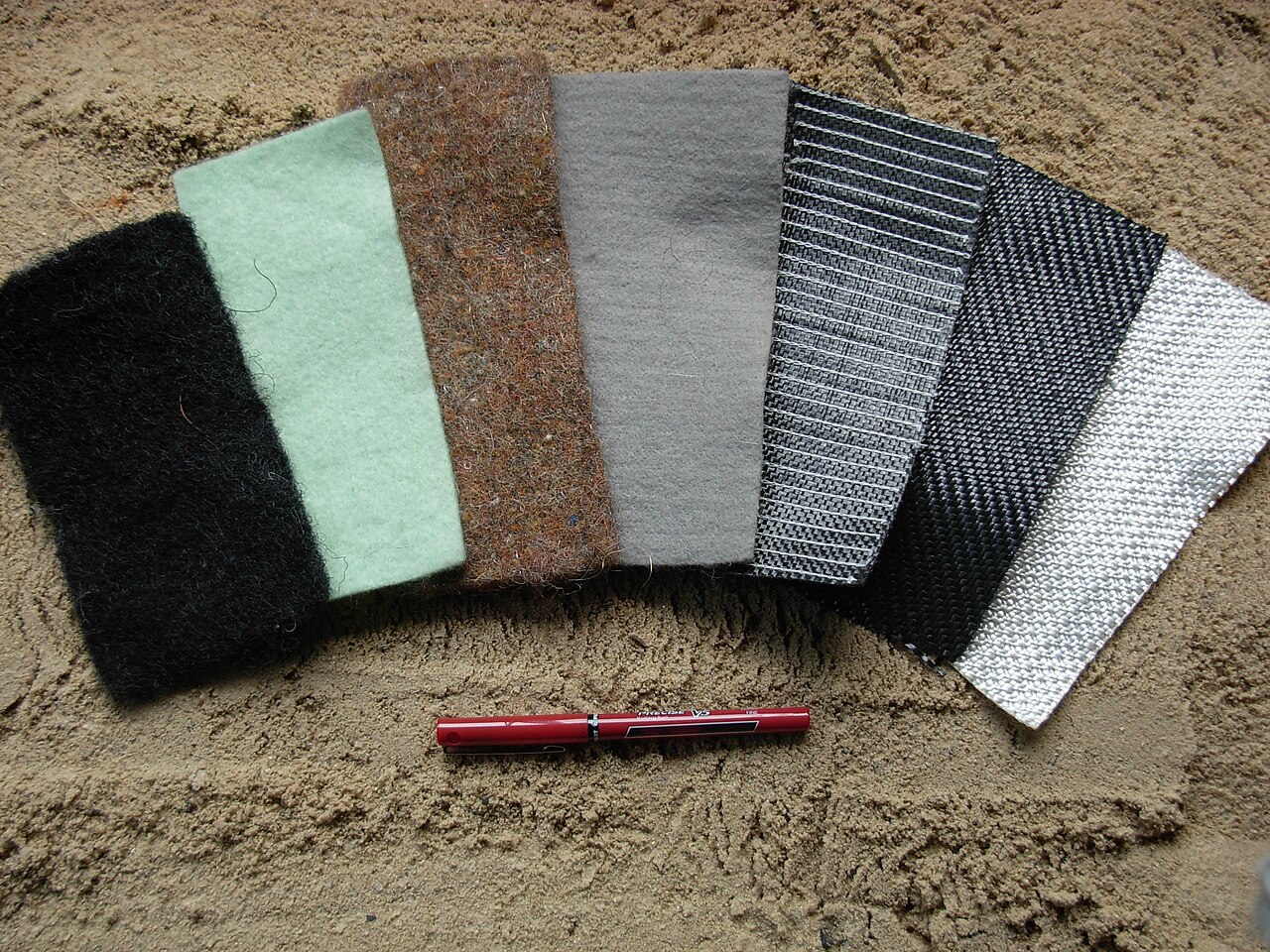
Photo: Marilyn475, Public domain, via Wikimedia Commons.

Which standards should the clause cite?
Cite the product standard the declaration of performance refers to, the code of practice for installation, and the test method behind each value you set. A value without its test method cannot be checked against a submittal.
- BS EN 13249
- Geotextiles and geotextile-related products. Characteristics required for use in the construction of roads and other trafficked areas (excluding railways and asphalt inclusion)
The application standard for geotextiles under roads, car parks and other trafficked areas, listing the characteristics to be declared for each function.
In the clause Name it with the function: "Declared to BS EN 13249 for separation and filtration".
- BS EN 13250 to BS EN 13257 and BS EN 13265
- Geotextiles and geotextile-related products. Characteristics required for use in ... (railways, earthworks, drainage, erosion control, reservoirs and dams, canals, tunnels, solid waste disposal, liquid waste containment)
The other application standards in the series, one per type of works. BS EN 13251 covers earthworks, foundations and retaining structures, BS EN 13252 drainage systems and BS EN 13253 erosion control.
In the clause Pick the one that matches the use: "Declared to BS EN 13252 for filtration" around a filter drain.
- BS EN ISO 12236
- Geosynthetics. Static puncture test (CBR test)
The plunger test that gives the CBR puncture resistance in newtons, the most common robustness value in UK specifications.
In the clause "Static puncture (CBR) resistance: not less than [value] N to BS EN ISO 12236."
- BS EN ISO 13433
- Geosynthetics. Dynamic perforation test (cone drop test)
A falling cone test that measures the hole made in the fabric, as a proxy for stones dropped during placing.
In the clause "Dynamic perforation: hole diameter not more than [value] mm to BS EN ISO 13433."
- BS EN ISO 12956
- Geotextiles and geotextile-related products. Determination of the characteristic opening size
The test for O90, the opening size that controls which soil particles the fabric retains.
In the clause "Characteristic opening size O90: not more than [value] mm to BS EN ISO 12956."
- BS EN ISO 11058
- Geotextiles and geotextile-related products. Determination of water permeability characteristics normal to the plane, without load
The flow rate of water through the fabric, needed wherever the geotextile acts as a filter.
In the clause "Water permeability normal to the plane: not less than [value] to BS EN ISO 11058."
- BS EN ISO 10319
- Geosynthetics. Wide-width tensile test
Tensile strength and elongation at maximum load, in both machine and cross-machine directions.
In the clause "Tensile strength: not less than [value] kN/m in both directions to BS EN ISO 10319."
- BS EN 12224
- Geotextiles and geotextile-related products. Determination of the resistance to weathering
The weathering test behind the declared time a geotextile can be left uncovered on site.
In the clause Use it in the exposure line: "Cover within the period declared from testing to BS EN 12224".
Confirm the current edition of each standard at every issue. Avoice's State of UK Specifications 2026 found a withdrawn standard cited in 40% of specifications at contract issue.
How do you write it in CAWS?
Most geotextiles on building projects sit under paving, so the usual home in CAWS is Q20, with a product clause 170 Geotextile filter/ separator membrane. The paving type clauses in Q22 to Q25 call up the Q20 sub-base, and the sub-base clause in turn calls up the geotextile, so one geotextile clause can serve every paving type on the project.
Where the geotextile belongs to earthworks or drainage rather than paving, NBS has equivalent clauses elsewhere: D20 Excavating and filling has a geotextile sheet clause, and R12 and R13 cover geotextiles around pipes and filter drains. Whichever section holds it, the clause relies on the subgrade preparation and sub-base placing clauses for the work around it.
- Location
- Between subgrade and Type 1 sub-base under car park paving, as paving drawings
- Manufacturer
- Submit proposals
- Product reference
- Submit proposals
- Type
- Non-woven polypropylene geotextile
- Standard
- Declared to BS EN 13249 for separation and filtration
- Static puncture (CBR) resistance
- TBC Depends on subgrade strength and sub-base grading, awaiting engineer's pavement design. Resolve before ordering.
- Dynamic perforation
- Not more than 25 mm to BS EN ISO 13433
- Tensile strength
- Not less than 10 kN/m in both directions to BS EN ISO 10319
- Characteristic opening size O90
- Not more than 0.10 mm to BS EN ISO 12956
- Water permeability
- Manufacturer's declared value to BS EN ISO 11058
- Durability
- Declared for not less than 25 years in natural soils
- Laps
- Not less than 300 mm, increased on soft subgrades as manufacturer
- Laying
- Flat and free of creases on the prepared subgrade; do not traffic before cover
- Cover
- Within the exposure period stated on the declaration of performance
Illustrative, not from a real project. One property is left as a TBC with a reason so it can be tracked and closed before issue.
Clauses the type clause relies on
- Q20/150
- Subgrades for vehicular areas Preparing and proof-rolling the formation the geotextile is laid on.
- Q20/211
- Granular material The sub-base material whose grading drives the puncture requirement.
- Q20/230
- Placing granular material generally Tipping and spreading stone without tracking plant on bare fabric.
- Q20/240
- Laying granular sub-bases for vehicular areas Layer thickness and compaction over the geotextile.
- Q20/340
- Protection Covering subgrades and sub-bases promptly and keeping traffic off.
Clause numbers vary between NBS versions and practice masters; check that the paving clauses in Q22 to Q25 point to the Q20 geotextile clause you actually keep.
How do you write it in Uniclass?
In Uniclass the geotextile is a product inside a system. Under paving that system is the sub-base layer, Ss_30_14_65_82 Sub-base layer systems, which describes the subgrade, the geotextile, the granular layers and the finished bearing and drainage it has to give.
The geotextile itself is written once as Pr_15_57_35_61 Plastics geotextiles, with its function, standard and declared values. The same product clause can then be pointed to from a filter drain or soakaway system, provided its filtration values suit that use too; if not, it is a second product with its own type mark.
- Description
- Granular sub-base on geotextile separator under car park paving
- Subgrade
- Proof-rolled formation, soft spots removed and replaced
- Geotextile
- Pr_15_57_35_61 Plastics geotextiles (GT01)
- Sub-base
- Type 1 unbound mixture, thickness as pavement design
- Laps
- Not less than 300 mm
- Placing
- End-tip and spread; no plant on uncovered geotextile
- Cover
- Within the declared exposure period
- Manufacturer
- Submit proposals
- Product reference
- Submit proposals
- Material
- Polypropylene, non-woven
- Standard
- Declared to BS EN 13249 for separation and filtration
- Static puncture (CBR) resistance
- TBC Awaiting engineer's pavement design for subgrade and sub-base grading. Resolve before ordering.
- Dynamic perforation
- Not more than 25 mm to BS EN ISO 13433
- Tensile strength
- Not less than 10 kN/m to BS EN ISO 10319
- Characteristic opening size O90
- Not more than 0.10 mm to BS EN ISO 12956
- Water permeability
- Manufacturer's declared value to BS EN ISO 11058
- Durability
- Declared for not less than 25 years in natural soils
Illustrative. Performance of the finished system sits in the system clause; properties of the product sit in the product clause.
There is no NBS Chorus reference against this product type in our data, so the Uniclass code carries the identification on its own; do not mix CAWS and Uniclass references in one specification.
What goes in the spec, and what goes in the schedule?
The specification defines each type once. The schedule and drawings say where each type goes.
In the specification
What the product is and how it performs and is installed. Written once per type.
In the schedule or drawings
Where each type goes and how much of it. Changes with every plan revision.
Give each grade a type mark (GT01, GT02) and let the paving and drainage details say where it goes. A detail note that just says "geotextile membrane" should point to the type mark, not stand in for a specification.
What are the common mistakes?
Most problems are a missing property, a property filled with the wrong kind of value, or a decision left silently open.
- Specified by weight alone. "200 g/m² geotextile" says nothing about puncture or filtration. Two fabrics of the same weight can differ widely in both.
- Called a membrane. The word leads some contractors to supply polythene or a geomembrane, which stops water passing. Say geotextile and say it must be permeable.
- No function named. Without a function the declaration of performance cannot be checked, because declared values only apply to the functions listed.
- Left in the sun. Rolls laid out weeks ahead of the sub-base go brittle. State the exposure limit and programme the cover.
- Plant on bare fabric. Tracking over uncovered geotextile tears it and moves the laps. Require end-tipping and spreading from the advancing layer.
- Laps too short on soft ground. A standard lap pulls apart when soft subgrade deforms under the first layer. Increase laps, or sew or overlap as the manufacturer requires.
How Avoice helps
Avoice's spec writer drafts geotextile clauses from the build-ups on your drawings, and keeps the function and values tied to each use.
- Drafts from your details
It picks up geotextile type marks from paving, drainage and retaining wall details and drafts the Q20, D20 or Uniclass clause with the function each location needs.
- Leaves a TBC where the design is missing
If the puncture value depends on a pavement design that has not arrived, the line says TBC with the reason and joins the project TBC register to close before tender.
- Writes in your format and your style
Choose CAWS or Uniclass. Avoice adapts your practice's own Q20 and D20 masters rather than replacing them with generic text.
- Checks the clause against everything else
QA/QC flags a detail note calling for a "membrane" where the specification has a geotextile, a GT02 with no clause, or a paving clause pointing at a Q20 clause that has been deleted.
- Keeps product data in one place
Declarations of performance live in the Product Room, linked to the clause, so a substitute roll can be checked against the declared functions and values the clause asks for.
Related guides: How to specify soakaway crates, How to specify block paving, How to specify gabions.
Software can draft and check. The designer still chooses the product and is responsible for the specification.
Draft your geotextile clause in Avoice
Upload your drawings and schedules. Avoice drafts the clause in CAWS or Uniclass, cites the standards and flags anything your information does not settle.
This guide is for general education and is not professional advice. Check current editions of standards and Approved Documents, the manufacturer's data, and the requirements of your project before relying on any clause.