
How to specify soakaway crates
What a geocellular soakaway clause has to settle, from the infiltration test to the load rating and the wrap, and how to write it in CAWS and in Uniclass.
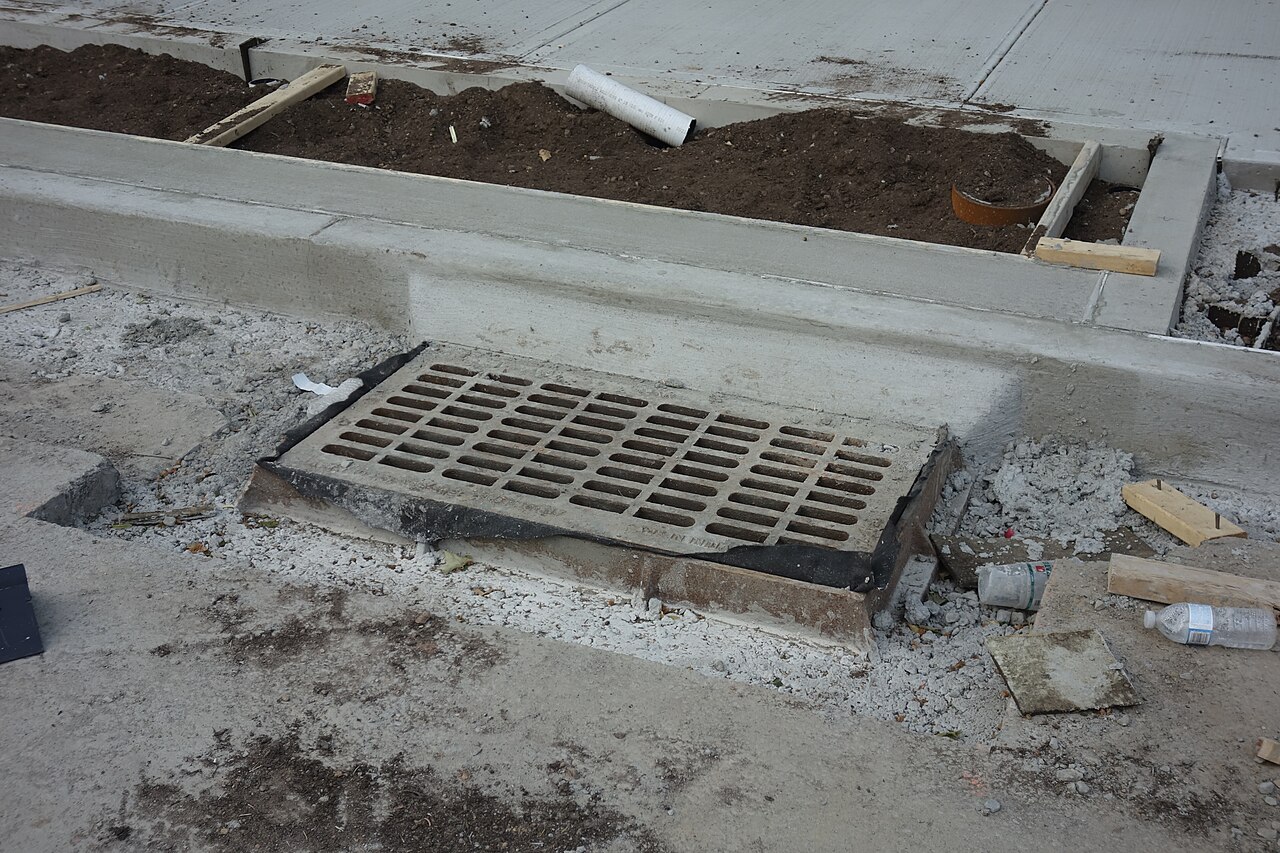
Photo: Tdorante10, CC BY-SA 4.0, via Wikimedia Commons.
_15_-_NYCDEP_Infiltration_Basins.jpg)
How do you specify soakaway crates?
To specify soakaway crates, start from the drainage design: a BRE 365 infiltration test at the soakaway position, a storage volume for the design storm, and a location at least 5 m from buildings and roads. Then name the units by their load rating for the actual depth of cover and traffic, wrap them in a geotextile so water can leave, and specify the bedding, backfill, silt protection and inspection access with the product.
A crate soakaway is a box of plastic void buried in a hole. The plastic is the easy part. Whether it works depends on the ground around it, the load on top of it and the silt that reaches it, and none of that is visible once the excavation is backfilled. A clause that names a crate and a volume, and nothing else, leaves the contractor to guess at all three.
This guide covers Uniclass Pr_60_50_96_31 Geocellular modular plastics storage units used as soakaways, where the water infiltrates into the ground. The same units sealed in an impermeable membrane become an attenuation tank, which NBS writes in a different clause and Uniclass places in a different system; the guide points out where the two part company.
What does a soakaway crate clause need to cover?
Some properties are specific to soakaway crates. Others belong in every product clause. A clause that leaves either out gives the contractor room to substitute.
What every product clause needs
- Manufacturer and product referenceNamed unit and grade, since grades differ in load rating.
- Product standardBS EN 17152-1 or a third-party certificate for the use.
- Installation methodBedding, wrap, backfill and cover depth per manufacturer.
- Technical submittalsInfiltration test, storage calculation and structural check.
- Operation and maintenance informationInspection points, silt removal and access for jetting.
Uniclass Pr_60_50_96_31 Soakaway crates. Not every property applies to every project; where one does not, say so rather than leaving it blank.
Which decisions does the clause depend on?
Most properties follow from the product you choose. These depend on the project, so they need a decision from the designer before the clause is written.
- 01
Infiltration test before volume
GroundThe crate does not decide how much water leaves the soakaway. The soil does. Approved Document H asks for percolation testing and a design for a storm with a return period of once in ten years, and refers larger soakaways to BRE Digest 365. The BRE 365 test digs a pit at the soakaway depth, fills it three times and takes the slowest rate. Specifying a crate volume before that test exists means the size is a guess, and clay sites often fail the test altogether.
How to decide
- Ask for a BRE 365 test at the proposed position and depth, not at a convenient spot on site.
- Have the drainage engineer size the storage from the slowest of the three results.
- Check the AD H 3.25 limits: 5 m from buildings and roads, no seasonal water table at the surface, clear of drainage fields.
- If infiltration fails, change the design to attenuation with a controlled outfall, which is a different clause.
Write it asInfiltration rate: Determined by trial pit test to BRE Digest 365 at the soakaway position and depth. Submit test results and storage calculation before ordering. - 02
Unit grade for the load and depth
LoadingMost ranges come in light and heavy grades, and a unit sold for gardens can collapse under a car park or under the excavator that backfills it. CIRIA C737 sets out how to check modular units for vertical and lateral load, including long-term creep of the plastic, and that check depends on the cover depth, the surfacing and the traffic. The clause should state those conditions so the manufacturer's design can be compared with them, rather than naming a grade and hoping.
How to decide
- State the surface above: soft landscape, pedestrian paving, cars, or service vehicles.
- Give minimum and maximum cover depth and the depth to the base of the units.
- Ask for the manufacturer's structural check to CIRIA C737 for those conditions.
- Say whether construction plant will cross the installed units, and if so what protection is needed.
Write it asStructural performance: Suitable for car parking with 600 mm minimum cover. Submit manufacturer's design check to CIRIA C737 for vertical and lateral loads at the installed depth. - 03
Geotextile wrap, not a membrane
WrapThe difference between a soakaway and an attenuation tank is the wrap. A soakaway is wrapped in a permeable geotextile that keeps soil out of the voids and lets water pass. An attenuation tank is wrapped in an impermeable geomembrane, often between protective geotextiles, with welded or taped joints. Copying a tank specification onto a soakaway seals it; copying a soakaway onto a tank sends water into ground that may be unsuitable. The wrap line in the clause is where that decision is recorded.
How to decide
- Infiltration design: non-woven geotextile to all faces, lapped as the manufacturer requires.
- Attenuation design: geomembrane with protection layers, and a separate clause.
- Pick the geotextile by its filtration properties against the surrounding soil, not by weight alone.
- Ask for the bedding and backfill material the manufacturer's load rating assumes.
Write it asWrap: Non-woven geotextile to all faces of the units, laps 300 mm, as manufacturer's recommendations. Do not use impermeable membrane. - 04
Silt protection and inspection
SiltSilt is what ends most soakaways early. Once fine material settles in the units and blinds the geotextile, the infiltration rate falls and there is no practical way to clean the faces. Roof water is relatively clean; runoff from paving and drives carries grit and leaves. A silt trap or catchpit upstream, and an inspection access into the crate field, let the client see silt building up and remove it before it reaches the units. Both need to be specified, or neither gets built.
How to decide
- Paved and driveway runoff: specify a silt trap or catchpit before the soakaway.
- Larger installations: include an inspection chamber or access shaft that reaches the base of the units.
- Check the manufacturer's range offers inspection or jetting access through the units.
- Put the inspection and cleaning regime in the O&M information.
Write it asSilt protection: Catchpit upstream of soakaway, as drainage drawing. Inspection access: Manufacturer's inspection shaft to base of units. - 05
Product standard and certification
EvidenceBS EN 17152-1 now gives a product standard for polypropylene and PVC-U storm water boxes used for infiltration, attenuation and storage. Many UK units are also sold under BBA or other third-party certificates, which state the uses and loads the product was assessed for. A brochure claim of compressive strength is not the same thing: it is usually a short-term test figure. Ask for the standard or the certificate, and read what it covers before accepting a substitution.
How to decide
- Ask which standard or certificate the unit is supplied under.
- Check the certificate covers infiltration use and the load class you need.
- Ask for the long-term design strength the structural check used, not only the short-term figure.
- Hold substitutions to the same evidence.
Write it asStandard: To BS EN 17152-1, or with current third-party certificate covering infiltration use at the stated loads. Submit certificate.
The values under "Write it as" are examples. The right value depends on the location, the use and the fire strategy.
Which standards should the clause cite?
Cite the product standard the declaration of performance refers to, the code of practice for installation, and the test method behind each value you set. A value without its test method cannot be checked against a submittal.
- Approved Document H
- Drainage and waste disposal (Part H3: rainwater drainage)
Paragraph 3.25 says infiltration devices should not be built within 5 m of a building or road, where the water table reaches the surface, or too close to drainage fields. Paragraph 3.27 asks for soakaways to be designed for a return period of once in ten years.
In the clause Use it for siting and design basis: "Location: not less than 5 m from any building or road, as Approved Document H paragraph 3.25".
- BRE Digest 365
- Soakaway design
The trial pit test for soil infiltration rate and the method for sizing soakaway storage. AD H paragraph 3.30 refers to it for soakaways serving larger areas.
In the clause "Infiltration rate: by trial pit test to BRE Digest 365 at the soakaway position."
- BS EN 17152-1
- Plastics piping systems for non-pressure underground conveyance and storage of non-potable water. Boxes used for infiltration, attenuation and storage systems. Specifications for storm water boxes made of PP and PVC-U
The product standard for polypropylene and PVC-U storm water boxes, covering their properties and test methods.
In the clause Cite it as the product standard, with a certificate route as the alternative: "Standard: to BS EN 17152-1 or current third-party certificate".
- CIRIA C737
- Structural and geotechnical design of modular geocellular drainage systems
How to check modular units for vertical and lateral load, long-term behaviour and the stability of the excavation and backfill. It replaced the earlier CIRIA C680.
In the clause "Submit manufacturer's structural design check to CIRIA C737 for the installed depth and loads."
- CIRIA C753
- The SuDS Manual
The UK reference for sustainable drainage design, including infiltration systems, geocellular storage, pre-treatment of runoff and maintenance.
In the clause Use it for design and maintenance principles in the drainage strategy rather than as a product reference.
- BS 8582
- Code of practice for surface water management for development sites
Surface water management for development sites, including infiltration and storage, and how they sit within the overall drainage strategy.
In the clause Usually cited in the drainage design brief: "Surface water design: in accordance with BS 8582".
- BS EN 13252
- Geotextiles and geotextile-related products. Characteristics required for use in drainage systems
The application standard for geotextiles used in drainage, which sets out the characteristics a declaration of performance has to cover for filtration and separation.
In the clause For the wrap: "Geotextile: declared for filtration and separation to BS EN 13252".
Confirm the current edition of each standard at every issue. Avoice's State of UK Specifications 2026 found a withdrawn standard cited in 40% of specifications at contract issue.
How do you write it in CAWS?
In current NBS, modular plastic soakaways have their own product clause in R17: 315 Modular plastics soakaway units. The clause describes the units, their wrap and the evidence of performance. R17 is written to be read with R12 Below ground drainage systems, which carries the general execution clauses for excavation, backfill, cleaning and testing, and the inlet pipework and chambers stay in R12.
If the same units are wrapped in a membrane and used for storage, NBS uses a different clause, R12/464 Modular stormwater attenuation units. Keeping the two apart in the specification is the simplest guard against a soakaway that has been sealed by a membrane copied from a tank clause.
- Description
- Geocellular soakaway serving roof and patio drainage, location as drainage layout
- Manufacturer
- Submit proposals
- Product reference
- Submit proposals
- Standard
- To BS EN 17152-1, or current third-party certificate covering infiltration use
- Material
- Polypropylene
- Storage volume
- As drainage engineer's calculation for a 1 in 10 year design storm
- Infiltration rate
- TBC BRE 365 trial pit test at the soakaway position not yet carried out. Resolve before ordering.
- Location
- Not less than 5 m from any building or road
- Loading
- Pedestrian paving over; manufacturer's structural check to CIRIA C737 for the installed depth
- Cover depth
- As drainage section, within manufacturer's minimum and maximum limits
- Wrap
- Non-woven geotextile to all faces, laps 300 mm, as manufacturer
- Bedding
- Level granular or sand bed, free of sharp material, as manufacturer
- Backfill
- Material and compaction as manufacturer's installation guide
- Silt protection
- Catchpit upstream, as drainage layout
- Inspection access
- Manufacturer's inspection shaft to base of units
Illustrative, not from a real project. One property is left as a TBC with a reason so it can be tracked and closed before issue.
Clauses the type clause relies on
- R17/R12/613
- Excavated material Setting aside turf and topsoil for reinstatement over the soakaway.
- R17/R12/683
- Laying pipelines Inlet pipework to line and gradient into the units.
- R17/R12/901
- Removal of debris and cleaning Clearing silt and debris from chambers and pipework before handover.
- R17/R12/464
- Modular stormwater attenuation units The separate clause for the same units used as sealed storage.
- R17/Q20/170
- Geotextile filter/ separator membrane Where the wrap is written as its own geotextile product clause.
Clause numbers vary between NBS versions and practice masters; the R17 and R12 numbers here are the ones NBS Source assigns to modular soakaway and attenuation units, and the R12 execution numbers come from a published NBS specification.
How do you write it in Uniclass?
Uniclass describes the installed soakaway as a system, Ss_50_70_05_82 Below-ground drainage modular plastics soakaway systems. The system clause carries the things that make it a soakaway: where it is, what it drains, the infiltration basis, the wrap, the silt protection and the access.
The crates themselves are a product clause, Pr_60_50_96_31 Geocellular modular plastics storage units, holding the unit properties and certification. The same product clause can serve an attenuation tank system elsewhere on the project, which is why the wrap belongs in the system clause, not in the product.
- Description
- Geocellular soakaway serving roof and patio drainage
- Location
- As drainage layout, not less than 5 m from buildings and roads
- Units
- Pr_60_50_96_31 Geocellular modular plastics storage units (SA01)
- Design basis
- 1 in 10 year storm, infiltration rate from BRE 365 test
- Wrap
- Non-woven geotextile to all faces, laps 300 mm
- Bedding and backfill
- As manufacturer's installation guide
- Silt protection
- Catchpit upstream
- Inspection access
- Inspection shaft to base of units
- Manufacturer
- Submit proposals
- Product reference
- Submit proposals
- Standard
- To BS EN 17152-1, or current third-party certificate covering infiltration use
- Material
- Polypropylene
- Unit grade
- TBC Load rating depends on the final cover depth and surfacing, not yet fixed. Resolve before ordering.
- Structural check
- Manufacturer's design to CIRIA C737 for installed depth and loads
- Void ratio
- Manufacturer's declared value, used in the storage calculation
- Accessories
- Connectors, side panels and inlet adaptors from the same range
- Maintenance
- Inspection and cleaning regime in O&M information
Illustrative. Performance of the finished system sits in the system clause; properties of the product sit in the product clause.
NBS Chorus gives these units the reference 90-10-95/480; use either that or the CAWS clause numbers your practice uses, but do not mix the two systems in one specification.
What goes in the spec, and what goes in the schedule?
The specification defines each type once. The schedule and drawings say where each type goes.
In the specification
What the product is and how it performs and is installed. Written once per type.
In the schedule or drawings
Where each type goes and how much of it. Changes with every plan revision.
Write the soakaway type once (SA01) and let the drainage layout and schedule say where each one goes, how big it is and what it drains. Sizes belong to the engineer's calculation, which changes with every test result.
What are the common mistakes?
Most problems are a missing property, a property filled with the wrong kind of value, or a decision left silently open.
- A volume with no test behind it. Sizing from a rule of thumb rather than a BRE 365 result at the soakaway position. On slow ground the crate fills and stays full.
- A tank membrane on a soakaway. The wrap line copied from an attenuation clause seals the units. Check the wrap says geotextile and that nothing else calls for a membrane.
- Light-duty units under a drive. A garden-grade crate placed below a parking area or crossed by plant during backfill. State the load and cover so the grade can be checked.
- Soakaway against the house. Positions on the drawing inside the 5 m distance AD H recommends from buildings and roads, often moved late to clear a tree or a boundary.
- No silt trap and no way in. Drive runoff piped straight into the units with no catchpit and no inspection access, so silting is only discovered when the soakaway floods.
- Testing in the wrong place. A trial pit dug where it was convenient rather than at the soakaway depth and location, then used to size a soakaway in different ground.
How Avoice helps
Avoice's spec writer drafts soakaway clauses from the drainage information on the project, and marks what still depends on the ground investigation.
- Drafts from your drainage drawings
It reads soakaway type marks such as SA01 from the drainage layout and schedule and drafts the R17 or Uniclass clause with the location, wrap and access the drawings show.
- Leaves a TBC where the test is missing
If there is no BRE 365 result or the cover depth is not fixed, the infiltration or load line says TBC with the reason, and the item joins the project TBC register to close before tender.
- Writes in your format and your style
Choose CAWS or Uniclass. Avoice adapts your practice's own R17 and R12 masters rather than replacing them with generic text.
- Checks the clause against everything else
QA/QC flags a soakaway clause that calls for a membrane, a soakaway drawn inside 5 m of the building, or a cross-reference to an R12 clause your specification does not contain.
- Keeps product data in one place
Certificates, structural checks and installation guides live in the Product Room, linked to the clause, so a substitute crate can be checked against the load and certificate the clause asks for.
Related guides: How to specify geotextiles, How to specify inspection chambers, How to specify permeable paving.
Software can draft and check. The designer still chooses the product and is responsible for the specification.
Draft your soakaway crate clause in Avoice
Upload your drawings and schedules. Avoice drafts the clause in CAWS or Uniclass, cites the standards and flags anything your information does not settle.
This guide is for general education and is not professional advice. Check current editions of standards and Approved Documents, the manufacturer's data, and the requirements of your project before relying on any clause.