
How to specify intumescent paint
What an intumescent coating clause has to say, the decisions that sit with the fire engineer and structural engineer, the standards to cite, and how to write it in CAWS and in Uniclass.
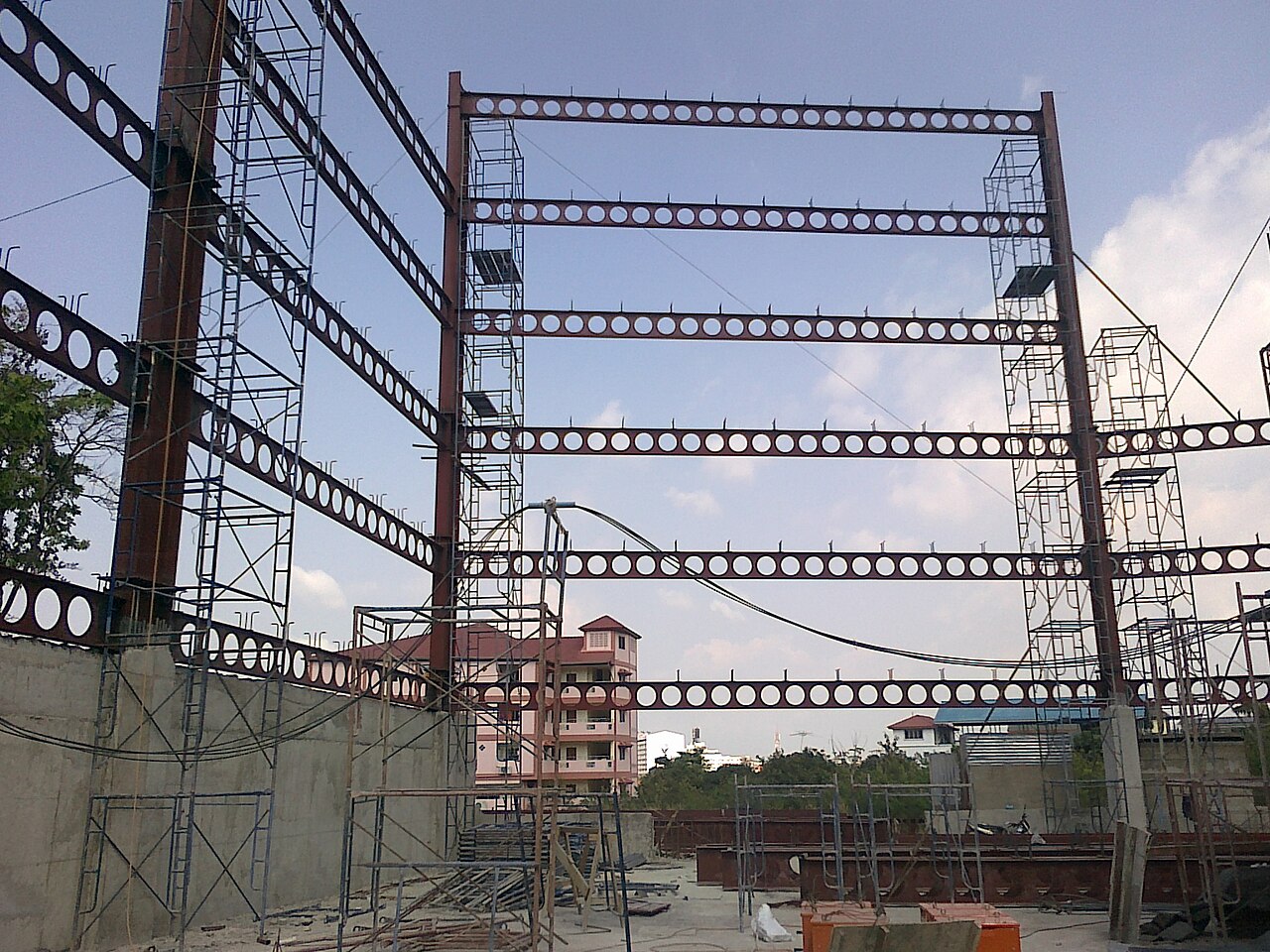
Photo: Meow2021, CC BY-SA 4.0, via Wikimedia Commons.

How do you specify intumescent coatings?
To specify intumescent paint for steelwork, state the fire resistance period and the critical steel temperature from the fire strategy and structural engineer, then require a coating assessed to BS EN 13381-8 with a dry film thickness schedule for every member by section factor. Specify the whole system, from surface preparation and compatible primer to topcoat, for the environment it will sit in.
An intumescent clause is only as good as the thickness schedule behind it. The coating does nothing until a fire, and the dry film thickness each member needs depends on its section factor, how many sides are exposed, the fire period and the temperature at which that member would fail. None of that is visible once the steel is painted. A clause that says "60 minutes intumescent" leaves every one of those numbers to the applicator, and nobody can check the result afterwards.
This guide covers Uniclass Pr_35_31_68_43 Intumescent protective coatings, mainly as reactive fire protection to structural steel. Flame-retardant coatings that upgrade the reaction to fire of timber or boards have their own Uniclass code and do a different job; they are covered briefly in the decisions below.
What does a intumescent coating clause need to cover?
Some properties are specific to intumescent coatings. Others belong in every product clause. A clause that leaves either out gives the contractor room to substitute.
Properties of intumescent coatings
- Reaction to fire classificationNever guessFor flame-retardant coatings: the class achieved on the substrate.
- Surface preparation gradeBlast cleaning grade to BS EN ISO 8501-1.
- Coat build-upPrimer, basecoat and topcoat DFTs per coat.
- Chemical resistanceOnly where exposed to chemicals or aggressive cleaning.
- Product typeThin-film intumescent, thick-film epoxy or flame retardant.
- Fire retardant durability classNever guessInterior or exterior durability for flame-retardant coatings.
- Sample approvalReference area to agree finish quality.
- FinishTopcoat colour and the visible quality expected.
- Corrosion protectionCorrosivity category to BS EN ISO 12944-2.
- Coating systemPrimer, intumescent and topcoat proven compatible together.
- Binder type and gradeWater-based, solvent-based or epoxy intumescent.
- Fire resistanceNever guessPeriod and critical temperature from the fire strategy.
- Gloss levelTopcoat sheen for exposed steelwork.
What every product clause needs
- Manufacturer and product referenceNamed coating system, or performance description if not named.
- Product standardAssessed to BS EN 13381-8; DoP via a European or UK Technical Assessment.
- Installation methodManufacturer's application instructions and approved applicator.
- Technical submittalsAssessment, DFT schedule and third-party certificate.
- Operation and maintenance informationAs-applied DFT records and repair method.
- SubstrateSteel grade and section, or timber and board.
- Application conditionsTemperature and humidity limits during application and cure.
Uniclass Pr_35_31_68_43 Intumescent protective coatings. Not every property applies to every project; where one does not, say so rather than leaving it blank.
Fields marked Never guess (reaction to fire classification, fire retardant durability class and fire resistance) depend on the project and should never be filled from a default or a previous job. If the information is not available yet, the clause should say so with a TBC and a reason.
Which decisions does the clause depend on?
Most properties follow from the product you choose. These depend on the project, so they need a decision from the designer before the clause is written.
- 01
Fire period and critical steel temperature
Never guessTwo numbers drive the coating thickness, and neither belongs to the architect. The fire resistance period comes from the fire strategy and Approved Document B. The critical steel temperature comes from the structural engineer, from the load each member carries in the fire condition: a lightly loaded beam can reach a higher temperature before it fails than a heavily loaded column. Defaulting to one temperature for every member either wastes coating or under-protects the members that matter most. Put both numbers on the steelwork fire protection schedule, member by member.
How to decide
- Get the period for each part of the frame from the fire strategy, and note any zones with a different period.
- Ask the structural engineer for critical temperatures by member, or by member group where loads are similar.
- State the period as an R classification to BS EN 13501-2 for loadbearing steel, for example R 60.
Write it asFire resistance: R 60 to BS EN 13501-2. Critical steel temperatures as the structural engineer's schedule. - 02
A dry film thickness schedule for every member
ThicknessThe manufacturer works out the thickness from its assessment to BS EN 13381-8, using each member's section factor (the heated perimeter over the cross-sectional area), its exposure on three or four sides, the period and the critical temperature. The output is a schedule giving the dry film thickness for every member. Ask for it before application starts, check it against the structural drawings, and require readings to BS EN ISO 19840 afterwards. Cellular beams and other members outside the assessment's scope need separate evidence, so the schedule should say which members they are.
How to decide
- Issue the structural member schedule with exposure noted: three-sided for beams under a slab, four-sided for free-standing members.
- Require the manufacturer's DFT schedule as a submittal, checked before any coating is applied.
- Ask for as-applied DFT readings per member, recorded and handed over.
Write it asDry film thickness: Per member, to the manufacturer's DFT schedule based on its BS EN 13381-8 assessment. Measure to BS EN ISO 19840 and submit records. - 03
Thin-film, thick-film or off-site
Coating typeWater-based thin-film coatings suit dry, heated interiors and exposed steel where the finish is seen. Solvent-based thin films tolerate colder and damper site conditions during application. Epoxy thick-film systems are used for longer periods, external steel and hydrocarbon fire exposure, and take more knocks. Off-site application in the fabricator's shop gives better control of conditions and thickness and takes the work off the site programme, but the coating then has to survive transport and erection, and connections need touching up on site.
How to decide
- Internal, dry and seen: water-based thin film, with the finish category stated.
- Cold or damp application conditions, or partly external: solvent-based thin film, or epoxy.
- External, aggressive or long periods: epoxy thick film, checked against the corrosivity category.
- Tight programme: consider off-site application and specify touch-up of connections.
Write it asProduct type: Water-based thin-film intumescent coating, applied on site to primed steel. - 04
Primer, intumescent and top coat as one system
CompatibilityThe intumescent only performs as tested if the primer underneath and the sealer or top coat over it are ones the manufacturer has shown to be compatible. Many problems start at the fabrication shop, where a standard primer goes on before anyone has chosen the intumescent. Write the system as one: surface preparation grade, primer, intumescent, top coat. State the corrosivity category of the location to BS EN ISO 12944-2, and require the intumescent manufacturer's written confirmation that the primer and top coat are compatible with its product.
How to decide
- Fix the primer in the steelwork specification before fabrication, or require the fabricator to use one the intumescent manufacturer approves.
- Set the corrosivity category for the location: C1 for heated dry interiors, higher near pools, kitchens or outside air.
- Ask for written compatibility confirmation as a submittal.
Write it asCoating system: Primer, intumescent and top sealer coat compatible as confirmed in writing by the intumescent manufacturer. Corrosivity category C1 to BS EN ISO 12944-2. - 05
Flame-retardant coatings: reaction to fire and durability
Never guessFlame-retardant coatings applied to timber or boards to improve their reaction to fire class are a different product doing a different job from intumescent protection of steel. State the Euroclass the lining has to reach to BS EN 13501-1, and ask for test evidence on the same substrate, thickness and finish. Treatments and coatings can lose performance with weathering or washing, so on timber and wood-based boards state the fire retardant durability class for interior or exterior use to BS EN 16755. Remember that Approved Document B classes apply to walls and ceilings, not floors.
How to decide
- Check whether the fire strategy needs a better reaction to fire class than the bare timber or board achieves.
- Ask for classification on the actual substrate, not a generic report.
- Outside, or in humid or regularly washed areas, require the exterior durability class to BS EN 16755.
Write it asReaction to fire: Class B-s1,d0 to BS EN 13501-1 on the specified timber substrate. Fire retardant durability: exterior class to BS EN 16755.
The values under "Write it as" are examples. The right value depends on the location, the use and the fire strategy.
Which standards should the clause cite?
Cite the product standard the declaration of performance refers to, the code of practice for installation, and the test method behind each value you set. A value without its test method cannot be checked against a submittal.
- BS EN 13381-8
- Test methods for determining the contribution to the fire resistance of structural members: applied reactive protection to steel members
The test and assessment method behind a manufacturer's DFT tables for each section factor, exposure, period and critical temperature.
In the clause Require the assessment to cover the job: "Assessed to BS EN 13381-8 for the sections, exposures and periods scheduled."
- BS EN 16623
- Paints and varnishes: reactive coatings for fire protection of metallic substrates, definitions, requirements, characteristics and marking
Product requirements for reactive coatings, including the characteristics to be declared and project-specific validation of materials.
In the clause "Validation of materials: in accordance with BS EN 16623. Submit test results on request."
- BS EN 13501-2
- Fire classification of construction products and building elements: classification using data from fire resistance tests
Fire resistance classification of the protected element, such as R 60 for a loadbearing steel member.
In the clause "Fire resistance: R 60 to BS EN 13501-2."
- BS EN ISO 12944 series
- Paints and varnishes: corrosion protection of steel structures by protective paint systems
Corrosivity categories (Part 2) and the selection of protective paint systems for them.
In the clause "Corrosivity category: C1 to BS EN ISO 12944-2."
- BS EN ISO 8501-1
- Preparation of steel substrates before application of paints and related products: visual assessment of surface cleanliness
Surface preparation grades such as Sa 2½ for blast cleaning and St 2 for hand tool cleaning.
In the clause "Surface preparation: blast cleaned to Sa 2½ to BS EN ISO 8501-1."
- BS EN ISO 19840
- Paints and varnishes: corrosion protection of steel structures by protective paint systems, measurement of and acceptance criteria for the thickness of dry films on rough surfaces
How dry film thickness is measured on blast-cleaned steel and when readings are accepted.
In the clause "Measure dry film thickness to BS EN ISO 19840 and submit readings per member."
- BS EN 13501-1
- Fire classification of construction products and building elements: classification using data from reaction to fire tests
The reaction to fire class achieved by a flame-retardant coating on a stated substrate.
In the clause "Reaction to fire: Class B-s1,d0 to BS EN 13501-1 on the specified substrate."
- BS EN 16755
- Durability of reaction to fire performance: classes of fire-retardant treated wood products in interior and exterior end use applications
Durability classes showing whether a fire-retardant treatment keeps its performance in interior or exterior use.
In the clause "Fire retardant durability: exterior class to BS EN 16755."
Confirm the current edition of each standard at every issue. Avoice's State of UK Specifications 2026 found a withdrawn standard cited in 40% of specifications at contract issue.
For the regulations behind these choices, see Approved Document B explained, Fire strategy reports explained, or search the Avoice Regulations library.
How do you write it in CAWS?
In CAWS, intumescent coatings to steel are written in M61. The section opens with system clauses for each coating situation on the project, named by where and how the coating goes on: on-site coating to primed steel, on-site coating to galvanized steel, off-site coating, coating to existing steel. Each one bundles the preparation, primer, intumescent coat and top sealer coat into a single clause and states the finish expected in visible and non-visible areas.
The fire period and the exposure conditions are usually written once in the performance clauses of M61 and referred to from each system clause, so a project with internal and external steel shares one fire performance clause. The general clauses then cover validation of materials, working procedures, working conditions, inspection by the manufacturer and surface preparation. The DFT per member sits in a schedule, not in the clause.
- Use/ Location
- Exposed internal faces of columns and beams, as steelwork fire protection schedule
- Fire performance
- To BS EN 13501-2, as clause 202
- Critical steel temperature
- TBC Structural engineer's critical temperatures by member outstanding. Resolve before the DFT schedule is issued.
- Assessment
- BS EN 13381-8, for the sections, exposures and periods scheduled
- Preparation
- Blast cleaned to Sa 2½ to BS EN ISO 8501-1 before priming
- Manufacturer
- Submit proposals
- Product reference
- Submit proposals
- Primer
- Type confirmed compatible in writing by the intumescent manufacturer
- Intumescent coat
- Water-based thin film
- Dry film thickness
- Per member, to the manufacturer's DFT schedule
- Finish
- Visible areas: normal decorative. Non-visible areas: basic
- Top sealer coat
- As the intumescent manufacturer's system
- Colour
- RAL 9010, eggshell
- Bolt head/ Nut protection
- As main steelwork
- DFT measurement
- To BS EN ISO 19840, readings recorded per member
- Reference area
- Agree on site before full application
Illustrative, not from a real project. One property is left as a TBC with a reason so it can be tracked and closed before issue.
Clauses the type clause relies on
- M61/202
- Fire performance to BS EN 13501-1 and -2 The fire resistance classification for the protected steel, written once for the section.
- M61/204
- Exposure and durability The environmental exposure and durability the coating system must suit.
- M61/205
- Validation of materials Project-specific evaluation of the coating materials in accordance with BS EN 16623.
- M61/210
- Working procedures Notice before preparation and application, and recorded quality control procedures.
- M61/215
- Working conditions Temperature, humidity and surface condition during application and drying.
- M61/270
- Inspection Access for the manufacturer to inspect work, check records and take DFT readings.
Clause numbers vary between NBS versions and practice masters. The general clauses here follow the M61 section of a published NBS-format tender specification; check that each clause your system clause refers to exists in your own M61.
For more on clause structure and checks, see NBS clause writing: common mistakes.
How do you write it in Uniclass?
In Uniclass the protected steelwork is written as a system and the coating as a product. Ss_40_90_40_42 Intumescent coating systems describes the whole treatment: what it is applied to, preparation, primer, intumescent and top coat, the fire resistance the protected member must achieve and how thickness is measured and recorded. The intumescent itself is a product clause under its Pr code.
The split puts the performance in the right place. The product clause holds what the manufacturer declares about the coating: its assessment, binder type, colour and gloss of the system. The fire period, critical temperatures and thickness per member belong to the system clause and the schedule, because they change with the steel, not the paint. Flame-retardant treatments to timber sit in a different system, Ss_40_90_95 Wood preservative and fire retardant treatment systems.
- Description
- Reactive fire protection to internal structural steel, applied on site
- Substrate
- Structural steel, internal, heated and dry, primed
- Preparation
- Blast cleaned to Sa 2½ to BS EN ISO 8501-1 before priming
- Coating
- Pr_35_31_68_43 Intumescent protective coatings (IC01)
- Fire resistance
- R 60 to BS EN 13501-2, or as steelwork fire protection schedule
- Corrosivity category
- C1 to BS EN ISO 12944-2
- Dry film thickness
- Per member, to the manufacturer's DFT schedule, measured to BS EN ISO 19840
- Records
- As-applied DFT readings per member at handover
- Manufacturer
- Submit proposals
- Product reference
- Submit proposals
- Assessment
- BS EN 13381-8, covering the sections and exposures scheduled
- Product type
- Water-based thin-film intumescent
- Critical steel temperature basis
- TBC Structural engineer's critical temperatures by member outstanding. Resolve before the DFT schedule is issued.
- Primer
- Compatible, as confirmed in writing by the manufacturer
- Top sealer coat
- Manufacturer's compatible sealer
- Colour
- RAL 9010
- Gloss level
- Eggshell
- Application conditions
- Within the manufacturer's limits for air and steel temperature, humidity and dew point
Illustrative. Performance of the finished system sits in the system clause; properties of the product sit in the product clause.
In NBS Chorus, Uniclass product clauses also carry an NBS reference (for intumescent coatings, 45-35-84/364). Use whichever your practice's masters use, but do not mix CAWS and Uniclass references in one specification.
What goes in the spec, and what goes in the schedule?
The specification defines each type once. The schedule and drawings say where each type goes.
In the specification
What the product is and how it performs and is installed. Written once per type.
In the schedule or drawings
Where each type goes and how much of it. Changes with every plan revision.
Write the coating system once with a type mark (for example IC01) and let the steelwork fire protection schedule give each member its period, section factor, critical temperature and DFT. Member sizes change through the design, so DFTs should be scheduled, never typed into the clause.
What are the common mistakes?
Most problems are a missing property, a property filled with the wrong kind of value, or a decision left silently open.
- A period with no DFT schedule. "60 minutes intumescent" cannot be checked on site. Require a member-by-member DFT schedule from the manufacturer's assessment.
- A default critical temperature. Assuming one temperature for every member can under-protect heavily loaded steel. Take the values from the structural engineer.
- An incompatible shop primer. Fabricators apply a standard primer before the intumescent is chosen. Specify the primer as part of the system, or require a compatibility statement.
- Internal coatings used outside. Water-based thin films in damp or exposed locations can fail. Match the product and topcoat to the corrosivity category.
- No measurement or records. Without DFT readings to a stated method, nobody can prove the steel is protected. Require readings and hand them over.
- Fire retardant and fire resistance confused. A flame-retardant varnish on timber improves its reaction to fire class. It does not give steel fire resistance. Name which one is needed.
How Avoice helps
Avoice drafts intumescent clauses from the steelwork and fire strategy information on the project, and records what still has to come from the engineers.
- Drafts from the fire strategy and steel drawings
It reads fire periods from the fire strategy drawings and exposed steel from the structural and architectural drawings, writes the M61 or Uniclass clause for each coating situation, and fills in what the information supports.
- Leaves a TBC for the engineers' numbers
If critical temperatures have not come from the structural engineer, or the period for a mezzanine is unclear, the clause says TBC with the reason. Each one is listed in the project TBC register to be closed before tender.
- Writes in your format
CAWS M61 system clauses or Uniclass system and product clauses, adapted from your practice's own masters rather than generic text.
- Checks against drawings and schedules
QA/QC flags a steel member on the fire strategy drawing with no protection specified, a clause that refers to a performance clause missing from your M61, a period in the clause that differs from the schedule, or a withdrawn standard.
- Keeps product data with the clause
Data sheets and declarations of performance sit in the Product Room, linked to the clause. Edit the linked coating once and every system clause that uses it updates. Approved Document B is in the Avoice Regulations library for checking the periods behind the schedule.
Related guides: How to specify fire doors, How to specify plasterboard.
Software can draft and check. The designer still chooses the product and is responsible for the specification.
For more on the evidence behind product choices, see the role of manufacturer product data in specification writing.
Draft your intumescent coating clause in Avoice
Upload your drawings and schedules. Avoice drafts the clause in CAWS or Uniclass, cites the standards and flags anything your information does not settle.
This guide is for general education and is not professional advice. Check current editions of standards and Approved Documents, the manufacturer's data, and the requirements of your project before relying on any clause.