
How to specify lead flashings
What a lead flashing clause has to say about code, lengths, laps, fixing, patination and hot work, and how to write it in CAWS and in Uniclass.
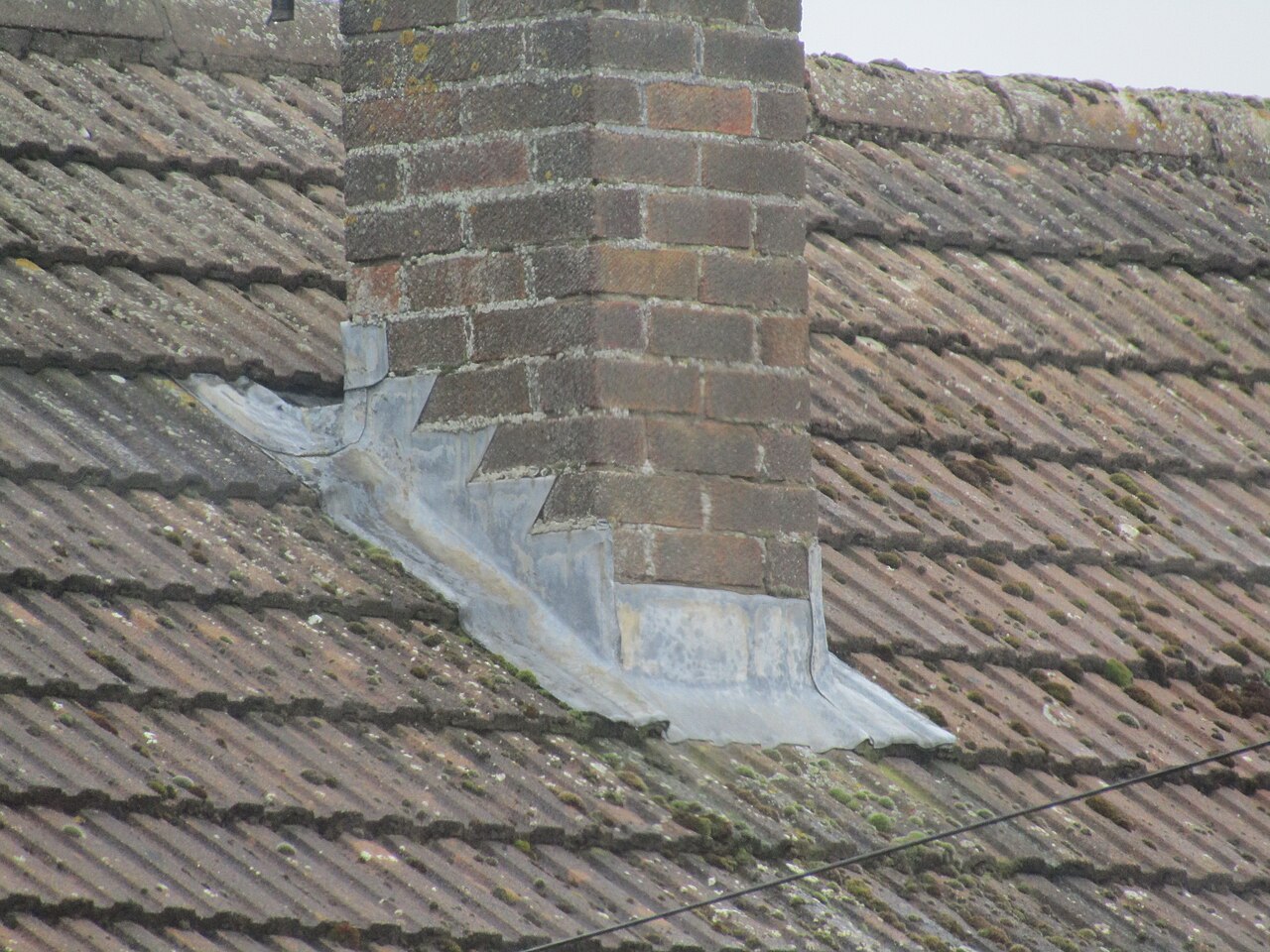
Photo: Kolforn, CC BY-SA 4.0, via Wikimedia Commons.

How do you specify lead flashings?
To specify lead flashings, state the lead type (rolled to BS EN 12588, or certified machine-cast), the code for each detail, the maximum lengths, laps and cover, and how each piece is fixed: wedges into raked-out joints, clips at free edges and nails at the head. Call up the Lead Sheet Training Academy manual and BS 6915 for workmanship, require patination oil, and say whether in situ leadwelding is allowed.
Leadwork is one of the oldest trades on a roof and one of the most often under-specified. A drawing note that says "lead flashings to LSA details" leaves the code, the lengths and the fixing to whoever turns up, and the failures that follow (thermal fatigue cracks, flashings lifted by wind, staining down a facade) all come from those three decisions.
This guide covers flashings, soakers and weatherings at abutments, chimneys and openings. In Uniclass the material is Pr_25_71_51_47 Lead rolled sheets; machine-cast and sand-cast lead have their own codes, Pr_25_71_51_46 and Pr_25_71_51_48. Fully supported lead roofs use the same material but are a different system, with bay sizes and drips governed by BS 6915.
What does a lead flashing clause need to cover?
Some properties are specific to lead flashings. Others belong in every product clause. A clause that leaves either out gives the contractor room to substitute.
Properties of lead flashings
- Reaction to fire classificationNever guessLead is non-combustible; hot work is the fire risk.
- Identification labellingColour marking for code, weight and type.
- SubstrateMasonry joints, tilting fillets or boarding behind the lead.
- FinishPatination oil to stop white carbonate staining.
- Material gradeRolled to BS EN 12588 or certified cast lead.
- FixingsLead wedges, clips and nails; type and centres.
- Product typeApron, cover, step, soaker, back gutter or saddle.
- Corrosion protectionBitumen coating where lead is bedded in mortar.
- Laps and jointsEnd laps and maximum piece lengths.
- AccessoriesClips, wedges, sealant and underlay at details.
What every product clause needs
- Manufacturer and product referenceLead supplier; usually contractor's choice to the standard.
- Product standardBS EN 12588 for rolled lead; certificate for machine-cast.
- Installation methodLSTA manual and BS 6915, by trained operatives.
- Technical submittalsSetting out of joints and any leadwelded details.
- Operation and maintenance informationInspection of wedges, clips and pointing after storms.
- MaterialRolled, machine-cast or sand-cast lead.
- ThicknessLead code for each detail, 3 to 8.
Uniclass Pr_25_71_51_47 Lead flashing. Not every property applies to every project; where one does not, say so rather than leaving it blank.
Fields marked Never guess (reaction to fire classification) depend on the project and should never be filled from a default or a previous job. If the information is not available yet, the clause should say so with a TBC and a reason.
Which decisions does the clause depend on?
Most properties follow from the product you choose. These depend on the project, so they need a decision from the designer before the clause is written.
- 01
Lead code for each detail
CodeLead sheet is sold by code, which is a thickness: Code 3 is 1.32 mm, Code 4 is 1.80 mm, Code 5 is 2.24 mm, Code 6 is 2.65 mm, Code 7 is 3.15 mm and Code 8 is 3.55 mm. Thicker lead is stiffer and more durable but heavier and harder to dress. The Lead Sheet Training Academy manual sets the code for each type of detail, and a clause that gives one code for "all leadwork" will be either wasteful on soakers or too thin on back gutters. Write the code against each flashing type, not once at the top.
How to decide
- Take the code for each detail from the current LSTA manual, Rolled Lead Sheet: The Complete Manual.
- Soakers are usually the thinnest lead on the job; back gutters and saddles need heavier codes.
- Use the same code throughout a run so laps and dressing are consistent.
Write it asStep flashings: Rolled lead to BS EN 12588, Code 4 (1.80 mm). - 02
Lengths, laps and how each piece is held
FixingLead moves a lot with temperature, and pieces that are too long or fixed too rigidly crack along the fold over time. That is why flashings are made in short lengths with laps between them rather than in one run. NBS-format clauses typically limit pieces to 1.5 m, lap ends by at least 100 mm, wedge the top edge into a raked-out joint and clip the free edge so wind cannot lift it. A flashing held only by sealant or by a wedge at each end will lift in the first storm.
How to decide
- Limit piece lengths and laps to the LSTA manual for the code and detail.
- Rake joints out to the depth the clause requires and fix with lead wedges at close centres and every change of direction.
- Clip free edges at laps and at intermediate centres on exposed sites.
Write it asFixing: Lengths not more than 1500 mm, laps not less than 100 mm. Lead wedges into joints raked out 25 mm, at not more than 450 mm centres. Clip free edge at laps and 500 mm centres. - 03
Rolled, machine-cast or sand-cast lead
Lead typeMost UK flashings use rolled lead to BS EN 12588, which is made to consistent thickness and marked with its code. Machine-cast lead is made differently and is not covered by that standard, so NBS clauses accept it only with third-party certification. Sand-cast lead is a traditional product used mostly on historic buildings, often where the conservation officer wants a match to existing work. Saying which type is acceptable avoids an argument when an unmarked roll turns up on site.
How to decide
- New work: rolled lead to BS EN 12588, identified by colour marking for its code.
- Allow certified machine-cast lead only if you are happy with it as an equal.
- Historic repair: check whether the conservation officer requires sand-cast lead.
Write it asLead: Rolled to BS EN 12588, colour marked for code. Machine-cast lead acceptable only with current third-party certification. - 04
Patination oil and contact with mortar
StainingNew lead forms a white carbonate on its surface in the first rains, and that run-off stains glass, render, stone and brick below it. Patination oil, applied as the lead is fixed, slows this down while the surface weathers to a stable grey. It is cheap and quick but only gets done if it is specified. Lead that is bedded in fresh mortar, for example as a dpc or cavity tray, should also be coated with bitumen paint on the bedded faces, because fresh lime and cement attack lead.
How to decide
- Specify patination oil on all exposed lead, applied in dry weather as work proceeds.
- Where lead runs onto glazing, light stone or render, check the run-off path on the details.
- Coat surfaces to be bedded in mortar with bitumen paint.
Write it asFinish: Apply patination oil evenly to all exposed lead as work proceeds. Coat surfaces bedded in mortar with high-build bitumen paint. - 05
Hot work, leadwelding and fire
Never guessLead itself is non-combustible, so reaction to fire is rarely a design question for flashings. The fire risk is the work. Leadwelding uses a naked flame next to timber boarding, underlay, insulation and old dust-filled roof voids, and roof fires on historic buildings during repair work are well documented. NBS clauses either forbid in situ leadwelding or allow it only under a hot work permit. Decide which before tender, because prefabricating welded pieces off site changes the programme and the price.
How to decide
- Historic or timber-roofed buildings: prohibit in situ leadwelding; allow bossing or welding off site.
- Where in situ welding is allowed, require a hot work permit and the client's insurer's conditions.
- If the flashing is part of a wall build-up on a relevant building, confirm the class with the fire strategy.
Write it asLeadwelding: In situ leadwelding not permitted. Prefabricate welded details off site.
The values under "Write it as" are examples. The right value depends on the location, the use and the fire strategy.
Which standards should the clause cite?
Cite the product standard the declaration of performance refers to, the code of practice for installation, and the test method behind each value you set. A value without its test method cannot be checked against a submittal.
- BS EN 12588
- Lead and lead alloys. Rolled lead sheet for building purposes
The product standard for rolled lead sheet used in UK flashings and coverings, including thickness tolerance and marking.
In the clause "Lead: Rolled to BS EN 12588, Code 4".
- BS 6915
- Design and construction of fully supported lead sheet roof and wall coverings. Code of practice
Design of lead roofs and wall coverings, including bay sizes, joints and fixing. NBS masters cite it with the LSTA manual for all leadwork.
In the clause "Workmanship: to BS 6915 and the current LSTA manual".
- Rolled Lead Sheet: The Complete Manual
- Lead Sheet Training Academy (LSTA)
The industry manual for leadwork details, codes for each detail, maximum sizes and fixing. The current edition is 2024; older masters refer to the Lead Sheet Association.
In the clause "Details: to the current edition of Rolled Lead Sheet: The Complete Manual, LSTA".
- BS EN 14783
- Fully supported metal sheet and strip for roofing, external cladding and internal lining. Product specification and requirements
The product standard for fully supported metal roofing, including lead. Relevant where lead forms a roof or wall covering rather than a flashing.
In the clause For lead roofs: "Roofing product: to BS EN 14783".
- BS 5534
- Slating and tiling for pitched roofs and vertical cladding. Code of practice
Tiling and slating design, including how the roof covering meets abutments where soakers and flashings are used.
In the clause "Abutments: soakers and step flashings coordinated with the tiling to BS 5534".
- BS EN 13501-1
- Fire classification of construction products and building elements. Classification using data from reaction to fire tests
Reaction to fire Euroclasses. Lead is non-combustible, but the classification may be asked for where lead forms part of an external wall.
In the clause "Reaction to fire: Class A1 to BS EN 13501-1".
Confirm the current edition of each standard at every issue. Avoice's State of UK Specifications 2026 found a withdrawn standard cited in 40% of specifications at contract issue.
For the regulations behind these choices, see Approved Document B explained, or search the Avoice Regulations library.
How do you write it in CAWS?
Leadwork is CAWS section H71. Lead roofs and dormer coverings are type clauses in the 100s, and flashings have their own clauses in the 400s, one for each kind of detail: apron flashings, cover flashings, soakers and step flashings, step and cover flashings, and chimney flashings that combine all of them. Each gives the code, maximum lengths, laps, cover and fixing for that detail.
General clauses in the 500s to 800s carry what every piece shares: workmanship to BS 6915 and the LSTA manual, leadwelding, the lead itself, substrates and timber, head fixing, nails and screws, clips, wedge fixing into joints, and forming details by bossing or welding. Soakers are usually fixed by the roofer, so the tiling clause in H60 or H65 should refer back to H71 for who supplies them.
- Lead
- Rolled to BS EN 12588, as clause 520
- Front apron
- Code 4; cover to roof not less than 150 mm; upstand not less than 75 mm
- Front apron fixing
- Lead wedges into bed joint, as clause 770
- Soakers
- Code 3; length gauge plus lap plus 25 mm; upstand not less than 75 mm; fixed by roofer
- Step flashings
- Code 4; lengths not more than 1500 mm; laps not less than 100 mm
- Step flashing cover
- Overlap to soaker upstands not less than 65 mm; lead wedges at every course
- Back gutter
- Code 5; upstand not less than 100 mm; cover up roof not less than 225 mm
- Back gutter cover flashing
- Code 4; overlap to back gutter upstand not less than 75 mm
- Underlay at back gutter
- UV-durable underlay dressed over tilting fillet
- Joints in masonry
- Raked out 25 mm, as clause 770
- Finish
- Patination oil to all exposed lead
- Leadwelding
- TBC Client's insurer to confirm whether in situ hot work is acceptable on this listed building. Resolve before tender.
- Workmanship
- To BS 6915 and the current LSTA manual, as clause 510
Illustrative, not from a real project. One property is left as a TBC with a reason so it can be tracked and closed before issue.
Clauses the type clause relies on
- H71/510
- Workmanship generally BS 6915 and the LSTA manual, trained operatives, no sharp marking tools.
- H71/516
- Leadwelding Whether in situ leadwelding is permitted, and under what permit.
- H71/520
- Lead sheet Rolled to BS EN 12588 or certified cast lead, labelled for code.
- H71/715
- Clips Lead, copper or stainless steel clips, sizes and fixing.
- H71/770
- Wedge fixing into joints/ chases Raking depth, wedge centres and sealant.
- H71/810
- Forming details Bossing or welding, and seam quality.
Clause numbers vary between NBS versions and practice masters; the numbers here follow an NBS-format H71 issued for a public repair contract on Public Contracts Scotland.
How do you write it in Uniclass?
In Uniclass flashings are a system in their own right: Ss_32_30_30_47 Lead flashing systems. The system clause describes where the flashings go and what they have to achieve, with the detail types, codes, fixing and workmanship standard.
The lead is a product clause under Pr_25_71_51_47 Lead rolled sheets. One product clause can serve flashings at every abutment, because the code is given per detail in the system clause rather than in the product.
- Description
- Lead flashings, soakers and back gutter at chimney on plain tile roof
- Lead
- Pr_25_71_51_47 Lead rolled sheets (L01)
- Codes
- Soakers Code 3; step flashings and aprons Code 4; back gutter Code 5
- Lengths and laps
- Not more than 1500 mm; laps not less than 100 mm
- Fixing
- Lead wedges into joints raked out 25 mm; clips at free edges
- Finish
- Patination oil to all exposed lead
- Workmanship
- To BS 6915 and the current LSTA manual
- Manufacturer
- Contractor's choice
- Standard
- BS EN 12588
- Codes
- 3, 4 and 5 as the system clause
- Identification
- Colour marked for code, weight and type
- Cast lead
- Machine-cast only with current third-party certification
- Bedded faces
- High-build bitumen paint where bedded in mortar
- Reaction to fire
- Class A1 to BS EN 13501-1
- Leadwelding
- TBC Client's insurer to confirm whether in situ hot work is acceptable on this listed building. Resolve before tender.
Illustrative. Performance of the finished system sits in the system clause; properties of the product sit in the product clause.
In NBS Chorus the Uniclass product clause also carries the NBS reference 45-65-52/370 for rolled lead sheet; use one referencing system throughout the specification.
What goes in the spec, and what goes in the schedule?
The specification defines each type once. The schedule and drawings say where each type goes.
In the specification
What the product is and how it performs and is installed. Written once per type.
In the schedule or drawings
Where each type goes and how much of it. Changes with every plan revision.
Write each flashing type once and mark its locations on the roof plan and elevations. Sketching every flashing in the clause makes it long and still misses the dormer that was added later.
What are the common mistakes?
Most problems are a missing property, a property filled with the wrong kind of value, or a decision left silently open.
- One code for all leadwork. Soakers, step flashings and back gutters need different codes. Give the code against each detail.
- Long runs in one piece. Lead fatigues and cracks when it cannot move. Limit lengths and lap the ends.
- Sealant instead of wedges. Sealant in an unraked joint will not hold a flashing in wind. Rake out, wedge and then seal.
- No patination oil. White run-off from new lead stains glass and stone. It costs little to specify and much more to clean.
- Soakers missed between trades. The leadworker assumes the roofer fits them and the roofer assumes they come with the lead. Say who supplies and who fixes.
- Leadwelding left to site. In situ welding is hot work on a timber roof. Decide before tender whether it is allowed.
How Avoice helps
Avoice drafts leadwork clauses from your roof plans, elevations and details, and leaves an explicit TBC where the decision is not made.
- Drafts from your drawings and schedules
It reads flashing types such as F01 and F02 from roof plans and details, picks H71 or the Uniclass lead flashing system, and fills in the detail types shown.
- Leaves a TBC where the information is not there
If in situ leadwelding depends on the insurer or the conservation officer has not confirmed cast lead, the clause says TBC with that reason, and it goes into the project TBC register.
- Writes in your format and your style
Choose CAWS or Uniclass. Avoice works from your practice's own H71 master, so your standard flashing clauses stay in your words.
- Checks the clause against everything else
QA/QC flags a chimney on the roof plan with no flashing clause, a tiling clause that does not say who fixes soakers, or a reference to the Lead Sheet Association where your master should now cite LSTA.
- Keeps product data in one place
Certificates for machine-cast lead and data sheets for patination oil and sealant sit in the Product Room, linked to the lead clauses, so an alternative can be checked against the clause.
Related guides: How to specify clay roof tiles, How to specify natural roof slates, How to specify standing seam roofs.
Software can draft and check. The designer still chooses the product and is responsible for the specification.
Draft your lead flashing clause in Avoice
Upload your drawings and schedules. Avoice drafts the clause in CAWS or Uniclass, cites the standards and flags anything your information does not settle.
This guide is for general education and is not professional advice. Check current editions of standards and Approved Documents, the manufacturer's data, and the requirements of your project before relying on any clause.