
How to specify permeable paving
What a permeable paving clause has to cover beyond the block, from infiltration system and sub-base storage to laying course, joints and maintenance, the standards to cite, and how to write it in CAWS and in Uniclass.
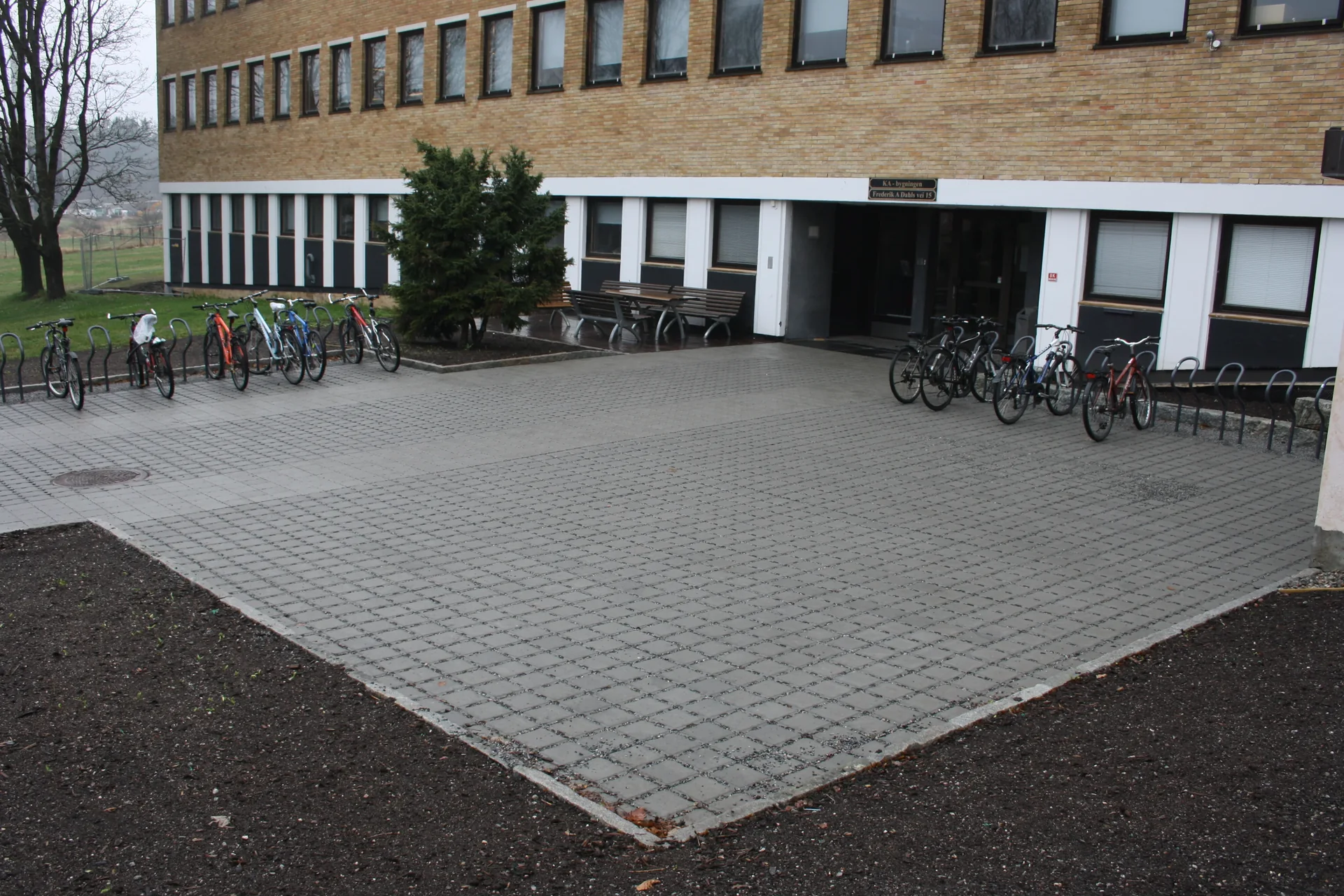
Photo: Alexander Henriksen, CC BY-SA 3.0, via Wikimedia Commons. Resized and converted to WebP.

How do you specify permeable paving?
To specify permeable paving, specify the whole pavement as a drainage system: say whether it is total, partial or no infiltration (System A, B or C), and take the sub-base depth from whichever of the structural and hydraulic designs needs more. Then specify blocks designed for permeable use, an open-graded laying course and joint fill, any geotextile or impermeable membrane, the outfall and the maintenance regime. BS 7533-103:2026 is the current design guide; BS 7533-13 was withdrawn in 2026.
Permeable paving is a drainage system with a paved top, and most of what decides whether it works is below the blocks. A clause that names a permeable block and then says "laid on Type 1 sub-base and sand" gets a pavement that looks permeable and floods at the first storm. The block, the joint aggregate, the laying course, the sub-base, any liner and the outfall have to be designed and specified together, usually by the drainage engineer and the architect between them.
This guide uses Uniclass Pr_25_93_60_17 Concrete paving blocks, the code NBS Source gives to most permeable concrete block ranges, which are dense blocks with wide joints formed by spacer nibs. Blocks made of porous concrete are Pr_25_93_60_28 Concrete porous paving blocks. The block itself is covered in more detail in our block paving guide; this one is about the permeable system around it.
What does a permeable paving block clause need to cover?
Some properties are specific to permeable paving. Others belong in every product clause. A clause that leaves either out gives the contractor room to substitute.
Properties of permeable paving
- Product typeBlock designed for permeable use, with spacer nibs.
- Nominal sizeBlock size and joint width affect surface infiltration.
- ThicknessNever guessSet by the traffic in the structural design.
- TolerancesDimensional tolerance keeps joints consistent and open.
- Edge treatmentChamfer and nibs that form the drainage joint.
- Slip resistanceDeclared value only for ground or polished faces.
- Wear resistanceBS EN 1338 abrasion class for the traffic.
- Freeze-thaw resistanceWeathering class where de-icing salt is used.
- Structural performanceNever guessTraffic category and structural design of all layers.
- Bedding and jointingOpen-graded laying course and joint fill, never sand.
- Laying patternHerringbone for vehicles, as for any block paving.
- Coating systemAvoid sealers that close the joints; state none.
- AccessibilityJoint width and fill on pedestrian routes.
What every product clause needs
- Manufacturer and product referenceNamed permeable block range, or a performance description.
- Product standardBS EN 1338 for the block; BS 7533-103 for the pavement.
- Installation methodBS 7533-103 installation guidance and manufacturer's instructions.
- Technical submittalsAggregate gradings, infiltration data, geotextile and liner data.
- Operation and maintenance informationSweeping regime, joint top-up, who maintains, what not to do.
- MaterialDense concrete with wide joints, or porous concrete.
- FinishColour and surface texture from the range.
Uniclass Pr_25_93_60_17 Permeable paving. Not every property applies to every project; where one does not, say so rather than leaving it blank.
Fields marked Never guess (thickness and structural performance) depend on the project and should never be filled from a default or a previous job. If the information is not available yet, the clause should say so with a TBC and a reason.
Which decisions does the clause depend on?
Most properties follow from the product you choose. These depend on the project, so they need a decision from the designer before the clause is written.
- 01
System A, B or C
SystemBS 7533-103 describes three ways a permeable pavement deals with water. System A is total infiltration: everything soaks into the ground below. System B is partial infiltration: some soaks away and the rest leaves through outlet pipes. System C has no infiltration: the pavement is lined with an impermeable membrane, stores and cleans the water, and releases it at a controlled rate. The choice depends on infiltration tests, the soil, groundwater, contamination and nearby foundations. It changes the build-up completely, so it has to be settled before the clause is written.
How to decide
- Ask the drainage engineer for infiltration test results and the system type their design assumes.
- Clay soils, contaminated ground, high groundwater or areas next to basements usually point to System C.
- Where the pavement is part of the drainage approval, write the system type and outfall into the clause so it cannot change at tender.
- On sloping sites, ask how storage is held back within the sub-base, because water collects at the low end.
Write it asSystem type: No infiltration (System C) to BS 7533-103, lined with impermeable membrane, outfall to flow control chamber as drainage engineer's design. - 02
Sub-base depth, structure and storage
Never guessThe sub-base of a permeable pavement does two jobs: it carries the traffic and it stores water. BS 7533-103 sets out a structural design from traffic categories and a separate hydraulic design for storage, and the sub-base has to be the deeper of the two. It also has a table of minimum recommended paving unit thicknesses for unbound permeable surfacing. The guide covers pedestrian and vehicle loading up to 11 000 kg axles and 30 million standard axles; heavier uses such as ports are outside it. Leaving the depth to a typical manufacturer's detail risks a pavement that either rocks under lorries or overflows in a storm.
How to decide
- Get both a structural and a hydraulic design, and use the deeper sub-base.
- Record the traffic category used, including refuse vehicles and fire appliances where they will run on the pavement.
- Take the block thickness from the structural design, not from the range brochure.
- Use coarse graded aggregate for the storage layer; a dense Type 1 cannot store water.
Write it asStructural and hydraulic design: To BS 7533-103 by engineer; sub-base depth the greater of the two. Block thickness: 80 mm, as engineer's design. - 03
Laying course, joints and geotextiles
Laying courseSand in the joints is the commonest way to turn permeable paving into ordinary paving. The laying course and joints are filled with a clean, open-graded fine aggregate, which lets water through while locking the blocks together. BS 7533-103 gives typical gradings for laying course, jointing and sub-base materials in an annex. Geotextiles may be needed between layers to stop fines migrating, specified for separation and filtration, and a System C pavement needs an impermeable membrane with sealed joints and sealed penetrations at outlets.
How to decide
- Specify laying course and joint aggregate by grading, to BS 7533-103 and the block manufacturer.
- Ban sand and fine dust in joints, and ban jointing compounds and sealers that close the joints.
- Specify geotextiles by function, to BS 8661, where the drainage engineer's section shows them.
- For System C, require the membrane joints and pipe penetrations to be sealed and tested.
Write it asLaying course and jointing: Open-graded fine aggregate, grading to BS 7533-103 and block manufacturer. Sand jointing and sealers not permitted. - 04
Keeping it permeable
MaintenancePermeable paving clogs slowly from the surface. Silt from building work, soil washed from planting beds and leaf litter close the joints, and infiltration falls. During construction, the sub-base can be ruined by mud from site traffic before the blocks are laid. BS 7533-103 includes guidance on protecting the pavement from construction traffic and on routine and remedial maintenance. The clause and the O&M information have to say how the pavement is kept clean, by whom, and what must not be done to it, such as resurfacing with impermeable material or allowing soil to wash on.
How to decide
- Protect the sub-base from site traffic and mud, or lay it late in the programme.
- Keep planting beds lower than the paving or edged so soil does not wash onto it.
- Agree who maintains the pavement after handover: a management company, the owner or an adopting authority.
- Put the sweeping regime and joint top-up in the O&M manual and the drainage maintenance plan.
Write it asProtection and maintenance: Protect sub-base and surface from construction traffic and silt to BS 7533-103. Provide maintenance schedule for inclusion in SuDS maintenance plan. - 05
Front gardens and planning
PlanningFor houses in England, permitted development for a new or replaced hard surface comes with a condition. Where the surface is between the front of the house and a highway and covers more than 5 m², it must be made of porous materials or drain to a permeable or porous area within the curtilage. Permeable block paving on a permeable base meets that, but the same blocks on a dense sub-base over clay may not. On larger schemes, the drainage strategy, the planning condition and any adoption by the local authority or a SuDS approving body each add their own requirements.
How to decide
- House front gardens in England: use a fully permeable build-up, or drain an impermeable surface to a soakaway or planted area within the plot.
- Flats, commercial sites and Wales: check the relevant permitted development rules and planning conditions instead.
- Where the paving will be adopted, check the adopting authority's own specification before writing the clause.
- Keep pedestrian routes comfortable: narrow joints and a well-filled surface suit wheelchairs and heels better than wide gaps.
Write it asConstruction: Fully permeable from surface to subgrade, to meet the Class F permitted development condition.
The values under "Write it as" are examples. The right value depends on the location, the use and the fire strategy.
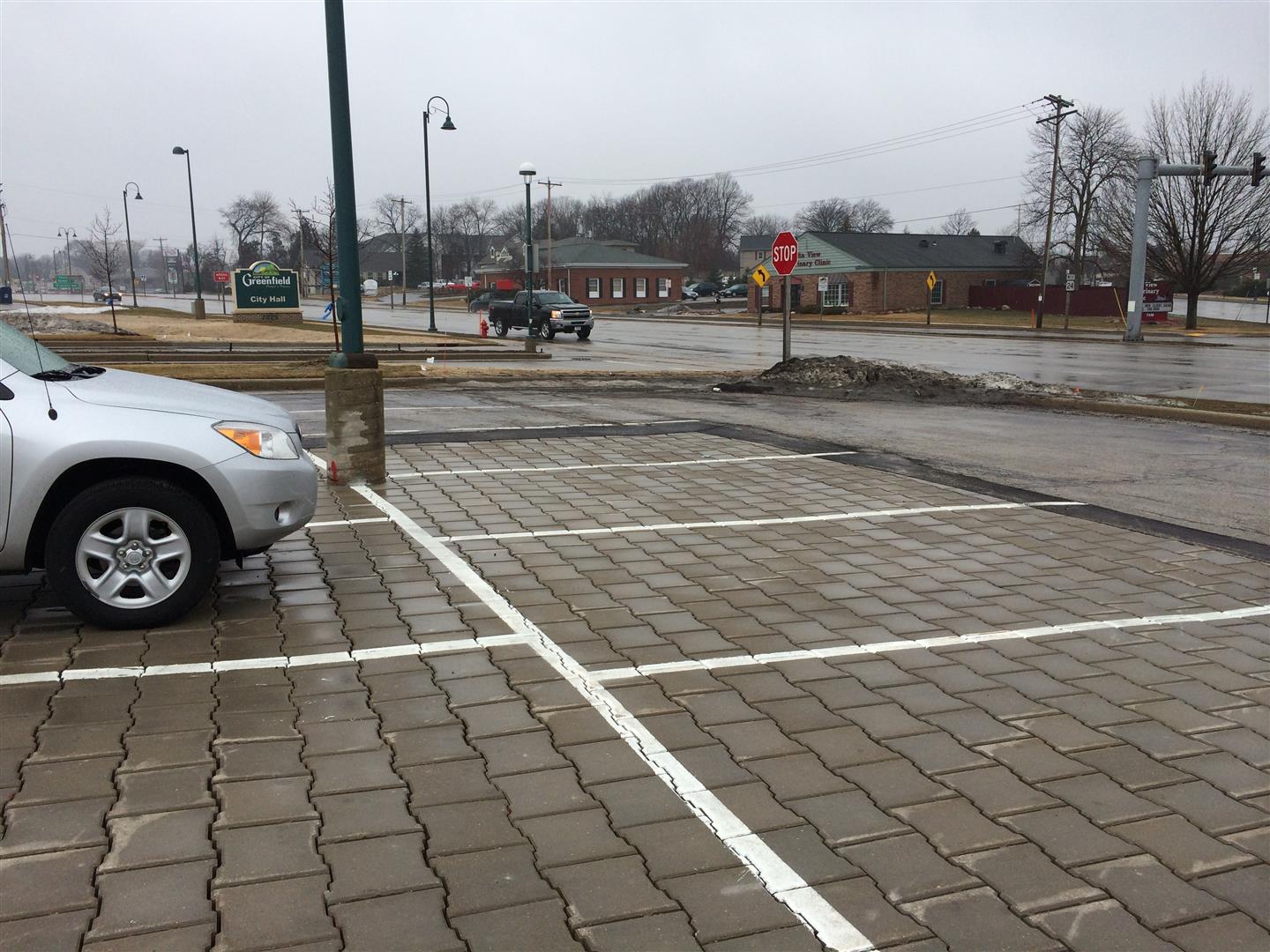
Photo: Aaron Volkening, CC BY 2.0, via Wikimedia Commons.

Which standards should the clause cite?
Cite the product standard the declaration of performance refers to, the code of practice for installation, and the test method behind each value you set. A value without its test method cannot be checked against a submittal.
- BS 7533-103
- Pavements constructed with clay, concrete or natural stone paving units. Design and installation of modular permeable pavements. Guide
Design and installation of modular permeable pavements: System A, B and C, structural and hydraulic design, gradings for sub-base, laying course and joints, geotextiles and membranes, installation and maintenance. The 2026 edition superseded BS 7533-13:2009.
In the clause "Permeable pavement: Designed and installed to BS 7533-103."
- BS 7533-101
- Pavements constructed with clay, concrete or natural stone paving units. Code of practice for the structural design of pavements using modular paving units
Structural design of modular pavements from the traffic category, used alongside Part 103 for conventional areas on the same scheme.
In the clause "Structural design of conventional areas: To BS 7533-101."
- BS 7533-102
- Pavements constructed with clay, concrete or natural stone paving units. Installation of pavements using modular paving units. Code of practice
Installation of modular pavements generally, including compaction and reinstatement.
In the clause "Laying and compaction: To BS 7533-102, as modified by BS 7533-103 for permeable construction."
- BS EN 1338
- Concrete paving blocks. Requirements and test methods
The product standard for concrete paving blocks, including weathering and abrasion classes, to which most dense permeable blocks are declared.
In the clause "Blocks: To BS EN 1338, designed for permeable paving."
- BS 8661
- Geotextiles. Guidance for specification for basic separation and filtration functions
Specifying geotextiles by function in pavements, including those used in permeable construction.
In the clause "Geotextile: Separation and filtration, to BS 8661."
- CIRIA C753
- The SuDS Manual
UK guidance on SuDS design, including pervious pavements, water quality treatment and maintenance.
In the clause "Hydraulic design: To CIRIA C753, as drainage engineer's details."
- BS 8582
- Code of practice for surface water management for development sites
Surface water management on development sites, of which the permeable pavement is one part.
In the clause "Surface water: As drainage strategy, to BS 8582."
- Town and Country Planning (General Permitted Development) (England) Order 2015, Schedule 2, Part 1, Class F
- Hard surfaces incidental to the enjoyment of a dwellinghouse
The condition that a new or replaced hard surface over 5 m² between a house and a highway in England is porous or drains to a permeable area within the curtilage.
In the clause "Construction: Permeable throughout, to meet the Class F condition."
Confirm the current edition of each standard at every issue. Avoice's State of UK Specifications 2026 found a withdrawn standard cited in 40% of specifications at contract issue.
How do you write it in CAWS?
Permeable block paving is written in CAWS section Q24 as a paving type clause in the 100s. A published NBS landscape specification for a London estate, for example, has a conventional concrete block type at 110 and permeable concrete paver types at 115. The type clause has to carry the permeable build-up: system type, sub-base, geotextile or membrane, laying course, block, joint fill and outfall.
The sub-base belongs in Q20, written as a coarse graded aggregate, not the dense Type 1 that most Q20 masters contain. Membranes, collector pipes and flow control are drainage items and may sit in the R sections, cross-referenced from the type clause. The Q24 execution clauses for adverse weather, laying, regularity and completion apply, but any clause about brushing sand into joints must not be referenced.
- Description
- Car park, no infiltration (System C) to BS 7533-103
- Impermeable membrane
- As drainage engineer's design, joints and penetrations sealed and tested
- Sub-base
- Coarse graded aggregate as section Q20, depth the greater of structural and hydraulic design
- Geotextile
- Separation and filtration to BS 8661, as drainage engineer's section
- Laying course
- Open-graded fine aggregate, grading to BS 7533-103
- Blocks
- To BS EN 1338, designed for permeable paving, spacer nibs
- Manufacturer
- Submit proposals
- Size and thickness
- 200 x 100 x 80 mm, thickness as engineer's design
- Colour
- TBC Block colour subject to planning condition on hard landscaping materials. Resolve before ordering.
- Bond
- Herringbone 45 degrees
- Jointing
- Open-graded aggregate as laying course; sand and sealers not permitted
- Outfall
- Perforated collector pipes to flow control chamber, as drainage drawings
- Edge restraint
- Precast concrete edging as section Q10, membrane detailed at edges
- Protection
- Protect sub-base and surface from construction traffic and silt
Illustrative, not from a real project. One property is left as a TBC with a reason so it can be tracked and closed before issue.
Clauses the type clause relies on
- Q24/200
- Execution generally Sets the installation standard for block paving.
- Q24/240
- Adverse weather No laying on frozen, waterlogged or silted layers.
- Q24/485
- Laying blocks/ pavers/ setts Setting out, cutting and compaction of blocks.
- Q24/505
- Regularity of paved surfaces Permitted deviation and level difference between blocks.
- Q24/615
- Completion of paving Final compaction and topping up joints with the specified aggregate.
Clause numbers vary between NBS versions and practice masters. The 115 type clause and the general clause numbers follow a published NBS landscape specification; check each referenced clause exists in your Q24.
How do you write it in Uniclass?
Uniclass gives the permeable pavement its own system code, Ss_30_14_90_62 Permeable small unit paving systems, separate from conventional block paving. The system clause is where the drainage design lives: the system type, the sub-base and storage depth, any membrane, the outfall and the maintenance requirements, with the structural and hydraulic performance.
The block is the product, Pr_25_93_60_17 Concrete paving blocks, with its size, thickness, nibs, colour and BS EN 1338 classes. If the same block is also used on conventional footways, both systems point to one product clause. Permeable flags have their own system, Ss_30_14_90_60 Permeable flag and slab paving systems.
- Description
- Car park, no infiltration (System C), lined
- Membrane
- Impermeable, sealed and tested, as drainage design
- Sub-base
- Coarse graded aggregate, depth as structural and hydraulic design
- Laying course and joints
- Open-graded fine aggregate to BS 7533-103
- Paving units
- Pr_25_93_60_17 Concrete paving blocks (PP01)
- Outfall
- Collector pipes to flow control chamber
- Design
- To BS 7533-103 and CIRIA C753, by engineer
- Maintenance
- As SuDS maintenance plan
- Manufacturer
- Submit proposals
- Product standard
- BS EN 1338
- Type
- Dense concrete block designed for permeable paving, spacer nibs forming drainage joints
- Nominal size
- 200 x 100 mm
- Thickness
- 80 mm
- Colour
- TBC Block colour subject to planning condition on hard landscaping materials. Resolve before ordering.
- Weathering resistance
- Class 3 (marking D) to BS EN 1338
- Abrasion resistance
- Class 4 (marking I) to BS EN 1338
- Surface infiltration
- Submit manufacturer's data for the joint and laying course aggregate proposed
Illustrative. Performance of the finished system sits in the system clause; properties of the product sit in the product clause.
In NBS Chorus the product clause also carries the NBS reference 45-20-64/400 for precast concrete paving blocks. Use one classification throughout and do not mix CAWS and Uniclass references in one specification.
What goes in the spec, and what goes in the schedule?
The specification defines each type once. The schedule and drawings say where each type goes.
In the specification
What the product is and how it performs and is installed. Written once per type.
In the schedule or drawings
Where each type goes and how much of it. Changes with every plan revision.
Give each permeable build-up a mark (PP01, PP02) and show its extent and system type on both the landscape and drainage drawings. If the drainage engineer's drawings define the sub-base depth, refer to them from the clause rather than repeating a number that may change.
What are the common mistakes?
Most problems are a missing property, a property filled with the wrong kind of value, or a decision left silently open.
- Citing BS 7533-13. It was withdrawn in 2026 and replaced by BS 7533-103, which raised the design infiltration rates. Update masters before issue.
- Sand in the joints. Sand closes the drainage path. Specify open-graded aggregate for the laying course and joints, and say sand is not permitted.
- Dense Type 1 under permeable blocks. A dense sub-base has almost no storage. Write a coarse graded aggregate clause in Q20 and point to it.
- No system type stated. Without System A, B or C in the clause, the contractor cannot tell whether a membrane or outfall is needed.
- Roofs drained onto the paving without allowance. Extra catchment adds water and silt. Only connect roofs or roads where the drainage design allows for it.
- Built before the muddy work finished. Site traffic and soil clog new joints and sub-base. Protect them, or programme the surface late.
How Avoice helps
Avoice drafts permeable paving clauses from the landscape and drainage drawings together, and flags where the two disagree.
- Drafts from your drawings and schedules
It picks up PP01 and PP02 areas from the landscape plan, reads the system type from the drainage information, writes the Q24 type clause or the Uniclass system and product pair, and fills in the build-up.
- Leaves a TBC with a reason
If the block colour is waiting on a planning condition, or infiltration tests have not yet decided between System A and C, the clause says TBC with the reason, and it joins the project TBC register to close before tender.
- Works from your own masters
Choose CAWS or Uniclass. Avoice adapts your practice's Q20 and Q24 clauses rather than replacing them with generic text.
- Checks the clause against everything else
QA/QC flags a permeable type clause pointing to a dense Type 1 sub-base, a lined pavement with no outfall on the drainage drawings, or a citation of the withdrawn BS 7533-13.
- Keeps product data linked
Aggregate gradings, membrane data and block declarations of performance sit in the Product Room against the clause, so a proposed substitute can be checked against what the design assumed.
Related guides: How to specify block paving, How to specify resin bound gravel, How to specify gravel grids.
Software can draft and check. The designer still chooses the product and is responsible for the specification.
Draft your permeable paving block clause in Avoice
Upload your drawings and schedules. Avoice drafts the clause in CAWS or Uniclass, cites the standards and flags anything your information does not settle.
This guide is for general education and is not professional advice. Check current editions of standards and Approved Documents, the manufacturer's data, and the requirements of your project before relying on any clause.