
How to specify plywood
What a plywood clause has to say, from the BS EN 636 service condition to the face grade and fire class of an exposed lining, and how to write it in CAWS and in Uniclass.
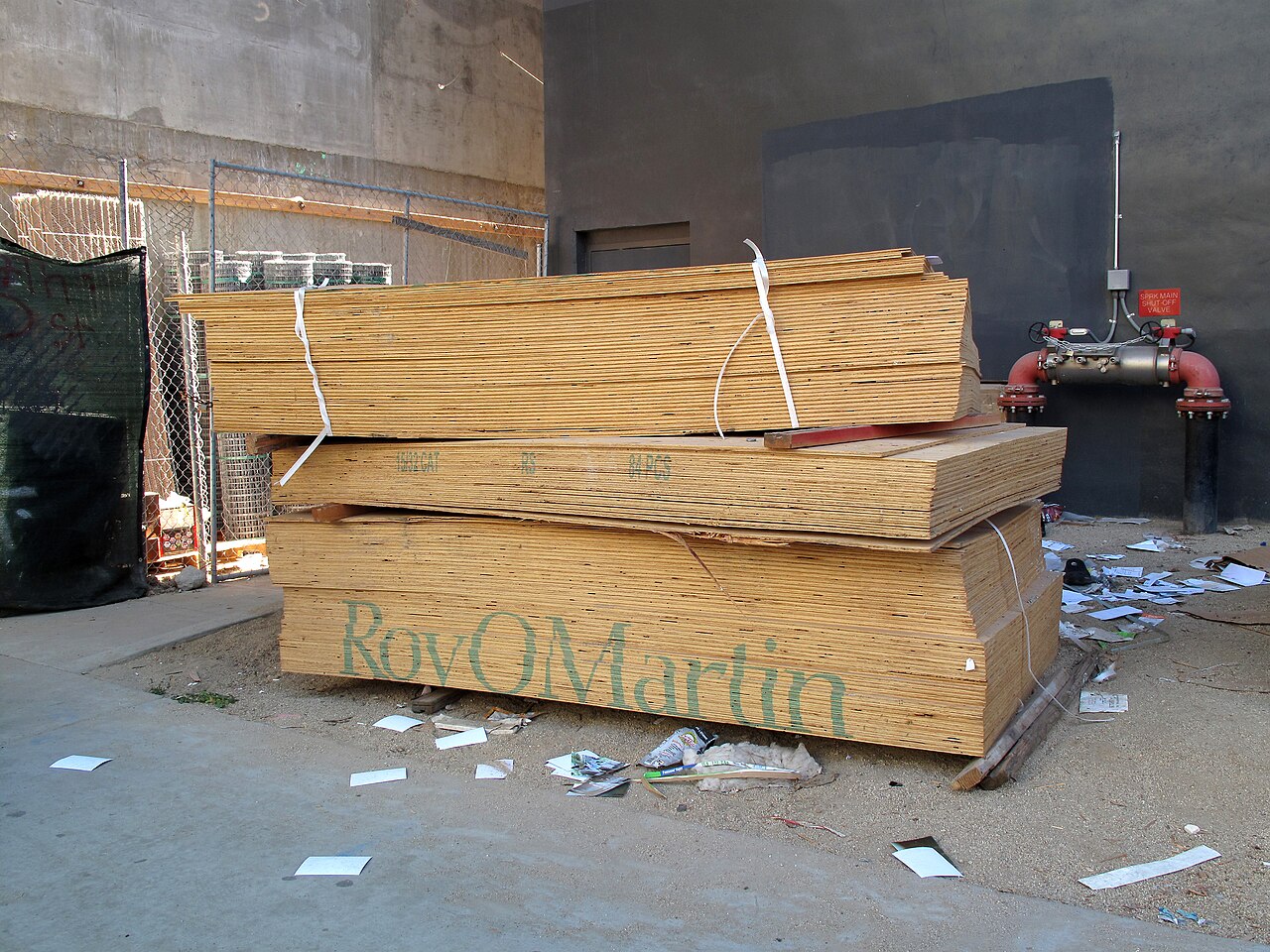
Photo: Downtowngal, CC BY-SA 4.0, via Wikimedia Commons.

How do you specify plywood?
To specify plywood, cite BS EN 636 with the service condition it must meet (dry, humid or exterior), then give the species, face grade, thickness, formaldehyde class and FSC or PEFC certification. Add what the location needs: a reaction to fire class for an exposed lining, a structural grade from the engineer for sheathing or decks, and a coating and edge-sealing regime for anything outside.
Plywood appears in specifications in three quite different jobs: as an exposed lining, as a hidden substrate or sheathing, and as a structural deck. Each needs different information, and the clause we most often find says "18 mm WBP plywood" and stops. WBP is an old trade description of the glue line. It tells the contractor nothing about the face veneer, the fire class of the sheet or where the timber was felled.
This guide works through an exposed birch lining, which Uniclass codes as Pr_25_71_97_91 Visual grade general veneer plywoods. Sheathing and decks use Pr_25_71_97_86 Structural veneer plywoods, and fire-retardant boards have their own code, Pr_25_71_97_30 Fire-retardant plywoods. The properties to cover are the same; the emphasis shifts from the face to the structural grade.
What does a plywood sheet clause need to cover?
Some properties are specific to plywood. Others belong in every product clause. A clause that leaves either out gives the contractor room to substitute.
Properties of plywood
- FixingsScrew type, finish and centres; visible heads need a pattern.
- Moisture contentBoard conditioned to the room before fixing.
- FinishClear lacquer, oil or paint; must be covered by the fire test.
- DurabilitySpecies durability matters outside, not for dry linings.
- AccessoriesShadow gap trims, edge profiles, matching plugs.
- Reaction to fire classificationNever guessEuroclass as fixed, including any treatment and finish.
- Fire retardant durability classNever guessBS EN 16755 class where the board is FR treated.
- EmissionsVOC limits for the finish as well as the board.
- Fire resistanceNever guessOnly from a tested system; a lining alone has none.
- Moisture movementDrives shadow gap widths at panel joints.
- Bonding classBS EN 314-2 class 1, 2 or 3 for the service condition.
- Structural performanceNever guessEngineer's grade if the sheet carries load or racking.
- Use classBS EN 335 use class for the exposure.
- DensityAffects screw holding and the fire classification conditions.
- Preservative treatmentNot needed in use class 1; say so.
- Recycled contentUsually nil for veneer plywood; ask, do not assume.
- TolerancesThickness and squareness show at open joints.
- Material gradeGeneral or structural, with the BS EN 636 condition.
- Appearance classFace and reverse grades to BS EN 635.
- Formaldehyde emission classE1 to BS EN 13986 for interior use.
- Timber source certificationFSC or PEFC chain of custody for the sheets supplied.
- Edge treatmentSquare, arrised or exposed-ply edges for a lining.
- Nominal sizeSheet size sets the joint pattern on the elevation.
- Third-party certificationCertificate for the FR treatment, if used.
- Moisture resistanceDry, humid or exterior, matching BS EN 636-1, -2 or -3.
What every product clause needs
- Technical submittalsData sheet, DoP and fire classification report before ordering.
- Operation and maintenance informationCleaning, refinishing and damage repair for the finished face.
- Product standardBS EN 636 with the service condition, via BS EN 13986 DoP.
- Installation methodManufacturer's instructions plus the fixing clause.
- Manufacturer and product referenceNamed mill and range, or a performance description.
- MaterialSpecies of face and core veneers, e.g. birch throughout.
- ThicknessSets stiffness between battens and screw holding.
Uniclass Pr_25_71_97_91 Plywood. Not every property applies to every project; where one does not, say so rather than leaving it blank.
Fields marked Never guess depend on the project and should never be filled from a default or a previous job. If the information is not available yet, the clause should say so with a TBC and a reason.
Which decisions does the clause depend on?
Most properties follow from the product you choose. These depend on the project, so they need a decision from the designer before the clause is written.
- 01
Service condition and bond class
Service conditionBS EN 636 has three parts for three service conditions: Part 1 for dry interiors, Part 2 for humid conditions and protected exterior use, Part 3 for exterior use. Each relies on a bond class from BS EN 314-2, and the bond class is what the old WBP shorthand was trying to say. A class 3 bond means the glue line survives wetting; it does not make the veneers durable. Manufacturers typically declare an exterior birch board only for use class 3 when it is coated and edge sealed, which is a maintenance commitment the client should know about.
How to decide
- Heated interiors: BS EN 636-1 is enough, though many birch boards are made to Part 2 or 3 anyway.
- Bathrooms, unheated roof voids and soffits under cover: BS EN 636-2.
- Exposed outside: BS EN 636-3, a durable species or treatment for the BS EN 335 use class, and a coating and edge-sealing regime in the O&M information.
- Check that the declaration of performance names the BS EN 636 part, not just a glue type.
Write it asPlywood: To BS EN 636-2, bond class 2 or better to BS EN 314-2. - 02
Reaction to fire of an exposed lining
Never guessUntreated plywood is normally class D-s2,d0 when it is at least 9 mm thick and fixed with no air gap to a non-combustible background, and manufacturers' declarations drop to D-s2,d2 where there is a narrow air gap (up to 22 mm) behind. Approved Document B asks for better than D on the walls of most rooms and circulation spaces, so an exposed lining usually needs a fire-retardant treated board. The classification report has to match the thickness, the mounting and the finish actually used. Fire resistance is a separate property: a plywood lining contributes none unless it is part of a tested wall system, and it does not need to be structural unless the engineer says so.
How to decide
- Read the lining class for each room from the fire strategy, and check the battens or air gap match the mounting in the classification report.
- Where the class is better than D, use a fire-retardant treated board or a plywood classified as supplied, and state its fire retardant durability class (the DRF class) to BS EN 16755: INT1 for dry interiors, INT2 for humid ones.
- Make the clear lacquer or paint part of the tested build-up, or ask for evidence that it does not change the class.
- Write "Fire resistance: not required" and "Structural performance: not required" for a lining, so nobody infers a requirement.
Write it asReaction to fire: Class B-s1,d0 to BS EN 13501-1, fire-retardant treated, durability of reaction to fire class INT1 to BS EN 16755. Submit classification report for the thickness, mounting and finish used. - 03
Face grade, species and grain
AppearanceOn an exposed lining the face is the product. BS EN 635 classifies plywood faces by the defects allowed (classes E and I to IV for hardwood faces), and birch suppliers also sell to their own letter grades, of which B, S, BB and WG are the most common. Patched faces, plugs and colour streaks are normal in the lower grades and look wrong on a feature wall. The reverse face can be a lower grade if it is never seen, but say so. Grain direction is a design decision too: a sheet set landscape and one set portrait read differently, and the face veneer runs along the long edge on most boards.
How to decide
- Visible faces: the top commercial grade the supplier offers, stated by name, with the BS EN 635-2 class the supplier declares for it.
- Reverse faces against battens: a lower grade is fine.
- Show the grain direction on the elevation drawing and in the clause.
- Require a control sample of several sheets, because one hand sample hides colour variation between batches.
Write it asFace veneers: Birch, supplier's grade B/BB (face/reverse), with corresponding BS EN 635-2 classes declared. Grain: Vertical, as elevation drawings. - 04
Timber source and formaldehyde
SourcingThe UK Timber Regulations make it illegal to place illegally harvested timber on the GB market, and the central government timber procurement policy asks for legal and sustainable timber, accepting FSC and PEFC certification as evidence. A clause that says "from sustainable sources" cannot be checked. What can be checked is a certificate claim on the invoice and the chain of custody number of the supplier. Formaldehyde is the other sourcing question: BS EN 13986 classes boards E1 or E2, and E1 is the norm for interior use in the UK.
How to decide
- State FSC or PEFC, and require the chain of custody number on delivery documentation.
- If the client follows a stricter procurement policy, quote it rather than paraphrasing.
- State E1, and if the project has an indoor air target, ask for emissions test data for the finished face, not just the board.
Write it asTimber source: FSC or PEFC certified, chain of custody number on delivery note. Formaldehyde: Class E1 to BS EN 13986. - 05
Conditioning, joints and fixing
MovementPlywood moves far less than solid timber across the sheet, but a large exposed panel still shrinks and swells with the room, and the movement shows at tight butt joints. Boards delivered before the wet trades have dried out are the usual cause. Shadow gaps hide the movement, and screw heads either disappear or become a deliberate pattern. Both are decisions for the drawing, and the clause should not leave them to the fixer.
How to decide
- Fix only once the building is dry and heated, after conditioning the sheets flat in the room.
- Use open shadow joints sized from the elevation, rather than butt joints, on any lining over a couple of sheets wide.
- Choose between concealed fixing and an exposed screw pattern, and give the screw finish and centres if exposed.
Write it asConditioning: Store flat in the room to be lined, at its normal heating, for the period the manufacturer recommends before fixing.
The values under "Write it as" are examples. The right value depends on the location, the use and the fire strategy.
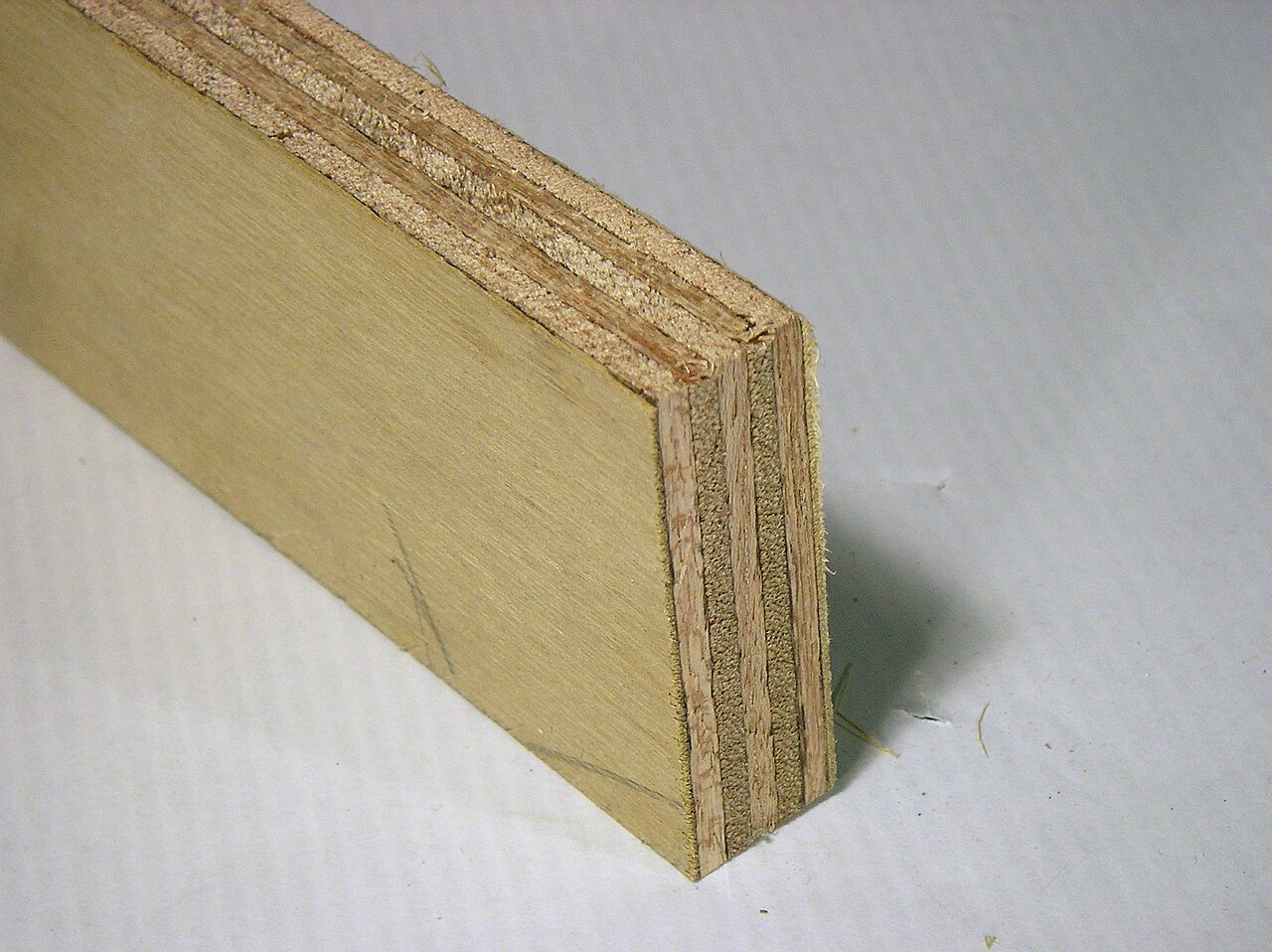
Photo: Rotor DB at English Wikipedia, CC BY-SA 3.0, via Wikimedia Commons.

Which standards should the clause cite?
Cite the product standard the declaration of performance refers to, the code of practice for installation, and the test method behind each value you set. A value without its test method cannot be checked against a submittal.
- BS EN 636
- Plywood. Specifications
Requirements for general purpose and structural plywood in dry (Part 1), humid (Part 2) and exterior (Part 3) conditions, with bending properties and bond quality.
In the clause Cite it with the part for the service condition: "To BS EN 636-2".
- BS EN 13986
- Wood-based panels for use in construction. Characteristics, evaluation of conformity and marking
The harmonised standard behind the declaration of performance, including formaldehyde classes and the reaction to fire classes boards achieve without further testing.
In the clause Use it for the DoP and formaldehyde class: "Formaldehyde: Class E1 to BS EN 13986".
- BS EN 314-2
- Plywood. Bonding quality. Requirements
Bond classes 1, 2 and 3 for dry, humid and exterior conditions. It replaced the WBP and MR descriptions still seen in older clauses.
In the clause "Bond class 2 or better to BS EN 314-2."
- BS EN 635-2
- Plywood. Classification by surface appearance. Hardwood
Face appearance classes for hardwood plywood such as birch, defined by the defects and repairs allowed. Part 3 covers softwood faces.
In the clause Give the supplier's grade name with the BS EN 635-2 class it corresponds to.
- BS EN 13501-1
- Fire classification of construction products and building elements: classification using data from reaction to fire tests
The Euroclass system used for wall and ceiling linings in Approved Document B.
In the clause "Reaction to fire: Class B-s1,d0 to BS EN 13501-1."
- BS EN 16755
- Durability of reaction to fire performance. Classes of fire-retardant treated wood products in interior and exterior end use applications
DRF classes INT1 (interior, dry), INT2 (interior, humid) and EXT (exterior) for fire-retardant treated wood products, so the treatment is shown to last in the conditions of use.
In the clause "Durability of reaction to fire class INT1 to BS EN 16755."
- BS EN 335
- Durability of wood and wood-based products. Use classes: definitions, application to solid wood and wood-based products
Use classes 1 to 5 describing the exposure, which decide whether durability or treatment needs to be specified.
In the clause "Use class: 1 to BS EN 335" for a heated interior lining.
- BS EN 1995-1-1
- Eurocode 5. Design of timber structures. General. Common rules and rules for buildings
The design code the engineer uses where plywood acts as sheathing, a diaphragm or a deck.
In the clause Only for structural plywood: "Structural grade and fixing to the engineer's design to BS EN 1995-1-1".
Confirm the current edition of each standard at every issue. Avoice's State of UK Specifications 2026 found a withdrawn standard cited in 40% of specifications at contract issue.
For the regulations behind these choices, see Approved Document B explained, Fire strategy reports explained, or search the Avoice Regulations library.
How do you write it in CAWS?
An exposed plywood lining belongs in CAWS section K13, the fine linings and panelling section, not K11, which is for sheathing, decking and linings that will be covered. K13 is written as type clauses in the 100s, one for each panelling type, and each type clause names the substrate, the board, its finish and how it is fixed.
The general clauses later in K13 hold what every panelling type shares: wood-based sheets generally, samples, the environmental conditions before fixing, accuracy and fixing. If the project also has sheathing behind cladding or a plywood deck, those go in K11 as separate clauses, even when the same board is used.
- Substrate
- Treated softwood battens on masonry, as joinery drawings
- Manufacturer
- Submit proposals
- Product reference
- Submit proposals
- Standard
- BS EN 636-2, bond class 2 or better to BS EN 314-2
- Species
- Birch face and core veneers
- Face grade
- Supplier's grade B/BB (face/reverse), corresponding BS EN 635-2 classes declared
- Thickness
- 18 mm
- Sheet size
- 1220 x 2440 mm, setting out as elevation drawings
- Grain direction
- Vertical
- Reaction to fire
- Class B-s1,d0 to BS EN 13501-1, fire-retardant treated, DRF class INT1 to BS EN 16755
- Formaldehyde
- Class E1 to BS EN 13986
- Timber source
- FSC or PEFC certified, chain of custody number on delivery note
- Finish
- TBC Choice between clear lacquer and water-based oil is open, and the fire classification must cover the finish chosen. Resolve before ordering.
- Joints
- Open shadow joints, width as elevation drawings
- Fixing
- Countersunk stainless steel screws in a regular pattern, as clause 350
- Fire resistance
- Not required
Illustrative, not from a real project. One property is left as a TBC with a reason so it can be tracked and closed before issue.
Clauses the type clause relies on
- K13/105
- Wood-based sheets generally Moisture content and handling of all board types used in the section.
- K13/220
- Material samples Sheets showing the range of colour and figure, approved before ordering.
- K13/260
- Environmental conditions Building dry and at service conditions before the lining is fixed.
- K13/310
- Accuracy of fabrication Squareness and joint widths for panels cut off site.
- K13/350
- Fixing linings and panelling Fixings, centres and alignment of exposed screw heads.
- K13/480
- Clear finished wood Preparation and coats of the clear finish, applied as tested for fire.
Clause numbers vary between NBS versions and practice masters; the numbers here follow an NBS-based K13 seen on a public project, so check them against your own K13.
How do you write it in Uniclass?
In a Uniclass specification the lining is a system, Ss_25_25_75_94 Wood panel lining systems, and the system clause holds the build-up and the performance of the finished wall, including its reaction to fire class with battens and finish. The plywood itself is a separate product clause under its Pr code.
That split earns its keep when one board appears in several places. The same birch sheet used for joinery, a wall lining and a soffit is written once as a product, and each system clause points to it. A fire-retardant version is a different product, so give it its own type mark rather than a note in the system clause.
- Description
- Exposed birch plywood lining on battens to masonry walls
- Substrate
- Treated softwood battens, as joinery drawings
- Panels
- Pr_25_71_97_91 Visual grade general veneer plywoods (PL01)
- Fixing
- Countersunk stainless steel screws in a regular pattern
- Joints
- Open shadow joints, width as elevation drawings
- Reaction to fire of finished lining
- Class B-s1,d0 to BS EN 13501-1, as tested with battens and finish
- Execution
- Fixed after conditioning in the room, building dry and heated
- Manufacturer
- Submit proposals
- Product reference
- Submit proposals
- Standard
- BS EN 636-2, bond class 2 or better to BS EN 314-2
- Species
- Birch face and core veneers
- Face grade
- Supplier's grade B/BB (face/reverse), corresponding BS EN 635-2 classes declared
- Thickness
- 18 mm
- Reaction to fire
- Class B-s1,d0 to BS EN 13501-1, fire-retardant treated, DRF class INT1 to BS EN 16755
- Formaldehyde
- Class E1 to BS EN 13986
- Timber source
- FSC or PEFC certified
- Finish
- TBC Clear lacquer or water-based oil not yet chosen, and the fire classification must cover it. Resolve before ordering.
Illustrative. Performance of the finished system sits in the system clause; properties of the product sit in the product clause.
In NBS Chorus the Uniclass product clause also carries an NBS reference (for visual grade plywood, 45-45-95/487); use whichever your masters use, but not both systems in one specification.
What goes in the spec, and what goes in the schedule?
The specification defines each type once. The schedule and drawings say where each type goes.
In the specification
What the product is and how it performs and is installed. Written once per type.
In the schedule or drawings
Where each type goes and how much of it. Changes with every plan revision.
Write each plywood type once with a type mark such as PL01, and let the finishes schedule and elevations show where it goes. A room-by-room list in the clause will not survive the next plan revision.
What are the common mistakes?
Most problems are a missing property, a property filled with the wrong kind of value, or a decision left silently open.
- "WBP plywood" and nothing else. It describes a glue line, not the board. Give the BS EN 636 part, the face grade and the fire class.
- D-s2,d0 assumed to be enough. That is the class of untreated plywood fixed tight to a non-combustible background. Most rooms and every circulation space need better, so check the fire strategy room by room.
- Finish left out of the fire test. A lacquer or paint added after a fire-retardant treatment can change the class. Make the finish part of the classified build-up.
- Exterior bond read as exterior durability. A class 3 bond keeps the sheet together. It does not stop the veneers rotting or the face checking outside.
- One hand sample for a feature wall. Birch varies between batches. Approve a set of sheets and keep them for comparison.
- "Sustainably sourced" with no scheme named. Name FSC or PEFC and ask for the chain of custody number on the delivery note.
How Avoice helps
Avoice's spec writer drafts plywood clauses from the joinery and finishes information already on the project, and marks what it cannot settle.
- Drafts from your drawings and schedules
It picks up lining types such as PL01 from the finishes schedule and elevations, chooses K13 or the Uniclass lining system, and fills in the board, thickness and fixing from what you have given it.
- Leaves a TBC where the information stops
If the finish or the fire class for a corridor has not been decided, the clause says TBC with the reason, and the item joins the project TBC register to close before tender.
- Writes in your format and your style
CAWS or Uniclass, built from your practice's own K13 and product masters rather than generic text.
- Checks the clause against everything else
QA/QC flags a lining shown in a circulation space on the drawings while the clause gives class D, a clause still citing WBP, or a PL02 on the schedule that the specification never defines.
- Keeps product data in one place
The DoP and the fire classification report sit in the Product Room linked to the clause, so a substitute board can be checked against the class and mounting it was tested in.
Related guides: How to specify OSB boards, How to specify timber cladding, How to specify acoustic panels.
Software can draft and check. The designer still chooses the product and is responsible for the specification.
Draft your plywood sheet clause in Avoice
Upload your drawings and schedules. Avoice drafts the clause in CAWS or Uniclass, cites the standards and flags anything your information does not settle.
This guide is for general education and is not professional advice. Check current editions of standards and Approved Documents, the manufacturer's data, and the requirements of your project before relying on any clause.