
How to specify porcelain paving
What an external porcelain paving clause has to cover, the decisions that come from the base and the traffic, the standards to cite, and how to write it in CAWS and in Uniclass.
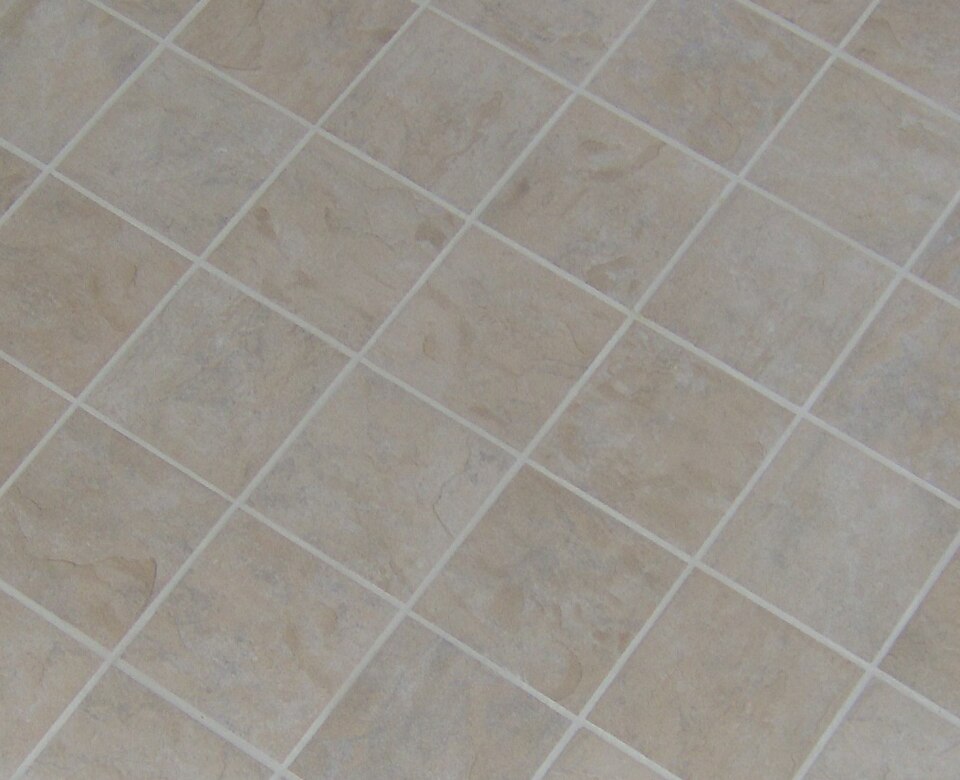
Photo: PJM, CC BY-SA 3.0, via Wikimedia Commons.

How do you specify porcelain paving?
To specify porcelain paving, name a frost-resistant BS EN 14411 Group BIa tile made for external use, with its format, thickness, finish and wet slip resistance, then specify the construction it sits on. Thickness and structural performance must come from the traffic and the base, not a default. Porcelain barely absorbs water, so bedding needs a priming slurry or bond bridge on the back of each unit, or a pedestal system designed for the load.
Porcelain paving is dense, hard and frost resistant, and it keeps its colour, which is why it has taken over so many terraces and podiums. Its weak points are elsewhere. The back of a porcelain slab absorbs almost no water, so it does not grip an ordinary mortar bed, and a 20 mm unit has none of the reserve of a 50 mm flag when it is laid over a weak or uneven base. Most failures on site come from the bedding and the construction underneath, not from the slab.
Uniclass has no code named for porcelain paving. The nearest product code is Pr_25_93_60_10 Clay paving tiles, which covers ceramic paving units, and that is the code used here. Porcelain used inside the building belongs under Pr_35_93_96_63 Porcelain tiles, which is worth keeping separate when the same range runs from a kitchen out onto a terrace.
What does a porcelain paving slab clause need to cover?
Some properties are specific to porcelain paving. Others belong in every product clause. A clause that leaves either out gives the contractor room to substitute.
Properties of porcelain paving
- Product typePorcelain slab, distinct from stone or concrete flags.
- Nominal sizeFormat sets layout, falls and point load risk.
- ThicknessNever guessMust suit the traffic and the bedding or pedestals.
- TolerancesRectified size and flatness control joints and lippage.
- Edge treatmentRectified square or eased arris; chipping and trip risk.
- Slip resistanceWet PTV by pendulum for external pedestrian areas.
- Wear resistanceDeep abrasion to BS EN ISO 10545-6.
- Freeze-thaw resistanceFrost resistant to BS EN ISO 10545-12.
- Structural performanceNever guessTraffic category and pavement design; breaking strength declared.
- Bedding and jointingMortar bed with priming slurry, or pedestals.
- Laying patternStack or bond, aligned with falls and drainage.
- Coating systemUsually none; say so, so that no sealer is added.
- AccessibilityTactile and contrast needs on routes, to BS 8300.
What every product clause needs
- Manufacturer and product referenceNamed external range, or a performance description.
- Product standardBS EN 14411 Group BIa, evidenced by the DoP.
- Installation methodManufacturer's laying guide plus this specification.
- Technical submittalsSlip, frost and breaking strength test evidence.
- Operation and maintenance informationCleaning regime and replacement stock for repairs.
- MaterialPorcelain body, through-body or glazed.
- FinishStructured external finish, colour and range reference.
Uniclass Pr_25_93_60_10 Porcelain paving. Not every property applies to every project; where one does not, say so rather than leaving it blank.
Fields marked Never guess (thickness and structural performance) depend on the project and should never be filled from a default or a previous job. If the information is not available yet, the clause should say so with a TBC and a reason.
Which decisions does the clause depend on?
Most properties follow from the product you choose. These depend on the project, so they need a decision from the designer before the clause is written.
- 01
What the paving has to carry
Never guessA private terrace with garden furniture and a courtyard that takes a refuse lorry or a cherry picker are different pavements. Once vehicles or maintenance plant are possible, the slab, the bedding and the base have to be designed together, and that design belongs with an engineer. BS 7533-101 sets out the design approach for modular pavements but does not name porcelain in its scope, so suitability for anything beyond pedestrian use rests on the manufacturer's written confirmation and test data for the slab, the bed and the base proposed.
How to decide
- Ask the client and the landscape architect what will actually cross the area, including maintenance, deliveries and emergency access.
- Pedestrian only: state it in the clause so the limit is on record.
- Any vehicle or plant: get an engineer to design the pavement and the manufacturer to confirm the slab for it in writing.
- Ask for the declared breaking strength to BS EN ISO 10545-4 as part of the submittal.
Write it asStructural performance: Pedestrian traffic only. Breaking strength declared to BS EN ISO 10545-4. Manufacturer's written confirmation of suitability for this construction. - 02
Thickness for the construction
Never guessTwenty millimetres is the usual thickness for external porcelain, and most ranges are sold that way, which is why it ends up in clauses without anyone deciding it. Whether it is enough depends on the format, the load and how the slab is supported. On a full bound bed the slab is carried across its whole area. On pedestals it spans between supports, so a large format can be marginal for the same use. Take the thickness from the manufacturer's data for the construction actually proposed.
How to decide
- Start from the traffic decision and the bedding or pedestal choice, then check thickness against the manufacturer's data.
- On pedestals, confirm the format and support layout with the manufacturer, particularly for larger formats.
- If a thicker or reinforced product is needed, write that requirement rather than the catalogue thickness.
Write it asThickness: 20 mm, confirmed by the manufacturer for pedestrian use on a full bound bed. Submit confirmation. - 03
Bound bed with a bond bridge, or pedestals
LayingOn a mortar bed, porcelain needs a priming slurry or bond bridge applied to the back of each slab and laid while it is still wet, or the slab sits on the bed rather than bonding to it. The bed has to give full contact, because a thin slab over a void will crack under a heel or a chair leg. On roof terraces and podiums, adjustable pedestals keep the waterproofing accessible, let water drain beneath and avoid loading the membrane with a heavy bed.
How to decide
- Over a waterproofed roof or podium, consider pedestals so the membrane can be reached later.
- On a bound bed, specify full bed contact and a priming slurry or bond bridge approved by the paving manufacturer.
- Choose the jointing to suit the construction: compound or mortar on a bound bed, open joints or spacers on pedestals.
- Use bedding and jointing products the paving manufacturer supports, so any warranty applies.
Write it asBedding: Full bound mortar bed; priming slurry applied to the back of each unit and laid wet. Jointing: Compound approved by the paving manufacturer. - 04
Slip resistance outside
SlipExternal paving is wet for much of the year in the UK, and it collects algae and leaf litter in shaded corners. The pendulum test is the measure to use, with a minimum wet PTV measured to BS EN 16165 Annex C using slider 96 for shod areas. UK Slip Resistance Group guidance treats a wet PTV of 36 or more as low slip potential. Many porcelain ranges come in a smooth internal finish and a structured external finish in the same colour, so the clause has to name the external finish and ask for its own test result.
How to decide
- Name the structured or textured external finish, not just the range and colour.
- Set a minimum wet PTV with slider 96, and a higher target for ramps and steps if the client or brief asks for it.
- Ask for the test report on the external finish, not a ramp test value.
- Think about cleaning: shaded north-facing areas will need a maintenance regime as well as a good finish.
Write it asSlip resistance: Wet PTV not less than 36, tested to BS EN 16165 Annex C using slider 96, on the external finish supplied. - 05
Falls, drainage and joint layout
FallsPorcelain does not take up water, so anything that ponds stays on the surface, freezes in winter and grows algae in summer. Falls have to be built into the base, not formed in the bedding, and they need to reach a channel or gulley. The joint layout should follow the falls: long joints running across the slope look intentional and help the setting out, while cuts at drainage channels and thresholds should be planned on the drawings rather than left to the paving gang.
How to decide
- Show falls and levels on the drawings and form them in the base.
- Set out the laying pattern with the fall, and coordinate joints with channels, gulleys and door thresholds.
- At thresholds, check the level of the paving against the internal floor and the door detail.
Write it asLaying pattern: Stack bond, long joints across the fall. Falls: In the base, as landscape drawings, with no ponding.
The values under "Write it as" are examples. The right value depends on the location, the use and the fire strategy.
Which standards should the clause cite?
Cite the product standard the declaration of performance refers to, the code of practice for installation, and the test method behind each value you set. A value without its test method cannot be checked against a submittal.
- BS EN 14411
- Ceramic tiles. Definition, classification, characteristics, assessment and verification of constancy of performance and marking
The product standard for ceramic tiles including external porcelain, which falls in Group BIa with very low water absorption.
In the clause "Product standard: BS EN 14411, Group BIa, external range."
- BS EN ISO 10545 series
- Ceramic tiles. Test methods
The tests behind each declared value: Part 4 breaking strength, Part 6 deep abrasion for unglazed tiles, Part 12 frost resistance.
In the clause Cite the part with the property: "Frost resistant when tested to BS EN ISO 10545-12".
- BS EN 16165
- Determination of slip resistance of pedestrian surfaces. Methods of evaluation
Annex C is the pendulum test, including slider choice: slider 96 for shod use and slider 57 for barefoot use. BSI withdrew BS 7976-2 in 2022, so older test reports may still quote it.
In the clause Name the annex and the slider: "Wet PTV not less than 36, tested to BS EN 16165 Annex C using slider 96".
- BS 7533-101
- Pavements constructed with clay, concrete or natural stone paving units. Code of practice for the structural design of pavements using modular paving units
The structural design approach for modular pavements. Porcelain is not named in its scope, so it is a reference for the method rather than a compliance route for the slab.
In the clause Use it for the engineer's design of trafficked areas: "Pavement design: by engineer, following the approach in BS 7533-101".
- BS 7533-102
- Pavements constructed with clay, concrete or natural stone paving units. Installation of pavements using modular paving units. Code of practice
Installation of bound and unbound modular pavements; its scope includes porcelain slabs.
In the clause "Installation: to BS 7533-102 and the paving manufacturer's instructions."
- BS 5385-3
- Wall and floor tiling. Design and installation of internal and external ceramic and mosaic floor tiling in normal conditions. Code of practice
Porcelain bonded to a rigid concrete base, including bed coverage and movement joints, where the construction is closer to tiling than to paving.
In the clause "Movement joints: to BS 5385-3, positions as setting-out drawing."
- BS 8300-1
- Design of an accessible and inclusive built environment. External environment. Code of practice
Accessible external routes, including surface evenness, gradients and the use of tactile paving.
In the clause Refer to it where the terrace is part of an accessible route: "Surfaces on accessible routes: to BS 8300-1".
Confirm the current edition of each standard at every issue. Avoice's State of UK Specifications 2026 found a withdrawn standard cited in 40% of specifications at contract issue.
For the regulations behind these choices, see Approved Document M explained, or search the Avoice Regulations library.
How do you write it in CAWS?
External porcelain paving is written in CAWS section Q25. In current NBS layouts the section opens with paving system clauses in the 100s, one for each construction, so a bound terrace and a pedestal-supported roof terrace are two separate clauses even if they use the same slab. Some practices then write the slab itself as a product clause in the 300s, for example 310, and point to it from the system clause.
Everything that applies to all paving types sits later in Q25: samples, adverse weather, laying generally, levels, regularity and protection. The system clause below keeps the slab properties with the construction for clarity, and relies on those execution clauses for how the work is done.
- Description
- Pedestrian terrace, porcelain slabs on a bound bed
- Base
- Concrete slab laid to falls, as landscape drawings
- Paving units
- External porcelain, BS EN 14411 Group BIa
- Size
- 900 x 600 mm, rectified
- Thickness
- 20 mm, confirmed by manufacturer for this construction
- Finish
- Structured external finish
- Colour
- TBC Landscape architect's selection awaiting client approval. Resolve before ordering.
- Slip resistance
- Wet PTV not less than 36, slider 96, to BS EN 16165 Annex C
- Frost resistance
- Frost resistant to BS EN ISO 10545-12
- Structural performance
- Pedestrian traffic only
- Laying course
- Bound mortar bed, full contact
- Accessories
- Priming slurry to back of each unit, laid wet
- Jointing
- 5 mm, compound approved by paving manufacturer
- Laying pattern
- Stack bond, long joints across the fall
- Coating
- None
Illustrative, not from a real project. One property is left as a TBC with a reason so it can be tracked and closed before issue.
Clauses the type clause relies on
- Q25/610
- Material samples Samples of slab and jointing colour submitted before orders are placed.
- Q25/616
- Control samples A finished sample area approved before the rest of the paving is laid.
- Q25/620
- Adverse weather Temperature limits for mortar-bedded work and protection from frost and rain.
- Q25/625
- Laying pavings - general Firm bedding with no rocking, falls to prevent ponding, clean cutting.
- Q25/637
- Regularity of paved surfaces Permitted undulation under a straightedge and level differences at joints.
- Q25/645
- Protection Keeping traffic and stacked materials off mortar-bedded paving while it cures.
Clause numbers vary between NBS versions and practice masters; the numbers here follow those seen in recent NBS-format landscape specifications. Check that each referenced clause exists in your own Q25.
For more on clause structure and checks, see NBS clause writing: common mistakes.
How do you write it in Uniclass?
Uniclass separates the construction from the slab. Ss_30_14_90_30 Flag and slab bound paving systems describes the base, laying course, priming, jointing and the performance of the finished surface. A roof terrace on adjustable supports would use Ss_30_14_90_34 Flag and slab pedestal-supported paving systems instead, with its own system clause.
The slab is written once as a product clause and both systems can point to it. That suits porcelain well, because the same external range often appears on a ground-floor terrace on a bound bed and on an upper terrace on pedestals, and a change of range or colour then only has to be made in one place.
- Description
- Pedestrian terrace, porcelain slabs on a bound bed
- Base
- Concrete slab laid to falls, as landscape drawings
- Paving units
- Pr_25_93_60_10 Clay paving tiles (P01)
- Laying course
- Bound mortar bed, full contact
- Priming
- Priming slurry to back of each unit, laid wet
- Jointing
- 5 mm, compound approved by paving manufacturer
- Structural performance
- Pedestrian traffic only
- Slip resistance of finished surface
- Wet PTV not less than 36 to BS EN 16165 Annex C, slider 96
- Manufacturer
- Submit proposals
- Material
- Porcelain, through-body
- Product standard
- BS EN 14411, Group BIa, external range
- Nominal size
- 900 x 600 mm, rectified
- Thickness
- 20 mm
- Finish
- Structured external finish
- Colour
- TBC Landscape architect's selection awaiting client approval. Resolve before ordering.
- Freeze-thaw resistance
- Frost resistant to BS EN ISO 10545-12
- Breaking strength
- Declared value to BS EN ISO 10545-4
- Edge treatment
- Rectified, square arris
Illustrative. Performance of the finished system sits in the system clause; properties of the product sit in the product clause.
In NBS Chorus, the product clause also carries an NBS reference (for this code, 45-20-64/345). Use one classification for the whole specification and do not mix CAWS and Uniclass references.
What goes in the spec, and what goes in the schedule?
The specification defines each type once. The schedule and drawings say where each type goes.
In the specification
What the product is and how it performs and is installed. Written once per type.
In the schedule or drawings
Where each type goes and how much of it. Changes with every plan revision.
Write each paving and construction combination once as a product with a type mark (for example P01) and let the landscape drawings say where it goes. The same slab on a mortar bed and on pedestals are two types, because their thickness and loading checks differ.
What are the common mistakes?
Most problems are a missing property, a property filled with the wrong kind of value, or a decision left silently open.
- No priming slurry or bond bridge. Porcelain will not bond to a plain mortar bed. Slabs sound hollow within a season and then come loose. Make the bond bridge a requirement in the clause.
- Spot or dab bedding. Voids under a thin slab crack under point loads. Specify full bed contact and check it by lifting a slab during the work.
- Thickness copied from the catalogue. Twenty millimetres on a pedestrian bed is not the same as twenty millimetres on pedestals or under a delivery van. Take thickness from the traffic and the construction.
- The internal finish used outside. Matching floors inside and out is popular, but the smooth internal finish is often slippery when wet. Name the external finish and ask for its own wet PTV.
- Sand bedding borrowed from flag paving. Unbound methods developed for thick concrete and stone flags rarely suit thin porcelain. Use a bound bed or a pedestal system the manufacturer supports.
- Falls left to the bedding. Porcelain does not absorb water, so ponding sits on the surface and freezes. Form falls in the base and show them on the drawings.
How Avoice helps
Avoice's spec writer drafts paving clauses from the landscape and architectural information on the project and shows what is still undecided.
- Drafts from your drawings and schedules
It reads paving types such as P01 and P02 from the landscape drawings and schedules, and writes a separate clause where the same slab is laid on a bound bed in one place and on pedestals in another.
- Leaves a TBC where the information stops
If nobody has confirmed whether the courtyard takes vehicles, or the colour is still with the client, the clause says TBC with the reason, and the item goes into one TBC register to close before tender.
- Writes in CAWS or Uniclass
Choose the format your practice uses. Avoice adapts your own master clauses for Q25 or for the Uniclass paving systems instead of replacing them with generic text.
- Checks the paving against the rest of the set
QA/QC flags a paving type on the landscape plan that the specification never defines, a clause that says pedestrian only where the drawings show a service route, broken cross-references and withdrawn standards.
- Keeps the manufacturer's evidence in one place
Data sheets, declarations of performance and slip test reports sit in the Product Room linked to the clause, so a proposed alternative range can be checked against the slip, frost and strength values the clause sets.
Related guides: How to specify ceramic tiles, How to specify natural stone tiles, How to specify tile adhesives.
Software can draft and check. The designer still chooses the product and is responsible for the specification.
For more on the evidence behind product choices, see the role of manufacturer product data in specification writing.
Draft your porcelain paving slab clause in Avoice
Upload your drawings and schedules. Avoice drafts the clause in CAWS or Uniclass, cites the standards and flags anything your information does not settle.
This guide is for general education and is not professional advice. Check current editions of standards and Approved Documents, the manufacturer's data, and the requirements of your project before relying on any clause.