
How to specify sheep wool insulation
What a sheep wool insulation clause has to say when there is no product standard to cite, the decisions behind evidence, insect treatment and fire, and how to write it in CAWS and in Uniclass.
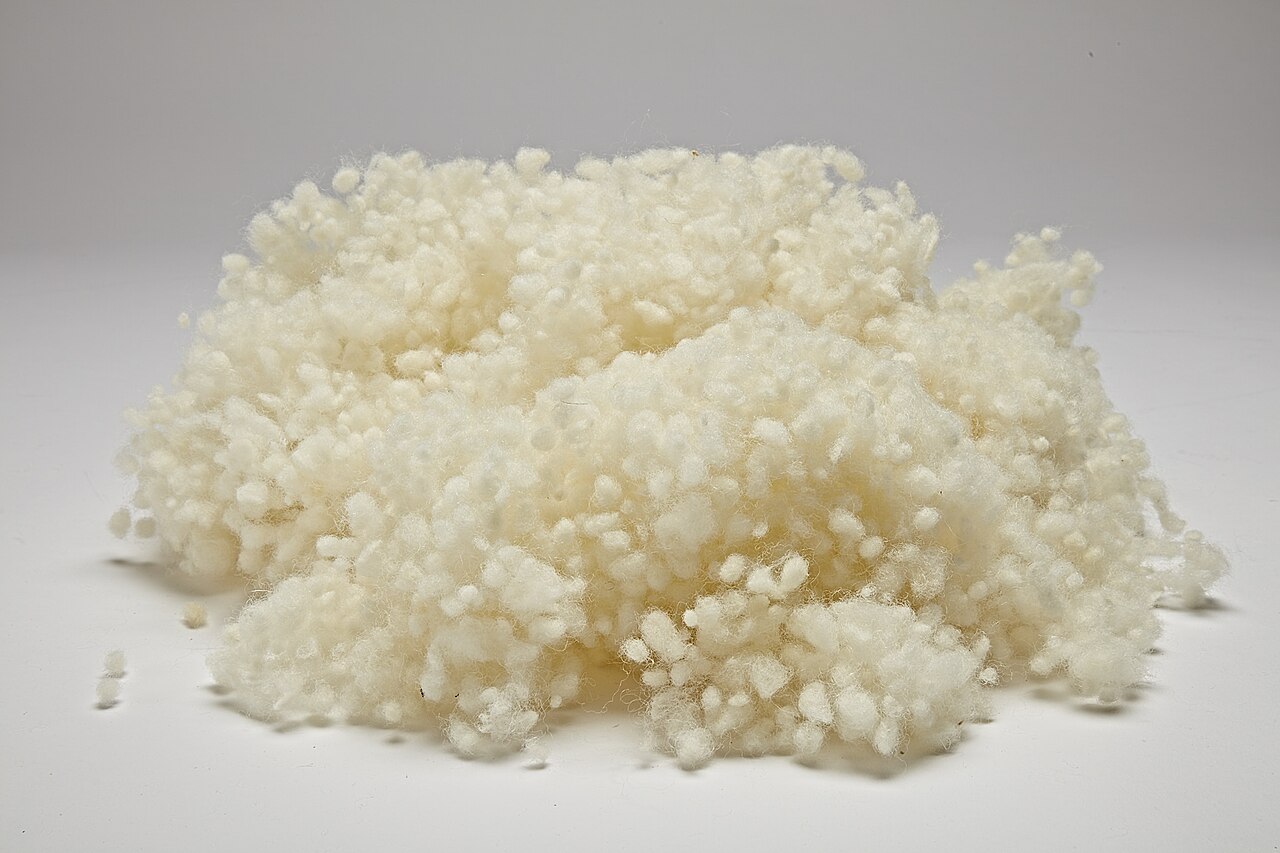
Photo: Josephcathcart, CC BY-SA 4.0, via Wikimedia Commons.

How do you specify sheep wool insulation?
To specify sheep wool insulation, name the product with its declared thermal conductivity, thickness, density and wool content, and say what evidence of performance you need, because there is no harmonised European standard for it: ask for the declaration of performance and any European Technical Assessment against EAD 040005-00-1201. State the insect treatment and how its resistance was tested, the Euroclass from the DoP, and the laying, eaves and loft hatch details.
Sheep wool is often specified for reasons that are partly technical and partly about the client: it is hygroscopic, pleasant to handle and from a renewable source, and on conservation and low-carbon projects those reasons decide it. What makes it awkward to specify is that there is no harmonised European standard for it, so the clause cannot cite a product standard and rely on the DoP the way a mineral wool clause can. It has to ask for the evidence directly.
This guide covers Uniclass Pr_25_57_06_76 Sheep wool insulation, with the sample clause for loft insulation between and over ceiling joists. Wool felts used as membranes have their own code, Pr_25_57_61_98 Wool felt membranes, and wool blown in loose falls under Pr_25_31_48 Loose insulation.
What does a sheep wool insulation roll clause need to cover?
Some properties are specific to sheep wool insulation. Others belong in every product clause. A clause that leaves either out gives the contractor room to substitute.
Properties of sheep wool insulation
- Product typeRoll, batt or loose fill.
- Thermal performanceDeclared lambda at the declared density.
- ThicknessAs the U-value calculation, after recovery from packing.
- DensityAffects lambda, and slumping in walls and slopes.
- Nominal sizeRoll width to suit joist or stud centres.
- Edge treatmentFriction-fit edges; cut slightly oversize.
- TolerancesThickness once recovered from compressed packing.
- Reaction to fire classificationNever guessUsually Euroclass E; check the DoP.
- Acoustic performanceAbsorption values declared by some makers.
- Water absorptionHygroscopic, but must not be wetted.
- Vapour resistanceLow; vapour-open.
- Dimensional stabilityBatts should not shrink back from joists.
- DurabilityDepends on the insect treatment and keeping it dry.
- FixingsFriction fit in lofts; staples or netting on slopes and walls.
- Third-party certificationETA or certificate where held; check building control.
- Recycled contentDeclared recycled polyester content, if any.
- Environmental product declarationFor embodied carbon reporting, where published.
What every product clause needs
- Manufacturer and product referenceNamed product, or wool content and properties if left open.
- Product standardNo harmonised EN; DoP via an ETA or the manufacturer.
- Installation methodTwo layers, the second across the joists, no gaps.
- Technical submittalsDoP, ETA if held, and the insect treatment statement.
- Operation and maintenance informationTreatment details and advice on loft storage.
- MaterialSheep wool, with any polyester binder fibre declared.
Uniclass Pr_25_57_06_76 Sheep wool insulation. Not every property applies to every project; where one does not, say so rather than leaving it blank.
Fields marked Never guess (reaction to fire classification) depend on the project and should never be filled from a default or a previous job. If the information is not available yet, the clause should say so with a TBC and a reason.
Which decisions does the clause depend on?
Most properties follow from the product you choose. These depend on the project, so they need a decision from the designer before the clause is written.
- 01
Evidence of performance without a product standard
EvidenceMineral wool, EPS and wood fibre each have a harmonised product standard, so a DoP against it tells you what has been tested and how. Sheep wool has none. Some products hold a European Technical Assessment against EAD 040005-00-1201, the assessment document for factory-made insulation of vegetable or animal fibres. Others are sold without an ETA, on the manufacturer's own declaration backed by test reports, with no technical body assessing the product as a whole. Both can be legitimate, but they are not the same level of evidence.
How to decide
- Ask for the DoP and the basis of each declared value: test standard, test report and laboratory.
- Prefer a product with an ETA or third-party certificate where the warranty provider or building control asks for one.
- Send the evidence to building control early, before the product is ordered.
Write it asEvidence of performance: Declaration of performance with test reports, and European Technical Assessment to EAD 040005-00-1201 where held. Submit before ordering. - 02
Insect treatment and moth resistance
InsectsUntreated wool is food for clothes moth and carpet beetle larvae. Wool insulation is treated against them, and treatments differ. Some products use a boron compound such as borax, which also acts as a fire retardant; others use a synthetic insecticide such as permethrin. Clients who chose wool to avoid synthetic chemicals sometimes find out later which one was used. Manufacturers usually declare moth resistance by a textile test, ISO 3998. The clause should name the treatment the client accepts and ask how permanent it is.
How to decide
- Ask the client whether synthetic insecticides are acceptable, and record the answer.
- Ask for the treatment, its permanence, and the moth resistance test report.
- Keep the wool dry in storage and in the roof; wet wool is more vulnerable.
Write it asInsect protection: Permanent treatment declared by manufacturer, moth resistance tested to ISO 3998. Submit treatment statement. - 03
Reaction to fire, cables and downlights
Never guessSheep wool insulation is combustible and is usually declared Euroclass E, often with a borax-type retardant. In a loft between joists it is not a lining, so the class rarely decides the design, but it still belongs in the clause from the DoP. Where it goes into walls, regulation 7(2) applies on a relevant building and requires A2-s1,d0 or A1 for materials becoming part of an external wall, so wool in a timber frame external wall is ruled out there. In lofts, recessed downlights, flues and cable runs need the clearances their manufacturers give.
How to decide
- Lofts: state the Euroclass from the DoP; ask whether smouldering resistance has been tested where cables are covered.
- External walls of relevant buildings, and residential buildings with a storey 11 m or more: not sheep wool.
- Downlights and flues: keep insulation clear by the manufacturers' distances, or fit rated covers.
Write it asReaction to fire: Euroclass E to BS EN 13501-1, as declared. Submit declaration of performance. - 04
Lambda, thickness and recovery
ThermalSheep wool lambda is declared at a stated density, and lighter and denser products of the same range can differ. Rolls are packed compressed and need time to recover their full thickness after opening; laying them straight from the pack, or squashing them under boards, gives a thinner layer than the U-value assumed. In a loft the first layer fills the joist depth and the second runs across the joists to cover them, because timber joists bridge a single layer.
How to decide
- Take lambda and total thickness from the ceiling U-value calculation.
- Specify two layers, the second at right angles to the joists.
- Require rolls to recover to their declared thickness before they are covered.
Write it asThermal conductivity: Declared value not more than the value used in the U-value calculation. Thickness: 300 mm total in two layers, second layer across joists. - 05
Hygroscopic is not a ventilation strategy
MoistureWool takes up and releases water vapour, which helps it ride out short spells of high humidity. That does not replace the moisture design of the roof. A cold loft still needs ventilation at the eaves and a well-sealed ceiling, with the hatch and service penetrations taped, following BS 5250. Wool pushed into the eaves to cover the wall head can block the ventilation path, and a loft that is wet for weeks will be wet whatever the insulant.
How to decide
- Check the roof ventilation design against BS 5250 for the roof type.
- Specify eaves ventilation trays or a stop so insulation cannot close the airway.
- Seal the ceiling: hatch, downlights and service holes.
Write it asEaves: Insulation carried over wall plate and stopped against eaves ventilation tray, as clause 165.
The values under "Write it as" are examples. The right value depends on the location, the use and the fire strategy.
Which standards should the clause cite?
Cite the product standard the declaration of performance refers to, the code of practice for installation, and the test method behind each value you set. A value without its test method cannot be checked against a submittal.
- EAD 040005-00-1201
- Factory-made thermal and/or acoustic insulation products made of vegetable or animal fibres
The European Assessment Document a technical assessment body uses to issue a European Technical Assessment for wool and other natural fibre insulation.
In the clause "European Technical Assessment to EAD 040005-00-1201, where held. Submit."
- BS EN 13501-1
- Fire classification of construction products and building elements. Classification using data from reaction to fire tests
The Euroclass declared for the product as supplied.
In the clause "Reaction to fire: Euroclass E to BS EN 13501-1, as declared."
- BS EN 12667
- Thermal performance of building materials and products. Determination of thermal resistance by means of guarded hot plate and heat flow meter methods. Products of high and medium thermal resistance
The test method most manufacturers use for the thermal conductivity they declare.
In the clause "Thermal conductivity: declared, tested to BS EN 12667. Submit test report."
- ISO 3998
- Textiles. Determination of resistance to certain insect pests
A laboratory test of resistance to moth and beetle larvae, used by manufacturers to support their insect protection claims.
In the clause "Moth resistance: tested to ISO 3998. Submit report."
- BS 5803-4
- Thermal insulation for use in pitched roof spaces in dwellings. Methods for determining flammability and resistance to smouldering
Tests for flammability and smouldering of loft insulation, which some sheep wool makers declare alongside the Euroclass.
In the clause "Flammability and smouldering: declared to BS 5803-4."
- BS 5250
- Management of moisture in buildings. Code of practice
Roof ventilation and condensation risk for cold and warm pitched roofs.
In the clause "Roof void ventilation in accordance with BS 5250."
- BS EN ISO 6946
- Building components and building elements. Thermal resistance and thermal transmittance. Calculation methods
The U-value method, including the bridging effect of joists through the first layer.
In the clause "Ceiling U-value calculated to BS EN ISO 6946."
Confirm the current edition of each standard at every issue. Avoice's State of UK Specifications 2026 found a withdrawn standard cited in 40% of specifications at contract issue.
For the regulations behind these choices, see Part L and the Future Homes Standard, Approved Document B explained, or search the Avoice Regulations library.
How do you write it in CAWS?
In CAWS, loft insulation is a product clause in P10. NBS Source lists natural fibre insulation against P10 clause 125 Insulation laid between ceiling ties/ joists, with separate clauses for the eaves (165) and loft access hatches (170). The pitched roof type clause, in H60 for a plain tiled roof for example, covers the roof covering; the ceiling-level insulation sits in P10 and the roof drawings show where it goes.
The insulation clause names the product, the evidence of performance, the insect treatment and the laying. It relies on the eaves and hatch clauses for those details and on clause 310 for any air and vapour control layer at ceiling level. A sloping ceiling insulated between rafters is a different P10 clause with its own ventilation and fixing lines.
- Location
- Loft over first floor ceilings, ventilated cold roof
- Insulation
- Sheep wool rolls, type I05
- Manufacturer
- Submit proposals
- Product reference
- Submit proposals
- Evidence of performance
- DoP with test reports; ETA to EAD 040005-00-1201 where held
- Wool content
- Declared, with any polyester binder fibre stated
- Insect protection
- TBC Client has asked to avoid synthetic insecticides; acceptable treatment not yet agreed. Resolve before ordering.
- Thermal conductivity
- Declared value not more than the value used in the U-value calculation
- Thickness
- 300 mm total: first layer to joist depth, second layer across joists
- Reaction to fire
- Euroclass E to BS EN 13501-1, as declared
- Laying
- Friction fit, no gaps or compression; rolls recovered to declared thickness before covering
- Eaves
- Carried over wall plate, stopped at ventilation tray, as clause 165
- Loft hatch
- Insulated and draught sealed, as clause 170
- Services
- Cables over insulation; clear of downlights and flues by manufacturers' distances
- Storage areas
- Raised platform over insulation; no boards laid directly on it
Illustrative, not from a real project. One property is left as a TBC with a reason so it can be tracked and closed before issue.
Clauses the type clause relies on
- P10/165
- Insulation to eaves How insulation meets the wall head without closing the ventilation path.
- P10/170
- Insulation to loft access hatches Insulating and draught sealing the hatch so it is not the weak spot.
- P10/310
- Air and vapour control layer Any membrane at ceiling level and how penetrations are sealed.
Clause numbers vary between NBS versions and practice masters, and NBS Source lists natural fibre insulation against both three-digit and newer short P10 numbers; check the clauses your insulation clause refers to exist in your own P10.
How do you write it in Uniclass?
Uniclass puts the loft insulation inside the roof system it belongs to. Ss_30_10_30_85 Timber roof framing systems describes the framing, ceiling-level insulation, ventilation and the U-value the ceiling must meet. The wool itself is a product clause under Pr_25_57_06_76, called up by type mark.
The evidence and treatment lines belong in the product clause, so they are written once. If the same wool is used in a sloping ceiling or a stud wall, those systems point to the same product, and a different thickness or density becomes a second product with its own mark.
- Description
- Ventilated cold pitched roof, insulation at ceiling level
- Framing
- Trussed rafters, as structural drawings
- Insulation
- Pr_25_57_06_76 Sheep wool insulation (I05)
- Ceiling
- Plasterboard with sealed penetrations
- Ventilation
- Roof void ventilated at eaves in accordance with BS 5250
- Loft hatch
- Insulated and draught sealed
- Ceiling U-value
- Not more than the value in the energy calculation
- Manufacturer
- Submit proposals
- Product reference
- Submit proposals
- Product type
- Roll
- Evidence of performance
- DoP with test reports; ETA to EAD 040005-00-1201 where held
- Wool content
- Declared
- Insect protection
- TBC Client has asked to avoid synthetic insecticides; acceptable treatment not yet agreed. Resolve before ordering.
- Thermal conductivity
- Not more than the value used in the U-value calculation
- Density
- As declared, matching the thermal conductivity declaration
- Reaction to fire
- Euroclass E to BS EN 13501-1
- Environmental product declaration
- Submit where published
Illustrative. Performance of the finished system sits in the system clause; properties of the product sit in the product clause.
In NBS Chorus the sheep wool product clause also carries the NBS reference 45-45-70/365. Use whichever referencing your practice masters use, but do not mix CAWS and Uniclass references in one specification.
What goes in the spec, and what goes in the schedule?
The specification defines each type once. The schedule and drawings say where each type goes.
In the specification
What the product is and how it performs and is installed. Written once per type.
In the schedule or drawings
Where each type goes and how much of it. Changes with every plan revision.
Write the loft insulation once and let the roof plan show where it goes. Boarded storage areas and sloping ceilings are separate build-ups, so give them their own types.
What are the common mistakes?
Most problems are a missing property, a property filled with the wrong kind of value, or a decision left silently open.
- "To BS EN ..." for sheep wool. There is no harmonised standard to cite. Ask for the DoP, its test basis and any ETA instead.
- Insect treatment not stated. The client finds out after installation which chemical was used. Agree it and write it down.
- Rolls covered straight from the pack. Compressed rolls need time to recover. Covered early, they never reach the thickness the U-value assumed.
- Wool pushed into the eaves. It blocks the roof ventilation. Stop it at an eaves tray.
- Storage boards laid on the insulation. The layer is squashed and its resistance lost. Build a raised platform.
- One layer between the joists. The joists bridge it at every joist. Add a cross layer.
How Avoice helps
Avoice's spec writer drafts the sheep wool clause from your roof drawings and keeps the evidence and treatment questions visible.
- Drafts from your drawings and schedules
It reads the roof types and ceiling areas from your drawings, writes the P10 loft insulation clause or the Uniclass roof system, and links the sheep wool product clause to each roof that uses it.
- Leaves a TBC where the client has not decided
If the acceptable insect treatment has not been agreed, the line stays TBC with the reason, and it goes into the project TBC register to close before tender.
- Writes in your format and your style
CAWS or Uniclass, adapted from your practice's own master clauses.
- Checks the clause against everything else
QA/QC flags a clause that cites a product standard sheep wool does not have, an eaves clause deleted from the master but still referred to, or a withdrawn standard.
- Keeps product data in one place
The DoP, ETA and treatment statement sit in the Product Room linked to the clause. Edit the linked product once and every roof that uses it updates.
Related guides: How to specify wood fibre insulation, How to specify mineral wool insulation, How to specify loft insulation.
Software can draft and check. The designer still chooses the product and is responsible for the specification.
Draft your sheep wool insulation roll clause in Avoice
Upload your drawings and schedules. Avoice drafts the clause in CAWS or Uniclass, cites the standards and flags anything your information does not settle.
This guide is for general education and is not professional advice. Check current editions of standards and Approved Documents, the manufacturer's data, and the requirements of your project before relying on any clause.