
How to specify taps
What a tap clause has to decide, from scald protection and flow rate to operation and supply pressure, the standards and schemes to cite, and how to write it in CAWS and in Uniclass.
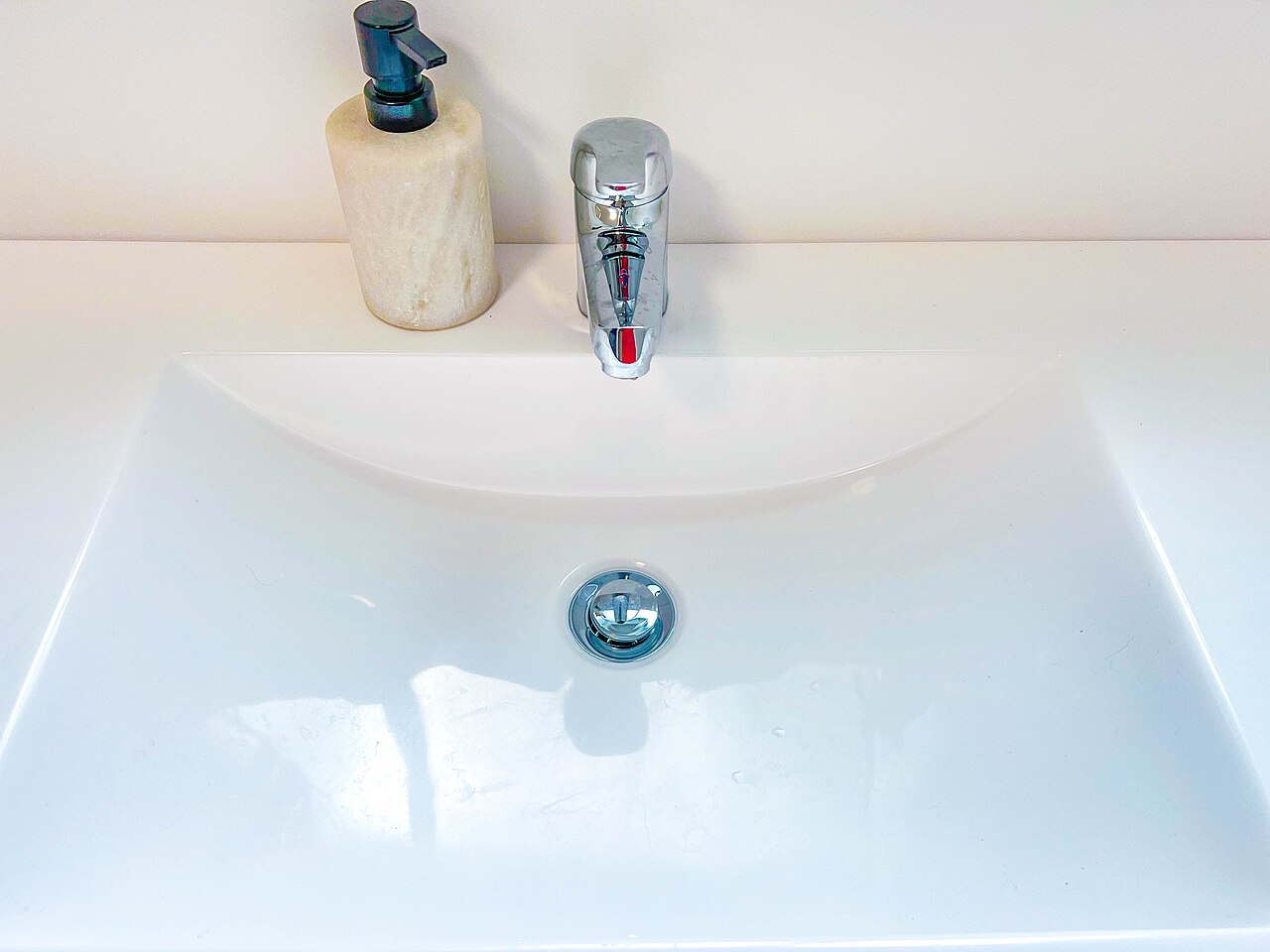
Photo: Smtzzz, CC BY-SA 4.0, via Wikimedia Commons.

How do you specify taps?
To specify taps, state the tap type and its product standard (BS EN 200 for single taps, BS EN 817 for mechanical mixers, BS EN 1111 or BS EN 1287 for thermostatic mixers, BS EN 15091 for sensor taps), the mounting and tap holes, the operation, the flow rate and the supply pressure it must work on. Where users could be scalded, set the maximum outlet temperature and the protection, such as a TMV2 or TMV3 approved valve, and require evidence that the tap complies with the Water Supply (Water Fittings) Regulations 1999.
Taps get specified by catalogue page more than any other sanitary item. The page shows the finish and the spout, but not whether the tap works on the building's supply pressure, whether it limits the temperature for the people using it, or whether its flow rate is the one the water calculation assumed. Those are the lines that matter at building control and in use.
This guide uses Uniclass Pr_40_20_87_55 Mixer taps as the example. The taps section has many neighbours, including Pr_40_20_87_98 Washbasin taps, Pr_40_20_87_87 Thermostatic mixer taps and Pr_40_20_87_03 Automatic-action thermostatic mixer taps. Pick the code that describes the product, and the product standard follows from it.
What does a tap clause need to cover?
Some properties are specific to taps. Others belong in every product clause. A clause that leaves either out gives the contractor room to substitute.
Properties of taps
- MaterialBrass, DZR brass or stainless steel body.
- FinishChrome normally; others must match the ironmongery set.
- Flow rateFeeds the Part G water efficiency calculation.
- Product typePillar, mixer, thermostatic, self-closing or sensor.
- Temperature controlNever guessTMV2 or TMV3 where users could be scalded.
- AccessibilityLever or automatic operation to AD M.
- Backflow protectionMust suit the fluid category of the appliance.
- AccessoriesIsolating valves, flow regulators, tails, wastes.
- Water regulations approvalEvidence of compliance, such as WRAS approval.
- Mounting typeDeck or wall mounted; must match basin tap holes.
- Maximum outlet temperatureNever guessSet by AD G for baths and by risk elsewhere.
- Operating mechanismLever, push, sensor, or clinical elbow lever.
- Operating pressureLow pressure or mains; wrong choice gives poor flow.
What every product clause needs
- Manufacturer and product referenceNamed tap, or performance description for proposals.
- Product standardBS EN 200, 817, 1111, 1287 or 15091 by type.
- Installation methodManufacturer's instructions and N13 installing taps clause.
- Technical submittalsFlow data, pressure range and approval certificates.
- Operation and maintenance informationCartridge spares, TMV servicing and temperature checks.
- FixingsDeck backnut, wall plate or concealed body fixing.
Uniclass Pr_40_20_87_55 Mixer taps. Not every property applies to every project; where one does not, say so rather than leaving it blank.
Fields marked Never guess (temperature control and maximum outlet temperature) depend on the project and should never be filled from a default or a previous job. If the information is not available yet, the clause should say so with a TBC and a reason.
Which decisions does the clause depend on?
Most properties follow from the product you choose. These depend on the project, so they need a decision from the designer before the clause is written.
- 01
Scald protection: which valve, and which scheme
Never guessHot water is stored hot enough to control Legionella, which is hot enough to scald. Where users are children, older people or anyone who cannot react quickly, the temperature at the outlet has to be limited, usually with a thermostatic mixing valve in the tap or close to it. In the UK this is described by approval scheme as much as by standard. TMV2 covers domestic-type use and tests to BS EN 1111 or BS EN 1287. TMV3 covers healthcare and tests to the NHS D 08 specification. Writing "thermostatic" alone allows a valve with neither.
How to decide
- Dwellings: TMV2 approved protection on baths as a minimum, because of the AD G bath limit.
- Care homes, hospitals and similar: TMV3 approved valves, as AD G and NHS guidance expect.
- Schools and nurseries: decide with the client's risk assessment; many specify TMV3.
- Offices and general washrooms: often unblended hot water is accepted, but record the decision.
Write it asTemperature control: Integral thermostatic mixing valve with TMV3 approval, tested to NHS D 08. Submit current scheme certificate. - 02
Maximum outlet temperature
Never guessRequirement G3(4) of the Building Regulations limits the hot water that can be delivered to any fixed bath to 48°C, but only in dwellings that are newly built or formed by a material change of use. Basins, showers and non-domestic buildings are not covered by that requirement, and their limits come from the client, the risk assessment and sector guidance such as the NHS documents. A clause that applies 48°C everywhere can be too hot for a care home basin, and one that sets nothing leaves the commissioning engineer guessing.
How to decide
- Baths in new dwellings: not more than 48°C at the bath, as G3(4) requires.
- Healthcare and care settings: take outlet temperatures from the client's water safety plan and NHS guidance.
- Other buildings: agree a set point with the client and the services engineer, and write it in.
- State that the setting is fixed and not adjustable by users.
Write it asMaximum outlet temperature: As water safety plan, set and locked at commissioning. Record settings in O&M information. - 03
Flow rate and the water calculation
Water useIn new dwellings the tap flow rates go into the Part G water efficiency calculation that is sent to building control. If the design is to the optional 110 litres per person per day limit, Approved Document G's fittings approach assumes basin taps at 5 litres per minute and sink taps at 6. The tap installed has to match what the calculation assumed, at the pressure the building actually has. A flow regulator in the outlet usually does it, but only if the clause asks for one.
How to decide
- Dwellings: take the figure from the Part G calculation and quote it in the clause.
- Non-domestic: use BREEAM or the client's water targets.
- Quote flow at a stated pressure; rates without a pressure cannot be checked.
- Sensor taps in washrooms: consider a lower flow and a run-time limit.
Write it asFlow rate: Not more than 5 litres per minute at 3 bar dynamic pressure, with flow regulator. - 04
Operation and accessibility
OperationApproved Document M Volume 2 asks for bath and washbasin taps in sanitary accommodation to be automatic or operable with a closed fist, such as lever action. Crosshead and small knob taps fail that test. In healthcare, clinical basins use long lever or non-touch taps for infection control. Sensor taps are hygienic but need a power supply, can run on when sensors are dirty, and need a hygiene flush regime where they are little used. Each choice brings extra lines into the clause.
How to decide
- Public and staff washrooms: lever or sensor operation.
- Accessible WCs: lever mixer, positioned on the side nearest the WC as the layout shows.
- Clinical areas: elbow or wrist lever, or non-touch, as the infection control brief requires.
- Sensor taps: specify the power supply, run-on time and any duty flush.
Write it asOperation: Single lever, operable with a closed fist, to Approved Document M Volume 2. - 05
Supply pressure
SupplyA tap designed for mains pressure will trickle on a gravity-fed low pressure system, and some thermostatic valves will not work at all without balanced supplies. BS EN 200 separates taps for high-pressure and low-pressure supply systems, and low pressure thermostatic mixers have their own standard, BS EN 1287. In refurbishments especially, the supply pressure is often unknown when taps are chosen. Ask the services engineer, and put the pressure range in the clause so a proposed alternative can be checked against it.
How to decide
- Mains or boosted supplies: high pressure taps and BS EN 1111 thermostatic valves.
- Gravity-fed low pressure: low pressure rated taps and BS EN 1287 valves.
- Unbalanced hot and cold pressures: ask for balanced supplies or a valve rated for imbalance.
- Refurbishment: confirm the pressure on site before ordering.
Write it asOperating pressure: Suitable for mains-fed balanced supplies, minimum 1 bar dynamic, as services engineer's design.
The values under "Write it as" are examples. The right value depends on the location, the use and the fire strategy.
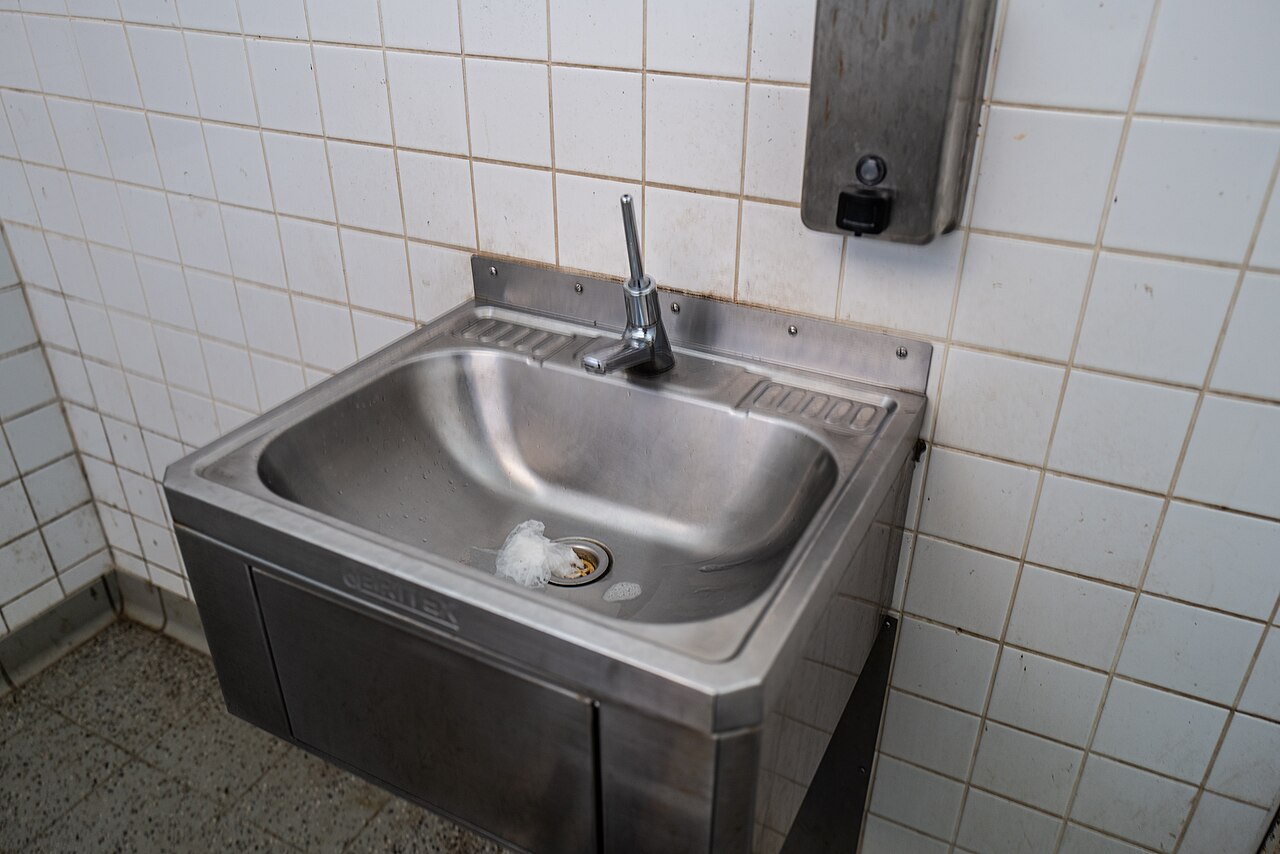
Photo: John Robert McPherson, CC BY-SA 4.0, via Wikimedia Commons.

Which standards should the clause cite?
Cite the product standard the declaration of performance refers to, the code of practice for installation, and the test method behind each value you set. A value without its test method cannot be checked against a submittal.
- BS EN 200
- Sanitary tapware. Single taps and combination taps for water supply systems of type 1 and type 2. General technical specification
Single taps and two-handle combination taps, covering dimensions, watertightness, flow and durability for high and low pressure systems.
In the clause "Pillar taps: to BS EN 200".
- BS EN 817
- Sanitary tapware. Mechanical mixing valves (PN 10). General technical specifications
Single-lever and other mechanical mixers. A 2024 edition has been published, so cite it undated unless your contract fixes the edition.
In the clause "Basin mixer: to BS EN 817".
- BS EN 1111
- Sanitary tapware. Thermostatic mixing valves (PN 10). General technical specification
Thermostatic mixers for high pressure supplies, and one of the test bases for the TMV2 scheme.
In the clause "Thermostatic mixer: to BS EN 1111, TMV2 approved".
- BS EN 1287
- Sanitary tapware. Low pressure thermostatic mixing valves. General technical specifications
Thermostatic mixers for low pressure supplies. Approved Document G refers to it alongside BS EN 1111.
In the clause "Low pressure thermostatic mixer: to BS EN 1287".
- BS EN 15091
- Sanitary tapware. Electronic opening and closing sanitary tapware
Sensor and other electronically opened and closed taps, with their water performance requirements and tests. Specify the power supply separately.
In the clause "Sensor tap: to BS EN 15091, mains powered".
- BS EN 816
- Sanitary tapware. Automatic shut-off valves (PN 10)
Self-closing push taps and similar timed valves used in public washrooms.
In the clause "Self-closing tap: to BS EN 816, run time adjustable".
- Water Supply (Water Fittings) Regulations 1999
- SI 1999/1148
Fittings must be of suitable quality and installed to prevent waste and contamination, including backflow protection matched to the fluid category. WRAS approval is the usual evidence.
In the clause "Water regulations: compliant with the Water Supply (Water Fittings) Regulations 1999. Submit WRAS approval or equivalent".
- NHS D 08 (HTM 04-01 supplement)
- Performance specification D 08: thermostatic mixing valves (healthcare premises)
The NHS performance specification behind the TMV3 scheme, now published as a supplement to HTM 04-01. Approved Document G points to D 08 for in-line blending valves in care homes.
In the clause "Thermostatic mixing valve: TMV3 approved, to NHS D 08".
Confirm the current edition of each standard at every issue. Avoice's State of UK Specifications 2026 found a withdrawn standard cited in 40% of specifications at contract issue.
For the regulations behind these choices, see Approved Document M explained, or search the Avoice Regulations library.
How do you write it in CAWS?
In current NBS layouts N13 does not give taps a clause of their own. They are written as "water supply fittings" inside the appliance clause: the basin clause in the 330s, the bath clause and the shower clause each list the tap or valve, its standard, flow rate and maximum temperature. That keeps the tap next to the tap holes and waste it has to suit.
Where the same tap serves several appliances, some practices write one taps clause and refer to it from each appliance clause. Either works, as long as the cross-reference points to a clause that exists. Installation is covered once by the N13 execution clauses, in particular installing taps, which fixes them against twisting and puts the hot tap on the left.
- Appliance
- Wash basin WB01, one centre tap hole
- Type
- Single-lever mechanical basin mixer
- Standard
- BS EN 817
- Temperature control
- Blended supply from in-line thermostatic mixing valve under basin, TMV3 approved, to NHS D 08
- Manufacturer
- Submit proposals
- Product reference
- Submit proposals
- Mounting
- Deck mounted, flexible tails
- Operation
- Lever, operable with a closed fist
- Water supply temperature (maximum)
- TBC Set point awaits client water safety plan. Resolve before commissioning.
- Flow rate
- Not more than 5 litres per minute at 3 bar
- Operating pressure
- Mains-fed, balanced hot and cold supplies
- Body material
- Dezincification-resistant brass
- Finish
- Chrome plated
- Water regulations
- WRAS approved or equivalent evidence
- Accessories
- Isolating valves and strainers on both supplies
Illustrative, not from a real project. One property is left as a TBC with a reason so it can be tracked and closed before issue.
Clauses the type clause relies on
- N13/610
- Installation generally Fix securely; components working correctly with no leaks on completion.
- N13/613
- Compatibility of components Tap, basin and waste functionally compatible as an assembly.
- N13/620
- Noggings and bearers Support for wall-mounted taps and concealed bodies in partitions.
- N13/710
- Installing taps Secure against twisting, watertight seal, hot tap on the left as viewed.
- N13/720
- Installing wastes and overflows The waste the tap discharges into, bedded and sealed.
Clause numbers vary between NBS versions and practice masters. The numbers here follow an issued NBS N13 section from a 2018 Scottish housing tender, where taps are written inside the basin clause; check them against your own N13.
How do you write it in Uniclass?
In Uniclass the tap is a product, and the assembly it belongs to is a system: for basins, Ss_40_15_75_92 Washbasin systems. The system clause states how basin, tap, waste and trap go together and what the assembly must deliver, such as maximum outlet temperature and flow. The product clause holds the tap's own properties.
That split is useful for taps because temperature limits depend on where the tap is used, not on the tap. The same TMV3 mixer can serve a basin in a ward bathroom and in a staff room, and each washbasin system can set its own maximum temperature while pointing to one product clause. For showers, the valve sits in Ss_40_15_75_78 Shower area systems instead.
- Description
- Wall-hung washbasin with single-lever mixer on blended supply
- Basin
- Pr_40_20_96_96 Wall-hung washbasins (WB01)
- Tap
- Pr_40_20_87_55 Mixer taps (TP01)
- Temperature control
- In-line thermostatic mixing valve under basin, TMV3 approved, to NHS D 08
- Maximum outlet temperature
- As water safety plan, set and locked at commissioning
- Flow rate
- Not more than 5 litres per minute at 3 bar
- Backflow protection
- Suitable for the fluid category of the appliance under the 1999 Regulations
- Commissioning
- Outlet temperatures recorded and included in O&M information
- Manufacturer
- Submit proposals
- Product reference
- Submit proposals
- Type
- Single-lever mechanical basin mixer
- Standard
- BS EN 817
- Temperature control
- For blended supply from in-line TMV3 approved valve, as system clause
- Mounting
- Deck mounted, one tap hole
- Operation
- Lever, operable with a closed fist
- Body material
- Dezincification-resistant brass
- Finish
- TBC Client to confirm chrome or brushed finish to match accessories. Resolve before ordering.
- Water regulations
- WRAS approved or equivalent evidence
Illustrative. Performance of the finished system sits in the system clause; properties of the product sit in the product clause.
In NBS Chorus, basin taps carry the NBS reference 45-35-70/371. Use whichever your practice's masters use, but do not mix CAWS and Uniclass references in one specification.
What goes in the spec, and what goes in the schedule?
The specification defines each type once. The schedule and drawings say where each type goes.
In the specification
What the product is and how it performs and is installed. Written once per type.
In the schedule or drawings
Where each type goes and how much of it. Changes with every plan revision.
Write each tap type once and let the sanitaryware schedule pair it with appliances. Room-by-room temperature set points belong in the commissioning schedule, with the clause stating who sets them and how they are recorded.
What are the common mistakes?
Most problems are a missing property, a property filled with the wrong kind of value, or a decision left silently open.
- "Thermostatic" without a scheme. A valve can be thermostatic without TMV2 or TMV3 approval. Name the scheme and ask for the certificate.
- 48°C everywhere. The AD G limit is for baths in new dwellings. Copying it to a care home basin or shower may set the wrong temperature for the people using it.
- A flow rate with no pressure. Five litres a minute means nothing without the pressure it was measured at. Quote both, or the figure cannot be checked.
- Mains taps on a gravity system. In refurbishments the supply is often low pressure. A high pressure mixer will barely run.
- Crosshead taps in accessible rooms. AD M asks for lever or automatic operation in sanitary accommodation. Check accessible WCs do not inherit the standard tap type.
- A cross-reference to a missing taps clause. "Taps: as clause 185" fails when the master has moved taps into the basin clause. Check every reference resolves.
How Avoice helps
Avoice writes tap clauses from your schedules and checks them against the basins, temperatures and water figures elsewhere in the project.
- Drafts from schedules and drawings
It picks up the tap types against each appliance in your sanitaryware schedule, and writes them into the N13 appliance clauses or a Uniclass mixer tap product clause.
- Records open decisions as TBC
If the outlet set point is waiting for the water safety plan, the clause says TBC with that reason, and the item goes into the project TBC register to close before tender.
- Uses your practice's masters
Choose CAWS or Uniclass. Avoice adapts your own N13 clauses, including whether taps sit in the basin clause or their own clause.
- Checks taps against basins
QA/QC flags a pillar tap paired with a one-hole basin, a reference to a taps clause that no longer exists, or a withdrawn standard in the tap line.
- Keeps evidence and regulations to hand
TMV certificates and data sheets sit in the Product Room linked to the clause, and the Avoice Regulations library holds Approved Documents G and M for the temperature and operation rules.
Related guides: How to specify washbasins, How to specify shower trays, How to specify Doc M packs.
Software can draft and check. The designer still chooses the product and is responsible for the specification.
Draft your tap clause in Avoice
Upload your drawings and schedules. Avoice drafts the clause in CAWS or Uniclass, cites the standards and flags anything your information does not settle.
This guide is for general education and is not professional advice. Check current editions of standards and Approved Documents, the manufacturer's data, and the requirements of your project before relying on any clause.