
NSSS Explained: Using the National Structural Steelwork Specification on a Project
What the 7th Edition covers, how to complete the project specification, and where the gaps are
Most structural engineers adopt the NSSS by reference and move on. That is sound practice, provided the project specification then makes the decisions the NSSS leaves open: Execution Class, connection design responsibility, corrosion protection, fire protection and sustainability. This guide explains what the 7th Edition, 1st Revision covers, how to fill in the project specification, and how to word the reference.
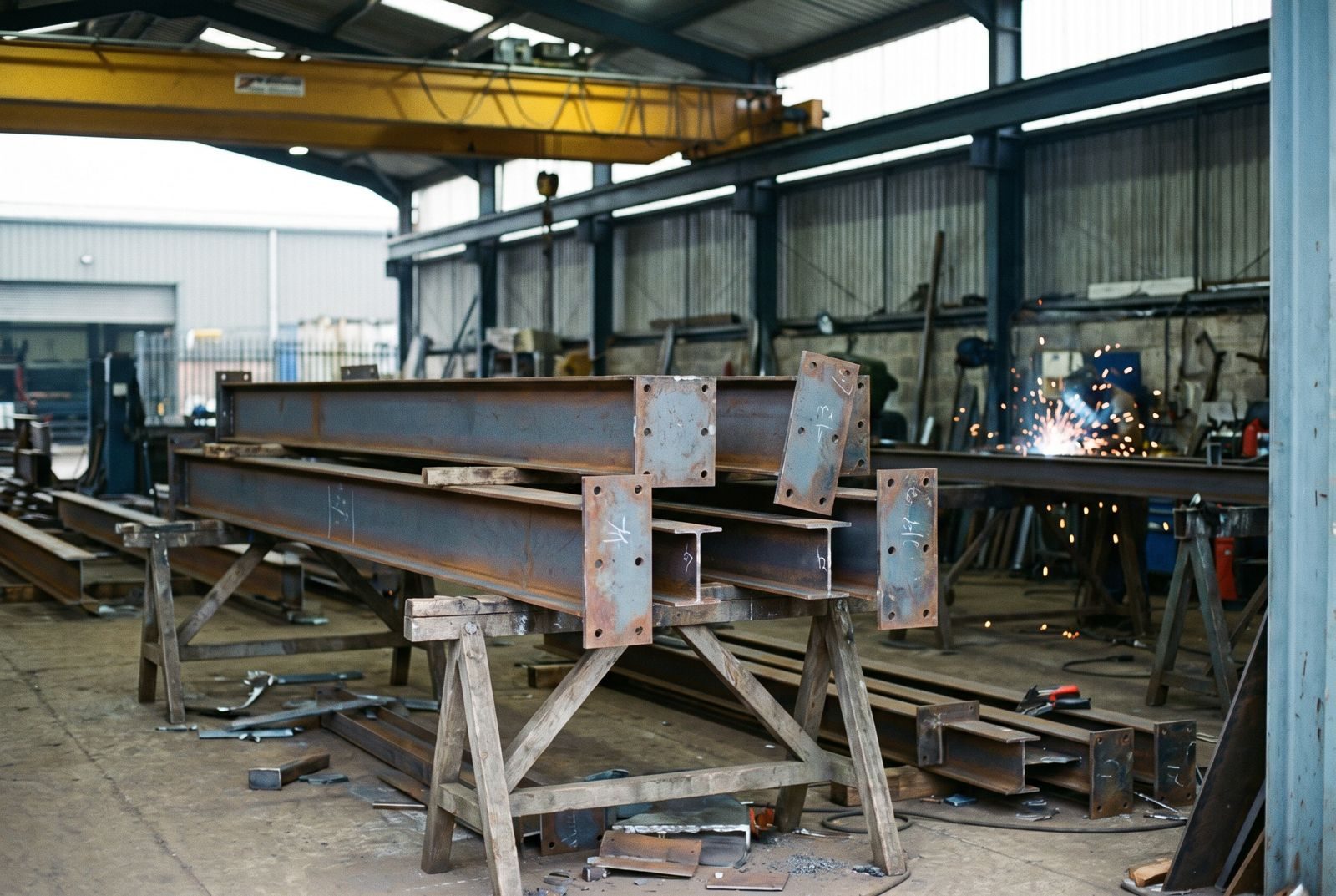
The NSSS supplies the general requirements. The project specification records the engineer's decisions by exception.
What is the NSSS and which edition applies?
The National Structural Steelwork Specification for Building Construction (NSSS) is the BCSA's execution specification for steel-framed buildings: it says which materials to use and how fabrication and erection are carried out so that the finished frame matches the designer's assumptions. The current document is the 7th Edition, 1st Revision, which took effect in October 2023.
The BCSA describes the purpose of the NSSS in terms any structural engineer will recognise. Design standards such as the Eurocodes give rules that are valid only if strength, dimensional accuracy and freedom from defects sit within presumed limits. The NSSS states what has to be done in the workshop and on site to stay within those limits. It is a construction specification, not a design standard.
The 7th Edition was published in 2020 and came into force on 1 January 2021. SCI describes it as the biggest change since the NSSS was introduced in 1989. A revision followed in 2023: the corrigenda were published in April 2023, and the BCSA lists the document as the 7th Edition, 1st Revision, launched on 3 October 2023. The main change was a new assessment scheme for steelwork contractors, the Register of Qualified Steelwork Contractors (Building), which became a mandatory clause. The revision also brought in Annex J, the Sustainability Specification. Both are dealt with below. The revision and Annex J can be downloaded free from the BCSA, and the Commentary (3rd edition, July 2022) explains the reasoning behind the clauses. Check the BCSA site for the current edition before issuing.
Scope matters before anything else. The BCSA states that the NSSS can be used for all types of building construction designed for static loading. The main body is based on Execution Class 2 (EXC2) steelwork designed to BS EN 1993-1-1 or BS 5950 and executed to BS EN 1090-1 and BS EN 1090-2. Annexes cover Execution Class 3 (EXC3) for static structures, and give general guidance on EXC3 for buildings subject to fatigue, such as crane-supporting structures. Bridges are outside it: highway structures normally use the Specification for Highway Works, and railway bridges use Network Rail's steelwork specification.
Where it sits among the other documents
The execution specification for a structure is never one document. SCI describes it as a set of contractual documents: drawings, a general specification with technical requirements for materials and workmanship, and project-specific requirements. BS EN 1090-2 is comprehensive for all steel structures and contains many options that must be selected, so a project needs its own requirements to supplement it. For buildings, the NSSS is that general specification. It defines the "project specification" as the NSSS, with any qualification the engineer adds, together with Parts 1 and 2 of BS EN 1090. Where the NSSS and BS EN 1090-2 conflict, the NSSS takes precedence, because it is likely to be the more onerous. SCI encourages specifiers to use it as the default for all steel building structures.
Scroll horizontally to view all columns.
| Document | Question it answers | Who owns it |
|---|---|---|
| BS EN 1993 (Eurocode 3) and its National Annex | How is the steel structure designed, and which Execution Class applies? | Structural engineer |
| BS EN 1090-1 and BS EN 1090-2 | What must fabricated components conform to, and which technical options apply? | Standards body, selected by the project |
| NSSS (7th Edition, 1st Revision) | How are orthodox building frames fabricated and erected, and what information passes between the parties? | BCSA, adopted by reference |
| Project specification and drawings | What is particular to this structure, by exception to the NSSS? | Structural engineer |
The NSSS does not replace the design standard or the execution standard. It turns BS EN 1090-2 into building-specific instructions, and leaves the project specification to record every choice that is particular to the job.
What does the NSSS cover, and what does it leave out?
The NSSS covers materials, workmanship, welding, bolting, fabrication and erection accuracy, protective treatment and quality management for orthodox building steelwork. It does not design the frame, allocate design responsibility, guarantee coating durability, or choose a fire resistance period. The project specification has to do those things.
SCI lists the principal topics as: information required by the steelwork contractor, materials, information provided by the steelwork contractor, workmanship, welding, bolting, fabrication accuracy, erection, erection accuracy, protective treatment (corrosion and fire) and quality management. Those topics restate the requirements of BS EN 1090-2 more concisely for orthodox building structures, with provision for modification where construction is unorthodox.
Several 7th Edition changes affect how the specification is written. The steelwork contractor's welding quality management system must be certified to BS EN ISO 3834-3 for EXC2, or BS EN ISO 3834-2 for EXC3. Clause 11.2.5 requires bolting to be coordinated by a Responsible Bolting Coordinator. Structural fastener suppliers must be certified to National Highways Sector Scheme 3. Factory production control assessment to BS EN 1090-1 must be carried out every year (clause 11.2.2). Stud welding must follow BS EN ISO 14555. Protective treatment was extensively rewritten, with new clauses on the specification, application and testing of intumescent coatings, and the document encourages paint systems to be applied in the workshop rather than on site.
The gaps are as important as the coverage, because each one is a place where the structural engineer's specification has to say something.
Scroll horizontally to view all columns.
| Topic | What the NSSS provides | What the project specification must add |
|---|---|---|
| Design responsibility | Checklists of information the contractor needs, including for connection design | Which party designs the connections (and any members), and the design information supplied |
| Corrosion protection | Requirements for application of the coating system, not its performance | Environment, required durability, the system, and surface preparation standard |
| Fire protection | Clauses on specification, application and testing of intumescent coatings | Fire resistance period, section factor data, who designs thickness, compatibility with the primer |
| Tolerances | Permitted deviations for fabrication and erection, in tables and diagrams | Tighter or special tolerances at cladding, lift and other sensitive interfaces |
| Execution Class | EXC2 in the main body, EXC3 in annexes | The class for each part of the structure, selected through the design standard |
| Sustainability | Annex J, when called up | Whether Annex J applies, and any project carbon or reuse targets |
| Stability during erection | Requires an erection method statement from the steelwork contractor under CDM | The designer's assumptions about stability and any sequence constraints |
The right-hand column is the real work of a project specification. If the engineer leaves it blank, the default is whatever the steelwork contractor assumes.
How do you fill in the project specification?
Work through the decisions BS EN 1090-2 leaves open and the NSSS checklists ask for, and record each one by exception. Execution Class, steel grades, connection design responsibility, tolerances, protective treatment, contractor competence and Annex J are the entries that most often need attention.
A project specification should be short. It does not repeat the NSSS. It lists the places where the project differs from the default, and it fills in the project data the NSSS cannot know. The sequence below follows the order in which the questions usually arise.
Work through these entries
- Execution Class. State the class for each part of the structure. EXC2 is the anticipated class for most buildings. Use EXC3 where the design standard requires it, for example for fatigue-loaded elements.
- Materials. State grades and sub-grades, including toughness. Select sub-grade for brittle fracture using SCI P419 or ED007 as appropriate, and say so.
- Connection design. State who designs the connections and what the engineer provides: forces, moments, tying requirements and any restrictions.
- Tolerances. Accept the NSSS tables or state where the structure needs more, and check the figures against the cladding and lift designers' assumptions.
- Protective treatment. Describe the environment, state the durability required, name the system and the surface preparation, and say where it is applied.
- Fire protection. State the fire resistance period and the data the contractor needs. Confirm compatibility between the corrosion system and any intumescent.
- Competence and quality. Require registration as a qualified steelwork contractor, welding certification for the class, and the bolting coordination arrangements.
- Sustainability. State whether Annex J applies, and add project requirements for EPDs, steel procurement and reuse.
- Information and submissions. State drawings, models, calculations and inspection records the contractor provides, and the review period.
Each entry depends on the one before it: the Execution Class drives inspection and welding quality, and the connection design decision drives the information the engineer must issue.
Execution Class
Execution Class sets the stringency of fabrication, welding, inspection and documentation. EXC2 is the anticipated class for most building structures, and the main body of the NSSS is written for it. Under the first-generation standards, the selection method sits in the design standard and the UK National Annex to BS EN 1993-1-1, not in BS EN 1090-2: SCI's advisory note AD 394 describes the relationship as one between consequence or reliability class, type of loading and steel grade, and records that the National Annex does not encourage EXC1. A specification should therefore give a reason for any class above EXC2 and state which elements it applies to. Rely on the current standard and its National Annex, not on the summary here.
Tolerances and surface preparation
The NSSS and BS EN 1090-2 give permitted deviations for fabrication and erection. SCI points out that these are typically given for fixed points, such as the level where a beam meets a column, and that deflection under load is not covered by tolerances. Where the deflected position matters, provide for adjustment. The engineer's task is to check the interfaces: façade fixings, lift guide rails and raised-floor zones often depend on tolerances tighter than the defaults, and the other designers' assumptions must be written down. Surface preparation belongs with protective treatment. Say which preparation grade applies, reference the preparation standard (BS EN ISO 8501-1 grades are the usual reference), and state whether blast cleaning is to be done in the workshop.
Protective treatment and the RQSC
SCI is direct about the limit of the NSSS: its requirements, and those of BS EN 1090-2, relate to the application of the coating system, not to its performance. The project specification therefore has to describe the environment (corrosivity categories under BS EN ISO 12944 are the usual language), state the durability required in years, and specify systems, not particular products. Standard systems for building steelwork are published and should be the starting point. Competence is the other new entry. Since 3 October 2023, including a Registered Qualified Steelwork Contractor in the project is a mandatory NSSS clause. The register is based on the BuildUK Common Assessment Standard and covers the contractor's fabrication facility, staff, product marking, management and health and safety systems, and sustainability and BIM credentials. Take the category wording for the project specification from the relevant NSSS section and the BCSA register.
Annex J, sustainability
Annex J is the Sustainability Specification for structural steelwork in buildings. BCSA first published it in January 2022, and it is now included in the NSSS 1st revision. It requires Environmental Product Declarations for new steel products and for corrosion and fire protection systems, and deals with steel procurement, project sustainability requirements and reuse. SCI records that it can be called up on its own with a short form of words, and BCSA has published a model specification for the purchase of reclaimed steel sections for use with it. Annex J is not a carbon limit. The engineer must state what the project wants, such as EPD submission, reuse targets or procurement rules, and Annex J provides the mechanism.
The NSSS is the default. The project specification is where the engineer's judgement shows.
Scroll horizontally to view all columns.
| Entry | Illustrative wording |
|---|---|
| Execution Class | EXC2 throughout, except the crane runway supports at grid C to D, which are EXC3. |
| Steel grade | Hot rolled sections S355 sub-grade J2, selected in accordance with SCI P419. Hollow sections S355J2H. |
| Connections | Designed by the steelwork contractor to the forces and tying requirements on the connection design schedule, except moment connections at gridline 4, which are designed by the engineer. |
| Tolerances | NSSS tolerances apply. Columns supporting the façade at levels 1 to 6 are erected to the special tolerances on drawing S-050. |
| Corrosion protection | Internal dry environment, durability of 25 years: blast clean and prime in the workshop to the preparation grade stated, system as listed in the protective treatment schedule. |
| Annex J | Applies. EPDs for steel, paint and intumescent coatings to be submitted before procurement. |
These entries are examples of the form, not recommended values. Replace each with the project's own decision and check it against the current edition of the NSSS.
What are the common gaps when specifying with the NSSS?
The gaps that recur are connection design responsibility, corrosion protection performance and the fire protection interface. In each case the NSSS provides a framework, and nobody completes it because each party assumes someone else has.
None of these gaps is a fault of the NSSS. It is a general specification, so it cannot decide how responsibility is split on a particular job. The problems arise when the drawings, the project specification and the contract each say something slightly different.
Connection design responsibility
SCI notes that the NSSS acknowledges the common situation where the steelwork contractor designs the connections, and in some cases the members as well. It includes checklists of the information the contractor needs. The trouble starts when the general notes say "connections by steelwork contractor" and the specification does not say what the contractor is given. A connection cannot be designed without forces, so the engineer must issue them, with tying and robustness requirements, restrictions on connection types and any members the engineer designs in detail. The engineer also needs a way to review what comes back, and the specification should say what is reviewed and for what purpose. The full allocation question is dealt with in Steel connection design responsibility. Give the answer a single home in the specification and make the drawings refer to it.
Corrosion protection
If the specification says only "paint to NSSS", the result is the minimum the contractor chooses. The NSSS fixes how the system is applied, not how long it lasts. State the environment and durability, name the system, say where it is applied and what happens at interfaces: the zones that will be encased, the surfaces that will be welded on site, and any galvanizing. Be careful with the temptation to name products. SCI recommends referring to systems.
The fire protection interface
Fire protection touches three people. The fire engineer or architect sets the required period. The structural engineer knows the members and their section factors. The coating applicator calculates thickness. The NSSS provides clauses on specifying, applying and testing intumescent coatings, and SCI stresses that compatibility with the corrosion system must be checked, with advice from the fire protection manufacturer. The specification should say who provides the period and the section data, who calculates thickness, who approves it, whether intumescent is applied in the workshop or on site, and what happens when the structural design changes after thickness has been issued.
Drawings
General note: connections designed by the steelwork contractor, level of information not stated.
Specification
Clause refers to the NSSS checklist and gives no connection forces, tying requirements or restrictions.
If the drawings assign connection design and the specification does not supply the design information, the allocation exists on paper only. Resolve it in one place before issue.
Three smaller gaps
Three further points deserve a line each. First, edition drift: state the edition and revision of the NSSS, because an unversioned reference will be read as whatever the contractor holds. Second, the temporary condition: the contractor provides the erection method statement under CDM, but only the designer knows what the permanent structure assumes about stability during erection, so say it. Third, inspection: decide the extent of non-destructive testing and any hold points beyond the NSSS defaults, and who witnesses them. A temporary works design brief covers the wider interface.
How do you reference the NSSS in a project structural specification?
Name the NSSS by title, edition and revision, state that the project specification amends it by exception, set an order of precedence, and list the annexes called up. Do not reproduce NSSS clauses in the project document.
The same pattern applies to every national specification: adopt by reference, amend by exception. Reproducing standard clauses invites the two copies to drift. The reference clause should be specific enough that a contractor in 2028 cannot argue over which document applied.
A form of words along these lines works, and should be adapted: Fabrication and erection of structural steelwork shall be in accordance with the National Structural Steelwork Specification for Building Construction, 7th Edition, 1st Revision (BCSA publication 62/20, with corrigenda 67/23), and the project-specific requirements in section [number] of this specification. Where the project-specific requirements differ from the NSSS, the project-specific requirements take precedence. The publication numbers are those given in SCI's list of resources, and the form of words is illustrative. SCI suggests calling up Annex J with a separate reference: Fabrication in accordance with (i) the NSSS, 7th edition, and (ii) NSSS Annex J, Sustainability Specification.
Order of precedence
State the order in the specification. The default hierarchy puts project requirements above the NSSS, and the NSSS above the standards it summarises, because the NSSS is likely to be the more onerous.
- 1. Project-specific requirements
- Contract amendments, drawings and the engineer's entries, by exception to the documents below.
- 2. NSSS and annexes called up
- The 7th Edition, 1st Revision, with Annex J where specified and the Execution Class annexes where required.
- 3. BS EN 1090-1 and BS EN 1090-2
- Conformity assessment and technical requirements. The NSSS takes precedence over BS EN 1090-2 where they conflict.
- 4. Product and test standards
- Referenced by the NSSS and BS EN 1090-2: plates, sections, hollow sections, welding and coatings.
Look ahead to the Eurocode transition
The NSSS is built on first-generation design standards. The first-generation Eurocodes are due to be withdrawn by BSI on 30 March 2028, and the second-generation Eurocode 3 changes the structure of the design rules, the steel grades covered and the way some clauses are cross-referenced. A project that will straddle that date should say which edition of the design standard applies, and should confirm with the BCSA whether the NSSS has been updated to match. The wider question is covered in Second-generation Eurocodes: what to change in your specifications.
A checklist before issue
- The NSSS is cited with title, edition, revision and any annexes called up.
- Execution Class is stated for every part of the structure, with a reason for anything above EXC2.
- Connection design responsibility appears once, with the information the engineer issues.
- Corrosion protection states environment, durability, system and surface preparation.
- The fire protection period, section data and responsibility for thickness are stated.
- RQSC registration and Annex J are called up or deliberately excluded.
- Every tolerance the façade, lift or services designers rely on is stated or confirmed as the default.
For the wider structure of the document this sits inside, see How to write a UK structural specification.
Questions engineers ask about the NSSS
What is the NSSS?
The National Structural Steelwork Specification for Building Construction, published by the BCSA. It states the materials, fabrication and erection requirements for orthodox steel building frames and is intended to be adopted by reference in a project specification.
Which edition of the NSSS is current?
The BCSA lists the 7th Edition, 1st Revision, launched on 3 October 2023. The 7th Edition itself came into force on 1 January 2021. The revision added the mandatory RQSC clause and Annex J. Confirm the position with the BCSA before issue.
Does the NSSS apply to bridges?
No. It is written for buildings designed for static loading, with annexes for Execution Class 3. Highway bridges normally use the Specification for Highway Works and railway bridges use Network Rail's steelwork specification.
Which Execution Class does the NSSS assume?
The main body is written for Execution Class 2, designed to BS EN 1993-1-1 or BS 5950 and executed to BS EN 1090-1 and BS EN 1090-2. Annexes cover Execution Class 3 for static structures and give guidance on fatigue-loaded buildings.
What is the RQSC clause?
A mandatory NSSS clause since 3 October 2023 requiring the steelwork contractor to be on the Register of Qualified Steelwork Contractors (Building), an assessment scheme based on the BuildUK Common Assessment Standard.
Does the NSSS deal with who designs the connections?
It provides checklists of the information a steelwork contractor needs where the contractor designs connections, but the allocation is a project decision. The project specification, drawings and contract must say who designs what.
Where Avoice fits
The NSSS only works as well as the project specification built on top of it, and the failures are almost always consistency failures between documents.
In Avoice, practice Rules can require every standard reference to carry its edition, and the pre-issue Technical Review compares the specification against schedules and drawings, which is the check that finds a connection note on the drawings with no matching information in the specification. The office master can hold the practice's standard wording for adopting a national specification by reference, so the order of precedence and the edition statement are not retyped each time, and standards sets keep the list of standards a specification may cite under control. Avoice now writes structural as well as architectural specifications, so the same checks apply across the disciplines on a project.
The boundary stays where it was. Software can hold the wording, compare the documents and flag the mismatch. The engineer decides the Execution Class, the connection design split and the durability, and the contract determines what those decisions mean.