
How to specify mineral wool insulation
What a mineral wool clause has to say, why the faced product's Euroclass and the density matter, how the insulation is held in place, the standards to cite, and how to write it in CAWS and in Uniclass.
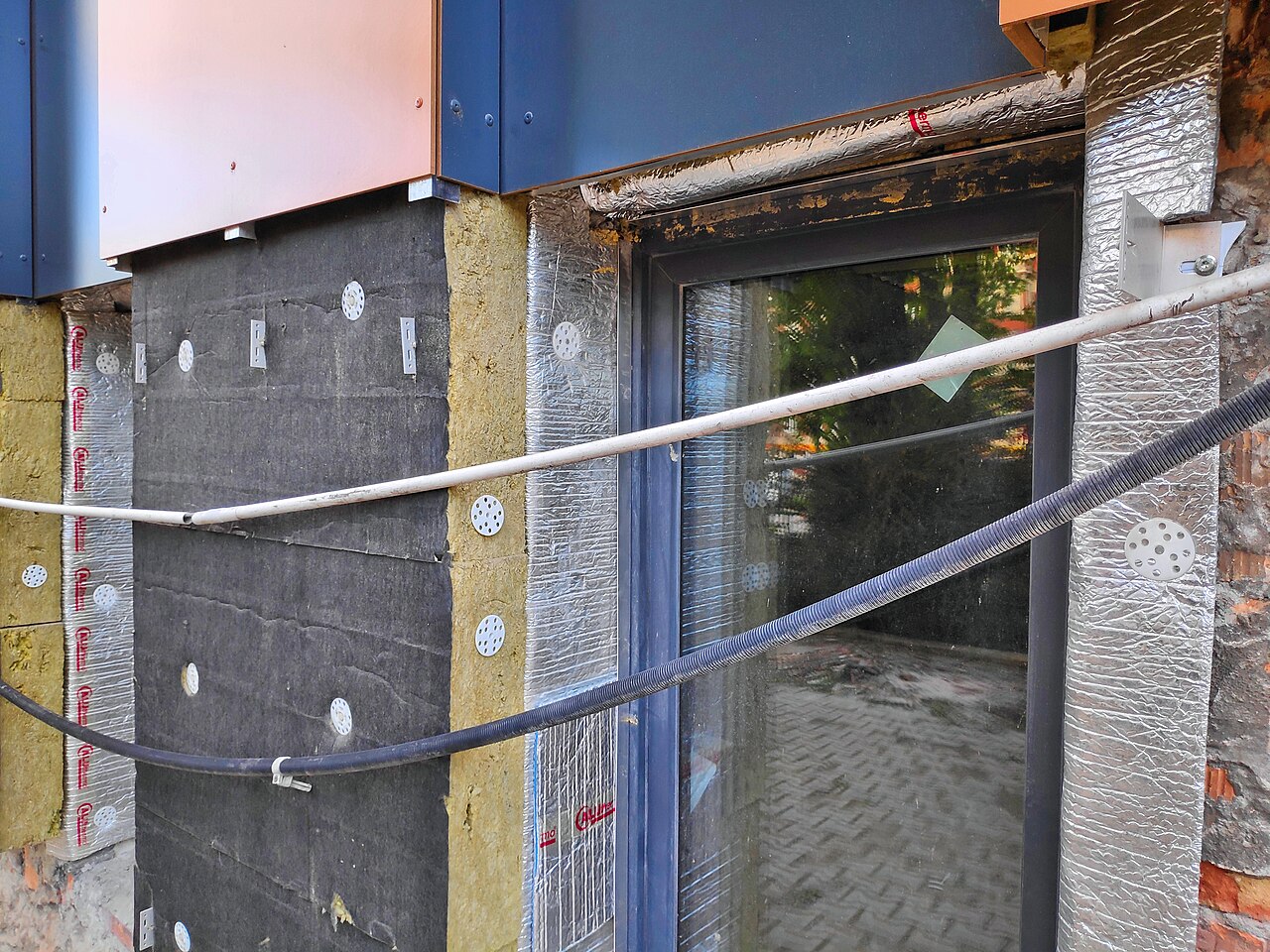
Photo: Marek Ślusarczyk (Tupungato), CC BY 3.0, via Wikimedia Commons.

How do you specify mineral wool insulation?
To specify mineral wool insulation, name the product to BS EN 13162 by type (glass or stone wool), form (roll, batt or slab), declared thermal conductivity, thickness and density, then confirm the Euroclass of the product as supplied, including any facing. In the external wall of a relevant building it must be A2-s1,d0 or A1. State the fixings and, for rainscreen or ventilated cavities, how the slab is retained against wind and slumping.
"100 mm mineral wool" appears in a lot of UK specifications and decides very little. Glass wool and stone wool differ in density, lambda and how they behave in a fire. A light loft roll and a dense acoustic batt share the name but not the performance, and a foil or kraft facing can change the Euroclass of the product that arrives. The clause has to say which product it means, why, and how it stays in place.
This guide covers Uniclass Pr_25_57_06_53 Mineral wool insulation. Uniclass also has narrower codes in the same group, such as Pr_25_57_06_54 Mineral wool sound insulation and Pr_25_57_06_56 Mineral wool slab insulation; use one of those where your practice prefers the more specific heading, as the properties below apply to all of them.
What does a mineral wool insulation product clause need to cover?
Some properties are specific to mineral wool insulation. Others belong in every product clause. A clause that leaves either out gives the contractor room to substitute.
Properties of mineral wool insulation
- Product typeRoll, batt or slab to suit the element.
- Thermal performanceDeclared lambda to BS EN 13162 used in calculations.
- ThicknessThickness and layers to meet the U-value or acoustic target.
- DensityDrives acoustic, compressive and fire behaviour.
- Nominal sizeWidths to suit stud, joist and rafter centres.
- FacingFacings can lower the Euroclass and add vapour resistance.
- Edge treatmentSquare edge for most uses; profiled for tight fits.
- TolerancesThickness tolerance class from BS EN 13162.
- Reaction to fire classificationNever guessEuroclass of the product as supplied, facings included.
- Acoustic performanceDensity and thickness the separating element was tested with.
- Structural performanceNever guessRainscreen slabs must resist wind and stay fixed.
- Compressive strengthOnly where slabs take load, e.g. under screeds.
- Water absorptionFull-fill cavity and rainscreen slabs must be water repellent.
- Vapour resistanceOpen wool is vapour open; facings change that.
- Dimensional stabilityShrinkage opens gaps and thermal bridges.
- DurabilityShould last the life of the element without slumping.
- FixingsFriction fit, retaining clips or non-combustible pins.
- Third-party certificationCertificate covering full-fill cavity or rainscreen use.
- Recycled contentDeclared content, common in glass wool.
- Environmental product declarationEPD to BS EN 15804 for embodied carbon.
What every product clause needs
- Manufacturer and product referenceNamed product, or a performance description if not named.
- Product standardBS EN 13162, evidenced by the declaration of performance.
- Installation methodManufacturer's instructions for the element: wall, floor, roof, partition.
- Technical submittalsDoP, certificates and U-value or acoustic evidence before ordering.
- Operation and maintenance informationProduct data and fire classification for the building record.
- MaterialGlass wool or stone wool; they perform differently.
Uniclass Pr_25_57_06_53 Mineral wool insulation. Not every property applies to every project; where one does not, say so rather than leaving it blank.
Fields marked Never guess (reaction to fire classification and structural performance) depend on the project and should never be filled from a default or a previous job. If the information is not available yet, the clause should say so with a TBC and a reason.
Which decisions does the clause depend on?
Most properties follow from the product you choose. These depend on the project, so they need a decision from the designer before the clause is written.
- 01
Euroclass of the product as supplied
Never guessUnfaced stone wool and most unfaced glass wool are A1, and that is why mineral wool is the default in external walls over 18 m. The class belongs to the product as tested, though. A kraft paper or foil facing, or a high binder content, can drop it to A2 or lower, and a faced product can then fail regulation 7(2) on a relevant building, or the A2-s1,d0 expectation in Approved Document B for residential buildings with a storey 11 m or more. The fix is simple: cite the Euroclass from the declaration of performance for the exact product, facing included.
How to decide
- External walls of relevant buildings, and residential buildings with a storey 11 m or more: A2-s1,d0 or A1, checked on the faced product.
- Inside walls and floors: the class the fire strategy sets for the element; unfaced products are usually A1.
- Separating walls and fire-resisting partitions: use the product the partition was fire tested with.
- Ask for the DoP, not a range brochure.
Write it asReaction to fire: Class A1 to BS EN 13501-1, for the product as supplied including any facing. Submit declaration of performance. - 02
Keeping it in place
Never guessMineral wool does not hold itself up in a cavity. Batts between rafters and in timber frame walls slump over time if they are not a tight fit or retained, leaving a cold strip at the top. Slabs behind ventilated rainscreens are loaded by wind and wetted during construction, and in a fire plastic fixings soften and let them fall. Whoever writes the clause should say how the product is held and with what, using the manufacturer's fixing schedule rather than an invented density of pins.
How to decide
- Between studs and rafters: friction fit at the right width, with fasteners where needed to stop slumping.
- Rainscreen and ventilated cavities: rigid slab, non-combustible fixings, pattern to the manufacturer's schedule for the design wind load.
- Under floors and suspended: netting, clips or battens, stated in the clause.
- If the engineer or façade designer has to confirm the pattern, record that as a TBC.
Write it asRetention: Non-combustible fixings to the insulation manufacturer's schedule for the design wind load. Slab to remain in place under wind and wetting during construction. - 03
Density for separating walls and partitions
AcousticIn a partition or separating wall, mineral wool is one part of a tested construction. The sound insulation figure in the acoustic report belongs to that construction as tested, with a particular stud, board and insulation density and thickness. Swap a dense acoustic batt for a light loft roll and the partition no longer matches the test, even though both are mineral wool. The clause should name the product the test used or state the density and thickness, and treat any substitute as a change to the partition.
How to decide
- Take density and thickness from the partition manufacturer's test data or the Robust Detail being followed.
- Where the acoustic consultant is still choosing the build-up, leave density as a TBC.
- If the same product also has a thermal role, put both requirements in the one clause.
Write it asDensity: As the tested partition system, not less than the density stated in the partition manufacturer's test evidence. - 04
Roll, batt or slab
FormThe form follows from where the product goes. Rolls are for lofts and between joists, where they can be unrolled and cut to length. Batts are semi-rigid and friction fit between studs and rafters. Slabs are rigid and are the only sensible choice for full-fill masonry cavities, rainscreens and loaded floors. Leave the choice open and the cheapest form that fits the space will turn up, which may be a roll in a wall where a batt was intended.
How to decide
- Lofts and floor voids: roll.
- Timber and metal stud walls, rafters: batt sized to the stud centres.
- Masonry cavities, rainscreens, under screeds: slab.
Write it asProduct type: Semi-rigid batt, width to suit 600 mm stud centres, friction fit. - 05
Full-fill cavities and wet exposure
MoistureFull-fill cavity batts sit against the outer leaf and have to be water repellent. Whether a given product can be used full fill depends on its third-party certificate, which limits use by exposure to wind-driven rain and sometimes by the outer leaf's construction. Rainscreen slabs face a different problem: they get wet before the cladding goes on and must recover without slumping. In both cases the certificate, not the product name, tells you whether the use is covered.
How to decide
- Check the site's exposure to wind-driven rain before choosing full fill.
- Require a current certificate covering full-fill use at that exposure.
- Rainscreen: specify a water-repellent slab made for ventilated cavities.
Write it asWater repellency: Water-repellent slab with current third-party certificate covering full-fill cavity use at the site exposure.
The values under "Write it as" are examples. The right value depends on the location, the use and the fire strategy.
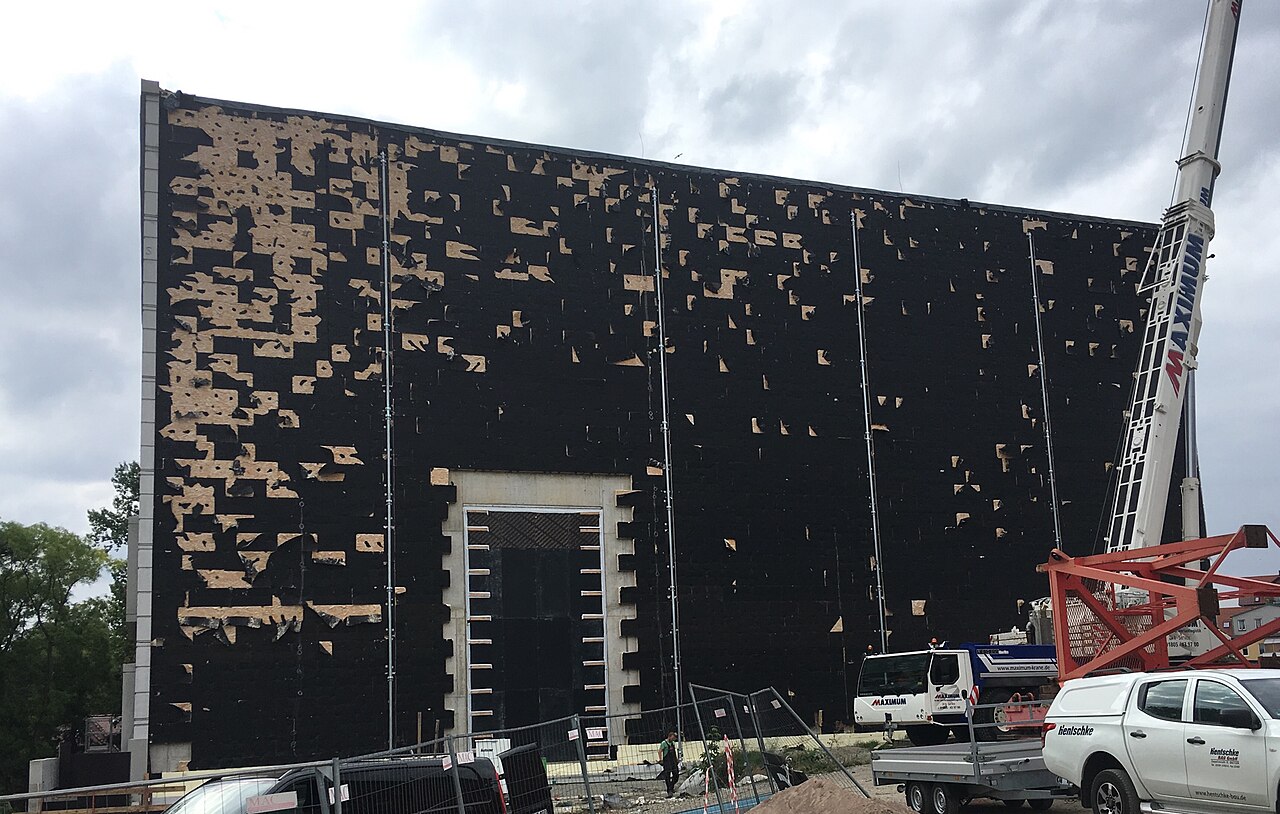
Photo: KaiKemmann, CC BY-SA 4.0, via Wikimedia Commons.

Which standards should the clause cite?
Cite the product standard the declaration of performance refers to, the code of practice for installation, and the test method behind each value you set. A value without its test method cannot be checked against a submittal.
- BS EN 13162
- Thermal insulation products for buildings: factory made mineral wool (MW) products, specification
The product standard for glass and stone wool. It sets the declared thermal conductivity, thickness tolerance classes and the other characteristics that appear on the declaration of performance.
In the clause Cite it as the product standard: "Mineral wool to BS EN 13162".
- BS EN 13501-1
- Fire classification of construction products and building elements: classification using data from reaction to fire tests
The Euroclass of the product as supplied, including any facing.
In the clause "Reaction to fire: Class A1 to BS EN 13501-1, as supplied including facing."
- BS EN 13501-2
- Fire classification of construction products and building elements: classification using data from fire resistance and/or smoke control tests, excluding ventilation services
Fire resistance classes (for example EI 60) for partitions and cavity barriers. The insulation contributes, but the class belongs to the tested element.
In the clause Cite it at partition or barrier level: "Fire resistance: EI 60 to BS EN 13501-2, as tested system".
- BS EN ISO 717-1
- Acoustics: rating of sound insulation in buildings and of building elements, airborne sound insulation
The single-number ratings (Rw, DnT,w) used for partitions and separating walls.
In the clause Use it in the partition clause: "Sound insulation: Rw as acoustic report, rated to BS EN ISO 717-1".
- BS EN ISO 6946
- Building components and building elements: thermal resistance and thermal transmittance, calculation methods
The U-value calculation that the declared lambda and thickness feed into.
In the clause "Substitutes: submit revised U-value calculation to BS EN ISO 6946."
- BS 5250
- Management of moisture in buildings: code of practice
Condensation risk and vapour control. Open mineral wool is vapour open, so the position of the vapour control layer matters.
In the clause "Vapour control layer: as condensation risk assessment to BS 5250."
- BS EN 1604
- Thermal insulating products for building applications: determination of dimensional stability under specified temperature and humidity conditions
Dimensional stability, which affects whether joints open after installation.
In the clause Normally covered by the product standard; cite it only where a system holder sets a limit.
- BS EN 15804
- Sustainability of construction works: environmental product declarations, core rules for the product category of construction products
The format for environmental product declarations, used for embodied carbon reporting.
In the clause "Submit EPD to BS EN 15804."
Confirm the current edition of each standard at every issue. Avoice's State of UK Specifications 2026 found a withdrawn standard cited in 40% of specifications at contract issue.
For the regulations behind these choices, see Approved Document B explained, Part L and the Future Homes Standard, or search the Avoice Regulations library.
How do you write it in CAWS?
Mineral wool turns up in several CAWS sections: in F30 for masonry cavities, in H92 for rainscreen slabs, in roof sections for warm decks. Insulation that is not part of another package goes in P10. P10 is built from product clauses, one per insulation type, each carrying its own installation requirements (joints, fasteners, service holes) inside the clause. It does not have a long run of general and execution clauses the way M40 or H92 does.
The example below is insulation in metal stud partitions. The partition itself is a K10 type clause, which refers to the P10 clause for its insulation, so the acoustic product is written once and any partition type can point to it. The P10 clauses it sits beside cover the cavity barriers and vapour control that often go in at the same time.
- Manufacturer
- Submit proposals
- Product reference
- Submit proposals
- Standard
- BS EN 13162
- Material
- Glass or stone mineral wool, as the tested partition system
- Product type
- Acoustic batt, unfaced
- Density
- TBC Acoustic consultant has not confirmed the tested partition build-up. Resolve before ordering.
- Thickness
- 50 mm
- Reaction to fire
- Class A1 to BS EN 13501-1, as supplied
- Width
- To suit stud centres for a friction fit
- Recycled content
- Submit manufacturer's declared value
- Installation
- Full height between studs and tracks, no gaps at head or base
- Joints
- Butted, no gaps
- Fasteners
- Where needed to retain the insulation and stop slumping
- Service penetrations
- Cut neatly around boxes and pipes, no voids left
Illustrative, not from a real project. One property is left as a TBC with a reason so it can be tracked and closed before issue.
Clauses the type clause relies on
- P10/310
- Air and vapour control layer Material, laps and sealing where the same insulation is used in an external stud wall.
- P10/410
- Flexible cavity barriers Barriers in ceiling and floor voids above and below the partition line.
- P10/420
- Sleeved mineral wool small cavity barriers Barriers in small cavities, sleeved to keep them dry and tidy.
- P10/430
- Wired mineral wool small cavity barriers Wire-reinforced barriers stapled into cavities, with their fire resistance rating.
Clause numbers vary between NBS versions and practice masters. The numbers here come from published NBS P10 sections; check that the clauses your partition type clause points to exist in your own P10 and K10.
For more on clause structure and checks, see NBS clause writing: common mistakes.
How do you write it in Uniclass?
In Uniclass the partition is the system. Ss_25_10_30_35 Gypsum board partition systems describes the framing, linings and insulation together, and carries the results that only the whole partition can achieve: its sound insulation rating and its fire resistance. Those come from a test of a specific build-up, so the system clause should name the tested system they rely on.
The mineral wool is a product clause under Pr_25_57_06_53, holding the properties the manufacturer declares: material, density, thickness, facing and Euroclass. Every partition type that uses the same batt points to that one product clause, and if the acoustic consultant changes the density, the change is made once.
- Description
- Metal stud partition, two layers of gypsum board each side
- System
- Partition manufacturer's tested system, submit proposals
- Insulation
- Pr_25_57_06_53 Mineral wool insulation (I02), full cavity depth
- Sound insulation
- Rw as the acoustic report, rated to BS EN ISO 717-1, as tested system
- Fire resistance
- As the fire strategy, classified to BS EN 13501-2
- Head detail
- Deflection head as tested, sealed for acoustic and fire performance
- Penetrations
- Sealed with products from the tested system
- Manufacturer
- Submit proposals
- Product reference
- Submit proposals
- Standard
- BS EN 13162
- Material
- Glass or stone mineral wool
- Product type
- Acoustic batt, unfaced
- Density
- TBC Acoustic consultant has not confirmed the tested partition build-up. Resolve before ordering.
- Thickness
- 50 mm
- Nominal size
- Width to suit stud centres
- Reaction to fire
- Class A1 to BS EN 13501-1, as supplied
- Recycled content
- Submit manufacturer's declared value
- Environmental product declaration
- Submit EPD to BS EN 15804
Illustrative. Performance of the finished system sits in the system clause; properties of the product sit in the product clause.
In NBS Chorus, Uniclass product clauses also carry an NBS reference (for mineral wool insulation, 45-45-70/355). Use whichever your practice's masters use, and keep CAWS and Uniclass references out of the same document.
What goes in the spec, and what goes in the schedule?
The specification defines each type once. The schedule and drawings say where each type goes.
In the specification
What the product is and how it performs and is installed. Written once per type.
In the schedule or drawings
Where each type goes and how much of it. Changes with every plan revision.
Write each mineral wool product once with a type mark and link it to the wall, floor and roof types. If one product serves thermal and acoustic roles, the clause should carry both requirements so neither is lost on substitution.
What are the common mistakes?
Most problems are a missing property, a property filled with the wrong kind of value, or a decision left silently open.
- Assuming all mineral wool is A1. Foil or kraft facings can drop the classification. Cite the Euroclass of the faced product you are specifying.
- Plastic pins in a rainscreen cavity. Regulation 7(3) exempts fixings, but plastic pins soften in a fire and can let an A1 slab fall away. Specify non-combustible fixings.
- "Mineral wool" with no density. A light thermal roll will not deliver the acoustic result of a dense slab. State density where acoustics or loading matter.
- Full-fill cavity without a certificate. Not every slab is certified for full-fill use in every exposure zone. Require the certificate and check the site exposure.
- Slabs left to slump. Unretained batts in timber frame or rainscreen cavities sag and leave cold bridges. Specify the fixing or retention method.
- Thickness copied, lambda dropped. Glass and stone wool products differ in lambda. Tie the thickness to the declared value in the calculation.
How Avoice helps
Avoice's spec writer puts the right mineral wool into each wall, floor and roof type from the information on your drawings, and says plainly what it could not settle.
- Drafts from your drawings and schedules
It reads the partition, wall and roof types from your drawings and schedules, writes the P10 or Uniclass product clause for each insulation type, and links it to the K10 partitions or wall systems that use it.
- Leaves a TBC where the acoustic or fire build-up is open
If the acoustic consultant has not fixed the partition build-up, density stays TBC with the reason. It goes into the project TBC register so it is closed before tender.
- Writes in your format and your style
CAWS or Uniclass, adapted from your practice's master clauses rather than generic text.
- Checks the clause against the drawings
QA/QC flags a partition type on plan that has no insulation clause behind it, a foil-faced product in an external wall type above 18 m, or a withdrawn standard. Approved Documents B and E are in the Avoice Regulations library for checking the requirement itself.
- Keeps product data in one place
The DoP and EPD sit in the Product Room, linked to the clause. If the same batt is used in six partition types, editing the linked product once updates all six.
Related guides: How to specify PIR insulation boards, How to specify breather membranes, How to specify fibre cement cladding.
Software can draft and check. The designer still chooses the product and is responsible for the specification.
For more on the evidence behind product choices, see the role of manufacturer product data in specification writing.
Draft your mineral wool insulation product clause in Avoice
Upload your drawings and schedules. Avoice drafts the clause in CAWS or Uniclass, cites the standards and flags anything your information does not settle.
This guide is for general education and is not professional advice. Check current editions of standards and Approved Documents, the manufacturer's data, and the requirements of your project before relying on any clause.